
This small commercial building on the southeast corner of Edgewood Avenue and Courtland Street in Downtown Atlanta would have been demolished long ago if it hadn’t served briefly as the first Coca-Cola bottling plant in the city. For that reason, the structure was designatedas a National Historic Landmark in 1983.1
Located at 125 Edgewood Avenue SE, the property is rare in Atlanta for maintaining the same numeric address for its entire existence. Local historians have long claimed the building was constructed in either 1890, 1891, or 1892. However, it’s well documented that the structure was built in 1889 and occupied in January 18902 3 — Atlanta is appallingly ignorant of its own history.
The building consists of two floors over a full basement,4 5 and is eclectically styled, incorporating Romanesque and Queen Anne elements. The exterior is covered in red brick with light granite trim, and the interior encompasses less than 6,000 square feet. While the architect is not officially known, all evidence indicates that G.L. Norrman was the designer.
The Design
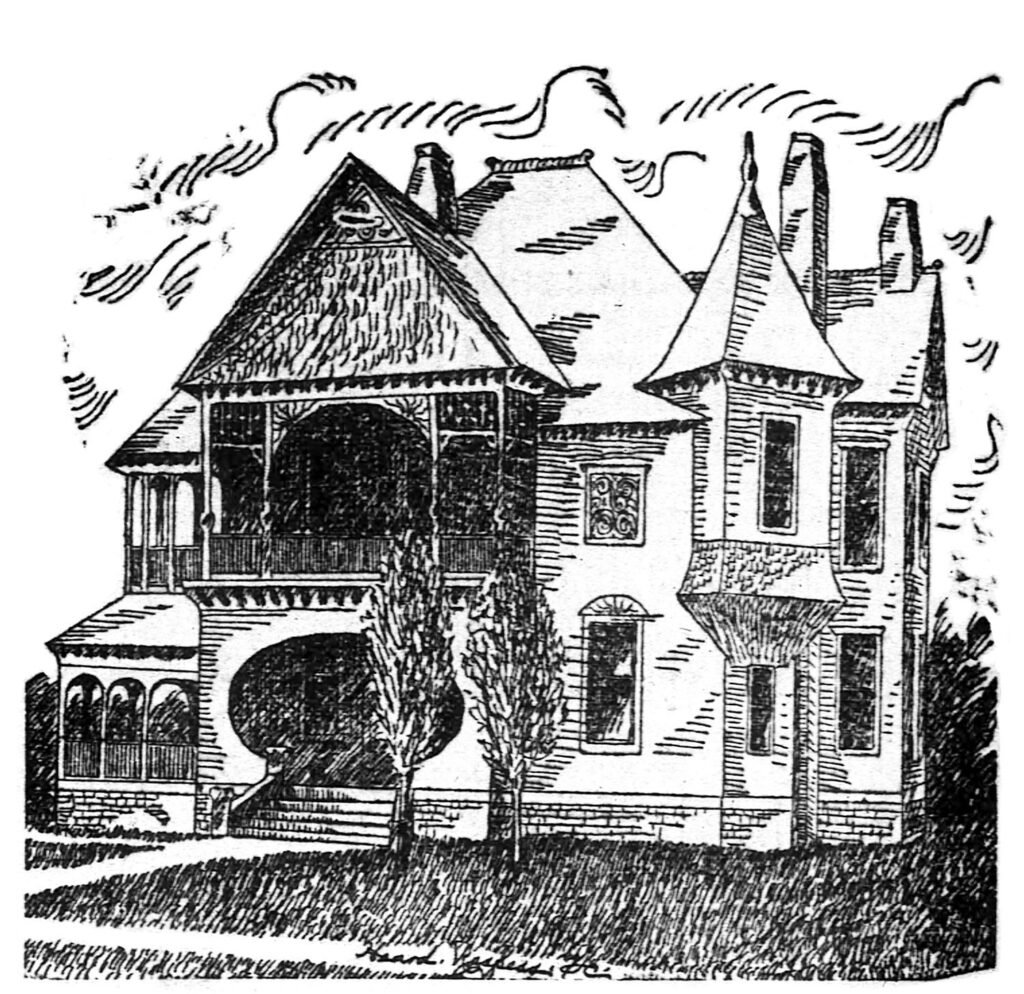
Anyone with an eye for his work would quickly observe that the overall design and massing of 125 Edgewood Avenue are characteristic of Norrman, and many specific elements also suggest his involvement:
- The oval window in the north gable was used by Norrman in multiple projects around the same time, including the Samuel McGowan House (1889) in Abbeville, South Carolina; the Atlanta & Edgewood Street Railway Shed (1889) and 897 Edgewood Avenue (1890) in Inman Park, and most notably, the nearby Exchange Building (1889, pictured below).
- Chimneys with tapered tops were a trademark element of Norrman’s in the 1880s and 1890s, and the same chimney designs were used in his 1889 plan for the H.M. Potts House (demolished) in Atlanta’s West End.
- The central chimneystack on the north side of the building serves as a focal point to visually balance the elevation’s two incongruent halves — this was a common technique used by Norrman in his compositions.
- A terracotta scroll bracket on the central chimneystack is of the same design as those used in Norrman’s designs for the Windsor Hotel (1892) in Americus, Georgia, and the Edgewood Avenue Grammar School (1892) in Atlanta.
- The stepped gables on the north and west sides of the building were incorporated in Norrman’s design for the nearby Exchange Building and later used on the Windsor Hotel.
- The Romanesque granite column on the northwest corner of the ground floor is a smaller version of one used in Norrman’s design for the Printup Hotel (1888) in Gadsden, Alabama.
- The porch on the west side of the building uses the same posts with curved brackets seen in Norrman’s design for the E.A. Hawkins House (1890) in Americus, Georgia, and the house at 897 Edgewood Avenue in Inman Park.
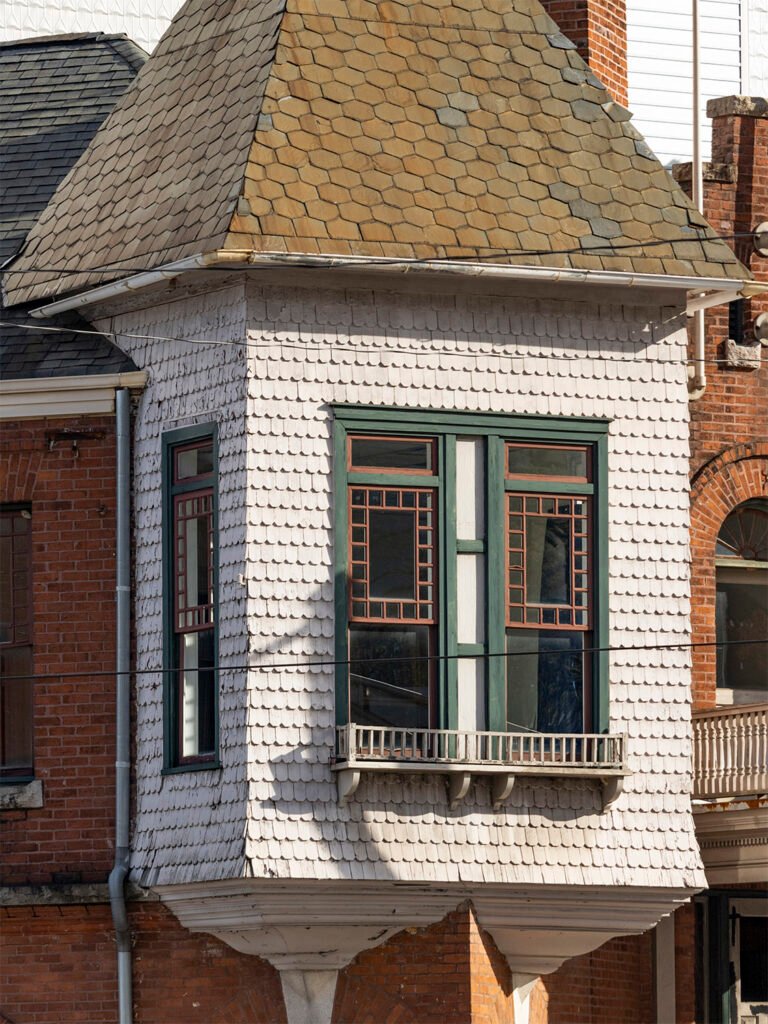
- The fish-scale shingles used in both the turret and balcony were incorporated into Norrman’s designs for the McGowan House, and the T.P. Ivy House (1895) in Atlanta, among others.
- The most obvious design clue is the square turret on the building’s northwest corner, which is a duplicate of one Norrman used in the H.M. Potts House the same year.6
The Background
The building at 125 Edgewood Avenue was one of at least three commercial spec structures built along Edgewood Avenue by Joel Hurt‘s East Atlanta Land Company — it appears Norrman designed all of them.
Norrman was a preferred architect for Hurt in the late 1880s and early 1890s, with four confirmed projects for Hurt’s companies and family, and four additional structures that can be attributed to him. He was also one of the opening-day tenants in Hurt’s Equitable Building (completed in 1892 and demolished in 1971), occupying a suite of offices on the top floor.8
The full list of Norrman’s completed projects for the Hurt companies and family follows:
- Exchange Building, completed 18899 and demolished 193910 11 – intersection of Edgewood Avenue and Gilmer Street, Atlanta [Map]
- 125 Edgewood Avenue, completed 1889 [Map] – design attributed to Norrman
- Commercial building, completed 1892 and demolished 1939 – 161-165 Edgewood Avenue, SW corner of Edgewood and Piedmont Avenues, Atlanta [Map] – design attributed to Norrman
- Three spec houses for the East Atlanta Land Company
- Atlanta & Edgewood Street Railway Shed, completed 1889 – 963 Edgewood Avenue NE; Inman Park, Atlanta [Map] – design attributed to Norrman
- C. D. Hurt House, completed 1893 – 36 Delta Place; Inman Park, Atlanta [Map] – design attributed to Norrman

The Beginning of Edgewood Avenue
The East Atlanta Land Company created Edgewood Avenue to serve as the main artery from Atlanta’s commercial district to the company’s suburban residential development, Inman Park.13
Joel Hurt was, by all accounts, a miserable bastard. He was also filthy rich, so of course, he felt entitled to receive whatever he wanted, running to the local press — often his sympathetic friends at The Atlanta Constitution — to whine petulantly when local leaders didn’t bow to his incessant demands.
In 1886, Hurt and his associates began pestering the city council to widen and extend an existing road called Foster Street,14 15 16 17 18 which ran from Atlanta’s Calhoun Street (later Piedmont Avenue) to the foot of Hurt’s 75-acre property near the Air-Line Railroad (later Belt Line Railroad).
Hurt also wanted the city to extend Foster Street from Calhoun Street westward to Ivy Street (later Peachtree Center Avenue), connecting it with another thoroughfare called Line Street (later Hurt Plaza), ending at the Five Points intersection in the center of the city.
Part of what made the scheme so contentious was that Hurt demanded the city of Atlanta use eminent domain to remove homes and buildings along the route.
The city council initially rebuffed Hurt’s proposal in June 1886,19 but mysteriously reversed course and approved it in August 1886.20 21

Hurt (pictured here) formed the East Atlanta Land Company the following year, with the expressed intention of developing his 75-acre estate and “building a street car line down Foster Street to the Boulevard and on through this suburban property.”22
Hurt’s demands for the project kept growing, and following nearly two years of discussion and revisions, the City of Atlanta and the East Atlanta Land Company finally settled on a deal, the details of which are too tedious to elaborate on.
Ultimately, both parties funded the construction of the street, while Hurt agreed to give ownership to the city, which, in turn, agreed to condemn any property or building along the route that Hurt’s company couldn’t purchase or remove through its own negotiations with property owners.23 24 25 26 27 28
As the project was underway, Foster Street was renamed Edgewood Avenue, which the Constitution described as “A Pretty Street with a Pretty Name…And the Men Who Made It Are Also Very Pretty, Etc. Etc.”29 So much for objective journalism.
It should come as no surprise that the area cleared for Edgewood Avenue was largely inhabited by poor and Black residents, a foreshadowing of Atlanta’s widespread clearance of low-income areas for freeways in the 1950s and 60s, the largest act of wholesale destruction in the city’s history (no, it wasn’t Sherman).
For their part, local newspapers had nothing but praise for Hurt’s project. In 1888, the Constitution predictably gushed:
“The objectionable houses that stood on Line Street have been torn down and now Edgewood avenue runs over the very spot where they once stood. The tearing down of these old houses and removing them from the heart of the city is an act the city should thank the company for.”30
“Objectionable houses,” incidentally, was a polite euphemism for brothels.
The Macon Telegraph was a little more explicit, explaining that the brick houses on Line Street “were once notorious resorts”, and that “the inmates [have] been required to move on to Collins Street” (later Courtland Street),31 which became Atlanta’s red-light district.
In a speech from September 1888, Hurt revealed the extent of the clearance:
“We have conducted negotiations with one hundred and thirty two property owners … it has been necessary to condemn the properties of about thirty parties. It has been necessary to move ninety buildings…We have destroyed $70,000 worth of brick and stone buildings alone.”32
Buried in the same speech was the following note:
“There are four properties of private individuals and one of the Atlanta street railroad company, extending slightly in the street, and at these points work has been delayed because of legal difficulties.”33
If Hurt’s description feels conveniently sanitized, a lawsuit filed by a property owner on Edgewood Avenue hints at the true contentious nature of the project.
In September 1888, Dennis F. O’Sullivan sued the East Atlanta Land Company for its seizure and destruction of his property on Edgewood Avenue.34 O’Sullivan alleged that the company “took forcible possession of [his] premises, moved two of his houses a considerable distance…and then filled in a strip of land…making it higher than the other part of his property, so that water collects there as in a basin.”
O’Sullivan additionally sued the City of Atlanta, because he claimed that he was “prevented by interfering from the police.” Cops defending monied interests? Shocker.
By the time Edgewood Avenue formally opened on September 26, 1888,35 the East Atlanta Land Company owned most of the property along the 2-mile route, which was accurately described as “the only perfectly straight street of any length in the city,”36 running from Five Points to Inman Park.
Hurt’s Atlanta & Edgewood Street Railroad Company (better known as the A&E) became the first electric street railway in Georgia when it debuted on August 22, 1889.37 Running on double tracks, the “new-fangled street car”38 glided at a cool 18 miles per hour39 along Edgewood Avenue, which city workers finished paving with Belgian block just four days earlier.40

Construction and History
Two weeks before the trolley’s debut, the building permit for 125 Edgewood Avenue was issued in early August 1889, with construction supervised by B.R. Padgett,41 a prolific contractor who in later years marketed himself as an architect (he wasn’t). Construction on the project was swift, with only four months from the date the permit was issued to the building’s opening.
Joel Hurt regularly employed convict labor in his civic projects, and chain gangs loaned by Fulton County were used in the construction of Edgewood Avenue.42 However, Hurt’s nearby Exchange Building was built with paid day labor,43 and 125 Edgewood was likely completed in the same manner.
Even if convicts didn’t work on the building, its distinctive red-clay bricks were almost certainly manufactured by the Chattahoochee Brick Company near Atlanta, which also ran on forced prison labor.44
Open House
Hanye Grocery Company was 125 Edgewood’s first tenant, opening on the ground floor in January 1890. Advertising itself as “The Prettiest Store and most Complete Grocery House in the South”, and “the finest this side of Baltimore, without any exaggeration”, the store purportedly offered “the finest fancy and domestic goods”.45
The store’s owner was R.M. Hanye, who moved his grocery business from a smaller space on Decatur Street. “I cordially invite the ladies to visit my grocery in the magnificent new brick building…”, Hanye proclaimed in newspaper ads.46
The new store was described as “palatial” by The Atlanta Journal, which noted the “three handsome double entrances” and marveled that “A person can enter the door at one end of the store and walk to the other end, taking a good view of the entire stock, and come out at the further entrance on the same street (Edgewood avenue.)”47
Unique for Atlanta, the building was designed so that the business proprietor could reside in the residential space above the store, accessed from Courtland Street by the porch built halfway between the first and second floors.
The concept even received national attention: An 1890 article in Architecture and Building mentioned Norrman’s similar design for the nearby Exchange Building, reporting, “A novel scheme for utilizing a triangular corner lot was evolved by Mr. Norrman, giving two residences over a store.”48
In 125 Edgewood, it appears the second-floor living space consisted of two large rooms and a bathroom, which were quickly divided into one-room apartments, based on a description in a 1896 advertisement.49 According to city directories from 1890 and 1891, Hanye both lived and worked in the building,50 51 although future tenants in the retail space lived off-site.
The Hanye Grocery Company was officially incorporated in July 1890,52 with Joel Hurt listed as one of the owners.53 A hand-painted sign advertising the grocery is still faintly visible on the east side of the building, although it has long outlasted the business.

In 1891, the Hanye Grocery Company reincorporated itself — without Hanye or Hurt — as the Atlanta Grocery Company,54 which closed by 1893, replaced by Hosch & Son grocers.55 In 1894, the space was occupied by yet another grocery, operated by Mrs. F.A. Holleran.56
From 1895 to 1898, 125 Edgewood Avenue housed Star Grocery, operated by John M. Waddill,57 58 59 and in 1895, the building also briefly contained a photography studio operated by Hugh Schmidt.60 61 In 1899, the building was vacant.62
The essential problem with the building’s location was already apparent in 1890, when Hanye’s ads stressed that his store was “Only three minutes’ ride on the Atlanta and Edgewood electric cars.”63 It was simply too far from the heart of Atlanta’s commercial district, primarily centered 3 blocks west at the intersection of Whitehall, Decatur, and Marietta Streets.
The East Atlanta Land Company clearly hoped that the building’s tenants would capture the business of trolley riders shuttling to and from Inman Park, yet, despite a wide-scale promotional blitz, early home sales in Inman Park were anemic.
Many of the giant spec houses planned by Atlanta’s leading architects sat empty for years or were rented out before Inman Park was swallowed up by the encroaching city and filled with smaller, cheaper homes in the early 20th century.
Peachtree Street remained the preferred address of the city’s elite for at least 20 years after Inman Park’s opening, and for the old-money families of Atlanta (whatever that meant in a 53-year-old city), the suburb could only have been viewed as a gauche, far-out enclave for the nouveau riche.

The Coca-Cola Year
Beginning circa April 1900,64 the Dixie Coca-Cola Bottling Company occupied 125 Edgewood for about 8 months, a tenancy so short-lived that the company’s presence isn’t even listed in city directories from the time, although newspaper classified ads confirm it.
One such ad requested: “Three boys about 17 to do rough light work; must be hustlers and willing to work cheap.”65 No comment necessary.
Typical of most Atlanta enterprises, Coca-Cola’s origins are shady and convoluted, but the product first debuted in 1886 as a medicinal tonic at Jacobs’ Pharmacy on Marietta Street, and steadily gained regional and national popularity as an alternative to alcohol when Atlanta and other cities began dabbling in prohibition. “The proper use of it will make a drunken man sober,” the ever-truthful Constitution claimed.66
In 1898, Coca-Cola opened new headquarters one block east of 125 Edgewood Avenue at the intersection of Edgewood and College Street (later named Coca-Cola Place), with a 3-story brick building designed by Bruce & Morgan and owned by the East Atlanta Land Company. 67 68 69 70
An important distinction to make is that it wasn’t the Coca-Cola Company that operated from 125 Edgewood Avenue, but an entirely separate bottling company licensed to distribute Coca-Cola’s product in the Southeast.71
Contrary to Coke’s corporate mythmaking, the company has long been a stodgy, insular, and conservative entity with a flair for empty self-promotion — not unlike Atlanta itself. In Coca-Cola’s early years, the beverage could only be purchased at soda fountains, and the company’s president, Asa G. Candler, didn’t see the value in bottling his product.
In 1899, Candler reluctantly agreed to grant bottling rights to J.B. Whitehead and B.F. Thomas, who subsequently established the Dixie Coca-Cola Bottling Company to distribute the soda throughout the Southeast. Starting their first bottling plant in Chattanooga, Tennessee, the men then opened a second plant at 125 Edgewood in Atlanta.72
In 1900, Coca-Cola reportedly sold 51,147 gallons in Atlanta 73 — that appears to be separate from the product bottled at 125 Edgewood, and it’s unclear how much was distributed from the building, but it couldn’t have been substantial. The plant’s output was limited by the size of its marketing territory, which was reportedly measured by how far a mule team could travel in a day.74
By January 1901, the Dixie Coca-Cola plant vacated 125 Edgewood and moved to 35 Ivy Street.75
In truth, Coke’s connection with 125 Edgewood is barely worth noting, but Atlanta has destroyed so much of its history that it has to cling to whatever remnants it can to pretend it has a cultural legacy beyond hype, moneymaking, and oppression.
After Coca-Cola
It’s also unclear when the East Atlanta Land Company sold 125 Edgewood, but with the failure of Inman Park and other projects, coupled with the severe financial depression of the mid-to-late 1890s, the company shed its assets in multiple auctions over the next decade.
Hurt seemingly lost interest in the company as he threw his energy and attention into the management of the Atlanta Consolidated Street Railway Company, formed in 1891 by the merger of the A&E and 5 other street railway companies,76 77 as well as the establishment that same year of the bank that would become the Trust Company of Georgia.78
The East Atlanta Land Company auctioned off the bulk of its Edgewood Avenue commercial property in 1903 79 80 81 82— including its property on Exchange Place and the Coca-Cola headquarters83 — followed by a final sale of its remaining assets in 1906.84 85 86 87 88 It appears that 125 Edgewood was likely sold in 1903, as the property wasn’t listed in the 1906 auction.89

For the next 20 years, 125 Edgewood hosted a revolving door of short-lived businesses:
- In December 1901, a grocery store operated by a man named Charles with the last name of either Charalambedis, Charalambitis,90 or Charalampe91 declared bankruptcy, selling a “stock of groceries and fixtures…including counters, show cases, and two soda founts…”92
- In May 1902, an entirely different grocery store, operated by I. Goldberg, also declared bankruptcy, selling its stock of “staple and fancy groceries fresh and in good condition, show cases, computing scales, coffee mill and other fixtures usually belonging to such business”.93
- In 1903, the space was occupied by L.C. Johnson and Company, described as “retail grocers and restaurant”.94
- In 1904, a cigar business owned by Henry I. Palmer was listed at the address.95
- In October 1904, a drug store at the location went into receivership, selling off “one stock of drugs and fixtures, stock bottles and show cases, one soda fount and all attachments; also one carbonator, filler, and Crown machine, almost new”. The store was advertised as “A splendid opportunity for a live young man.”96
- A drug store operated by George C. Mizell operated at the address in 1905.97
- In 1906, the ground floor of the building was occupied by Central Pharmacy, with Virgil A. Jones, a barber, on the second floor.98 In January 1906, a “12-syrup soda fount, A1 condition, cheap, if sold at once”, was advertised at the address.99
- Central Pharmacy was still in business in 1907, operated by Henry F. Askam, although the barber shop was replaced by a “pressing club” operated by John R. Thomason.100
- By 1908, Central Pharmacy had become the Askam & Alford pharmacy, operated by Askam with N.E. Alford.101 The business was again called Central Pharmacy in 1909.102
- In 1909, J.B. Peyton applied for a transfer of a near-beer license at the address from J. Bigler.103 Georgia enacted Prohibition in 1907, so saloons at the time only served non-alcoholic beverages. Ahem.
- Peyton’s saloon was still in operation in 1910, occupying the ground floor,104 but Peyton transferred the license to George N. Weekes in December 1910.105 That year, the top-floor apartment was occupied by two men: James Lindsey and William T. Culbreath.106
- In 1911, the structure was owned by the Adair family’s local real estate empire, and a building permit was issued for $220 in fire damage repair.107
- In 1912, the building housed another saloon, operated by William T. Murray.108
- From 1913 to 1916, a saloon and pool room operated by Louis Silverman was located in the building,109 110 111 112
- In 1917, the Turman & Calhoun real estate company advertised the building’s “clean storeroom”, noting it was “within three minutes of Peachtree”.113
- Directories from 1918 list the building space as vacant,114 but by August of that year, the building housed the Atlanta Screen and Cabinet Works, owned by J.W. Biggers.115
- In 1920 and 1921, the space was occupied by a dry goods store operated by Harris Roughlin.116 117
- In 1922, the Mazliah & Cohen dry goods store operated in the space,118 and by 1923, it had been replaced with a dry goods store owned by Joe Horwitz.119
- In 1924, a “well-established millinery business” at the address was listed for sale.120

The Briscoe-Morgan Murder-Suicide
The ground-floor space at 125 Edgewood was occupied by B. and B. Clothing Company121 — a store owned by J.W. Biggers of Atlanta Screen and Cabinet Works fame — when it was the scene of a murder-suicide in 1924.122 123
On August 7, 1924, Fannie Briscoe, a 36-year-old saleswoman at the business, was shot to death by W.R.L. Morgan, a 52-year-old insurance salesman who had reportedly been in a relationship with Briscoe. Immediately after killing her, Morgan turned the pistol around and shot himself in the head, “falling dead at Mrs. Briscoe’s feet.”124
The scene was witnessed by a man repairing his tire outside the store, who reported that Briscoe screamed “Don’t do that! Don’t do that” in the moments before she was killed.125
Newspapers at the time described a typical Atlanta romance: Briscoe had divorced her first husband and was separated from her second when she began a relationship with Morgan. The two “became infatuated with each other” and lived together in an apartment on Pryor Street, but had recently broken up.126
A police investigator explained that “Morgan’s mind seemed to have become somewhat unbalanced following this separation and he became deeply depressed at times.”127
Three letters found in Morgan’s pocket addressed various aspects of post-mortem business, with such tedious and clichéd phrasing as: “I am tired of life. The world has gone back on me.”
Apparently fond of morose prose, Morgan left another letter in his apartment, in which he moaned: “Fannie Briscoe is the cause of it all. I can’t stand the way she has done me. That’s all. Good by to all.”128
Even in death, Atlantans are narcissistic and boring.

Crime and Seediness
Early claims that Edgewood Avenue would “attract the rich and fashionable to live upon it”129 were pure Atlanta bullshit, and while never a prestige address, it’s clear that 125 Edgewood quickly became just as seedy and crime-ridden as the properties demolished for the street’s construction a few years earlier.
Recall that in 1889, the “inmates” of the former Line Street had simply been pushed over to Courtland Street, so of course, the location was destined to draw an unsavory element.
In October 1906, the building’s second floor was raided by police for housing an illegal gambling establishment. Twelve men were arrested during a game of poker,130 in which “it was found necessary to break in one or two doors”, according to the Journal, which added: “it is said that Sergeant Lanford swung a sledge hammer like a veteran blacksmith.”131
In 1916, Louis Silverman, the proprietor of a pool room and saloon in the building, was ordered to appear in court for allowing minors to play,132 apparently leading to the closure of the business.
In 1924, less than a month after the murder-suicide, the B. and B. Clothing Company was robbed of a satin dress.133
In 1925, the space housed a store operated by Morris Jackson, which was robbed in an overnight burglary that resulted in the loss of 15 dozen pairs of hosiery, 13 shirts, 12 pairs of suspenders, and 23 necklaces.134
In September 1928, the building was occupied by the Atlas Dry Goods Store when it was robbed again — this time of 20 dresses. 135 Three months later, the store’s “show window” was smashed in during an overnight robbery attempt.136
One 1982 article from the Constitution said of the property: “There is even evidence to suggest that, at one down-at-the-heels juncture in its past, the second story was a house of ill repute disguised as a boarding home.”137 The mind boggles.
Occupants in the Mid-20th Century
Following the 1924 murder-suicide, 125 Edgewood hosted a few more short-lived businesses, although occupancy at the location stabilized through mid-century:
- In October 1925, a “candy kitchen, fully equipped” was auctioned off at the location.138
- In December 1925, a restaurant owned by O.G. Hughes operated from the building, where his 2-year old son was severely scalded by a pot of boiling water.139 140
- The Warner Heating and Plumbing Company operated from the building, circa 1930-1936.141 142
- A shop selling “sandwiches and drinks, doing nice business” with “low rent” was advertised in the Business Opportunities section of theConstitution classifieds in 1935.143
- The Shepard Decorating Company was owned by Virgil W. Shepard, who bought the building from the Metropolitan Life Insurance Company in 1939144 and operated the business at the location until 1951.145 146 147
- Brown Radio Sales & Service, a Philco dealership, operated at 125 Edgewood from 1952 to 1969.148 149

Reassessment
After years of neglect, in 1966,150 the Atlanta Baptist Association purchased 125 Edgewood with plans to demolish it, but when Georgia State University identified the property as one it intended to include in its campus expansion plans, the organization instead kept the building to sell to the university.151
While it waited for Georgia State to purchase the property, in 1969, the association opened the Baptist Student Union at 125 Edgewood.152 You gotta stash the kids somewhere, right? What started as a temporary tenancy became the building’s longest occupancy.
Georgia State abandoned its plan to purchase 125 Edgewood circa 1976, when the building was nominated to the National Register of Historic Places.153
In 1978, the building was additionally nominated as a National Historic Landmark. The Historic Preservation Section of Georgia’s Department of Natural Resources submitted the nomination,154 citing the building’s connection to Coca-Cola, although the company’s executives — esconced in their dreary concrete fortress on North Avenue — apparently wanted nothing to do with it.
“The Coca-Cola people weren’t overjoyed by the nomination,” recalled a historian from the DNR, adding: “Perhaps they didn’t want such a tacky little building representing them.”155
A Coca-Cola spokesperson responded with bland corporate diplomacy: “I don’t think we would object to it being on the list, but I don’t think we would have pushed it either.”156 Is it any wonder Atlanta never saves a damn thing?

Constricted by the building’s new historic designations, the Atlanta Baptist Association decided to renovate 125 Edgewood, which by the early 1980s was in a visible state of disrepair but described as “extremely sound.”157
Photographs from 1976 reveal the many alterations that occurred over the years: the building’s brick facade had been painted, the corner windows on the ground floor were boarded over, and the original porch and balcony had been removed.
“One of the things about the building is that it looks like it’s not occupied,” explained one of the student union’s leaders. “You can walk by and think no one’s here.”158
A renovation and expansion plan was completed in 1980 by Cavender/Kordys Associates Inc.,159 a small architectural firm from nearby East Point, Georgia.160 The firm estimated the project would cost $475,000, and the association began a fundraising campaign to pay for it.161
By 1987, the renovation had yet to begin, and the building’s structural integrity had so deteriorated that it was reported to the United States Congress as a Threatened National Historic Landmark.162
Renovation and Addition
Renovation on 125 Edgewood finally proceeded in 1989,163 164 including a reconstruction of the porch and a shortened version of the second-floor balcony, using a 1893 photograph of the building as a design reference.165
The building’s windows were replaced with recreations of the originals, the paint was removed from the brick, and the broken chimneystack on the north side was rebuilt.
For the modern addition, a small, unobtrusive wing was attached to the south side of the building, designed with matching brick and granite stringcourses to complement the historic structure while providing the student union with extra space.
The project restored the building’s outer shell, but no attempt was made to restore the interior to its former appearance — the original stairwells were ripped out, walls were removed to create open meeting space, and the ceilings were covered in standard 1980s acoustic tile.
A 2003 update to the building’s landmark nomination form explained that the renovation, combined with 100 years of previous interior changes, had “altered the original floor plan to where it is virtually indiscernible.”166

Return to Dilapidation
Atlanta abhors maintaining its historic buildings — or anything, for that matter — and in the early 21st century, 125 Edgewood again shows signs of long-term neglect.
Visible issues in 2025 included a broken window in the corner turret covered with a flimsy tarp, rotting wood on the porch and balcony, missing shingles, and a mysterious dark stain running down the side of the porch. Images from the same year revealed the interior’s dilapidated state, including major flooding in the basement.167
Nearly 60 years after it moved into the building, in December 2024, the BCM at Georgia State (formerly the Baptist Student Union) vacated 125 Edgewood,168 and the property was placed for sale, marketed as ‘one of the last “true” relatively untouched Victorian mansions left downtown’,169 an erroneous statement in every conceivable fashion. The building is currently abandoned.
An Uncertain Future
As of 2026, the future of 125 Edgewood Avenue is anything but certain.
The building’s National Historic Landmark status doesn’t amount to much, as proven by Atlanta University Center’s Stone Hall (1882), also designed by Norrman and designated as a National Historic Landmark. Abandoned in 2003, Stone Hall has been heavily vandalized and in a state of rapid deterioration for years, with no meaningful funding or plans to return it to viable use.
Because 125 Edgewood is designated as a City of Atlanta Landmark, the structure is well protected from demolition,170 but it’s unclear how the building could be suitably repurposed, as it’s too small and poorly positioned for a public-facing business.
Parking at the location is also limited, and Atlantans value their vehicles more than their lives, so if a business isn’t within feet of cheap, abundant parking, it has no chance of survival.
The building appropriately sits on the route for the revived Atlanta Streetcar, although that, too, doesn’t count for much. Atlanta’s streetcar is an absolute failure of a vanity project that’s barely used by anyone — that is, if it’s even running at all.
The one certainty about the property is this: despite its unique design and historic significance, 125 Edgewood has never been a good place for a business.

References
- National Historic Landmark Nomination: Dixie Coca-Cola Bottling Company Plant ↩︎
- “The City Council.” The Atlanta Constitution, August 6, 1889, p. 5. ↩︎
- “Georgia’s Prettiest”. The Atlanta Journal, January 14, 1890, p. 7. ↩︎
- “Miscellaneous.” The Atlanta Constitution, March 28, 1895, p. 9. ↩︎
- National Historic Landmark Nomination: Dixie Coca-Cola Bottling Company Plant ↩︎
- “Society Gossip.” The Atlanta Constitution, October 9, 1889, p. 4. ↩︎
- “West End.” The Atlanta Constitution, April 27, 1890, p. 21. ↩︎
- “In the Equitable.” The Atlanta Constitution, May 31, 1892, p. 7. ↩︎
- “Home Building.” The Atlanta Constitution, March 20, 1889, p. 8. ↩︎
- “Old City Hall Site Exchange Effective April 15”. The Atlanta Journal, April 10, 1939, p. 4. ↩︎
- “Mayor Requests $25,000 Gifts For Auditorium Park”. The Atlanta Constitution, August 30, 1939, p. 9. ↩︎
- Carson, O.E. The Trolley Titans: A Mobile History of Atlanta. Glendale, California: Interurban Press (1981). ↩︎
- “Building a Suburb”, The Atlanta Constitution, November 6, 1887, p. 5. ↩︎
- “Important Petition.” The Atlanta Journal, February 1, 1886, p. 1. ↩︎
- “Opening a New Street.” The Atlanta Constitution, March 24, 1886, p. 7. ↩︎
- “To Meet Tomorrow.” The Atlanta Constitution, April 21, 1886, p. 7. ↩︎
- “The Aldermanic Board.” The Atlanta Journal, May 6, 1886, p. 1. ↩︎
- “The Board of Aldermen.” The Atlanta Constitution, May 7, 1886, p. 7. ↩︎
- “The Foster Street Extension.” The Atlanta Constitution, June 8, 1886, p. 1. ↩︎
- “Our City Legislature.” The Atlanta Journal, August 3, 1886, p. 1. ↩︎
- “Aldermanic Board.” The Atlanta Journal, August 5, 1886, p. 4. ↩︎
- “Another Grand Enterprise.” The Atlanta Journal, May 9, 1887, p. 4. ↩︎
- “A Liberal Offer.” The Atlanta Constitution, February 7, 1888, p. 8. ↩︎
- “The Foster Street Extension.” The Atlanta Constitution, February 17, 1888, p. 7. ↩︎
- “Foster Street.” The Atlanta Constitution, February 18, 1888, p. 7. ↩︎
- “Foster Street.” The Atlanta Constitution, February 19, 1888, p. 14. ↩︎
- “Whisky and Streets”. The Atlanta Constitution, February 21, 1888, p. 5. ↩︎
- “They All Like It.” The Atlanta Constitution, February 22, 1888, p. 5. ↩︎
- “The New Avenue”. The Atlanta Constitution, September 5, 1888, p. 5. ↩︎
- “Building.” The Atlanta Constitution, December 16, 1888, p. 22. ↩︎
- “Clearing Away Houses.” The Macon Telegraph, August 2, 1888, p. 4. ↩︎
- “Building.” The Atlanta Constitution, December 16, 1888, p. 22. ↩︎
- ibid. ↩︎
- “About the Steps.” The Atlanta Constitution, September 6, 1888, p. 5. ↩︎
- “The New Street.” The Atlanta Constitution, September 27, 1888, p. 7. ↩︎
- “We, Us and Co.” The Atlanta Constitution, August 14, 1887, p. 4. ↩︎
- Carson, O.E. The Trolley Titans: A Mobile History of Atlanta. Glendale, California: Interurban Press (1981), p. 12. ↩︎
- “For Inman Park.” The Atlanta Constitution, August 21, 1889, p. 8. ↩︎
- “Electric Street Cars.” The Atlanta Journal, April 13, 1889, p. 2. ↩︎
- “Changing Atlanta.” The Atlanta Constitution, August 18, 1889, p. 16. ↩︎
- “The City Council.” The Atlanta Constitution, August 6, 1889, p. 5. ↩︎
- “Through the City”. The Atlanta Constitution, April 30, 1888, p. 5. ↩︎
- “Home Building.” The Atlanta Constitution, March 20, 1889, p. 8. ↩︎
- “The City Council.” The Atlanta Constitution, April 20, 1886, p. 5. ↩︎
- “The Grocery” (advertisement). The Atlanta Journal, January 23, 1890, p. 3. ↩︎
- ibid. ↩︎
- “Georgia’s Prettiest”. The Atlanta Journal, January 14, 1890, p. 7. ↩︎
- Boorman, T.H. “Through Georgia.” Architecture and Building, Volume 13, No. 1 (July 5, 1890), p. 8. ↩︎
- “ROOMS — Furnished or Unfurnished.” The Atlanta Constitution, December 27, 1896, p. 23. ↩︎
- Atlanta City Directory Co.’s Greater Atlanta (Georgia) city directory (1890) ↩︎
- Atlanta City Directory Co.’s Greater Atlanta (Georgia) city directory (1891) ↩︎
- “The Hanye Company.” The Atlanta Constitution, July 1, 1890, p. 2. ↩︎
- Legal notice. The Atlanta Journal, June 4, 1890, p. 7. ↩︎
- “In the Courts.” The Atlanta Constitution, March 10, 1891, p. 8. ↩︎
- Atlanta City Directory Co.’s Greater Atlanta (Georgia) city directory (1893) ↩︎
- Atlanta City Directory Co.’s Greater Atlanta (Georgia) city directory (1894) ↩︎
- Atlanta City Directory Co.’s Greater Atlanta (Georgia) city directory (1896) ↩︎
- “Miscellaneous.” (advertisement) The Atlanta Constitution, March 28, 1895, p. 9. ↩︎
- “Red Trading Stamps.” (advertisement) The Atlanta Journal, June 17, 1898, p. 11. ↩︎
- “Wanted — Help — Female.” (advertisement) The Atlanta Journal, August 17, 1895, p. 11. ↩︎
- “Instruction.” (advertisement) The Atlanta Constitution, September 15, 1895, p. 22. ↩︎
- Atlanta City Directory Co.’s Greater Atlanta (Georgia) city directory (1899) ↩︎
- “The Grocery” (advertisement). The Atlanta Journal, January 23, 1890, p. 3. ↩︎
- “Coca-Cola Carbonated.” The Atlanta Constitution, April 8, 1900, p. 9. ↩︎
- “HELP Wanted–Male.” (advertisement) The Atlanta Constitution, July 6, 1900, p. 9. ↩︎
- “The Story of Coca-Cola”. The Atlanta Constitution, November 20, 1901, p. 4. ↩︎
- “Lights and Shades.” The Atlanta Constitution, March 9, 1898, p. 9. ↩︎
- “Coca Cola Company Begins New Building”. The Atlanta Journal, March 18, 1898, p. 3. ↩︎
- “Many Visitors Present.”The Atlanta Constitution, December 14, 1898, p. 11. ↩︎
- “Coco-Cola Building Has Been Opened”. The Atlanta Journal, December 15, 1898, p. 12. ↩︎
- National Historic Landmark Nomination: Dixie Coca-Cola Bottling Company Plant ↩︎
- ibid. ↩︎
- “The Story of Coca-Cola”. The Atlanta Constitution, November 20, 1901, p. 4. ↩︎
- Walker, Tom. “Coca-Cola Bottling: 75
Refreshing Years”. The Atlanta Journal, July 25, 1975, p. 3-C. ↩︎ - “Lost.” (advertisement) The Atlanta Constitution, January 5, 1901, p. 6. ↩︎
- “The Deal Closed.” The Atlanta Constitution, March 15, 1891, p. 20. ↩︎
- “Articles of Incorporation”. The Atlanta Journal, April 10, 1891, p. 3. ↩︎
- Carson, O.E. The Trolley Titans: A Mobile History of Atlanta. Glendale, California: Interurban Press (1981). ↩︎
- “Central Lots Will Be Sold”. The Atlanta Constitution, April 6, 1903, p. 2. ↩︎
- “Big Real Estate Sale”. The Atlanta Journal, April 10, 1903, p. 14. ↩︎
- “Central Lots Bring High Figures”. The Atlanta Journal, April 21, 1903, p. 1. ↩︎
- “Edgewood Avenue Lots Bring Good Prices”. The Atlanta Journal, April 22, 1903, p. 4. ↩︎
- “Over Seven Acres Central Property At Auction Tuesday”. The Atlanta Journal, April 19, 1903, p. 9. ↩︎
- “Forrest and George Adair Edgewood Avenue Property For Sale” (advertisement). The Atlanta Journal, April 15, 1906, p. 4. ↩︎
- “Edgewood Avenue Property” (advertisement). The Atlanta Constitution, May 26, 1906, p. 12. ↩︎
- “Real Estate For Sale By Adair.” (advertisement) The Atlanta Constitution, June 3, 1906, p. 5. ↩︎
- “For Sale–Real Estate.” The Atlanta Journal, June 7, 1906, p. 14. ↩︎
- “Real Estate For Sale By Adair”. The Atlanta Constitution, June 10, 1906, p. 10. ↩︎
- “Forrest & George Adair–Auctioneers” (advertisement). The Atlanta Constitution, June 10, 1906, p. 8. ↩︎
- Atlanta City Directory Co.’s Greater Atlanta (Georgia) city directory (1902) ↩︎
- Atlanta City Directory Co.’s Greater Atlanta (Georgia) city directory (1900) ↩︎
- “Bankrupt Sale”. (advertisement) The Atlanta Journal, December 28, 1901, p. 11. ↩︎
- Legal notice. (advertisement)The Atlanta Journal, May 9, 1902, p. 11. ↩︎
- Atlanta City Directory Co.’s Greater Atlanta (Georgia) city directory (1903) ↩︎
- Atlanta City Directory Co.’s Greater Atlanta (Georgia) city directory (1904) ↩︎
- “Receiver’s Sale”. (advertisement) The Atlanta Journal, October 15, 1904, p. 13. ↩︎
- Atlanta City Directory Co.’s Greater Atlanta (Georgia) city directory (1905) ↩︎
- Atlanta City Directory Co.’s Greater Atlanta (Georgia) city directory (1906) ↩︎
- “For Sale–Miscellaneous” (advertisement). The Atlanta Journal, January 25, 1906, p. 17. ↩︎
- Atlanta City Directory Co.’s Greater Atlanta (Georgia) city directory (1907) ↩︎
- Atlanta City Directory Co.’s Greater Atlanta (Georgia) city directory (1908) ↩︎
- Atlanta City Directory Co.’s Greater Atlanta (Georgia) city directory (1909) ↩︎
- “Miscellaneous” (advertisement).The Atlanta Journal, December 14, 1909, p. 18. ↩︎
- Atlanta City Directory Co.’s Greater Atlanta (Georgia) city directory (1910) ↩︎
- “Miscellaneous” (advertisement).The Atlanta Journal, December 16, 1910, p. 21. ↩︎
- Atlanta City Directory Co’s Greater Atlanta (Georgia) city directory (1910) ↩︎
- “Building Permits.” The Atlanta Constitution, June 2, 1911, p. 15. ↩︎
- Atlanta City Directory Co.’s Greater Atlanta (Georgia) city directory (1912) ↩︎
- Atlanta City Directory Co.’s Greater Atlanta (Georgia) city directory (1913) ↩︎
- Atlanta City Directory Co.’s Greater Atlanta (Georgia) city directory (1914) ↩︎
- Atlanta City Directory Co.’s Greater Atlanta (Georgia) city directory (1915) ↩︎
- Atlanta City Directory Co.’s Greater Atlanta (Georgia) city directory (1916) ↩︎
- “For Rent–Stores” (advertisement).The Atlanta Journal, October 1, 1917, p. 14. ↩︎
- Atlanta City Directory Co.’s Greater Atlanta (Georgia) city directory (1918) ↩︎
- “Carpenter Shop.” (advertisement)The Atlanta Constitution, August 1, 1918, p. 11. ↩︎
- Atlanta City Directory Co.’s Greater Atlanta (Georgia) city directory (1920) ↩︎
- Atlanta City Directory Co.’s Greater Atlanta (Georgia) city directory (1921) ↩︎
- Atlanta City Directory Co.’s Greater Atlanta (Georgia) city directory (1922) ↩︎
- Atlanta City Directory Co.’s Greater Atlanta (Georgia) city directory (1923) ↩︎
- “Business Opportunities” (advertisement). The Atlanta Journal, May 23, 1924, p. 34. ↩︎
- “Shoots Woman And Then Kills Self In Atlanta Store”. The Atlanta Journal, August 7, 1924, p. 1. ↩︎
- “W.R.L. Morgan Fatally Wounds Woman He Loved”. The Atlanta Constitution, August 8, 1924, p. 1. ↩︎
- “Atlantian Shoots Woman to Death and Kills Himself”. The Atlanta Journal, August 9, 1924, p. 1. ↩︎
- “Funeral Services Today for Victims of Double Killing”. The Atlanta Constitution, August 9, 1924, p. 4. ↩︎
- “Hunt for Double Motive In Killing Dropped By Police”. The Atlanta Journal, August 8, 1924, p. 12. ↩︎
- “Funeral Services Today for Victims of Double Killing”. The Atlanta Constitution, August 9, 1924, p. 4. ↩︎
- ibid. ↩︎
- “Hunt for Double Motive In Killing Dropped By Police”. The Atlanta Journal, August 8, 1924, p. 12. ↩︎
- “H.L. Wilson, — Auctioneer” (advertisement). The Atlanta Constitution, May 13, 1888, p. 20. ↩︎
- “Is Atlanta Again to Open Doors to the Professional Gamblers Using Queer Cards and Dice?” The Atlanta Constitution, October 21, 1906, p. 1. ↩︎
- “Gaming House Is Raided By Police”. The Atlanta Journal, October 16, 1906, p. 1. ↩︎
- Police Plan to Ban All Minors From Pool Rooms”. The Atlanta Journal, July 2, 1916, p. 12. ↩︎
- “Gems Worth $1,500 Taken From Jeweler’s Home in Druid Hills”. The Atlanta Journal, September 3, 1924, p. 11. ↩︎
- “Burglars Reap Rich Harvest in Clothing; Tire Thieves Flourish”. The Atlanta Journal, March 13, 1925, p. 38. ↩︎
- “Atlanta Burglars Get Tough Breaks On Decatur Street”. The Atlanta Journal, September 19, 1928, p. 7. ↩︎
- “Radio Set Is Taken In Burglary at Home”. The Atlanta Journal, December 26, 1928, p. 16. ↩︎
- Bailey, Sharon. “GSU Baptist students have hopes to restore 1891 Victorian structure.” The Atlanta Journal, December 19, 1982, p. 43. ↩︎
- “Financial” (advertisement). The Atlanta Journal, October 18, 1925, p. F3. ↩︎
- “Small Boy Scalded By Boiling Water”. The Atlanta Constitution, November 26, 1925, p. 5. ↩︎
- “Boy, 2, Badly Scalded”. The Atlanta Journal, November 26, 1925, p. 2. ↩︎
- Advertisement. The Atlanta Journal, May 1, 1930, p. 4. ↩︎
- Advertisement. The Atlanta Journal, August 16, 1936, p. 41. ↩︎
- “Business Opportunities”. The Atlanta Constitution, April 7, 1935, p. 23. ↩︎
- “Sales of $70,959 for Adams-Cates”. The Atlanta Constitution, April 16, 1939, p. 12. ↩︎
- “Employment” (advertisement). The Atlanta Constitution, March 30, 1943, p. 18. ↩︎
- “Household Goods”. The Atlanta Journal, May 29, 1947, p. 26. ↩︎
- Shepard Decorators, Inc. advertisement. The Atlanta Journal, August 30, 1951, p. 33. ↩︎
- Brown Radio Service & Sales advertisement. The Atlanta Journal, October 29, 1952, p. 15. ↩︎
- Advertisement. The Atlanta Constitution, March 14, 1969, p. 14. ↩︎
- National Historic Landmark Nomination: Dixie Coca-Cola Bottling Company Plant ↩︎
- Bailey, Sharon. “GSU Baptist students have hopes to restore 1891 Victorian structure.” The Atlanta Journal and Constitution, December 19, 1982. ↩︎
- Patereau, Alan. “43 Georgia sites are in elite group.” The Atlanta Journal, August 25, 1987, p. 21. ↩︎
- Bailey, Sharon. “GSU Baptist students have hopes to restore 1891 Victorian structure.” The Atlanta Journal and Constitution, December 19, 1982. ↩︎
- Patereau, Alan. “43 Georgia sites are in elite group.” The Atlanta Journal, August 25, 1987, p. 21. ↩︎
- ibid. ↩︎
- ibid. ↩︎
- Bailey, Sharon. “GSU Baptist students have hopes to restore 1891 Victorian structure.” The Atlanta Journal and Constitution, December 19, 1982. ↩︎
- ibid. ↩︎
- ibid. ↩︎
- “Gov. Harris to dedicate new South Fulton chamber building in Union City”. The Atlanta Journal, August 16, 1984, South Fulton Extra, p. 1K. ↩︎
- Bailey, Sharon. “GSU Baptist students have hopes to restore 1891 Victorian structure.” The Atlanta Journal and Constitution, December 19, 1982. ↩︎
- National Historic Landmark Nomination: Dixie Coca-Cola Bottling Company Plant ↩︎
- Fox, Catherine. “Born-Again Buildings”. The Atlanta Journal, December 11, 1989, p. 27. ↩︎
- National Historic Landmark Nomination: Dixie Coca-Cola Bottling Company Plant ↩︎
- ibid. ↩︎
- National Historic Landmark Nomination: Dixie Coca-Cola Bottling Company Plant ↩︎
- Green, Josh. “1890s downtown ATL landmark up for grabs. Any big ideas?“, Urbanize Atlanta. ↩︎
- About Us — BCM at Georgia State ↩︎
- 125 Edgewood – Atlanta – Property for Sale | PL | JLL ↩︎
- Auchmutey, Jim. “Staying the Wrecking Ball”. The Atlanta Journal, August 24, 1988, p. 1D. ↩︎