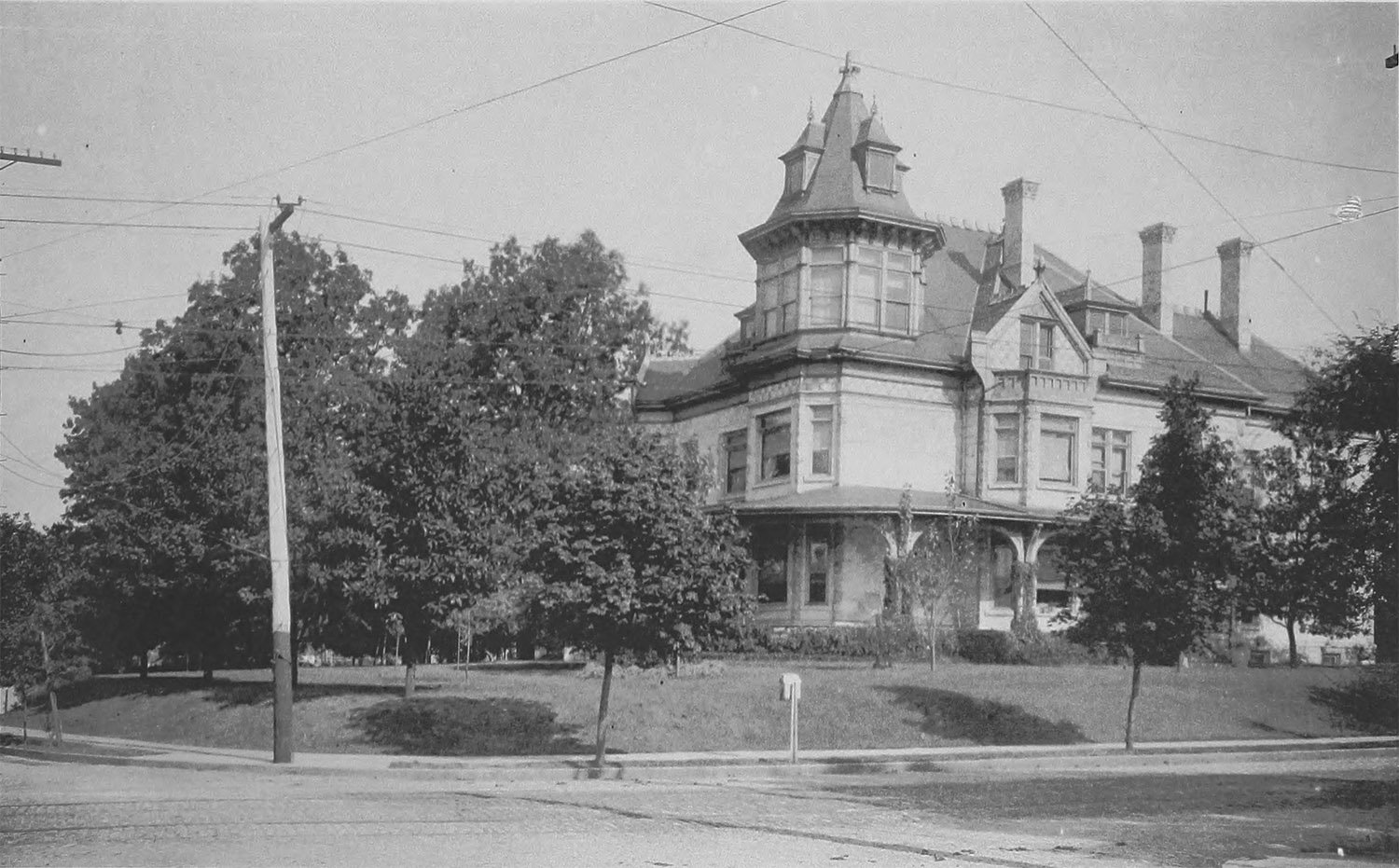
The Background
This is the first in a series of articles written for The Atlanta Journal in 1890 and 1891 by William Wordsworth Goodrich (1841-1907), professionally known as W.W. Goodrich, an architect who practiced in Atlanta between 1889 and 1895.
Here, Goodrich argued for the employment of a competent architect when building a home, at a time when the building industry was almost entirely unregulated—particularly in the Southeast—and anyone could market themselves as an architect regardless of training or experience.
Goodrich particularly emphasized the need for high-quality plumbing—indoor plumbing was still an emerging technology available primarily to the wealthy, and dangerous and catastrophic plumbing failures caused by substandard materials and improper installation were common.
On Housebuilding.
Some Valuable Hints By An Architect.
Points About How to Build a House
Give Your Suggestions to an Architect and Trust Him With the Work–A Professional Man Knows More Than a Non-Professional.
Written for the Journal.
To the prospective home-builder, I would address this warning: You are about to build or add to your present domestic or business accommodations. Possibly you have had some experience in planning and construction. Remember a good architect will save far more than his commission, and there is no economy in dispensing with his services.
The reason why houses are so ill-constructed, is not far to seek. The blame rests partly upon the builder, but a large share belongs to the owner’s ignorance of what is essential to a perfect house, or to his unwillingness to pay for it when pointed out by the architect.
While the architect has a recognized superiority in matters of taste and design, he is also better fitted to direct the great variety of artisans employed about a house. It is common but mistaken custom to give this direction to a contractor or builder, who is usually a mason or carpenter, and who is not thorough in his own trade, while lamentably ignorant of the details of other men’s work, which he has to superintend. The solo interest of such a man is to get through each job as soon as possible and with the least trouble and outlay. He is the plumber’s worst friend, when he winks at the latter’s failure to do justice to the owner’s interest, while, as he has no comprehension of the importance of good plumbing, he takes no pains to secure it. The practice of sub-letting plumbing to such men or any lump contractor is very objectionable and all sanitary details should have the personal supervision of the architect. The same reasoning will apply in the case of other departments of house construction and proves the necessity of competent mechanics.
Before undertaking any building or other like work it is always best to draw up a detailed specification, with plans, to ensure against errors or misunderstandings, which create disputes in settling accounts and to thus make it clear just what it is proposed to do, and what are the duties and obligations of all parties concerned. Detailed sketches and working plans will also be found useful, especially for explaining designs to persons not familiar with building operations. A building specification should be brief, concise, yet clear; but the terms should be specific, and particularly those relating to plumbing and drainage; the kind and character of each article or material named should be defined so as to prevent the substitution of an inferior article; and weight of pipes should be stated. And here it should be said that it is always safest and cheapest in the end to specify the best materials. The difference in first cost, for example, between (medium and heavy water supply or waste pipe or between) light and heavy lining for tanks or baths, is slight compared to the durability and safety of the better material. A chain is only as strong as its weakest link and the quality of material has a far more important bearing in plumbing than in other work. This is a matter of great importance and one in which owners are liable to be deceived. It is a common thing for unscrupulous plumbers to substitute light weight pipe, full of sand holes, where sound material is specified and there are no official tests for such material, only great watchfulness will guard against frauds of this kind. The rules of the New York board of health regarding the weight and quality of plumbing materials to be used in new houses may be consulted to advantage. In making contracts for plumbing it should be remembered that the lowest bidder may be the most expensive man in the end. No bid should be accepted at so low a rate that the mechanics who take the contract must either suffer loss or “scamp” the job and therefore be attempted to cheat at every step. Let the owner inquire about cost of materials and labor and make sure of his own protection that there is a living profit for the contractor, for he may be sure that the latter will “get even with him” in some way, and it is better that the owner should agree to pay a suitable price at the outset, than that his house should be ruined and the lives of its future occupants endangered by this common “penny wise” practice.
Two facts should be especially borne in mind by property owners. First, that a great saving can be made by having their sanitary arrangements made right in advance, instead of correcting them afterwards; and secondly, that a house in first-class sanitary condition will bring a much higher price than another which has only ordinary drainage arrangements.
When the house is building it is easy to run pipes in any direction, but when plastering has to be torn down and replaced, double expense is incurred. It is estimated that the difference between good plumbing and the average work of this kind does not exceed twenty-five percent of the original outlay.
If a compromise must be made because the owner’s purse cannot afford the best plumbing, then let the amount of the work be reduced, not the quality. It is far wiser to be satisfied with one really good plumbing appliance than with two inferior articles. Get the best under any circumstances. Let all the materials be sound and durable, and do not get anything merely because it is cheap; above all, remember that the cost of replacing a worn out or flimsy fixture with a good one, is usually almost equal to the cost of putting in a first-class article in the beginning.
The very first requisite before beginning to build a house, is to get good mechanics in every line of work.
If it asked “how am I to know a good plumber from another”, I answer how are you to know a good doctor or lawyer or architect – simply by taking pains to inquire and by avoiding the too common delusion that the cheapest man is the best. The only safeguard, is to employ a mechanic of known good character who has a reputation to lose, and who will be guided by his interest and his probity to do only first class jobs. If the public will insist on having good plumbing they will get it. If a man persists in buying sour bread or diseased meat no one pities him. Why then should we condole with one who engages the first plumber who comes along, without asking the least pains to learn his capacity or honesty, and who in consequence gets cheated? It would be amusing, if it were not so tragic in its consequences, to hear the common complaints of the duplicity of plumbers. The burthen of the story is always the same: “He was a stranger, I trusted him implicitly, and he deceived me.” We answer, why then did you trust a stranger? Next time take warning and find out something about those whom you employ and you will obtain men as worthy of your confidence in this calling as in any other.
Householders who are given to cursing the plumber will very often find, on examination, that their execrations would be more judiciously bestowed on themselves.
Having selected a competent architect, let the owner make up his mind not to hamper him by needless interference. He should take every precaution to secure a trustworthy man, and after giving him general instructions, let him carry them out in his own way. If the architect knows his business he can teach his client more than the latter can teach him. Nothing is more absurd than for people to presume to tell specialists how to carry on their specialty. This is especially the case with sanitary matters, in which amateur opinions are almost certain to be wrong, and wherein a little knowledge is most dangerous. Mr. Eidlitz takes the true professional ground when he says that “an architect, who permits a layman to decide upon the merit of his work, to gauge it, correct it, accept or refuse it – has already given up his position as a professional man.
W.W. Goodrich3
References
- Photo credit: Art Work of Atlanta, Georgia: Published in Nine Parts ↩︎
- “Edgewood Avenue House Is Destroyed By Fire”. The Atlanta Journal, January 28, 1918, p. 9. ↩︎
- Goodrich, W.W. “On Housebuilding.” The Atlanta Journal, April 12, 1890, p. 16. ↩︎