The Background
This is the eighth in a series of articles written for The Atlanta Journal in 1890 and 1891 by W.W. Goodrich, an architect who practiced in Atlanta between 1889 and 1895.
In the heady and arrogant days of the Gilded Age, a popular notion among Americans was that the United States was the spiritual successor to ancient Greece.
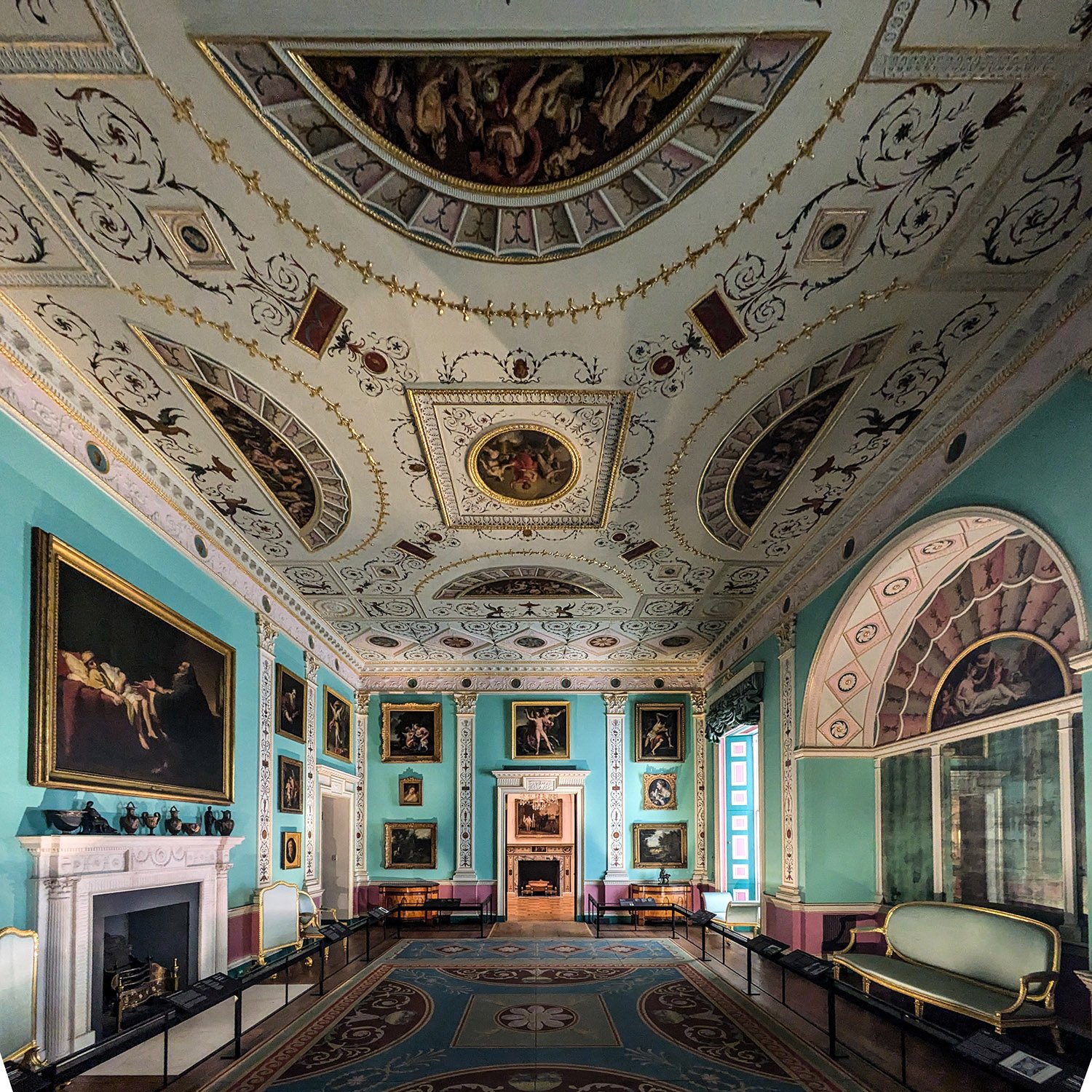
Here, Goodrich gives an exhaustingly detailed description of an upper-class residence decorated with a Greek-inspired motif that sounds hideous and overwrought in every way—although that could describe just about any interior design of the era.
This article is similar to Goodrich’s earlier article “Pretty Homes” and is full of the pretentiously florid language, condescending assertions, and tedious run-on sentences that define his writing.
Goodrich paints an illustration of a “simple and noble” reception hall decorated in no less than 13 different hues, including “gold color with hue of blue verging on green,” “a subdued gold color composed of ochre, Venetian red and a little blue,” and “rich terra cotta inclining to gold.”
An adjoining drawing room is described as including furniture and decorations made of wood and marble, “carved after the Grecian order.”
Within a few years of this article’s publication, most Atlanta architects would cede the design of interior spaces to specialized decorating firms, and perhaps in anticipation of this emerging trend, Goodrich remarks that “It is the educated architect to whom should be left the composition of all rooms”, concluding rather dubiously that “coin cannot blind him from his duty.”
All hail the honest and virtuous architect.
A Decorated House.
An Architect’s Idea of Beauty
In the Decoration of a House.
It Is the One Who Devotes Himself to the Study of What Is Beautiful That Knows the False Art From That Which is True.
Written for the Journal.
How the world has progressed since its awakening from its long inexplicable sleep of the Dark Ages! Let the peevish say what they will to the contrary; let them say that man has only been unearthing, so to speak, things of which nations long since passed from the face of the globe knew the uses – nay, had carried to a degree of perfection beyond our very conceptions; let them, if they please, in order to show their profundity, even quote from the Egyptian authority (Manetho) who says in substance that his country was settled some two hundred and seventy centuries before Herodotus, the “father of history,” had wandered among the broken shrines of its temple–that is to say, about twenty-seven thousand five hundred years before the Christian era, leaving it inferred that during that time the wonderful race had reached the highest elevation, morally, physically and scientifically, within the province of man, that is simplicity; and let them say, finally, that the very complexity of our boasted inventions proves our crudity and inferiority.
But, be that as it may, the fact is, that by a gentle pressure on the little knob of the electric bell, I had the pleasure of having the door opened to me by a very pleasant mannered servant.
As you enter through the vestibule doorway you find yourself in a corridor some twenty-four feet long by twelve wide. Midway between its rear exit and vestibule, and directly opposite the entrance to the parlor or reception room, is a mirror reaching from the thick-carpeted floor up to the cornice mouldings, the frame woodwork of which is exactly the same as that of the parlor door. On each side of this mirror is a doorway admitting into the drawing room in which are hung rich, heavy draperies that fall in easy folds to the floor. While the servant, with silver salver — on which was deposited my card – went to announce my presence, I took a look at my surroundings. I stood in a room about sixteen feet by twenty-four feet, furnished in a most complete manner, and showing at once that much attention has been bestowed in rendering it full of ease and comfort for visitors. A beautiful thick rug of eastern design and color left exposed the artistically inlaid border of the parquetry floor. Half a dozen chairs, simple in upholstery, occupied judicious positions. The two entrances already mentioned were hung on the inside with transparent portieres of exquisite Grecian pattern in gold and soft salmon and light peach blossom and a little blue, with appropriate fringes of the same colors. Originally fringes were nothing more than the tying in of bunches of the ragged edges of the taff to keep it from unraveling; to-day they are are used more as a means of ornamentation, but that is no excuse for their very often most absurd positions. In the centre of the rug, on a table of prima vara, which, like the general woodwork of the room, was beautifully carved after the Grecian order – was placed a shallow vase of dark green bronze, in which was a glass dish filled with charming fresh flowers whose fragrance filled the air. In the middle of the wall opposite the two entrances referred to was an elegant mantel in prima vara and black marble, enclosing a large fire-place, in which could be burned real logs or coal. A few, but wonderful specimens of handicraft in metal and in stone were tastefully distributed on the mantel-shelf, and a faultless mirror, enclosed in a graceful prima vara frame, by its true reflections, added to the pleasing aspect of the room. Connected with this room was a recess adjoining the vestibule, and of the same depth as it, with a large, cheerful window looking on the avenue. Two comfortable divans, facing each other, occupied the entire width of its walls. A rug similar to the other covered the floor. A slender black marble column of Grecian design stood in the center, supporting a vase the same as the one already described, and, like it, filled with beautiful fresh flowers. This charming recess was partly cut off from the drawing room by portieres in colors and design the same as those of the doorways.
It is the educated architect to whom should be left the composition of all rooms, for he alone who devotes his life to the study of what is true and beautiful can discern the true from the false, the rich from the tinsel, and coin cannot blind him from his duty.
There is a question often asked, and very seldom answered. “What is the proper manner in which to decorate a room?” First let us inquire, “For what is the room to be used?” Now, here is this reception hall. It is to be taken for granted that it is a room for the reception of all visitors, and especially of strangers–a room in which visits are not expected to take place. Intimate friends will linger but a moment, and then pass beyond; strangers or those calling on business will end their mission and then depart. I think that a room calculated for such a purpose is one in which nothing capable of bewildering a person’s mind should be allowed, that there should not be any ostentatious display of grandeur capable of filling one’s breast with timidity arising from such awe. Such is the room I am describing. Everything is quiet, flowing, gentle; in coloring, soft, cheerful, chase; in drawing, exquisite. But I do not mean that over-met with sharp, straight line. I mean that form constructed mainly on the lines of beauty, the anthers of a graceful flower. I do not mean the Greek ornamentation as shown in details in cheap prints, hastily seized upon by shallow decorators and reproduced on ceilings and walls, regardless of the fact that they have been copied from tombs and much less sacred places. I mean those exquisite compositions, the highest attainment of freehand drawing, such as a Phidias might have designed and a Pericles have admired.
The ceiling of this room is of soft salmon color, composed of an admixture of gold ochre, Venetian red, and a little white. The four corners are ornamented with a beautiful composition made up of anthemions a little deeper in tone than the ceiling, filled in with gold and outlined with a subdued burnt sienna. An easy flowing border, treated in the same manner, and running parallel with the cornice, connects the corner one with the other. The center, or field of the ceiling, is figured with a small ornament of the same character, just strong enough to be seen, and tipped with gold. Below this is an upright cone separated from the ceiling by a moulding ornamented with a design constructed of the same figure mentioned, and colored with gold, gold color with hue of blue verging on green. The cone is in a subdued gold color composed of ochre, Venetian red and a little blue. Upon this is worked the same anthemions in a very good composition, a little heavier and bolder in color and design than are the corners on the ceiling. Under the cone is a moulding some four inches wide, modelled and treated as the one above it. The wall is a rich terra cotta inclining to gold, in which the same pigments – ochre, Venetian red and cobalt blue – are used, as in fact, they form the base of all the coloring of the room. About twenty-four inches below the cornice is a band of color a little darker than the wall, but of the same hue, upon which is painted a very artistically constructed border of the same color, deep terra cotta blue and gold metal, representing, like the rest, inlaid work outlined with burnt sienna.
Such is the room which to me appears both simple and noble, and yet the whole painted decoration is constructed of one simple figure and three colors. About it there was no deceptiveness, no false effects. The closest scrutiny would fail to discover anything but the same beautiful curves and tapering anthemions. Is not this the secret of the power of Greek ornamentation? Is it not his very monotonous repetition of its favored ornament–brought to near perfection, no doubt, by centuries of re-production–that had the power to draw forth the sincere admiration of the more enlightened of mankind? Take any number of fragments or examples of pure Greek decoration, and you will discover the same principle maintained throughout. The masters who gave creation to such a mode of ornamentation surely did not aim at merely covering surfaces: their first thought was to produce an ornamentation which would imbue their countrymen with a true sense of refinement in design. What better models than those constructed of the natural lines of beauty could they have held up to them?
W.W. Goodrich1
References
- Goodrich, W.W. “A Decorated House.” The Atlanta Journal, November 8, 1890, p. 1. ↩︎