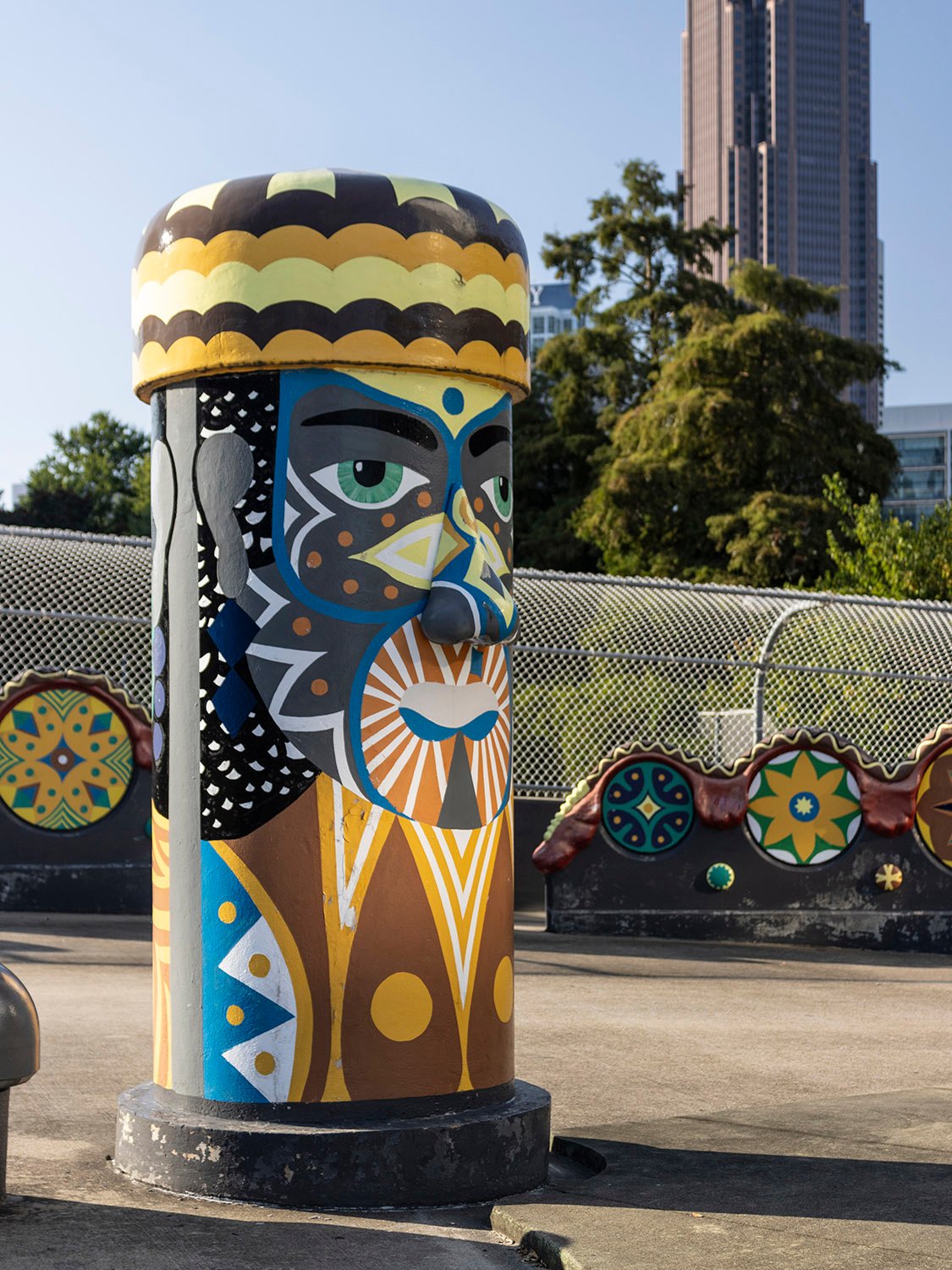
The Background
This is the sixth in a series of articles written for The Atlanta Journal in 1890 and 1891 by W.W. Goodrich, an architect who practiced in Atlanta between 1889 and 1895.
I’ll be blunt: this article is unreadable garbage.
Here, Goodrich concocted a tale set in the state of Washington that begins with an ill-fated hunting excursion by “Wyltwyck, the haughty queen of the Nooksacks.”
Wiltwyck, of Dutch origin, wasn’t the name of any Indigenous person in Oregon—it was the original name for Kingston, New York,2 where Goodrich may have been raised and practiced architecture from 18753 to 1878.4
For a mythomaniac, Goodrich’s storytelling skills were atrocious: after reading this article multiple times, I still don’t know what the hell it’s about.
My best guess is that he started writing one story, and when he couldn’t figure out how to advance the plot, decided to jam an entirely different one into it.
As if the article weren’t incomprehensible enough, Goodrich packed it full of Chinook Jargon and outright gibberish. Terms like Sahale Tyee, Nika tilakum, and kloochman are accurate,5 but much of the text reads like the speech of a babbling toddler.
Sample sentence: “Loved by the tribe and by her Ikt man kwon esum mit lite kopa ikt kloochman.” Da fuq?
Despite his own grade-school writing ability, Goodrich audaciously derided the intelligence of Indigenous people, noting “the simplicity of [Wyltwyck’s] nature” and later referring to “the simple-minded Indian.”
Goodrich also made the character of Wyltywk an adherent of Christianity—because of course he did—describing her recitation of the Lord’s Prayer to “the Great Jehovah, or Great Spirit.”
As a compulsive liar and criminal fraud, you can be sure Goodrich was an exceptional Christian.
Incidentally, the translation of the Lord’s Prayer is mostly accurate —Goodrich copied it from George Gibbs‘ Dictionary of the Chinook Jargon.
The only value in reproducing this article is to show the kind of pure bullshit that the United States has built its myths on—moronic fantasies spun by narcissistic infants who lack experiential knowledge and are desperate to prove their superiority by portraying other people as weak and inferior.
If you think there’s a shred of truth in this cultus wauwau, grow up and read a history book.
Goodrich used a word from Chinook Jargon that is now considered offensive and will not be reproduced here. The term has been replaced with the [omitted] tag, and trust me, it doesn’t make the article any worse.
Wyltwyck.
Written for the Journal.
[Note.–For the definitions of the Indian words in this story, see the end of the article.]
The cold, gray clouds were drifting over Mount Baker. Occasionally a rift in the moving mass of snow would reveal the glaziers in the canyons, and the rugged ridges of rock protruding from the ice in uneven peaks. The stillness of death reigned everywhere. Flake upon flake, at first floating silently by, would be raised from the crust to again mingle with the storm’s ever increasing determination to bury all surviving life under its revengeful mantle. Upon a projecting crag overlook a precipice, whose depth was many hundreds of feet, was Wyltwyck, the haughty queen of the Nooksacks. Tall, straight as an arrow, with knotted muscles, in silent determination she waited, with bow bent, the spring of the mountain lion, that terror of the northwest, which was crouched, ready to spring upon her as its victim for its evening meal. Cat-like, with stealth, crawling slowly, its hair raised and tail in gentle twirl, it crouched for a spring. Instantly was heard the hiss of the speeding arrow, straight and unerring. The beast had been hit in a vital part and was mortally wounded. It snaps at the arrow in its fury rolling over and over in the snow. The proud queen of the Nooksacks mockingly laughs, taunting it with expressions of ridicule that a [omitted] Kloochman should have dealt this noble beast in its own home its death blow. The snow is crimson from the warm blood of the beast; in its final agony it makes one desperate jump at the squaw, only to be met with the dagger’s blow, severing the jugular vein. The death dance over an enemy in all its peculiar quaintness and picturesqueness, in the solitude of the mountain’s fastness, with no mortal soul to witness the ceremony and in the storms of relentless fury, made the heart of Queen Nooksack bound with intense delight. Such is the Indian’s desire for solitude. Sahala Tyee, Sahala Tyee, Nika Tilakum Wyltwyck was alone, and in calling up on the Great Jehovah, or Great Spirit, she in the simplicity of her nature acknowledged the beneficience [sic] of God Almighty, as the saviour of the human soul, and for her safe return to her people Stepping to the edge of the precipice overlooking the deep recesses of the canyon, looking for salt chuck, as her bearing to the Boston, she realized she was lost and had become separated from her tribal relations in the hunt. With hands uplifted towards the unseen God, who lived upon the mountain top she prayed and in the fervency of her prayer and anguish the words echoed and re-echoed from peak to peak, from canyon to canyon, but the Lord’s Prayer never sounded sweeter to the Saviour nor came nearer the throne of grace than did the prayer of this lone Indian squaw several thousand feet above the sea Nepika Sahale Tyee Klaxta Mitlite Kopa sahale Koshe Kopa nesika tumtum mika mem. Kloshe Mika tyee Kopa Konaway tilikum Kloshe Mika tumtum Kopa illahe kahwka kopa sahale potlatch konaway sun neiska muckamuck pee kopet kumtuks konaway nesika mesache kahkwa nesika mamook kopa klaska spose mamook mesahche kopa nesika marsh siah kopa nesika konaway mesanche. KLOSHE KAHKWA.
She had not eaten for many hours as her muckamuck was gone Hyas til Nika, and wrapping her pasee about her, she was soon asleep in the Tkope snass.
The [omitted] Sail house was east of the Boston town of Nooksack on the Nooksack river at the foot of Mount Baker, whose great and majestic grandeur must been seen to be appreciated. On its sides are five glaziers moving constantly and steadily to the plains and valleys below, from under which are heard dense crunchings and loud reports and moans, caused by the ice and rocks gravitating to the lower levels and melting in a higher temperature. All of these sounds are a constant source of terror to the simple-minded Indian, who imagines these noises are devils and demons in mortal combat, each arrayed against the other, and that the smoke from the peak is caused by their firing their respective hells with each other’s bodies, as a burnt sacrifice to allay the wrath of the defeated chief devil, acknowledging that even devils have an affinity for some sort of a patched up friendship.
The homes of these people were built of bark, skins and rifted cedar thatched with wild grasses. At the apex was an opening for the egress of smoke; their muck-a-muck was game dried and jerked. Salmon were speared, halved, salted and dried and then smoked. To soften them a pointed stick was run through the thick part of the tail and then the fish was pinned to the bed of the river under water to freshen and soften preparatory to cooking and eating, a sure and speedy way.
They raised yesolth and few vegetables, and were a dreamy, superstitious and quiet people, only going on the warpath when repeatedly insulted, and never giving in till the foe were entirely wiped out of existence even to the last papoose.
A Boston man came among them to purchase skins and barter for gold. He built a marmook and lived in simple style and readily took to the native ways. His goods were brought from Linden, the head of navigation in the [omitted] Canum. Tyee Wyltwyck, and his Queen were carefully and courteously treated, and their daughter, Pilchickanim, their only child, was a Hyas Kloshe Tenas Kloochman, the handsomest female of the several tribes with hosts of suitors. She was tall, stately, her piercing black eyes penetrating as an eagle’s, her long waving, straight black hair, fine as silk, trailing on the ground, a veritable queen, and set off with trinkets and jewelry of Boston made her a picture in nature never to be forgotten. Boston was envied by all the young bucks, and many a one was felled to the ground by Boston in fights with the girl’s lovers.
With her cedar canoe she could out-race any two of the tribe, and many a deer and bear fell an easy victim to her arrow and spear-thrust as they swam the river. Boston loved Pilchickanim. His love was reciprocated by the girl in her Indian way–coy, shrewd and distant. His was love as only a Boston can–affection for this maid of the forest, in his manly Boston way. To see the two in her canoe as she speedily paddled the river with or against the current one would not suspect that the were lovers. She never betrayed an emotion, but when Boston was sick she nursed him back to life. When he was assailed by any of her tribe she fought like a mountain lion with her dagger. Her own tribal relations, and always routed the young bucks.
The sun was setting over the salt chuck. Its brilliant rainbow colors now soft and subdued, rose and fell with the long rook of the ocean. From the northwest came that brilliant glare and with beautiful vibrations lurid and distinct of the auroborealis [sic]. The tribe were with the Tyee Wyltwyck at the Sail house, fearful of an impending fate, when into their midst walked Boston without hesitation. He addressed the chief, Nika Tikeh Malleh Pilchicknin. The Tyee arose and, brandishing his dagger, swore, never! Instantly Pilchicknin, with the stately bearing of her princely birth, advanced to the side of her lover, Boston. Ah, ha! ws Tyee Wyltwyck. The simple Indian ceremony was soon over, and with her husband, she went to live at the Markook house. Loved by the tribe and by her Ikt man kwon esum mit lite kopa ikt kloochman.
The run of salmon had been light; game was scarce; the season had been too cold for yeosolth, and supplies at the Markook were at an ebb, when a great hunt was planned by the tribe, following up the Nooksack to the glaziers [sic], from under which the buttermilk chuck was constantly running. Suddenly a Hyas skookum cly Hyas mowich, the moose sank into the snow as a shower of arrows went hissing on their deadly mission. Tyee Wyltwyck rushed forward to end the career of the moose should it not have been killed by the arrows. But in the snow lay Queen Wyltwyck wrapped in a moose skin, unharmed. She had seen her people in search of her, and surmising that they would take her for a moose, as she was clothed in a moose skin, dropped in the snow. She had subsisted for several days on the moose, and brought the lion skin as a memento.
W.W. GOODRICH
DEFINITION OF INDIAN WORDS
Sahala Tyee, Sahala Tyee (great Jehova or Great Spirit), mika tilikum (I want my tribe, I want to go to my people, literally).
THE LORD’S PRAYER
Nepika (our) sahale (Father) klaxta (who) mitlite (art) kopa (in) sahale (the spirit) kloshe (good) kopa (in) nesika (our) tumtum (hearts) mika (be thy) mem (name) kloshe (good) mika (thou) tyee (chief) kopa (among) konaway (all) tilikum (people) kloshe (good) mika (thy) tumtum (will) kopa (upon) iliahe (earth) kahkwa (as) kopa (in) sahale (the spirit) potlatch (give) konaway (every) sun (day) mesika (our) muckamuck (food) pee (and) kopet-kumtuks (remember not) konaway (all) nesika (our) mesache (sins) kahwka (as) nesika (our) mesache (sins) kahkwa (as) nesika (we) mamook (do) kopa (to) klaska (them) spose (that) mamook (do) mesahche (wrong) kopa (to) nesika (as) marsh (put away) siah (far) kopa (from) nesika (us) konaway (all) mesahche (evil). Kloshe kahkwa (amen).
Hyas til nika (I am very tired). Tkope snass (the snow). Sail house (tent). Yesolth (corn). Pilchicanim (I want to marry you golden beauty). Hoyas skookum cly (a great shot). Hyas mowich (big horse). Tossee (blankets). Boston (a white man). Muckamuck (food). [omitted] canim (Indian canoe).6
References
- Fox, Catherine. “Folk Art Parks Downtown”. The Atlanta Journal-Constitution, April 26, 1996, p. F1. ↩︎
- Kingston, New York – Wikipedia ↩︎
- Advertisement. The Daily Freeman (Kingston, New York), October 5, 1875, p. 1. ↩︎
- Advertisement. The Daily Freeman (Kingston, New York), December 9, 1878, p. 2. ↩︎
- Gibbs, George. A Dictionary of the Chinook Jargon Language, or Trade Language of Oregon. New York: Cramoisy Press (1863). ↩︎
- Goodrich, W.W. “Wyltwyck.” The Atlanta Journal, October 11, 1890, p. 7. ↩︎