The Background
In July 1892, The Atlanta Constitution published the following blurb titled “Why Not Come South?”, inviting “native Americans” of the northern states—by which they meant White people—to move to the Southeast:
The Constitution wrote:
“There are several millions of well-to-do native Americans in the north and west who are dissatisfied with their environment.
“They are not millionaires and they are not paupers. They belong to the great middle class, owning their homes, and having money in the bank or invested in real estate and various enterprises.
“What these people want is security. They view with apprehension the little civil war at Homestead, and they remember the bloody riots of Pittsburg, the troubles at Spring Valley and Braidwood, Ill., Hocking valley, Brazil, Ind., and the Reading colleries, where the employers provoked disturbance and then shot down their laborers. Where will it all end? is the question asked by these law-abiding and peaceful people.
“Another element of dissatisfaction is the rigorous climate, which oppresses the Americans of today more than it did their more hardy ancestors. And still another grievance is the rapid influx of foreigners, many of whom belong to the anarchist element of Europe.
“We would say to these middle-class native Americans of the north and west that our great Piedmont region, and many other localities in the south, offer them health, happiness, peace and prosperity. They will find here a purely American population, with diversified industries, and all the conveniences and luxuries of civilization. They will find a progressive people who have forgotten the old war issues, and who are now engaged in developing their resources. And they will find cheap and productive lands, tempting business opportunities, a warm-hearted, hospitable people, and a land where there has never been a clash of arms between capital and labor, and where the reign of law is upheld by a conservative God-fearing people.
“But the race problem? Well, come down here help us settle it. We are willing to trust you. When you settle among us and see the situation as it is you will be on our side. Think it over. Abandon a section hampered by so many increasing disadvantages–give it up to the plutocrats and their serfs–give it up to the immigrant hordes who are turning it into another Europe with all of Europe’s worst evils and few of its good points. Southward ho! should be the cry, and if you are wise you will lose no time in seeking homes this favored garden of the gods!”1
The article was quite typical of the self-fellating promotional slop that filled Atlanta’s newspapers at the time, and while its language is perhaps a bit too coarse for the sensitive, modern palette that prefers its bullshit served in benign, fuzzy terms, it’s astounding how little has actually changed in 130 years.
In a country founded and built by immigrants, Americans still fear a “rapid influx of foreigners,” with entire political campaigns built on stoking a collective terror over “immigrant hordes who are turning it into another Europe.”
In the 1890s, the “anarchist element” that spurred labor strikes was the bogeyman, because God forbid workers have rights. Today, it’s the socialist element, because God forbid everyone has access to healthcare. Different century, same old tired nonsense.
People from all parts of the United States have poured into the Deep South unabated since the mid-20th century, often blaming the “rigorous climate” from whence they migrated. More often than not, however, the driving reason is that they entertain utopian delusions of the Southeast as a place of “cheap and productive lands…where the reign of law is upheld by a conservative God-fearing people” and a “purely American population.”
Instead, what the immigrant to the Southeast invariably finds is a sweltering shithole of empty promises, a land of angry and aggrieved infants who seek to control and dominate each other in the most insidious way possible: through syrupy smiles and passive-aggressive sneers, blasphemously invoking the name of Jesus to justify their satanic oppression.
It’s not that cheap, either—especially in Atlanta.
The Constitution‘s claim that the Southeast was “a land where there has never been a clash of arms between capital and labor” glossed over the fact that Atlanta and the region barely had any industry to speak of in the 1890s, and what little there was ran largely off prison labor2 3 and other exploited workers, including women and children.
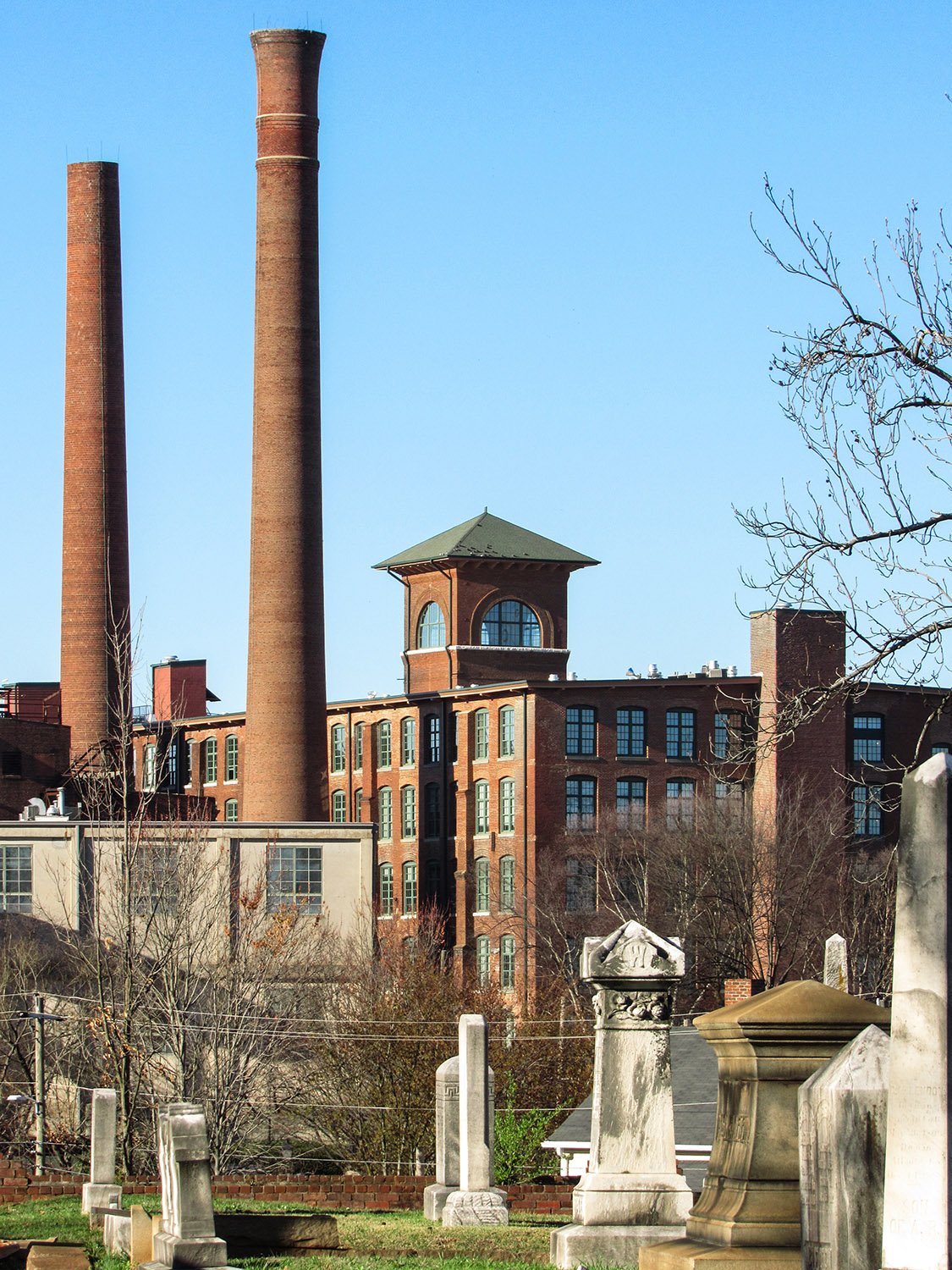
For instance, in 1900, a federal commission visited the Fulton Bag and Cotton Mills (pictured at top), one of the city’s earliest manufacturers, and found a “deplorable condition of affairs,”4 including workers under the age of 12.5 Laborers worked 66 hours a week6 and were forced to live in “ramshackle structures,”7 complaining that “nearly the full amount of their wages was deducted for rent charges and charges at the company store.”8
The Constitution‘s hand-waving dismissal of the “race problem” was also particularly galling: “When you settle among us and see the situation as it is you will be on our side.” Which is to say: you, too, will like White supremacy.
Enter W.W. Goodrich, a pathological liar, criminal fraud, and prototypical carpetbagger, but still the kind of man the Constitution so eagerly desired—Caucasian.
In the following letter, Goodrich praised the newspaper’s “magnificent article” and spoke in characteristically florid terms of “the middle class” that “patronize only what is American; they absorb only what is of American origin, and their garments are of only American products and American manufacture.”
Now that both American industry and the American middle class are essentially nonexistent—sold out by American capitalists in favor of foreign sweatshops that run off forced labor and other exploited workers—his sentiments are laughably quaint.
He Endorses It.
Atlanta, July 11.—Editor Constitution: Your editorial on “Why Not Come South” is a magnificent article, that just enters as a wedge, separating the body artisan nee the pauper or spendthrift from the great middle class that saves and banks away for a rainy day. This middle class, so called are for and to man the welfare of the entire country, and more especially are they for the upbuilding of America and American institutions in preference to anything foreign. They patronize only what is American; they absorb only what is of American origin, and their garments are of only American products and of American manufacture. Please keep this line of thought of the editorial in today’s paper at the head of your columns, and you will do an invaluable service to our sunny south.
W.W. GOODRICH9
References
- “Why Not Come South?” The Atlanta Constitution, July 11, 1892, p. 4. ↩︎
- “Is A Body Blow At Convict Labor”. The Atlanta Journal, February 2, 1897, p. 3. ↩︎
- “Labor Men Wage War On Convict-Made Brick”. The Atlanta Constitution, February 3, 1897, p. 1. ↩︎
- “Industrial Commission Hears Plan Talk From Labor Men”. The Atlanta Constitution, March 21, 1900, p. 7. ↩︎
- “Investigation Ended; Commissioners Leave”. The Atlanta Journal, March 21, 1900, p. 8. ↩︎
- “Lack Of Facts In The Testimony Heard By Industrial Commission”. The Atlanta Constitution, March 22, 1900, p. 9. ↩︎
- “Industrial Commission Hears Plan Talk From Labor Men”. The Atlanta Constitution, March 21, 1900, p. 7. ↩︎
- ibid. ↩︎
- Goodrich, W.W. “He Endorses It.” The Atlanta Constitution, July 13, 1892, p. 4. ↩︎