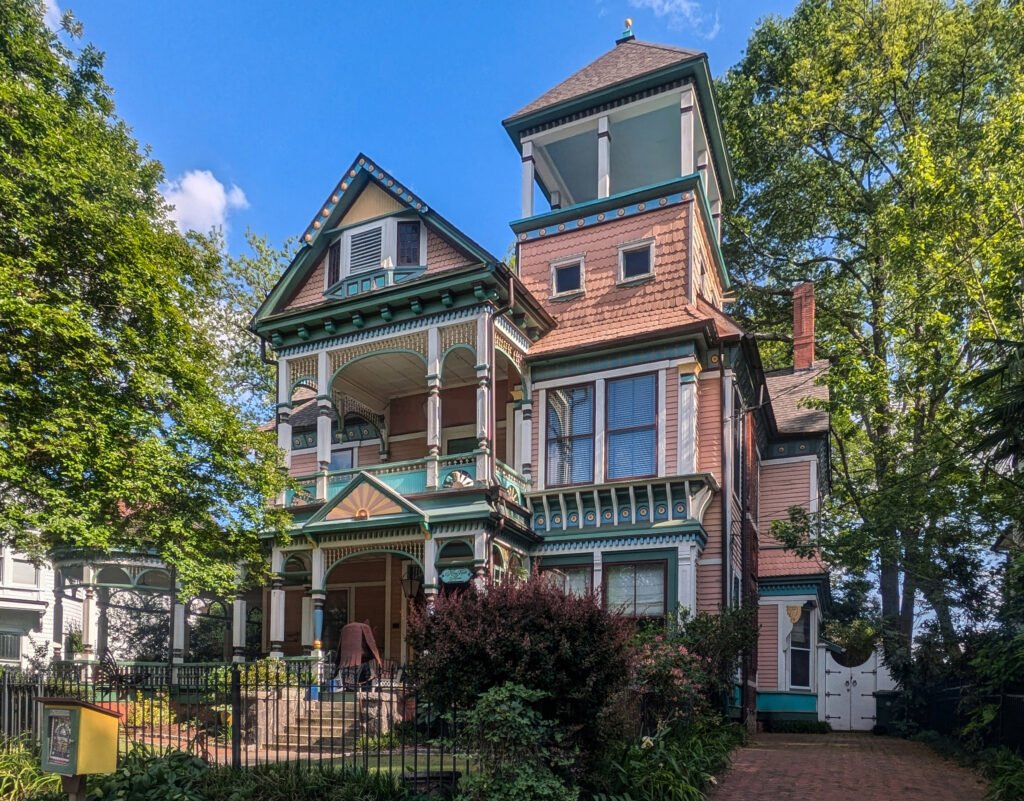
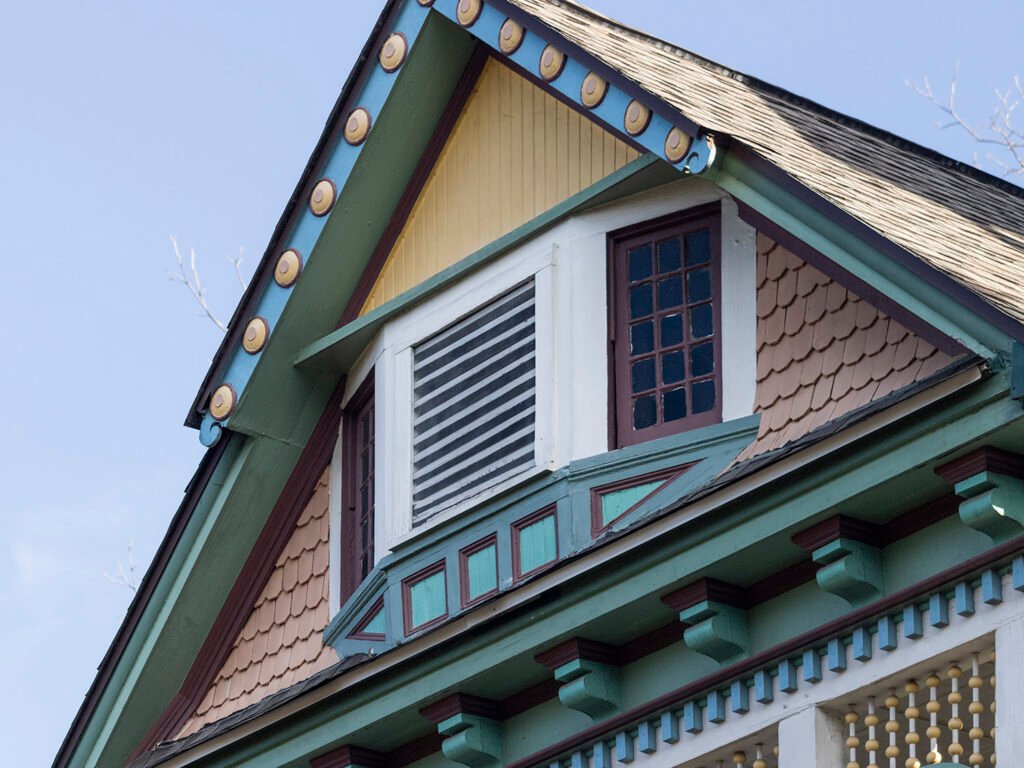
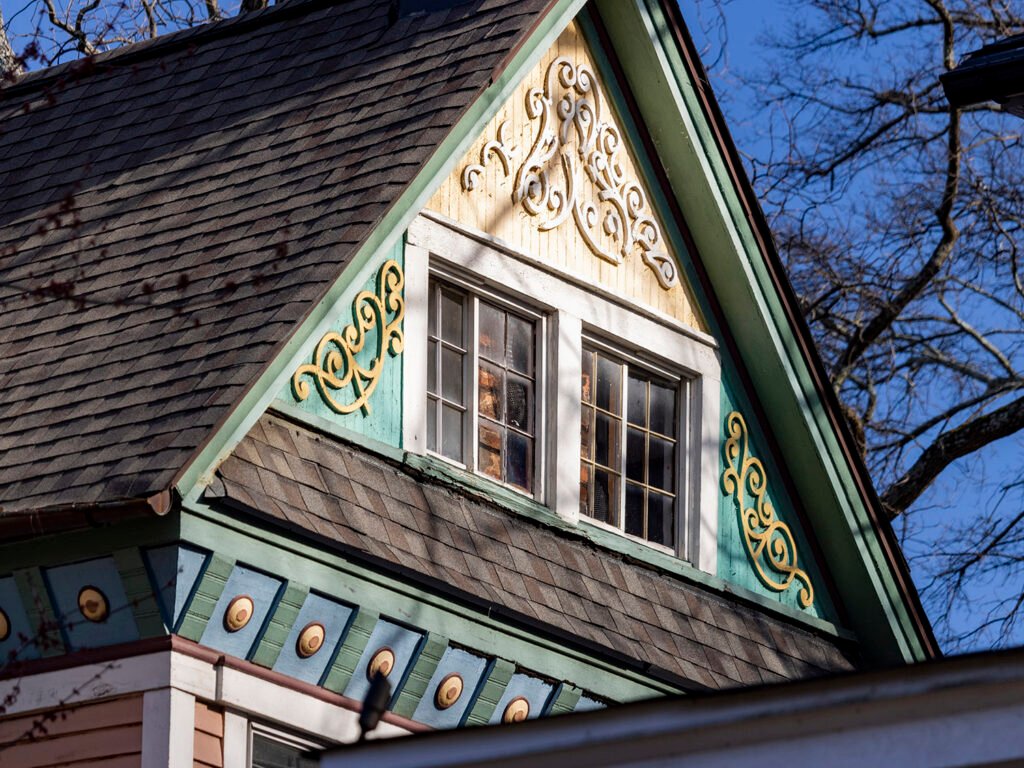
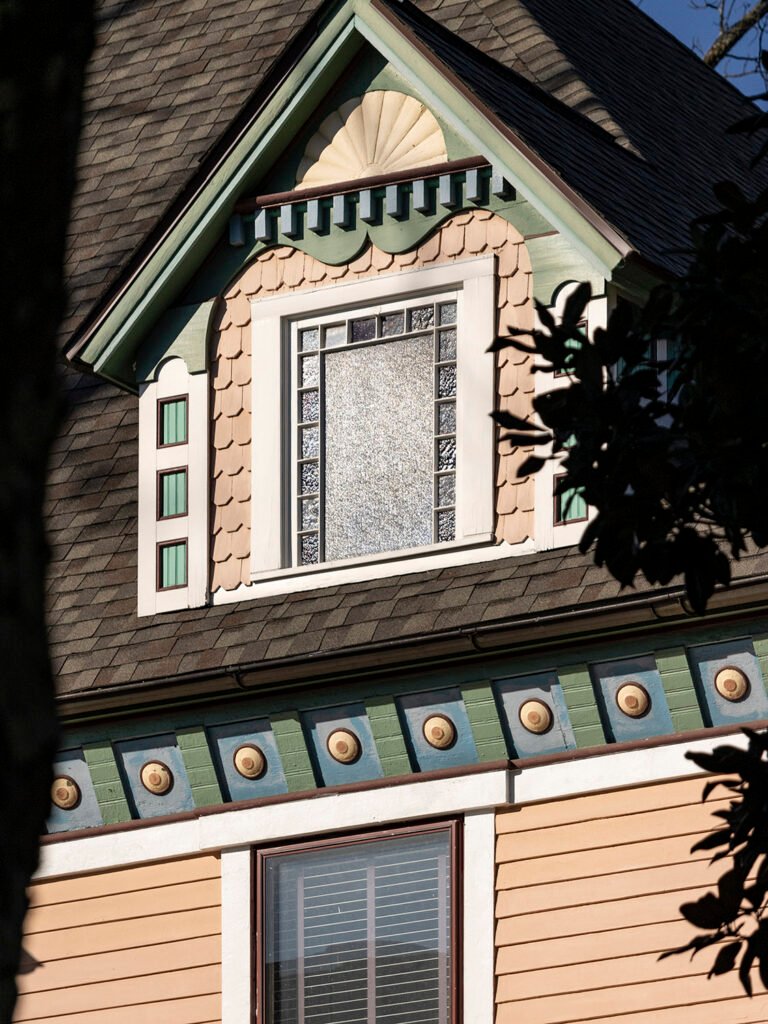
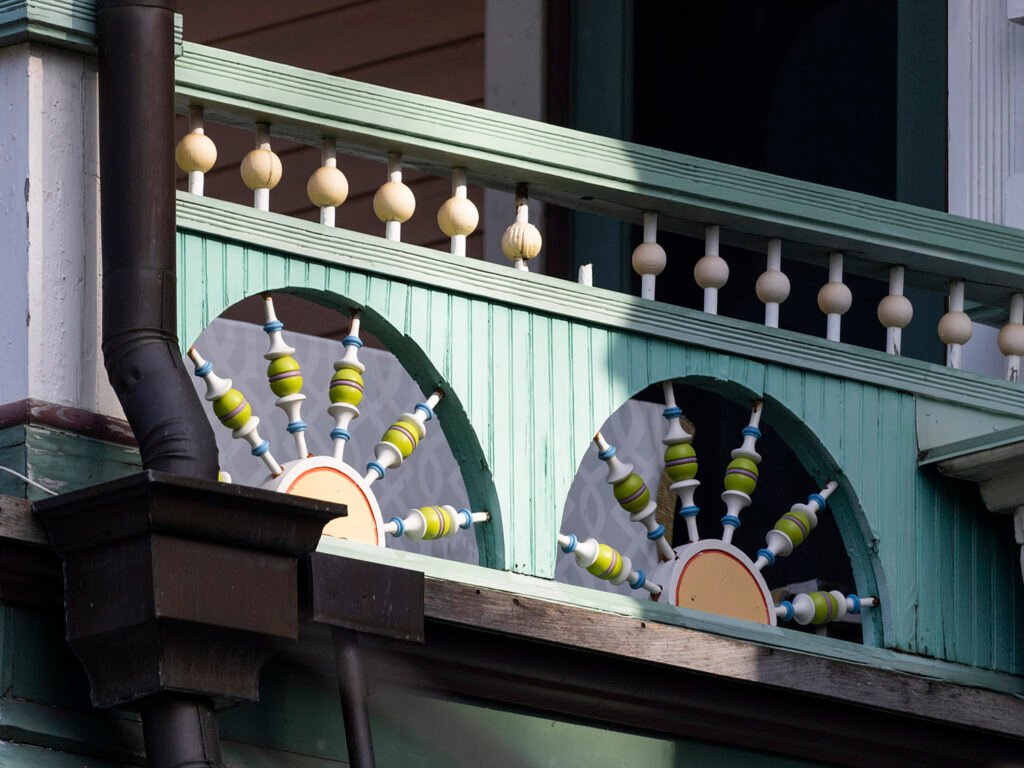
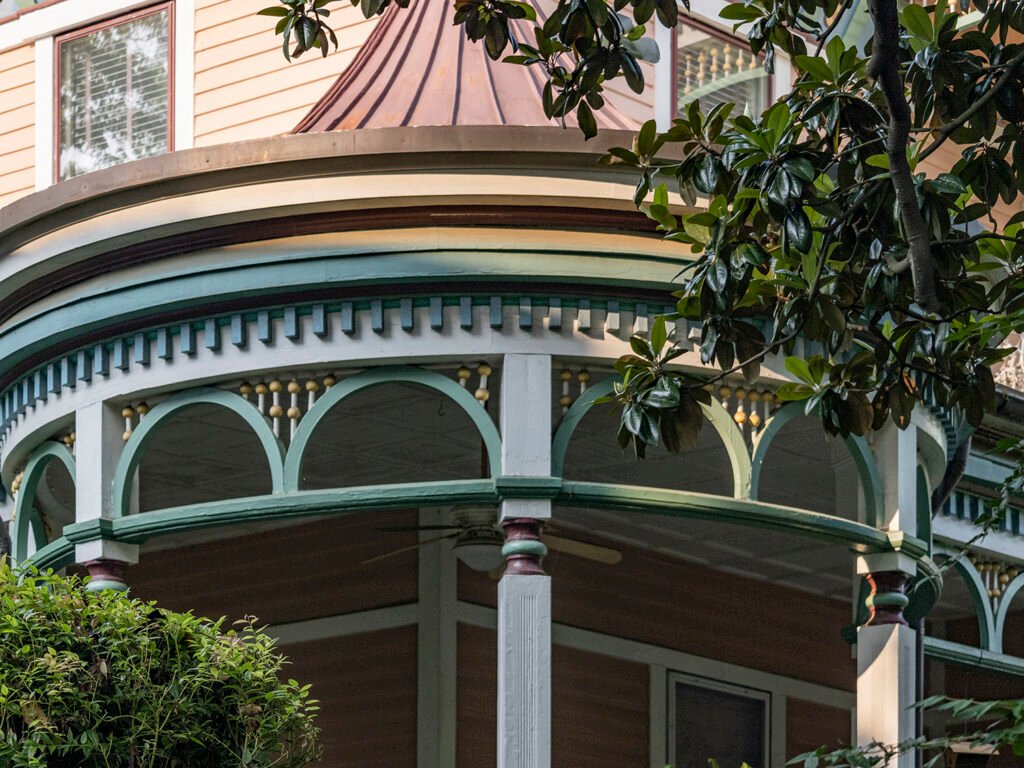
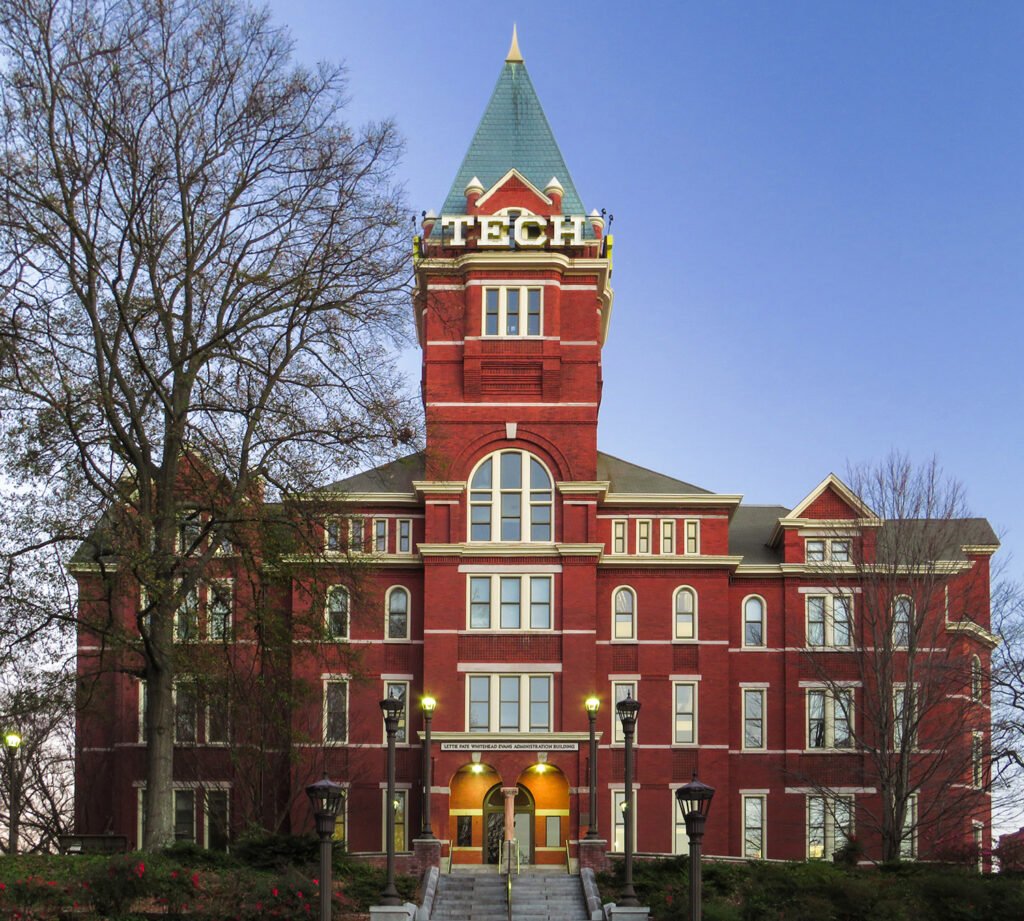
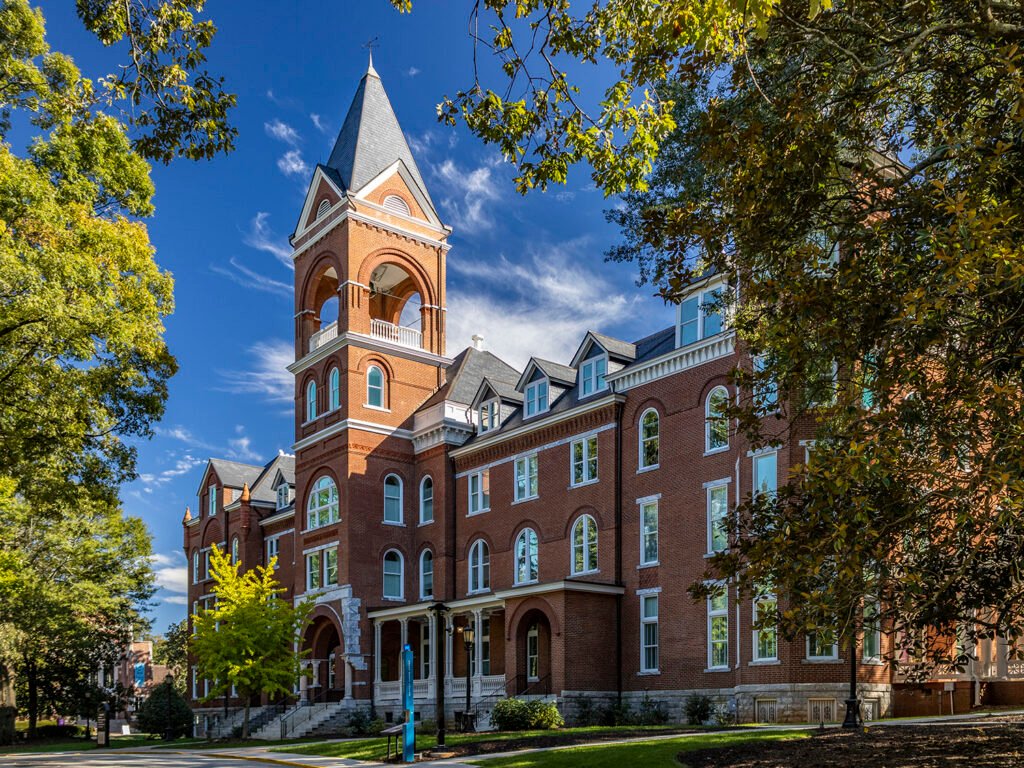
Bruce & Morgan. George E. King Residence (1890). Inman Park, Atlanta.123456Oriel window on the north facade of the George E. King ResidenceGable on the west facade of the George E. King ResidenceAttic dormer and cornice on the east elevation of the George E. King ResidenceFretwork rails on the second-floor porch of the George E. King ResidenceLooking at the first-floor porch of the George E. King Residence from the northeast
References
“From Our Notebook.” The Atlanta Constitution, March 13, 1890, p. 4. ↩︎
“The Inman Park Sale.” The Atlanta Journal, April 21, 1890, p. 3. ↩︎
“Real Estate Sales.” The Atlanta Constitution, May 21, 1890, p. 6. ↩︎
“Hundreds of Homes”. The Atlanta Journal, July 30, 1890, p. 1. ↩︎
“Atlanta Building Up.” The Atlanta Constitution, October 3, 1890, p. 3. ↩︎
“Inman Park Items.”The Atlanta Constitution, December 19, 1890, p. 9. ↩︎
Bruce & Morgan. Kiser Law Building (1891-1936). Atlanta.1
The Background
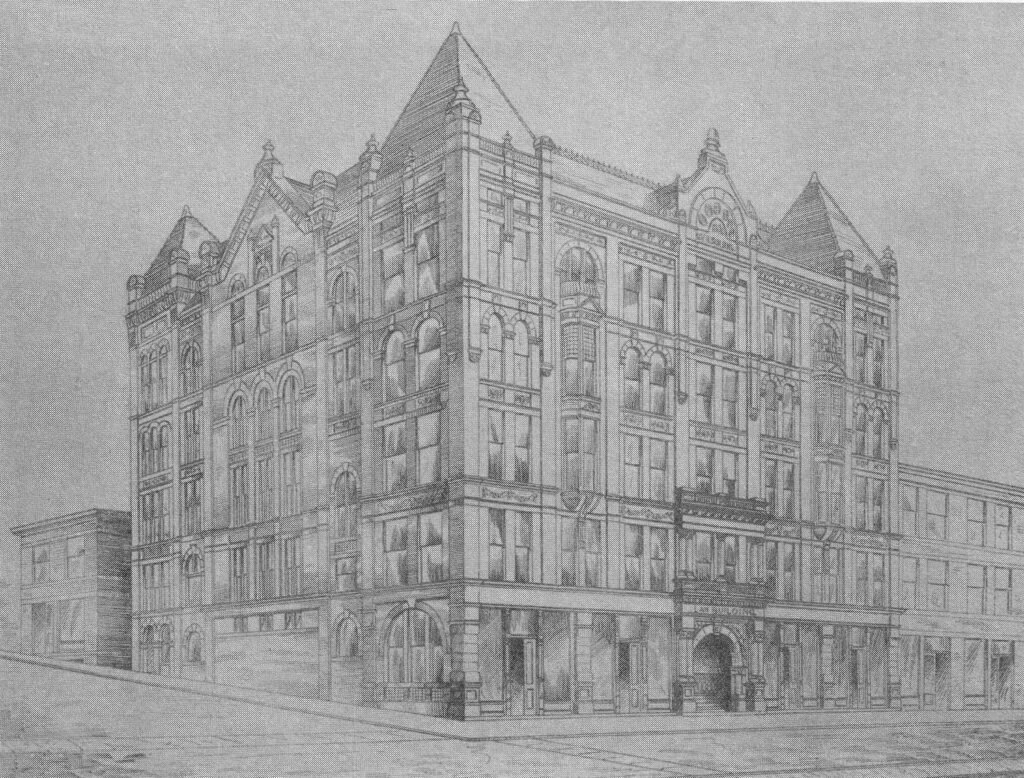
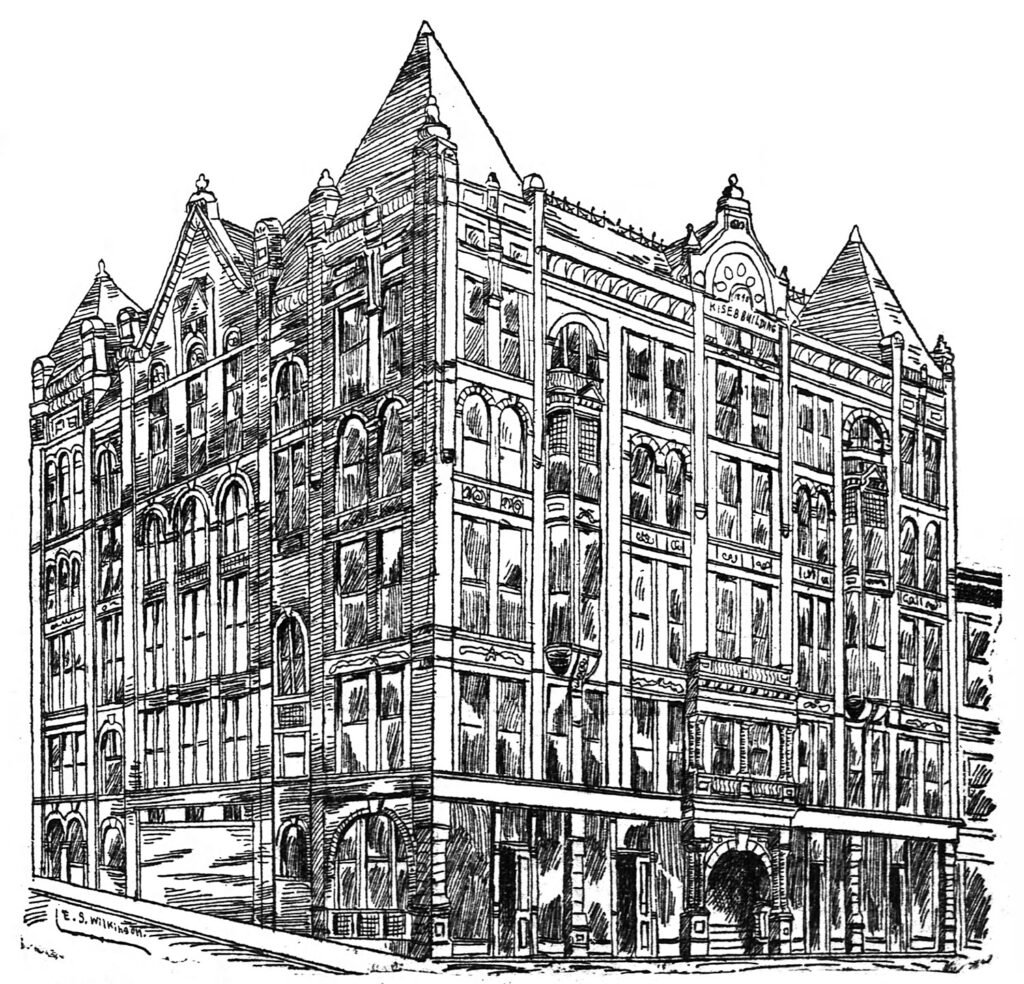
The following article, published in The Atlanta Constitution in 1890, includes an illustration and a brief description of the Kiser Law Building, completed in 1891 and designed by Bruce & Morgan.
Located at the northwest corner of Hunter and Pryor Streets (later Martin Luther King, Jr. Drive SE and Pryor Street SE) in Atlanta, the five-story office building was owned byM.C. Kiser, a local real estate developer.
Location of Kiser Law Building
Members of the Atlanta Bar Association had reportedly approached Kiser for several years with requests for him to build a structure designed exclusively for law offices.23
When Kiser finally agreed to the project, the association formed a building committee that considered two designs for the structure: one by A.Mc.C. Nixon, and the winning plan by Bruce & Morgan.45
Bruce’s Approach
Although T.H. Morgan increasingly became the primary designer for Bruce & Morgan through the 1890s, A.C. Bruce still handled the majority of the firm’s output in the early part of the decade, and the Kiser Law Building appears to have been his design.
Bruce was a former cabinet maker and carpenter who lacked formal architectural training, and by 1890, the limits of his skill set were becoming readily apparent.
Many of Bruce’s designs from the early 1890s appear heavy-handed and anachronistic: you can see he was attempting to adapt to modern tastes, but his design sensibility was still fundamentally stuck in the 1870s — the Kiser Law Building was a prime example.
Looking at the illustration above, the building resembles a stack of drawers haphazardly piled on top of each other, and oversized windows of varying shapes and sizes junk up both facades.
That additive approach to design was typical of architects with a background in carpentry, who often designed buildings as if they were giant pieces of furniture, joining disparate elements and tacking on unnecessary embellishments instead of envisioning their compositions as solid masses to be sculpted into form.
The building’s overall style is equally baffling: Bruce was presumably aiming for the Romanesque, but for all the eclectic adornments, including terra cotta trim,67a decorative slate roof with iron crestings, ornamental iron balconies, and marble columns,8 he didn’t quite achieve a cohesive style. The pyramidal peaks and elaborate gables were also becoming rapidly outdated by 1891.
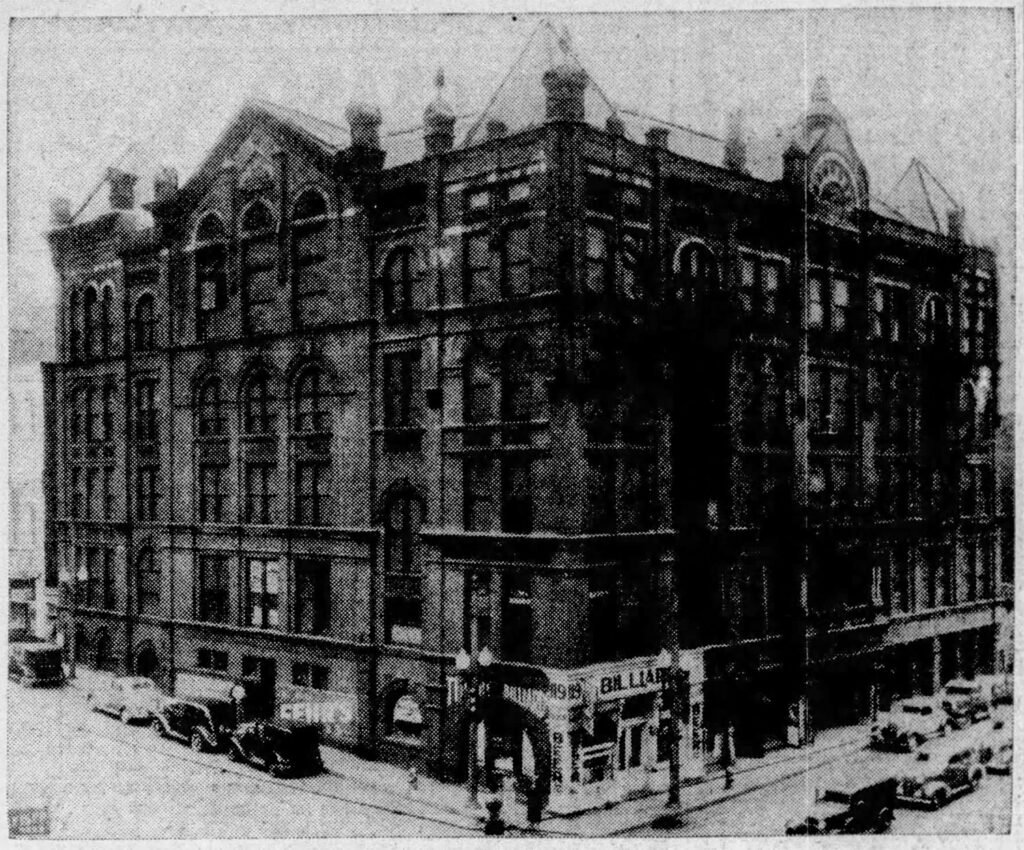
Kiser Law Building circa 1936
Design and Construction
As construction began, it was reported that the Kiser Law Building would be constructed of either Berea sandstone or marble.9 It’s Atlanta, so it appears they opted for the cheaper sandstone for most of the structure and incorporated marble trim around the entrance.10
Set over a full basement, the building’s five floors included a 16-foot-wide central hall, served by one elevator, four stairwells, and two fire escapes. A light court was also designed to extend from the top to the bottom floor, so that each of the building’s 84 offices would be lighted and ventilated from the outside.11
The building was illuminated with electric lighting and included “water closets of the latest patterns…located in the rear [heh] of every floor.12
While it was originally reported that the building would be heated by steam,1314 Kiser ultimately chose the Bolton Hot Water System, which was marketed as a “purely scientific, healthful way of heating.”15
I don’t really care enough about such things to learn more; however, the man who supervised the heating system’s installation told the Constitution: “…the larger buildings in the north have been heated by hot water apparatuses for the last ten or twelve years, yet it is practically new for the south…”16
No surprise, really: Atlanta’s self-conscious developers are always late to the game, simply replicating what was done a decade ago in the better cities of the North.
The floors of the Kiser Law Building were planned as follows:
The ground floor included spaces for four stores — the storefront at the corner of Hunter and Pryor was designated for a bank,17 and another space facing Pryor Street was planned as a restaurant.18 The entrance hallway featured marble wainscoting and tile19 and led to “four broad stairways” and “an elevator of the most approved pattern.”20
The second, third, and fourth floors were identical in design, and each contained 28 office suites — 14 on each side of the central hall. The offices were finished in hardwoods and Georgia pine, with fireproof vaults and closets.2122
The fifth floor was intended to housetwo large halls “suited to the use of secret societies, public meetings and other similar purposes,”23 as well as a kitchen, storerooms, reception room, and a club room or library.24
Construction on the building began on April 8, 1890,25 with J.H. Matthews,26 “a wide-awake contractor”,27 supervising the project. The initial estimated cost of the building was $90,000, with a projected completion date of April 1, 1891.28 The cost rose to $100,000 by 1891,29 and the building was completed in August 1891.3031
Local interest in the project was high, and while construction was still underway in November 1890, Kiser had reportedly received applications from 100 lawyers seeking office space.32
Firms began announcing their intention to move to the building in early 1891,33 and in June 1891, George W. Adair, who handled leasing for the property, reported: “The Kiser law building is nearly ready for occupancy, which is good news to those who have already selected their rooms, and others that are waiting for its completion.”34
Their lease agreements should have included the following caveat: the only thing slimier than a lawyer is an Atlanta developer.
The Terminal Debacle
In July 1891, Kiser leased nearly the entire law building — including the top four floors, the corner store on the ground floor, and the full basement3536 — to a single firm: the Richmond Terminal Company, which had abruptly decided to relocate its headquarters from Washington, D.C. to Atlanta.37
The company stated its intention to use the Kiser Building as temporary office space until it could build its own facility in the city,38 signing a two-year lease for the then-unheard-of sum (in Atlanta anyway) of $14,500 a year.3940
Commonly referred to as the “Terminal”, the company had previously purchased the Central Railroad and Banking Company, Georgia’s oldest railroad,41 based in Savannah. The Terminal’s new Atlanta headquarters consolidated the employees from both Savannah and Washington in a single location.
However, the Kiser Building was much too small to house the Terminal’s 250 to 300 workers,4243 and one executive stated, “Unfortunately that building is not large enough to fully accommodate all the offices, but we will try to make do.” Kiser said of the negotiation: “…the trouble was they wanted more room, but finally concluded they could get along by adding the corner room and the basement.”44
The Terminal’s hasty relocation to Atlanta was more than a little suspicious, and there were allegations that it wasn’t “bona fide”, which the company denied.45 Atlanta’s newspapers, of course, hailed the move, with the always-bloviating Constitution prognosticating:
“A grand new depot and office building. That is the inevitable result.
The bringing of these offices to Atlanta is a bigger thing than might appear at first glance. This naturally makes Atlanta the center of the railroad situation of the south, and, as Atlanta is now the insurance center, it becomes beyond question the financial center of the south.”46
The lawyers who already selected offices in the Kiser Building just had to suck it, I guess. The Odd Fellows probably weren’t too thrilled either: the Constitution reported in July 1891 that “about ten days ago they selected the fifth floor of the Kiser building and immediately rented it as an Odd Fellows’ hall. Then the Terminal people came along and wished the place.”47
Anyone who knows how shit goes down in Atlanta could guess what happened next: Just six months after the Terminal employees began working in the Kiser building, the Central Railroad was forced into receivership by a local judge.4849
Rumors of the Terminal’s financial difficulties and potential bankruptcy had swirled around Atlanta for months, spurred by the resignations of top executives and directors who had reportedly been battling for control of the company.5051
There was also the time in January 1892, when the company apparently lacked the funds to pay its employees, delaying their paychecks for more than a week,52535455 a situation charitably described as “embarrassing.”56
The final blow was delivered in a lawsuit filed by a stockholder against the company, alleging that, among other things, the Terminal’s owners were conspiring to transfer $500,000,000 in debt onto the Central Railroad, “which it [could] never pay,”5758 presumably with the intent to bankrupt it. Sounds like business as usual for an American enterprise.
Under the rules of the receivership, the Central Railroad’s 74 employees59 returned to Savannah,6061 and while it initially appeared that the remaining Terminal employees would stay in Atlanta, they were ordered back to Washington in June 1892, leaving the Kiser Building nearly vacant.6263The company hired George W. Adair to sublet the building,64 which was filled with lawyers as originally planned.65
The Inevitable Demise
Office structures tend to fall out of fashion quickly, and in 1930, the Journal said of the Kiser Law Building: “…the lawyers, loan brokers, and trade representatives [have] shifted to more modernly equipped buildings…”, noting that, “storms of nearly half a century have raised havoc with the structure and its artistic domes, its oriel windows, and its ornamental trimmings.”66
By 1936, the Kiser Law Building was reportedly “almost empty except for a store or two on the sidewalk.”67 No one seemed too upset when the structure was demolished in November and December 1936 for — take a wild guess — a parking lot.686970
The Article
Major M.C. Kiser’s “Law Building” will be one of the handsomest buildings in the south, and when finished will be one of Atlanta’s greatest attractions.
The Constitution gives here an excellent cut of the building, made from the drawings of Bruce & Morgan, the architects. The uses to which the building are to be put have been fully explained in these columns.
The building will be erected at the corner of Pryor and Hunter streets, fronting on Pryor, and will be five stories in height. It will be devoted to offices for lawyers, with clubrooms for a Lawyers’ club. It will be just as complete as possible, an ideal building in every respect.71
References
Illustration credit: Atlanta in 1890: “The Gate City”. Atlanta: The Atlanta Historical Society, Inc. (1986), p. 62. ↩︎
“The Kiser Building”. The Atlanta Constitution, January 26, 1890, p. 19. ↩︎
“Kiser’s Law Building.” The Atlanta Constitution, April 8, 1890, p. 7. ↩︎
“The Kiser Building”. The Atlanta Constitution, January 26, 1890, p. 19. ↩︎
“Kiser’s Law Building.” The Atlanta Constitution, April 8, 1890, p. 7. ↩︎
“The Kiser Building”. The Atlanta Constitution, January 26, 1890, p. 19. ↩︎
“History In Clay.” The Atlanta Constitution, May 15, 1892, p. 3. ↩︎
“Kiser’s Law Building.” The Atlanta Constitution, April 8, 1890, p. 7. ↩︎
“Kiser’s Law Building.” The Atlanta Constitution, April 8, 1890, p. 7. ↩︎
“The Kiser Building”. The Atlanta Constitution, January 26, 1890, p. 19. ↩︎
“Kiser’s Law Building.” The Atlanta Constitution, April 8, 1890, p. 7. ↩︎
Bruce & Morgan. Cherokee County Courthouse (1892-1895). Murphy, North Carolina.
The Background
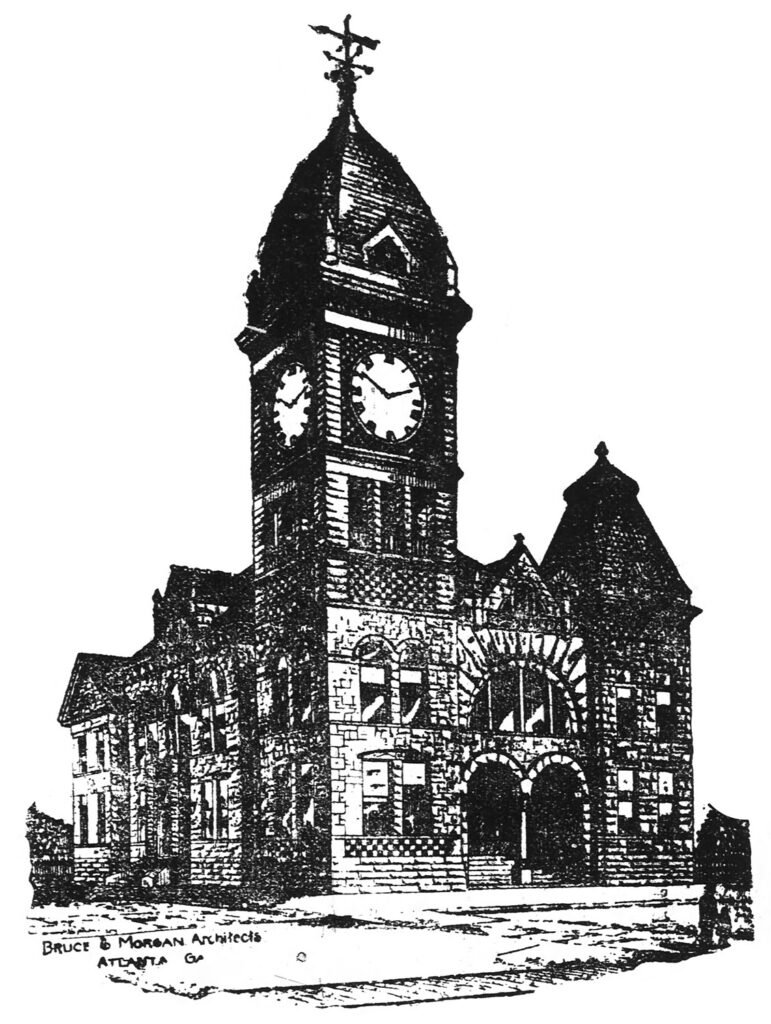
The following article was published in The State Chroniclein 1890, and includes an illustration and description of the Cherokee County Courthouse in Murphy, North Carolina, designed byBruce & Morgan.
A vernacular interpretation of the Romanesque Revival style, the building depicted in the illustration appears to be a competent effort by A.C. Bruce, and an updated version of his plan for the Newton County Courthouse in Covington, Georgia, completed in 1884.
The only questionable elements in the otherwise cohesive composition are the odd pediment and oversized half-round window above the entrance portico. This wasn’t an exceptional design, by any means, but generally well-proportioned and tastefully executed.
Location of Cherokee County Courthouse
The article states that the county’s leaders were unsure whether the courthouse should be built of brick with marble trimmings or “an entire marble face,” a preposterous question for a rural jurisdiction in the Deep South.
Marble was so cost-prohibitive in the late 19th century that even Atlantans couldn’t afford it as a primary building material, much less the inhabitants of a dirt-poor county in the hills of Carolina.
Unsurprisingly, the finished courthouse was primarily built with pressed brick, while the foundation and steps were composed of marble.1 The initial cost of the project was reported as $21,5002 by one source and $22,5753 by another, but other reports estimated it at $40,000.456
It’s difficult to find a definitive date for the building’s completion, but the cornerstone was laid in July 1891,7 and most sources state it was finished in 1892, which would be a reasonable timeframe.
Despite this article’s claim that the courthouse would “stand the storm of ages”, the building was destroyed by fire on December 13, 1895,8 less than four years after its completion, although the outer walls were left intact.9
In early 1896, Bruce & Morgan were hired as architects for the building’s replacement,10 and it appears they essentially replicated the previous design.
The rebuilt courthouse was also destroyed by fire on January 16, 1926,1112and replaced with an entirely new structure.1314
So much for it being “a monument for centuries to come.”
Murphy’s New Court House.
The State Chronicle is glad to be able to present to its readers to day a picture of the new Court House which the Commissioners and Magistrates of Cherokee county have decided to erect at Murphy. It will be a handsome building and an ornament to the town and county, as well as its best advertisement. It is to have a face and trimmings of marble quarried from the Cherokee county quarries. Marble of almost every shade of color is found in Cherokee, and the Western North Carolina Railroad runs in such close proximity to the marble as to enable parties to load it directly from the quarries into the cars. A marble Court House will advertise this marble better than an hundred agents and an hundred newspapers. The Commissioners and Magistrates have not exactly determined whether it shall have an entire marble face, and have advertised for bids with the marble face and only with marble trimming. But they have decided to build it, and it is a decision in which the entire State is interested. It shows that we are going forward. As the Murphy Bulletin well and truly put it: “The Court House will stand the storm of ages and retain its original beauty and magnificence.” The Commissioners and Magistrates have acted wisely, and the Chronicle rejoices that a spirit of faith in the glorious future of their county has been present with them. This marble Court House will be a monument for centuries to come of the wisdom of the men now living in Cherokee.15
“Cherokee County Court House Swept By Disastrous Fire for Second Time In History, Damage Believed $100,000.” The Sunday Citizen (Asheville, North Carolina), January 17, 1926, p. 20. ↩︎
“Cherokee Courthouse Is Destroyed By Fire”. The Charlotte News (Charlotte, North Carolina), January 16, 1926, p. 1. ↩︎
“Cherokee County Court House Swept By Disastrous Fire for Second Time In History, Damage Believed $100,000.” The Sunday Citizen (Asheville, North Carolina), January 17, 1926, p. 20. ↩︎
“Start Plans For Cherokee Courthouse”. The Asheville Times (Asheville, North Carolina), January 22, 1926, p. 18. ↩︎
“New Courthouse Will Be Built In Cherokee County”. Salisbury Evening Post (Salisbury, North Carolina), January 28, 1926, p. 6. ↩︎
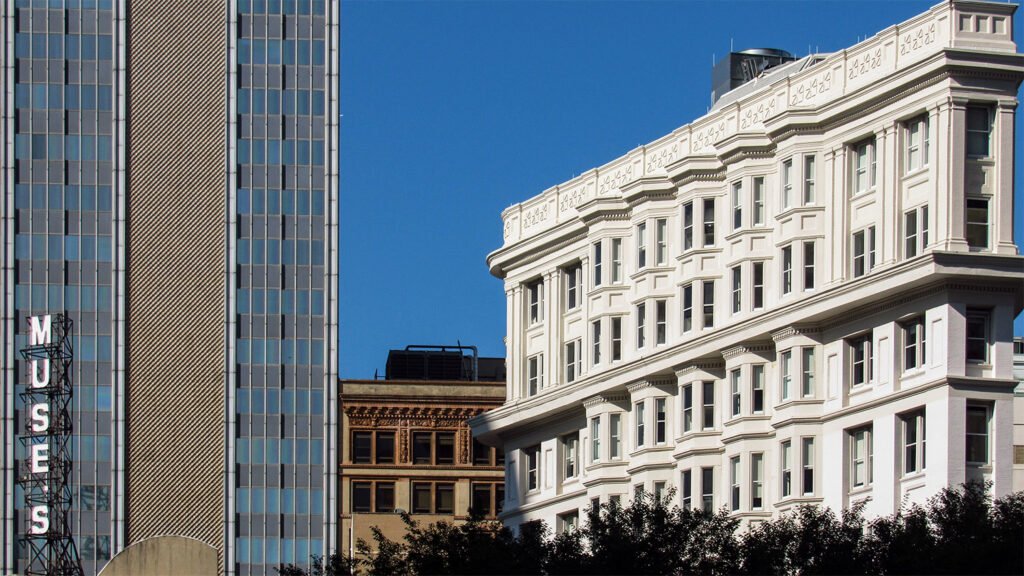
From left to right: Muse’s Department Storesign, The Bank of Georgia/34 Peachtree (1961), Citizens & Southern National Bank (1901), English-American Building (1898). Fairlie-Poplar, Atlanta.
Bruce & Morgan. Carrie Steele Orphans’ Home (1889, unbuilt). Atlanta.
The Background
The following article was published in The Atlanta Constitutionin December 1889 and discusses the proposed design for the Carrie Steele Orphans’ Home, prepared by Bruce & Morgan of Atlanta.
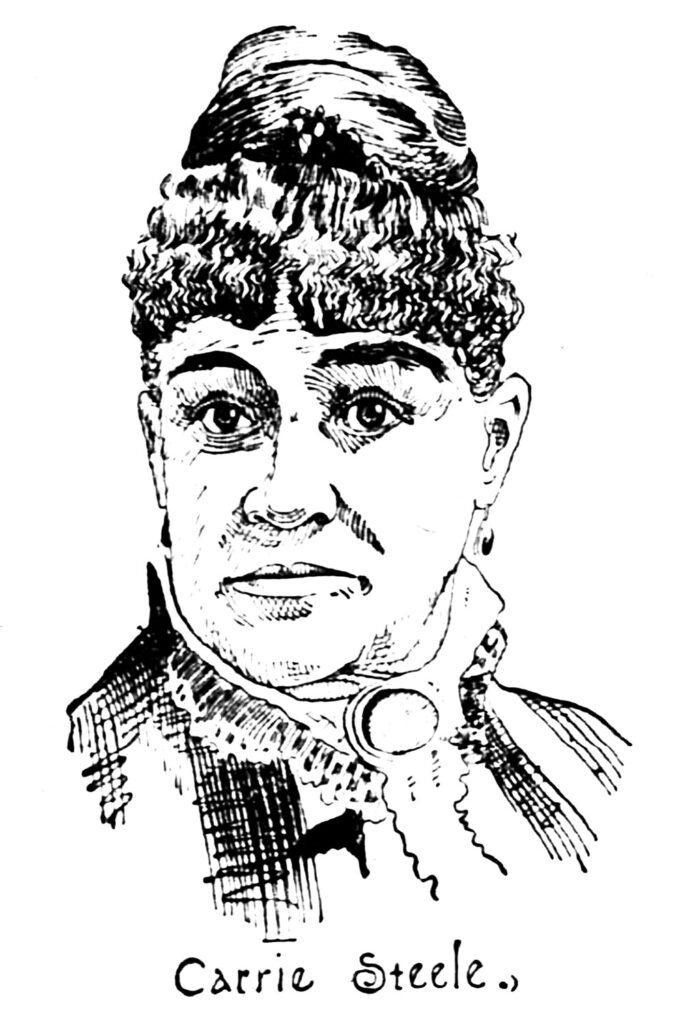
Carrie SteeleLogan (pictured here1)was “well known and highly respected”2 in both the White and Black communities of Atlanta in the late 19th century. Born into slavery in 1829,3 she worked for many years as an attendant in Atlanta’s passenger depot,45 where she reportedly became distressed by the “little army of street vagrants who ran around the depot entrance.”
Steele ultimately quit her job, “impressed with the responsibility of rescuing the little tots that struggled for existence,” and according to the Constitution, “as she left the depot she led several homeless waifs to her home on Wheat street.”
In 1887, Steele began raising money to build an orphanage for Black children, which the Constitution described as a “praiseworthy work,” opining that: “The home will do a vast amount of good in recovering from lives of vice and crime the little negroes who run around our streets ragged, friendless and homeless…”
Note that in this article, Albert Howell, one of the orphanage’s early supporters, claimed that the home would “take the little negro waifs and make good servants of them.”
Steele was a tenacious advocate for the project, pursuing every possible fundraising method. In 1888, she even published a book of anecdotes about her time working in Atlanta’s depot, titled Life and Adventures of Mrs. Carrie Steele, Stewardess Atlanta Depot, with proceeds funding the orphanage.6
Lacking land for the project, in 1889, Steele petitioned the City of Atlanta,78which granted her a 99-year lease9 on a 4 to 5-acre parcel1011 near the intersection of Fair Street and Flat Shoals Road (now the southeast corner of Memorial Drive SE and Holtzclaw Street SE).
Location of Carrie Steele Orphans’ Home
Steele reportedly “made many friends among the white people”,12 and it’s a testament to her reputation that the orphanage’s construction was funded by several of Atlanta’s wealthiest citizens, including Jonathan Norcross,13 who was, by all accounts, a miserly old asshole.
In March 1890, The Atlanta Journal said of Steele’s fundraising efforts:
“Almost all the prominent white people in the city have contributed something to the good cause, and to those who have not we desire to say that you could not contribute to a more laudable undertaking.”14
Construction on the orphanage began in July 1890,15 but because it had to be built in stages as funding permitted, the project was completed in May 1892.16 However, the final structure wasn’t the onedesigned by Bruce & Morgan.
The original design had apparently been dropped by May 1890, when Steele bought 30,000 bricks for the project1718 — note that the plan described and illustrated here was for a wood-frame building.
Architect unknown. Carrie Steele Orphans’ Home (1892). Atlanta.19
The plain brick structure that was ultimately built for the orphanage appears to have had no designer — or at least, not a good one. Containing 13 rooms,20 the orphanage housed 36 children at its dedication,21 and by 1896, it sheltered 75 children between the ages of one and fifteen years old.22
In 1894, Steele told a reporter from the Constitution:
“If these were my own children I could not love them more than I do. They all look up to me as if I were their mother, and come to me with all their little troubles as if I always had a remedy for them. I have had a great many discouragements and trials, but when I look back over these years and see how the Lord has taken care of me and my children, I feel that I ought to be thankful.”23
Steele died in November 1900 at the age of 61, two months after a debilitating stroke.24 Her funeral was reportedly attended by 3,000 people,25 with the Constitution reporting that “the church was filled to overflowing and about half of the audience was composed of whites.” She was buried in Oakland Cemetery, the final resting place of Atlanta’s most distinguished citizens.
Steele’s husband managed the orphanage until he died in 1904,26 which continued operating under a succession of directors, notably Clara M. Pitts, who managed the home from 1919 to 1950.27
In 1928, the orphanage left its original property on Fair Street and moved to the Pittsburgh neighborhood in southwest Atlanta.28 Later renamed the Carrie Steele-Pitts Home, the orphanage moved to Faiburn Road in west Atlanta in 1964,29 where it remains in operation as the oldest black orphanage in the United States.30
For Negro Orphans.
The Good Work Which Carrie Steele Has Done.
The Home As It Will Appear When Finished — What a City Officer Has To Say About It — Other Notes of Interest.
“That’s the best investment Atlanta has ever made.”
Colonel Albert Howell was the speaker. As he made the remark he pointed to an architect’s drawing of the Carrie Steele Orphan home.
“Yes,” said Colonel Howell, “that is one of the most sensible charities ever inaugurated, and to one woman belongs the credit for its inception and the good work that has already been done. Carrie Steele is a good woman, and I know she deserves every success in this life work of hers. For it is a life-work. It is two years now since the project was conceived by Carrie, or rather since she gave up her position at the carshed that she might devote her whole time to this home. She has labored honestly and earnestly for its success, and she expects to devote the rest of her life to it.”
Colonel Howell has shown his faith by his works. It was through his influence as alderman that the lease on the four acres of city land, upon which the home will stand was extended from ten to ninety-nine years. And in all her efforts to secure city aid, Colonel Howell has been one of Carrie Steele’s most staunch supporters.
“It is a good thing for Atlanta as well as the state at large–this orphans’ home,” he said yesterday. “For it is the intention of the people interested in the home to take the little negro waifs and make good servants of them. The education they receive will all be in the direction of practical usefulness.”
The home will be located on the Flat Shoals road where Fair street will intersect it. This is about two and a half miles from the center of the city and is delightfully located.
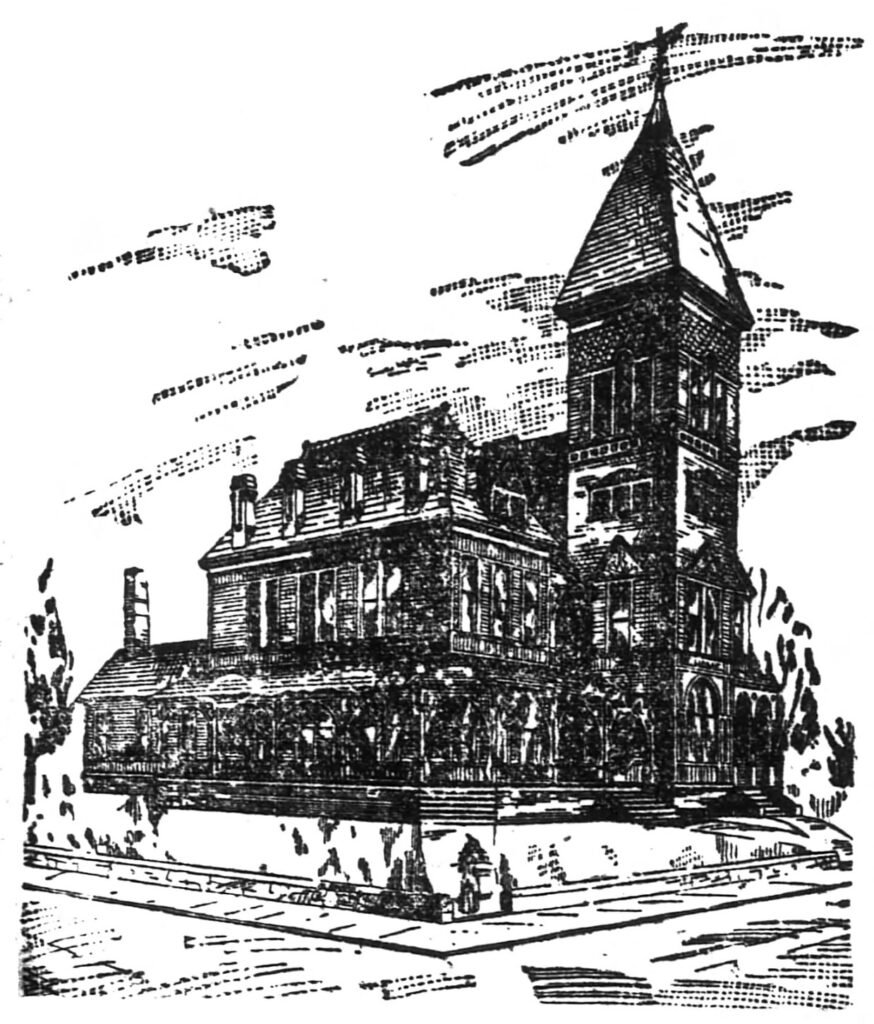
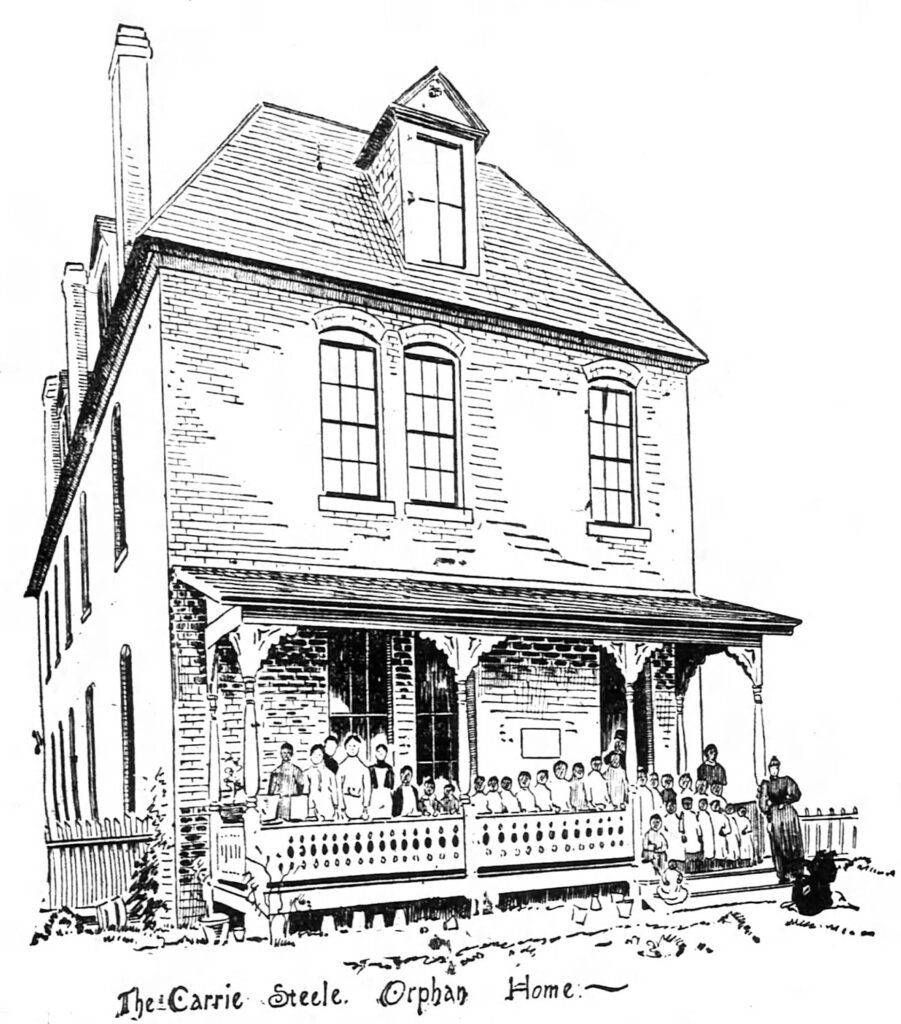
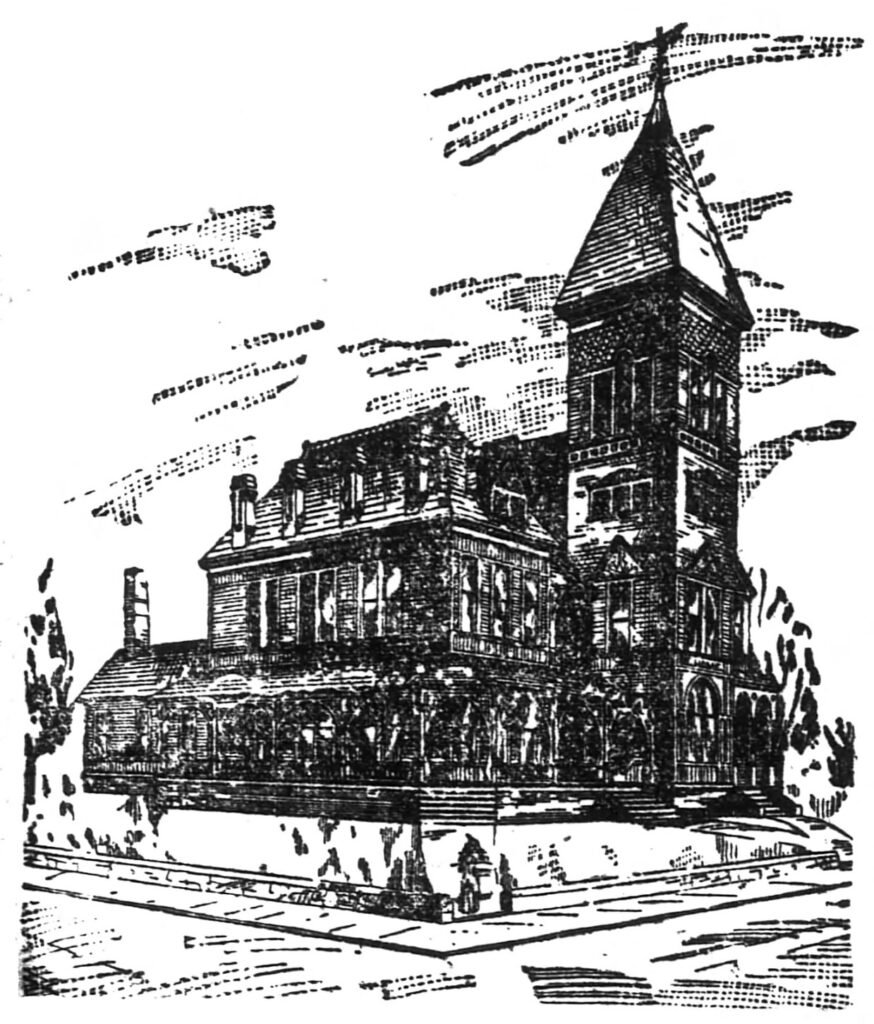
The building, which, when completed, will look like the accompanying cut, will be a frame structure built in the most substantial manner. The building when finished which will contain, on the first floor an office and room for matron, with two school rooms, chapel and large dining room, with kitchen and laundry rooms, for teaching kitchen work. The second floor will contain dormitories, bath rooms, and all modern conveniences, and in every way adapted to the purposes for which it is intended. The plans were prepared by Messrs. Bruce & Morgan, and preparations are being made for commencing the work at once.
It is the intention of the projector to start with one wing, and use that for the purposes of the home. Then as the years go by and the home gets well started, the building will be completed.31
References
Illustration credit: “Training The Colored Children”. The Atlanta Constitution, June 7, 1896, p. 3. ↩︎
“The Colored Orphans’ Home.” The Atlanta Constitution, June 9, 1889, p. 3. ↩︎
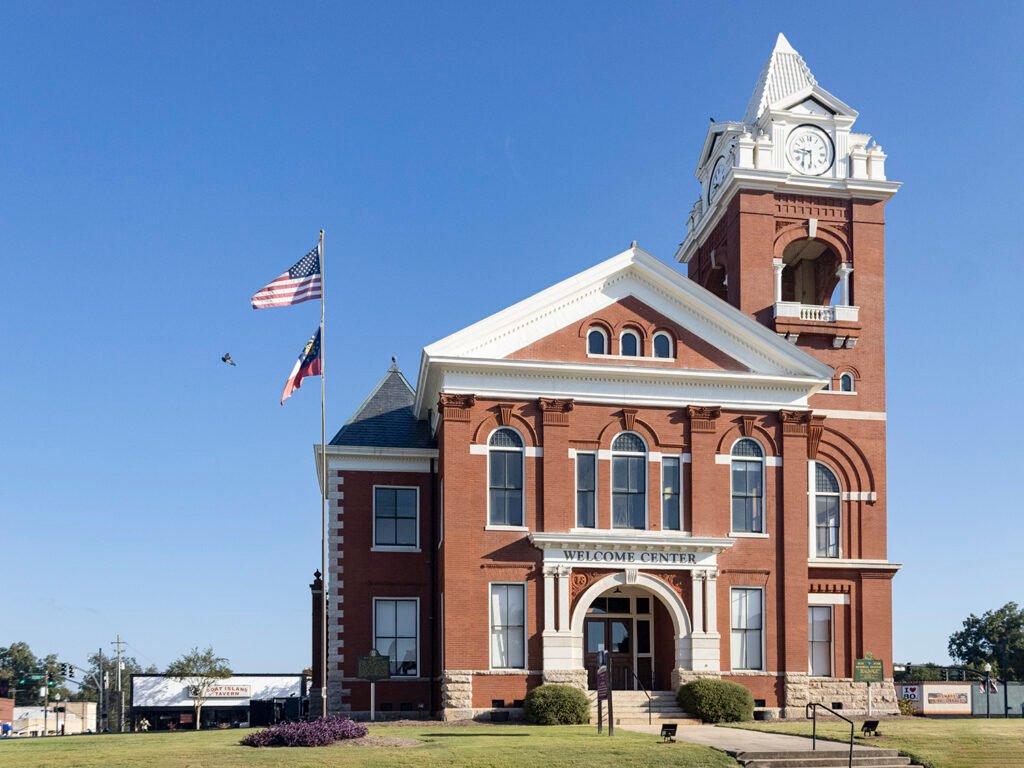
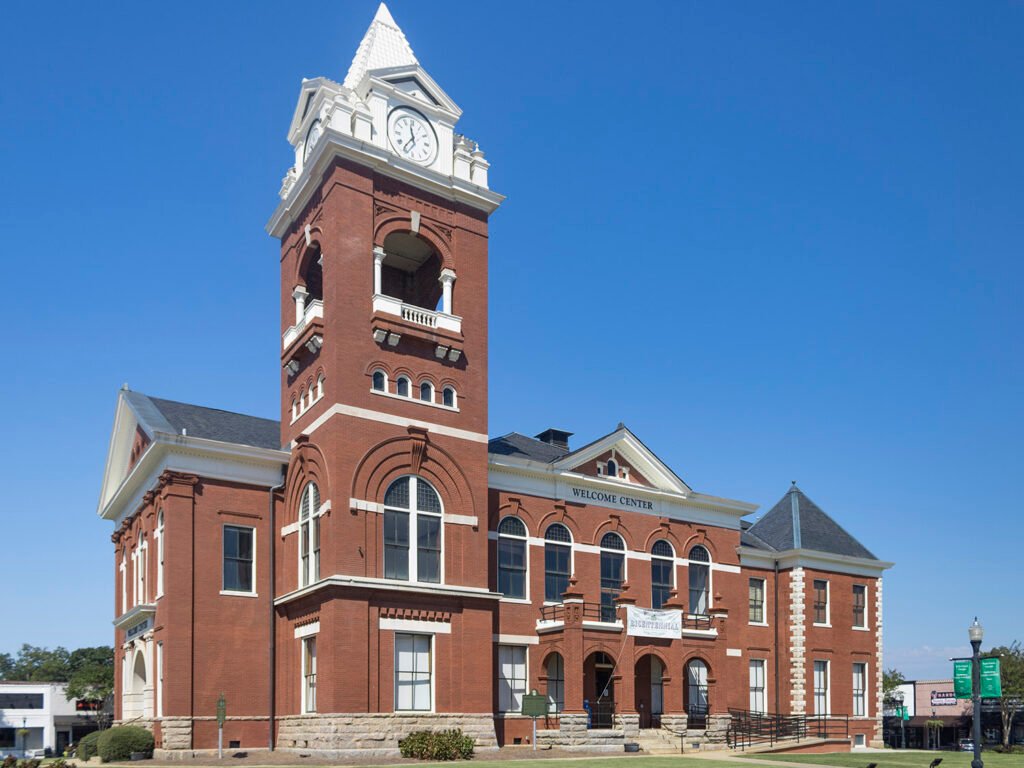
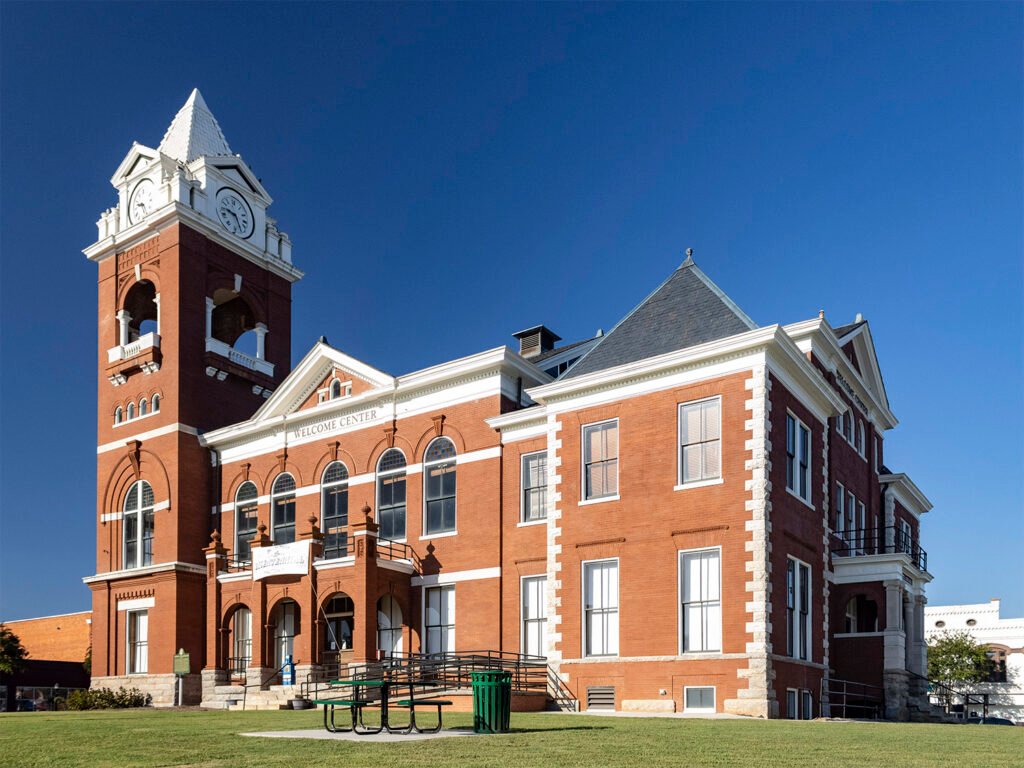
Bruce & Morgan. Butts County Courthouse (1898). Jackson, Georgia.123East elevation of Butts County CourthouseNortheast corner of Butts County Courthouse
References
“Notice to Contractors.” The Atlanta Constitution, June 8, 1897, p. 11. ↩︎
“Butts’ New Courthouse.” The Atlanta Constitution, September 14, 1897, p. 5. ↩︎
A.C. Bruce of Bruce & Morgan. Walnut Street Christian Church (1886-1976). Chattanooga, Tennessee.1
The Background
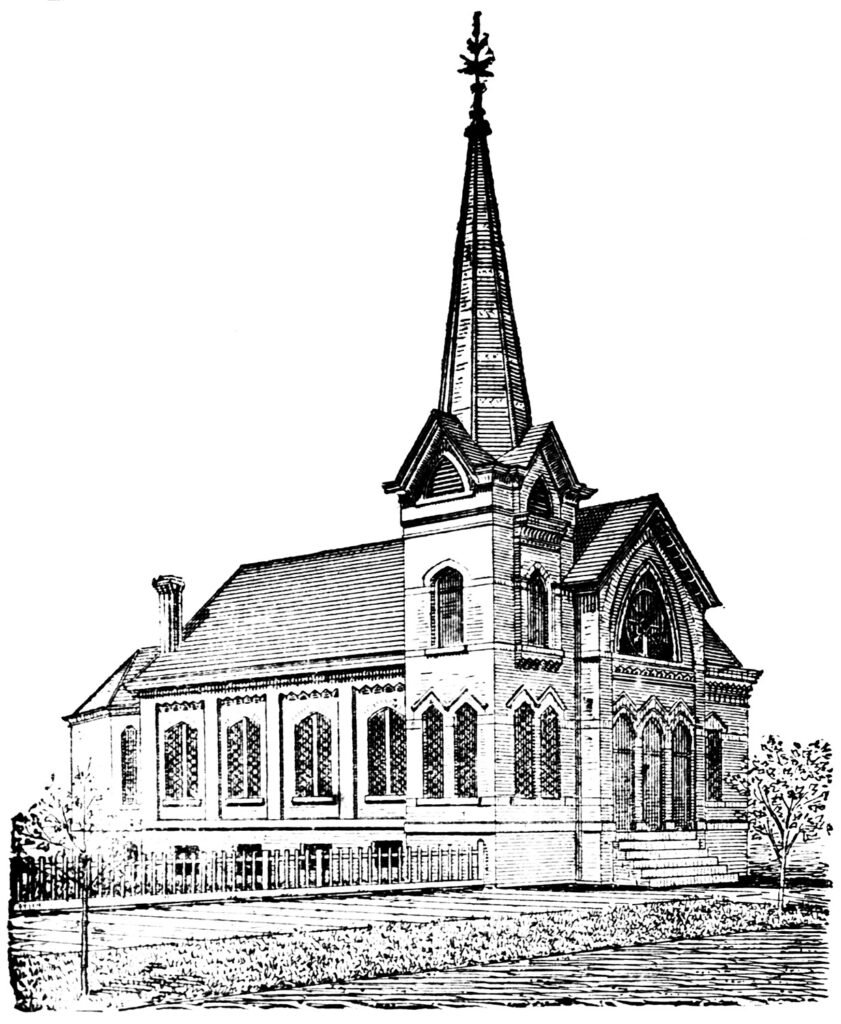
The following article waspublished in TheChattanooga Daily Times and details the plan and construction of the Walnut Street Christian Church in Chattanooga, Tennessee, built in 1886 and designed byA.C. Bruceof Bruce & Morgan. The building was demolished circa 1976.
Bruce was raised in Nashville, Tennessee, and began his practice in Knoxville, Tennessee. When he later partnered with T.H. Morgan in Atlanta, the firm continued to secure considerable work throughout eastern Tennessee, including, as the article notes, Chattanooga’s Hamilton County Courthouse and First Presbyterian Church, both demolished.
Location of Walnut Street Christian Church
The design of the tidy Gothic-style church, shown in the illustration above, is typical of Bruce, who consistently struggled to balance solids and voids in his compositions. Note that the doors and windows appear just a little too large for the overall massing: Bruce frequently drew doors and windows out of scale.
The Walnut Street Christian Church occupied this building until 1910, when the congregation moved half a block to the former First Presbyterian Church, becoming Central Christian Church.23
The old Christian Church building was then sold to the local chapter of the Knights of Pythias organization, who converted it into a meeting hall.4 Based on fire maps, the structure’s original 85-foot-high steeple5 was removed at some point,6 likely during this renovation.
In 1923, the building was sold again to the neighboring Newell Sanitarium,7 which converted it into a 10-room annex circa 1925.8 It appears the former church — altered at least twice — remained at 709 Walnut Street9 until the construction of the neighboring Downtown General Hospital, which opened in July 1976.10 The hospital’s parking lot replaced the building.
I won’t lie: This is a dead-boring article that reads a lot like those Old Testament books with endless lists of names and dry histories — the ones Christians pretend to read, if they read the Bible at all.
To make it easier to find, I’ve highlighted the portion about the building’s design in tasteful lavender. You’re welcome.
The New Christian Church to be Dedicated Today.
Handsome Brick Structure on Walnut Street Between Seventh and Eighth Streets.
History Of The Church.
Its Organization, Struggles, Work and Final Great Success–Full Roster of the Membership
During the winter of 1879, A. Teachout of Cleveland, O., came to this city to spend some months, and being an earnest Christian, he sought out some men and women of his own “faith and order,” and induced them to engage with him in an effort to begin the work in this city which has culminated in their house today, and the happy and memorable occasion which will there be celebrated. Among this little band who were brave enough to make such a beginning, may be mentioned Lucius DeLong and wife, N.P. Nail, R.S. Kendrick and wife, and W.C. Carter and wife.
Arrangements were made by them to invite Dr. W.H. Hopson, of Louisville, Ky., to preach a series of sermons in this city. Accordingly Dr. Hopson came and preached for about a week in the old Southern Methodist church, which stood at the corner of Eighth and Market, where Loveman’s new building stands. Dr. Hopson concluded his services in James Hall. In some respects, this was a notable meeting. Large crowds waited upon the preaching and the immediate results were ten accessions by obedience of the gospel: Bradford Post and wife, Fred H. Phillips, B.H. Ferguson and wife, James Nichols, Mrs. Webb and three others.
Before leaving the city Dr. Hopson effected a temporary organization and A. Teachout was appointed Elder of the church. From the time of organization regular meeting were held in a hall or other place within their reach. The worship of God has therefore been steadily maintained ever since.
THE SUNDAY SCHOOL
was established about 1878. Probably its first Superintendent was Weston F. Burch, of Missouri,–a man of rare worth never to be forgotten by those who knew him. His successors in that office have W.C. Carter, G.B. Woolworth, R. W. Andrews and the present incumbent, D.W. Chase, who has brought the school to unprecedented prosperity.
The school undertook to pay for the eight stained windows in the auditorium and will succeed. The children and the teachers of the school have paid to the building fund about $400 during the past two years besides paying their own current expenses and are ready to be among the first today to make pledge for liquidating the indebtedness. There is also a lively Mission Sunday School under the care of Charles Caldwell and Charles R. McCall, which has started during the last spring, which will bear its share of the responsibility.
THE PREACHERS
who have served the church have been A. Allison, Geo. W. Abell, J.R. Biggs, F.M. Hawkins, Dr. A.G. Thomas, A.S. Johnson, D.T. Beck and T.D. Butler. In a brief history such as this aims to be, many names which are entitled to honorable mention are likely to be overlooked. This is unavoidable and should not be construed by partial friends as intentional.
The local organization of the Christian Womens’ Board of Mission, which has done a large share of the work of raising money for this new house, as it had done for the very eligible lot upon which it stands, is largely due to Mrs. G.B. Woodworth for its establishment and successful management, though no year of its existence has been crowned with such prosperity as the present, under the active and indefatigable Presidency of Mrs. Eva Wilkinson.
The following have served the church as its Elders: A. Teachont [sic], N.P. Nail, B. Post, L.S. Barret, Isaac Strickle and G.B. Woodworth.
The Deacons have been: L. DeLong, Fred H. Phillips, S.J. Graham, Jno. A. Graham, A.B. Phillips, W.T. Lucas, J.R. Hays, R.W. Andrews, B. Post and Geo. B. Woodworth and D.W. Chase.
Up to the 1st of September, 1884, much had been done by this active and devoted people. They had secured the lot they now occupied and nearly paid for it, and they had made an appeal to the Home Missionary Society of the church in America to help them to sustain regular preaching. An arrangement was completed by which their present pastor, T.D. Butler, came among them, and the work at once began to advance vigorously. The new house, which is to be opened today, was started, and a systematic series of operations pursued by which financial help was received. To this end Mr. Butler has traveled much in Tennessee, Kentucky, Ohio, Indiana, Illinois and Missouri, and has raised nearly $2,500 in cash, and has secured loans to the amount of $1,500 on safe and advantageous terms. In addition to this, the spiritual needs of the church have been amply supplied, and more than a hundred members added to the membership. The lot furnishes only a narrow margin beyond the walls, but the house stands 75×50 feet, with a first-class basement. Here are two rows of graceful iron columns, supported by a substantial footing of stone, and thes [sic] in turn adequately support the floor of the auditorium. We reach the main room by spacious steps, which lead into a vestibule of ample size, having a door on the right which opens into the pastor’s room–as on the left you pass into the gallery above, which has a capacity of nearly 100 people–or below into the commodious school and prayer meeting room. The auditorium is furnished with neat pews from the Excelsior Furniture Co., Cincinnati, O., and cathedral glass windows from the Robert Mitchell Furniture House, Cincinnati. Beneath the rostrum is a baptistery [sic], with all the modern appliances, and on either side are the robing rooms to be used by candidates for baptism and for other purposes. On the whole this is one of the neatest, best furnished and most convenient churches in the city.
The plans and specifications for this church were generously donated by A.C. Bruce, Esq., of Bruce & Morgan, Architects, Atlanta, Ga.–the architect of the court house and the First Presbyterian church.
THE CONTRACTORS.
Stone work, Trout & Coxon; brick work, J.F. Wright; slate and galvanized iron, J.C. Banks & Co.; roof and tower, R.D. Whitice; carpenter work, W.M. Cosby and R.W. Andrews; gas fitters, Lookout Plumbing Company and plumbing by H.A. McQuade.
The building committee has been Isaac Strickle, D.W. Chase, G.B. Woodworth, R.W. Andrews, W.M. Cosby and John A. Graham.
The Trustees are Lucius Delong, President; D.W. Chase, Secretary and Treasurer; Bradford Post, G.B. Woodworth, M.M. Caldwell.
The present organization of the church is: Thomas D. Butler, Pastor; Official Board, G.B. Woodworth, Chairman; B. Post, D.W. Chase, John A. Graham, A. B. Phillips, W.M. Cosby, L. DeLong, G.M. King, J.T. Lynn.
[LIST OF CHURCH MEMBERS — too long and boring to repeat here.]11
References
“The New Christian Church to be Dedicated Today.” The Chattanooga Daily Times (Chattanooga, Tennessee), August 8, 1886, p. 8. ↩︎
“Dr. Boswell In His New Pulpit”. The Chattanooga News (Chattanooga, Tennessee), January 3, 1910, p. 2. ↩︎
“Reasons For Their Faith”. The Chattanooga Daily Times (Chattanooga, Tennessee), January 3, 1910, p. 3. ↩︎
“New Home Of Keystone Lodge”. The Chattanooga News (Chattanooga, Tennessee), January 8, 1910, Magazine Section, p. 4. ↩︎
This is the eighth in a series of articles published by The Atlanta Journal in 1898 featuring illustrations and floor plans of residences designed by Atlanta architects.
Here, the Journal highlighted a “model cottage” owned by W.D. Grant and designed by Bruce & Morgan. Grant was one of Atlanta’s wealthiest citizens, having amassed a fortune in railroad building before becoming a local real estate tycoon.1
He was also a longtime client of Bruce & Morgan, and the firm designed multiple projects for Grant’s family and companies, starting with a block of stores in 18822 and culminating in 1899 with one of Atlanta’s first skyscrapers — the 10-story Grant Building3 — which still stands.
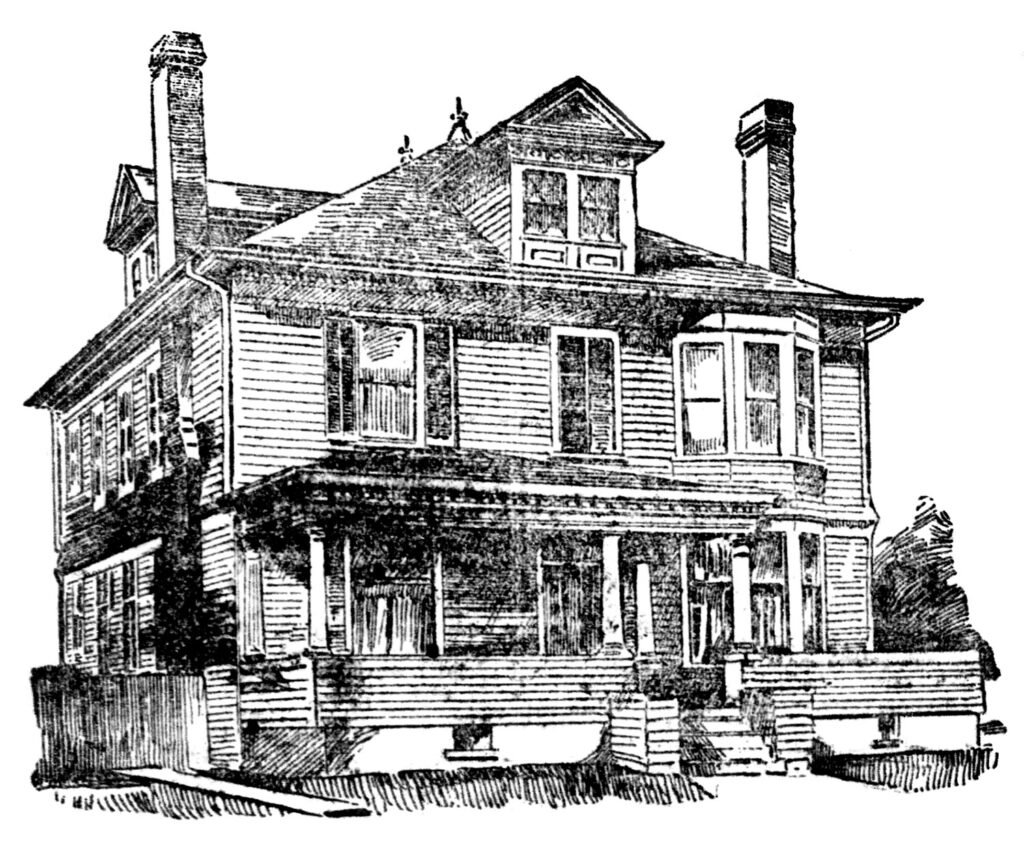
The 2-story cottage shown here was much more modest in scope, but one of 7 apparently identical residences that Grant commissioned the firm to design for various locations around the city, presumably as rental properties.
The home’s appearance was a simple but attractive expression of the Colonial style, with classical columns, dentilled cornices, a stringcourse between the floors, and a hip roof topped with dormer windows and decorative finials.
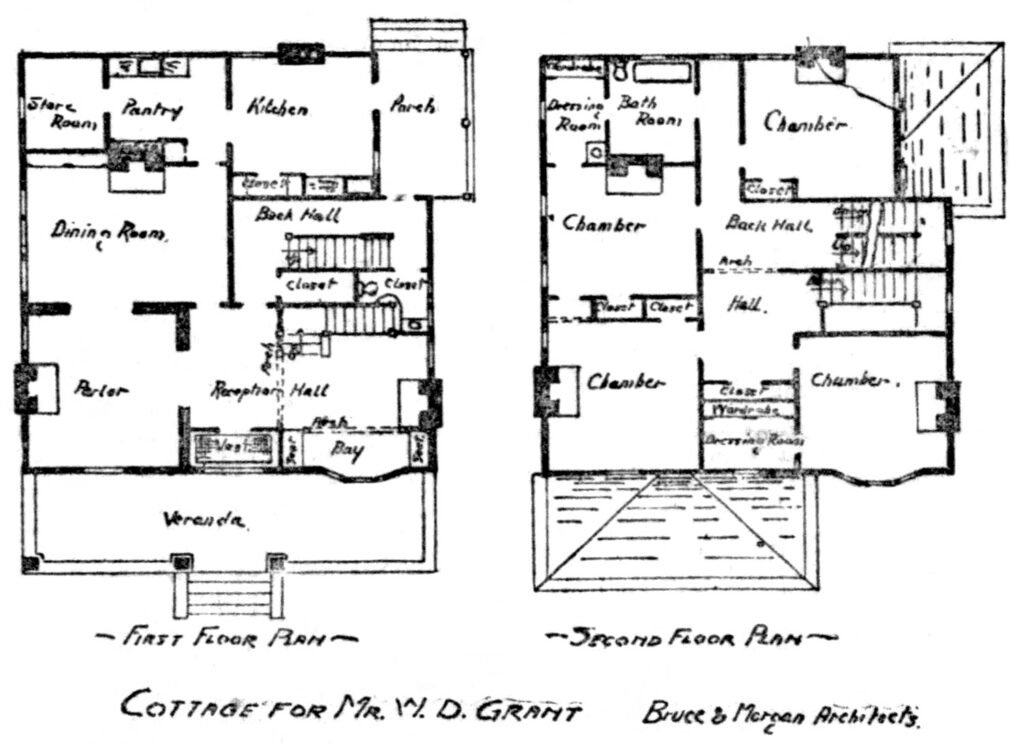
The floor plan was based on a simple 4-square grid and managed to pack in a reception hall, parlor, dining room, kitchen, 3 bedrooms, one full bath on the second floor, and a half-bath on the ground floor.
A few interesting aspects of the plan are the front and back stairs separated by a shared wall, the lavatory tucked beneath the back stairs — also seen in the plan for the James F.Meegan Residence — and the built-in seating and shelves in the reception hall.
The design fits in well with Bruce & Morgan’s other work: never especially exciting or innovative, but consistently thoughtful and competently executed, particularly given the partners’ lack of formal training.
Based on the location details provided in the article, none of the 7 cottages from this plan survives.
Journal Model Houses; One of Captain Grant’s Cottages
The accompanying illustration and plans show the exterior appearance and reveal the interior arrangement of a model cottage, which is one of a number recently constructed by Captain W.D. Grant. The plans were drawn by Bruce & Morgan. The cost to construct and fit out with mantels, tiling, plumbing, etc., was $3,500.
Captain Grant built five of the cottages on Piedmont avenue, one on Currier street, and now has another in process of erection on Courtland near Pine.
The exterior presents a well proportioned and substantial building, which is nevertheless attractive in its architectural effect.
The first floor has a spacious veranda connected by a vestibule with the reception hall.
The second story has four bed chambers, dressing rooms, closets and a bath room.
The fixtures, as well as the architectural style, are of the most improved plain. The plumbing is of the best, while the handsome mantels, tiling and stained glass windows add much to the beauty of the residence. The house provided with both gas and electric lights.
The plans will be received with favor by those who are contemplating building houses.4
References
“Funeral of Captain Grant To Occur This Afternoon”. The Atlanta Constitution, November 8, 1901, p. 5. ↩︎
“Architecture.” The Atlanta Constitution, September 23, 1882, p. 9. ↩︎
“Georgia Marble in the Prudential”. The Atlanta Journal, May 10, 1899, p. 10. ↩︎
“Journal Model Houses; One of Captain Grant’s Cottages”. The Atlanta Journal, April 23, 1898, p. 4. ↩︎