The Background
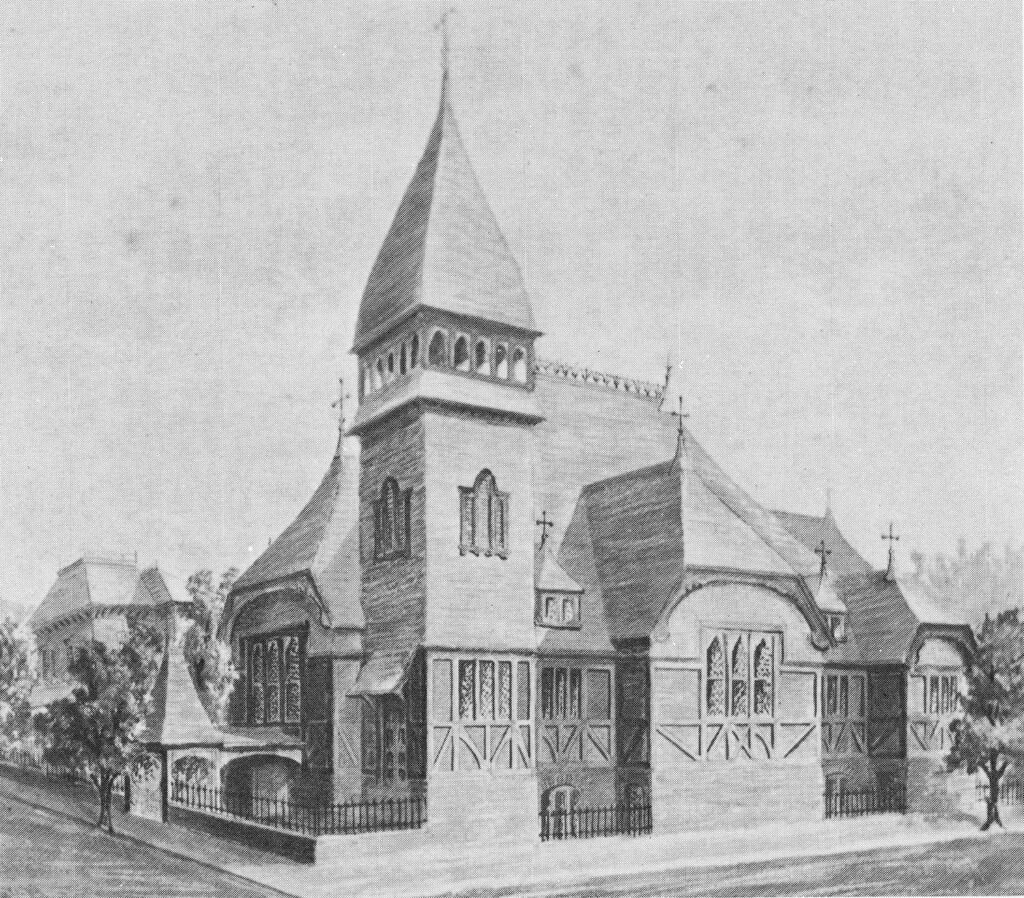
The following article was published in The Atlanta Constitution in February 1883, and celebrated the completion of one of the first major works by G.L. Norrman (1848-1909) in Atlanta: St. Luke’s Cathedral.
Although the project was credited to the firm of Humphries & Norrman, it appears Norrman was the primary designer — the illustration included with the article is even signed in his handwriting.
St. Luke’s Episcopal Church was founded in 1864, with its first building destroyed by the Union army in the burning of Atlanta.2 The church’s second structure was located at the southeast corner of Spring and Walton Streets,3 but in 1882, the congregation was forced to sell the property after it failed to pay for furnishings from a local store owner, who in turn sued the church and won.4 Pay for your pews, damn it.
Humphries & Norrman began working on plans for a new building in July 1882, although it wasn’t clear if the project would even be executed, as the church also considered moving its old structure to their new property5 at the northeast corner of Houston and Pryor Streets, just off Peachtree Street.
Location of St. Luke’s Cathedral
The plans were ultimately accepted, and construction on the sanctuary was rapid — about 4 months. Building had “begun only a few weeks ago” when the cornerstone was laid on October 21, 1882,6 and the first service was held in the church’s basement on Christmas Day 1882,7 although the interiors were completed in February 1883.
The article below describes the building’s interior in exacting detail, but doesn’t say anything about its exterior, which was clad in brick and topped with a 60-foot-high steeple.8 The final cost of the project was just $5,500.9
When the church was constructed, it was barely within the city limits and towered over the one and two-story homes around it.
Within ten years, Atlanta’s ever-expanding commercial district engulfed the building, and in 1892, when the church lost its cathedral designation to nearby St. Philip’s,10 the St. Luke’s sanctuary was overshadowed by the rise of its new next-door neighbor: DeGive’s Grand Opera House, a 7-story entertainment palace.
One year later, Atlanta’s first “flatiron” structure, the 3-story commercial Peck Building, designed by G.L. Norrman, was erected on a sliver of land across from St. Luke’s entrance, blocking the church’s exposure to Peachtree Street.
In 1906, only twenty-three years after the sanctuary’s completion, St. Luke’s sold out to DeGive,11 and the congregation moved further up Peachtree Street into a new building designed by P. Thornton Marye,12 13 which still stands.
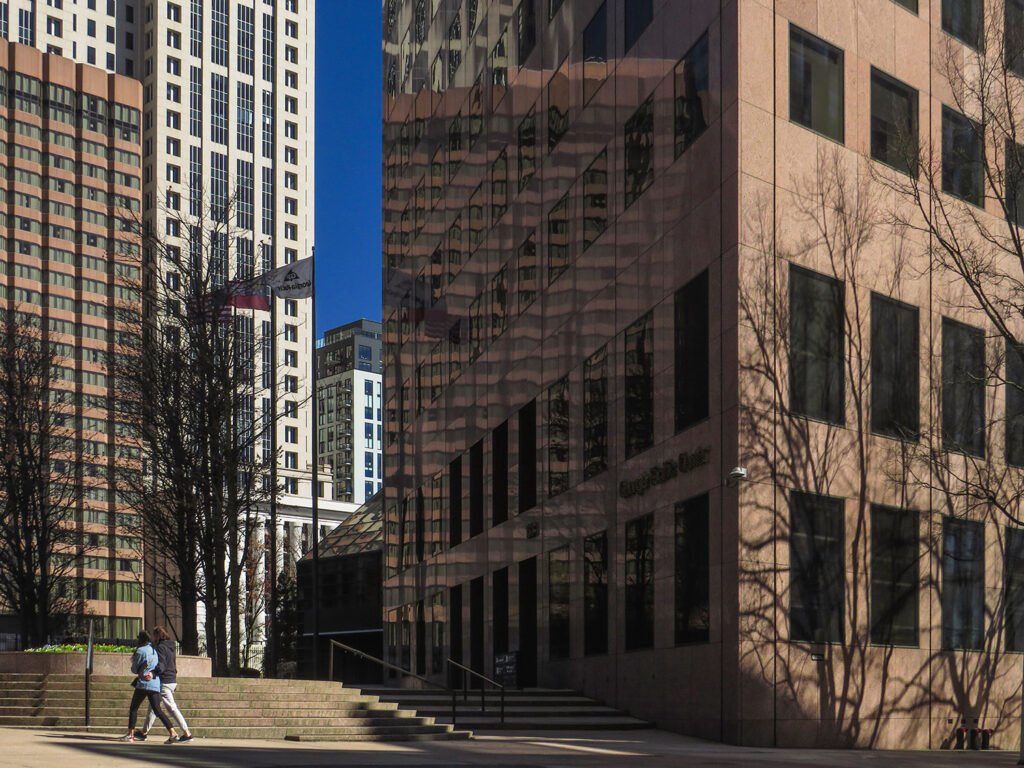
The old St. Luke’s was demolished in October 1906, with materials from the structure salvaged to build a home on Gilmer Street,14 also long since destroyed. The former church property was replaced with a block of single-level stores15 and is now the site of the Georgia-Pacific Center in Downtown Atlanta.
After the sanctuary was demolished, “M.S” commented on the church’s move in the “Women and Society” column of The Atlanta Journal:
In olden times if a congregation wished to build a new church and leave the old building for the new it was looked upon by other congregations with distress and disapproval, and the next thing to giving up their religion itself. This no doubt was only sentiment; but it seems to me if we of this day would cultivate a little more of the true sentiment and love for the pure and beautiful and less of the worldlier sentimental we would live sweeter and more wholesome lives, nearer in a true sense to one another, to nature and to nature’s God.16
Bitch, please, this is Atlanta.
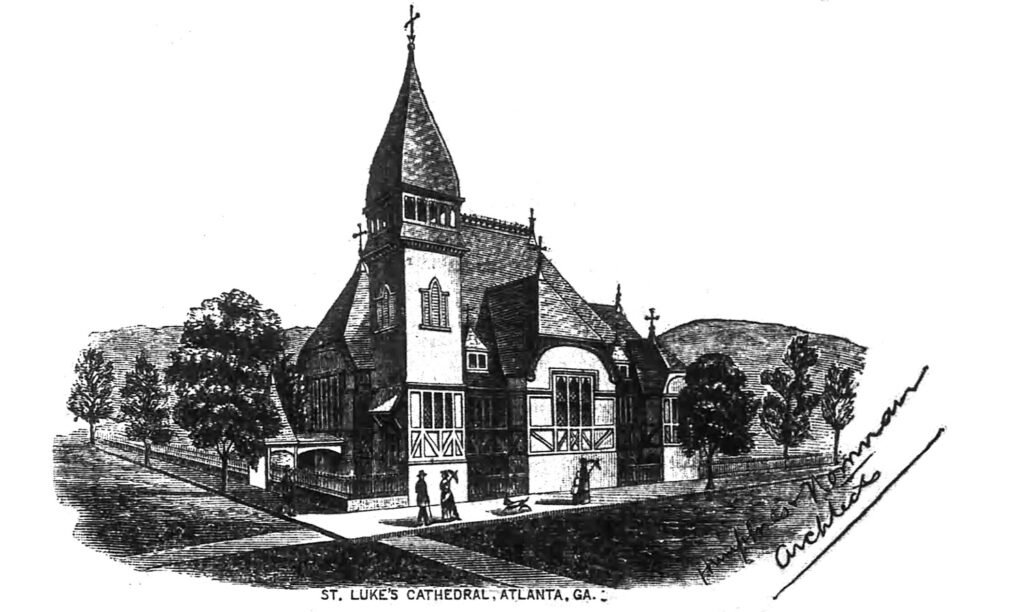
St. Luke’s Cathedral.
Was yesterday finished and will be opened to-day to the public, and is one of the handsomest churches in the city.
It is located on the corner of Houston and Pryor street, facing Peachtree. The plans were drawn by Messrs. Humphreys and Norman [sic], architects. Under their personal supervision it has been built and they have reason to feel proud of it. The contractors, Messrs. Oliver and Carey, and their foreman, Mr. Edward Edge, deserve much credit for the construction. It is of the old English architecture and is much admired. The interior finish in ceiling is Georgia pine left in its natural color, all other woodwork walnut, except the pews which are ash ends and poplar seats and backs, all upright walls are plastered and will be frescoed by Messrs. Sheriden & Bro.
The chancel furniture is being made the Gate City Planing company and will be finished within two weeks and will consist of the bishop’s chair with canopy, altar table with eight foot arch, credance table, two priest’s chairs, two priest’s stalls and kneeling desks, pulpit, two lectern, all walnut except the credence tables, which is made of Virginia pine from the old Blankford church, near Petersburg, Virginia, built in colonial days over one hundred fifty years ago.
The chancel will be enclosed with a brass rail now being made in New York.
The church will be lighted with gas, having one large 20 light chandelier and 12 two light brackets. The organ will be a very fine one and built by Messrs. Pilcher & Co., of Louisville, Ky. Negotiations are now progressing for its constrnction [sic]. The font will be of Tennessee marble and be located at the intersection of the aisles in the body of the church.
A cathedral is the principal church in a diocese and is where the bishop presides and has a seat is the center of his authority.
Atlanta is the residence of the bishop of Georgia and St. Luke’s has been built for the bishop as the cathedral
Space forbids a more detailed description of the new church. The following sessions will be held therein commencing this morning at seven o’clock and continue during Lent:
The Rev. Mr. Beckwith will preach to-day at 11 o’clock, and the Rev. Mr. Williams this evening at 7:30 o’clock.17
References
- Illustration credit: Lyon, Elizabeth A. Atlanta Architecture: The Victorian Heritage, 1837-1918. The Atlanta Historical Society (1976), p. 43. ↩︎
- “St. Luke’s Church Now For Sale By Owner”. The Atlanta Journal, July 29, 1906, p. 12. ↩︎
- “Auction Sale of Central Property.” The Atlanta Constitution, August 6, 1882, p. 3. ↩︎
- “A Verdict Against a Church.” The Atlanta Constitution, June 22, 1882, p. 4. ↩︎
- “Real Estate and Industrial Notes.” The Atlanta Constitution, July 28, 1882, p. 7. ↩︎
- “The Corner-Stone”. The Atlanta Constitution, October 22, 1882, p. 6. ↩︎
- “St. Luke Episcopal Church To Build At Once”. The Atlanta Journal, March 9, 1906, p. 7. ↩︎
- Atlanta, Georgia, 1886 / published by the Sanborn Map and Publishing Co Limited ↩︎
- “The Building Outlook.” The Atlanta Constitution, February 1, 1883, p. 7. ↩︎
- “St. Luke Episcopal Church To Build At Once”. The Atlanta Journal, March 9, 1906, p. 7. ↩︎
- “Big Apartment House On St. Luke’s Site”. The Atlanta Journal, August 1, 1906, p. 15. ↩︎
- “Plans Of New St. Luke Church Completed By Architect Marye”. The Atlanta Constitution, January 12, 1906, p. 3. ↩︎
- “St. Luke Episcopal Church To Build At Once”. The Atlanta Journal, March 9, 1906, p. 7. ↩︎
- “Tearing Down Old Landmark”. The Atlanta Constitution, October 12, 1906, p. 11. ↩︎
- Insurance maps, Atlanta, Georgia, 1911 / published by the Sanborn Map Company ↩︎
- M.S. “The Passing of Old St. Luke’”. The Atlanta Journal, November 11, 1906, p. 6S. ↩︎
- “St. Luke’s Cathedral”. The Atlanta Constitution, February 11, 1883, p. 9. ↩︎