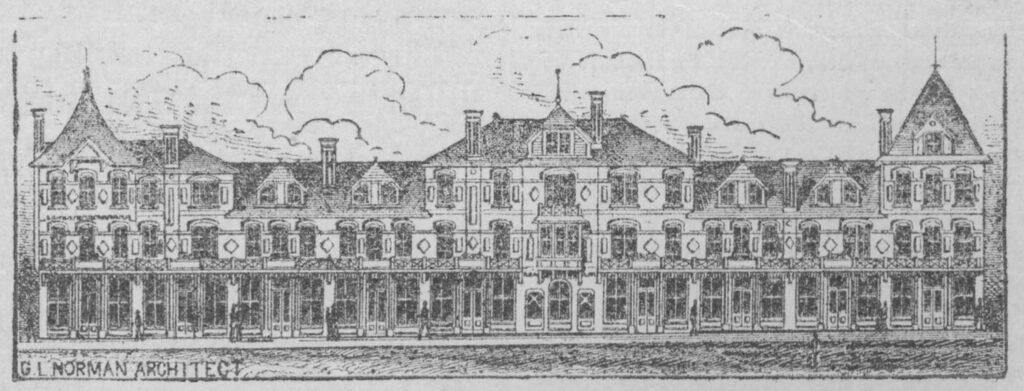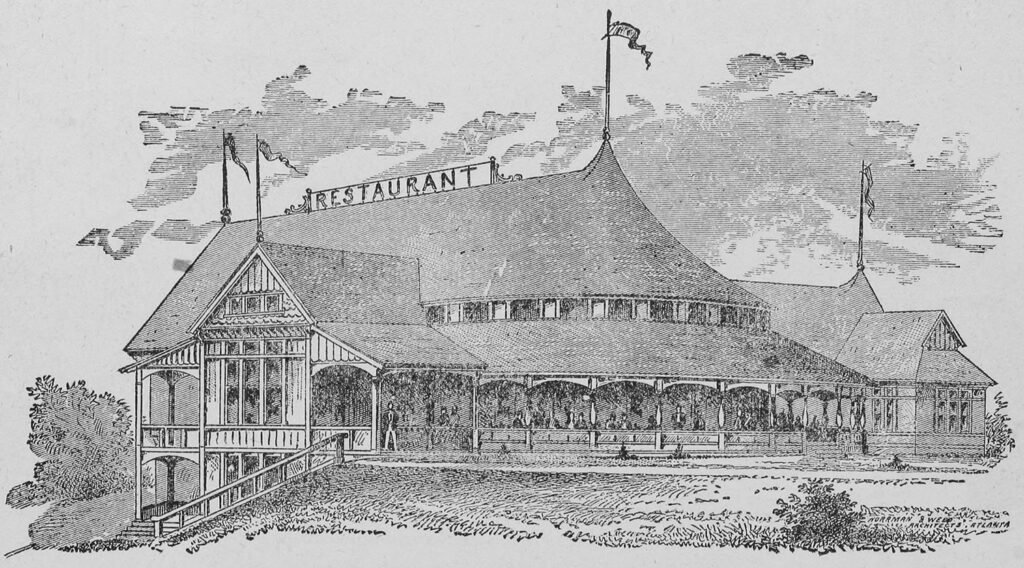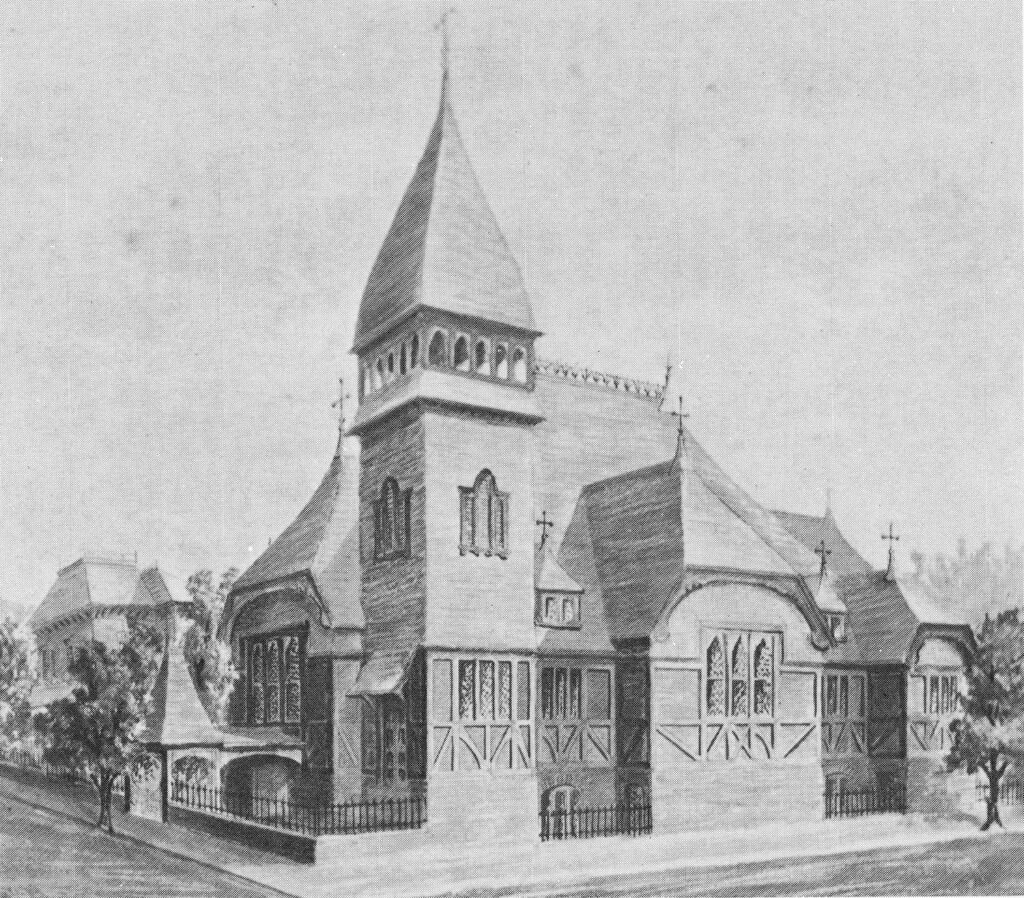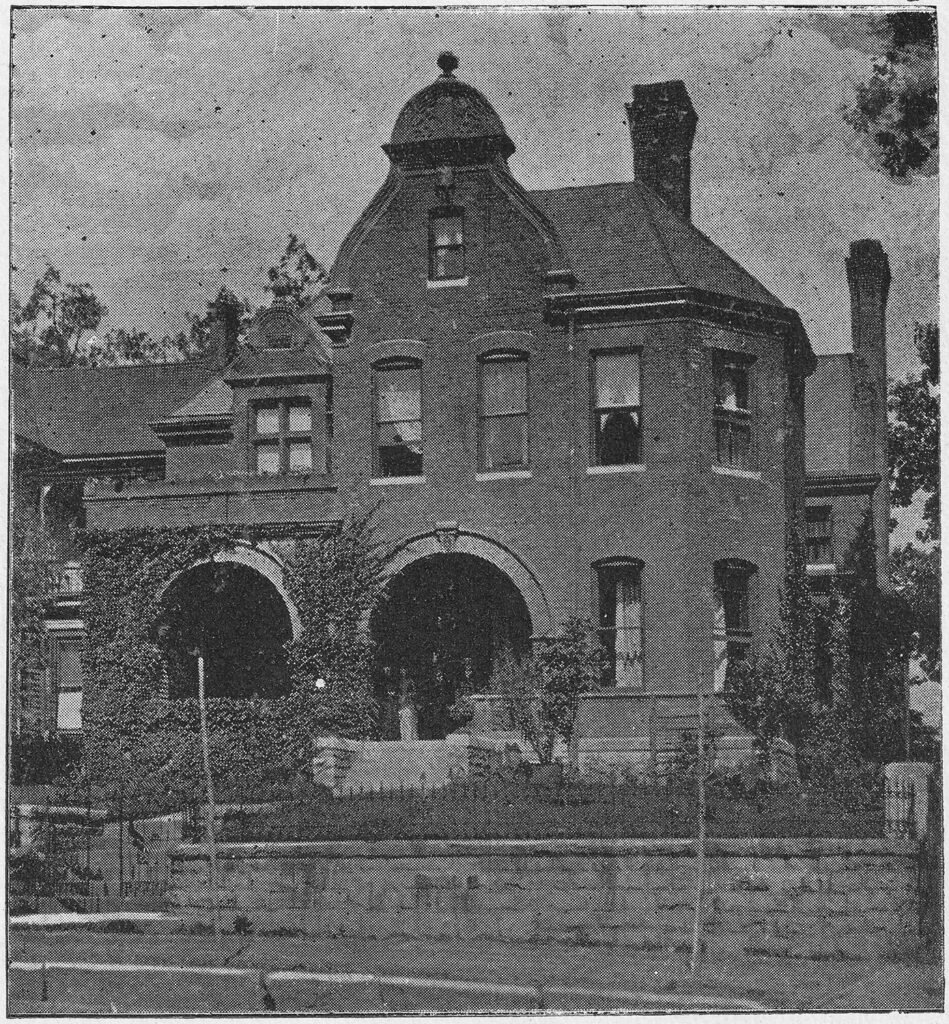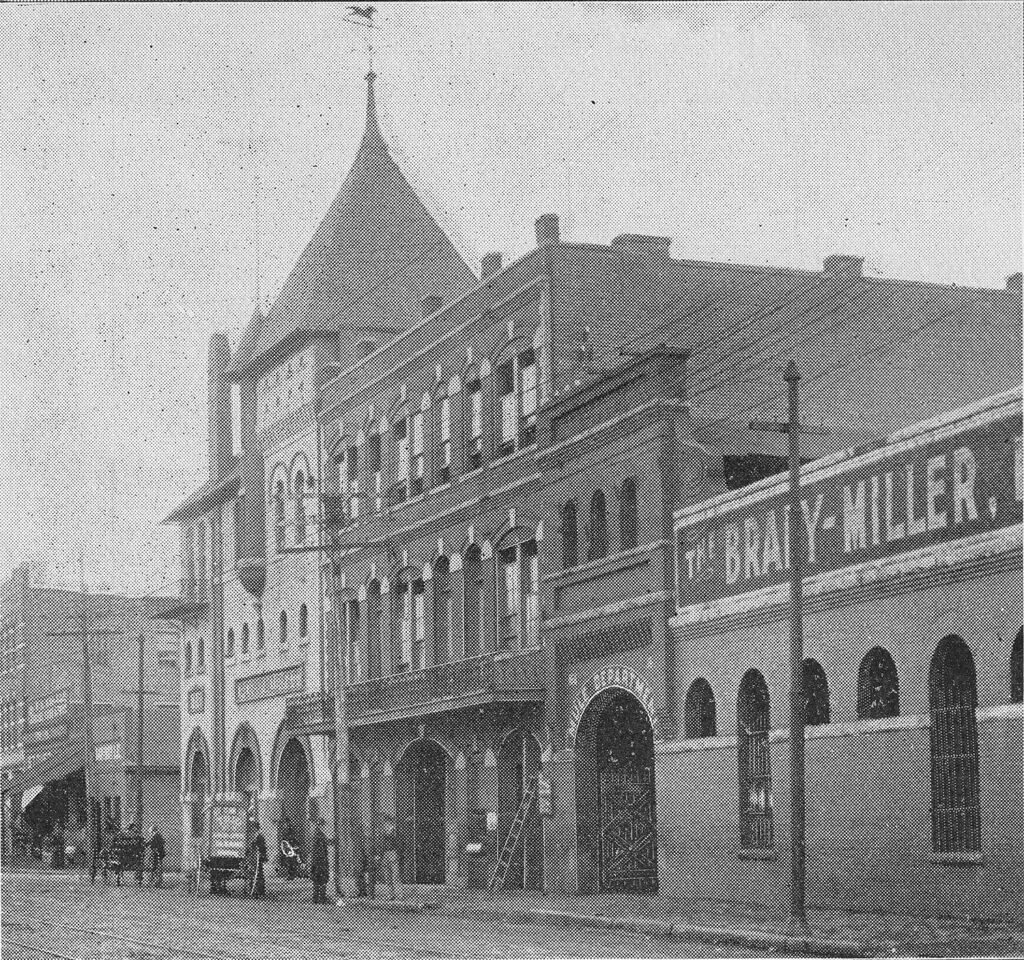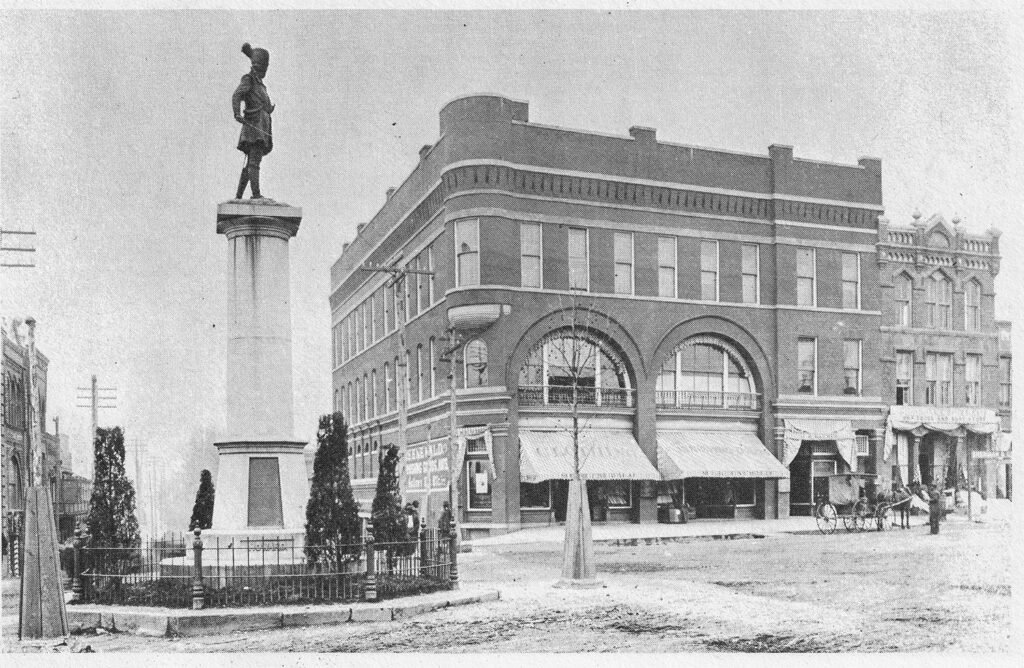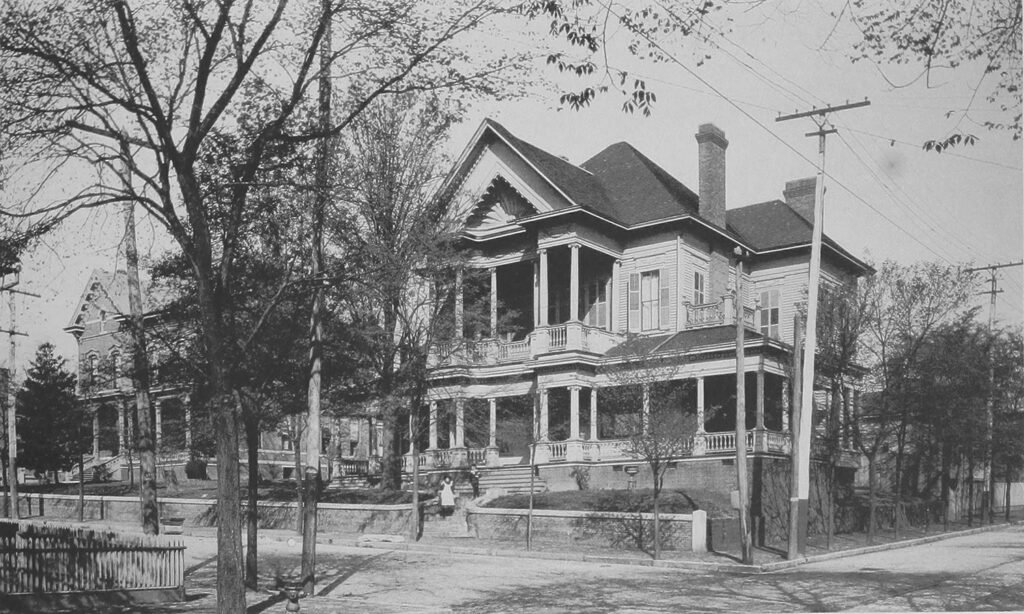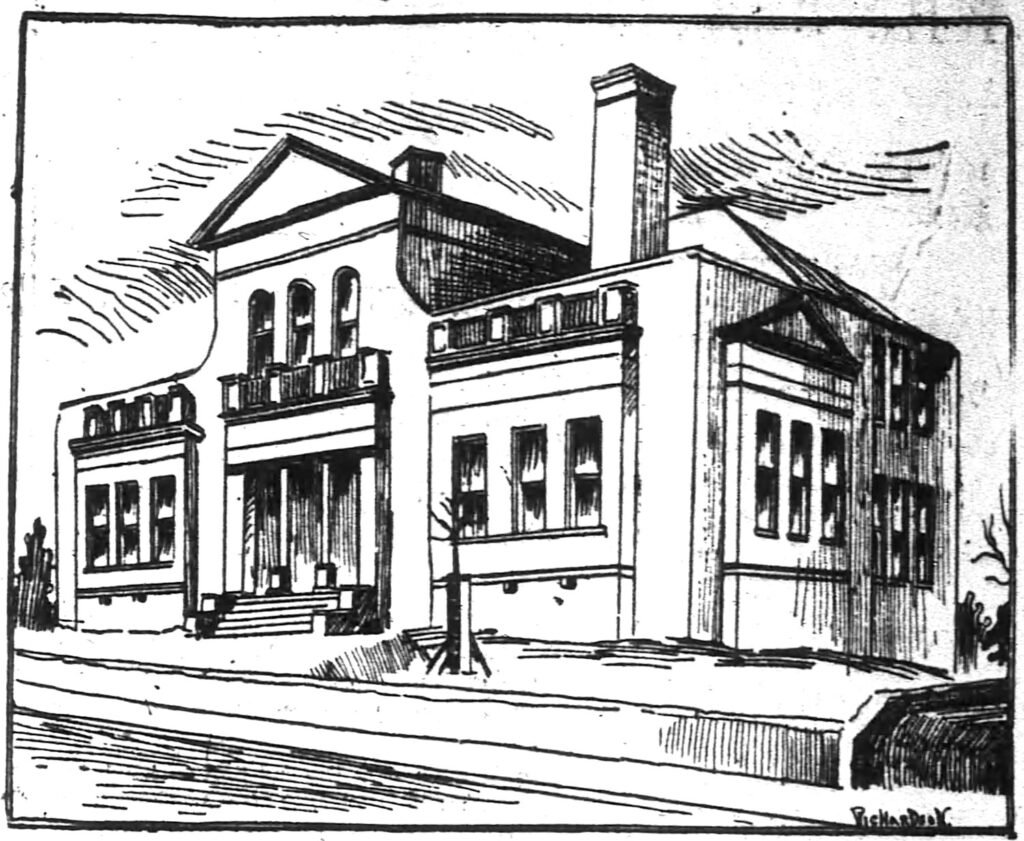
Category: Architects of Atlanta and the Southeast

  • “Catherine Romeyn, Or The Bride’s Forgiveness” (1890) by W.W. Goodrich

    The Background

    This is the eleventh in a series of articles written for The Atlanta Journal in 1890 and 1891 by W.W. Goodrich, an architect who practiced in Atlanta between 1889 and 1895.

    Ever the delusionist, here Goodrich paints a story of himself as a school boy of Dutch descent. The story is set in the town of Kingston, New York, where Goodrich may have been raised, and practiced architecture from 18751 to 1878.2 In this story, Goodrich makes extensive use of place names from that area of Upstate New York. Fox Hall Road, for instance, still exists in Kingston as Foxhall Avenue.

    It is incredibly hard to nail down any firm details of Goodrich’s early life, but it appears that his family was from Kingston, while census records show a person of his name and birthdate living in different households in Harmony, New York, near Pennsylvania, in 1850,3 and New York City in 1860.4

    Goodrich uses his fictionalized reminiscence as a framing device for another tale — one just as terrible as any of his other stories, although it is notable for its unusually progressive central character: Catherine, a “brave, self-conscious and noble woman” who steers her fiancé’s sloop down the Hudson River on New Year’s Eve, racing past her bitterly jealous ex-suitor.

    For reasons unclear, Catherine’s ex-suitor sheds his anger upon being overtaken by her sloop and later asks forgiveness for his surly behavior. Having tasted independence by steering the ship, Catherine promptly goes to church and marries her fiancé at midnight. This was, after all, the 19th century.

    Goodrich was no doubt pleased to impress his readers with an arsenal of nautical terms: jib, belay, topsail, mainsail, and the like. The best of the bunch is — inarguably — lee scuppers. Look up the definition yourself.

    Goodrich seems to have had an affinity for the name Catherine — it may have been the name of his mother.5 In 1901, he wrote a poem called Cathrine, about a young girl of Scottish — not Dutch – descent. The poem was published in multiple newspapers across the country. A representative passage follows:

    “This little Miss, we’ve named her a dear,
    Old fashioned-name;
    ‘Tis sweet to call her Cathrine, for with
    her
    The fairies came.”6

    It isn’t very good.


    Catherine Romeyn,

    OR

    The Bride’s Forgiveness.

    A New Year’s Story of the Hudson River.

    Written for the Journal.

    On Fox Hall road, in Kingston, was a gothic church, whose pointed spire towering to the ethereal blue, that canopied the Katterskills, as well as the noble river of Hendrik Hudson, upon which Rip Van Winkle first looked when he opened his eyes from his long sleep. Upon the apex of the spire was the cross of the infinite Saviour, its golden letters “In Hoc Signo Vinces” assuring the observer that the Saviour was, and always will be, the divine mediator between finite and infinite.

    Dominee Fort ascended his pulpit, as the old chapel bell began to toll, its peal of silvery notes rang out upon the evening air, calling the old and young to witness that the scythe of Father time was speedily weakening in its efforts of destruction, and its arduous uses of, and during the first closing year were at the end. At midnight of each closing year, and at the first moments of the new, was always a marriage, most solemnly solemnized by the church and its communicants.

    Dominee Fort was a most striking figure, clothed in a long white silk gown, his long white hair and beard of snowy whiteness, falling way down upon his back and chest; with a pair of big, round, gold-rimmed glasses, which he always wore, made him at all times a figure awe-inspiring to the Knickerbocker youngsters. And we were no exception, although we had frequently been to New Amsterdam and did not think we were so green as the boys show had not yet taken the packet for the ocean’s entreport (New York city). The pulpit was perched up to the underside of the lower chords of the roof truss and could only be reached by a winding staircase at its back. As we look back upon those scenes of our youth, and see this good old man in his box looking down upon us, we can but think of how the back of our necks used to ache, after listening to his sermon of an hour or over, as we had to look up at an angle of forty-five degrees to see the dominee. And if we fell asleep by the way of showing our appreciation of the dominee that we were not afraid of his anathemas, we were sure to get the placky’s striking blows when we got home, and then the dominee would not fare so well in our minds, reasoning as we did that he had no right to talk so long or so loud on subjects that did not interest our youthful minds, nor could we understand.

    How quaintly we were dressed in those times! Long pants, home-made by mamma and home-spun caps with big ear-laps and sole-leather fronts; coats that would fit older and larger boys; home-made, that had done service to our elders; shoes with wooden soles and leather strings, worn only to church and Sabbath-school; as soon as boys could go alone, put in pants (either side was front), and long ones at that. And back in the Catskills to this day the old Holland people still adhere to the days of 1850.

    The business on the Hudson river was done by sailing vessels, mostly by sloops of one hundred tons. With their big jibs, flying jibs, main sail and top sail, they presented a dashing appearances that was exhilarating to the well wishes of each skipper’s admirers.

    The Addison had just been launched. As she left the ways, full rigged, for her trial trip, her skipper, Hans Van Schoonovan, with his affianced bride, stood on the knight heads. Catharine Romeyn, a proud Knickerbocker beauty, a stately brunette with true Dutch accent, christened the vessel the Addison by breaking a bottle of old Holland gin over her bow spirit. As she floated upon Esopus creek at Roundout, the ebb-tide just making, the skipper ordered the sailors to raise the jib, while Miss Romeyn took the wheel. “Clear away the mainsail! Hoist away! Belay all!” were the rapid orders of Hans, as the Addison made headway. She rapidly showed her heels. “Shake out the topsail! Run up the flying jib, belay all,” and sailed out Rondout creek. Miss Romeyn as “wheelsman and sailing master”, she kept her in the wind’s eye. As she turned the light house entering the Hudson river the crack sloops were in waiting to give her a brush to test her speed. Now, Hans had an enemy who had been an aspirant for the hand and heart of his affianced, who was the skipper and sailed the Hudson as her sailing master. She had been and was the crack sloop of the river, and her skipper, William Deitrich never forgot Hans for capturing the hand of Catharine Romeyn. As the two vessels came in stays, and Deitrich saw Kate at the wheel, he was furious at her audacity. Shaking out his kites he ordered a chase, the wind sou! sou! east! blowing twenty knots. The barometer was falling, and as the vessel rounded Esopus light, each staggering under full sail, the water rising in the lee scuppers. Hans ordered his hatches battered and his cabin locked. “We’ll see who is fastest;” taking one of his new brooms he ran it to the top mast-head, and closer hauled his sheets. Great white caps came bows on, the Addison rose on the crest of the waves like a duck, the Hudson fast falling behind in the wake of the Addison, buried her nose under each swell, this new greyhound of the Hudson, as she passed Hyde park, was the object of all eyes, as Deitrich had said in his braggadocia that he could not be beaten nor outsailed, and yet, here was a girl not twenty, sailing-master of her future husband’s vessel, she was keel hauling his vessel out of sight. Plucky girl! And there are thousands more like you when danger threatens, who can handle the wheel in all its watches with an expertness and dexterity that becomes a brave, self-conscious and noble woman. Poughkeepsie was soon passed, Newburg bay broadening out towards the highlands was entered. As Kate swept by the deck at Newburg the steamboats of that time rang their bells and whistled the brave girl a ringing salute, the Norwich giving chase under full steam. Sweeping close to Cornwall and tacking ship, she laid her course for New Hamburg. Dietrich, had tacked at Poughkeepsie and was sailing home, sadly and badly disappointed. Kate soon overhauled him a Esopus light bound up, the Addison prancing along like a race horse was a thing of life, and Kate was a sweet bareheaded girl. The thrill of joy could be seen in her eyes, her rosy cheeks kissed by the spray, her long trailing tresses flying in the winds, made her an object that excited the admiration of all the tars, and as she flew by them, her nostrils dilated, her grip on the wheel only intensified, she was the very personification of beauty, health and quiet determination – brave beautiful Kate. Deitrich dropped his colors and hauled down his broom that he had had at his mast head for years and as Kate swept by she waved her apron at him, crossed his bow and smiled. And Deitrich! He cried! Kate’s smile had melted his enmity towards her Hans, thereafter they were warm friends.

    Hans and Kate walked up the aisle, Kate between the elder and Hans between the deacons as the bell tolled twelve o’clock midnight. Ring out the old-ring in the new, chanted the old Dutch preacher. The flickerings of the tallow candles and whale oil lamps, making the gold rim of his glasses glint and shine. He said Hans Van Schoonoven, do you take Catherine Romeyn to be your only wife, and to love cherish, protect and support her, for and during your life? I do. Catharine Romeyn, do you take Hans Van Schoonoven to be your husband and he only to love for his natural life? I do. Has any one in this congregation any reason why these two, this man and woman, should not be united in the holy bonds of matrimony? Slowly there came forward a man, whilst all eyes were instantly upon him. He was William Deitrich. Stepping in front of the elders, he said, in a low, clear voice, with much emotion: “I love Catharine Romeyn. She does not love me. I have hated Hans Van Schoonoven. I am sorry I did so. I was wrong. As the New Year is here, I ask forgiveness of Hans and of his future bride. I know they will as fully forgive me as I have been in the wrong, nay more, they will never remember it against me. Dominee Fort at this frank confession asked the couple to signify their wishes. Hans quickly forgave with a firm grasp of the hand, and speechless, the tears coursing down his cheeks, he led Deitrich to Kate. She was too full of joy for utterance, but clasping their hands together, Dietrich blessed them and prayed God Almighty to witness that the future of Hans and Kate should be as the vier’s seins when drawn ashore – full of fish so that the meshes of the net break. Throwing some rice upon the new married couple, Dominee Fort blessed them, telling Kate that, as she was such an expert sailor, she had the ocean of life before her, and by her dexterity and alertness she can sail this life over and enter that future sea of golden beauty with her husband, and whether the barometer was falling or rising hers would be a tranquil life of Christian firmness and lovable charity.

    W.W. Goodrich7

    References

    1. Advertisement. The Daily Freeman (Kingston, New York), October 5, 1875, p. 1. ↩︎
    2. Advertisement. The Daily Freeman (Kingston, New York), December 9, 1878, p. 2. ↩︎
    3. United States Census, 1850, William Goodrich, Harmony, Chautauqua, New York, United States. ↩︎

    4. United States Census, 1860, William Goodrich, 2nd District 7th Ward New York City, New York, New York, United States. ↩︎

    5. “Death of C.E. Goodrich”. The Atlanta Journal, April 22, 1892, p. 5. ↩︎
    6. “Cathrine”. The Buffalo Sunday News (Buffalo, New York), October 13, 1901, p. 1. ↩︎
    7. Goodrich, W.W. “Catherine Romeyn, Or The Bride’s Forgiveness.” The Atlanta Journal, December 31, 1890, p. 2. ↩︎
  • “A Crockery Crate” (1891)

    The Background

    This is the tenth in a series of articles written for The Atlanta Journal in 1890 and 1891 by W.W. Goodrich, an architect who practiced in Atlanta between 1889 and 1895.

    Here, Goodrich revisits his bootblack persona introduced in “The President and the Bootblack”, with a Dickensian tale set in New York City in Christmas 1863.

    Goodrich’s writing is characteristically atrocious, but he at least draws a colorful cast of supporting characters: the grieving Irish-born mother of a dead Union soldier (Goodrich couldn’t resist a stereotyped accent), a rich old bitch decked in furs (“Get out of the way, you dirty little brat”), and a kindly cop who treats him to a Christmas feast (Yeah, this is pure fantasy).

    The Civil War backdrop allows Goodrich to throw in a random reference to Ambrose Burnside, and the description of “brave boys in blue, some with arms and legs shot off” is particularly grim.

    Goodrich was familiar enough with New York to mention the Bowery and the Cooper Union, but his usual embellishment makes the city seem much more bleak than it actually is. Having slept 3 nights on the streets of New York in December, I can assure you — it’s not that bad.

    A flashback dream in the story mentions Rondout, a village in Upstate New York that became part of nearby Kingston, New York, where Goodrich may have been raised and practiced architecture from 18751 to 1878.2

    The dream sequence also reveals that the character’s mother died during his birth — it’s unclear if that particular detail is based on Goodrich’s life, but a traumatic entry into the world and a neglectful childhood could certainly explain his compulsive lying.


    A Crockery Crate.

    A True Story of Christmas.

    Written for the Journal.

    The day before Christmas of ’63 was cold, dreary, generally uncomfortable and disagreeable, a drizzling rain, with slight falls of snow, which was rapidly melted, and at times the sharp driving sleet, penetrating to the skin, chilled and benumbed the thinly clad; and many were the cries of the bootblacks, “Shine, sir!” “Shine, sir!” but whose shines were not wanted, and the newsboys, whose papers were not taken and these boys whose stomachs were empty, and who were thinly clad, whose clothes were in rags, let alone the bare feet and almost bare ones, who had no homes to go to, no friendly voice to ask “howdy,” and with the salutation, a request to go to my home and get the comfort of warmth, good food, warm raiment, and a comfortable bed. All of these good things were unknown to the struggling news boy or boot black at that time, and are, to many, now.

    Clad in a woolen shirt, twice too large for me, that was given me by an Irish woman, who said with the offering, “Smug, take this; me bonnie av a bye is asleep aff Hatteras, this wan he left at home, ye’es welcum; General Burnside will niver have me bye to carry the ould colors agin. Mike was a brave lad, kind to his mither, and win he left me arms it was with a “May the Holy Mither of God be wid ye’es and bring ye home agin, Mike. Sich a bye was me brave bye, Mike.”


    A pair of pants suitable for a person whose avoirdupois [sic] might have been two hundred pounds, a strap for a suspender, in lieu of buttons were nails, an old slouch hat, a boot and a shoe, both of which were out at the toes. Thus equipped, with a twenty-five-cent and a ten-cent shin plaster and nothing to eat the previous night or day, I wandered down Broadway, cold, chilling benumbing cold, hungry, and longing for Kris Kringle to come and find me and take me to his home, which in my youthful imagination I pictured was heaven. Purchasing a broom for thirty cents, I had five cents left for a half loaf of bread which I had partly eaten and divided the balance with a fellow shiner. Sweeping the crossing across Broadway at Spring street in front of the Revere house, brave boys in blue, some with arms and legs shot off, discharged, homeward bound for the Christmas, others on their way to the army, whose term of furlough had expired, still others who had re-enlisted, old veterans, on their way to the front. The stores were gaily decorated and a general air of plenty and contentment possessed the many. No one wanted a shine. Kris Kringle did not come. From down Broadway a portly man and woman richly dressed in furs came to crossing after crossing, but which were not clean enough for them and they south higher up for one; coming to mine, with youthful boyishness I presented arms, as I had seen the soldier boys, as my walk was clean and dry as could be with the storm, when, with this gruff remark from the woman, “Get out of the way, you dirty little brat,” I courtesied [sic] with military salutation their passage over my crossing. A shop girl of a group passing at the time overheard the remark of the rich woman, and, reaching her hand to her pocket, drew out a crumpled five cent shin plaster, said, “Take this, Smug, you look hungry,” but I could not take it. Never a bootblack, nor street sweeper, nor newsboy yet was so ungallant as to take from the tired, careworn and overworked, half starved shop girl or woman, their scanty store. The day had passed, night drew on, the cold, gray clouds became darker and more dismal, the pent up storm, uneasy at being kept in check, suddenly burst, and with snow and rain and chilling sleet drove me off the street and to seek a place of shelter. Hurrying over to the Bowery, up to Fourth Avenue, I found an empty crockery crate on the sidewalk under the shadow of Cooper’s institute. It was but a moment’s exertion, and I was under the straw and had crawled near to the bottom of the crate. Wet, hungry and extremely tired, I was soon asleep.

    Eighteen years before the above date, a lady of noble birth, closely related to the Stuarts of Scotland, eloped with a young man from Edinburgh, Scotland. Her noble parents spurned with contempt the adoration of their daughter’s suitor, for no other reasons save and except that the blood of the royal Stuarts did not flow in his veins. The young man was of honorable parentage. His father had been a poet laureate of Great Britain, and he had met this nobleman’s daughter while accompanying his poet father on visits to the gentleman’s castle. The young couple were of age and loved each other as only those can who are lovers for time and eternity, through prosperity and adversity. A quiet wedding in that city. Ostracised [sic] and disowned. Thrust out upon the world. This tender, but lovable woman, true to her husband and facing the future, entered the new world. He quickly obtained work, tending the pitch pot, turning the grindstone, plugging decks, a down pull in the saw pit, wedging treenails, a handy man about the ship yard at Rondout, New York. A daughter and son came to their home. With the advent of the son the mother’s life departed, even before the babe was clothed the noble mother was dead. The savings of the few years embalmed the mother’s body, and provided a burial case. The sorrowing father, with the daughter and his wife’s remains, returned to the mother’s old home in Scotland, where, by request, he was asked to bring the mother and her offspring should death be her fate before a reconciliation. The boy was left in the New World; his was fate. The daughter lies beside the father and mother in the old Kirk yard at Edinburgh. Requiescat in pace.


    Kris Kringle is coming. The bells ring aloud the joyful sound. The choir is chanting. A pure voice is singing:

    “Jesus, lover of my soul,
    Let me to thy bosom fly;
    While the raging billows roll,
    While the storms of life are nigh.
    Hide him, oh, my Savior hide,
    Till the storms of life are past;
    Sate into this heaven guide,
    Oh receive his soul, my son’s,
    My precious boy’s soul at last.”

    “Mother! Mother! Mother!”

    The struggle woke me up, and as I lay enraptured at the vision it slowly vanished away. I realized that I was a captive, the sleet had frozen over the crate and the snow was several inches deep over which was a crust. I gradually dug a hole in the straw to the side of the crate, and catching the coat of a cop, he saw my hand and dumped the crate over into the street which released me from my snow bound position.

    “Come along wid me, Smug,” laying his hand on my shoulder. Thinking I was off for the stationhouse, with a resigned feeling I complied. On Tenth street he suddenly halted, and pushing me into a restaurant he sang out, “I say Jim, whar is yer?” The proprietor coming to the door, the peeler taking from his pocket a shin plaster of unknown denomination said, “Fill Smug up to the muzzle, for he’s a muzzle loader.” Kris Kringle had come. What a feast. Roast turkey and all that went with the bird as an accompaniment. My eyes could hardly believe this good fortune. But it was a reality, and ample justice was done to the repast.

    Going up town after this meal, the strains of the music still ringing in my ears. Hark! from far away the same sweet strains were in the air. Entering a church of gothic purity, whose vaulted ceiling and chaste harmony enraptured my gaze. “In the gallery you will find a seat,” said the usher. Below, in the highest priced pew, was the lady and her husband, whose abrupt “Get out of the way, you dirty little brat,” instantly attracted my attention, still more fashionably dressed and richly attired. There was no present for the bootblack or newsboy, no one to wish them a merry Christmas. Wealth maketh many friends, but the poor is despised of his neighbor. And as the chimes of the old Trinity still linger in my ear, “Jesus Lover of My Soul,” methinks I can see that “angel mother,” with arms outstretched, ready to welcome her boy to that heavenly home, where is Kris Kringle always.

    W.W. GOODRICH.3

    References

    1. Advertisement. The Daily Freeman (Kingston, New York), October 5, 1875, p. 1. ↩︎
    2. Advertisement. The Daily Freeman (Kingston, New York), December 9, 1878, p. 2. ↩︎
    3. Goodrich, W.W. “A Crockery Crate.” The Atlanta Journal, December 25, 1890, p. 4. ↩︎
  • M. Rich and Brothers Company (1924) – Atlanta

    Hentz, Reid & Adler. M. Rich and Brothers Company. Atlanta.1 2 3

    References

    1. “Building Permits For One Day Reach Nearly $2,000,000.” The Atlanta Journal, January 2, 1923, p. 1. ↩︎
    2. “$1,500,000 Store Will Open Today”. The Atlanta Constitution, March 24, 1924, p. 1. ↩︎
    3. Rogers, Ernest. “Admiring Host Throngs Rich Store For Opening; Leading Citizens Speak”. The Atlanta Journal, March 24, 1924, p. 1. ↩︎
  • “A Strange Hermit” (1890) by W.W. Goodrich

    Mammoth Cave, Kentucky

    The Background

    This is the ninth in a series of articles written for The Atlanta Journal in 1890 and 1891 by W.W. Goodrich, an architect who practiced in Atlanta between 1889 and 1895.

    Here, Goodrich tells a fantastic and adventurous tale about a man living alone in an Oregon cave. Naturally, it’s complete bullshit.

    Goodrich claims to have discovered the hermit, “alone, without a pet of any kind”, while scouting for a railroad, staying in his “cabin of logs” — just say log cabin, dammit.

    Oddly hospitable for a recluse, the “most singular character” tells Goodrich that he fled to the remote Oregon wilderness from “a far-away eastern city” when a 22-year-old girl with whom he became infatuated refused him. Surely there are easier ways to deal with rejection.

    Being an obsessive creep, the hermit was, of course, a devout Christian and, despite having no human contact, also somehow knew the ways and language of the Samish people — Goodrich, ever the expert on indigenous cultures, misspells it as “Simash”.

    Goodrich gets to include more of the Chinook Jargon1 and nonsense words he was so enamored of, and like the title character of his earlier story, “Wyltwyck“, he also has the hermit recite the Lord’s Prayer. Thank God he didn’t publish it in full again.

    Unlike “Wyltwyck”, this story is (mostly) intelligible, ending with the hermit escorting Goodrich by the arm through a series of canyons, a petrified forest, a waterfall, and a cave full of hieroglyphics and mummies, among other implausibilities.

    Somehow, Goodrich still makes it sound boring.


    A Strange Hermit.

    A True Story Of An Old Man Out West

    He is Visited by An Atlantan Man, Who Tells the Story of the Old Fellow–Crossed in Love, He Entirely Secludes Himself.

    Written for the Journal.

    On the north side of the glaciers of Mount Baker, winding its sinuous way about the mountain, the north fork of the Norksock opens out in a beautiful basin, and in this basin, at the foot of a lofty peak, its summit in perpetual snow and ice, lives a most remarkable hermit. In his cabin of logs he lives a solitary life. Alone, without a pet of any kind, he has chosen this fascinating spot as his abode on earth. He has converted this fertile basin into a most wonderful ranch, even running his trailing arbutis up the rugged rocks and fissures of the formation of the canyons sides, and projecting crags of the rocky cliffs. And all about were clinging vines and shrubs, beautiful fuchias, growing like trees, geraniums growing wild in a natural climate, calla lilies and other semi-tropical plants. The Japanese current of warm air continuously swept through this lovely canyon and kept it warm even during the most violent storms of further down the canyon. The gulf stream comes close to the shores of the states bordering on the Pacific slope, and while the mountains are in perpetual snow, the valleys and canyons will be robed in eternal green, with all nature robed in beautiful flowers and fragrant trailing vines, when but a few miles further away from the ocean will be the frigidity of winter. This old hermit was a most singular character, clothed in buckskin, with moose moccasins, a gray, grizzled beard and long, gray hair away down upon his shoulders. He was well educated, he used excellent language. We stayed in his cabin and partook of his generous hospitality. Seated in front of his 6×8 foot fire place, the dying embers gradually fading away like the green sunsets of this far away ranchman’s home, he soliloquized to himself, as he said, we were the first “Bostons” to visit his home, why we invaded the solitude of his mountain home. Simply in quest of a pleasurable outing, was our answer, and business pleasure. We informed him we were prospecting for this iron horse, and to find a trail for his swift-moving carriage from the east to the rapidly-improving west, or in other words we were looking over the land to lay out a line for a great railway across the mountains to the cities of the Puget Sound basin. At this he appeared in apparent anger, and rising to his feet, reproachfully suggested that as he had left civilization forever he did not want to be any nearer than he was. And, said he, we could not get through this canyon with a line on account of the vast expanse which he would prove to as in subsequent outings over the mountains, again seating himself. Nodding to the embers in the fire-place, he said:

    “Many years ago I lived in a far-away eastern city; I was valedictorian of my class. I studied for my ministry. In my seminary course I frequently preached in rural districts. One day at the seminary I received an invitation to go to a certain place and remain with an elder as his guest over the Sabbath. In his family were several children. His eldest daughter, a beautiful girl of 22, the very personification of all that is pure and truthful, led the choir. Somehow I did not sleep that night. Strange sensations would rack my vision. Was I in love? The Sabbath dawned with a perfect day and was spent as a Sabbath should be. I returned to the seminary. In a few weeks I was again invited to preach in that same place, and was the guest of the same elder. Before leaving on the first of the week, as I stayed purposely to know my fate, I was flatly refused.”

    His head dropped over on his bosom, and the tears welled up into his eyes and rolled down upon his cheeks, “refused,” soliloquizing, “refused.”

    He got up and walked out into the beautiful moonlight to calm his emotions. I had nearly fallen asleep in my hollowed-out log chair when he returned.

    “Did I say I was refused?”

    “Yes, you said refused.”

    “Well, I was refused; from that day to this no mortal soul knows where I am. I did not go back to the seminary, but going to New York I secured passage for ‘Frisco, dressed as a miner, and during the Frazier river excitement I came this way, and drifted into this beautiful spot, and here I intend to stay till death takes my soul to the God who created it, Sahale Tyee, as the Indians call the Great Spirit.”

    His conversation, acts and manners were extremely interesting. His logical conclusions of God, of the plan of salvation by the infinite Savior, were most edifying, but his mind on the score of his first and only love was unbalanced. And thus as a life of usefulness was a failure as far as his fellow men were concerned, what a power a loveable woman wields for good. The fire fly may be the light of her eyes, the glow worm the lamp to her feet, the song of the mocking bird cooing to its mate in its tenderest strains, the voices of love, but a man without the influence of a noble woman’s love and affection as his incentive to a future of an earnest lie. A useful life is a most pitiful wreck. Yes, a more complete wreck than an old hulk dismantled, water-logged, drifting about without sail, rudder or any power to avoid unseen rocks. He said she gave him no other alternative, no hope, no promise of a reconsideration of her flat refusal. She told him her refusal was final. He was a pitiful object, as his frame swelled with emotion, the gray and grizzled features of a once handsome man, now shunning his fellows and only wanting solitude. Crawling into our extemporized bunk, with several bearskins as a mattress, and our blankets for a covering, I was soon asleep. At early day break he called us to prayers, in a cave of several hundred feet in extent, with its stalagmites and stalactites glittering and sparkling with the many rays of the rising sun, was a beautiful, natural auditorium. At one end farthest from the entrance, which was like a roman arch, was a natural stone pulpit of gold bearing quartz, with wire-gold seamed through it in filmy threads. The side walls and ceiling were like the pulpit. Thin veins of native silver were interlaced with the gold. Ascending his pulpit, in front of which we stood, he called upon “Sahale Tyee” in an ardent, earnestness that was effecting, and forcibly reminded us of many famous pulpit orators of the present day, from whose lips we have intently and interestedly listened.

    He rendered “Rock of Ages, Cleft for Me” with excellent effect, the sound of his voice resonant with melodious purity and symphony. We stood the service through, resting against a stalagmite. His sermon was brief, probably not to exceed 20 minutes, but the situation was so novel it did not seem 5 minutes. He dismissed us with the Lord’s prayer in the Simash [sic] dialect. Kloshe Kahkiva with excellent fervency, was rendered with a subdued melody of expression. Taking my arm in his own we walked about the cave. The beautiful tracery of native gold and silver, as nature wrought with her own hands, was a marvel of perfection. A treasure hunter would here find a “markook” house rich in the precious metals. Seeking, the air, he took me up the canyon at right angles with his own, There is a smaller one up which we wandered for a mile. Here the canyon pinched together with another one at right angles, crossing the stream, which was far down beneath us, on a fallen tree of immense proportions. On the other side he said, “Look again at that tree.” By the action of silification or some other process of nature it had become transformed into agate. Its length was about two hundred feet, about one hundred and twenty-five feet spanning the perpendicular gorge of the canyon. In places the bark adhered, but where the bark had fallen away the fiber had become transparent and the jasper colors of red, yellow and emerald are distinctly discernable. The ring circles, which can be seen in all trees, in this leviathan of the forest appear plainly, like the colors in polished onyx. It was, when alive, a giant spruce, which grew alongside the canyon it now bridges.

    The Indians, when in need of obsidian, for arrow points, came to this spot, where quantities of it can be had for the taking. This is not the only tree that has become petrified, there are many more lying about in different positions, showing the remarkable chemical action of nature and her laboratory. High up above this natural bridge over the canyon, from out the side of the rocky wall, a large stream of water comes gushing out of the ace wall of the canyon was if it were a gigantic nozzle from some hoze, and falls perpendicularly a beautiful waterfall in the canyon below, resplendent with all the colors of the rainbow and sparkling like diamonds and before reaching the bottom of the water spreads out with the currents of the air into spray, the sport of the winds. It is a strange and weird sight. Perhaps in some remote period of time, long past, the bed of this river was where the water emerges, but an earthquake or volcanic upheaval had changed the face of nature, sinking and carrying the bed of the river hundreds of feet down or broken off its course, and leaving the water to pour out from its high up channel which was the original bed. The range of mountains about Mount Baker are rugged and terrifically rough like sawteeth, showing glacial abrasions and wearing way, rich veins of iron ore, anthracite and bituminous coal. Galena and copper are on every side. Turning at a sharp angle we came face to another cave, which we entered. On the sides were mummies, done up like the Egyptians, with peculiar heirogliphics [sic] all over the wrappings. The roof was quite high. The air was intensely cold in the center of the cave was a lake of unknown depth. No life anywhere. A ledge of gold quartz ran across the cave, disappearing in the lake. On a shelf at the rear were human bones and some pottery and obsidian points. Who these dead were, what race they were, no one knows; possibly Aztecs. Our guide did not comprehend in the slightest degrees the characters on the cases, and could give us no information. Suddenly he spoke in a loud, stentorian voice, and the sound was as the roar of artillery, the bombardment of numerous canon against metal plates, deafening and thunderous it seemed so suddenly as if all the canon of the entire service had been off in round after round in volley after volley. It was several minutes before the noise diminished enough to speak and be heard, so remarkable are the acoustics of this wonderful cave.

    W.W. Goodrich2

    References

    1. Gibbs, GeorgeA Dictionary of the Chinook Jargon Language, or Trade Language of Oregon. New York: Cramoisy Press (1863). ↩︎
    2. Goodrich, W.W. “A Strange Hermit”. The Atlanta Journal, December 13, 1890, p. 3. ↩︎
  • “A Home Stage” (1891) by W.W. Goodrich

    The Background

    This is the sixteenth in a series of articles written for The Atlanta Journal in 1890 and 1891 by W.W. Goodrich, an architect who practiced in Atlanta between 1889 and 1895.

    Here, Goodrich plays the role of amateur dramaturg, instructing his readers on how to stage their own plays at home using furniture and found objects — cabbage, for instance.

    Some of his suggestions are quite dubious, particularly regarding the construction of colored lights:

    “Many colors can be obtained by a little study of chemistry”, he explains, suggesting readers use “nitrate of strontia, chlorate of potash, sulphuret of antimony, sulphur, oxymuriate of potassa, metallic arsenic and pulverized charcoal”. Try it for yourself, kids!

    The article is packed with references to plays and actors that would have been familiar to 19th-century audiences, although absolutely no one knows them today. Links to further information are provided when possible.

    As always, Goodrich shares his insightful and expert opinions. Among them: “Imitation negro minstrels are funny” and “A pretty girl can be made out of a young man by rouge, chalk and a blonde wig.” Ah, the good old days.

    Goodrich, of course, was a born actor, fabricating much of his life story and committing fraud in multiple states under a plethora of false identities.

    In 1884, the Los Angeles Herald reported that when Goodrich was taken to jail for check fraud, “he developed a new character, and put on the insane dodge, showing that he had been an inmate of an insane asylum at Danvers, Massachusetts, and threw himself down in paroxysms on the floor”.1 It doesn’t get more dramatic than that.

    A small portion of the article text has been lost because of a tear in the original newspaper page. The missing portions are indicated by the [obliterated] tag.


    A Home Stage.

    How To Build It And What To Play On It.
    Some Valuable Hints for Ambitious Amateur Actors.
    The Curtain, the Footlights, the Properties and Colored Lights.
    A Delightful Way to Prevent Dullness in the Home–Instructions for Youthful Disciples of Kiralfy

    Written for the Journal.

    Some of our opulent citizens have built private theaters in their palaces. This is taking time by the forelock and arranging for a whole family of coming histrionic geniuses. But when the whole arrangement is improved (and indeed it is greater fame to play in a barn than on the best stage) the following hints may prove serviceable.

    Wherever the amateur actor elects to play, he must consider the extraneous space behind the acting arena necessary for his theatrical properties. In an ordinary house the back parlor, with two doors opening into the dining room, makes an ideal theater, for the exits can be masked and the space is especially useful. One door opening into another room is absolutely necessary, if no better arrangement can be made.

    The Best Stage.

    The best stage, of course, is like that of a theater, raised with all areas about it for the players to retire and issue from. However, drawing up the big sofa in front of the footlights and arranging a pair of screens and a curtain will do, if nothing else can be done.

    It is hardly necessary to say that all these arrangements for a play depend on the requirements of the play and its legitimate “business,” which may demand a table, a bureau, a piano or a bed. The very funny piece Box and Cox needs nothing but a bed, a table and a fireplace.

    And here it may be said to the youthful actor: Select your play with a view to its requiring little change of scene and not much furniture. A young actor needs space. He is embarrassed by too many chairs and tables. Then choose a play that has so much varied incident in it that it will play itself.

    How to Build the Stage.

    The first thing is to build the stage, which any carpenter with a few boards on joists can do for a few dollars. Sometimes ingenious boys build their own stage with a few boxes, but this is apt to be dangerous. Very few families are without an old carpet, which will serve as a stage covering, and if this is lacking, green baize is very cheap. A whole stage fitting, curtains and all, can be made of green baize. Footlights can be made of tin with bits of candle in them. A row of old bottles of equal height with candles stuck in the bottles makes a most [obliterated]

    [Obliterated]

    The curtain is always a trouble, especially in a parlor. A light wooden frame should be made by the carpenter, firm at the joints and as high as the room allows. Joined to the stage at the foot, this frame forms three sides of a square, and the curtain must be firmly nailed to the top piece. A stiff wire should be run along the lower edge of the curtain and a number of rings be attached to the back of it in squares, three rows of four rings each extending from top to bottom. Three cords are now fastened to the wire and, passing through the rings, are run over three pulleys on the upper piece of the frame. It is well for all young managers of “garret theaters” to get up one of these curtains, even with the help of an upholsterer, as the other draw curtain never works securely often hurts the denouement of the play. In case of the drop curtains above described, one person holds all the strings and it pulls together.

    The Stage Properties.

    Now for the stage properties. They are easily made. A boy who can paint a little will indicate a scene with black paint on a white ground, and tinsel paper, red flannel and old finery will supply the fancy dresses. A stage manager who is a natural born leader is indispensable.

    Young men at college get up the best of all amateur plays, because they are realistic and stop at nothing to make strong outlines and deep shadows. They, too, buy many properties like wigs, dresses, and to the make-up of the character give study and observation. If they need a comic face they have an artist from the theater come and put it on with a camel’s hair pencil. An old man’s face or a brigand’s is only a bit of water color. A pretty girl can be made out of a young man by rouge, chalk and a blonde wig. For a drunkard or a villain, a few purple spots are painted on chin, cheek, forehead and nose judiciously.

    The Stage Manager’s Task

    The stage manager has a difficult role to play, for he may discover that his people must change parts. This always leads to a wounded self-love and the tempers get excited.

    If the amateur stage ceases to amuse and the play is given up, it can be used for tableaux-vivants, which are always pretty and may be made very artistic.

    The Stage Lights

    Although the pure white light of the candles and kerosene or lime light is the best for such pictures, very pretty effects can be easily introduced by the use of colored lights, such as can be produced by the use of nitrate of strontia, chlorate of potash, sulphuret of antimony, sulphur, oxymuriate of potassa, metallic arsenic and pulverized charcoal. Muriate of ammonia makes a bluish green fire, and many colors can be obtained by a little study of chemistry.

    To make a red fire: Five ounces of strontia, dry; and one and one half ounces finely powdered sulphur; take five drachms sulphuret of antimony; powder these separately in a mortar, then mix them on a paper, having mixed the other ingredients previously powdered; add these last and rub the whole together on paper. To use, mix a little spirits of wine with the powder and burn in a flat iron plate or pan. The effect is excellent.

    Sulphate of copper, when dissolved in water, will give a beautiful blue.

    Colored Lights from Cabbages.

    The common red cabbage gives three colors. Slice the cabbage and pour boiling water on it. When cold add a small quantity of alum and you have purple. Potash dissolved in the water will give a brilliant green. A few drops of muriatic acid will turn the cabbage water into crimson. These put in globes with a candle behind will throw the light on the picture.

    Again, if a ghostly look be required and a ghost scene be in order, mix common salt with spirits of wine in a metal cup and set it upon a wire frame over a spirit lamp. When the cup becomes heated and the spirits of wine ignites, the other lights in the room should be extinguished and that of the spirit lamp hidden from the observer. The result will become like the witches in Macbeth: “That look not like the inhabitants of the earth, but yet are of it.”

    Some Good Amateur Plays.

    To return for a moment to the first use of the stage, the play. It is a curious thing to see the plays which amateurs do well. The Rivals is one of these, and so is “Everybody’s Friend.” “The Follies of a Night” plays itself, and “The Happy Pair” goes very well. “A Regular Fix,” one of Sothern‘s plays, the Liar,” in which Lester Wallack played, and Woodcock’s Little Game are all excellent.

    Imitation negro minstrels are funny and apt to be better than the original. A funny man, a mimic, one who can talk in various dialects, is a precious boon to the amateur. Many of Dion Boucicault‘s Irish characters can be admirably imitated.

    The Orchestra a Great Help.

    But in this connection, why not call in the transcendent attraction of music? Now that we have lady orchestras, why not have them on the stage or have them play occasionally music between acts, or while the tableaux are on? It adds a great charm.

    The family circle where the brothers have the learned the key bugle and cornet, trombone and violencello, and the sisters the piano and harp, is to be envied. What a blessing in the family is the man who can sing comic songs and who does not sing them too often. A small operetta is often very nicely done by amateurs.

    Tableaux-Vivants.

    Tableaux-vivants are a very favorite amusement. They are easily gotten up at the end of a long parlor, requiring nothing but a movable stage, raised three or four feet from the floor, with curtains of green baize for a background, and a draw-curtain to go up and down. A row of common lights is placed in front for footlights and the lights can be thrown from behind.

    As to dresses it is the easiest thing possible to invent them from the cheapest cretonne or the most cottony of velvets. The household will furnish discarded curtains and old dresses which a clever girl will instantly find a use for. The getting up of the tableaux will occupy a rainy week to great advantage.

    When the art of entertaining has reached its apothesis, it is certain that this influence will be found emanating from every opulent country house, and that there will be no more complaint of dullness.

    W.W. Goodrich2

    References

    1. “An Old Fraud Heard From”. Los Angeles Herald, March 16, 1884, p. 4. ↩︎
    2. Goodrich, W.W. “A Home Stage.” The Atlanta Journal, October 31, 1891, p. 12. ↩︎
  • “A Decorated House” (1890) by W.W. Goodrich

    Robert Adam. Drawing Room from Landsdowne House (1766-75). On exhibit at the Philadelphia Art Museum.

    The Background

    This is the eighth in a series of articles written for The Atlanta Journal in 1890 and 1891 by W.W. Goodrich, an architect who practiced in Atlanta between 1889 and 1895.

    In the heady and arrogant days of the Gilded Age, a popular notion among certain Americans was that the United States was the spiritual successor to ancient Greece. Here, Goodrich gives an exhaustingly detailed description of an upper-class residence decorated with a Greek-inspired motif that sounds hideous and overwrought in every way — although that could describe just about any interior design of the era.

    This article is similar to Goodrich’s earlier article “Pretty Homes” and is full of the pretentiously florid language, condescending assertions, and tedious run-on sentences that are the defining qualities of his writing.

    Goodrich paints an illustration of a “simple and noble” reception hall decorated in no less than 13 different hues, including “gold color with hue of blue verging on green”, “a subdued gold color composed of ochre, Venetian red and a little blue”, and “rich terra cotta inclining to gold”. An adjoining drawing room is described as including furniture and decorations made of wood and marble, “carved after the Grecian order”.

    Within a few years of this article’s publication, most Atlanta architects would cede the design of interior spaces to specialized decorating firms, and perhaps in anticipation of this emerging trend, Goodrich remarks that “It is the educated architect to whom should be left the composition of all rooms”, concluding rather dubiously that “coin cannot blind him from his duty”. All hail the honest and virtuous architect.


    A Decorated House.

    An Architect’s Idea of Beauty
    In the Decoration of a House.
    It Is the One Who Devotes Himself to the Study of What Is Beautiful That Knows the False Art From That Which is True.

    Written for the Journal.

    How the world has progressed since its awakening from its long inexplicable sleep of the Dark Ages! Let the peevish say what they will to the contrary; let them say that man has only been unearthing, so to speak, things of which nations long since passed from the face of the globe knew the uses – nay, had carried to a degree of perfection beyond our very conceptions; let them, if they please, in order to show their profundity, even quote from the Egyptian authority (Manetho) who says in substance that his country was settled some two hundred and seventy centuries before Herodotus, the “father of history,” had wandered among the broken shrines of its temple–that is to say, about twenty-seven thousand five hundred years before the Christian era, leaving it inferred that during that time the wonderful race had reached the highest elevation, morally, physically and scientifically, within the province of man, that is simplicity; and let them say, finally, that the very complexity of our boasted inventions proves our crudity and inferiority.

    But, be that as it may, the fact is, that by a gentle pressure on the little knob of the electric bell, I had the pleasure of having the door opened to me by a very pleasant mannered servant.

    As you enter through the vestibule doorway you find yourself in a corridor some twenty-four feet long by twelve wide. Midway between its rear exit and vestibule, and directly opposite the entrance to the parlor or reception room, is a mirror reaching from the thick-carpeted floor up to the cornice mouldings, the frame woodwork of which is exactly the same as that of the parlor door. On each side of this mirror is a doorway admitting into the drawing room in which are hung rich, heavy draperies that fall in easy folds to the floor. While the servant, with silver salver — on which was deposited my card – went to announce my presence, I took a look at my surroundings. I stood in a room about sixteen feet by twenty-four feet, furnished in a most complete manner, and showing at once that much attention has been bestowed in rendering it full of ease and comfort for visitors. A beautiful thick rug of eastern design and color left exposed the artistically inlaid border of the parquetry floor. Half a dozen chairs, simple in upholstery, occupied judicious positions. The two entrances already mentioned were hung on the inside with transparent portieres of exquisite Grecian pattern in gold and soft salmon and light peach blossom and a little blue, with appropriate fringes of the same colors. Originally fringes were nothing more than the tying in of bunches of the ragged edges of the taff to keep it from unraveling; to-day they are are used more as a means of ornamentation, but that is no excuse for their very often most absurd positions. In the centre of the rug, on a table of prima vara, which, like the general woodwork of the room, was beautifully carved after the Grecian order – was placed a shallow vase of dark green bronze, in which was a glass dish filled with charming fresh flowers whose fragrance filled the air. In the middle of the wall opposite the two entrances referred to was an elegant mantel in prima vara and black marble, enclosing a large fire-place, in which could be burned real logs or coal. A few, but wonderful specimens of handicraft in metal and in stone were tastefully distributed on the mantel-shelf, and a faultless mirror, enclosed in a graceful prima vara frame, by its true reflections, added to the pleasing aspect of the room. Connected with this room was a recess adjoining the vestibule, and of the same depth as it, with a large, cheerful window looking on the avenue. Two comfortable divans, facing each other, occupied the entire width of its walls. A rug similar to the other covered the floor. A slender black marble column of Grecian design stood in the center, supporting a vase the same as the one already described, and, like it, filled with beautiful fresh flowers. This charming recess was partly cut off from the drawing room by portieres in colors and design the same as those of the doorways.

    It is the educated architect to whom should be left the composition of all rooms, for he alone who devotes his life to the study of what is true and beautiful can discern the true from the false, the rich from the tinsel, and coin cannot blind him from his duty.

    There is a question often asked, and very seldom answered. “What is the proper manner in which to decorate a room?” First let us inquire, “For what is the room to be used?” Now, here is this reception hall. It is to be taken for granted that it is a room for the reception of all visitors, and especially of strangers–a room in which visits are not expected to take place. Intimate friends will linger but a moment, and then pass beyond; strangers or those calling on business will end their mission and then depart. I think that a room calculated for such a purpose is one in which nothing capable of bewildering a person’s mind should be allowed, that there should not be any ostentatious display of grandeur capable of filling one’s breast with timidity arising from such awe. Such is the room I am describing. Everything is quiet, flowing, gentle; in coloring, soft, cheerful, chase; in drawing, exquisite. But I do not mean that over-met with sharp, straight line. I mean that form constructed mainly on the lines of beauty, the anthers of a graceful flower. I do not mean the Greek ornamentation as shown in details in cheap prints, hastily seized upon by shallow decorators and reproduced on ceilings and walls, regardless of the fact that they have been copied from tombs and much less sacred places. I mean those exquisite compositions, the highest attainment of freehand drawing, such as a Phidias might have designed and a Pericles have admired.

    The ceiling of this room is of soft salmon color, composed of an admixture of gold ochre, Venetian red, and a little white. The four corners are ornamented with a beautiful composition made up of anthemions a little deeper in tone than the ceiling, filled in with gold and outlined with a subdued burnt sienna. An easy flowing border, treated in the same manner, and running parallel with the cornice, connects the corner one with the other. The center, or field of the ceiling, is figured with a small ornament of the same character, just strong enough to be seen, and tipped with gold. Below this is an upright cone separated from the ceiling by a moulding ornamented with a design constructed of the same figure mentioned, and colored with gold, gold color with hue of blue verging on green. The cone is in a subdued gold color composed of ochre, Venetian red and a little blue. Upon this is worked the same anthemions in a very good composition, a little heavier and bolder in color and design than are the corners on the ceiling. Under the cone is a moulding some four inches wide, modelled and treated as the one above it. The wall is a rich terra cotta inclining to gold, in which the same pigments – ochre, Venetian red and cobalt blue – are used, as in fact, they form the base of all the coloring of the room. About twenty-four inches below the cornice is a band of color a little darker than the wall, but of the same hue, upon which is painted a very artistically constructed border of the same color, deep terra cotta blue and gold metal, representing, like the rest, inlaid work outlined with burnt sienna.

    Such is the room which to me appears both simple and noble, and yet the whole painted decoration is constructed of one simple figure and three colors. About it there was no deceptiveness, no false effects. The closest scrutiny would fail to discover anything but the same beautiful curves and tapering anthemions. Is not this the secret of the power of Greek ornamentation? Is it not his very monotonous repetition of its favored ornament–brought to near perfection, no doubt, by centuries of re-production–that had the power to draw forth the sincere admiration of the more enlightened of mankind? Take any number of fragments or examples of pure Greek decoration, and you will discover the same principle maintained throughout. The masters who gave creation to such a mode of ornamentation surely did not aim at merely covering surfaces: their first thought was to produce an ornamentation which would imbue their countrymen with a true sense of refinement in design. What better models than those constructed of the natural lines of beauty could they have held up to them?

    W.W. Goodrich1

    References

    1. Goodrich, W.W. “A Decorated House.” The Atlanta Journal, November 8, 1890, p. 1. ↩︎
  • Agnes Scott Hall (1891) – Decatur, Georgia

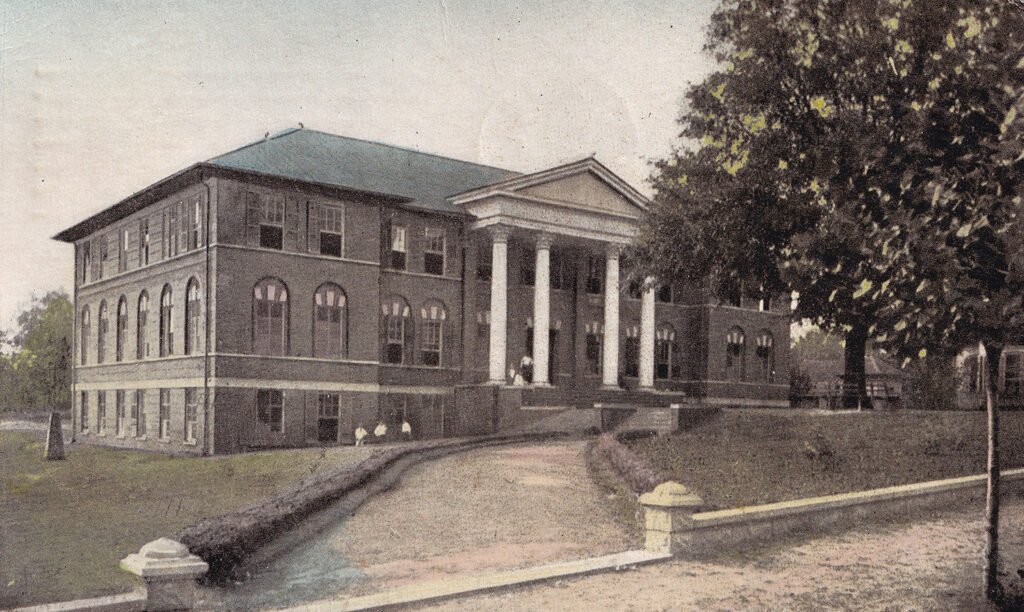
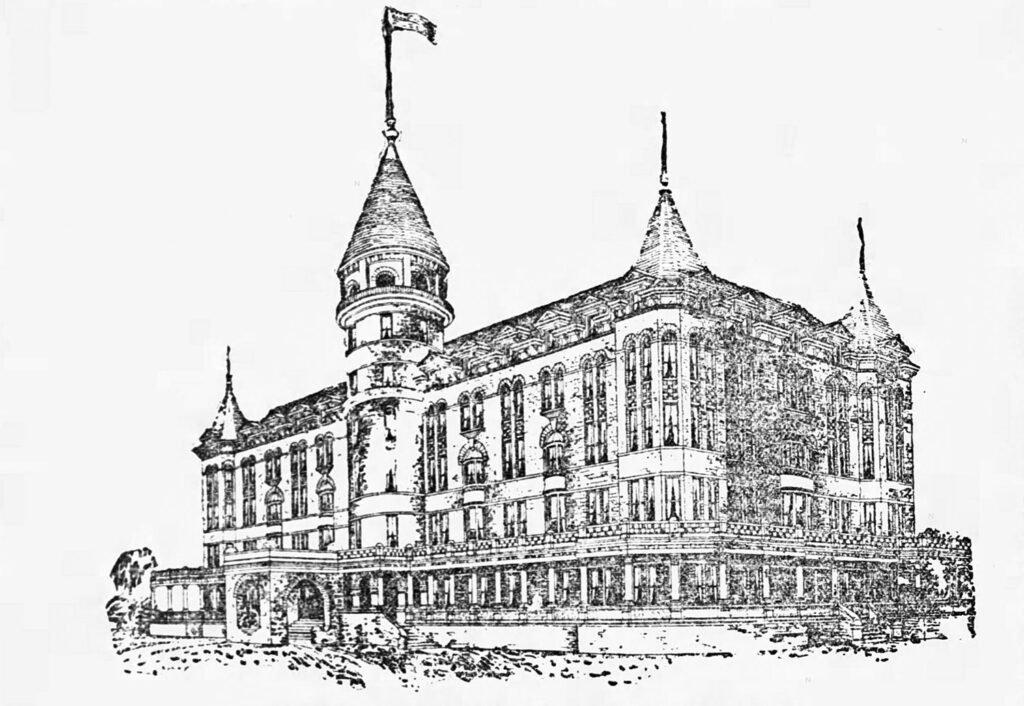
    Bruce & Morgan. Agnes Scott Hall (1891). Agnes Scott College, Decatur, Georgia.1 2

    References

    1. “At The Agnes Scott.” The Atlanta Journal, June 20, 1890, p. 4. ↩︎
    2. “The Agnes Scott Institute.” The Atlanta Constitution, July 29, 1891, p. 8. ↩︎
  • “Land of the Indian” (1890) by W.W. Goodrich

    The Background

    This is the seventh in a series of articles written for The Atlanta Journal in 1890 and 1891 by W.W. Goodrich, an architect who practiced in Atlanta between 1889 and 1895.

    Americans have an innate infantile tendency to mythologize that which they destroy, like the toddler who squishes a bug and then babbles endlessly about how pretty it was. The prime modern example is the suburbanites who herd into treeless residential developments named — take your pick: Oak Manor, Cherry Ridge, Deer Valley, or what have you.

    As they gaze over a barren landscape primped and manicured within an inch of its life, the ground drenched in cancerous chemicals to keep their exotic grasses artificially green and free of animal life, they lament their disconnect from nature and pine for a visit to the nearest state park.

    The same sort of nonsense was happening in the 19th century, when White Americans suddenly became fascinated by the culture of the native tribes whom they had all but eliminated through genocide, or — for those who are too delicate to face uncomfortable truths — “removal”.

    Goodrich gives his own opinion of the indigenous people here: “…they will never be quiet until the last one is made a good Indian, ‘that is a dead one.’” A charming human being, no?

    This article is a self-indulgent mess of a creative writing exercise, even for a cut-rate fabulist like Goodrich. Here, he describes the land around Mount Baker and the Nooksack River in what is now the state of Washington, although his descriptions are largely inaccurate.

    Goodrich also weaves in an “Indian legend” that appears entirely invented, throwing in bits of Chinook Jargon that are often incorrectly used and misspelled, and absurd names that could have been concocted by a child.

    The only accurate name is Nez Perces, a tribe whose territory originally encompassed 17 million acres in portions of what are now the states of Idaho, Montana, Oregon, and Utah. By the 1890s, the tribe had been confined to a reservation of about 750,000 acres in northern Idaho, which still exists today.

    Goodrich bounced around the Western territories for several years, and no doubt picked up bits and pieces of Native American lore — he certainly created lore of his own. In 1879, he moved to Denver,1 leaving Colorado in 1881 after he was arrested for check fraud and larceny.2

    He briefly practiced in Boise, Idaho, in 18823 before spending 6 months in Seattle,4 reappearing in San Francisco in 1883, where he presented himself as “recently from New York”.5 That same year, he was arrested in both Los Angeles and Boston for check fraud,6 7 8 before moving to Oakland, California, in 1885.9

    Given his brief stint in Washington, his reputation for falsity, and the flimsy claims made here, it’s likely that Goodrich never actually visited the places he described.

    Among the notable inaccuracies in this article:

    • This is Goodrich’s second use of the characters, “Queen Wyltwyck”, Boston and Pilchickanim. Wyltwyck, of Dutch origin, was the original name of Kingston, New York, where Goodrich may have been raised and practiced architecture from 187510 to 1878.11
    • The 365-foot natural bridge “of solid marble” on the Nooksack River never existed.
    • Nooksack Falls is 88 feet high, not 400 feet, as Goodrich claims.
    • The Tsiatko were considered forest spirits, not human ghosts.
    • “Nika tilakum” is a mangled spelling of the Chinook Jargon phrase Nika tilikum, meaning “my people”.
    • “Uyuck”, “Pilchikanin” appear to be entirely invented names.

    Other Chinook Jargon terms used in this article include:

    • Tyee – leader, chief
    • Sahale – mountain
    • Kloshe – good
    • Kloochman – woman
    • Markook – trading house or store12

    Goodrich also uses a word from Chinook Jargon that is now considered offensive and will not be reproduced here. The term has been replaced with the [omitted] tag.


    Land of the Indian.

    The Wonders of Nature That Abound
    In the Native Home of the Warrior
    Some of the Wonderful and Awe-Inspiring Scenery Viewed and Described by an Atlanta Man – One of the Indian Legends

    Written for the Journal.

    Wonders of nature face the traveler as he journeys over the lands of Queen Wyltwyck.

    On each hand there are certainly some of the greatest natural curiosities to be found on the earth.

    Forests of gigantic spruce, cedars and firs two and three hundred feet high, at three feet from the ground forty feet in circumference, is no uncommon sight.

    In the dense forests lie great mountain giant cedars that have grown to enormous heights, and by the fierce storms have fallen over, we have counted five growths thus lying across each other making a total thickness of forty-seven feet.

    There are several natural bridges spanning certain canyons which are almost true arches. A natural bridge across the Nooksack near Mt. Baker is far down in the canyon’s depths, and hence has seldom been seen by a white man. Gliding under it in a canoe, it is seen to be one massive arch, which is 365 feet across, and far below the arch runs the river of Buttermilk chuck. Among the ragged rocks and projecting crags it windows its circuitous way to the salt chuck.

    While above, rising in sheer perpendicular ascent, tower the granite cliffs of the canyon 2,000 feet or more in the air, showing seams of coal, iron, fluorspar, quarts carrying gold, galena carrying gray copper, with threads of native copper, inaccessible to man, but which can be found in the river’s bed. Beautiful agates, crystals and amethysts are everywhere in more or less profusion. Under each end of the arch are beautiful marble shafts, polished by the winds and drifting sands, of uncut native and natural art. The great architect of nature has here shown that the art of man is insignificant and puny in comparison to the wondrous works of Sahale Tyee. The bridge itself is of solid marble, of wondrous purity and richness. Below the bridge are the upper falls and rapids which take a plunge of nearly 300 feet in succeeding short falls, with a final plunge of 400 feet to the canyon some nine miles from the bridge, from which point the waters are placid for several miles.

    The Indians give the bridge a wide berth. They are extremely afraid of it. Tsiatko; at the merest mention of this word, they tremble in terror.

    A Kloshe [omitted] sought the bridge as a way across the canyon, and was never more heard from. She was a most beautiful squaw, brave and true. When the chilling blasts come through the canyon from above the bridge, and the winds whistle through the trees, they imagine they see her tsiatko, or ghost, walking across the span.

    A peculiarity of the apparition is that at from noon to about 1:30 p.m., clear, cold days, a shadowy figure does promenade always one way – from the east to the west. The apparition is only the sun’s rays reflecting on the smooth walls of the canyon, producing in a marked degree, almost a human form. Above the bridge to the glaciers the current is swift, with sunken rocks to swamp the canoe, should its handler not be careful. Salmon and trout are plentiful. The salmon are easily speared, and a salmon broil over a bed of coals is a delicacy that must be partaken of to be known in its intrinsic advantage over the false so-called modern cooking by grease of any kind. With a hard tack and a hat full of salmon berries it is a feast of natural and delicate food easily digested, and hungry for more is the dyspeptic’s actual cry. He soon finds his dyspepsia is a thing of the past, his insomnia has disappeared, and he can sleep like a log, figuratively speaking, that even the caterwauling of a mountain lion fails to awaken him from his sound sleep. And a mountain lion’s cry is not to be sneezed at, to use a street expression.

    Our guide Uyuck, a tall sinewy [omitted], with iron nerves that never flinched in mortal combat with man or beast, trembled as he beheld this majestic bridge, with its graceful sweep and arching curves.

    The arch itself is stupendous. A clear span, over the river from the top of the bridge to where it springs from the fall of the side wall is nearly one hundred feet, while its thinnest part at center of span in the center over the river is only eight feet, with a width for a foot-path only, and above the water nearly one thousand feet.

    The river below looks like a thread of frayed cotton flying in the winds, so great is the tossing about of the water in the center of the rapids. Truly a great view from the bridge. To the north, is Mount Baker, clad in eternal snow, its ever moving glaziers [sic] of ice glistening and flashing reflecting rays from peak to peak, from canyon to canyon, from range to range. To the east the Rocky Mountains; to the south the west Puget Sound region; to the west old ocean, pacific when it pleases. But in its bosom there lurks a danger that man cannot overcome. We have seen it quiet and restful, its long, gentle roll, upon which, with sportive play, leaped the fur seal, after its meal of salmon; the leopard seal after its prey; the great whale with jaws open, and rushing through the water, when of a sudden it closes its jaws and it has its catch of fish, as it spouts and sprays us with water. Again we have seen it in its anger, when its fury was let loose, and we, like the Indian, trembled at its majestic grandeur, and arching waves that over-topped our yard arms and descended upon our ship’s decks with a thunderous thud, that made every timber creak and tremble. Yes, we, too, have said “Sahale tyee, sahale tyee, nika tilakum.”

    Ascending the river still further toward the glaziers, our guide points out to us various points of interest.

    Upon a level plain, several years before, was fought an Indian battle of remarkable fierceness.

    The Nez Perces had crossed the range to avenge an insult, as they said. A Nez Perces buck had abducted a [omitted] Kloochman. In taking the female over the range to his tribe he was overtaken. His ears were cut off, and he was turned adrift to go to his tribe as he had come. The Nez Perces are a war-like people, and have caused Uncle Sam already many men and much money to keep them upon their reservation: but they will never be quiet until the last one is made a good Indian, “that is a dead one.” The chief of the Nez Perces sent over the range several hundred of his best warriors and fiercest fighters. They were met at this plain by the Queen of the Wyltwick tribe. With her eagle feathers in profusion and dressed in a lion’s skin, she led her bucks in person as Tyee Wyltwyck was sick nigh unto death. She left him at the Markook with Pilchickanin and Boston and the squaws and papooses. The fight raged for three days, day and night, and when the last of the Nez Perces was exterminated and she was triumphant, and her dead braves had been laid to rest upon the platforms of the dead that were hastily made, and not until then was there such an Indian dance for joy at the extermination of a foe, as the Rocky mountains before or since have ever seen. Her dead braves were mourned and wailed for at the sail house, incantations for their journey to the happy hunting grounds in successive eras of prosperity were prayed for, and after weeks of mourning and moons of wailing, all again was as quiet as the placid waters of the lake.

    W.W. Goodrich13

    References

    1. Advertisement. Rocky Mountain News (Denver), May 24, 1879, p. 2. ↩︎
    2. “Held to Answer”. Rocky Mountain News (Denver), March 26, 1881, p. 2. ↩︎
    3. “Architect”. Idaho Tri-Weekly Statesman (Boise, Idaho), March 14, 1882, p. 3. ↩︎
    4. Advertisement. Seattle Daily Post-Intelligencer, September 29, 1882, p.2. ↩︎
    5. “Brevities”. Seattle Daily Post-Intelligencer, July 25, 1883, p. 3. ↩︎
    6. “A Worthless Check”. The Boston Herald, November 27, 1883, p. 1. ↩︎
    7. “Operation With Checks”. Boston Daily Advertiser, November 27, 1883, p. 8. ↩︎
    8. “An Old Fraud Heard From”. Los Angeles Herald, March 16, 1884, p. 4. ↩︎
    9. “A New Architect”. Oakland Daily Evening Tribune (Oakland, California), July 23, 1885, p. 2. ↩︎
    10. Advertisement. The Daily Freeman (Kingston, New York), October 5, 1875, p. 1. ↩︎
    11. Advertisement. The Daily Freeman (Kingston, New York), December 9, 1878, p. 2. ↩︎
    12. Gibbs, George. A Dictionary of the Chinook Jargon Language, or Trade Language of Oregon. New York: Cramoisy Press (1863). ↩︎
    13. Goodrich, W.W. “Land of the Indian.” The Atlanta Journal, November 1, 1890, p. 3. ↩︎

  • First National Bank (1913) – Dublin, Georgia

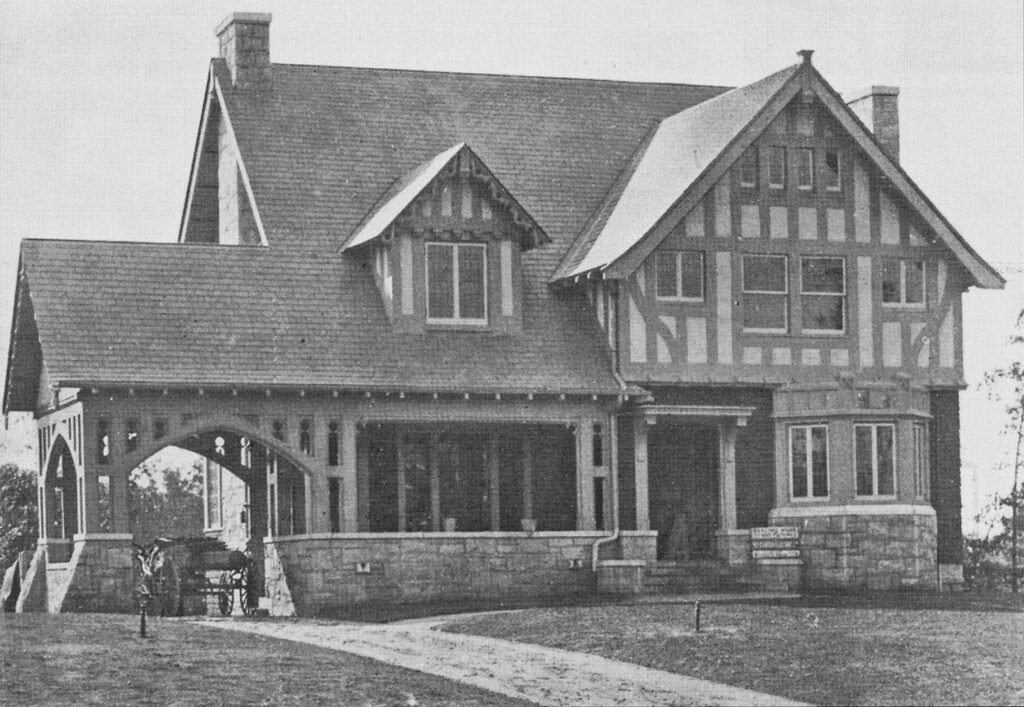
    A. Ten Eyck Brown. First National Bank (1913). Dublin, Georgia.1 2 3 4

    References

    1. “Sealed Proposals for the Erection and Completion of Bank and Office Building for the First National Bank, Dublin, Georgia”. The Atlanta Constitution, April 21, 1912, p. 4. ↩︎
    2. “Atlanta Firm Will Build Dublin Bank”. The Atlanta Constitution, June 3, 1912, p. 2. ↩︎
    3. “Dublin National Bank Declares Dividend”. The Macon News (Macon, Georgia), January 27, 1913, p. 2. ↩︎
    4. “Dublin Is Erecting Eight-Story Building”. The Atlanta Journal, January 27, 1913, p. 2. ↩︎
  • “Wyltwyck” (1890) by W.W. Goodrich

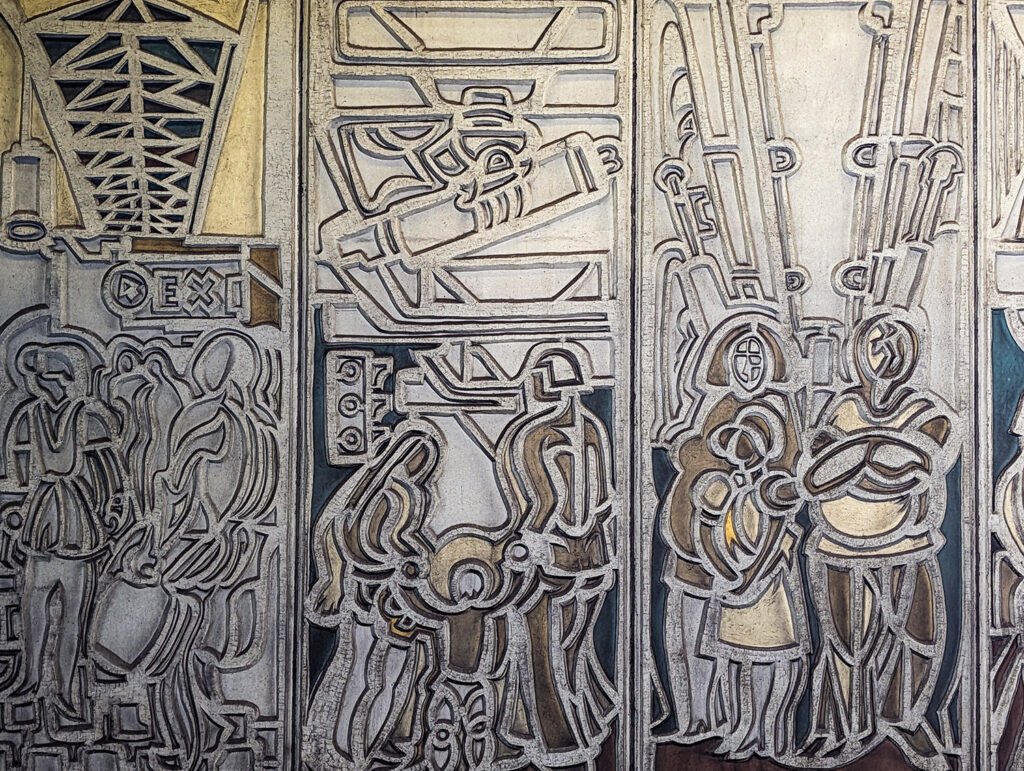
    Pat Connell. Homage to St. EOM‘s Pasaquan (1996). Folk Art Park, Atlanta.1

    The Background

    This is the sixth in a series of articles written for The Atlanta Journal in 1890 and 1891 by W.W. Goodrich, an architect who practiced in Atlanta between 1889 and 1895.

    I’ll be blunt: this article is unreadable garbage.

    Here, Goodrich concocted a tale set in the state of Washington that begins with an ill-fated hunting excursion by “Wyltwyck, the haughty queen of the Nooksacks”.

    Wiltwyck, of Dutch origin, wasn’t the name of any Indigenous person in Oregon — it was the original name for Kingston, New York,2 where Goodrich may have been raised and practiced architecture from 18753 to 1878.4

    For a mythomaniac, Goodrich’s storytelling skills were atrocious: after reading this article multiple times, I still don’t know what the hell it’s about. My best guess is that he started writing one story, and when he couldn’t figure out how to advance the plot, decided to jam an entirely different one into it.

    As if the article weren’t incomprehensible enough, Goodrich packed it full of Chinook Jargon and outright gibberish. Terms like Sahale Tyee, Nika tilakum, and kloochman are accurate,5 but much of the text reads like the speech of a babbling toddler.

    Sample sentence: “Loved by the tribe and by her Ikt man kwon esum mit lite kopa ikt kloochman.” Da fuq?

    Despite his own grade-school writing ability, Goodrich audaciously derided the intelligence of Indigenous people, noting “the simplicity of [Wyltwyck’s] nature” and later referring to “the simple-minded Indian”.

    Goodrich also made the character of Wyltywk an adherent of Christianity — because of course he did — describing her recitation of the Lord’s Prayer to “the Great Jehovah, or Great Spirit”. As a compulsive liar and criminal fraud, you can be sure Goodrich was an exceptional Christian.

    Incidentally, the translation of the Lord’s Prayer is mostly accurate — Goodrich copied it from George Gibbs Dictionary of the Chinook Jargon.

    The only value in reproducing this article is to show the kind of pure bullshit that the United States has built its myths on — moronic fantasies spun by narcissistic infants who lack experiential knowledge and are desperate to prove their superiority by portraying other people as weak and inferior.

    If you think there’s a shred of truth in this cultus wauwau, grow up and read a history book.

    Goodrich used a word from Chinook Jargon that is now considered offensive and will not be reproduced here. The term has been replaced with the [omitted] tag, and trust me, it doesn’t make the article any worse.


    Wyltwyck.

    Written for the Journal.

    [Note.–For the definitions of the Indian words in this story, see the end of the article.]

    The cold, gray clouds were drifting over Mount Baker. Occasionally a rift in the moving mass of snow would reveal the glaziers in the canyons, and the rugged ridges of rock protruding from the ice in uneven peaks. The stillness of death reigned everywhere. Flake upon flake, at first floating silently by, would be raised from the crust to again mingle with the storm’s ever increasing determination to bury all surviving life under its revengeful mantle. Upon a projecting crag overlook a precipice, whose depth was many hundreds of feet, was Wyltwyck, the haughty queen of the Nooksacks. Tall, straight as an arrow, with knotted muscles, in silent determination she waited, with bow bent, the spring of the mountain lion, that terror of the northwest, which was crouched, ready to spring upon her as its victim for its evening meal. Cat-like, with stealth, crawling slowly, its hair raised and tail in gentle twirl, it crouched for a spring. Instantly was heard the hiss of the speeding arrow, straight and unerring. The beast had been hit in a vital part and was mortally wounded. It snaps at the arrow in its fury rolling over and over in the snow. The proud queen of the Nooksacks mockingly laughs, taunting it with expressions of ridicule that a [omitted] Kloochman should have dealt this noble beast in its own home its death blow. The snow is crimson from the warm blood of the beast; in its final agony it makes one desperate jump at the squaw, only to be met with the dagger’s blow, severing the jugular vein. The death dance over an enemy in all its peculiar quaintness and picturesqueness, in the solitude of the mountain’s fastness, with no mortal soul to witness the ceremony and in the storms of relentless fury, made the heart of Queen Nooksack bound with intense delight. Such is the Indian’s desire for solitude. Sahala Tyee, Sahala Tyee, Nika Tilakum Wyltwyck was alone, and in calling up on the Great Jehovah, or Great Spirit, she in the simplicity of her nature acknowledged the beneficience [sic] of God Almighty, as the saviour of the human soul, and for her safe return to her people Stepping to the edge of the precipice overlooking the deep recesses of the canyon, looking for salt chuck, as her bearing to the Boston, she realized she was lost and had become separated from her tribal relations in the hunt. With hands uplifted towards the unseen God, who lived upon the mountain top she prayed and in the fervency of her prayer and anguish the words echoed and re-echoed from peak to peak, from canyon to canyon, but the Lord’s Prayer never sounded sweeter to the Saviour nor came nearer the throne of grace than did the prayer of this lone Indian squaw several thousand feet above the sea Nepika Sahale Tyee Klaxta Mitlite Kopa sahale Koshe Kopa nesika tumtum mika mem. Kloshe Mika tyee Kopa Konaway tilikum Kloshe Mika tumtum Kopa illahe kahwka kopa sahale potlatch konaway sun neiska muckamuck pee kopet kumtuks konaway nesika mesache kahkwa nesika mamook kopa klaska spose mamook mesahche kopa nesika marsh siah kopa nesika konaway mesanche. KLOSHE KAHKWA.

    She had not eaten for many hours as her muckamuck was gone Hyas til Nika, and wrapping her pasee about her, she was soon asleep in the Tkope snass.

    The [omitted] Sail house was east of the Boston town of Nooksack on the Nooksack river at the foot of Mount Baker, whose great and majestic grandeur must been seen to be appreciated. On its sides are five glaziers moving constantly and steadily to the plains and valleys below, from under which are heard dense crunchings and loud reports and moans, caused by the ice and rocks gravitating to the lower levels and melting in a higher temperature. All of these sounds are a constant source of terror to the simple-minded Indian, who imagines these noises are devils and demons in mortal combat, each arrayed against the other, and that the smoke from the peak is caused by their firing their respective hells with each other’s bodies, as a burnt sacrifice to allay the wrath of the defeated chief devil, acknowledging that even devils have an affinity for some sort of a patched up friendship.

    The homes of these people were built of bark, skins and rifted cedar thatched with wild grasses. At the apex was an opening for the egress of smoke; their muck-a-muck was game dried and jerked. Salmon were speared, halved, salted and dried and then smoked. To soften them a pointed stick was run through the thick part of the tail and then the fish was pinned to the bed of the river under water to freshen and soften preparatory to cooking and eating, a sure and speedy way.

    They raised yesolth and few vegetables, and were a dreamy, superstitious and quiet people, only going on the warpath when repeatedly insulted, and never giving in till the foe were entirely wiped out of existence even to the last papoose.

    A Boston man came among them to purchase skins and barter for gold. He built a marmook and lived in simple style and readily took to the native ways. His goods were brought from Linden, the head of navigation in the [omitted] Canum. Tyee Wyltwyck, and his Queen were carefully and courteously treated, and their daughter, Pilchickanim, their only child, was a Hyas Kloshe Tenas Kloochman, the handsomest female of the several tribes with hosts of suitors. She was tall, stately, her piercing black eyes penetrating as an eagle’s, her long waving, straight black hair, fine as silk, trailing on the ground, a veritable queen, and set off with trinkets and jewelry of Boston made her a picture in nature never to be forgotten. Boston was envied by all the young bucks, and many a one was felled to the ground by Boston in fights with the girl’s lovers.

    With her cedar canoe she could out-race any two of the tribe, and many a deer and bear fell an easy victim to her arrow and spear-thrust as they swam the river. Boston loved Pilchickanim. His love was reciprocated by the girl in her Indian way–coy, shrewd and distant. His was love as only a Boston can–affection for this maid of the forest, in his manly Boston way. To see the two in her canoe as she speedily paddled the river with or against the current one would not suspect that the were lovers. She never betrayed an emotion, but when Boston was sick she nursed him back to life. When he was assailed by any of her tribe she fought like a mountain lion with her dagger. Her own tribal relations, and always routed the young bucks.

    The sun was setting over the salt chuck. Its brilliant rainbow colors now soft and subdued, rose and fell with the long rook of the ocean. From the northwest came that brilliant glare and with beautiful vibrations lurid and distinct of the auroborealis [sic]. The tribe were with the Tyee Wyltwyck at the Sail house, fearful of an impending fate, when into their midst walked Boston without hesitation. He addressed the chief, Nika Tikeh Malleh Pilchicknin. The Tyee arose and, brandishing his dagger, swore, never! Instantly Pilchicknin, with the stately bearing of her princely birth, advanced to the side of her lover, Boston. Ah, ha! ws Tyee Wyltwyck. The simple Indian ceremony was soon over, and with her husband, she went to live at the Markook house. Loved by the tribe and by her Ikt man kwon esum mit lite kopa ikt kloochman.

    The run of salmon had been light; game was scarce; the season had been too cold for yeosolth, and supplies at the Markook were at an ebb, when a great hunt was planned by the tribe, following up the Nooksack to the glaziers [sic], from under which the buttermilk chuck was constantly running. Suddenly a Hyas skookum cly Hyas mowich, the moose sank into the snow as a shower of arrows went hissing on their deadly mission. Tyee Wyltwyck rushed forward to end the career of the moose should it not have been killed by the arrows. But in the snow lay Queen Wyltwyck wrapped in a moose skin, unharmed. She had seen her people in search of her, and surmising that they would take her for a moose, as she was clothed in a moose skin, dropped in the snow. She had subsisted for several days on the moose, and brought the lion skin as a memento.

    W.W. GOODRICH

    DEFINITION OF INDIAN WORDS

    Sahala Tyee, Sahala Tyee (great Jehova or Great Spirit), mika tilikum (I want my tribe, I want to go to my people, literally).

    THE LORD’S PRAYER

    Nepika (our) sahale (Father) klaxta (who) mitlite (art) kopa (in) sahale (the spirit) kloshe (good) kopa (in) nesika (our) tumtum (hearts) mika (be thy) mem (name) kloshe (good) mika (thou) tyee (chief) kopa (among) konaway (all) tilikum (people) kloshe (good) mika (thy) tumtum (will) kopa (upon) iliahe (earth) kahkwa (as) kopa (in) sahale (the spirit) potlatch (give) konaway (every) sun (day) mesika (our) muckamuck (food) pee (and) kopet-kumtuks (remember not) konaway (all) nesika (our) mesache (sins) kahwka (as) nesika (our) mesache (sins) kahkwa (as) nesika (we) mamook (do) kopa (to) klaska (them) spose (that) mamook (do) mesahche (wrong) kopa (to) nesika (as) marsh (put away) siah (far) kopa (from) nesika (us) konaway (all) mesahche (evil). Kloshe kahkwa (amen).

    Hyas til nika (I am very tired). Tkope snass (the snow). Sail house (tent). Yesolth (corn). Pilchicanim (I want to marry you golden beauty). Hoyas skookum cly (a great shot). Hyas mowich (big horse). Tossee (blankets). Boston (a white man). Muckamuck (food). [omitted] canim (Indian canoe).6

    References

    1. Fox, Catherine. “Folk Art Parks Downtown”. The Atlanta Journal-Constitution, April 26, 1996, p. F1. ↩︎
    2. Kingston, New York – Wikipedia ↩︎
    3. Advertisement. The Daily Freeman (Kingston, New York), October 5, 1875, p. 1. ↩︎
    4. Advertisement. The Daily Freeman (Kingston, New York), December 9, 1878, p. 2. ↩︎
    5. Gibbs, George. A Dictionary of the Chinook Jargon Language, or Trade Language of Oregon. New York: Cramoisy Press (1863). ↩︎
    6. Goodrich, W.W. “Wyltwyck.” The Atlanta Journal, October 11, 1890, p. 7. ↩︎