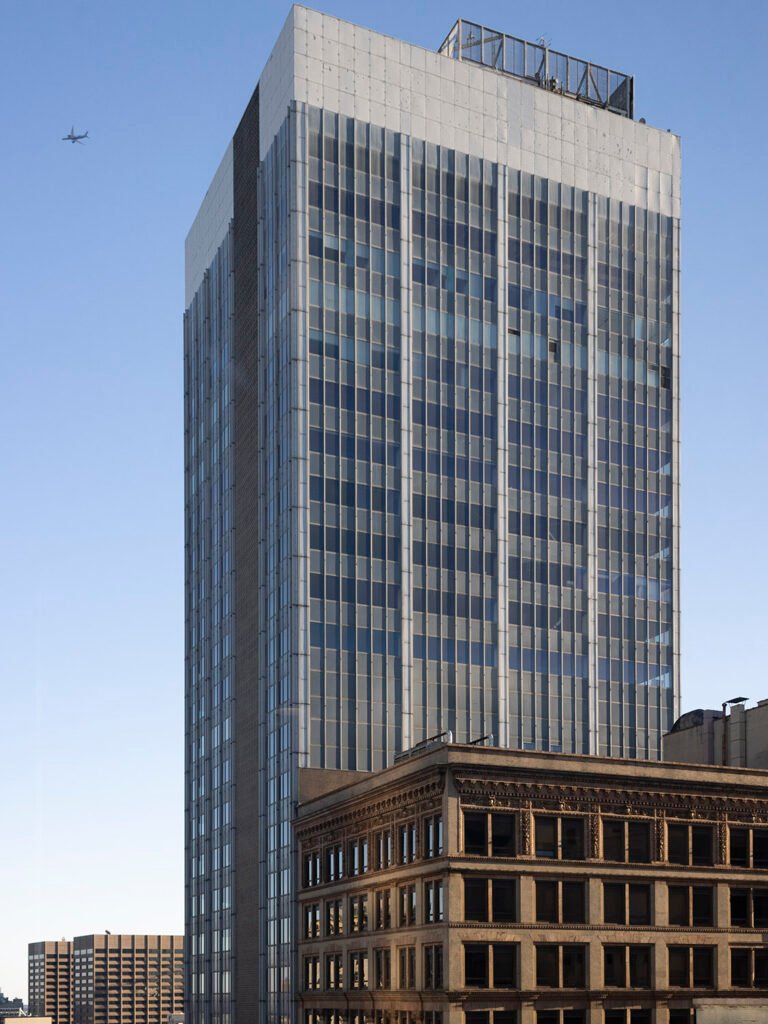
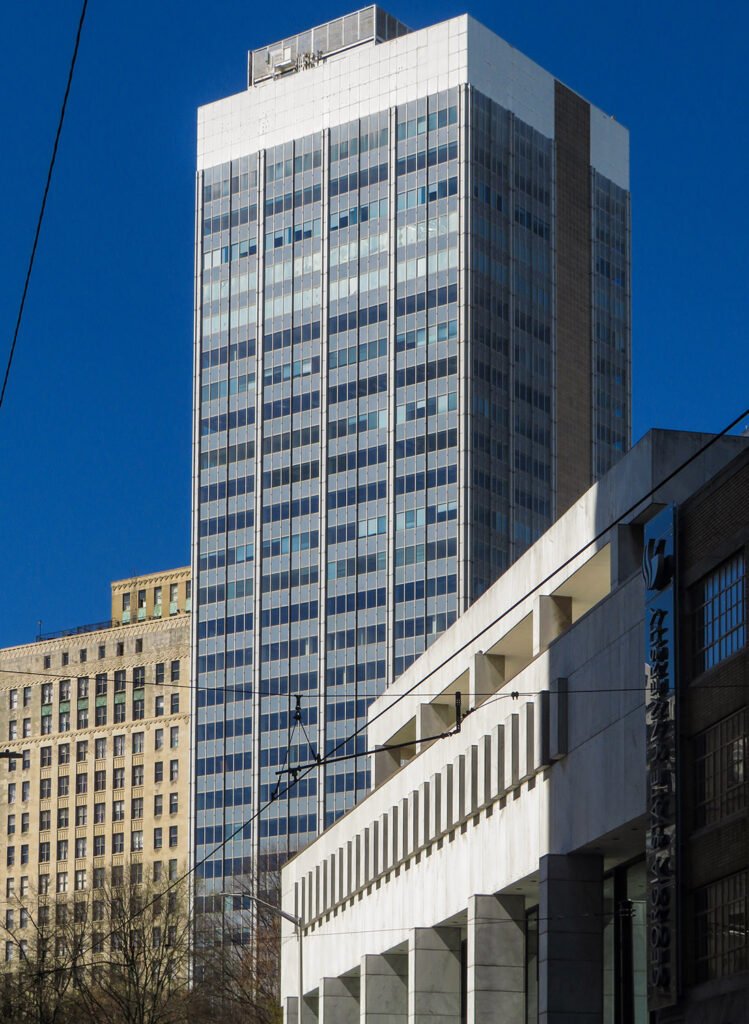
This 31-story International-style tower was arguably the first “modern” skyscraper in Atlanta, although it’s now pushing 70 years old and looks every day of it.
The tower opened in 1961 as the home of The Bank of Georgia and was purported to be the “tallest structure south of Baltimore,”4 surpassed a few years later by Atlanta’s First National Bank,56 built one block away.
It’s telling that the Bank of Georgia had to hire an out-of-town firm, Hedrick & Stanley of Dallas, to design the building — none of Atlanta’s architects at the time had the chops for such a large-scale project.
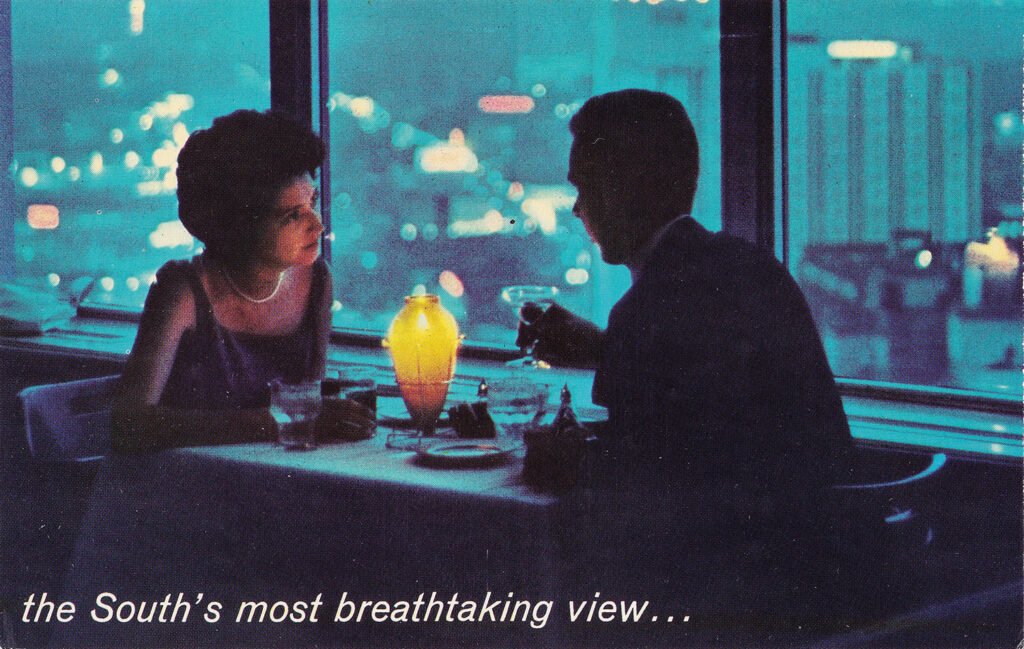
Top O’ Peachtree Restaurant. Photograph from an undated postcard published by Stein Craftsmen of Atlanta.
For the first 11 years, the 30th floor of The Bank of Georgia tower was occupied by the Top O’ Peachtree restaurant and “lookout lounge”, later described as ‘”the” place to go for dinner or drinks in its beginning.’7
Based on photographs, Top O’ Peachtree was no doubt an ideal rendezvous for married bank executives and their secretaries. Oh, come on, you know it happened.
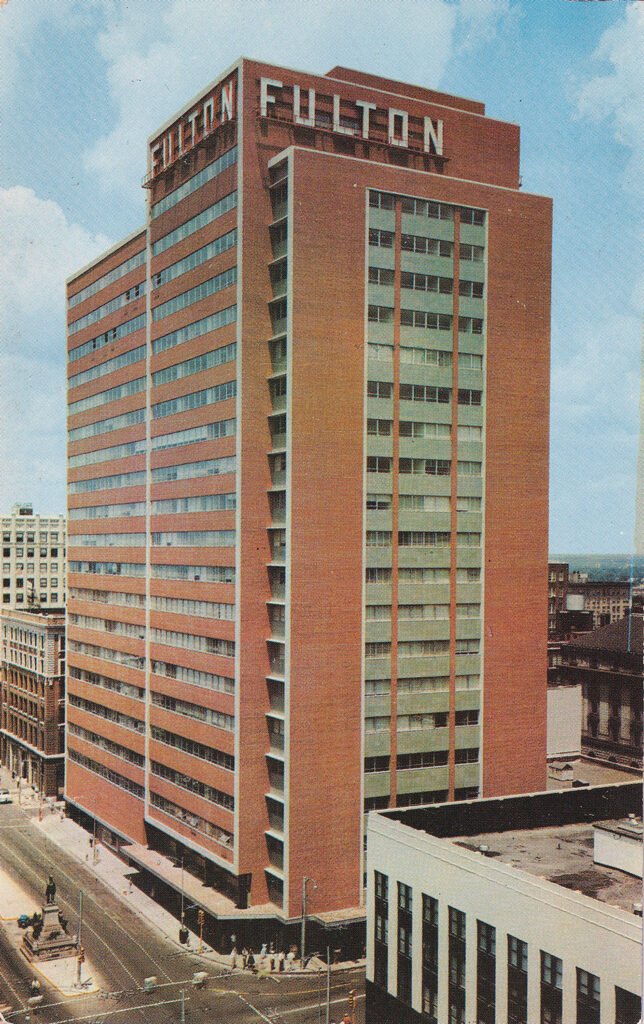
Wyatt C. Hedrick Company with Willner & Millkey.89Fulton National Bank (1955). Atlanta. Photograph from an undated postcard published by Dexter Press, Inc. of West Nyack, New York.
When the Bank of Georgia tower was sold in 1979, it was described as one of “the two homeliest buildings in town,” along with the nearby Fulton National Bank building (1955),10 which was entirely accurate — then and now.
Designed by Wyatt C. Hedrick Company of Dallas,11 which later became Hedrick & Stanley, the Fulton National Bank building has been renamed 55 Marietta and remains in active use, now serving as a data center. The Bank of Georgia, however, hasn’t fared as well.
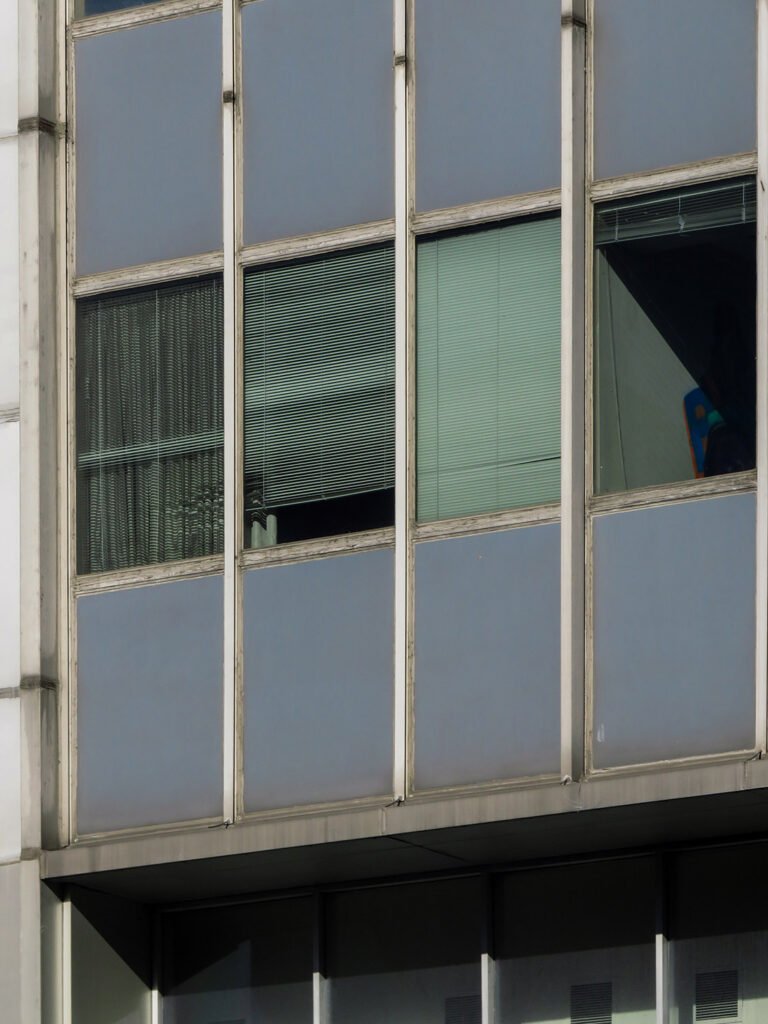
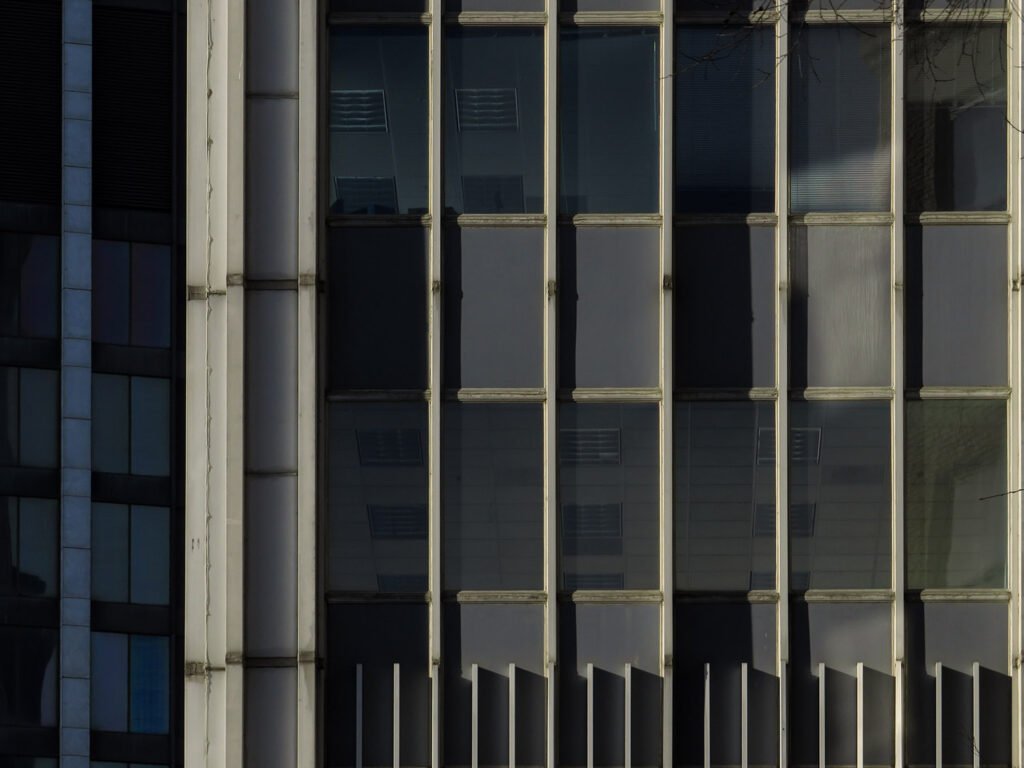
Detail of windows on The Bank of Georgia (34 Peachtree)
Later renamed 34 Peachtree, the former Bank of Georgia has passed through a succession of owners and is currently vacant, with missing windows on the upper floors and its street-level retail spaces obscured by brown paper.
A peek through the doors and windows at night reveals the dead escalators in the lobby and dangling ceiling tiles in the office spaces.
In 2017, pieces of the building’s facade fell to Peachtree Street during a bout of high winds, prompting the closure of several streets.12
Looking at the north elevation of The Bank of Georgia (34 Peachtree)
There have been empty promises to convert 34 Peachtree into residential units,13 but that’s just typical Atlanta bullshitting, quite unlikely to transpire, as the cost to renovate such behemoths is overwhelmingly prohibitive.
Office buildings are rapidly becoming a relic of the past, and as more skyscrapers begin to deteriorate, it will be interesting to see what cities like Atlanta do with them, particularly as the United States plunges headfirst into inevitable social and economic decline.
I suspect that in decades to come, many American cities will be filled with vacant, crumbling towers that no one will have the money to demolish or renovate — unsightly monuments from an age of decadence and arrogance best left forgotten.
Looking at The Bank of Georgia (34 Peachtree) from Edgewood Avenue
References
Erwin, George. “Bank Plans 31-Story Building At 5 Points, Costing 10 Million”. The Atlanta Journal, March 1, 1959, p. 1. ↩︎
The Atlanta Journal and The Atlanta Constitution, April 2, 1961, Bank of Georgia Section. ↩︎
“Bank of Georgia To Open Monday”. The Atlanta Journal, March 28, 1961, p. 33. ↩︎
Veale, Frank. “35,000 Expected At Gala Opening Of New Building”. The Atlanta Journal, April 2, 1961, p. 2-F. ↩︎
Crown, John. “40-Story Bank Building to Rise in Atlanta”. The Atlanta Journal, August 11, 1963, p. 1. ↩︎
“Atlanta Reaches for the Sky–More Giants on Way”. The Atlanta Journal, May 17, 1966, p. 12. ↩︎
Henderson, Barry. “Top O’ Peachtree Sale Set”. The Atlanta Constitution, September 23, 1972, p. 8. ↩︎
“Equipment Came From All Over U.S., Materials From All Over The World”. The Atlanta Journal, October 18, 1955, p. 3-F. ↩︎
“It’s the tops” (advertisement). The Atlanta Constitution, October 19, 1955, p. 2-F. ↩︎
Kossoff, Evan. “New Owner Giving 2 Downtown Buildings a Facelift”. The Atlanta Constitution, December 10, 1979, p. 9-D. ↩︎
“Company Completes 26-story Fulton National Bank Building on schedule!” (advertisement). The Atlanta Journal, October 18, 1955, p. 18-F. ↩︎
Judd, Alan. “Georgia: Irma set to arrive today.” The Atlanta Journal-Constitution, September 11, 2017, p. A1-A6. ↩︎
Torpy, Bill. “Can office conversions save downtown?” The Atlanta Journal-Constitution, July 31, 2023, p. A9. ↩︎
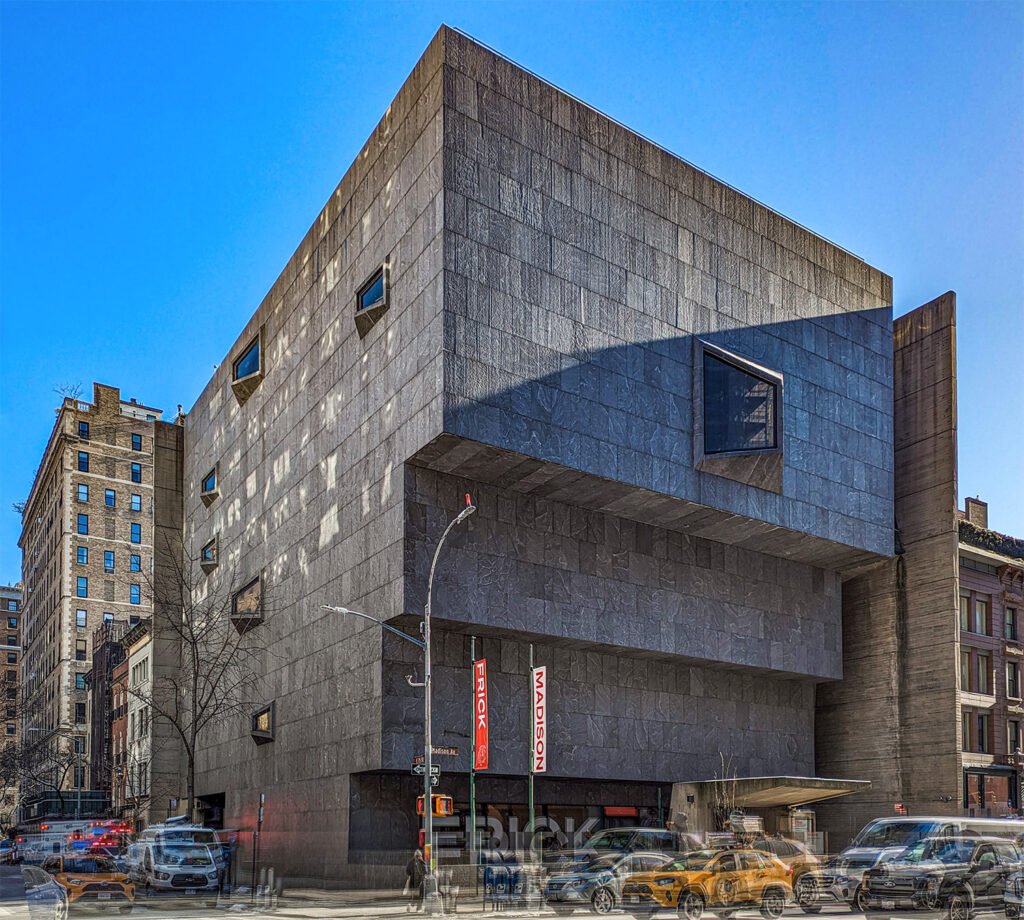
Marcel Breuer and Hamilton P. Smith. Whitney Museum of Art (1966). New York.
A masterpiece of the Brutalist style, the Whitney Museum of Art (1966) in New York was designed by Marcel Breuer (1902-1981), an American modernist architect of the 20th century.
Like so many architects of his era, Breuer’s legacy has been rapidly forgotten in the 21st century, with many of his buildings now under threat or destroyed.
Born in Hungary to a Jewish family, Breuer (pronounced Broy-er) was both a student and teacher at the Bauhaus in Germany, where he became known for his cutting-edge furniture designs, most famously the Wassily chair.
With the rise of the Nazi regime, Breuer moved to England in 1935, then immigrated to the United States in 1937 with his mentor, Walter Gropius, becoming a member of the influential Harvard Five group of architects.
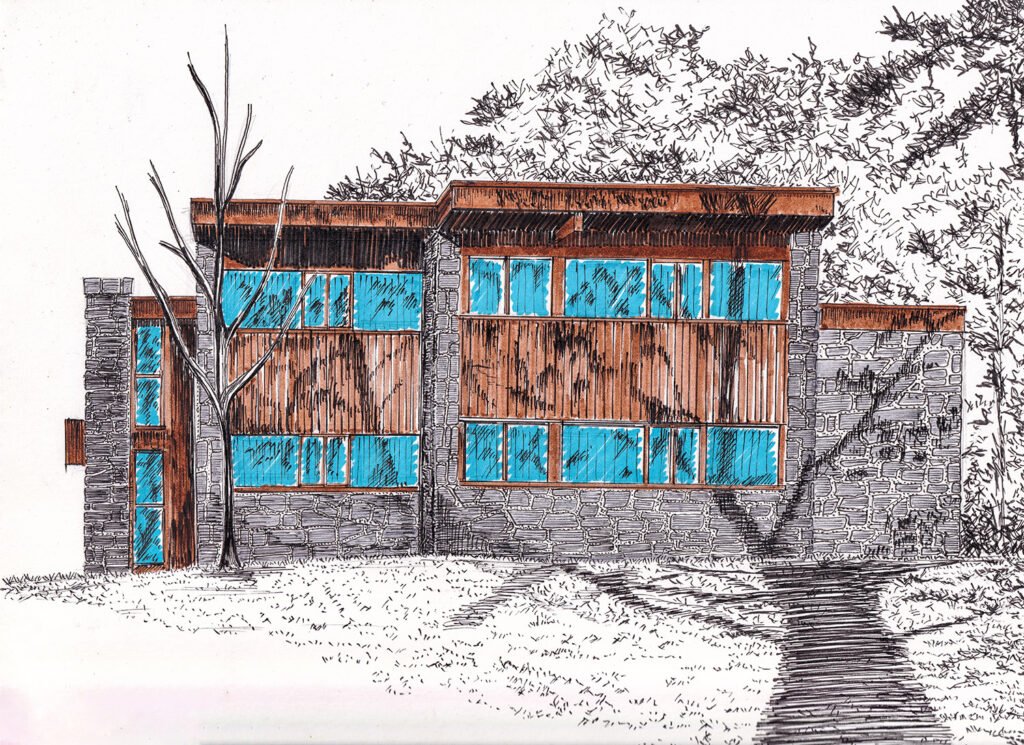
Between 1938 and 1941, Gropius and Breuer designed several residential projects together before Breuer broke off and began his solo practice. One of their joint works is the Weizenblatt Duplex (1941) in Asheville, North Carolina, for which Breuer is credited as the primary designer.
Walter Gropius and Marcel Breuer. Weizenblatt Duplex (1941). Asheville, North Carolina. Illustration by Monastic.
Breuer’s architectural career is neatly bifurcated into 2 distinct periods that couldn’t be any less alike.
In the 1940s and 50s, he was chiefly a small-scale designer and specialized in the creation of light, airy International style residences that were much praised for their innovative floor plans and use of materials and building techniques.
In the 1960s and 70s, Breuer abruptly switched gears and almost exclusively produced larger and more lucrative corporate and civic projectsin the forceful and imposing Brutalist style, using concrete as his primary material.
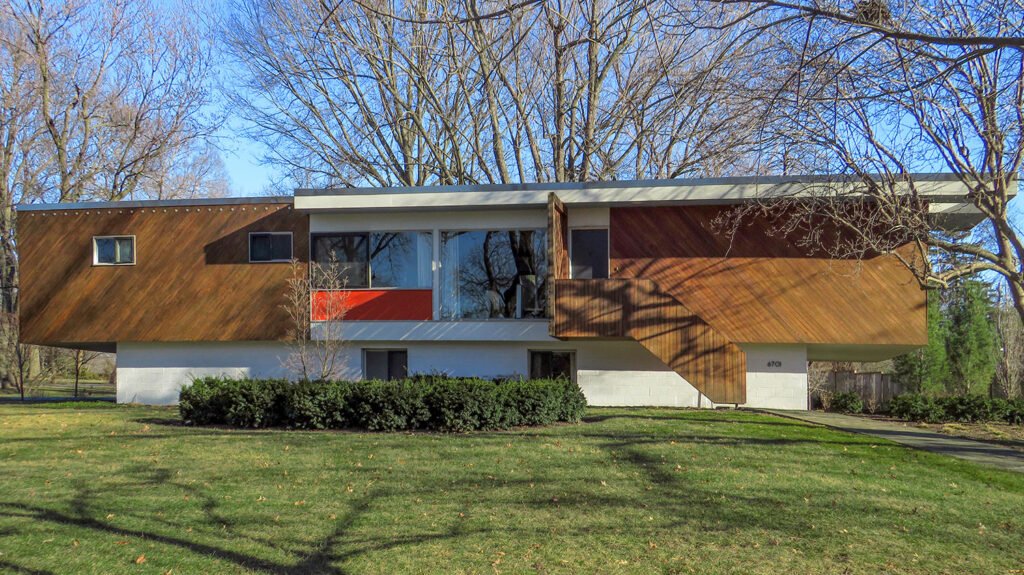
Marcel Breuer with Robert F. Gatje.Snower House (1954). Mission Hills, Kansas.1
A typical design of Breuer’s residential period, the Snower House (1954) is also one of his least-known projects, occupying a large corner lot in the Mission Hills suburb of Kansas City.
The design is essentially a 1,800-square-foot rectangular box cantilevered on a concrete block base and was reportedly modeled after Breuer’s first home in New Canaan, Connecticut2, although most of his houses from the era had a similar look.
Breuer’s work was heavily concentrated in New England and the East Coast, and together with a house in Aspen, Colorado, the Snower house is one of only 2 completed residential projects he designed west of the Mississippi River3 — he never even visited the property.4
No one would claim the Snower house is one of Breuer’s better works, but it still has all the trademarks of his early residential designs. Notably, the home utilizes Breuer’s “bi-nuclear”floor plan, with living spaces placed on one side and sleeping areas on the other.
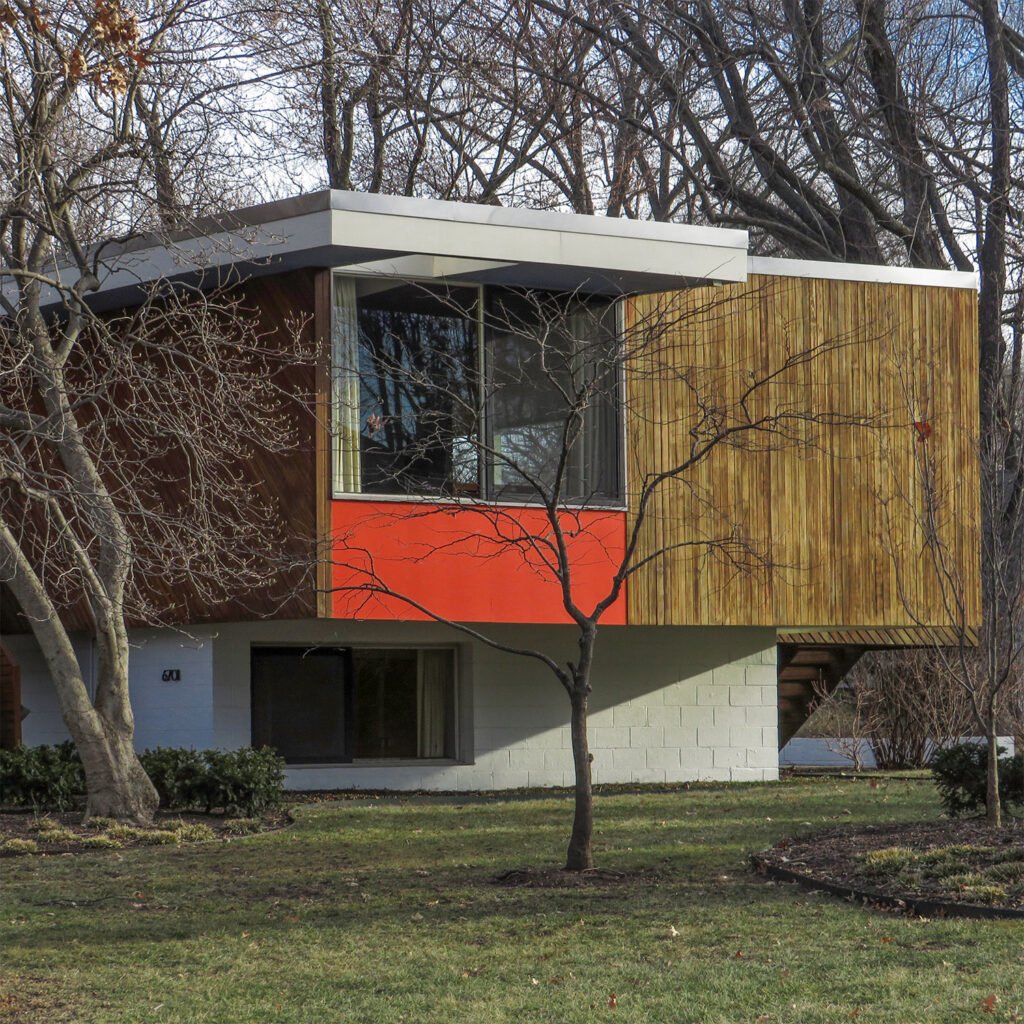
Detail of Snower House
You can also clearly identify Breuer’s attention to form and creative use of materials: large windows on every side of the home blur the boundary between exterior and interior, tiny windows punctuate walls patterned in cedar strips, and brightly-colored asbestos panels add much-needed visual contrast.
The home has remained remarkably true to its initial design and, at the time of a 2015 article, had retained many of its original furnishings, including living and dining furniture designed or specified by Breuer, the original kitchen cabinets, and a built-in bookcase in the living room.
As of 2015, the interior still included the original cedar plank ceilings and walnut flooring, and the owners had restored the original orange, blue, and gold interior color scheme.5
The Snower house was built as a country residence, but is now surrounded by a sprawling maze of cookie-cutter homes. The structure spends most of the year concealed by trees, and with its cantilevered design, it almost appears to float among the greenery.
It’s a home that takes a certain amount of architectural knowledge to appreciate: while groundbreaking when it was constructed, today an uninformed observer could easily misjudge it as a holdover from a high-end trailer park.
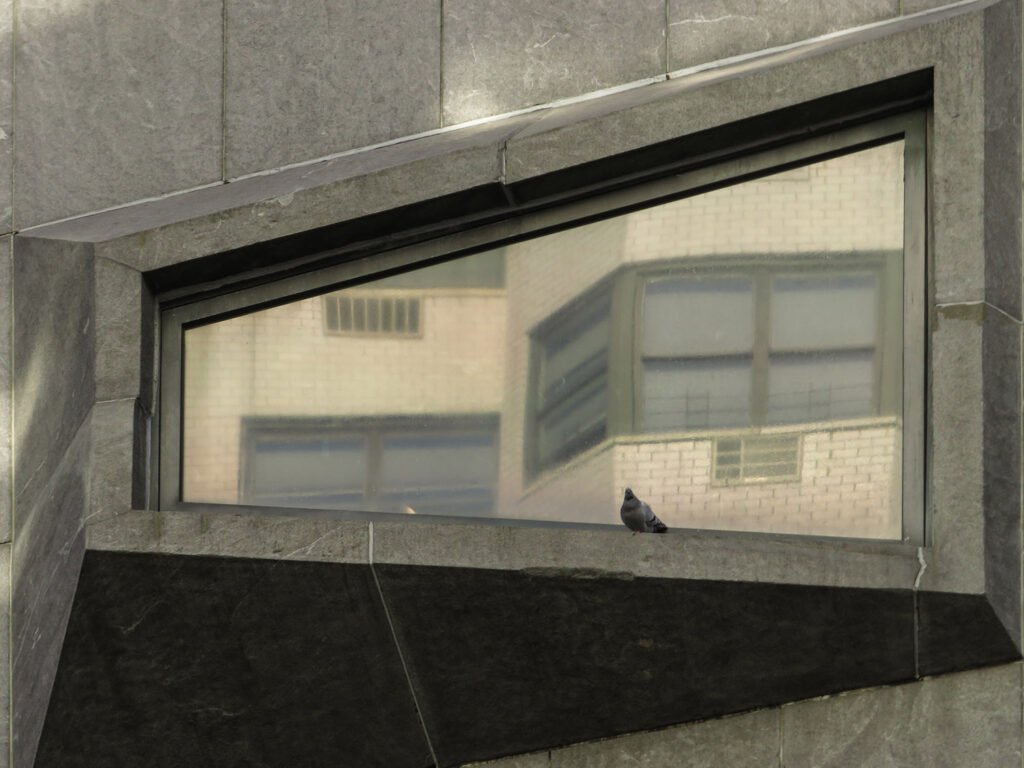
Trapezoidal window detail on the Whitney Museum of Art
Twelve years after the Snower house was built, Breuer’s design for the Whitney Museum of Art was completed at 945 Madison Avenue in New York’s Upper East Side.
Anyone unfamiliar with Breuer’s work would never guess the two projects were by the same architect, but look closely, and you’ll note that both buildings give the same suggestion of floating, and both show the same attention to form and materials.
Looking something like an inverted ziggurat, the7-story, 76,830 square foot structure — now also known as the Breuer Building — was designed by Breuer with his longtime associate Hamilton P. Smith.
The building’s exterior is defined by cantilevered floors that progressively extend toward the street, covered in dark granite tiles over reinforced concrete. The ground floor entrance is set back from the street, accessed by a bridge spanning a moat-like sunken courtyard.
The facade presents a nearly blank face to Madison Avenue, apart from a large trapezoidal window, an element that became one of Breuer’s signatures. The north side of the building facing East 75th Street is punctuated by 6 smaller windows, similar to Breuer’s use of tiny windows in the Snower residence.
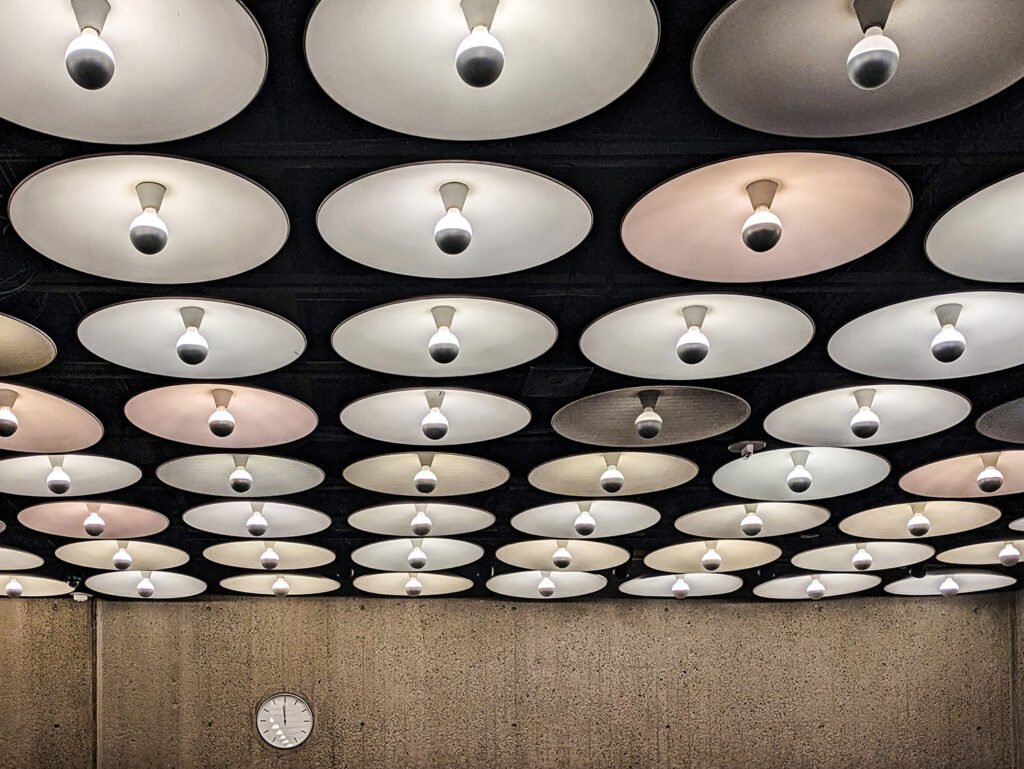
Lobby detail of the Whitney Museum of Art
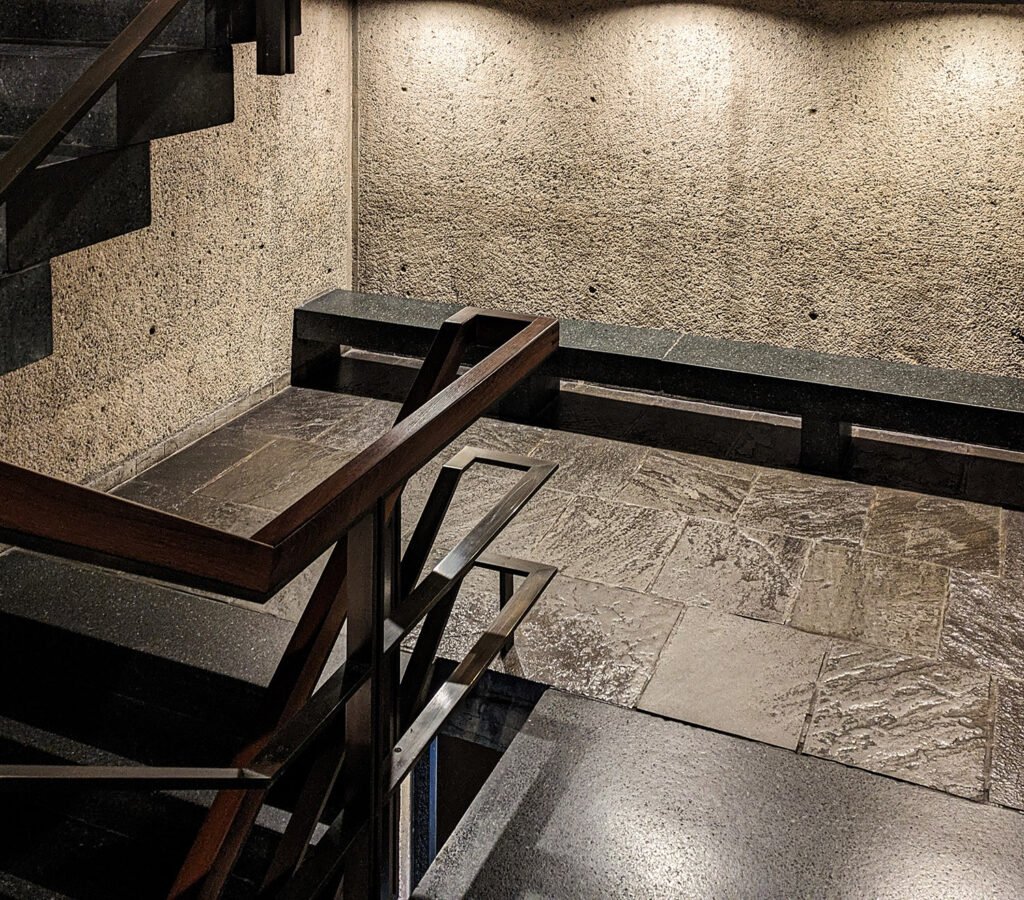
The building’s interior showcases Breuer’s ability to masterfully blend textures and patterns, particularly in the lobby and stairwells.
Smooth concave dome lights in the lobby contrast against the dark ceiling and roughly textured walls, created with vertical board-formed concrete. Floors throughout the building are covered in bluestone slab tile, and the walls in the stairwells are formed with bush-hammered concrete.
Sleek bronze railing on the stairs recalls Breuer’s earlier furniture designs, and the abundance of built-in seating thoughtfully incorporated throughout the building is an obvious byproduct of his residential period.
Detail of the stairwell in the Whitney Museum of Art
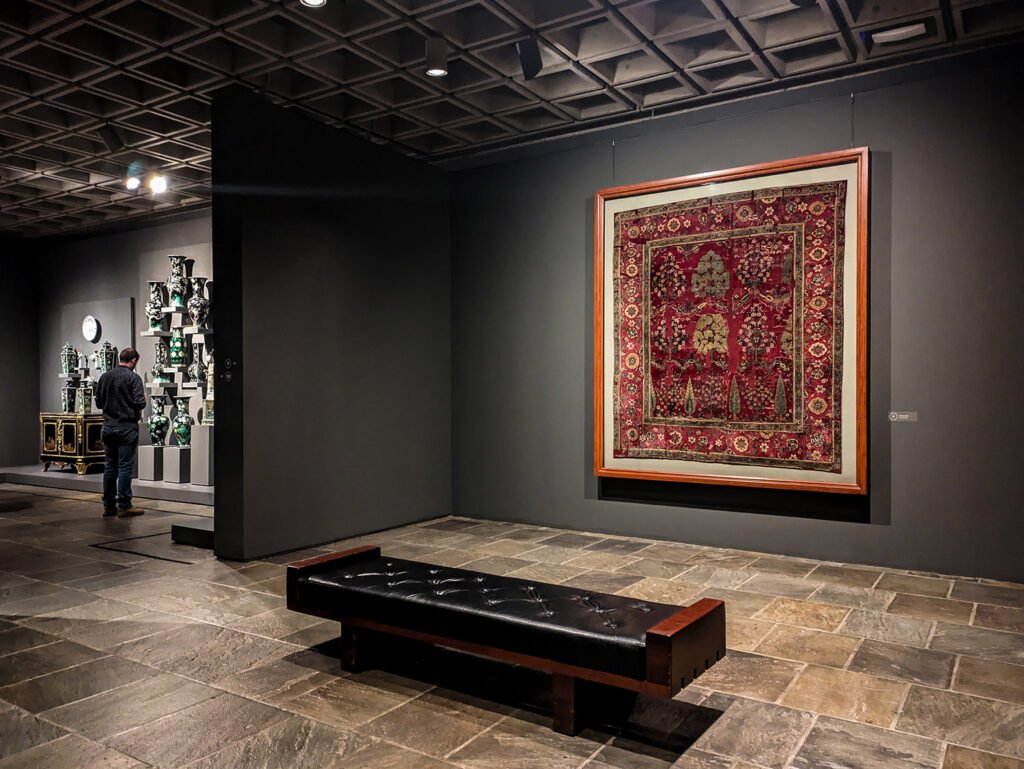
I visited 945 Madison in January 2024, when the building was about to end its 3-year run as the temporary home of the Frick Collection.
The Frick was a grim and joyless experience, and, for whatever reason, the museum’s management prohibited photography in the galleries — it’s not like any of their boring art was worth a picture. I dodged the leering security guards and snapped a photo anyway, because fuck that Nazi-inspired nonsense.
The Frick had covered Breuer’s signature windows with giant scrims, so there wasn’t much to admire in the building’s galleries. In the image below, you can still see some of the coffered ceilings, bluestone tiles, and built-in seating.
I took a picture in the gallery. Sue me.
Breuer’s creative output arguably peaked with the Whitney and became increasingly repetitive and self-referential through the late 1960s.
In 1968, the same year he was awarded the Gold Medal of the American Institute of Architects, Breuer also faced severe backlash for his proposed Grand Central Tower, which called for the demolition of New York’s landmark train station, only a few years after the destruction of the original Penn Station ignited widespread protest.
New Yorkers aren’t known for forgiveness, and at Breuer’s death, Paul Goldberger, then the architecture critic for TheNew York Times, stated in his obituary for Breuer that the architect was “most likely to be remembered for things that are very small — things that are not buildings at all.”6
That observation was catty but dead on, as Breuer’s contributions to architecture are essentially unknown to the public today. And why is that?
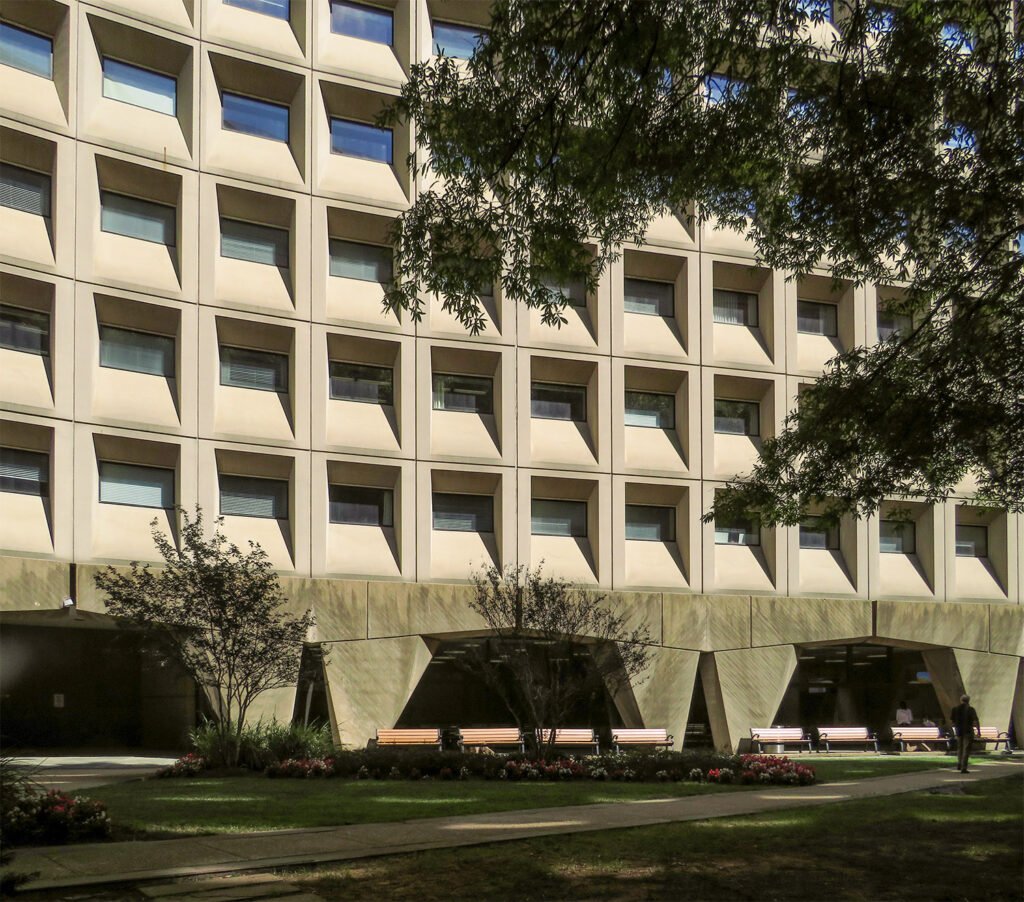
Marcel Breuer and Herbert Beckhard. Department of Housing and Urban Development (1968). Washington, D.C.
Societal taste in architecture is always fickle, but the backlash against Brutalism has been especially swift and severe. What was initially embraced in the 1960s as a universal, egalitarian, and essentially optimistic style was, by the 21st century, widely viewed as hostile, oppressive, and just plain ugly.
It doesn’t help that concrete ages poorly: it cracks, it stains, and if it isn’t regularly power-washed (and it never is) it just looks drab and dirty. Slapping white paint on old concrete buildings has become popular in recent years, but it’s a cheap trick that never succeeds.
Breuer’s output was also wildly inconsistent in the second half of his career. While he had a few outstanding gems like the Whitney, his firm also produced a large number of banal and uninspired projects in the 1960s and 70s, with a clear prioritization for commissions over creativity.
Thus, Breuer’s name is associated with such dreary designs as the Department of Housing and Urban Development (1968) in Washington, D.C., or the downright hideous building for the Department of Health, Education, and Welfare (1977) in the same city.
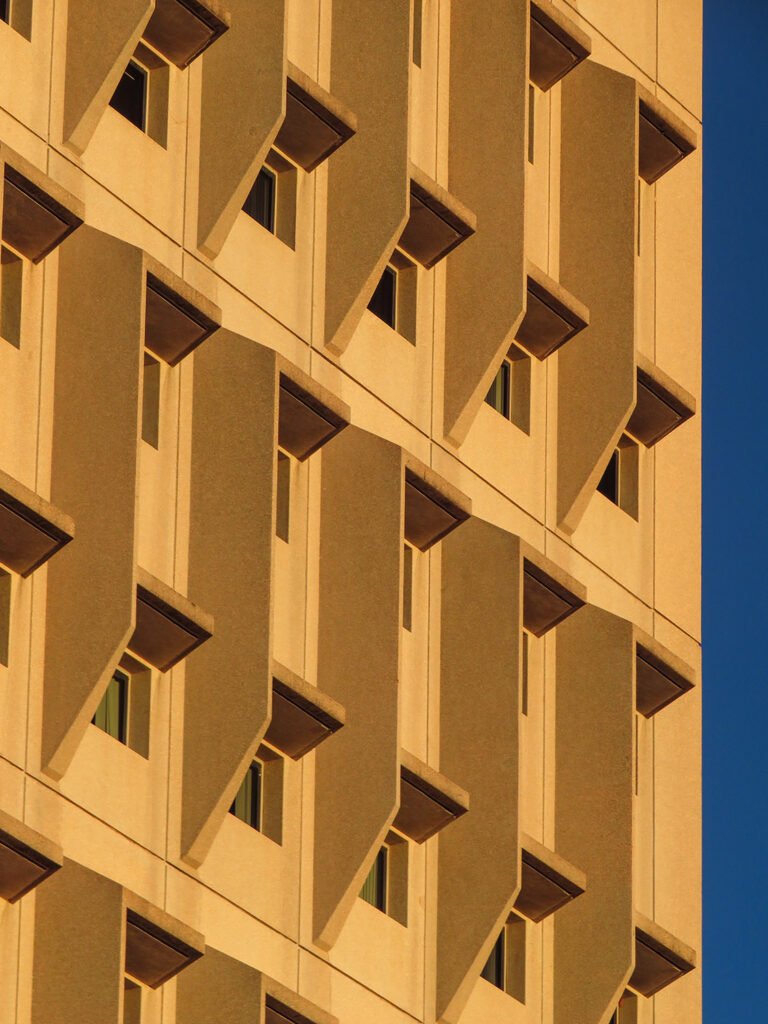
Later projects like the Strom Thurmond Office Building and Federal Courthouse (1979) in Columbia, South Carolina, shouldn’t even be mentioned in the same breath as Breuer, since he obviously had nothing to do with their design.
Breuer’s disappearance from public consciousness is also hardly unique: most people today are unfamiliar with his contemporaries like Philip Johnson, Louis Kahn, Paul Rudolph, or I.M. Pei, and the average person’s assessment of any of those designers’ best works would likely be unfavorable.
Marcel Breuer and Hamilton P. Smith. Detail of Strom Thurmond Office Building and Federal Courthouse (1979). Columbia, South Carolina.
Some of Breuer’s projects have found new uses: in 2003, part of Breuer’s landmark design for the Armstrong Rubber Company (1966) in New Haven, Connecticut, was demolished for the construction of an IKEA store, but the remaining portion of the structure has since been converted to a boutique hotel.
Atlanta’s Central Library (1980) was the last project credited to Breuer, and it too faced possible destruction until it was spared by a controversial renovation completed in 2021. That story will be forthcoming.
References
McCarter, Robert. Breuer. New York: Phaidon Press Limited (2016). ↩︎
Billhartz Gregorian, Cynthia. “An original vision with an attention to detail”. The Kansas City Star, October 18, 2015, p. 20G. ↩︎
McCarter, Robert. Breuer. New York: Phaidon Press Limited (2016). ↩︎
Paul, Steve. “Architecture A to Z”. The Kansas City Star Magazine, April 18, 2010, p. 15. ↩︎
Billhartz Gregorian, Cynthia. “An original vision with an attention to detail”. The Kansas City Star, October 18, 2015, p. 20G. ↩︎
Burnett, W.C. “Architect Marcel Breuer’s influence memorialized in Atlanta Public Library”. The Atlanta Journal, July 8, 1981, p. 3-B. ↩︎