Category: Postcards from the South

  • Postcards from the South: Sarasota Terrace Hotel – Sarasota, Florida

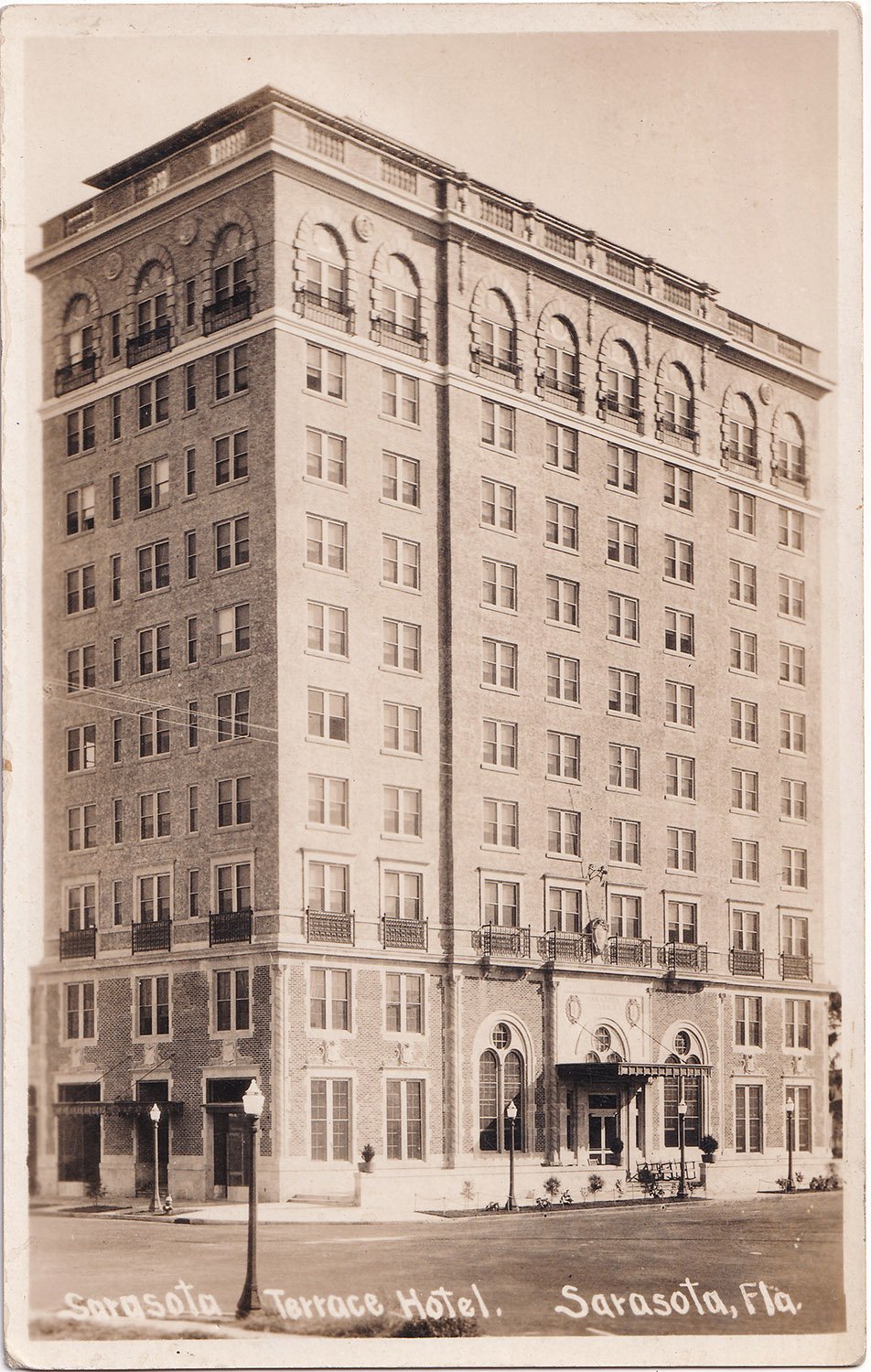
    Postcard view of the Sarasota Terrace Hotel, Sarasota, Florida

    I grew up in Florida, so I can say with complete authority that it’s a miserable state: ugly, plagued with deadly heat and reptiles, and teeming with the most hostile, willfully ignorant people in the United States—though they’ve got a lot of competition these days.

    In recent years, I’ve occasionally dipped back into Florida to photograph buildings, but only in the winter, when snakes and alligators are in hibernation. Unfortunately, the people never disappear.

    I visited Sarasota twice, primarily to see its surviving Modernist structures from the Sarasota School of Architecture, but I never got around to photographing the old Sarasota Terrace Hotel, completed in 19261 and designed by Pringle & Smith2 of Atlanta.

    Location of Sarasota Terrace Hotel

    In truth, the building just doesn’t interest me that much. It’s a standard Beaux-Arts affair: handsome and solidly executed, but not unlike a thousand others of the same style.

    The 10-story hotel cost $750,0003 to build and was developed by Charles Ringling4 of the Ringling Brothers. Yep, the circus people.

    When the Sarasota Terrace closed in 1972, the Sarasota Herald-Tribune noted that “it never achieved the prominance [sic] of some of the other area hotels.”5

    Sarasota County purchased the property the same year, and the building was renovated to serve as the county’s administration center.6

    Pringle & Smith designed another building in Sarasota at the same time as the hotel: the nearby American National Bank,7 8 also 10 stories, and also underwhelming.

    Atlanta architects have rarely done their best work in Florida.

    References

    1. “Robinson First Guest At Sarasota Terrace”. Sarasota Herald (Sarasota, Florida), May 15, 1926, p. 1. ↩︎
    2. Craig, Robert M. The Architecture of Francis Palmer Smith, Atlanta’s Scholar-Architect. Athens, Georgia: University of Georgia Press (2012), p. 120-22. ↩︎
    3. “Building Activities Here”. Sarasota Herald (Sarasota, Florida), June 29, 1926, p. 2. ↩︎
    4. “Ringlings To Arrive Saturday”. Sarasota Herald (Sarasota, Florida), January 29, 1926, Section Four, p. 1. ↩︎
    5. Cullinane, Jim. “Hotel Rooms, Corridors Now Quiet”. Sarasota Herald-Tribune (Sarasota, Florida), December 11, 1972, p. 2B. ↩︎
    6. The Sarasota Terrace Hotel | Sarasota History Alive! ↩︎
    7. “Permit Issued For Bank Home”. Sarasota Herald (Sarasota, Florida), October 21, 1925, p. 16. ↩︎
    8. “American National Is Towering Structure Of Prominence In City”. Sarasota Herald (Sarasota, Florida), December 15, 1926, p. 12. ↩︎
  • Postcards from the South: IC Depot – New Orleans

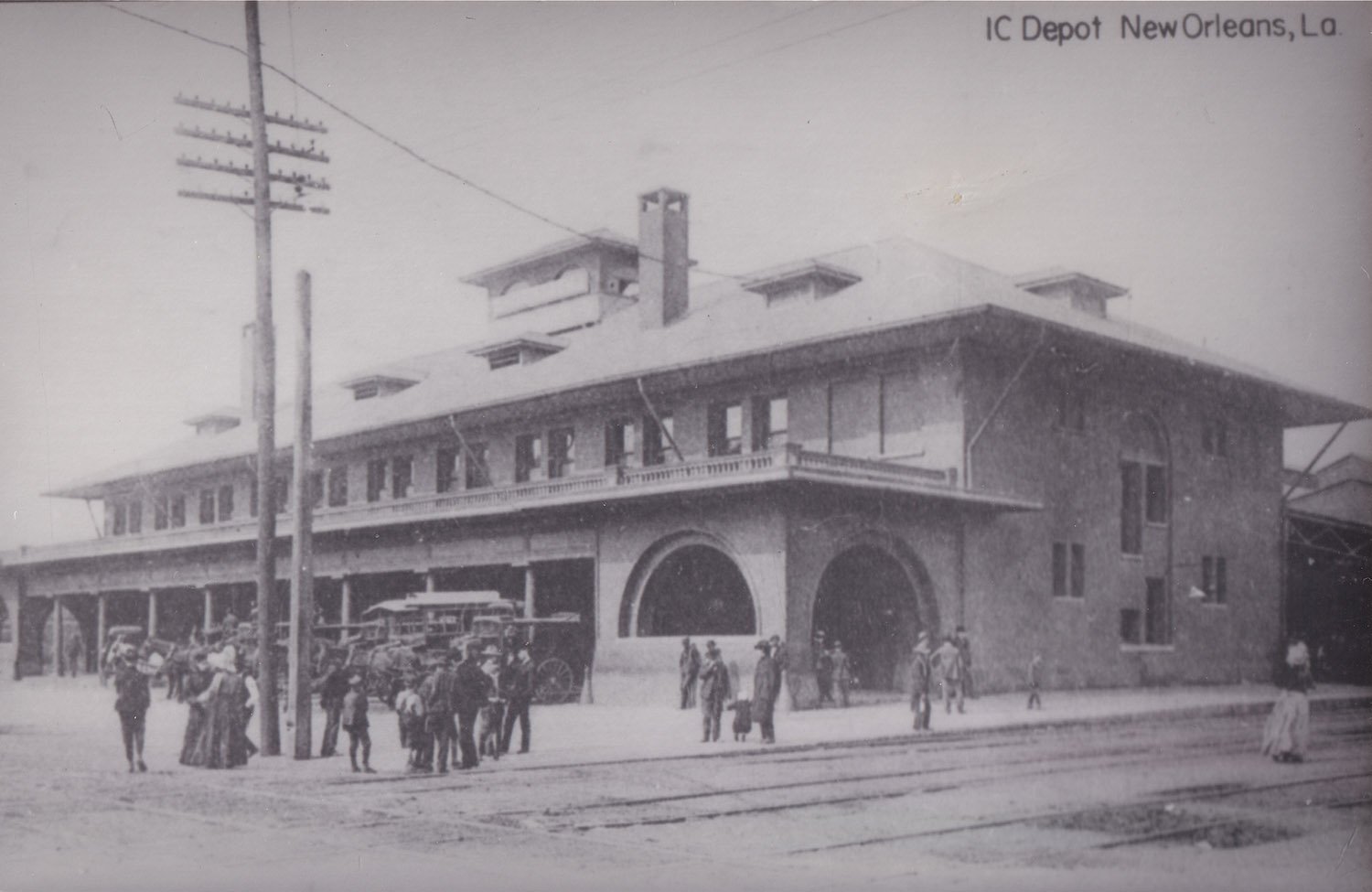
    Postcard view of the IC Depot, New Orleans

    This undated postcard depicts the Illinois Central (IC) Depot in New Orleans, later referred to as Union Station, opened in 18921 2 and demolished in 1954.3 4

    Officially credited to Louis Sullivan, the project likely had at least some input from Sullivan’s assistant at the time, Frank Lloyd Wright, who drafted the station’s blueprints.5

    In the depot design, you can spot the nascent elements of what would become the Prairie School style: the low-slung composition, hip roof, wide eaves, and patterned grouping of windows on the side were all radically different from the prevailing architecture of the time—certainly in the Deep South.

    That’s not to say it was an attractive building, though. In fact, I would consider it downright ugly. The New Orleans press apparently agreed, with the Times-Picayune saying rather demurely at the station’s opening:

    “It is not the finest depot in America, but it is a comfortable, ornamental building…”6

    Ouch.

    My pet theory is that the IC Depot’s design influenced G.L. Norrman—you knew I’d fit him into this somehow.

    Norrman visited New Orleans at least four times between 1893 and 1894,7 8 9 10 11and he must have seen the structure. Within a few years, he fully embraced low-slung buildings with hip roofs, though he began heading in that direction with his design for the C.D. Hurt Residence in 1893.

    Note the similarities between the depot and Norrman’s design for the Eureka Hotel (1902), or better yet, Denmark Hall (1901), which included a hip roof, thin chimneys, a porch lined with columns, and a second-floor balustrade, much like the depot.

    There’s no such thing as original art.

    References

    1. “The Railroads.” The Daily Picayune (New Orleans), June 1, 1892, p. 9. ↩︎
    2. “Railroad Racket.” The Times-Democrat (New Orleans), June 1, 1892, p. 9. ↩︎
    3. “Partial Use of New R.R. Station Is Slated to Start Next Friday”. The Times-Picayune (New Orleans), January 3, 1954, p. 1. ↩︎
    4. “Train Service Is Inaugurated in Union Passenger Facility”. The Times-Picayune (New Orleans), January 9, 1954, p. 1. ↩︎
    5. Louis Sullivan’s sophisticated Union Depot welcomed train passengers to New Orleans for more than 60 years | Preservation Resource Center of New Orleans ↩︎
    6. “The Railroads.” The Daily Picayune (New Orleans), June 1, 1892, p. 9. ↩︎
    7. “The Social World.” The Atlanta Journal, December 9, 1893, p. 10. ↩︎
    8. “Personal”. The Daily Picayune (New Orleans), December 24, 1893, p. 8. ↩︎
    9. “Society”. The Atlanta Journal, January 17, 1894, p. 2. ↩︎
    10. “Personal.” The Times Democrat (New Orleans), June 22, 1894, p. 3. ↩︎
    11. “In the Social World.” The Atlanta Journal, November 30, 1894, p. 2. ↩︎
  • Postcards from the South: Howard Library – New Orleans

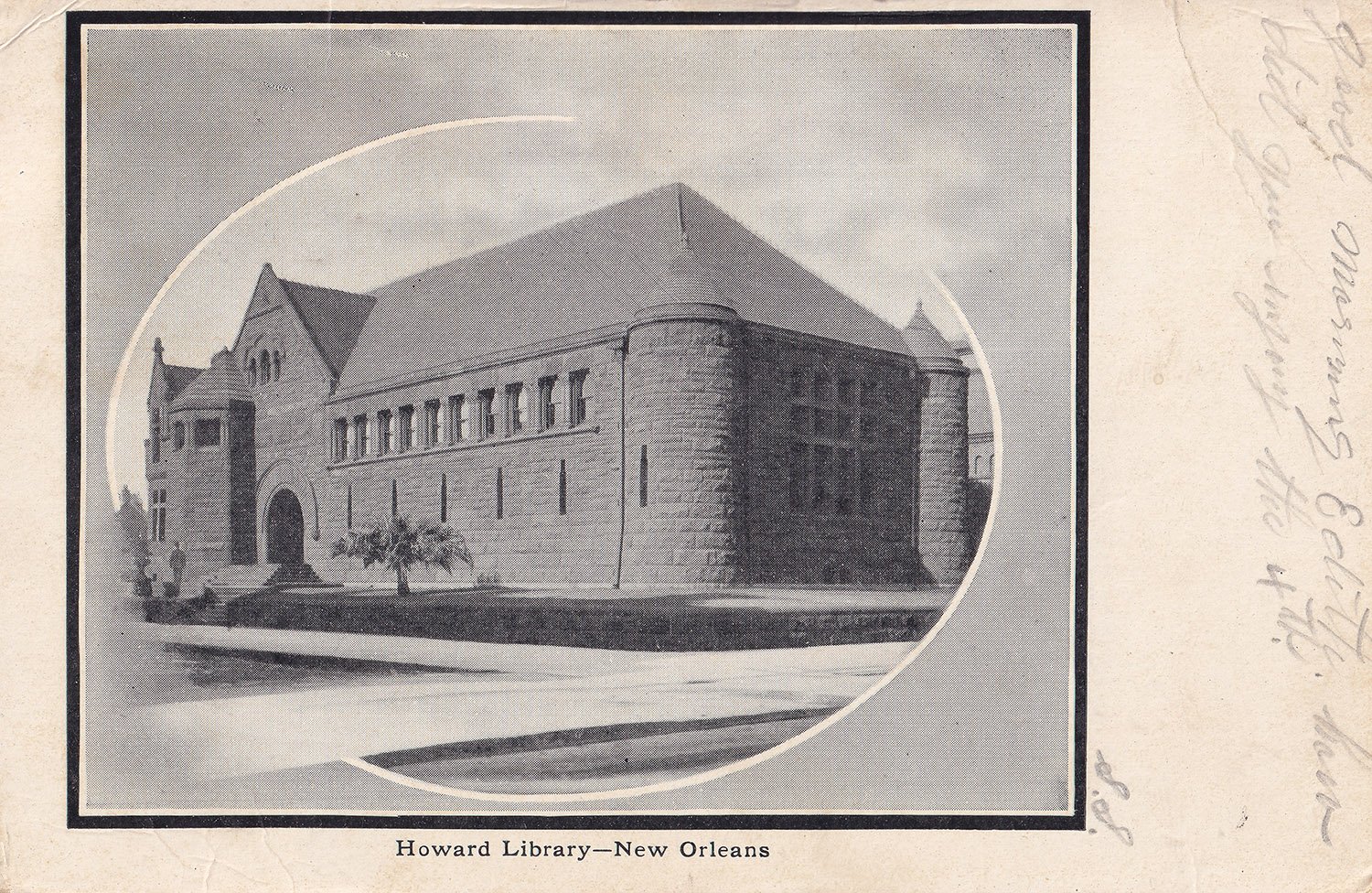
    Postcard view of the Howard Library, New Orleans

    Several years ago I drove around New Orleans for about two hours—long enough to learn that the place is a charmless shithole.

    On my way out of town, I was chased for several miles by some cracked-out asshole screaming and throwing objects at my rental car, for reasons that could only make sense to an addled mind.

    Before that inglorious send-off, I drove through the French Quarter and the Garden District and was quite underwhelmed by New Orleans’ so-called architecture, which is little more than cheap cast iron slapped onto a lot of gaudy, poorly designed buildings.

    I made a point of driving by the former Howard Memorial Library, completed in 18891 and ostensibly designed by H.H. Richardson,2 who grew up in New Orleans but wisely moved North to practice architecture.

    Location of Howard Memorial Library

    The building’s style is, of course, Romanesque—Richardson is credited with inventing the style. It’s not one of his better works, though, and was based on a rejected design for a Michigan library.3

    Richardson never saw the building either: construction began a year after his death, and his successor firm, Shepley, Rutan & Coolidge, dusted off the plans and reworked them.4

    Thus, it could reasonably be argued that Richardson didn’t design the building at all, although it’s often touted as his only work in the South. It certainly lacks the sophistication of his better Northern designs, but Richardson’s output was always hit-or-miss.

    I also suspect that Shepley, Rutan, and Coolidge, who were originally Richardson’s assistants, were largely responsible for his later designs anyway, but that’s a discussion for another time.

    I’d originally planned to take pictures of the library, but I’ll never set foot in New Orleans again, so this postcard will suffice.

    On the front, S.S. writes:

    “Good morning Edith. How did you enjoy the 4th.”

    The card was addressed to Miss Edith Smith of Box 85, Clinton, Miss., and postmarked on July 5, 1907.

    References

    1. “Opening the Howard Library.” The Daily Picayune (New Orleans), March 4, 1889, p. 4. ↩︎
    2. “Howard Memorial Library.” The Daily Picayune (New Orleans), January 30, 1887, p. 10. ↩︎
    3. The Howard Memorial Library – myneworleans.com ↩︎
    4. Howard Memorial Library | SAH ARCHIPEDIA ↩︎

  • Postcards from the South: Adams Motel – Dothan, Alabama

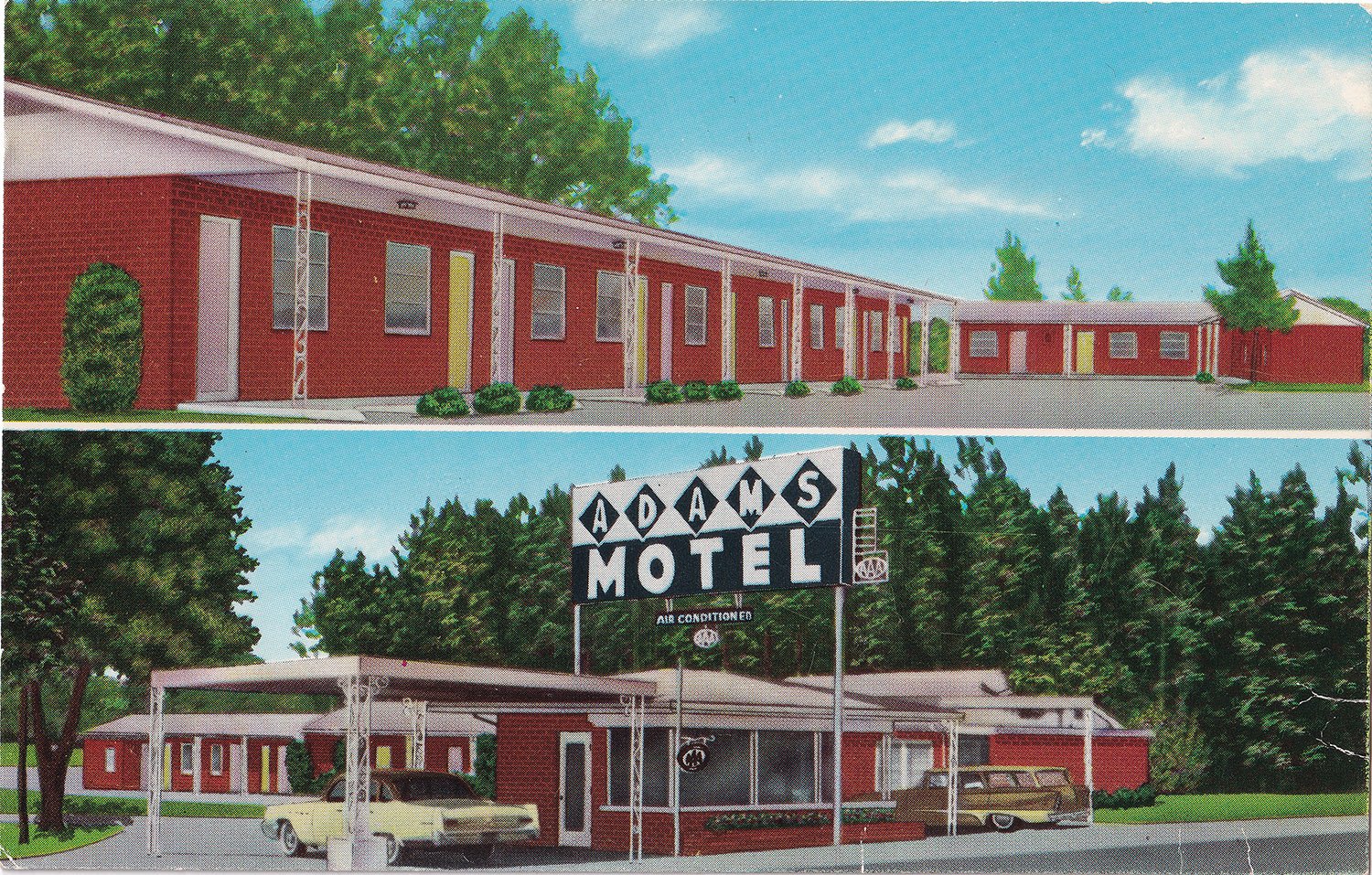
    Postcard view of the Adams Motel, Dothan, Alabama

    Ever been to Dothan, Alabama?

    I know I’ve driven through there a few times, but I’ll be damned if I can remember anything about it. That doesn’t surprise me, though—Alabama towns are generally sad and unremarkable.

    This postcard depicts the Adams Motel in Dothan and was published by W.P. Shealy Advertising of Dothan.

    The back of the postcard contains the following description:

    ADAMS MOTEL
    Located 1 block North of Traffic Circle
    on U.S. Hwy. 231
    39 Units – Air-Conditioned – Panel-Ray Heat –
    Tile Tubs and Showers – Room Phones – Con-
    veniently Located Near Restaurants.
    Phone: Area Code 205 – 792-5194
    Dothan, Alabama
    Owned & Operated by Mr. & Mrs. Luther Snell

    The motel still exists, albeit altered, and is now the Adams Inn. The Googie-style sign shown on the postcard is long gone.

    This postcard was never mailed, but someone used it to tally up their trip expenses, with the following calculations scribbled on the back:

    1/30/66 With Red Massy [?]

    2 Rooms $14.00

    Tax .42


    Dinner “Billy’s”

    3 meals 11.50

    Tax .36

    Tip 1.25

    13.11

    You only tipped 10 percent? Cheap bastard.

  • Postcards from the South: Dinkler Motor Hotel – Atlanta

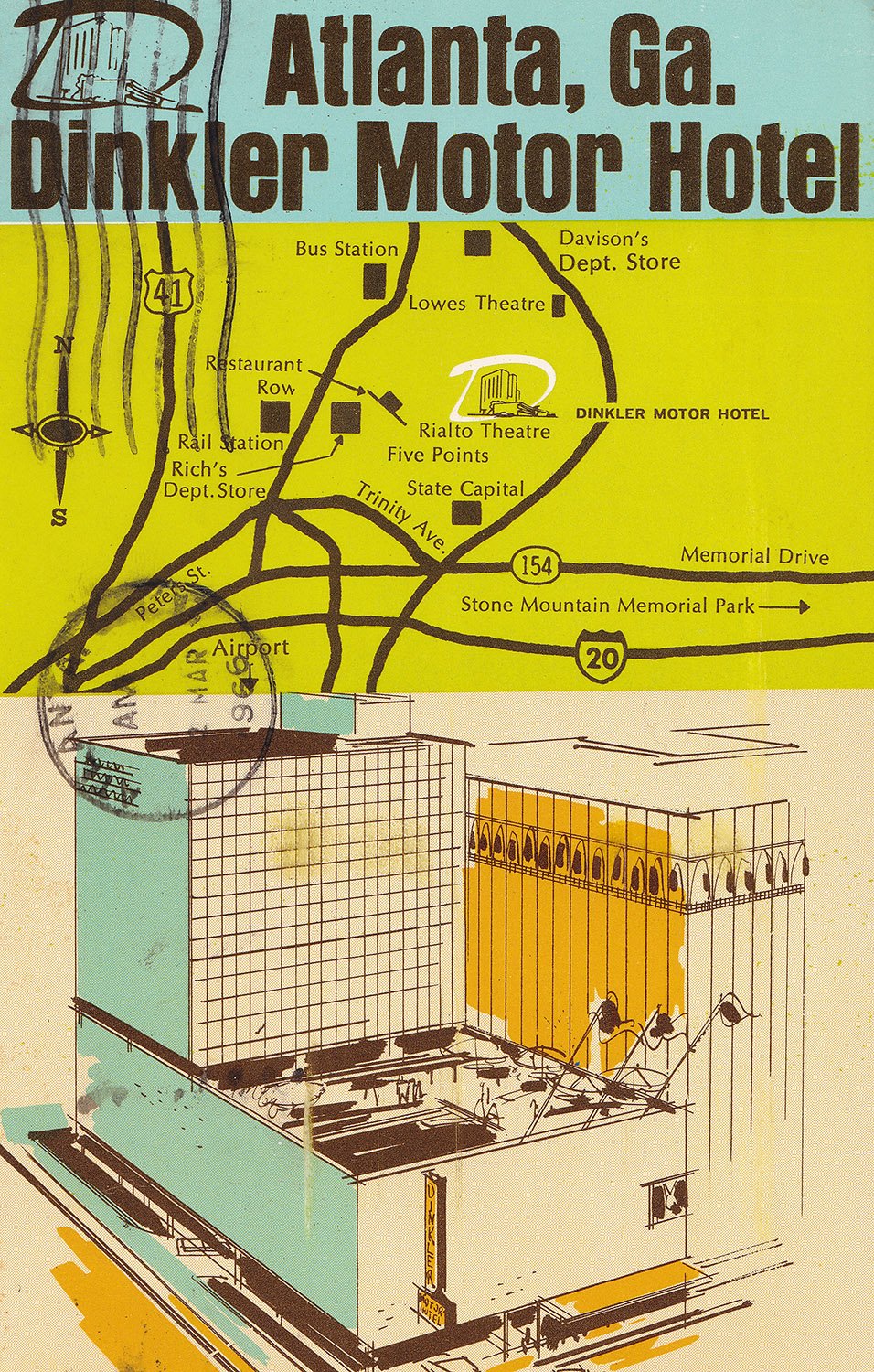
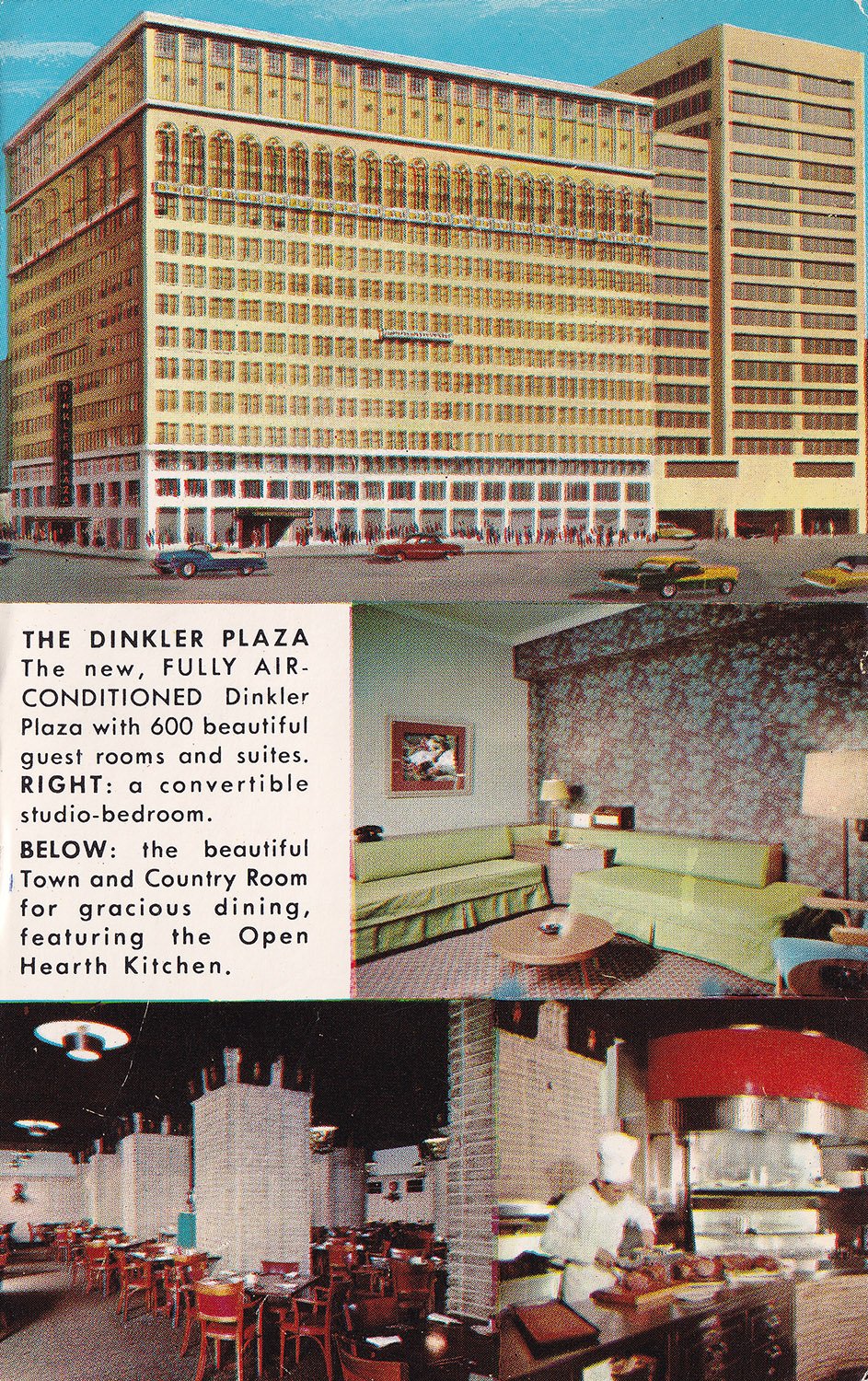
    Postcard illustration of the Dinkler Motor Hotel (1965), Atlanta

    This postcard depicts the Dinkler Motor Hotel in Atlanta, designed by Herbert C. Milkey Associates and completed in 1965.1 The building is still in use as a sleazy motel and is the only part of the Dinkler Plaza complex that survives.

    The card was published by Dinkler Hotel Corporation, “A wholly owned subsidiary of Transcontinental Investing Corporation”, and contained the following description on the back:

    THE DINKLER MOTOR HOTEL, Atlanta, Georgia
    The Crossroads of the South and center of social, business and political life. Air conditioned, television, free parking, swimming pool, four famous restaurants, outstanding convention service. International welcome center to greet foreign guests.

    The card was addressed to Mrs. Margaret Cohen of 47 Phipps Lane in Plainview, N.Y, and included the following heartfelt note:

    “3/1/66

    Honey —

    Thinking of you

    Love
    Irving“

    There was a Playboy Club in the motel.2 Just saying.

    References

    1. “Dinkler To Open 11-Story Addition”. The Atlanta Journal, February 17, 1965, p. 44. ↩︎
    2. O’Dark, Aft. “Playboy Club To Open Up With Fanfare”. The Atlanta Journal, February 27, 1965, p. 20. ↩︎
  • Postcards from the South: Top of the Mart – Atlanta

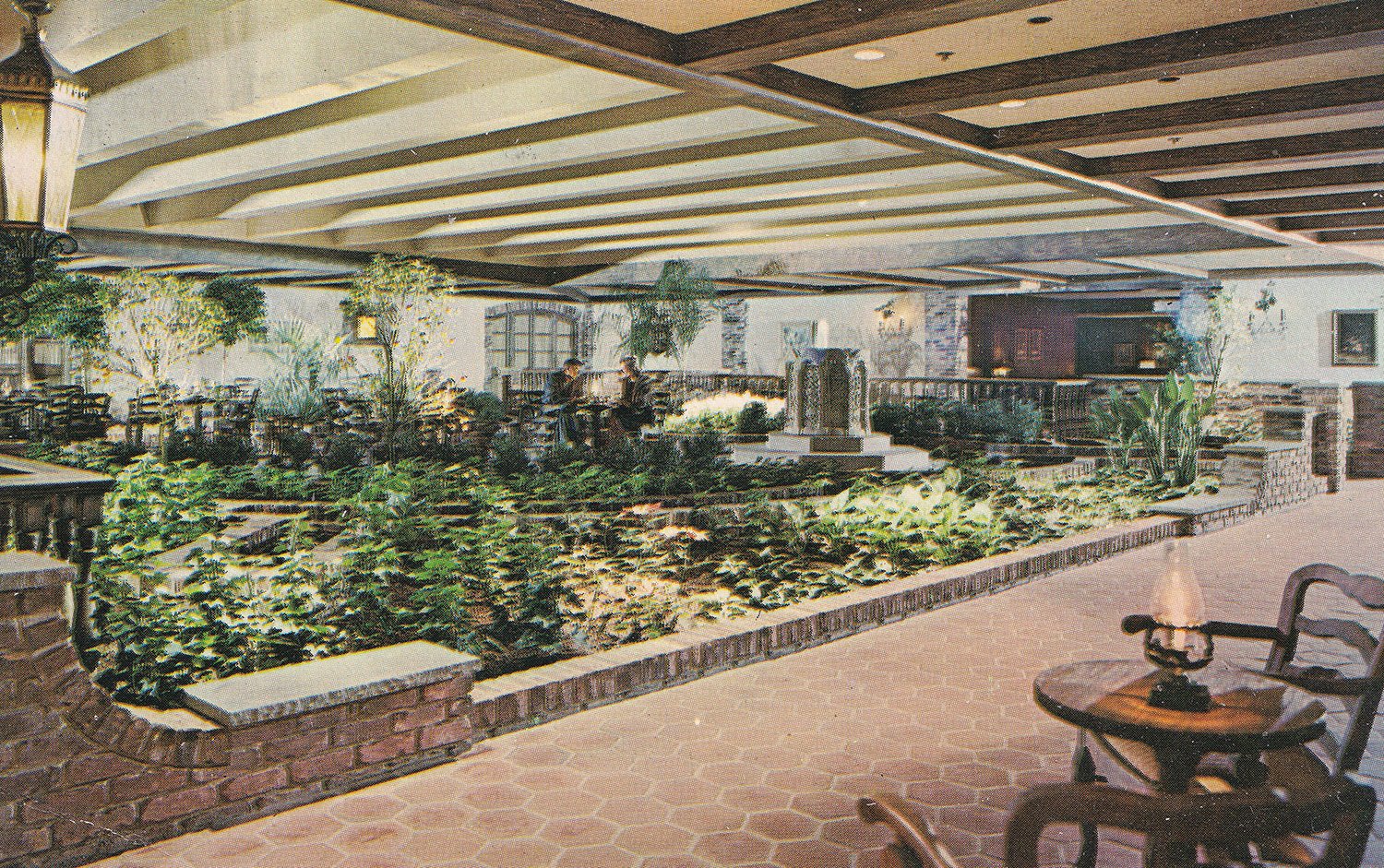
    Postcard view of Top of the Mart (1961), Atlanta

    This postcard depicts the Top of the Mart restaurant at the Atlanta Merchandise Mart, designed by John C. Portman, Jr. of Edwards & Portman and completed in 1961.

    Published by Colourpicture of Boston, the card includes the following description of the restaurant:

    TOP OF THE MART
    240 Peachtree St., N.W. Atlanta Ga 30303


    This enchanting, live Mediterranean Garden Court is a delightful introduction to the exciting “Top of the Mart” restaurant-lounge on the 22nd floor of Atlanta’s new Merchandise Mart. Luncheon, dinner and late dining . . . famous Stouffer food and your favorite beverages are served. Party and banquet facilities are available. Call 688-8650.

    The postcard was addressed to Mr. + Mrs. C.M. Whyte of Platt Hill Road in Winsted, Connecticut. Oh, they were whyte, alright.

    A note dated “Mon.-8-2-76,” states:

    “Hi! Congratulation! to Angies Deal. You must be happy with the performance. I missed the boat this time. Did you go up? Had dinner at This Restorant twice. last yr – in Atlanta, very good. Am looking forward to my 4 days at Wentworth by the Sea. Love to all

    Aunt Agnes.”

    I thought only TV characters were named Aunt Agnes.

  • Postcards of the South: Lenox Square – Atlanta

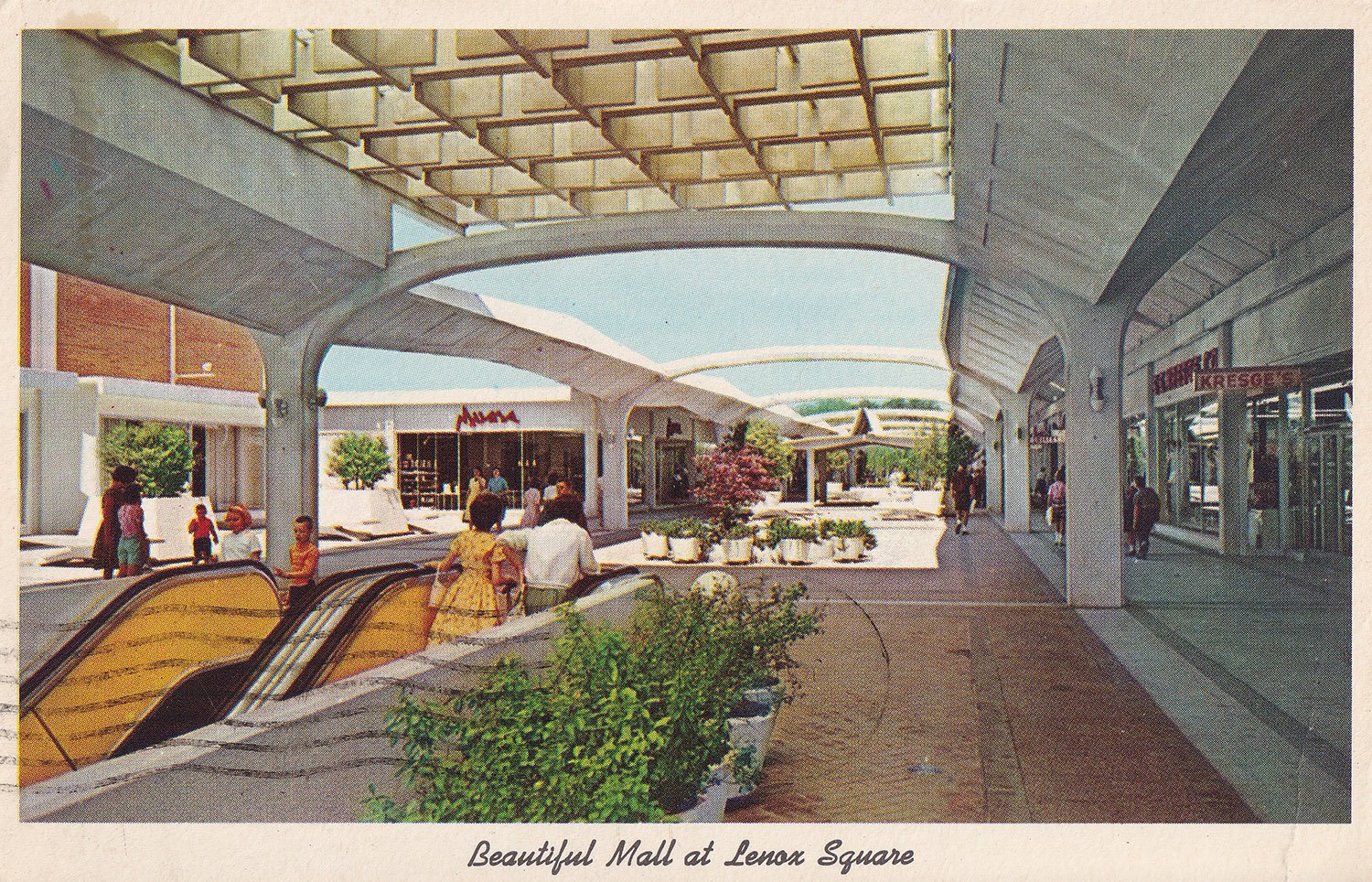
    Postcard view of Lenox Square (1959), Atlanta

    This postcard depicts the original Lenox Square in Atlanta, designed by Joseph Amisano of Toombs, Amisano & Wells, and completed in 1959.

    The shopping center still remains, but has been so completely altered that nothing in this photograph exists. It also has a roof now—I don’t know how anyone ever thought an open-air concept in Atlanta was a good idea.

    A description on the back of the card says:

    G-127–BEAUTIFUL LENOX SQUARE
    ATLANTA, GEORGIA

    One of the places that Atlantans point to with pride is fabulous Lenox Square Shopping Center. Outstanding architecture, 67 stores and services, flowering trees, plants and shrubs; a year-round program of events make this center more than a market place.

    Published by Gaston Photo Service of Atlanta, the card was postmarked in Atlanta on June 18, 1962, and addressed to Mrs. Wm. Grist c/o Mr. L.N. Jackson of Star Route #1 in Grayling, Michigan.

    Included is a short note:

    “6/16/62

    We are visiting friends here who used to be good friends of ours in St. John Woods. We window shopped in this area yesterday.

    As ever,

    Adele“

  • Postcards from the South: Dinkler Plaza Hotel – Atlanta

    Postcard view of the Dinkler Plaza Hotel, Atlanta

    This postcard depicts the Dinkler Plaza Hotel in Atlanta, originally the Hotel Ansley, designed by Brinton B. Davis with W.L. Stoddart and completed in 1913.

    Later purchased by the Dinkler Hotel Corporation, the hotel became a sprawling downtown behemoth, altered beyond recognition by multiple mid-20th-century renovations and additions, and was ultimately demolished in 1973.1 2

    This postcard includes the following description on the back:

    THE DINKLER PLAZA, Atlanta, Georgia – This outstanding hotel is FULLY AIR-CONDITIONED. An entirely new wing has been added to provide Atlanta’s newest, most outstanding convention service. Four famous restaurants offer fine dining in varied settings. TELEVISION.

    Published by Curtiecholor, the card was postmarked in Atlanta on July 10, 1958, and addressed to Clock Show Case of “308 PO Box New York 46, NY”.

    H.G. Stamey of P.O. Box 23, Cleveland, Ga., included the following cryptic note:

    “The price is Right – $22,97.90”

    Alright, Bob Barker.

    References

    1. “Dinkler Comes Down”. The Atlanta Constitution, February 6, 1973, p. 7-D. ↩︎
    2. Tharpe, Gene. “Wreckers in the Money”. The Atlanta Journal and The Atlanta Constitution, February 18, 1973, p. 1-E. ↩︎
  • Postcards from the South: McCain Library – Decatur, Georgia

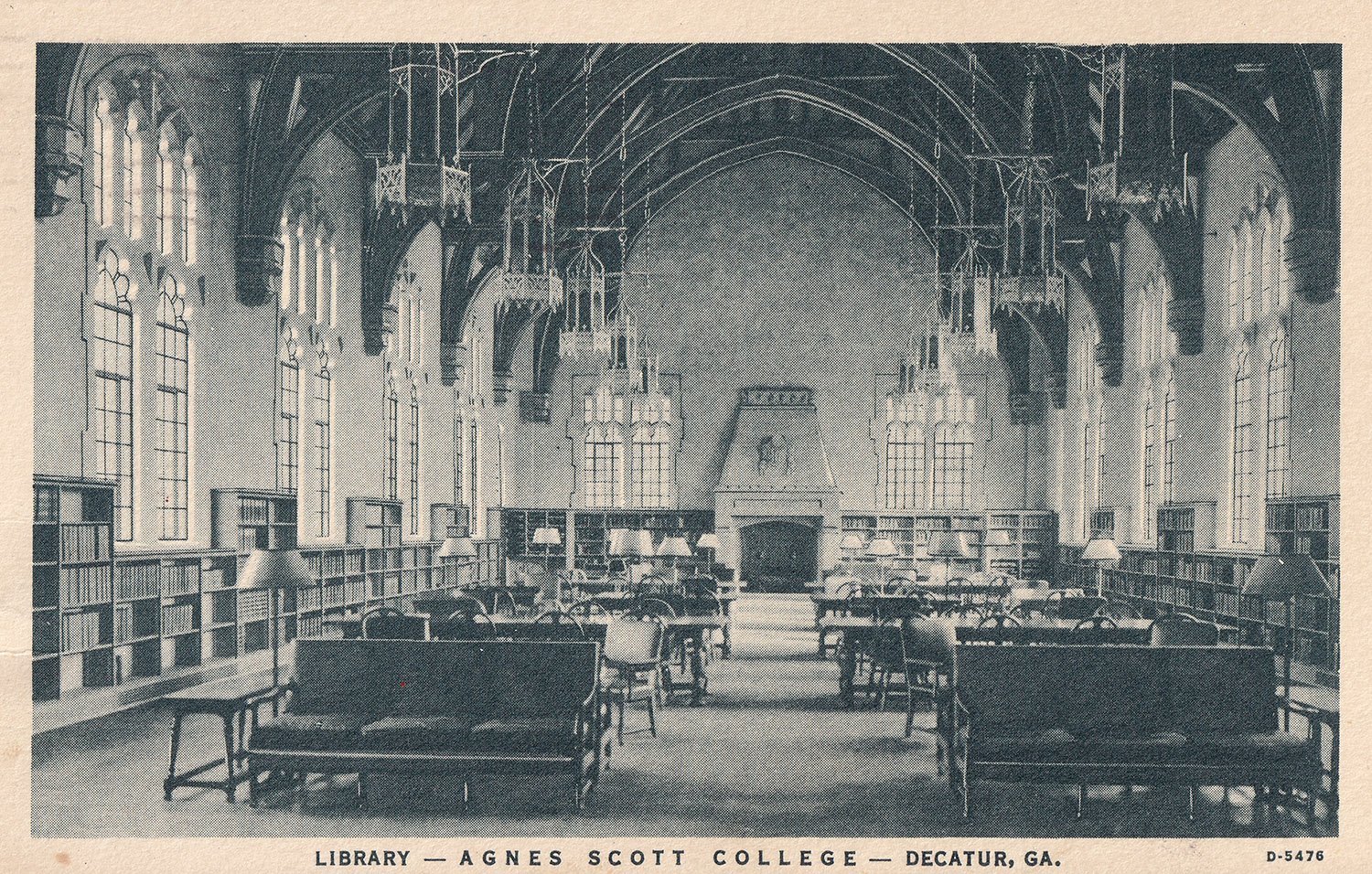
    Postcard view of the interior of McCain Library (1936) at Agnes Scott College, Decatur, Georgia

    This postcard depicts the interior of the McCain Library at Agnes Scott College in Decatur, Georgia, designed by W.J. Sayward of Edwards & Sayward and completed in 1936.

    Published by the AH Company, the card was postmarked in Decatur on November 5, 1942, and addressed to Miss Caroline Lorry of 124 E. Harrison in Maumee, Ohio.

    The following note fills the back:

    “It is always good to have news of you + your job + I am so happy you are liking your work. We have a larger school this year then last. Sarah Massey was promoted to Asst. Buyer for one of the depts. at Richs + soon after became very sick. She is critically ill with double pneumonia probably – they thought once it was typhoid. Miss Mac is working on the index of [?] it is about to get the best of her – she is so anxious to get it finished.

    Love, Bee Miller“

    Bee sounds like a busybody.

  • Postcards from the South: U.S. Post Office – Atlanta

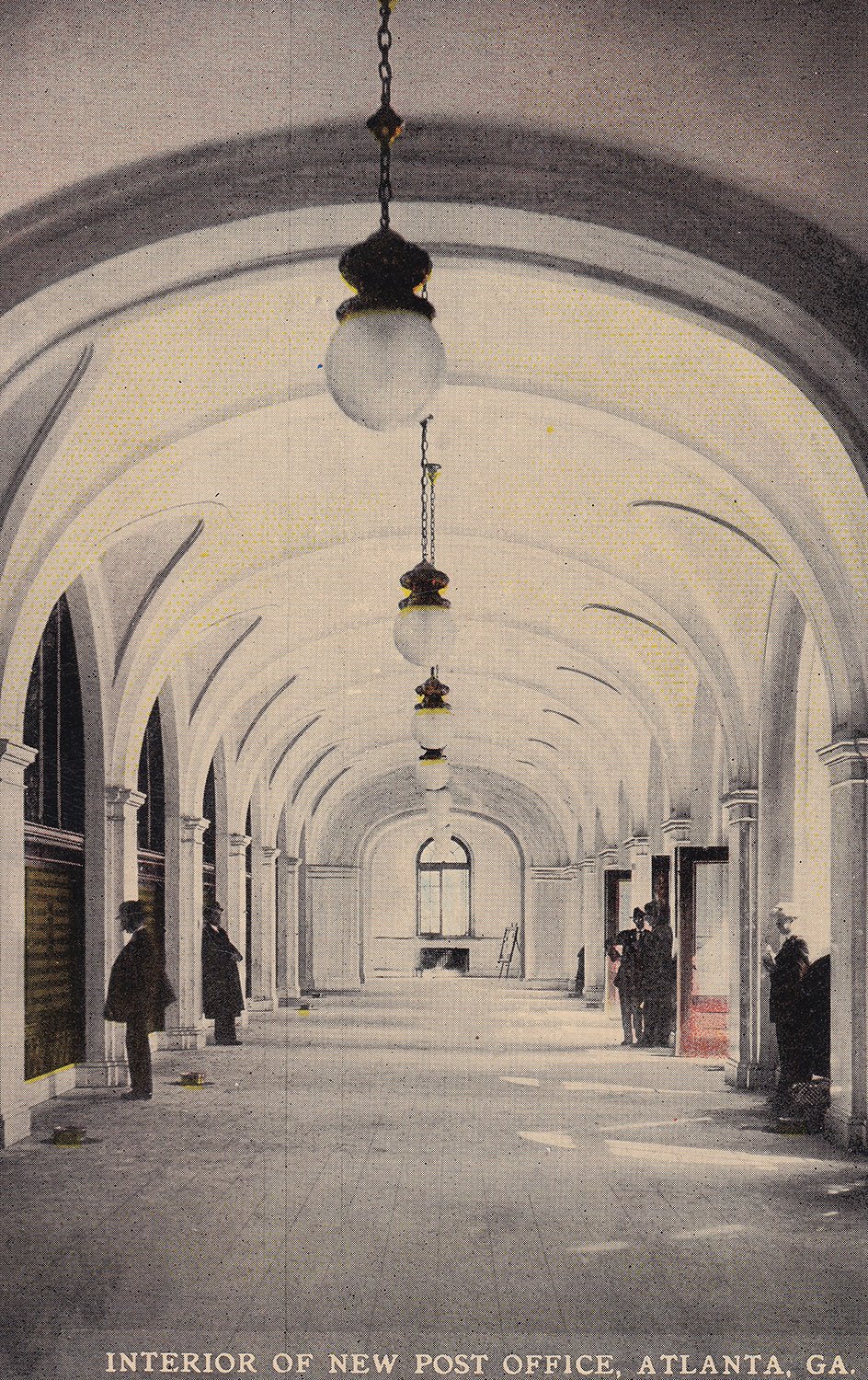
    Postcard view of the interior of the U.S. Post Office (1909), Atlanta

    This postcard depicts the interior of the U.S. Post Office in Atlanta, designed by John Knox Taylor and completed in 1909.

    Published by I.F. P. Co. of Atlanta, the card wasn’t postmarked but was addressed to Miss Lena Grow of #29 Dewey Ave. in Atlanta.

    The note on the back says:

    “Hello, my little friend [not creepy at all – ed.] how are you getting along how is Charlie hope he is better. if you did not mean that you could go to the meeting what did you mean be cause I do not understand wont you please tell me. I sure had a nice time Sunday hope you did. But I did not meet Miss”

    Literally everything about that message is disturbing.