The Background
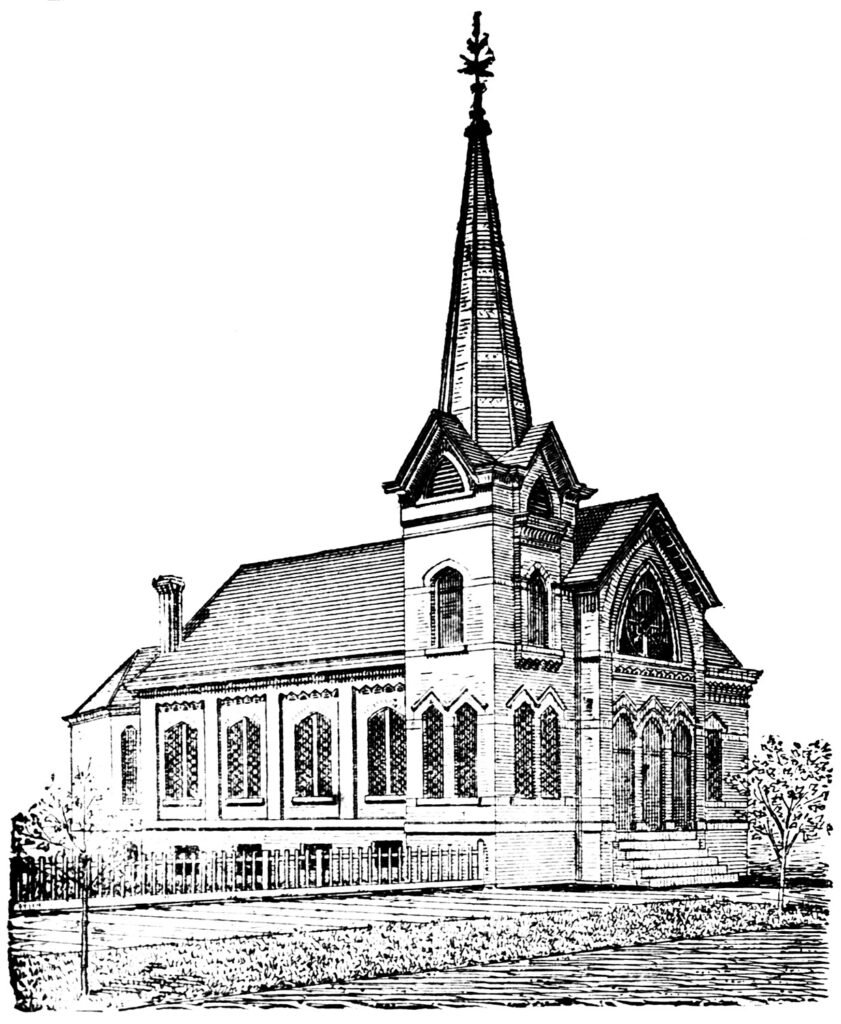
The following article was published in The Chattanooga Daily Times and details the plan and construction of the Walnut Street Christian Church in Chattanooga, Tennessee, built in 1886 and designed by A.C. Bruce of Bruce & Morgan. The building was demolished circa 1976.
Bruce was raised in Nashville, Tennessee, and began his practice in Knoxville, Tennessee. When he later partnered with T.H. Morgan in Atlanta, the firm continued to secure considerable work throughout eastern Tennessee, including, as the article notes, Chattanooga’s Hamilton County Courthouse and First Presbyterian Church, both demolished.
Location of Walnut Street Christian Church
The design of the tidy Gothic-style church, shown in the illustration above, is typical of Bruce, who consistently struggled to balance solids and voids in his compositions. Note that the doors and windows appear just a little too large for the overall massing: Bruce frequently drew doors and windows out of scale.
The Walnut Street Christian Church occupied this building until 1910, when the congregation moved half a block to the former First Presbyterian Church, becoming Central Christian Church.2 3
The old Christian Church building was then sold to the local chapter of the Knights of Pythias organization, who converted it into a meeting hall.4 Based on fire maps, the structure’s original 85-foot-high steeple5 was removed at some point,6 likely during this renovation.
In 1923, the building was sold again to the neighboring Newell Sanitarium,7 which converted it into a 10-room annex circa 1925.8 It appears the former church — altered at least twice — remained at 709 Walnut Street9 until the construction of the neighboring Downtown General Hospital, which opened in July 1976.10 The hospital’s parking lot replaced the building.
I won’t lie: This is a dead-boring article that reads a lot like those Old Testament books with endless lists of names and dry histories — the ones Christians pretend to read, if they read the Bible at all.
To make it easier to find, I’ve highlighted the portion about the building’s design in tasteful lavender. You’re welcome.
The New Christian Church to be Dedicated Today.
Handsome Brick Structure on Walnut Street Between Seventh and Eighth Streets.
History Of The Church.
Its Organization, Struggles, Work and Final Great Success–Full Roster of the Membership
During the winter of 1879, A. Teachout of Cleveland, O., came to this city to spend some months, and being an earnest Christian, he sought out some men and women of his own “faith and order,” and induced them to engage with him in an effort to begin the work in this city which has culminated in their house today, and the happy and memorable occasion which will there be celebrated. Among this little band who were brave enough to make such a beginning, may be mentioned Lucius DeLong and wife, N.P. Nail, R.S. Kendrick and wife, and W.C. Carter and wife.
Arrangements were made by them to invite Dr. W.H. Hopson, of Louisville, Ky., to preach a series of sermons in this city. Accordingly Dr. Hopson came and preached for about a week in the old Southern Methodist church, which stood at the corner of Eighth and Market, where Loveman’s new building stands. Dr. Hopson concluded his services in James Hall. In some respects, this was a notable meeting. Large crowds waited upon the preaching and the immediate results were ten accessions by obedience of the gospel: Bradford Post and wife, Fred H. Phillips, B.H. Ferguson and wife, James Nichols, Mrs. Webb and three others.
Before leaving the city Dr. Hopson effected a temporary organization and A. Teachout was appointed Elder of the church. From the time of organization regular meeting were held in a hall or other place within their reach. The worship of God has therefore been steadily maintained ever since.
THE SUNDAY SCHOOL
was established about 1878. Probably its first Superintendent was Weston F. Burch, of Missouri,–a man of rare worth never to be forgotten by those who knew him. His successors in that office have W.C. Carter, G.B. Woolworth, R. W. Andrews and the present incumbent, D.W. Chase, who has brought the school to unprecedented prosperity.
The school undertook to pay for the eight stained windows in the auditorium and will succeed. The children and the teachers of the school have paid to the building fund about $400 during the past two years besides paying their own current expenses and are ready to be among the first today to make pledge for liquidating the indebtedness. There is also a lively Mission Sunday School under the care of Charles Caldwell and Charles R. McCall, which has started during the last spring, which will bear its share of the responsibility.
THE PREACHERS
who have served the church have been A. Allison, Geo. W. Abell, J.R. Biggs, F.M. Hawkins, Dr. A.G. Thomas, A.S. Johnson, D.T. Beck and T.D. Butler. In a brief history such as this aims to be, many names which are entitled to honorable mention are likely to be overlooked. This is unavoidable and should not be construed by partial friends as intentional.
The local organization of the Christian Womens’ Board of Mission, which has done a large share of the work of raising money for this new house, as it had done for the very eligible lot upon which it stands, is largely due to Mrs. G.B. Woodworth for its establishment and successful management, though no year of its existence has been crowned with such prosperity as the present, under the active and indefatigable Presidency of Mrs. Eva Wilkinson.
The following have served the church as its Elders: A. Teachont [sic], N.P. Nail, B. Post, L.S. Barret, Isaac Strickle and G.B. Woodworth.
The Deacons have been: L. DeLong, Fred H. Phillips, S.J. Graham, Jno. A. Graham, A.B. Phillips, W.T. Lucas, J.R. Hays, R.W. Andrews, B. Post and Geo. B. Woodworth and D.W. Chase.
Up to the 1st of September, 1884, much had been done by this active and devoted people. They had secured the lot they now occupied and nearly paid for it, and they had made an appeal to the Home Missionary Society of the church in America to help them to sustain regular preaching. An arrangement was completed by which their present pastor, T.D. Butler, came among them, and the work at once began to advance vigorously. The new house, which is to be opened today, was started, and a systematic series of operations pursued by which financial help was received. To this end Mr. Butler has traveled much in Tennessee, Kentucky, Ohio, Indiana, Illinois and Missouri, and has raised nearly $2,500 in cash, and has secured loans to the amount of $1,500 on safe and advantageous terms. In addition to this, the spiritual needs of the church have been amply supplied, and more than a hundred members added to the membership. The lot furnishes only a narrow margin beyond the walls, but the house stands 75×50 feet, with a first-class basement. Here are two rows of graceful iron columns, supported by a substantial footing of stone, and thes [sic] in turn adequately support the floor of the auditorium. We reach the main room by spacious steps, which lead into a vestibule of ample size, having a door on the right which opens into the pastor’s room–as on the left you pass into the gallery above, which has a capacity of nearly 100 people–or below into the commodious school and prayer meeting room. The auditorium is furnished with neat pews from the Excelsior Furniture Co., Cincinnati, O., and cathedral glass windows from the Robert Mitchell Furniture House, Cincinnati. Beneath the rostrum is a baptistery [sic], with all the modern appliances, and on either side are the robing rooms to be used by candidates for baptism and for other purposes. On the whole this is one of the neatest, best furnished and most convenient churches in the city.
The plans and specifications for this church were generously donated by A.C. Bruce, Esq., of Bruce & Morgan, Architects, Atlanta, Ga.–the architect of the court house and the First Presbyterian church.
THE CONTRACTORS.
Stone work, Trout & Coxon; brick work, J.F. Wright; slate and galvanized iron, J.C. Banks & Co.; roof and tower, R.D. Whitice; carpenter work, W.M. Cosby and R.W. Andrews; gas fitters, Lookout Plumbing Company and plumbing by H.A. McQuade.
The building committee has been Isaac Strickle, D.W. Chase, G.B. Woodworth, R.W. Andrews, W.M. Cosby and John A. Graham.
The Trustees are Lucius Delong, President; D.W. Chase, Secretary and Treasurer; Bradford Post, G.B. Woodworth, M.M. Caldwell.
The present organization of the church is: Thomas D. Butler, Pastor; Official Board, G.B. Woodworth, Chairman; B. Post, D.W. Chase, John A. Graham, A. B. Phillips, W.M. Cosby, L. DeLong, G.M. King, J.T. Lynn.
[LIST OF CHURCH MEMBERS — too long and boring to repeat here.]11
References
- “The New Christian Church to be Dedicated Today.” The Chattanooga Daily Times (Chattanooga, Tennessee), August 8, 1886, p. 8. ↩︎
- “Dr. Boswell In His New Pulpit”. The Chattanooga News (Chattanooga, Tennessee), January 3, 1910, p. 2. ↩︎
- “Reasons For Their Faith”. The Chattanooga Daily Times (Chattanooga, Tennessee), January 3, 1910, p. 3. ↩︎
- “New Home Of Keystone Lodge”. The Chattanooga News (Chattanooga, Tennessee), January 8, 1910, Magazine Section, p. 4. ↩︎
- Image 9 of Sanborn Fire Insurance Map from Chattanooga, Hamilton County, Tennessee. | Library of Congress ↩︎
- Image 42 of Sanborn Fire Insurance Map from Chattanooga, Hamilton County, Tennessee. | Library of Congress ↩︎
- “Knights Of Pythias Give Up Old Home”. Chattanooga Daily Times (Chattanooga, Tennessee), March 24, 1923, p. 1. ↩︎
- “Newell Sanitarium To Increase Capacity”. Chattanooga Daily Times (Chattanooga, Tennessee), December 10, 1925, p. 9. ↩︎
- Rothberger Directory Company’s Chattanooga, Tennessee City Directory 1960. Chattanooga, Tennessee: Rothberger Directory Company (1960). ↩︎
- “In Tennessee”. Bristol Herald-Courier (Bristol, Tennessee), July 11, 1976, p. 1. ↩︎
- “The New Christian Church to be Dedicated Today.” The Chattanooga Daily Times (Chattanooga, Tennessee), August 8, 1886, p. 8. ↩︎