The Background
The following article was published in The Atlanta Journal in 1908, featuring an interview with Henrietta C. Dozier (1872-1947), the first female architect in Atlanta and the Southeastern United States.
In 1908, Dozier was chosen by the Atlanta chapter of the American Institute of Architects as its delegate to the International Congress of Architects in Vienna, prompting her to spend 4 weeks in Paris before attending the conference, followed by visits to Venice, Florence, Rome, Naples,4 5 6 and other destinations.
A European excursion was an obligatory rite of passage for any American architect of the era — at least, those who were serious about the profession. The United States was then in the throes of the Beaux-Arts movement, and architects were expected to examine the works of their European forebears for inspiration.
“Strange to say, the architecture of Europe did not particularly interest me,” Dozier later recalled in a 1939 interview, which mirrored her remarks here.
The writer of this article (also a woman) wanted an architect’s impressions of Europe, and she got them — Dozier found Vienna “disappointing” and Brussels “not very interesting”. On the flip side, she thought Antwerp was “perfectly fascinating” and enjoyed the fashions of the “chic Parisiennes”, although she barely mentioned Paris’ architecture. Priorities.
Dozier inserted some interesting observations about American indifference toward architecture, and she pointedly criticized the preferential treatment given to her male colleagues at the conference: “I don’t mind adding that the men had altogether the best of it when it came to getting particular good from the congress, as on especial meetings the women were packed off on some excursion…”
Given her unorthodox character, it seems entirely fitting that Dozier broke away from those excursions (“I did my own sight-seeing in my own way…”), and that she got “forbidden snapshots” with her Kodak camera “in spite of the signs and guards”. My kind of woman.
Miss Henrietta C. Dozier, Architect, Talks of Congress in Vienna
“I have been interviewed several times and I don’t think the interviewer ever got what he wanted from me.”
This from Henrietta Dozier, architect, in answer to a question regarding her recent trip abroad.
[Reporter:] “Perhaps I am not as hard to please as those others; I only want to know something about the purpose of your journey.”
[Dozier:] “I was a delegate to the National Congress of Architects which met in Vienna, a congress representing Italy, France, Germany, Russia, England and America. There were about five hundred delegates, several hundred of them women. I don’t mind adding that the men had altogether the best of it when it came to getting particular good from the congress, as on especial meetings the women were packed off on some excursion about the town or its environments. None of that for me, however. I did my own sight-seeing in my own way and got a world of good out of my half loaf of travel. As for the purpose of the congress it is primarily to arouse greater interest on the part of the different governments for a purer architecture to appoint a commission by the government to make laws whereby it will be impossible for an unsightly building to be built by one ranking in the thousands; to have some rules so that in time each country will show not only a few perfect buildings but that there will be a harmony in the whole. It seems a gigantic undertaking but in Europe architects have an important share in the making of the cities and in the brighter and more hopeful interest taken in civic improvement it may not be long before they will come into their own in America.”.
“What do I think of Vienna? I found it disappointing. It is all so new—the best of their buildings are modeled from the classic—there is nothing original in them. The best thing except for St. Stephens‘, are the new parliament buildings, but they are distinctly similar to the new university at Athens, and Greece has accomplished nothing better than the ancients and know enough to cling to their ideals. St. Stephens’ is delightful and quite, to my mind, the best thing in Vienna. The rest of the city I found German,” (which, parenthetically, would arouse the ire of both Austrians and Germans could they hear it.)
Miss Dozier, builder though she is, in brick and stone, is not above a weakness for the creations in less lasting fabrics, and confesses to a keen admiration for the chic Parisiennes and fashions of the Rue de la Paix, Paris.
But in Paris she found the best in architecture.
“They are clever, those Frenchmen, nobody is their equal in planning and proportion. One of the finest things I have ever seen in my life is Napoleon’s tomb, and it took a Frenchman to do it—that marvelous management of lighting, the effect of moonlight gained by the use of pale yellow and blue glass there is nothing like it in the world. It is only in their detail that they overdo. I don’t understand why they do it. Planned and proportioned perfectly they will stick a lot of silly detail on that will come near to ruining their entire piece of work.”
“Perhaps that is as characteristic as the stolidness you find in German architecture.”
“Perhaps it is the super adornment, the ornateness, the extra trimming both in manner and building, but oh, they are so clever.
“I saw an architectural exhibit in the Salon and there was nothing like it for beauty of outline or plan.”
“No the Salon was not particularly interesting. Of course there were some good things, but I was surprised at the acceptance of some of the pictures; they were far below the usual standard.”
[Reporter:] “That wouldn’t be if all artists had the ideals of Monet.”
“No, indeed, it must have taken nerve to destroy £20,000 worth of pictures without taking into consideration the time and effort he must have put into them. Coming back to architecture, it hurts so to see the prevailing indifference of America to what architecture really means, so little realization of what a telling criticism a building of stone is on generations of the past. How ignorance endures in stone and how, when well done, what a monument to knowledge and culture.
[Reporter:] “Don’t you think, architecturally speaking, that the south has deteriorated since the [Civil] war instead of growing?”
“Oh, no; not at all, the people as a whole, are building better and more harmonious homes than ever before.
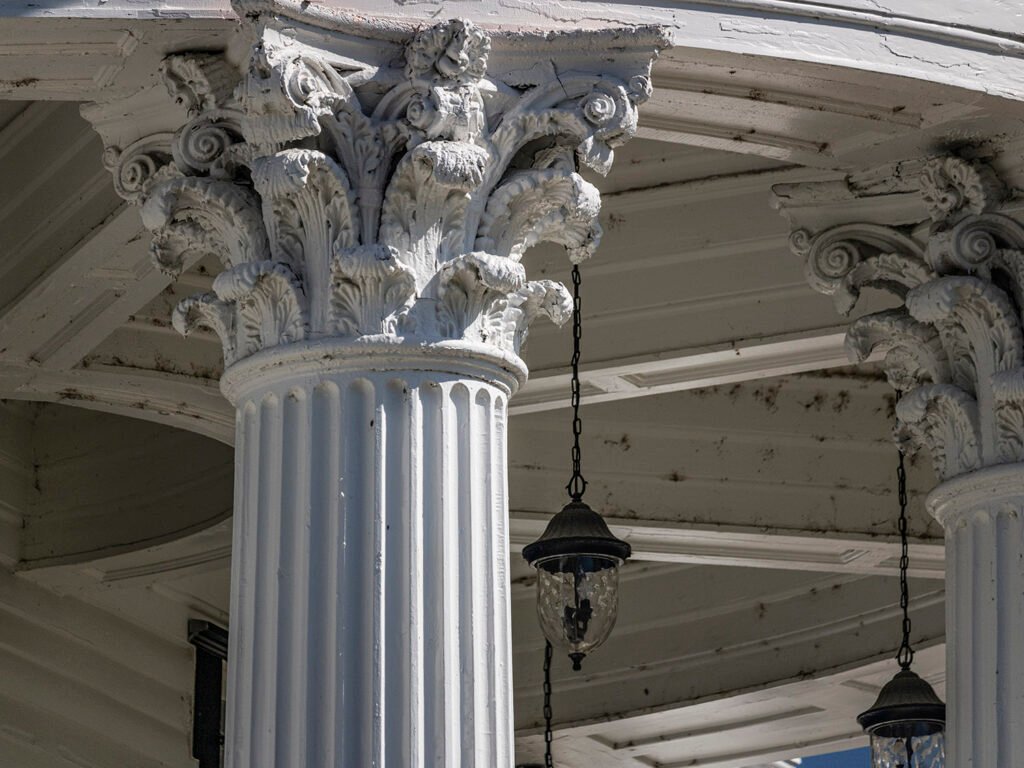
“Of course in the ante-bellum south the homes were modeled, many of them, from places already old when America was young. Built by men who wanted to bring with them the atmosphere of England to the new world—cultured students—men who knew the difference between cornices and capitals and who knew better than to confuse Gothic with Doric. A great deal of trouble comes from magazines. Not that I wish to underrate the undeniable good that magazines do, for they do a great deal in bringing to the people a broader, better view on homes and home surroundings. If the readers were only educated enough to differentiate between the bad and the good. But a little knowledge is as dangerous in architecture as it is in most things and people who have not made it a study and who wish to build would do well to leave it some one who has made it a specialty. Atlanta has made a great stride forward in the appointment of a civic improvement commission and we can hope for a more beautiful, a more harmonious Atlanta.
“And it is along these lines that the commission of the International Congress is working.
“The meeting in Vienna was the eighth which has been held and there were delightful social features in connection with the more interesting business ones. A reception at which Frances Joseph [sic] entertained the delegates, another charming one at Sehonbrun [sic], the summer palace, carriage drives on the Ringstrasse [sic] and out into the Danube valley and a number of formal affairs at private homes.
“About the rest of my trip? There was the landing and a stay of several days at Antwerp that I found perfectly fascinating. Antwerp is a place you could stay and long time in and not get tired of it. Then from there to Brussels which is not very interesting to me, and I only stayed for a short time on the way to Paris, where I spent three weeks, and to where I am going back at my first opportunity. Basle was attractive and I had a delightful stay in Salzburg and Munich, then Linz, where I took the boat for Vienna on the Danube. From Vienna I went to Venice, Rome and Naples from which point I sailed. It was a nice half-loaf, but it made me hungry for the other half, and the next time I go I hope to stay longer and see more.”
Miss Dozier took a number of interesting kodak pictures and in spite of the signs and guards, got views of San Angelo, interior details of St. Peter’s and a series of forbidden snapshots in the French capital.
MABEL DRAKE.7
References
- “Personal and Incidental.” The Columbus Enquirer-Sun (Columbus, Georgia), October 17, 1909, p. 4. ↩︎
- “Wanted–Driver and Butler.” (classified advertisement) The Columbus Ledger (Columbus, Georgia), September 25, 1910, p. 2. ↩︎
- “Mrs. Blackmon’s Bridge Party”. The Columbus Enquirer-Sun (Columbus, Georgia), March 5, 1911, p. 2. ↩︎
- “Miss Dozier Goes Abroad.” The Atlanta Constitution, April 5, 1908, p. 4. ↩︎
- “Miss Dozier Sails On European Trip”. The Atlanta Journal, April 5, 1908, p. 24. ↩︎
- “Some Personal Mention”. The Atlanta Journal, April 5, 1908, p. 39. ↩︎
- Drake, Mabel. “Miss Henrietta C. Dozier, Architect, Talks of Congress in Vienna” The Atlanta Journal, June 19, 1908, p. 13. ↩︎