The Background
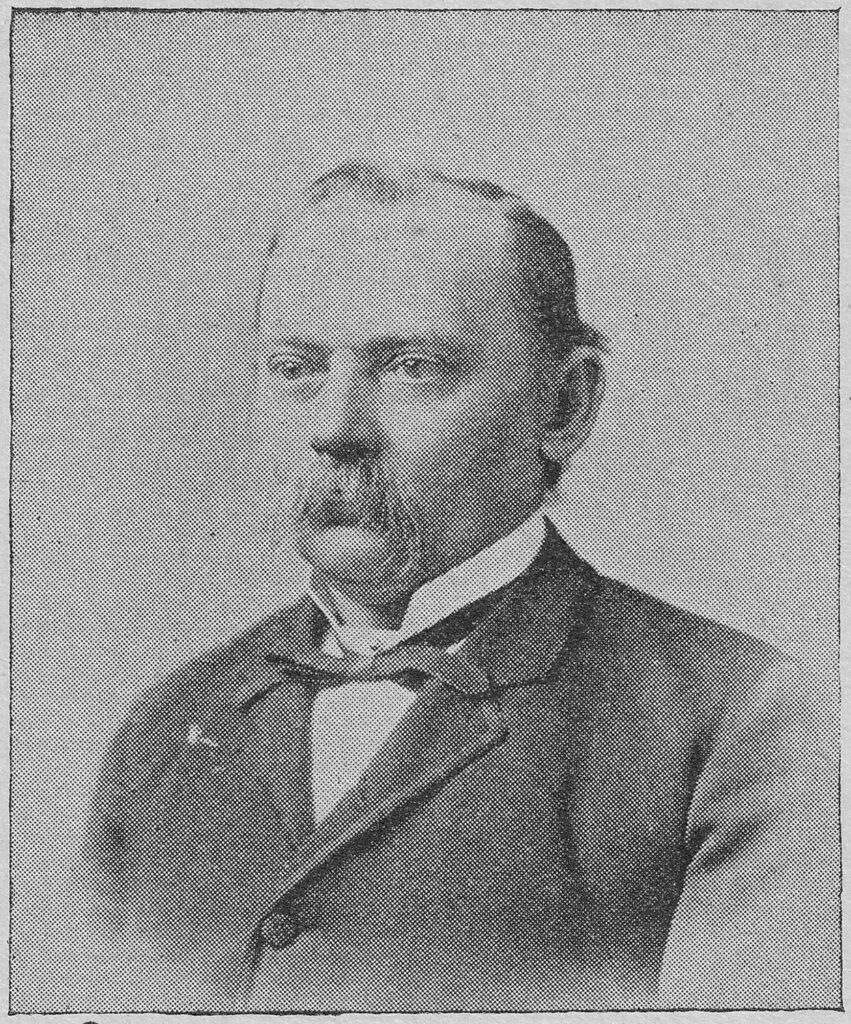
The following autobiographical account was written by Paul Romare (1828-1904, pictured here) of Atlanta and published in 1892-93.
Romare was born in Sweden and raised in a working-class family, but later became an American citizen and one of Atlanta’s most prominent social figures, serving nearly 40 years at the Atlanta National Bank.
At the time he wrote this sketch, Romare was employed as the bank’s vice president, but was appointed president in 1903. When he died just a year later, it was reported that “no one had more friends than he.”1
Romare’s story provides a fascinating glimpse into his circuitous journey to the Deep South, an uncommon destination for Swedish immigrants in the 19th century.
The story is particularly interesting because of the many parallels between Romare’s life and that of his younger friend and fellow Swede, G.L. Norrman, whose own coy autobiographical sketch a few years later was much less revealing.
I kinda wish Norrman had taken a cue from Romare and shared more details of his early life, but alas, the enduring mystery of the man is part of his appeal.
Mr. Paul Romare.
Paul Romare, Vice-President of the Atlanta National Bank, whose history being somewhat out of the usual line, may prove a matter of interest to his many friends and the readers of these pages. We give his life and life work in his own words:
I am a Swede, born on the shores of the Cattegat, in the town of Tonkon, Province of Skane, Sweden, November 20, 1928.
I was the youngest of five children, three brothers and one sister. From the age of six to fourteen I attended the village school, where I obtained a knowledge of arithmetic, geography, and history. At fourteen I left school and began life in earnest. My father, Paulus Romare, was Captain of a merchant ship for over thirty years. Too young to launch out for myself, I went with him as cabin boy to New York in 1843.
Of course the impressions of this first sight of America and an American city were not only deep but naturally enchanting to a young lad such as I was. None but a foreigner can appreciate the newness and beauty of a place like New York, and right then I felt that at some time this to me new world must and should furnish a home.
Of course I returned with my father in Sweden, and remained at home one summer. The next fall I sailed again as cabin boy with an older brother, who was the Captain of a ship. We sailed from Stockholm to Marseilles, returning home in the summer of ’45. That same summer I sailed again with a friend of my father’s for the Island of Java, touching Cape of Good Hope going and returning.
Resting a while in Stockholm I sailed with the same Captain for New York once more, and from New York to Rotterdam, Holland. While in this city the First Mate left the ship and I was given his position at the age of eighteen. However, by this time I had considerable acquaintance with the sea and sea-faring, and had gathered some knowledge of navigation from my father, brother, and present Captain. We returned to America, visiting Philadelphia and New York, and while in this city that had for me so many charms an incident occurred which changed my future and indeed my entire life. My Captain and I had a quarrel, and vowed I would never return with him to Sweden. Of course I kept my decision a secret for prudential motives.
Of course I ran considerable risk, but I went at once to see a friend, a Swede who live in New York for some years. I told him I was determined to remain in America. He promised to come to our ship that night in a boat and help me off. Like a true Swede, he kept his word, and I was soon securely hid in his home.
Just at this time, unfortunately for me, my brother’s ship was in the harbor of New York ready for sea. He was duly notified by the Captain of my escapade. He hastened to our mutual friend, feeling sure he knew of my whereabouts. I heard him coming; I knew his step. A closet being near, I opened the door, went in and was secure and out of sight. I could even hear his voice and what he said. My friend was astonished at my leaving; it was all news to him. I knew from what my brother said he did not believe one word, but seeing search in vain he left, and before next morning he was far out on the Atlantic. The ship I had so hastily abandoned also left in a day or two.
Left now absolutely master of myself and fortune at the mature age of eighteen, a stranger in a strange land, not one word of English at my command, I began to turn my thoughts to the serious side of my situation. That America was to be the home of my adoption was absolutely decided. That a knowledge of the English language was absolutely necessary to my progress in the new home was also decided. What to do while gaining that knowledge was the next serious question. This last query was soon settled by my shipping on an American brig as a sailor, bound for Mobile. On that trip I took my first lessons in English. On the vogage I found Dana‘s “Two Years Before the Mast.” Being far more familiar with the sea than I was with the land, the book naturally caught my fancy, being the plain and simple experience of a man who was two years before the mast. How I read it, now after the lapse of so many years, I cannot tell, but that I did read it and enjoyed it I am certain. Having no one near me who knew one word of my native tongue, I soon from sheer necessity had quite a vocabulary at my command.
I made various trips after this, crossing the Atlantic at least a dozen times; also had two or three trips to the West Indies and Mexico–on one of these trips taking army supplies to troops in Mexico. My last trip was from Charleston to Havana and back to Charleston, and in this city I was attacked with rheumatism, upon which my slight misfortune hinged my future plans.
One summer day, stopping at a cigar store on Broad street, I met a gentleman, a Swede, who had recently purchased large interests in the iron works at Cooperville, South Carolina. I had seen him before, and being countrymen, we were mutually drawn to each other. Approaching me, he said in Swedish, “Come, go with me to the iron works; you will soon get well, and I am in need of an interpreter. I cannot speak English, and I need a good man who can help me manage the business. I decided to go, and at the iron works took my first lessons in native business, first clerking at the supply store and then keeping books for the company. I was there from 1850 to 1854. It was then a prosperous concern, working about three hundred hands and manufacturing pig iron, bar iron, and hollow-ware.
In the summer of 1854, having laid aside some money, I resolved to see my native land once more. I left New York the last of April and reached my old home on Sunday, May 15. I notified no one of my coming. Reaching our house I rang the bell, asking for Captain Romare. My father did not know me, but in a little while all the household gathered to rejoice over the long lost and long regretted.
After a most delightful visit I returned to the home of my adoption. That fall I accepted a position in the Bank of Chester from the President, Mr. George S. Cameron, who was a friend of mine as long as he lived. I remained in Chester till the commencement of the war, when I enlisted with the old Chester Blues, the first company that left our place. I remained with that company till I was detailed for service in the War Department at Richmond, and was there till the evacuation, when I left with the retreating army, and in a few weeks the surrender at Appomattox ended the struggle.
In 1863, I was married in Grace Church, Camden, to Miss Lucy Fisher. I returned to Camden, and in the fall came to Atlanta to accept a position in the Atlanta National Bank, offered by my old and true friend, George S. Cameron, who with General Alfred Austell were the founders of that bank immediately after the war. I may mention that I received the first deposit ever made in that bank.
The rise, success, and prosperity of the institution are too well-known to be repeated. My life and life-work I may truly say has been here. For more than a quarter of a century my days have been spent in this bank, and to it has been given my best of life and time. Those who began here when I did are few indeed. I may say that I am the only one of the original officers and stockholders that is still interested in the bank.
I have made my home in Atlanta; here I expect to spend the rest of my life, and departing bequeath to this city and her people my fondest wishes and blessings.2