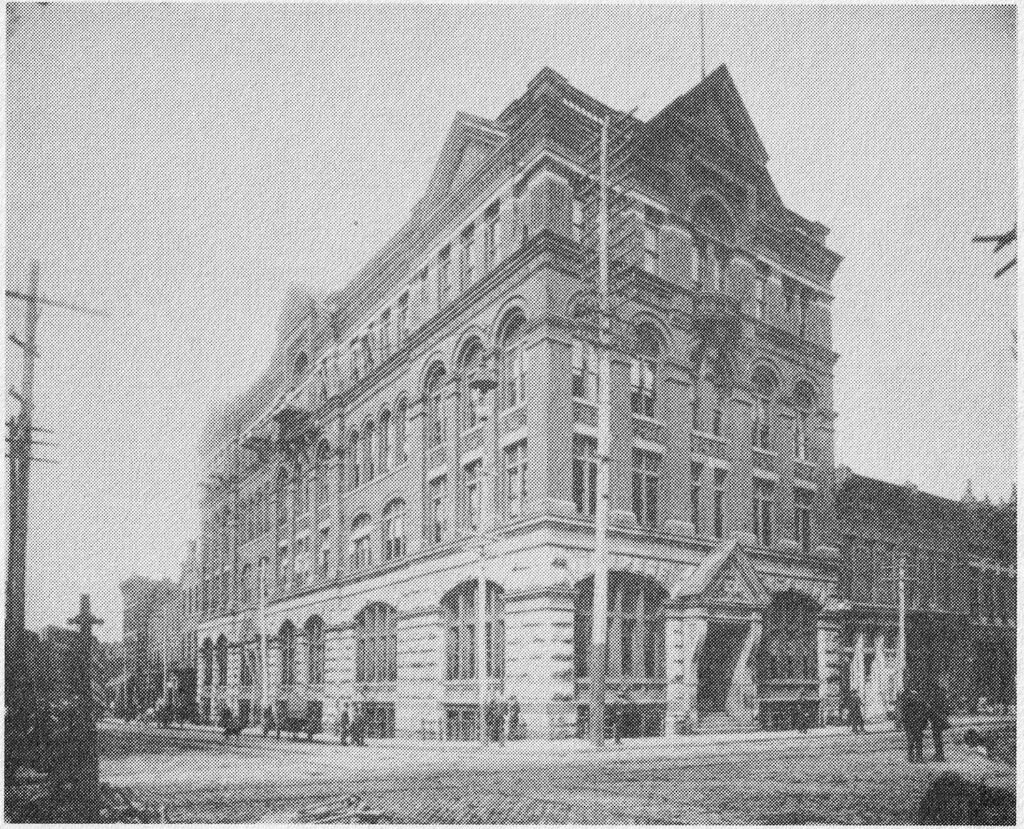
The Background
The following biographical sketch, published in 1884, is one of just a few sources with details about the early life of G.L. Norrman, including an interesting anecdote about a violent outburst in his youth — a forerunner of many to follow.
The sketch appeared as part of an article in The Atlanta Constitution heralding the completion of the first “modern” office building in the city, which was designed by Norrman and owned and anchored by the Gate City National Bank.
Located at the southeast corner of Alabama and Pryor Streets, the 5-story structure was one of Norrman’s most important early works, designed in the “metropolitan style”, with Stone Mountain granite for the foundation, Tennessee limestone on the lower floors, and pressed brick on the upper floors.
Location of Gate City National Bank
The building’s entrance porticoes were made of Ohio freestone and carved by a mysterious Mr. Ruckle, who was said to be a graduate of the “national school of fine arts at Munich”.2 Inside, the building included an elevator,3 among the earliest in Georgia (the first one debuted at Atlanta’s J.F. & M.C. Kiser department store in 18774).
The project took nearly 2 years to complete5 and was officially credited to Humphries & Norrman.6 However, George P. Humphries left the firm shortly before its completion,7 and it appears Norrman was the primary designer, assisted by his first known draughtsman, Aug Petersen.
L. J. Hill, president of the Gate City National Bank, praised Norrman’s design for the building, saying: “…no finer architect need be wanted by anyone than Mr. Norrman.”
Although the article calls it the “Hill building”, the structure was typically referred to as the Gate City National Bank until the institution abruptly closed its doors and was sold in 1893,8 9 after an employee embezzled over $100,000 from its coffers.10 11
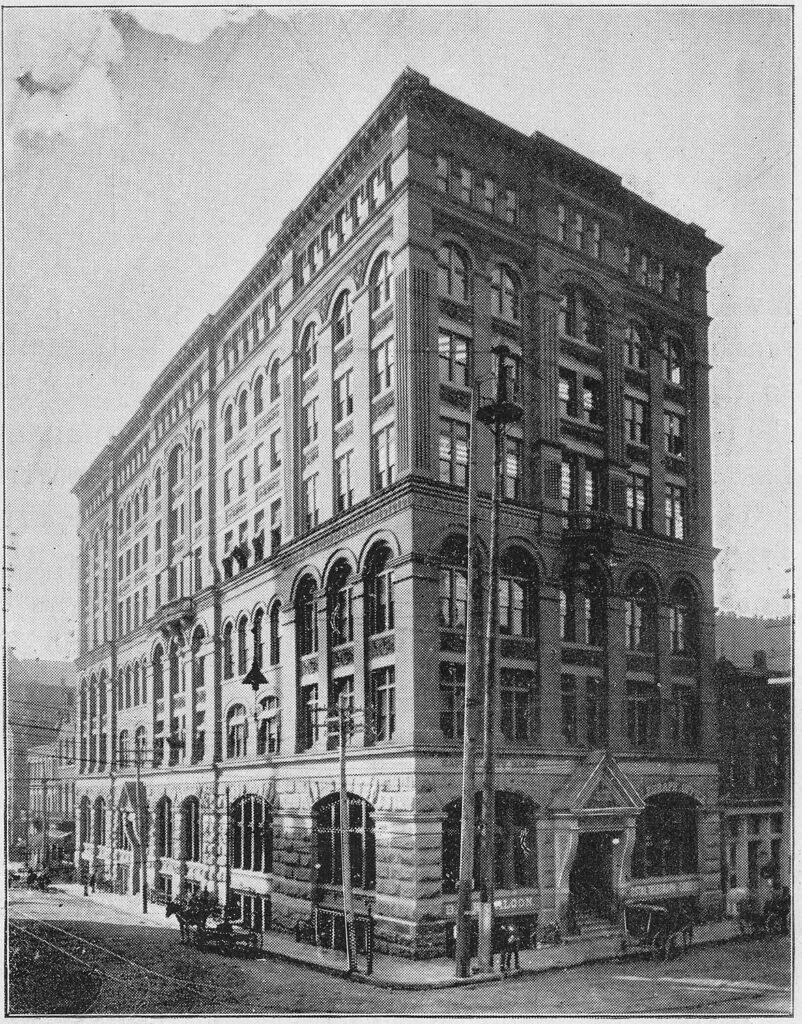
Seizing the opportunity for prime real estate, the Venable Brothers of Atlanta purchased the building,13 and in 1895, added 3 floors14 with a roof garden,15 installed “two swift modern elevators”,16 renovated the interior,17 and renamed the structure Temple Court (pictured above).18
Billed as “Taller than the Equitable“,19 the 8-story Temple Court gave the structure a new lease on life, as it was already becoming outmoded by Atlanta’s first “skyscrapers” of the 1890s, which topped out at a whopping 10 floors by the end of the decade.
The Temple Court addition was reportedly designed by another architectural firm,20 but while work was underway on the project,21 Norrman was also hired by the Venables to design the 10-story Hotel Venable (unbuilt).22 23 24 25 26 Whoever was responsible for the Temple Court addition (I suspect Bruce & Morgan27), it appears to have seamlessly matched Norrman’s original design.
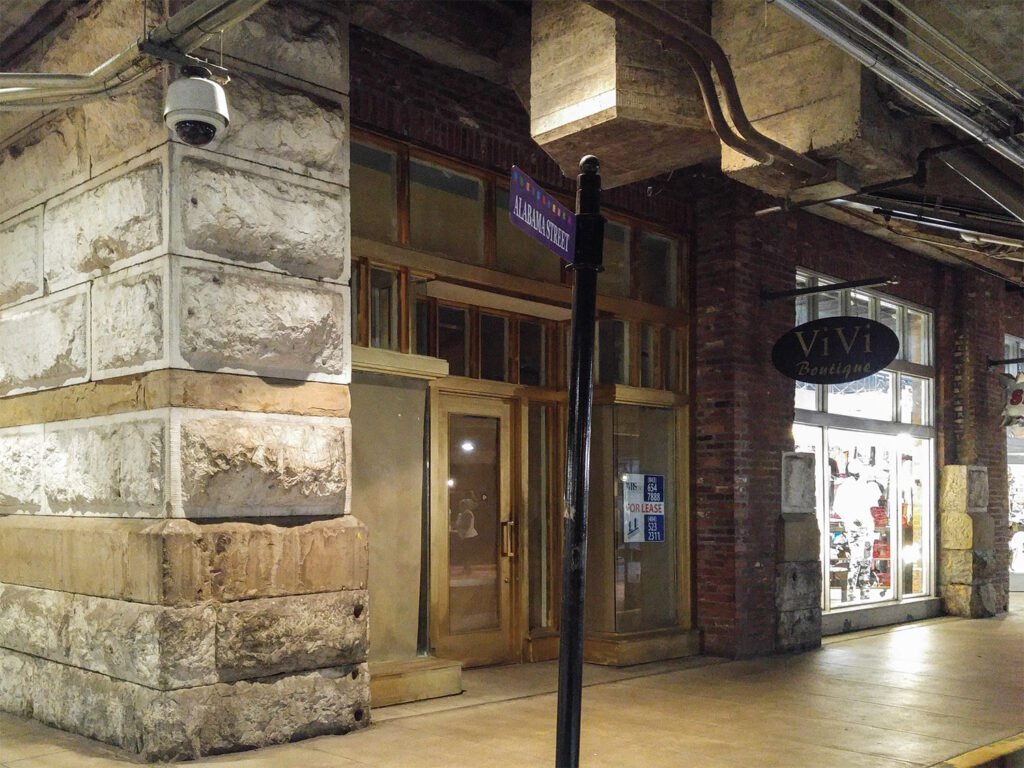
Temple Court was demolished in May 1929 for a 3-story hotel,28 29 shortly after its ground floor and basement were stripped of their ornamentation and sealed beneath the Alabama Street viaduct, then under construction.30 The new structure was simply built on top of the old building’s ground floor, vestiges of which can still be seen in whatever remains of Underground Atlanta.
This need for fact-checking is strong in this biographical sketch, which appears to have been hastily written: it’s chock-full of run-on sentences, overlong paragraphs, and numerous mangled names. It also makes several claims that merit further attention. Among them:
- I haven’t been able to confirm that Norrman served 3 years in the “royal navy”, but in the mid-19th century, all Swedish males between the ages of 20 and 25 were required to serve in the military for 4 weeks every 2 years.31 At Norrman’s death, a photograph was also found of him “in full dress suit of a marine”.32
- The “government engineer corps” mentioned in the article could be the Pontonjärbataljonen, a battalion stationed in Stockholm that primarily built bridges.
- The “Academy of Design” could refer to the Teknologiska institutet in Stockholm. However, it could also reference the Royal Danish Academy of Fine Arts in Copenhagen, as papers found at Norrman’s death33 indicated he attended “the famous University of Copenhagen”34 and a German technical university.35 36 Adding to the confusion, a 1892 profile claimed Norrman “finished his regular educational course in the finest school of Stockholm.” It does seem likely that he was educated in that city, as Swedish church records show that Herr Gottfrid Leonard Norrman left his home parish for Stockholm at the age of 18.
- Norrman and his first partner in Atlanta, M.B. Weed, can only be partially credited with the design of the main building at the International Cotton Exposition. The original plan was designed by W.H.H. Whiting of Boston,37 38 and it appears Norrman & Weed designed multiple expansions of the building during its construction.39 40 The firm also designed 5 accessory buildings at the exhibition, with Fay & Eichberg of Atlanta designing two.41 42
- In addition to the exposition buildings, 19 of Norrman’s other works are mentioned in the sketch, although many are given incorrect names or locations. Only one of those, the Edward C. Peters House, remains standing — Atlanta does love the wrecking ball. The correct names, dates, and locations for each project are:
- St. Luke’s Cathedral, built 1883 and demolished 1906 – NE corner of North Pryor and Houston Streets, Atlanta – later site of Georgia-Pacific Center, Downtown [Map]
- Unitarian Church of Our Father, built 1883 and demolished 1900 for construction of Carnegie Library – SW corner of Church and Forsyth Streets, Atlanta [Map]
- Edward C. Peters Residence, “Ivy Hall”, completed 1883 – 179 Ponce de Leon Avenue NE; Midtown, Atlanta [Map]
- William H. Venable Residence, built 1883 – 19 Forrest Avenue, Atlanta [Map]
- William S. Everett Residence, built 1884 – 278 Peachtree Street, Atlanta – later site of Atlanta Expressway (I-75/85) [Map]
- William D. Ellis Residence, built 1882 and demolished for construction of Atlanta Expressway (I-75/85) – 193 Washington Street, Atlanta [Map]
- John Milledge Residence, built 1883 – 120 East Peters Street, NE corner of East Peters Street and Capitol Place, Atlanta – later site of 2 Capitol Square SW, Downtown [Map]
- Horace Bumstead Residence, “Bumstead Cottage”, built 1883 and demolished by 1929 – 169 Vine Street, NE corner of Vine Street and University Place, Atlanta [Map]
- Thomas H. Blacknall Residence, built 1883 and likely demolished for construction of East-West Expressway (I-20) – 56 Park Avenue, SE corner of Park and Lee Streets, West End, Atlanta [Map]
- West End Academy, built 1883-4 and demolished circa 1911 – Lee Street, West End, Atlanta [Map]
- Ponce De Leon Springs pavilion, built 1883 and demolished circa 1914 – later site of Sears, Roebuck & Company Building, Atlanta. [Map]
- Robert A. Hemphill Residence, built 1884 – 231 Peachtree Street, Atlanta – later site of SunTrust Plaza, Downtown [Map]
- Daniel N. Speer Residence, built 1882 – 486 Peachtree Street, SW corner of Peachtree and Linden Streets, Atlanta – later site of Emory University Hospital Midtown [Map]
- Dr. Spalding Residence, built 1883 – 484 Peachtree Street, NE corner of Peachtree and Howard Streets, Atlanta – later site of Emory University Hospital Midtown [Map]
- Nathaniel P.T. Finch Residence, built 1881 – 388 Peachtree Street, Atlanta [Map]
- R. H. Richards Residence, built 1885 and demolished 1925 for construction of Davison-Paxon-Stokes Company building – 190 Peachtree Street, Atlanta [Map]
- Homer G. Barber Residence, built 1884 – 147 Forrest Avenue, Atlanta – later site of Georgia Power Company, Old Fourth Ward [Map]
- William A. Osborn Residence, built 1884 – 194 Jackson Street, Atlanta [Map]
- Grant Park pavilion, built 1884 – Grant Park, Atlanta [Map]
G.L. Norrman, Architect.
Probably no man in Atlanta is more widely or favorably known than Mr. G.L. Norrman. He has only been here about three years, but in that time has furnished designs for fully $2,000,000 worth of buildings of every character, including of course, the time when he had Mr. Humphries associated with him as partner.
Mr. Norrman now occupies rooms 58 and 59 on the fourth floor, and is nicely equipped with all the appurtenances of a first class architect. He is a Swede by birth, and held a position for three years in the royal navy. He has ever been a man of great nerve and pluck an amusing incident which occurred while he was in the navy going to prove this fact. A superior officer having given him some very insolent words, had the pleasure of being straightened out on deck by a blow from Mr. Norrman’s fist. He soon after resigned from the marine service, and took a position in the government engineer’s corps where he distinguished himself for his ability. Mr. Norrman was educated in architecture at the Academy of Design in Stockholm. His first work after reaching Atlanta was to draw up plans for the great cotton exposition buildings in 1881, which were accepted and will be remembered by everyone, of course. He also designed the St. Luke’s cathedral and the Unitarian church, which are universally admired. The great characters [sic] which Mr. Norrman’s work always shows, has made it popular among those who appreciated individuality, and the fact that within three years he has done $2,000,000 in houses, is sufficient evidence of his merit as an architect. He designed Colonel Richard Peter‘s fine house on Peachtree [sic] , Mr. W.H. Venabla‘s [sic], Mr. Everett‘s, Mr. Ellis‘, on Washington; Captain Milledge‘s, Professor Bumbstead‘s [sic], Major Blacknall’s at West End; the West End academy buildings, the Ponce de Leon pavilion, Mr. R.A. Hemphill‘s, Colonel Dan Speer‘s, Mr. Spaulding‘s [sic], Mr. Finchs‘s [sic] and many others not necessary to mention. Mr. Norman now has a number of homes in hand, among them Mr. Richard‘s [sic] fine residence on Peachtree, which is to cost $40,000; Mr. Barber‘s, Mr. Osborne‘s [sic] on Jackson street, and many others. He has also the designs for a very neat pavilion to be placed in Grant’s park.
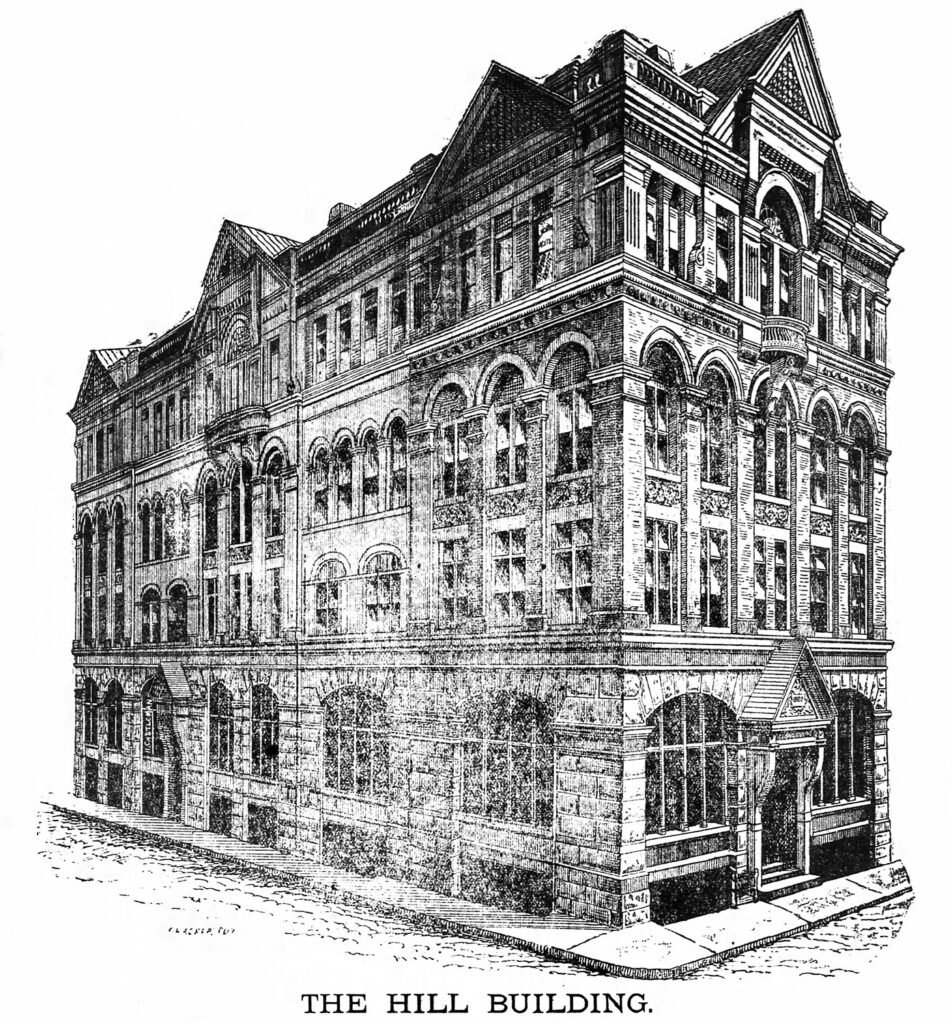
Perhaps the great monument to Mr. Norrman’s architectural skill and ability is the Hill building, the subject of this sketch. The cut herewith presented does not give an adequate idea of the perfection of the building, but it serves to show in a measure its graceful, massive proportions. Mr. Hill expresses himself more than satisfied. Said he, “I consider my building one of the best constructed in the country, and I take pleasure in saying that no finer architect need be wanted by anyone than Mr. Norrman. His work here far exceeded may expectations.” Mr. Aug Peterson, also from Sweden, is associated as assistant with Mr. Norrman. He studied architecture at the institute of technology in Norkpoking [sic]. It gives The Constitution pleasure to add its own praise to Mr. Norrman’s value to the architectural worth of Atlanta.43
References
- Photo credit: The Atlanta Historical Society. Atlanta in 1890: “The Gate City”. Macon, Georgia: Mercer University Press (1986). ↩︎
- “The Hill Building.” The Atlanta Constitution, March 16, 1884, p. 4. ↩︎
- ibid. ↩︎
- “A Bounding Business”. The Atlanta Constitution, August 2, 1877, p. 2. ↩︎
- ibid. ↩︎
- “Real Estate Notes.” The Atlanta Constitution, May 8, 1882, p. 7. ↩︎
- “Dissolution.” The Atlanta Constitution, February 28, 1884, p. 3. ↩︎
- “It Is Closed.” The Atlanta Journal, February 24, 1893, p. 1. ↩︎
- “The Building Is Sold.” The Atlanta Journal, April 27, 1893, p. 1. ↩︎
- $65,000!” The Atlanta Journal, February 22, 1893, p. 1. ↩︎
- “Redwine $103,148 Short”. The Atlanta Journal, March 16, 1893, p. 1. ↩︎
- Photo credit: Atlanta City Council and the Atlanta Chamber of Commerce. Handbook of the City of Atlanta: A Comprehensive Review of the City’s Commercial, Industrial and Residential Conditions (1898). ↩︎
- “The Highest In Atlanta”. The Atlanta Journal, September 28, 1894, p. 8. ↩︎
- “Three Stories Higher”. The Atlanta Journal, February 4, 1895, p. 5. ↩︎
- ‘It Will Be “Temple Court.” The Atlanta Journal, June 24, 1895, p. 7. ↩︎
- ibid. ↩︎
- “Three Stories Higher”. The Atlanta Journal, February 4, 1895, p. 5. ↩︎
- ‘It Will Be “Temple Court”.’ The Atlanta Journal, June 24, 1895, p. 7. ↩︎
- “The Highest In Atlanta”. The Atlanta Journal, September 28, 1894, p. 8. ↩︎
- “G.L. Norrman Ends His Life In Room In the Majestic”. The Atlanta Journal, November 16, 1909, p. 1. ↩︎
- “By the Venables.” The Atlanta Constitution, May 1, 1895, p. 5. ↩︎
- “Ten Stories High”. The Atlanta Constitution, April 4, 1895, p. 5. ↩︎
- “Hotel Venable Goes Up”. The Atlanta Journal, April 4, 1895, p. 6. ↩︎
- “‘Twill Be a Big Hotel”. The Atlanta Constitution, April 5, 1895, p. 5. ↩︎
- “It Will Be Built”. The Atlanta Constitution, April 6, 1895, p. 5. ↩︎
- “The Proposed Hotel Venable.” The Atlanta Journal, April 8, 1895, p. 10. ↩︎
- “New Buildings.” The Atlanta Constitution, July 13, 1895, p. 9. ↩︎
- “Plan for Hotel on Temple Court Site Announced”. The Atlanta Journal, April 28, 1929, p. D8. ↩︎
- “Building Material”. The Atlanta Constitution, May 26, 1929, p. 7C. ↩︎
- Rubin, Ernest. “Property Owners See Bright Future For Viaduct Area”, The Atlanta Constitution, December 23, 1928, pp. 1, 6. ↩︎
- Allotment system – Wikipedia ↩︎
- “Architect G.L. Norrman Speeds a Fatal Bullet Through Right Temple”. The Atlanta Constitution, November 17, 1909, p. 1. ↩︎
- “G.L. Norrman Ends His Life In Room In the Majestic”. The Atlanta Journal, November 16, 1909, pp. 1-2. ↩︎
- ibid. ↩︎
- ibid. ↩︎
- “Architect G.L. Norrman Speeds a Fatal Bullet Through Right Temple”. The Atlanta Constitution, November 17, 1909, p. 1. ↩︎
- The International Cotton Exposition of Products, Machinery and Manufactures. Atlanta: Jas. P. Harrison & Co. (1881). ↩︎
- “Exposition Notes.” The Atlanta Constitution, November 12, 1881, p. 11. ↩︎
- “Spreading Out.” The Atlanta Constitution, September 11, 1881, p. 7. ↩︎
- “Cotton.” The Atlanta Constitution, October 5, 1881, p. 10. ↩︎
- The International Cotton Exposition of Products, Machinery and Manufactures. Atlanta: Jas. P. Harrison & Co. (1881). ↩︎
- “Cotton.” The Atlanta Constitution, October 5, 1881, p. 10. ↩︎
- “The Hill Building.” The Atlanta Constitution, March 16, 1884, p. 4. ↩︎