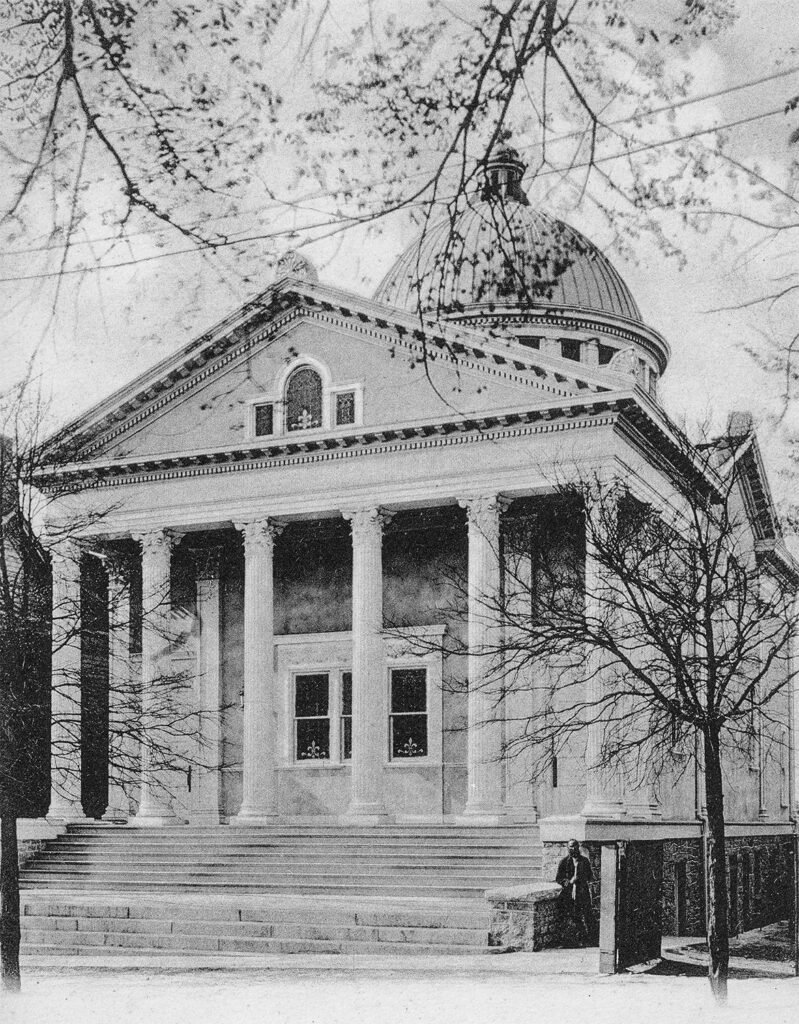
The Background
Five months after Wallace Putnam Reed’s anecdote about G.L. Norrman and Mrs. Mims, a much-expanded version of the tale made its way to Washington, D.C., where the story was reported in the “One Woman’s View” column of The Washington Post.
The new version included an additional detail about windows, and reduced Norrman to something of a buffoonish caricature, affecting an exaggerated Scandinavian accent and playing on the “dumb Swede” stereotype that was prevalent in the 19th century.1
Norrman was anything but dumb, of course, speaking at least 3 languages and later described as “one of the best read men in the country and well informed on any and all subjects.”2 But why let truth get in the way of a humorous story, eh?
The revised story was subsequently published in newspapers across the United States.
Article Excerpt:
They have been building a Christian Science church down in Atlanta—I think it’s Atlanta—so a man from Georgia tells me, and the architect they selected to do the thing is a Scandinavian who is as frank in manner as he is artistic in practice. When the building was nearly completed, one of the leading women of the church, mother of a very famous Georgia belle, came to look at it.
“Ah, Mr. Blank,” said she, “it is very beautiful: but you musn’t take too much credit to yourself. Thought has played a great part in bringing this to pass. Not work, but thought. I have put my mind on it since it began to be. I have given you absent treatment to help you. That is why you have been so successful. I have helped you greatly, with my thought.”
“Dank you, madam; I dank you much,” responded the architect. “But I wish you had told me about dis sooner yet. I vould haf tole you what to do. Myself, I can build churches. I do not need your thoughts. But it is that man that puts in the glass. Why you not put your mind on him? He haf put in the most tam bad glass whatever I did see.”
When that Christian Science church in Atlanta was completed, the chief woman member of the congregation gazed at it admiringly.
“It is a thought of God materialized,” she said—I don’t pretend, by the way, to have her phraseology exactly, but I think I convey her meaning. “It is thought made manifest. It is mind made visible. What a pity it is not in marble.”
“Ach, madam,” said the architect, “whose fault is that? I haf no thought; I haf only bricks. I build it with bricks. You haf the thoughts. Why did you not think marble while you were thinking?”3
References
- Swedish Americans – Wikipedia ↩︎
- “Prominent Architect Here.” The Spartanburg Herald (Spartanburg, South Carolina), September 30, 1909, p. 8. ↩︎
- “One Woman’s View”. The Washington Post, June 3, 1900, p. 23. ↩︎