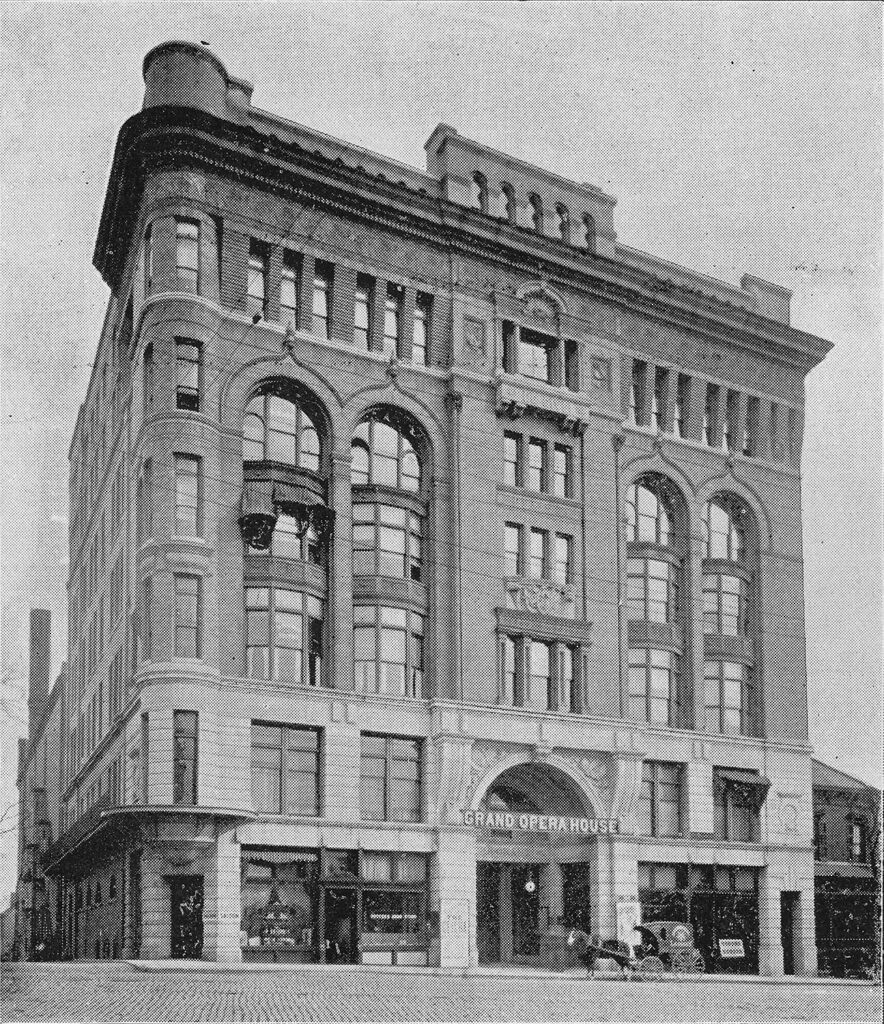
The Background
The following treatise was written by A. McC. Nixon, an architect who practiced in Atlanta from 18887 to 1896.8
The paper was read at the Second Annual Convention of the Southern Chapter of the American Institute of Architects, held in Birmingham, Alabama, in January 1893, and later published in the February 1893 edition of The Southern Architect.
Here, Nixon lamented a lack of expertise in the architectural profession, a dearth of “practical knowledge” in the construction industry, and the general public’s need to understand the “principles of taste and scientific building”.
None of those complaints were uncommon among architects at the time, but Nixonadditionally called for the establishment of a national University of Architecture, outlining a regimented training program of 8 to 9 years that would be required before a designer was allowed to practice as an architect.
Ironically, there is no evidence that Nixon had any formal training in architecture himself, although that was certainly the norm for Southern architects at the time, and the need for architectural education in the region was acute.
The first school in the Deep South to offer architectural study was Tuskegee University in 18929 — available to Black students only. Atlanta’s first wave of trained architects appeared in the late 1890s and early 1900s, although they were all educated in the Northeast or abroad. The school of architecture at Georgia Tech in Atlanta was finally established in 1908.10
Nixon included two references in this paper that would be unfamiliar to modern readers, alluding to the “unscrupulous attempts by Buddensieck” and the “fruitless efforts of the Albany State capitol of New York”.
Charles A. Buddensiek was a New York contractor who was said to be “notorious as a builder of cheap edifices.”11 In April 1885, he was overseeing the construction of eight 5-story tenement houses that collapsed, killing one worker and injuring at least 16 others.12 13 14 The buildings were hastily assembled and used substandard materials and labor at Buddensieck’s insistence, leading to his eventual conviction for manslaughter.15 16
The New York State Capitol building was still under construction in 1893, nearly 30 years after the project began in 1867. The project was plagued by cost overruns and political meddling, with design and construction handled by a succession of 4 different architects before it was finally completed in 1899.
The Problem of Architectural Education.
In preparing this paper on such a problem I am fully aware that architectural education has been fully outlined by the various institutes of the country purporting to teach the students various branches of the study of architecture in a one, two or three year’s course. But the question before us is, what shall constitute the architectural student’s course in the practitioner’s office so as to combine practice with theory and fit our young men as efficient assistants?
The wealth and luxury of the American nation is fast pushing to the front the architectural excellence of its structures, and it behooves us to look ahead and examine closely whether there may not be some remedy for evils existing.
I will endeavor, in a contemplative way, to discover and lay bare the defects and principal causes.
First – There is a great want of sufficient practical, theoretical and scientific education of the architectural student of to-day.
Second – A want of practical knowledge in the contractor.
Third – A want of acquaintance on the part of the public in the principles of taste and scientific building.
It is too plain to the profession that the limited knowledge displayed by some, claiming to be practitioners in the execution of their work, leads them into absurd extravagances, and who labor under the mistaken-structural meanness for economy, and thus mislead and often discourage the many projects for fine buildings from even being placed in the hands of the more skilled.
The builder, lacking the proper practical and scientific knowledge, enters now upon the work to attempt to carry out these gross absurdities, or further tries to induce and influence the minds of those building to break confidence with the skilled architect and execute the work from haphazard conglomeration of his confused mind, from what the plans were intended to convey, evidence of which appears too often in the preposterously inconvenient and grotesque masses of folly, totally devoid of all taste and architectural structure in our chief cities.
There are some extenuating circumstances sometimes surrounding all this, such as the proprietor attempting to build with insufficient funds, and the employment of a builder without reputation or knowledge.
Of course, we admit that there are competent and honorable members of the building fraternity and the architectural profession are ready to recognize such and are indeed much indebted to them.
The public universally are ready to admit, too, that they lack the essential knowledge necessary, in a certain measure, to make them understand just what they want, and to what extent they ought to place reliance upon the architectural services employed. They certainly know when to appreciate a well designed and executed building when the proper care has been bestowed upon it. Why, how much of the detail of many of our buildings of to-day are worthy of imitation? But take the buildings of the Greeks, Romans and Europeans of the early and middle ages, and you will find a delightful field of research. But with all this it is a fact that the architect of to-day has less control, or is less able to influence the employer in his design, arrangements or material of the structures put into his hands for skillful manipulation, just as a physician would have in building up the physical condition from the patient’s own prescribing. Take for instance the unscrupulous attempts by Buddensieck [sic], and the fruitless efforts of the Albany State capitol of New York, endangering life and property as well as squandering of public and private funds; I ask is it reasonable to expect comfort and credit from investment?
Knowledge, tradition and science have to be employed in designing and in the execution of edifices, and yet it is often expected from the heterogeneous mass of opinions to combine some daring innovations with ill-contrived plans for an experimental attempt to produce something out of nothing.
Now, all this goes to prove that the architect, builder and public must possess the necessary essential knowledge to be qualified for any undertaking. Integrity must take a hand too, and must characterize the dealings between architect and employer, and acknowledged skill and taste must be recognized for the honorable fulfillment of the work. The public will then pronounce the verdict at completion of the building. Public opinion is respected in this; and must be in all matters. It is the voice of the people, let us respect it in the higher arts and furnish suggestions for a necessary course of instruction and in acquiring such knowledge that will characterize the buildings of a nation.
It is proposed, therefore, that a National College of Architecture shall be established in the United States for the acquirement of architecture and the practice regulating it, as follows:
That after an examination, and the student is found to possess sufficient grounding in common school education, a term of two or three years shall be devoted to a thorough study of free-hand model and perspective drawing, geometry, mensuration and mechanics which shall enable the student to enter an architect’s office as pupil, and after three years’ apprenticeship, during which term he shall study and qualify himself in the principles of classic architecture and the styles of the middle ages, and practically delineate and trace scaled drawings and visit the various works in course of construction, he shall, after prescribed examination at the college, be acknowledged a member of the Architectural Association with a certificate to such effect, issued him by said college, which shall entitle him to accept a junior position in an architect’s office at a stipulated remuneration.
That after a further term of three years with additional practice as a junior, he shall pass an examination which shall qualify him as senior draughtsman. And after passing a still further examination in the nature and strength of materials, hydrostatics, prices, economy of construction and design and a higher knowledge of mathematics, construction, archaeology, ventilation and heating, he shall be entitled to practice as an architect.
By this means I think we should insure excellence as a whole and avoid rudeness in design and premature decay and failure.
That every contractor, foreman or clerk of works shall be required to show his certificate of having passed the full course in his trade at one of the acknowledged technological institutes of the country and exhibit a practical knowledge of building in all its branches, and shall pass an examination at said college testifying to his ability in managing all classes of building, after which he shall be entitled to carry on and enter into contracts for the execution of public and private works.
That at our public schools and other places of learning the privilege shall be granted to the student of a course in designing and color (as well as music), that the general public by this means shall imbibe the spirit of taste and skill.
That all persons who shall have received their certificates or qualification shall be deprived of the privilege of performing their function in either an architect’s office, or as senior draughtsman, junior assistant or builder, foreman or clerk of works, by reason of unskilled handling of work, if it is proved that they lack the information as herein prescribed, and shall be reinstated only upon a further examination by said college.
That the Board of Examiners shall be appointed annually to conduct all examinations, chosen from among the members of the profession in good standing, which shall also act as referees in public competitions.
In connection with all the foregoing suggestions, there are numerous theories to be considered, such as the maintenance and governance of such a national college, the studies taught, the library, collection of prize drawings and the minutiae too voluminous to enter into detail now; but suffice it to say, that by the formulation of this institution of architectural learning it is proposed to insure to the public and to the individual the greatest economy, advanced taste, science and skill in building, that will be a credit to the nation and a profitable return for the great outlay of wealth, as well as providing the best means for a thorough, systematic and speedy education in the science and art of building, and which will tend to draw out the best and most honorable talent of the country, and will also insure the builder against the discredit of failure, and will inspire confidence to the investor; and chiefly it will be the means of encouraging proper friendly relations in all business enterprises to the benefit of the laborer, artisan, builder, architect and the public, all working together for the noble purpose of leaving behind standing monuments worthy of the country’s pride.
A. McC. Nixon17
References
- “The New Theater.” The Atlanta Journal, August 5, 1890, p. 1. ↩︎
- “It Is Going Ahead Rapidly”. The Atlanta Constitution, January 25, 1892, p. 6. ↩︎
- “Building Going On”. The Atlanta Constitution, September 3, 1893, p. 4. ↩︎
- “DeGive’s Grand Theater.” The Atlanta Journal, February 10, 1893, p. 3. ↩︎
- Goolrick, Chester and King, Barry. “Flames Destroy Loew’s Theater; Eight Injured”. The Atlanta Constitution, January 31, 1978, p. 1. ↩︎
- Atlanta City Council and the Atlanta Chamber of Commerce. Hand Book of the City of Atlanta: A Comprehensive Review of the City’s Commercial, Industrial and Residential Conditions (1898), p. 20. ↩︎
- “From Our Notebooks.” The Atlanta Constitution, October 1, 1888, p. 4. ↩︎
- “Mr. A. McC Nixon Dead.” The Atlanta Journal, October 26, 1896, p. 5. ↩︎
- Preserving the Legacy of America’s First Black Architect – HOK ↩︎
- “School of Architecture Great Success At Tech”. The Atlanta Constitution, December 6, 1908, p. 4. ↩︎
- “Fall Of A Whole Block.” Democrat and Chronicle (Rochester, New York), April 14, 1885, p. 1. ↩︎
- “Eight Houses Collapse.” New-York Tribune, April 14, 1885, p. 1. ↩︎
- “Engulfed In The Ruins”. The New-York Times, April 14, 1885, p. 1. ↩︎
- “Shell Houses”. Buffalo Weekly Express, April 16, 1885, p. 1. ↩︎
- “Buddensiek Convicted”. The New York Times, June 19, 1885, p. 8. ↩︎
- “Buddensiek Is Guilty.” The Sun (New York), June 19 1885, p. 1. ↩︎
- Nixon, A. McC. “The Problem of Architectural Education.” The Southern Architect, Vol. 4, no. 4 (February 1893), pp. 99-100. ↩︎