The Background
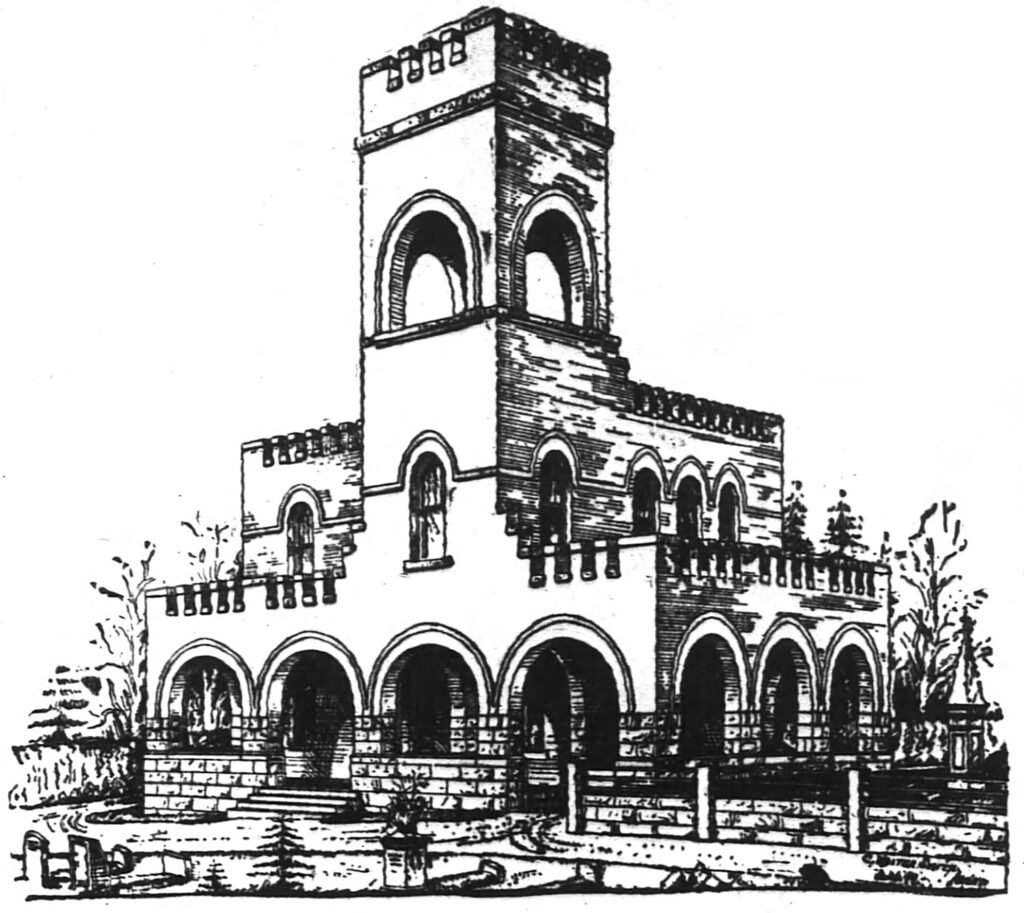
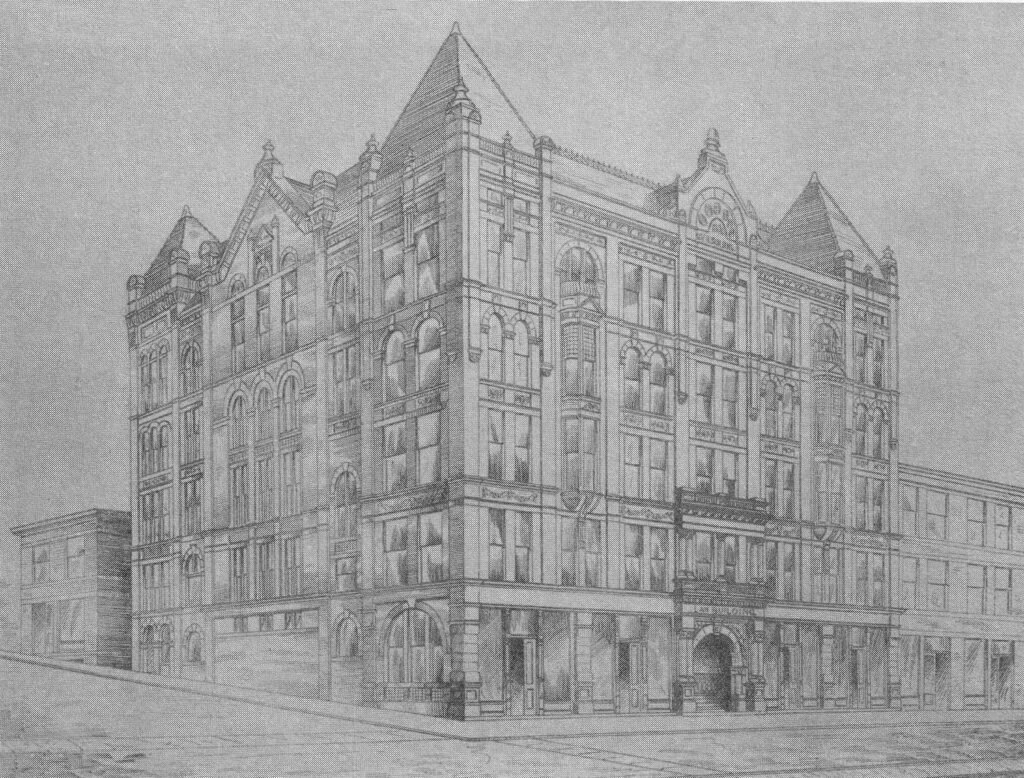
The following article, published in The Atlanta Constitution in 1890, includes an illustration and a brief description of the Kiser Law Building, completed in 1891 and designed by Bruce & Morgan.
Located at the northwest corner of Hunter and Pryor Streets (later Martin Luther King, Jr. Drive SE and Pryor Street SE) in Atlanta, the five-story office building was owned by M.C. Kiser, a local real estate developer.
Location of Kiser Law Building
Members of the Atlanta Bar Association had reportedly approached Kiser for several years with requests for him to build a structure designed exclusively for law offices.2 3
When Kiser finally agreed to the project, the association formed a building committee that considered two designs for the structure: one by A.Mc.C. Nixon, and the winning plan by Bruce & Morgan.4 5
Bruce’s Approach
Although T.H. Morgan increasingly became the primary designer for Bruce & Morgan through the 1890s, A.C. Bruce still handled the majority of the firm’s output in the early part of the decade, and the Kiser Law Building appears to have been his design.
Bruce was a former cabinet maker and carpenter who lacked formal architectural training, and by 1890, the limits of his skill set were becoming readily apparent.
Many of Bruce’s designs from the early 1890s appear heavy-handed and anachronistic: you can see he was attempting to adapt to modern tastes, but his design sensibility was still fundamentally stuck in the 1870s — the Kiser Law Building was a prime example.
Looking at the illustration above, the building resembles a stack of drawers haphazardly piled on top of each other, and oversized windows of varying shapes and sizes junk up both facades.
That additive approach to design was typical of architects with a background in carpentry, who often designed buildings as if they were giant pieces of furniture, joining disparate elements and tacking on unnecessary embellishments instead of envisioning their compositions as solid masses to be sculpted into form.
The building’s overall style is equally baffling: Bruce was presumably aiming for the Romanesque, but for all the eclectic adornments, including terra cotta trim,6 7a decorative slate roof with iron crestings, ornamental iron balconies, and marble columns,8 he didn’t quite achieve a cohesive style. The pyramidal peaks and elaborate gables were also becoming rapidly outdated by 1891.
Design and Construction
As construction began, it was reported that the Kiser Law Building would be constructed of either Berea sandstone or marble.9 It’s Atlanta, so it appears they opted for the cheaper sandstone for most of the structure and incorporated marble trim around the entrance.10
Set over a full basement, the building’s five floors included a 16-foot-wide central hall, served by one elevator, four stairwells, and two fire escapes. A light court was also designed to extend from the top to the bottom floor, so that each of the building’s 84 offices would be lighted and ventilated from the outside.11
The building was illuminated with electric lighting and included “water closets of the latest patterns…located in the rear [heh] of every floor.12
While it was originally reported that the building would be heated by steam,13 14 Kiser ultimately chose the Bolton Hot Water System, which was marketed as a “purely scientific, healthful way of heating.”15
I don’t really care enough about such things to learn more; however, the man who supervised the heating system’s installation told the Constitution: “…the larger buildings in the north have been heated by hot water apparatuses for the last ten or twelve years, yet it is practically new for the south…”16
No surprise, really: Atlanta’s self-conscious developers are always late to the game, simply replicating what was done a decade ago in the better cities of the North.
The floors of the Kiser Law Building were planned as follows:
- The ground floor included spaces for four stores — the storefront at the corner of Hunter and Pryor was designated for a bank,17 and another space facing Pryor Street was planned as a restaurant.18 The entrance hallway featured marble wainscoting and tile19 and led to “four broad stairways” and “an elevator of the most approved pattern.”20
- The second, third, and fourth floors were identical in design, and each contained 28 office suites — 14 on each side of the central hall. The offices were finished in hardwoods and Georgia pine, with fireproof vaults and closets.21 22
- The fifth floor was intended to house two large halls “suited to the use of secret societies, public meetings and other similar purposes,”23 as well as a kitchen, storerooms, reception room, and a club room or library.24
Construction on the building began on April 8, 1890,25 with J.H. Matthews,26 “a wide-awake contractor”,27 supervising the project. The initial estimated cost of the building was $90,000, with a projected completion date of April 1, 1891.28 The cost rose to $100,000 by 1891,29 and the building was completed in August 1891.30 31
Local interest in the project was high, and while construction was still underway in November 1890, Kiser had reportedly received applications from 100 lawyers seeking office space.32
Firms began announcing their intention to move to the building in early 1891,33 and in June 1891, George W. Adair, who handled leasing for the property, reported: “The Kiser law building is nearly ready for occupancy, which is good news to those who have already selected their rooms, and others that are waiting for its completion.”34
Their lease agreements should have included the following caveat: the only thing slimier than a lawyer is an Atlanta developer.
The Terminal Debacle
In July 1891, Kiser leased nearly the entire law building — including the top four floors, the corner store on the ground floor, and the full basement35 36 — to a single firm: the Richmond Terminal Company, which had abruptly decided to relocate its headquarters from Washington, D.C. to Atlanta.37
The company stated its intention to use the Kiser Building as temporary office space until it could build its own facility in the city,38 signing a two-year lease for the then-unheard-of sum (in Atlanta anyway) of $14,500 a year.39 40
Commonly referred to as the “Terminal”, the company had previously purchased the Central Railroad and Banking Company, Georgia’s oldest railroad,41 based in Savannah. The Terminal’s new Atlanta headquarters consolidated the employees from both Savannah and Washington in a single location.
However, the Kiser Building was much too small to house the Terminal’s 250 to 300 workers,42 43 and one executive stated, “Unfortunately that building is not large enough to fully accommodate all the offices, but we will try to make do.” Kiser said of the negotiation: “…the trouble was they wanted more room, but finally concluded they could get along by adding the corner room and the basement.”44
The Terminal’s hasty relocation to Atlanta was more than a little suspicious, and there were allegations that it wasn’t “bona fide”, which the company denied.45 Atlanta’s newspapers, of course, hailed the move, with the always-bloviating Constitution prognosticating:
“A grand new depot and office building. That is the inevitable result.
The bringing of these offices to Atlanta is a bigger thing than might appear at first glance. This naturally makes Atlanta the center of the railroad situation of the south, and, as Atlanta is now the insurance center, it becomes beyond question the financial center of the south.”46
The lawyers who already selected offices in the Kiser Building just had to suck it, I guess. The Odd Fellows probably weren’t too thrilled either: the Constitution reported in July 1891 that “about ten days ago they selected the fifth floor of the Kiser building and immediately rented it as an Odd Fellows’ hall. Then the Terminal people came along and wished the place.”47
Anyone who knows how shit goes down in Atlanta could guess what happened next: Just six months after the Terminal employees began working in the Kiser building, the Central Railroad was forced into receivership by a local judge.48 49
Rumors of the Terminal’s financial difficulties and potential bankruptcy had swirled around Atlanta for months, spurred by the resignations of top executives and directors who had reportedly been battling for control of the company.50 51
There was also the time in January 1892, when the company apparently lacked the funds to pay its employees, delaying their paychecks for more than a week,52 53 54 55 a situation charitably described as “embarrassing.”56
The final blow was delivered in a lawsuit filed by a stockholder against the company, alleging that, among other things, the Terminal’s owners were conspiring to transfer $500,000,000 in debt onto the Central Railroad, “which it [could] never pay,”57 58 presumably with the intent to bankrupt it. Sounds like business as usual for an American enterprise.
Under the rules of the receivership, the Central Railroad’s 74 employees59 returned to Savannah,60 61 and while it initially appeared that the remaining Terminal employees would stay in Atlanta, they were ordered back to Washington in June 1892, leaving the Kiser Building nearly vacant.62 63The company hired George W. Adair to sublet the building,64 which was filled with lawyers as originally planned.65
The Inevitable Demise
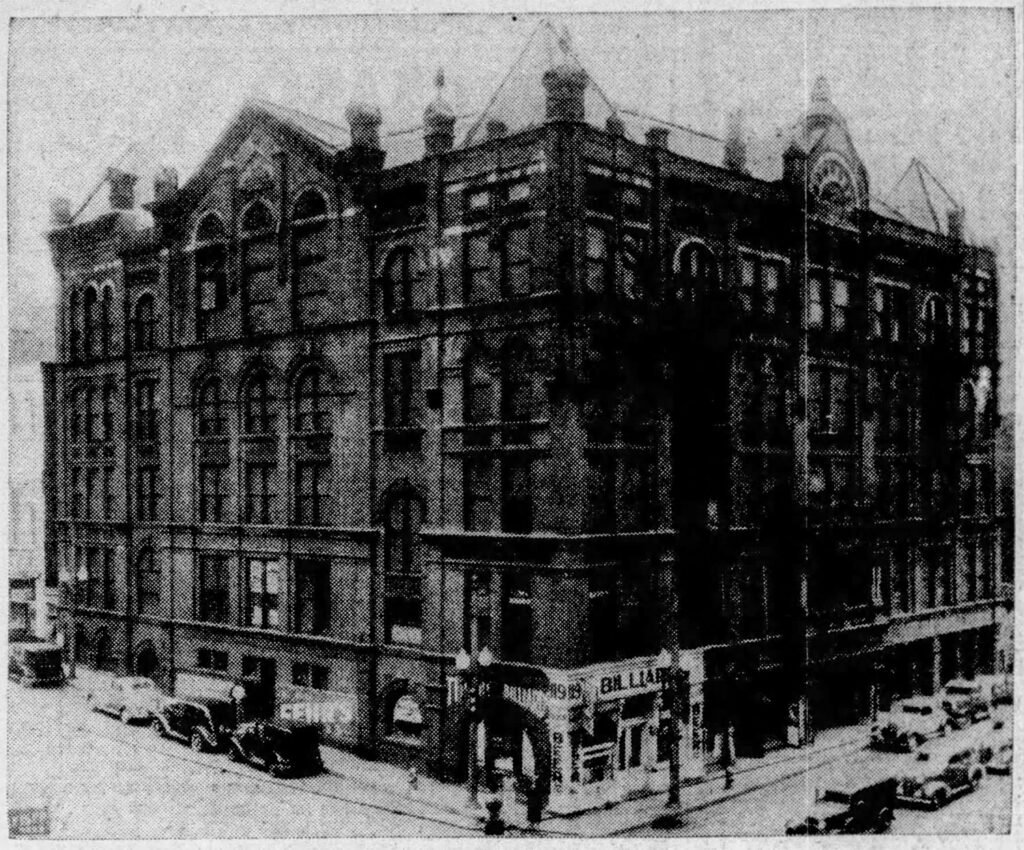
Office structures tend to fall out of fashion quickly, and in 1930, the Journal said of the Kiser Law Building: “…the lawyers, loan brokers, and trade representatives [have] shifted to more modernly equipped buildings…”, noting that, “storms of nearly half a century have raised havoc with the structure and its artistic domes, its oriel windows, and its ornamental trimmings.”66
By 1936, the Kiser Law Building was reportedly “almost empty except for a store or two on the sidewalk.”67 No one seemed too upset when the structure was demolished in November and December 1936 for — take a wild guess — a parking lot.68 69 70
The Article
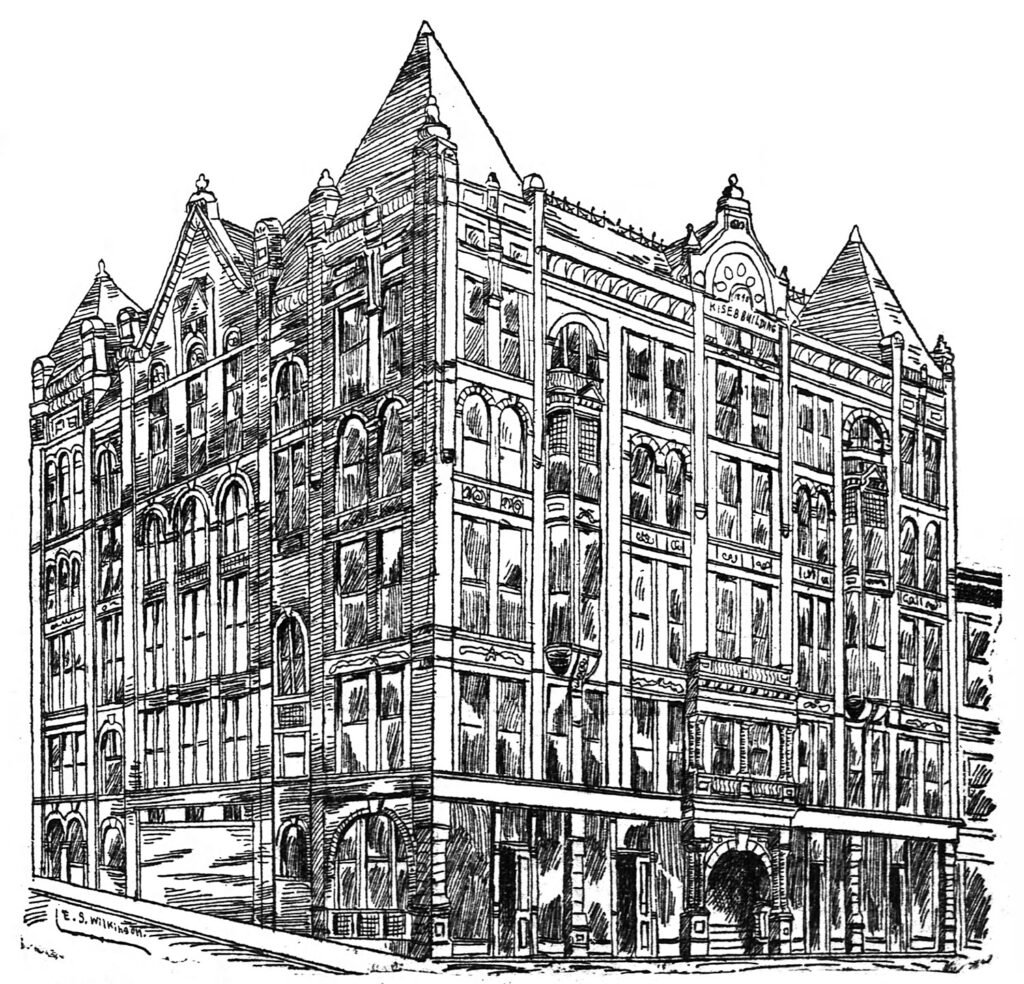
Major M.C. Kiser’s “Law Building” will be one of the handsomest buildings in the south, and when finished will be one of Atlanta’s greatest attractions.
The Constitution gives here an excellent cut of the building, made from the drawings of Bruce & Morgan, the architects. The uses to which the building are to be put have been fully explained in these columns.
The building will be erected at the corner of Pryor and Hunter streets, fronting on Pryor, and will be five stories in height. It will be devoted to offices for lawyers, with clubrooms for a Lawyers’ club. It will be just as complete as possible, an ideal building in every respect.71
References
- Illustration credit: Atlanta in 1890: “The Gate City”. Atlanta: The Atlanta Historical Society, Inc. (1986), p. 62. ↩︎
- “The Kiser Building”. The Atlanta Constitution, January 26, 1890, p. 19. ↩︎
- “Kiser’s Law Building.” The Atlanta Constitution, April 8, 1890, p. 7. ↩︎
- “The Kiser Building”. The Atlanta Constitution, January 26, 1890, p. 19. ↩︎
- “Kiser’s Law Building.” The Atlanta Constitution, April 8, 1890, p. 7. ↩︎
- “The Kiser Building”. The Atlanta Constitution, January 26, 1890, p. 19. ↩︎
- “History In Clay.” The Atlanta Constitution, May 15, 1892, p. 3. ↩︎
- “Kiser’s Law Building.” The Atlanta Constitution, April 8, 1890, p. 7. ↩︎
- “Kiser’s Law Building.” The Atlanta Constitution, April 8, 1890, p. 7. ↩︎
- “The Kiser Building”. The Atlanta Constitution, January 26, 1890, p. 19. ↩︎
- “Kiser’s Law Building.” The Atlanta Constitution, April 8, 1890, p. 7. ↩︎
- ibid. ↩︎
- “The Kiser Building”. The Atlanta Constitution, January 26, 1890, p. 19. ↩︎
- “Kiser’s Law Building.” The Atlanta Constitution, April 8, 1890, p. 7. ↩︎
- “Kiser Building.” The Atlanta Constitution, September 6, 1891, p. 3. ↩︎
- ibid. ↩︎
- “Kiser’s Law Building.” The Atlanta Constitution, April 8, 1890, p. 7. ↩︎
- “The Kiser Building”. The Atlanta Journal, November 29, 1890, p. 5. ↩︎
- “The Kiser Building”. The Atlanta Constitution, January 26, 1890, p. 19. ↩︎
- “Kiser’s Law Building.” The Atlanta Constitution, April 8, 1890, p. 7. ↩︎
- “The Kiser Building”. The Atlanta Constitution, January 26, 1890, p. 19. ↩︎
- “Kiser’s Law Building.” The Atlanta Constitution, April 8, 1890, p. 7. ↩︎
- ibid. ↩︎
- “The Kiser Building”. The Atlanta Constitution, January 26, 1890, p. 19. ↩︎
- “Kiser’s Law Building.” The Atlanta Constitution, April 8, 1890, p. 7. ↩︎
- “Atlanta Building Up.” The Atlanta Constitution, October 3, 1890, p. 3. ↩︎
- “A Hoisting Elevator.” The Atlanta Journal, November 11, 1890, p. 1. ↩︎
- “Kiser’s Law Building.” The Atlanta Constitution, April 8, 1890, p. 7. ↩︎
- “Etched and Sketched.” The Atlanta Constitution, July 30, 1891, p. 4. ↩︎
- “Railroad Notes.” The Atlanta Constitution, August 16, 1891, p. 19. ↩︎
- “They Are Here.” The Atlanta Constitution, August 24, 1891, p. 4. ↩︎
- “The Kiser Building”. The Atlanta Journal, November 29, 1890, p. 5. ↩︎
- “Land Titles.” The Atlanta Journal, April 30, 1891, p. 7. ↩︎
- “FOR RENT — Houses, Cottages, Etc.” The Atlanta Constitution, June 28, 1891, p. 10. ↩︎
- “The Kiser Building”. The Atlanta Constitution, July 23, 1891, p. 4. ↩︎
- “Terminal Offices In The Kiser Block.” The Atlanta Constitution, July 24, 1891, p. 2. ↩︎
- “The General Offices”. The Atlanta Constitution, July 22, 1891, p. 7. ↩︎
- ibid. ↩︎
- “Terminal Offices In The Kiser Block.” The Atlanta Constitution, July 24, 1891, p. 2. ↩︎
- “Then And Now.” The Atlanta Constitution, July 28, 1891, p. 5. ↩︎
- “The Central’s Fate.” The Atlanta Constitution, March 5, 1892, p. 1. ↩︎
- “To Move Their Offices.” The Atlanta Journal, June 17, 1892, p. 3. ↩︎
- “Fleming Out.” The Atlanta Constitution, July 25, 1892, p. 3. ↩︎
- “Terminal Offices In The Kiser Block.” The Atlanta Constitution, July 24, 1891, p. 2. ↩︎
- ibid. ↩︎
- ibid. ↩︎
- “Might Have Interrupted Their Plans.” The Atlanta Constitution, July 26, 1891, p. 15. ↩︎
- “A Receiver!” The Atlanta Journal, March 4, 1892, p. 1. ↩︎
- “The Central’s Fate.” The Atlanta Constitution, March 5, 1892, p. 1. ↩︎
- “Changes In The Terminal.” The Macon Telegraph (Macon, Georgia), January 5, 1892, p. 1. ↩︎
- “The Complete Story”. The Atlanta Constitution, January 6, 1892, p. 1. ↩︎
- “Railroad News.” The Atlanta Constitution, January 1, 1892, p. 3. ↩︎
- “Pay Day Postponed.” The Atlanta Journal, January 1, 1892, p. 3. ↩︎
- “They Have Resigned”. The Atlanta Journal, January 5, 1892, p. 3. ↩︎
- “Salaries Paid.” The Macon Telegraph (Macon, Georgia), January 7, 1892, p. 2. ↩︎
- “Atlanta’s Rumors.” The Morning News (Savannah, Georgia), January 7, 1892, p. 1. ↩︎
- “A Receiver!” The Atlanta Journal, March 4, 1892, p. 1. ↩︎
- “The Central’s Fate.” The Atlanta Constitution, March 5, 1892, p. 1. ↩︎
- “Fleming Out.” The Atlanta Constitution, June 25, 1892, p. 3. ↩︎
- “Paints A Rosy Picture.” The Atlanta Journal, March 29, 1892, p. 1. ↩︎
- “The Central’s Officials”. The Atlanta Journal, March 30, 1892, p. 1. ↩︎
- “To Move Their Offices”. The Atlanta Journal, June 17, 1892, p. 3. ↩︎
- “Are Anxious To Leave.” The Atlanta Journal, June 18, 1892, p. 3. ↩︎
- “Mr. W.G. Oakman”. The Atlanta Journal, June 22, 1892, p. 1. ↩︎
- “Kiser Building, Familiar Landmark Here For Almost 50 Years, Will Be Demolished”. The Atlanta Journal, November 15, 1936, p. 8-D. ↩︎
- Moody, George O. “‘Home’ In Kiser Building Lost By Pigeons”. The Atlanta Journal, July 6, 1930, p. 2. ↩︎
- “Old Landmark Of City Will Be Demolished”. The Atlanta Constitution, November 15, 1936, p. 6C. ↩︎
- ibid. ↩︎
- “Kiser Building, Familiar Landmark Here For Almost 50 Years, Will Be Demolished”. The Atlanta Journal, November 15, 1936, p. 8-D. ↩︎
- “Adair Announces Important Leases”. The Atlanta Journal, December 6, 1936, p. 6-D. ↩︎
- The Atlanta Constitution, March 30, 1890, p. 8. ↩︎