This postcard depicts the Citizens Bank in Savannah, Georgia, designed by G.L. Norrman and completed in 1896.
Published by the Souvenir Post Card Co. of New York and printed in Germany, the card was postmarked in Savannah on February 9, 1912, and addressed to Mrs. Chas. E. Simond of 316 E. Monroe Street in Jacksonville, Florida.
Written on the back is the following note from Mrs. Mac:
“I am having a good time. We are on the [?] most of the time. I got use of the [?] at the party yesterday. It is much warmer but I nearly froze last week. [?] love to from you. Will be home next week.”
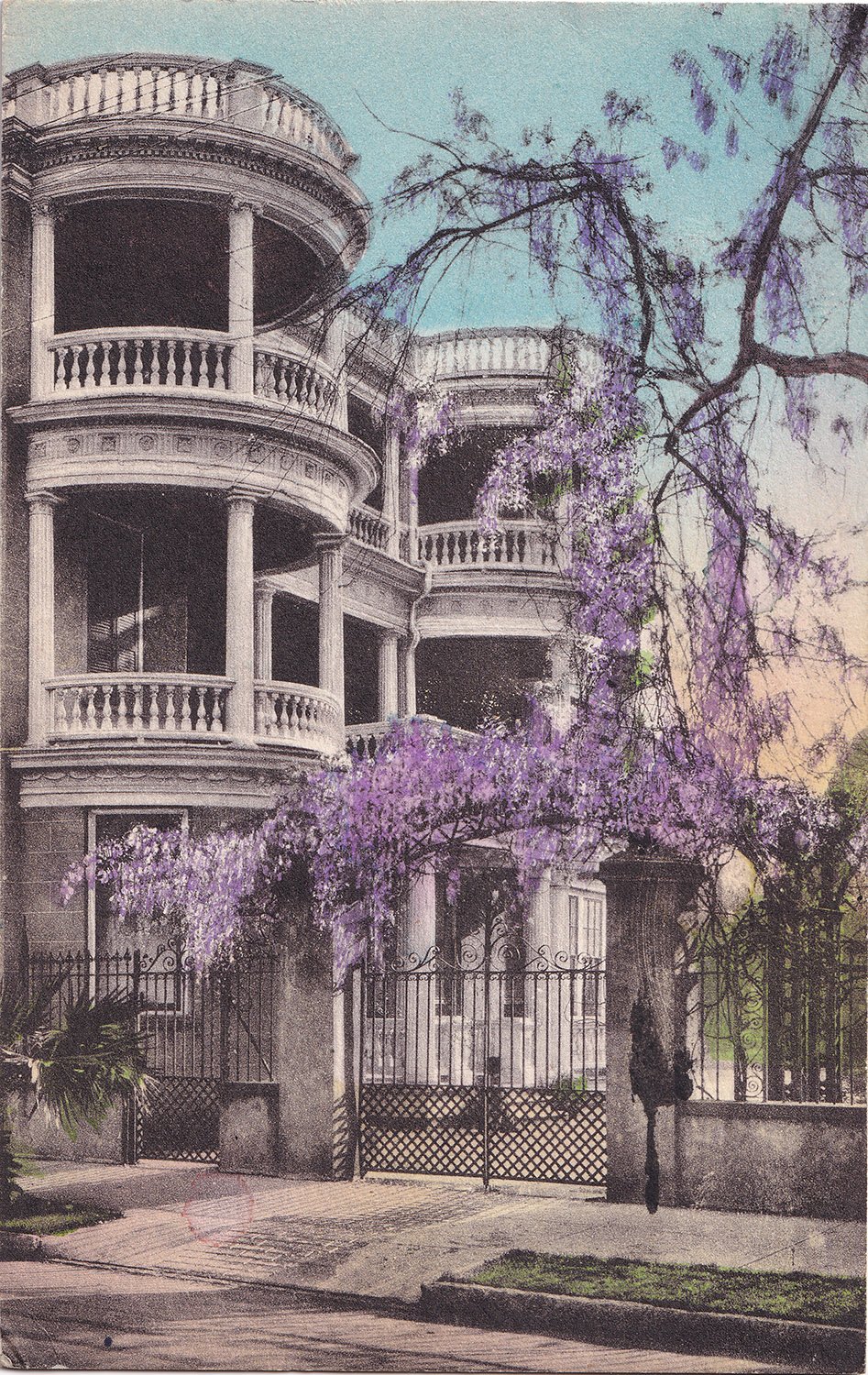
This postcard depicts the W.B. Chisolm Residence in Charleston, South Carolina, renovated with a design by G.L. Norrman (or so say I) circa 1893.
The card was hand-colored and published by Lanneau’s Art Store in Charleston, and postmarked in Charleston on May 18, 1946.
Addressed to Mrs. A. Joceyln of 23 Essex Street, Holyoke, Mass., the card’s message is written by Edith and Brenda:
Edith: “Hi [Harmony?] Jocelyn – We are here and loving every moment 2 our stay. We are doing our best + live as you showed me the way + are perfectly happy I feel fine. We are gaining weight, + tanning well. Love, Edith.”
Brenda: “She is really gaining weight. She is now down (?) to 126 lbs. Brenda”
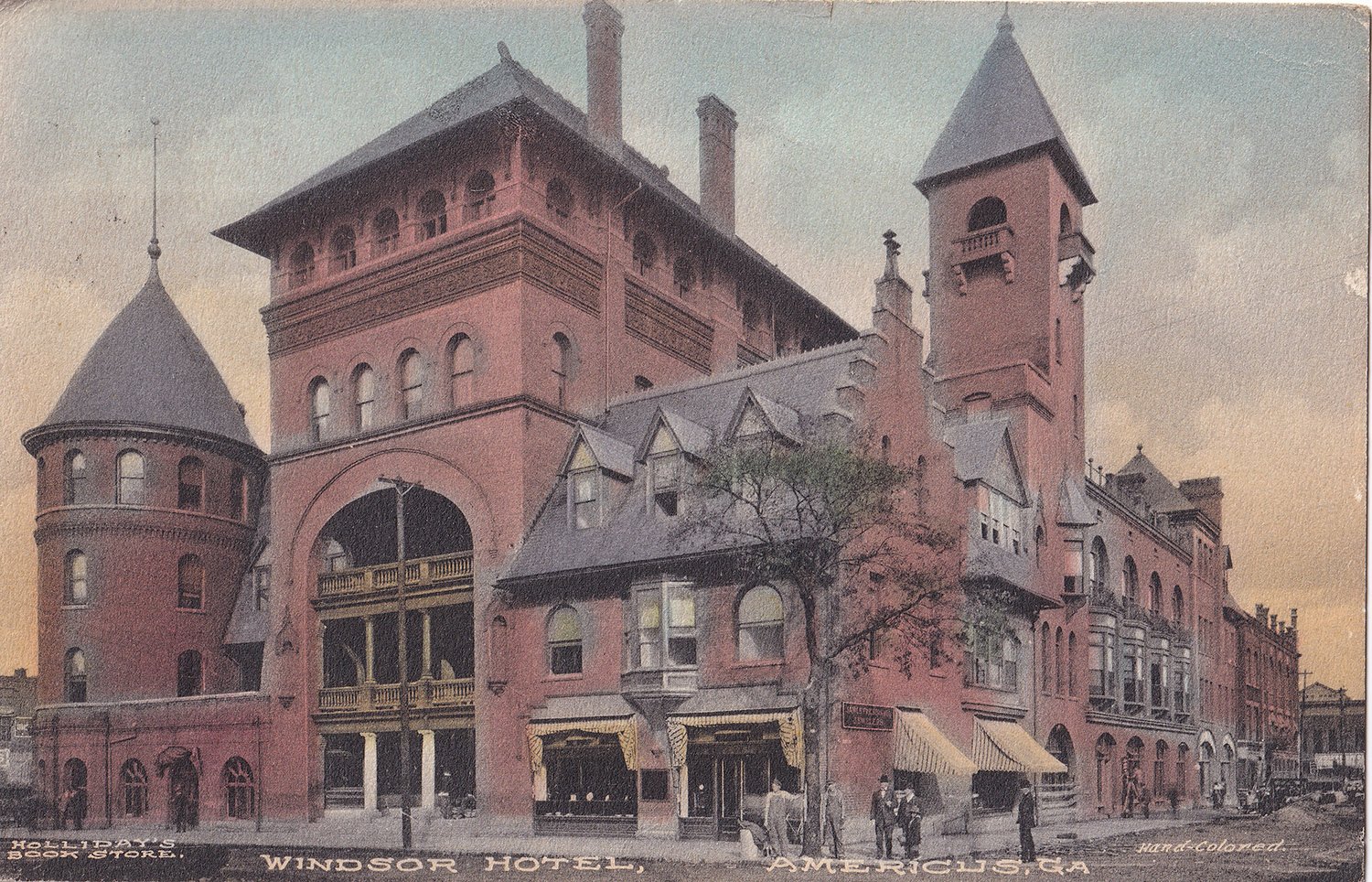
This postcard depicts the Windsor Hotel in Americus, Georgia, designed by G.L. Norrman and completed in 1892.
Published by Holliday’s Book Store in Americus, the card was postmarked in Americus on February 12, 1912, and addressed to Mademoiselle [Myte Schmitz?] of 26 rue de la [something] in [Don’t know] France. Ooh la la.
Barrien wrote on the back:
“La Palace hotel de cetta [?]. C’est ici que j’ai éler domicile.”
Roughly translated and filling in the blank, we get:
“The Palace hotel of this [shithole town]. This is where I have taken up residence.”
Let’s hope he got out of there—Americus isn’t kind to outsiders.
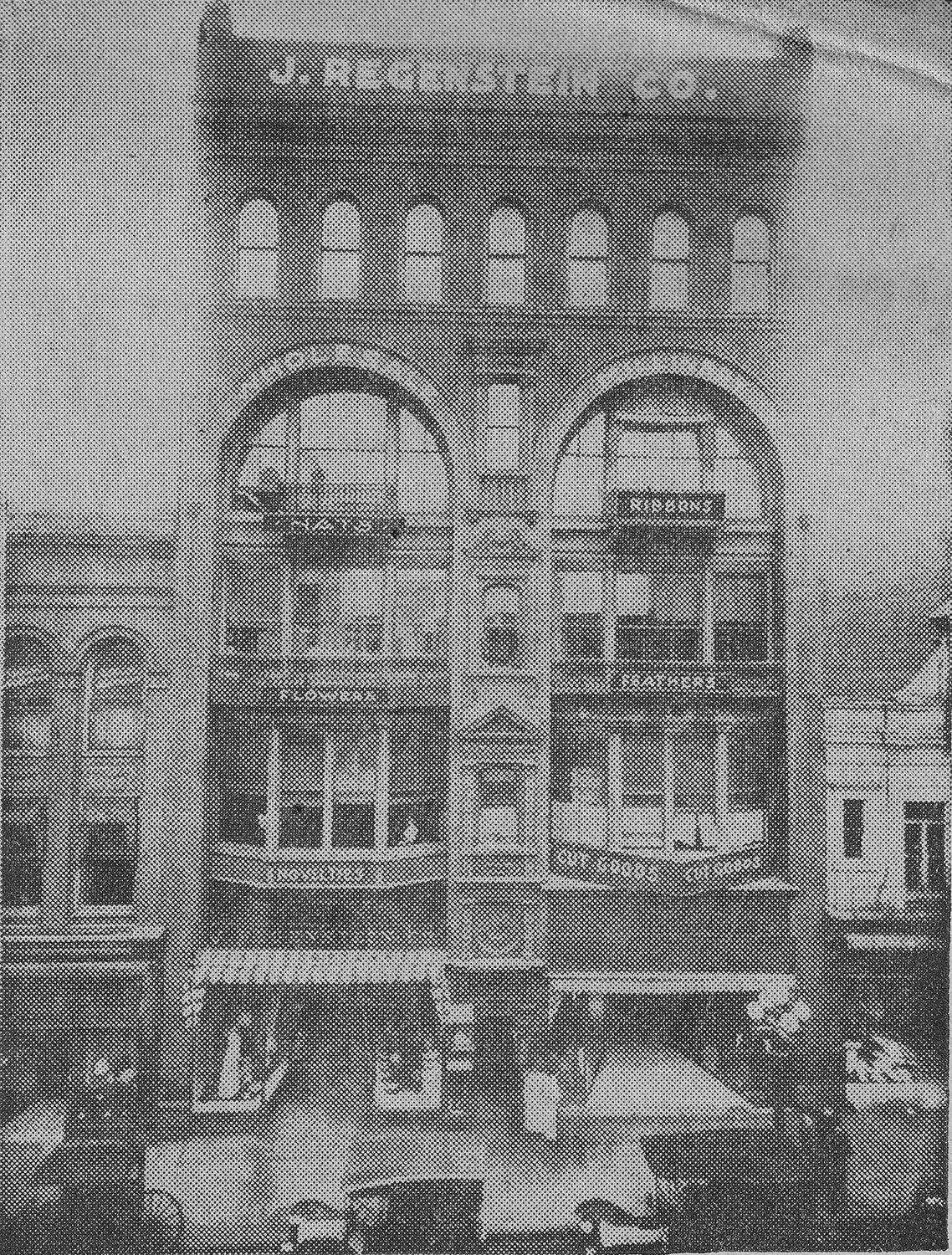
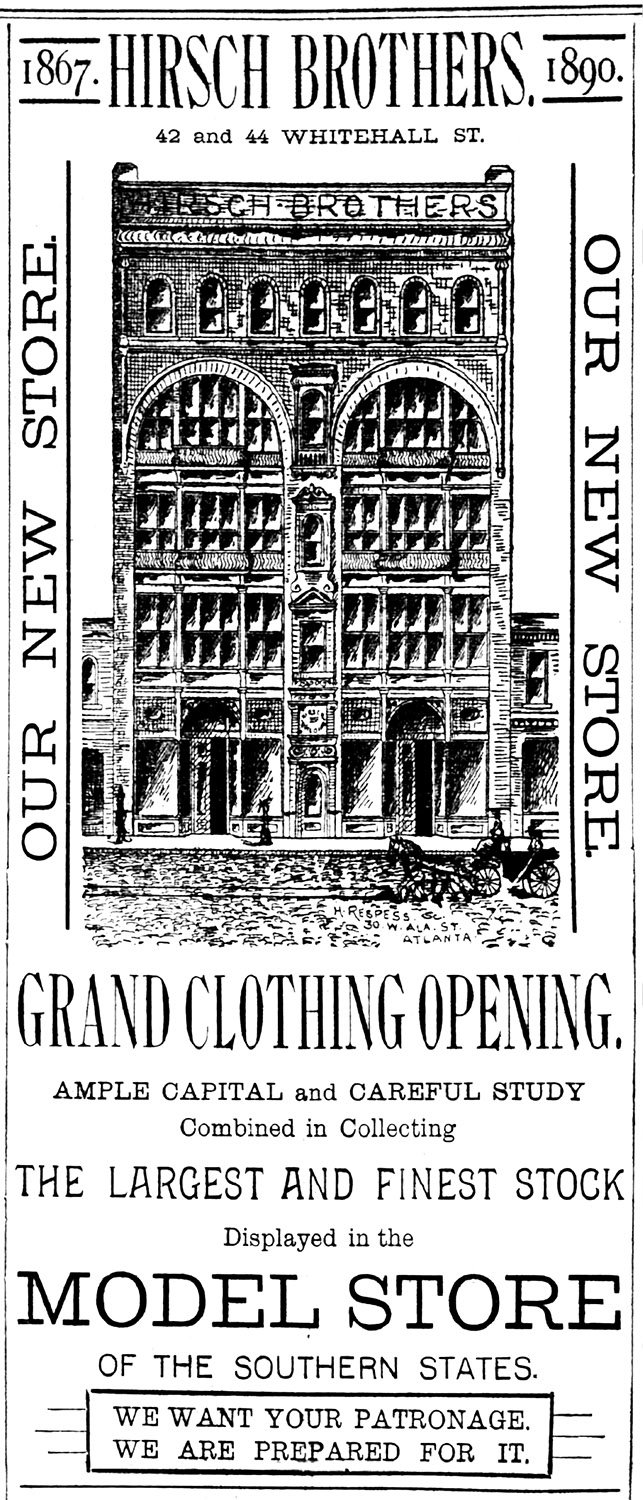
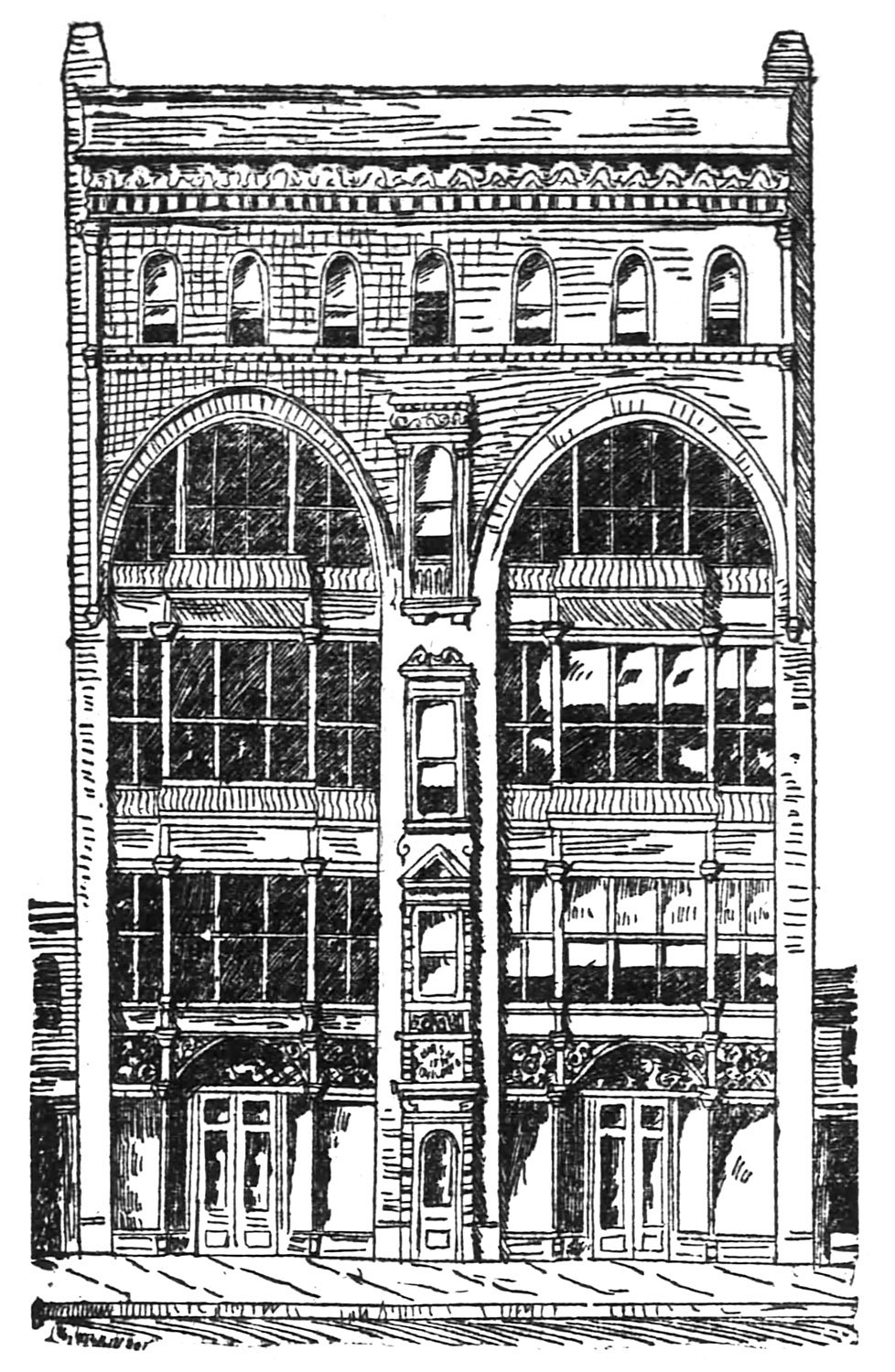
The article below, published in The Atlanta Constitution in March 1890, includes an illustration and description of theHirsch Building in Atlanta, designed by G.L. Norrman.
Located at 40-44 Whitehall Street (later 70-74 Peachtree Street SW), the five-story building opened with two anchor stores on the first floor—Hirsch Bros. and J. Regenstein & Co.23—with smaller businesses and apartments on the upper floors.
Location of the Hirsch Building
The Design
The Hirsch Building was Norman’s most significant commercial design in Atlanta since the completion of the Gate City National Bank in 1884, following a construction slump in the mid-to-late 1880s, due, in part, to the city’s short-lived attempt at prohibition.
The project also ushered in a period between 1890 and 1893 when Norrman was at the peak of his artistic skill and professional reputation, attracting both regional and national attention.
It was a heady time when everything seemed to come together for him: After 15 years as an architect, Norrman had honed his talent to such an impeccable degree that his designs consistently set him apart from those of Atlanta’s other architects.
He was also clearly studying the work of nationally ranked designers, and while he wasn’t the only Atlanta architect doing so, Norrman’s training allowed him to grasp their underlying theories and integrate them with his own distinctive design approach.
The city’s other designers, lacking formal education, could only imitate what they had seen elsewhere—often badly.
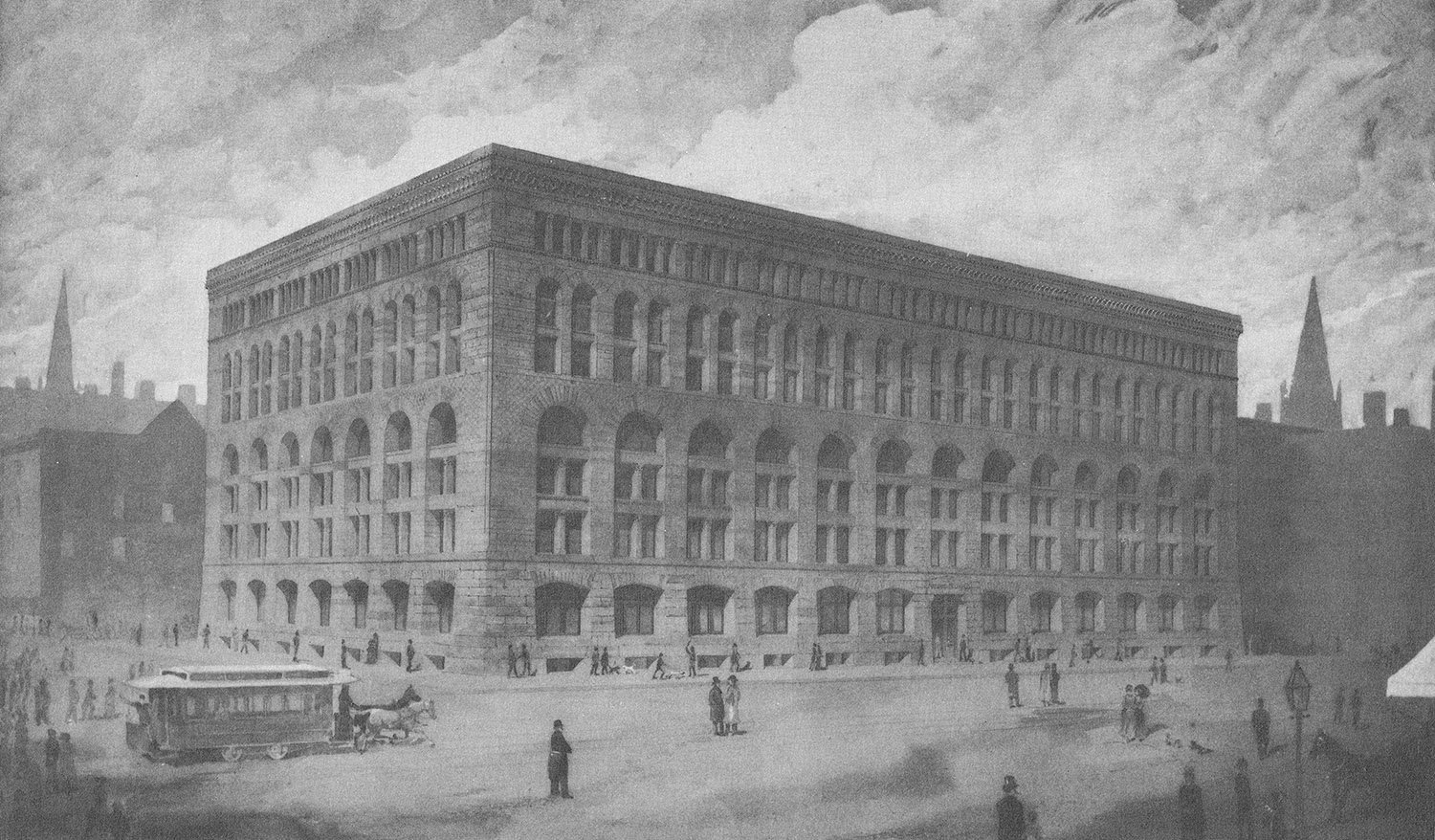
H.H. Richardson. Marshall Field’s Wholesale Store (1887-1930). Chicago.456
For the Hirsch Building, Norrman drew obvious inspiration from the grand store buildings of larger cities, including Marshall Field‘s in Chicago, designed by H.H. Richardson and completed in 1887.
Compared to Atlanta’s other retail structures at the time, the Hirsch Building’s design was bold, brash, and modern. Norrman used the stark Romanesque massing pioneered by Richardson, and deftly incorporated elements of the Renaissance Revival style developed by McKim, Mead & White, which was then brand-new to the Southeast.
The Hirsch Building also included Norrman’s first known use of two arched bays spannedby a row of windows, a simple but refined design he would repeat in projects over the next two years, including the Standard Wagon Company in Atlanta, the Duncan Building in Spartanburg, South Carolina, and the Windsor Hotel in Americus, Georgia.
Between the arched bays, Norrman placed a single column of narrow windows, each uniquely styled and topped with a different Classical pediment as if it were a towering temple, an unconventional choice that created a dynamic focal point for the composition and subtly advertised the building’s status as a retail shrine.
To understand how much of a departure the Hirsch Building was for Atlanta’s architecture, consider the nearby Kiser Law Building, also built in 1890 and designed by A.C. Bruce of Bruce & Morgan. The Kiser Building’s stuffy, cluttered facade was typical of the commercial structures built in the city for years, and wouldn’t have looked out of place in the 1870s.
In contrast, the Hirsch Building’s design was fresh, inventive, and even a little irreverent, entirely fitting for an audacious young city eager to enter the 20th century as the region’s commercial epicenter.
The Hirsch brothers were German-born immigrants who became an Atlanta institution in the late 19th century, and their legacies will be forever entwined with the city.
The three siblings opened their first clothing store, M. & J. Hirsch, circa 1867, when the city was “a heap of ashes,”7 as the Constitution later recalled—somewhat exaggeratively.
In later years, the Hirsch’s descendants claimed a 1863 founding for the store,89 but that doesn’t match the historic record: a Hirsch isn’t even listed in Atlanta’s city directory for 1867.10
At the opening of their first store, the Hirsch brothers purportedly had so little money that they used a “store box as a desk,”11 but as their business grew, Morris and Joseph gradually settled into executive roles, while their younger brother, Henry, remained closely involved with day-to-day operations.
By 1890, the Hirsches operated two wholesale stores in Atlanta: the original M. & J. Hirsch on Pryor Street and Hirsch Bros. on Whitehall Street.
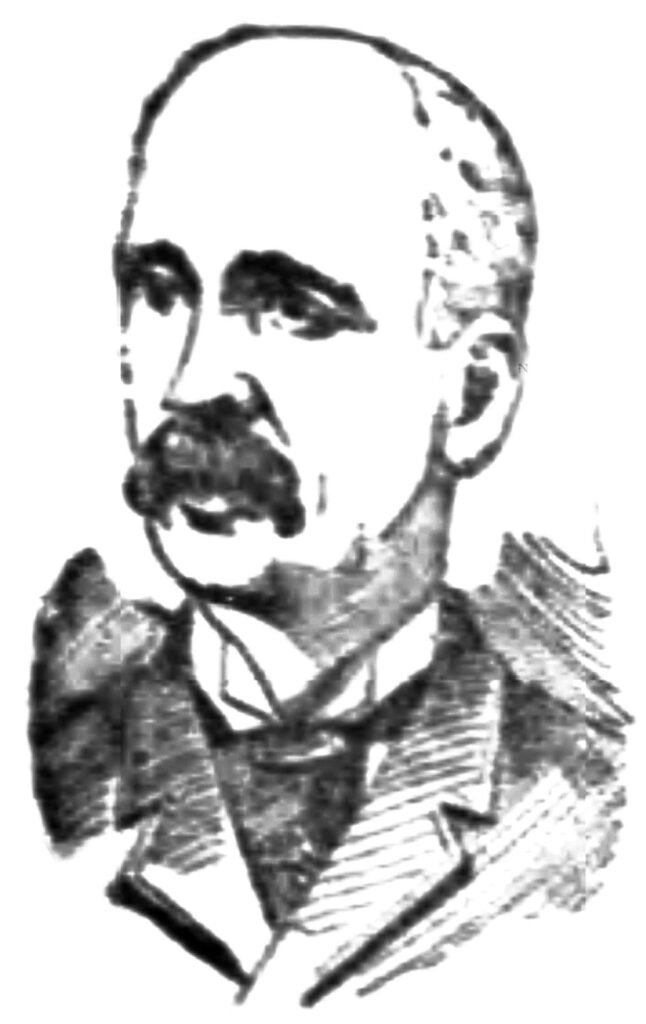
Morris Hirsch (1841-190613) was described as “very popular”14 and “one of the wealthiest and most enterprising men in Atlanta.”15
At his death, the Constitution remarked: “He started out as a penniless boy and by hard work and perseverance became a man rich in money and reputation.”16
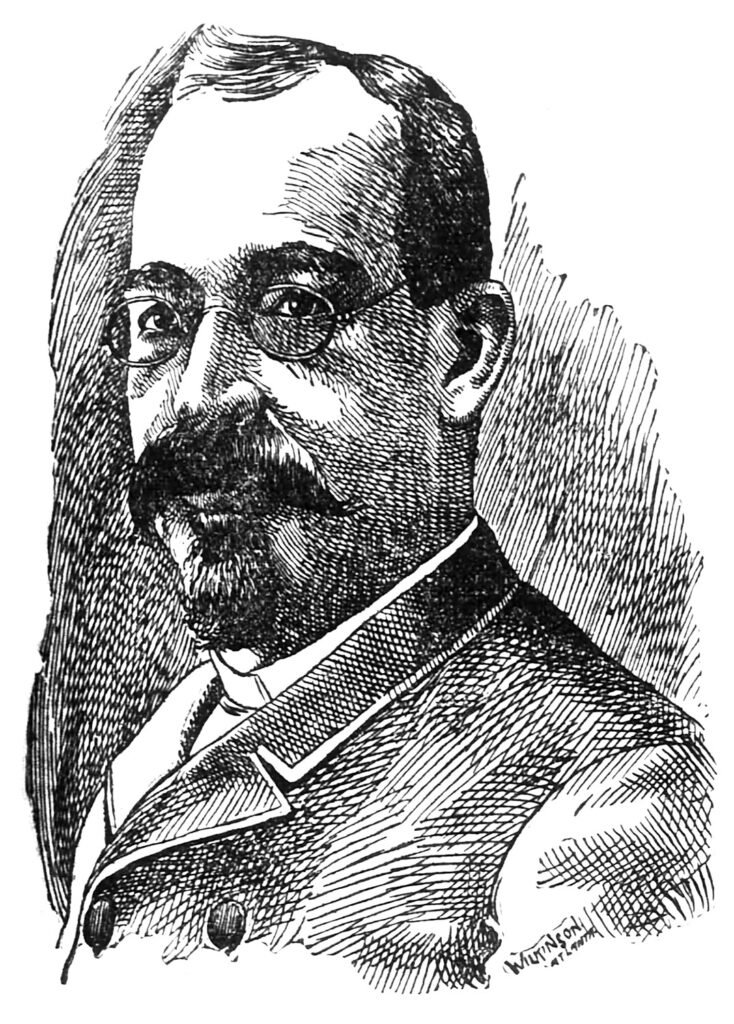
Joseph Hirsch (1845-19141819) was one of Atlanta’s leading citizens in the 19th century, and his most lasting contribution to the city was the founding of Grady Memorial Hospital,20 which he also named.21
In 1890, he served as a city council member, a school board member, president of the Empire Loan and Building Association,22 and a board member of the ill-fated Confederate Veterans Home.23
Norrman and Joseph Hirsch likely knew each other well, since Hirsch also founded Atlanta’s Hebrew Orphans’ Home,24 which Norrman designed in 1887. Hirsch was born in Germany, and Norrman was educated there, so the men shared at least a couple of languages and some cultural background.
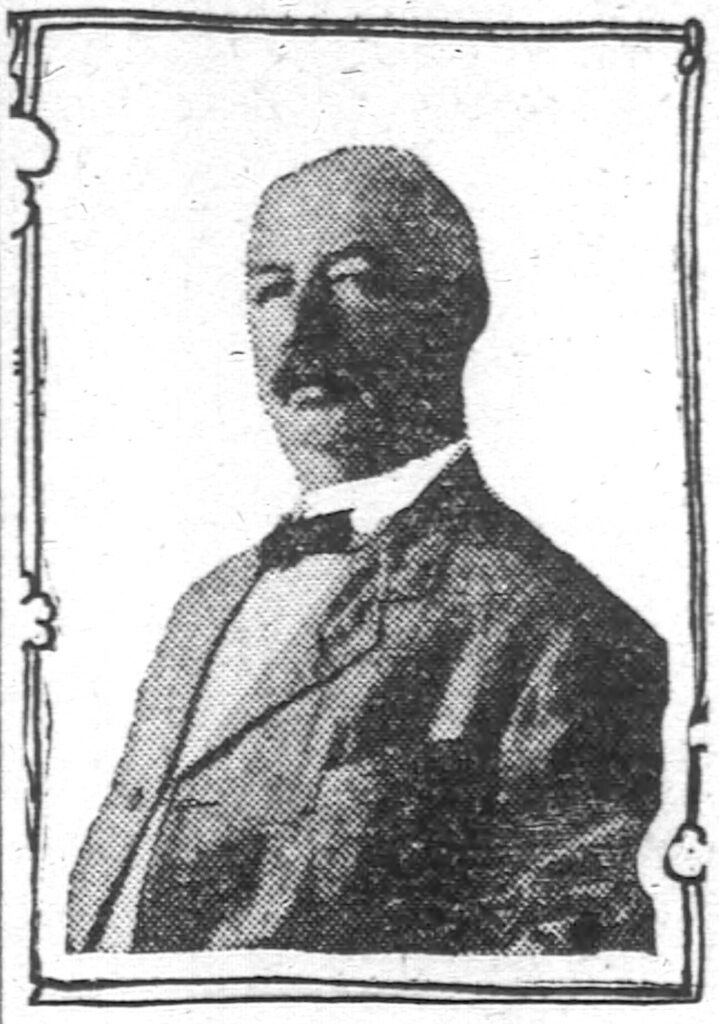
As a silent partner,26Henry Hirsch (1837-1919) maintained a lower profile than his older brothers, but when he died, the Constitution claimed: “Nearly every week for fifty-four years Mr. Hirsch was in his store…”27
Once again, the numbers don’t add up, since the store had been in operation for 52 years at that point—Atlanta math makes my head hurt.
About Regenstein’s
Regenstein’s was owned by Julius Regenstein, who opened his first Atlanta store in 1871 as Regenstein & Bro.,28 although the store later claimed a 1872 founding.29 I really can’t stress enough how ignorant Atlantans are of their own history—or anything else, for that matter.
Known for many years as “The Surprise Store,” Regenstein’s was a “mammoth millinery establishment” that reportedly employed “the first saleswoman in the South,” Martha Owens, who began working shortly after the store’s opening and remained for 20 years.30 In 1890, the store’s “leading milliner” was another woman: a mysterious “MadamGroskuth.”31
Regenstein’s pairing with Hirsch Brothers made sense: both were leading Jewish retailers, but their product lines were also completely different, so they were never in direct competition.
Hirsch Bros. specialized in men’s and boys’ clothing, andRegenstein’s sold women’s items, including hats, bonnets, hosiery, gloves, and underwear.
To give you an idea of Regenstein’s offerings, the store’s specials in 1890 included “Fine French and Swiss made Underwear at remarkably low prices.”32Ooh la la!
Competition and Construction
Since 1880, the Hirsch Brothers store had operated in a two-story building33 on Whitehall Street,34 and in late 1889, the Hirsches reportedly decided to build a new, larger structure on the same lot to expand their business.35
At the time, Atlanta’s commercial district occupied about 10 blocks south of Five Points, between Decatur and Mitchell Streets, and Whitehall was its main artery, lined on both sides by the city’s most prestigious retailers.
The Whitehall businesses had been locked in competition for years to see who could build the newest, largest, and most elaborate stores, and gut renovations or complete rebuildings of Atlanta’s leading retail establishments were common.
The Hirsch’s lot was narrow—only 120 feet wide36—but with five full floors, the new Hirsch Building would tower over the two- and three-story buildings on every side, for a few years anyway.
The project was first announced in January 1890,37 with a building permit issued in February 1890,38 and the existing structure was demolished by the end of the month.39Construction lasted six months and was completed in early September 1890.40
The Hirsch Building was furnished with steam heat, the “very best lights,” and an electric elevator4142—you’ll be hearing more about the elevator.
The elevator and stairs were crammed into a narrow hallway between the two anchor stores,43 and the stairs must have been incredibly steep, judging from the floor plans shown on insurance maps.
I’ve explored enough of Norrman’s buildings to know that he thought nothing of designing tight passages or steep flights of steps, but accessibility wasn’t a consideration of any architect in 1890.
May Mantel Company of Atlanta designed the Hirsch Building’s interiors,44 and with a full slate of other projects, Norrman was likely happy to delegate the task—interiors were never his primary focus, and from the 1890s onwards he increasingly paid them less attention apart from certain prestige projects.
The article below reports that Joseph Hirsch supervised the building’s construction himself, but I’m always skeptical of such claims. Surely Norrman or one of his assistants was on hand to ensure a competent execution of the plans, but maybe not—Norrman had projects in at least five states that year, and he and his staff must have been stretched to their limit.
Regenstein’s was the first tenant to move into the Hirsch Building,46474849opening on September 25, 1890,50 followed by Hirsch Brothers a few days later.51 Suites on the building’s upper floors began renting out in October 1890.52
Hirsch Brothers’ new, larger space allowed the store to expand its product offerings, as the Constitution described in an opening-day article:
“Hirsch Brothers will make a special feature of their hat department. Heretofore they have not had the room.
“Gent’s furnishings will also receive the attention of Hirsch Brothers. They will also make a specialty of this line of goods and can accommodate all those who desire goods of this character.”53
I’m not entirely sure what “gent’s furnishings” would be, but I’m guessing it included dressers, clothing cabinets, shaving mirrors, and the like.
The store’s tailoring department also expanded, reportedly employing “the very best tailors that could be secured in New York and London…”54 Yeah, I call bullshit on that one.
A Pretty Picture
Another of the Hirsch Building’s opening tenants was the Atlanta Photo Company, which also occupied a space in the company’s previous structure.55
Before the studio’s opening in October 1890,56TheAtlantaJournal proclaimed: “It will be the finest gallery in Atlanta. It will be the only gallery reached by an elevator.”57 Fancy.
In advertisements, the business touted its top-floor placement:
“It is located in the fifth story, above the noise, heat and dust of the city, free from reflections of surrounding buildings; has therefore, direct unobstructed light and pure air. The best of all, for the comfort of our customers, it is reached by a fine passenger elevator, thereby avoiding the fatigue of climbing stairs.
“Call and see us whether you want pictures or not.”58
A Cursed Elevator
Atlanta’s first passenger elevator debuted in 1877, and by 1890, they’d become a familiar sight in the city’s public buildings, so you’ve got to wonder what was so unusual about the Hirsch Building’s elevator that led to a trio of injuries in its first year of operation.
In December 1890, just a few months after the building’s opening, a man named C.C. Samswas struck in the head by the elevatorand “cut open to the skull.” The Journal explained that “He was looking up to see if the elevator was coming down, and didn’t see it.”59 Why was he standing underneath the damn thing?
One month later, two young newsboys outside the Hirsch Building were reportedly engaged in rough-housing and horseplay—I’ve been itching to use those terms for a while. In the excitement of the moment, one of the boys, Hunter Adams, ran into the building’s center hallway and pushed open the elevator door.60
Unfortunately for Adams, the elevator was in use on an upper floor, and he fell down the elevator shaft into the basement, landing on “a young man who caught the force of the fall upon his shoulder.” Adams received a sprained ankle and bruises,61 and I’m sure the guy he fell on wasn’t in great shape, either.
The corresponding story in the Constitution was titled “Down The Shaft.” Just leaving that there.
A week later, the boy’s mother sued Hirsch Brothers for $10,000, claiming her son had received permanent injuries.62 No word on the outcome.
The third and most serious incident occurred in July 1891, when a young man was crushed in the elevator’s gears. Sixteen-year-old Stonewall Paul—great name, no?—was employed by the Hirsches to operate the building’s elevator.6364 Also present was his father, R.K. Paul, who maintained the elevator’s hydraulic system.65
By 1891, the Constitution was starting to feel the heat of the rival Journal‘s more sensational storytelling methods, and its grisly description of the event is a breathtaking piece of macabre news writing:
“Yesterday the machinery got out of order, and the boy left the elevator to help his father fix it. The floor was wet, the boy’s foot slipped and he fell upon the cogwheels working the pump.
“The wheels were moving, and the father saw his son being rapidly drawn between them. In a second he grasped the boy, and with a frenzied jerk, separated him from the machinery, leaving between the wheels pieces of torn and bleeding flesh torn from the breast and side.
“The wheels with a tear and crunch had dragged half the shirt and pieces of flesh from the body and crushed every rib of the left side.
“With the fainting boy in his arms the father started for help which soon arrived. The boy was stretched out upon the floor of the engine room and physicians were sent for. It was a pitiful and frightful sight—the young boy lying on his back, perfectly conscious, but not allowing even a moan to pass his lips; his breast bare and blood running from holes where flesh had been torn from it. Just at and below the left nipple was an opening large enough for a man to thrust a hand in, lying loosely over which was a large piece of skin torn from one side, but attached to the other.
“Through this opening the heart’s action could be plainly seen, as that organ contracted and relaxed.
“Here, too, was a break in the left lung, and through the hole the boy heavily breathed. With every labored breath the loose skin would flutteras the air rushed in, and as it rushed out with a loud, gasping sound, drops of blood would be blown out and scattered.
“The poor father was wild with grief. Without the heart to look at the bleeding form of the boy, he threw himself upon the ground outside, and there moaned and talked to himself.”66
While it initially appeared young Stonewall would die,6768 he remarkably recovered,69707172 although the incident reportedly made him a “cripple for life.”73 Their words.
Paul’s parents sued the Hirsches for either $10,00074 or $15,000,75 but the case was ultimately “nonsuited” by a judge two years later.76 Atlanta justice for you.
The Mysterious Shooting of Dr. Jackson
Any building of consequence in Atlanta has been the scene of at least one bizarre crime, and a particularly baffling one occurred on September 4, 1894, when a doctor was shot three times in his room on the third floor of the Hirsch Building.
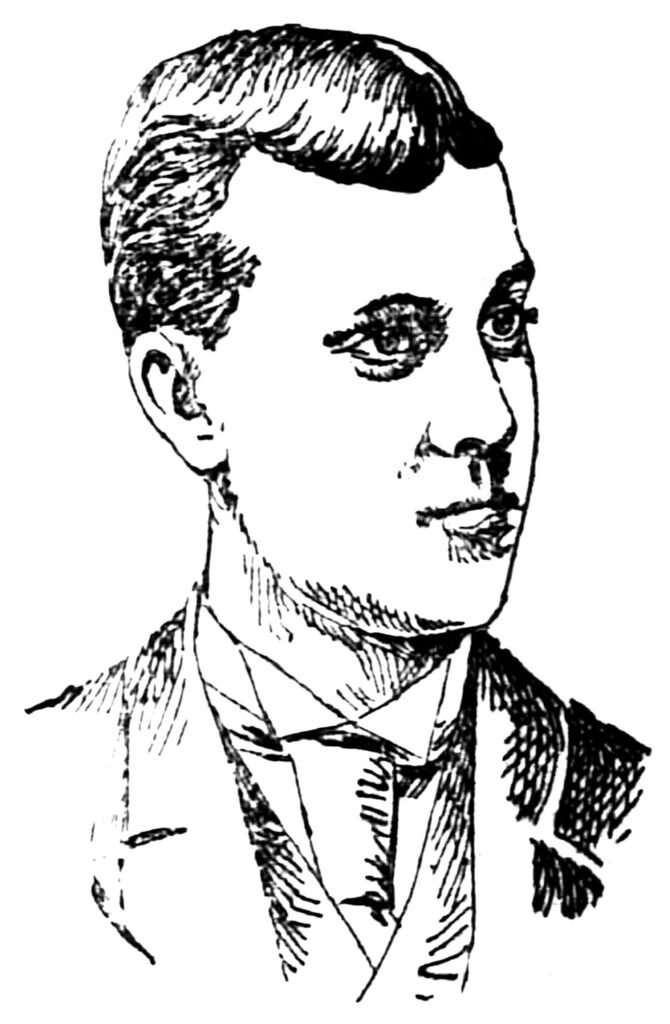
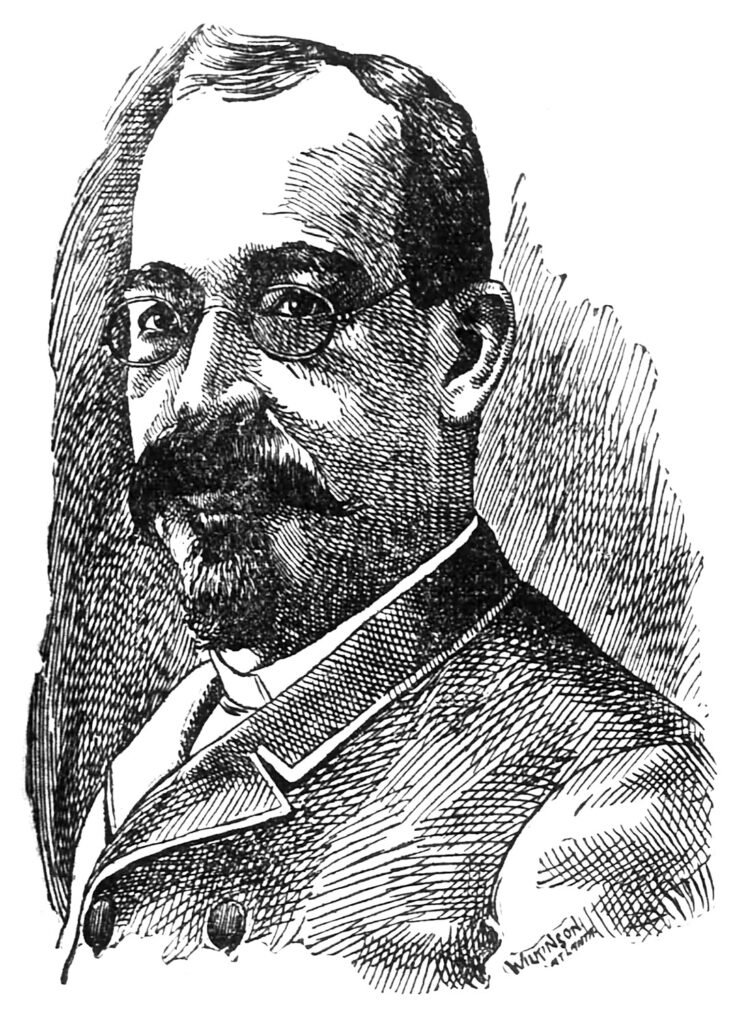
Dr. R.G. Jackson (pictured here77) was one of the Hirsch Building’s original tenants. Pretty man, don’t you think?
Jackson specialized in—well, I’ll quote one of his many newspaper advertisements: “Piles, fistula, and all Rectal Diseases treated by a painless process.”78
Jackson’s suite consisted of two connecting rooms: a larger one for his living quarters, and a smaller one for his office, which contained “his surgical chair and the cabinet in which his instruments are kept.”79 Savory.
That the shooting occurred in Jackson’s bedroom, and not his office, apparently sent local tongues a’wagging. And Atlantans do like to wag their nasty tongues.
Once again, the Constitution described the incident in breathless detail, with tantalizing morsels worthy of a pulp story:
‘At 8 o’clock Dr. Jackson took supper at Durand’s restaurant. He was in a gay humor and laughed and talked with several friends who were sitting at the same table.
‘He left for his rooms at 40 Whitehall for the purpose of changing his clothes preparatory to making an evening call. As he started up the stairway he met Patrolman Braselton and the two men stopped for a short chat. He entered the door of his bedroom, lit a cigarette and played for a few seconds with his setter dog before beginning to undress for a bath.
‘He had taken off his coat and top shirt and walked into his office room to make arrangements for a bath. As he stepped into the room a suspicious noise attracted his attention. He stopped and looked back, but his dog was coming from that direction and he decided that the noise was made by him.
‘Dr. Jackson had reached the washstand. His suspenders were down and in order to prevent his pistol, which he carried in his right hippocket, from falling, he placed it on the table.
‘As he turned to go back into his bedroom for a towel the curtain moved and the face of a strange negro stuck itself out.
“Hold Up Both Hands.”
‘”What are you doing there, you black rascal?” As he said this the doctor walked towards the man.
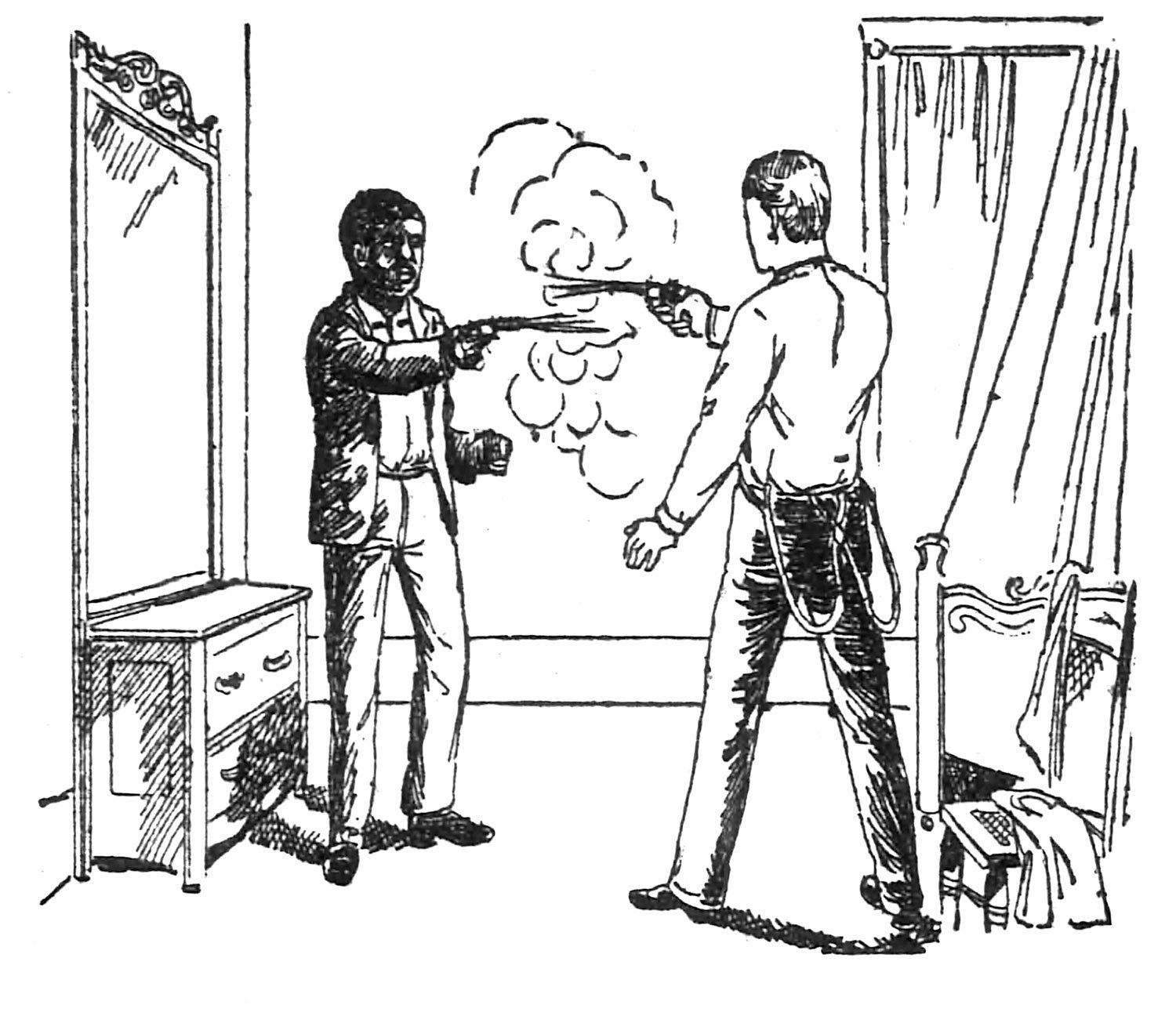
‘In an instant the burglar jumped from behind the curtain. “Hold up both hands or I’ll put a hole through your head,” covering the doctor as he spoke, the negro pushed the gleaming barrel in the doctor’s face.
‘It was a critical moment and the doctor realized it. He did not hesitate. With the fiery dash and bravery which have always characterized him he jumped to the table for the pistol. Quicker than the flash of his weapon he turned and fired. The negro was behind the curtain and it is thought that the ball failed to strike him.
‘Before the doctor could fire again and when he was blinded by the smoke of his own revolver the burglar gave a quick step forward, placed his pistol opposite the doctor’s head and pulled the trigger.
‘The ball struck with fearful force, causing Dr. Jackson to reel and fall backwards against the washstand.
‘Taking advantage of his position the negro stepped further up and fired again. The ball struck in the left hip joint and the doctor fell again. Then, with superhuman effort he raised himself. The negro had taken cover behind the curtain again and was firing at the place where he knew the doctor to be standing. At the same time Jackson began firing and for a second there was a fearful fusillade.
‘Both men had emptied their revolvers. Through the blinding smoke the burglar glared at the bleeding figure of his almost helpless victim.
‘”I am going to kill you, damn you.” The doctor heard him say this as he rushed forward to grapple.
‘On his feet again Jackson reached out both hands for the throat of the desperate man. He was too weak to hold him off and they clinched.
‘In his hands the negro still held the smoking pistol and as he grappled gave the doctor a terrific blow on the skull. Again the physician sank to the floor and again rose up to fight his merciless antagonist. A second time the pistol descended and once more the doctor went to the floor, blood gushing from his head and body.
‘Like an enraged tiger the burglar stood above his prostrate form ready again to strike. Jackson came up once again and succeeded in getting his arm around the man’s waist. It was a struggle for his life and with supreme determination, Jackson retained his grasp. The men tumbled about and the burglar attempted to extricate himself all the while beating his pistol savagely against the doctor’s head.
‘They had neared the window and were going at it wildly. At a sudden turn the pair fell against the glass which was crashed to pieces. They separated, the doctor reeling back toward the door with the burglar following.
‘Here the struggle was renewed again fiercer than before. Thoroughly exhausted, Jackson was overpowered finally. The streaming blood covered his face and when the burglar left it was impossible for him to tell which way he went.”‘80
Jackson’s friend “Patrolman Braselton,” who had been chatting with him moments before the shooting, was reportedly walking down Whitehall Street when he heard the shots being fired, then ran back into the Hirsch Building and bolted up the stairs.82 Good thing he didn’t use the elevator.
At the top of the steps, the cop found Jackson on the floor, sobbing, “My God, Braselton, they have murdered me.”83 So melodramatic. Jackson, incidentally, recovered from his injuries.
Braselton recalled: “As I was standing at the bottom of the staircase and saw no one go out, it occurred to me at once that the man who did the shooting was in the house and I started out to look for him.”84 Smart thinking there, boss.
The Constitution described the extent of the search:
“Lanterns were secured and a large searching party covered the tin roof. Every chimney was examined and all the corners of the building looked into. Squads of police entered the different rooms in the building with the hopes that the man might have stopped on his way down to escape to conceal himself there.
“No trace of him could be found.
“Every foot of the large roof was looked at but no blood nor sign of the man’s presence could be seen.”85
Jackson insisted that he was shot by a Black man, later stating, “The man who shot me was a young negro. He seemed to be about eighteen years old, and wasvery black.”86
That information was corroborated by the engineer for the Hirsch Building, J.W. Vaughan, who lived on the fourth floor with his wife and claimed to have chased the shooter through the building before the man jumped out of a fourth-floor window.87
We all know that White Southerners get off on accusing Black men of crimes, so it’s interesting that so few people in Atlanta seemed to believe Jackson’s description of the shooter, with the Journal expressing outright skepticism:
“There is an air of mystery surrounding the affair, and accounts of the shooting which has been given to the police and press have been slowly accepted.
“That Dr. Jacksons’ assailant was a man there can be little doubt.
“There is some doubt, however, about it being a negro man and burglar.”88
The Journal reported on a group of eyewitnesses who saw a man jump from the window of the Hirsch Building to the roof of an adjoining structure, adding:
“It was too dark to tell whether it was a white or a colored man, but it was certainly a man…”
The Constitution followed up the next morning, referring to the rival Journal as “the afternoon paper”:
“During the day there had been many wild reports concerning the affair, and many were inclined to give it a mysterious coloring. Theories of various kinds were hatched up by those who doubted the story of the burglar. These reports had reached the doctor, and he was much incensed. Concerning the report in the afternoon paper, which openly expressed a doubt as the truth of his statement, he was enraged…”89
Jackson publicly addressed at least one “rumor” associated with the shooting, or maybe he was just creating one of his own:
“I naturally expected rumors about a woman in the case to come up, as is always the case in an affair of this kind, but my statement of the shooting is so fully corroborated by circumstances, that I have no time to pay any attention to them.”90
At least three Black men were arrested on suspicion of the shooting—one in Madison, Georgia,91 another in Americus, Georgia,92939495 and a third in Birmingham, Alabama.96 None of the men was the shooter, who was never caught.97
The lack of an arrest continued to fuel public skepticism, with the Constitution repeating a few days after the shooting:
“The various reports which have been circulated and published reflecting upon the doctor’s account of the affair are all known to him, and he is warmly indignant and declares that he intends to resent personally any insinuations against his character.”98
Nine days after the shooting, Jackson left the city without notice, apparently returning to his father’s home in New Orleans.99
Before the incident, Jackson had been distressed by the recent death of his mother, with the Constitution noting that “the shock on receiving the news nearly prostrated him.” It was also said that as he lay on the floor bleeding when he was shot, Jackson “frequently called the name of his mother.”100
Jackson returned to Atlanta two weeks later, with the Constitution describing him as “looking very pale,” and adding that he “shows very plainly the effects of his suffering from the terrible encounter with the burglar.”101
As if insulting his appearance wasn’t enough, the report again referred to the “wild stories” surrounding his shooting:
“The doctor denounces the stories that were circulated about the shooting affair soon after it occurred to the effect that the murderous assault was not made by a negro burglar. Those damaging stories gained considerable circulation, but no one who knew Dr. Jackson gave them credence.”102
Nothing about the incident made any damn sense, and Jackson’s behavior in the following year was equally baffling.
In May 1895, he had “a very quiet wedding,”103 marrying a Miss Lizzie Renfroe, although the papers couldn’t even agree on where the ceremony occurred: the Constitution claimed it was at the West End Methodist parsonage,104 while the Journal said it was at “the home of the bride in Edgewood,”105 on the other side of the city.
Jackson made news again in October 1895, when he engaged in a cane fight with a local attorney, J.E. Robinson, at Atlanta’s police headquarters,106 an incident stemming from “an old feud between the two men.”107
The Constitution described their dispute:
“Robinson spoke to the physician, whereupon the latter remarked that he recognized only gentlemen as his acquaintances. The remark angered Robinson, who asked the physician if he intended to intimate that he, the attorney, was not a gentleman. Dr. Jackson replied in the affirmative, whereupon Robinson struck him.”108
As a result of the fight, “Dr. Jackson received a cut on the forehead which brought the blood freely, staining an immaculate shirt front and collar.”109
Surely Jackson’s reputation in Atlanta was shot at that point: his last newspaper advertisement was published one month later in November 1895,110 and it appears he gave up his medical practice completely.
The doctor and his mysterious wife moved to Brunswick, Georgia, in March 1900, where he worked as a representative for the Sun Insurance Company of Canada.111
Twelve years after the shooting, a columnist for the Constitution recalled the case and claimed that Atlanta police had later determined the shooter was a member of “a strong secret organization” that Jackson had unwittingly crossed years earlier.112
The convoluted and frankly preposterous explanation was that the shooter posed as a locksmith in the Hirsch Building for a year to monitor Jackson’s movements. On the night he shot Jackson, the shooter purportedly coated his face in lamp black, which was said to have been found near a bowl of dirty water in the back of the building, “a year or two later.”113
The story is too outlandish and full of holes to be credible, and it doesn’t help that the columnist got so many basic details of the case wrong, including that Jackson was shot at 2 a.m., and that “a few months later [he] died out west.”114
If we’re going to entertain far-fetched theories, I’m more inclined to believe that Jackson’s shooting was the result of a lovers’ spat between downlow Atlanta men—surely that was one of the “damaging stories” being whispered about.
There are plenty of clues to support the theory, and for God’s sake, the guy examined assholes for a living.
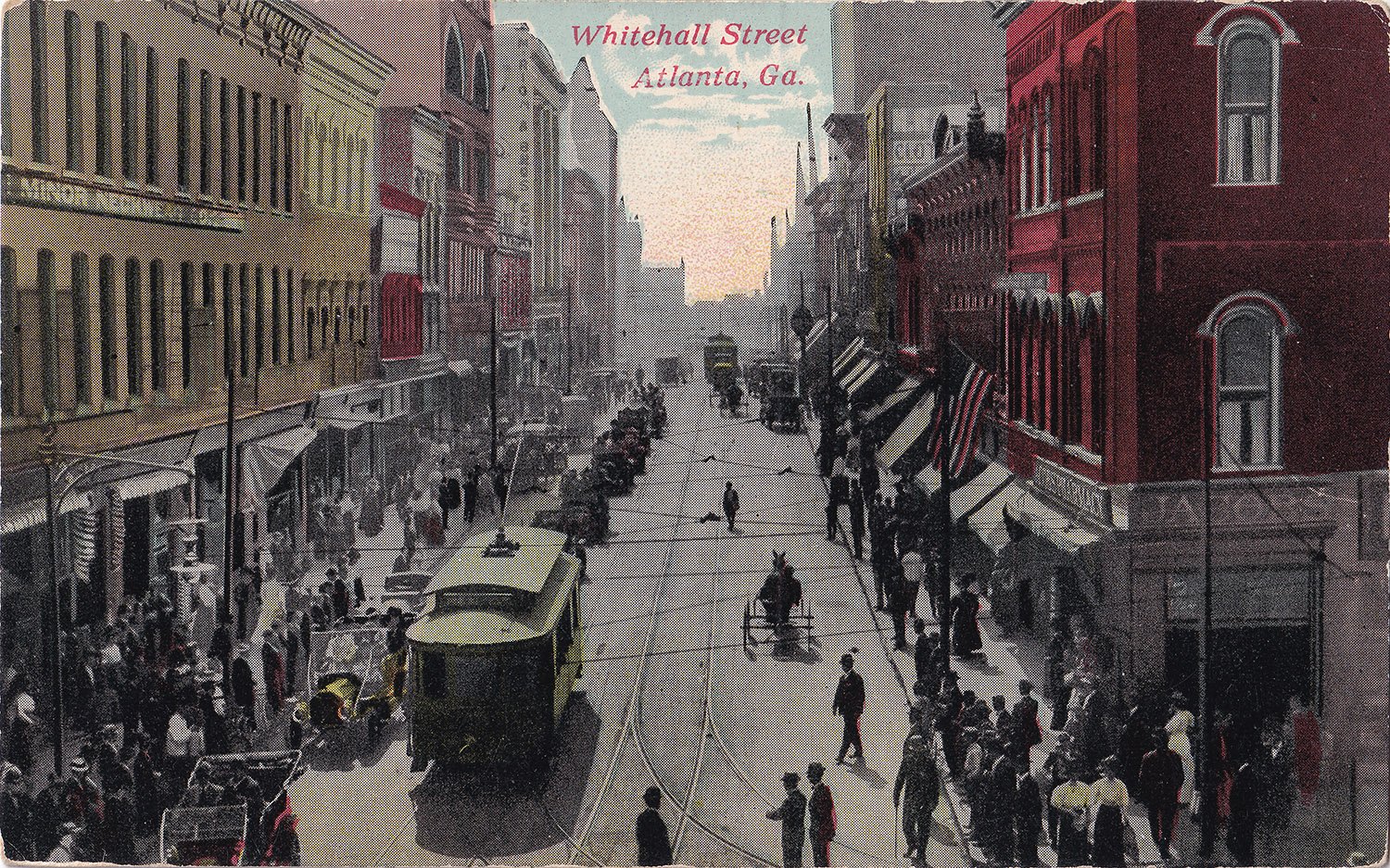
Looking south on Whitehall Street, with the Hirsch Building visible on the distant left. Illustration from an undated postcard published by Witt Bros. of Atlanta and Berlin.
Consistencyand Change
Within 10 years of the Hirsch Building’s completion, most of the storefronts on Whitehall Street had grown to five or more floors, and as Atlanta’s first skyscrapers of eight to 10 stories began forming a nascent skyline, the briefly prominent structure increasingly faded into the cityscape.
In 1894, Morris and Joseph Hirsch sold their shares in Hirsch Brothers to their sons, L.H. Hirsch and M.R. Hirsch, although Henry Hirsch retained his share in the store,115 which continued operation as Hirsch Brothers.
Hirsch Brothers and Regenstein’s remained the anchor tenants for the Hirsch Building’s entire existence, but the upper floors, divided into much smaller spaces, became a hodgepodge of businesses that often vanished as quickly as they appeared.
The building particularly attracted two types of entrepreneurs in its early years: medical practitioners and boutique dressmakers.
In the early 1890s, the Hirsch Building’s tenants included “The Sultan’s Physician,” who advertised cures for “Cancer, Blood and Skin Diseases,”116Mrs. A.M. Smith, a “massage and complexion specialist,”117 and at least three dentists.118119120 In 1898, the building was the home of Madame Browne, an “expert dermatologist.”121
The Hirsch Building housed dozens of dressmakers in the 1890s, including Mrs. V.A. Foster, who specialized in “evening costumes,”122 the parlors of Mrs. Odair and Miss Shumate, who made “ladies’ gowns in the latest and most stylish manner,”123 and Alice & Co., a New York-based studio that designed—what else?—”fashionable gowns.”124
Other businesses in the early 1900s included “Miss Stokes“, who sold “The Most Elegant Gowns”125 and “Madam Alice,” for “women who take a pride in being well gowned.”126 So many damn madames.
By 1896, the Atlanta Photo Company was out of business and replaced by another photo studio,127 and in the late 1890s, yet another madame, Madame Marie Percy,128 began offering “Scientifically correct readings from marking of hands.”129
But Madame Marie had nothing on Madame Paulini, “the most noted Scientific Palmist of the age,”130 who operated in the Hirsch Building for 10 months in 1906 and 1907.131
Following Henry Hirsch’s death in 1919, the Hirsch Brothers store was incorporated as Hirsch Brothers Company, managed by the descendants of the three original Hirsches.133
Remember that hazardous elevator? Well, in 1921, another worker in the Hirsch Building was severely injured when he was crushed between the elevator and the third floor.134 It wasn’t the same elevator, though: the original had apparently been replaced during a 1915 renovation.135
Maybe it was just the building that was cursed.
Atlanta Moves On
By the 1920s, Atlanta’s commercial district had been drifting northward for years, following the city’s wealthiest residents as their swift new automobiles took them miles away from Whitehall Street into the suburbs of Ansley Park, Druid Hills, Buckhead, and places beyond.
In 1930, Regenstein’s opened a second, much larger store several blocks north at the corner of Peachtree and Cain Streets, while continuing to operate its original location in the Hirsch Building.
It wasn’t too shocking when Regenstein’s announced five years later that it would move its older store to a larger space at 80 Whitehall Street.136137
Following the Regenstein’s announcement, the Hirsch organization revealed that Hirsch Brothers would also be moving to a new space, several blocks north at 79 Peachtree Street.138
With the removal of its two anchor stores, the Hirsch Building was demolished exactly 45 years after its completion, in September 1935139—well, most of the building, anyway.
Only the top three floors of the Hirsch Building were demolished, while the bottom two floors were renovated and given a new facade designed by Dillon & Lewis of Atlanta.140141
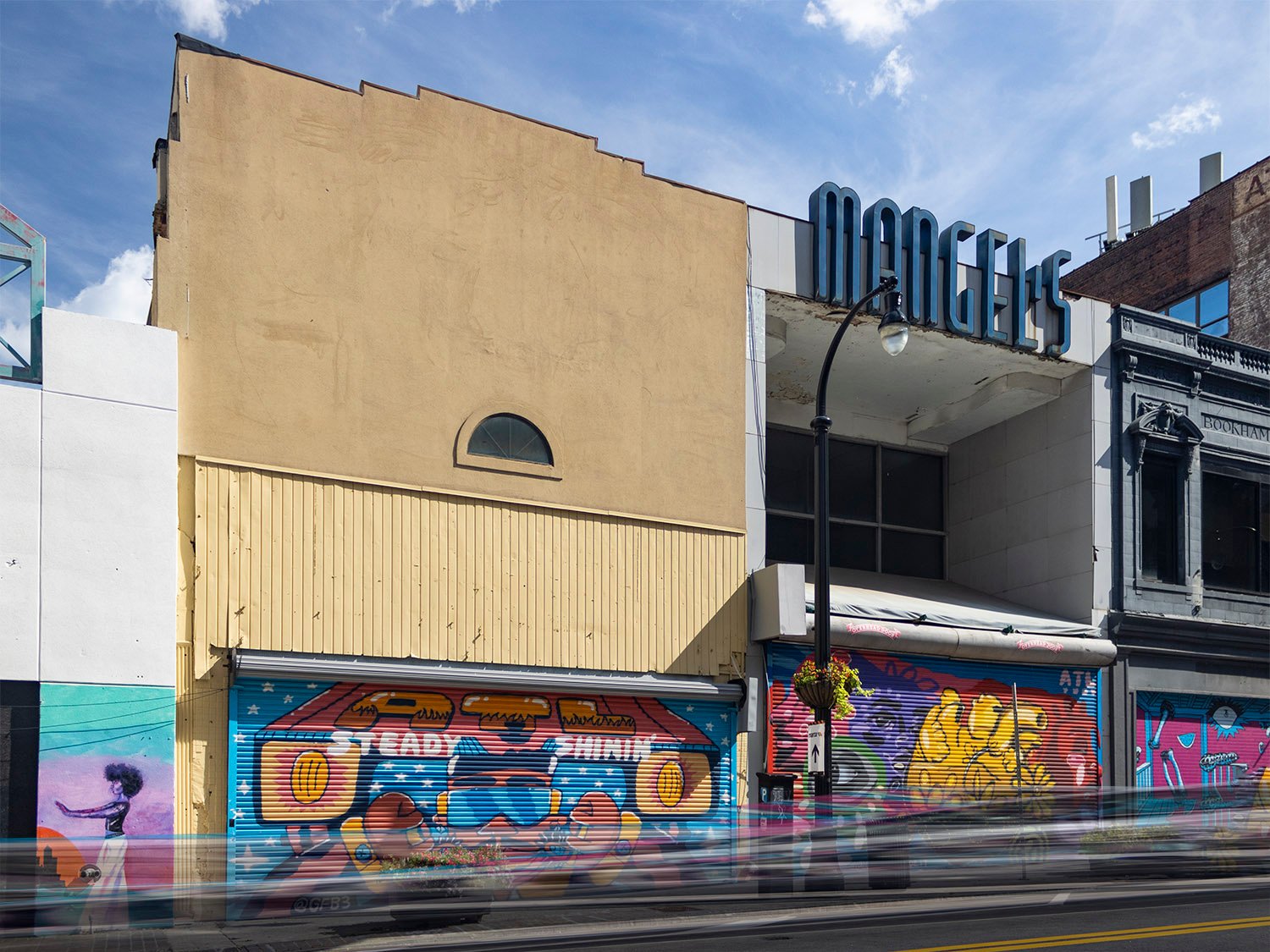
The two-story shell of the former Hirsch Building survives, although nothing of Norrman’s design remains, and even the 1935 facade has been replaced at least twice. It could be argued that the structure technically exists, but since it’s been so substantially altered, I consider it as good as demolished.
70-72 Peachtree Street, Atlanta. Shell of the former Hirsch Building.
Out With a Whimper
In 1963, Hirsch Brothers celebrated its 100th anniversary as “Atlanta’s Oldest Retail Store”, a designation that it probably should have shared with Rich’s, which also began in 1867.142 By the time the second Morris Hirsch died in 1967, the rebranded Hirsch’s had expanded to six stores in the Atlanta area,143 five of them located in shopping malls.
Based on the company’s flurry of newspaper advertisements in the 1960s and 70s, Hirsch’s valiantly attempted to modernize and adapt its offerings to suit changing consumer tastes, but in its final years, the company made no secret of its desperate fight for survival.
One particularly pathetic ad from 1979 stated: “After 115 years as one of Atlanta’s Leading men’s clothiers we are forced to RE-EVALUATE & CONSOLIDATE. currently negotiating lease expirations, we must make the important decision whether or not to STAY OR GO!”144 Apparently, the store was now claiming a 1874 founding.
Within months, Hirsch’s operated just one store, at Greenbriar Mall145 in southwest Atlanta. That location apparently closed circa 1981 without any press notice.146
Regenstein’s died just as quietly. After expanding to four stores across metro Atlanta in the mid-20th century, the Regenstein family sold their company to a Texas businessman in 1976 because “none of the younger members of the family intended to carry on the business.”147
By 1985, the company had reduced its operations to one location and shifted its focus to selling furs.148 The store was gone by 1994,149 again, without any press mention.
Today, you’d be lucky to find anyone in Atlanta who’s heard of either Hirsch’s or Regenstein’s.
The Hirsch Building.
Above is a picture of the elegant front of Hirsch Bros. new building which is being erected at No. 40 Whitehall street.
It will be one of the handsomest and most perfectly constructed buildings in the city, and will rear its stately front in the very busiest portion of metropolitan Atlanta.
It will be a double building, five stories high, designed with a skilled appropriateness for the purposes intended. It will be of brick and iron, the interior magnificently finished in wood of the finest material.
The building will cost all the way from $40,000 to $45,000, and the construction is being superintended by Mr. Joe Hirsch, the senior member of the firm, in person, and his long experience in business enables him to design and execute the plans and specifications, with an eye to the greatest economy of interior space coupled with the elegance in proportion and outside adornment of a skilled architect.
It was begun about the first of the present month, and will be completed by from the 1st to the 15th of August next. One-half of the building will be occupied by Hirsch Bros. big retail store, and the other half has been rented to another large retail concern.150
References
Photo credit: “Pages From Regenstein’s Family Album 1872-1939” (advertisement). The Atlanta Journal, December 15, 1939, p. 55. ↩︎
“The City In Brief.” The Atlanta Constitution, March 29, 1890, p. 5. ↩︎
“Little Locals.” The Atlanta Constitution, September 4, 1890, p. 8. ↩︎
Illustration credit: Van Rensselaer, Mariana Griswold. Henry Hobson Richardson and His Works. New York: Dover Publications, Inc. (1969) ↩︎
“Plan To Raze Old Field Building, City Landmark”. Chicago Sunday Tribune, March 30, 1930, Part 1, p. A9. ↩︎
“Huge Blocks In Old Field Warehouse To Stay Where They Are”. Chicago Sunday Tribune, May 4, 1930, Part 2, p. 14A. ↩︎
“Mr. Joseph Hirsch.” The Atlanta Constitution, February 5, 1893, p. 3. ↩︎
“Hirsch Bros. Company Plans Eight-Day Sale In Observance of 69th Anniversary Here”. The Atlanta Journal, September 9, 1932, p. 25. ↩︎
“Hirsch To Celebrate 69th Anniversary”. The Atlanta Constitution, September 10, 1932, p. 3. ↩︎
Barnwell’s Atlanta City Directory. Atlanta: Intelligencer Book and Job Office (1867). ↩︎
“Hebrews Of Atlanta”. The Atlanta Constitution, January 12, 1890, p. 16. ↩︎
Illustration credit: “Israelites”. The Atlanta Journal, November 21, 1891, p. 7. ↩︎
“Morris Hirsch Drops Dead While Visiting Sick Friend”. The Atlanta Journal, February 6, 1906, p. 7. ↩︎
“Morris Hirsch To Be Buried At Oakland”. The Atlanta Journal, February 7, 1906, p. 6. ↩︎
“Morris Hirsch Drops Dead While Visiting Sick Friend”. The Atlanta Journal, February 6, 1906, p. 7. ↩︎
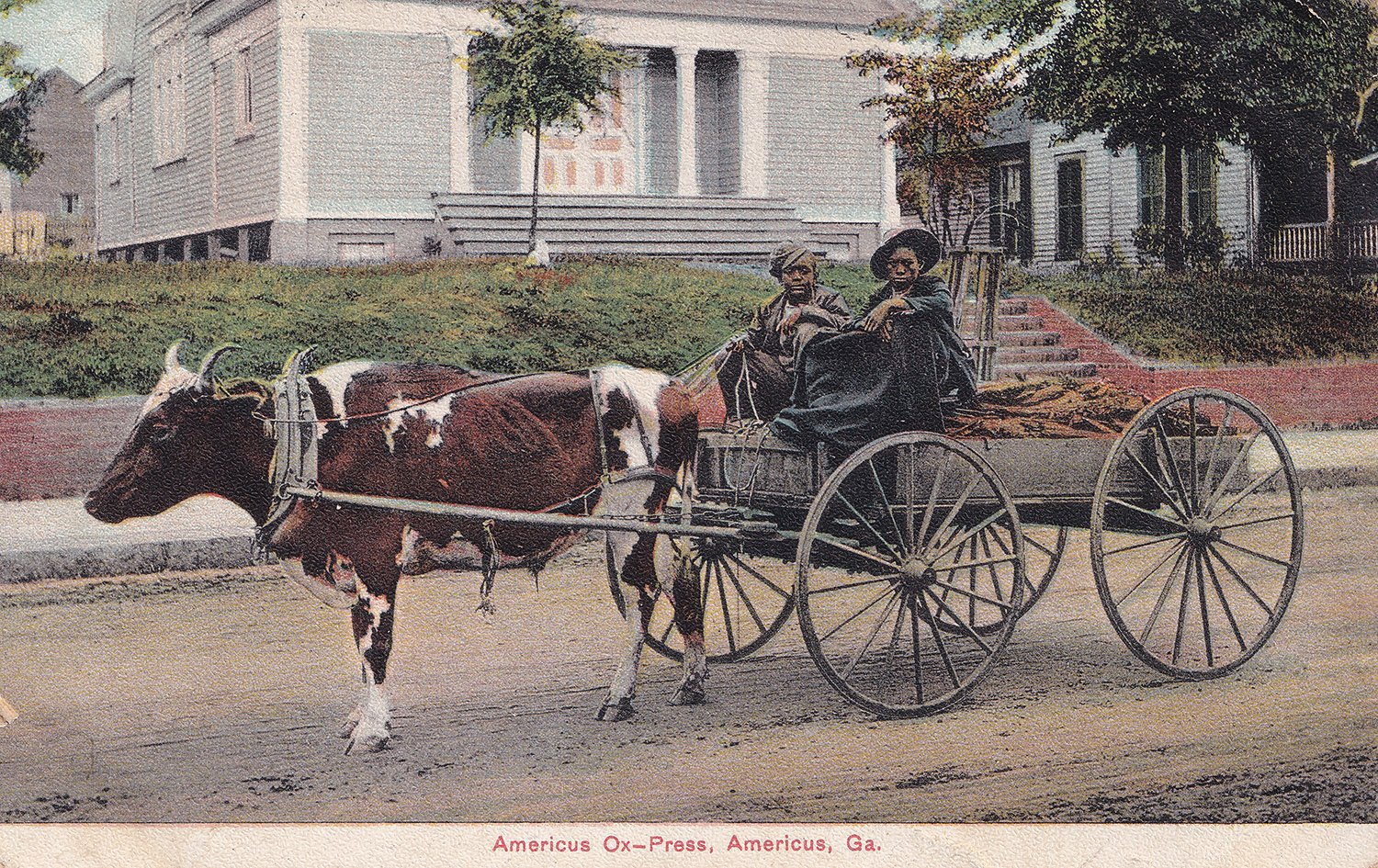
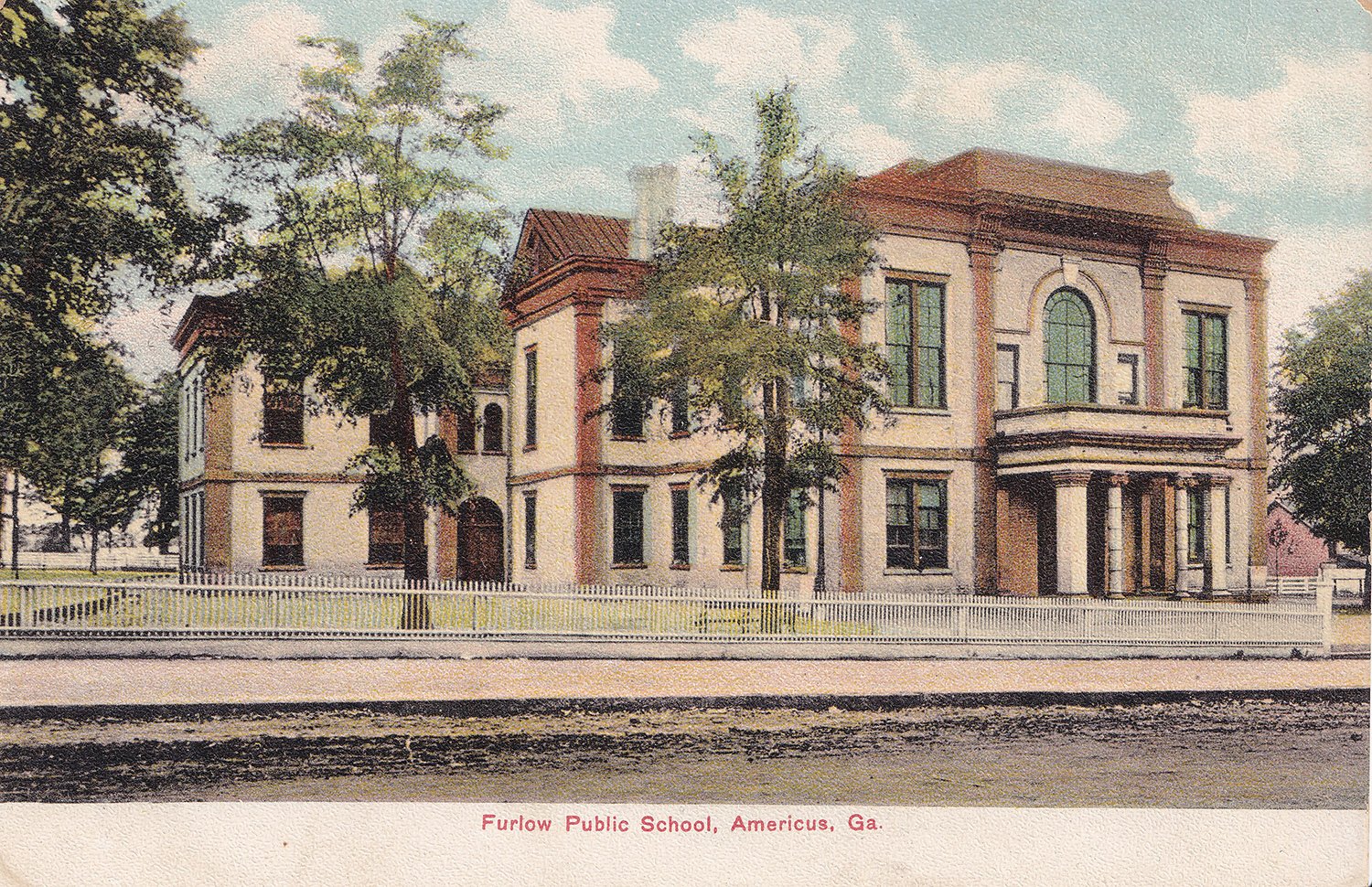
This postcard depicts the Furlow Public School in Americus, Georgia, which received a renovation and expansion designed by G.L. Norrman in 1890.
Published by the American News Company of New York and printed in Germany, the card was postmarked in 1908 and addressed to Marie Smetzer of “808 S. West Grand Ave., Springfield, Ill.”
Corrine from nearby Plains, Georgia, wrote the following note on the back:
“Recd card many thanks. Hope you will like this one Come soon again”
Not very eloquent, but that’s a Sumter County education for you. Trust me, I know.
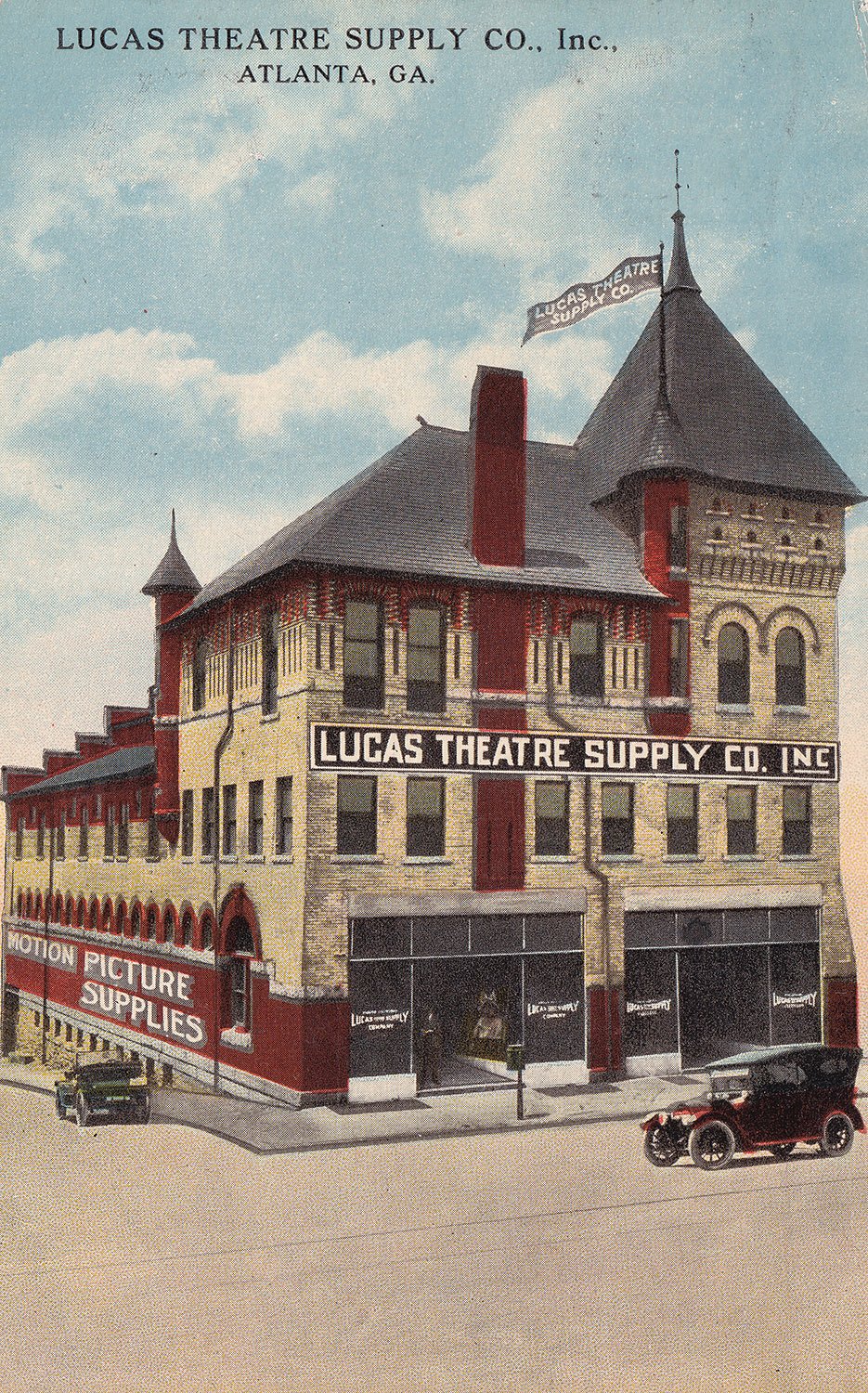
This postcard depicts the Lucas Theatre Supply Company in Atlanta, housed in the former Miller-Brady Feed & Sale Stables, designed by G.L. Norrman and completed in 1890.
The following promotional copy is printed on the back:
“PICK THIS UP!” (Things You Should Know)
That we are the South’s largest, oldest and most progressive exclusive Theatre Supply House.
That we have established a National Reputation for quick service, individual attention and courteous treatment.
That we carry a tremendous stock, embracing all make machines as well as the thousands of minor theatre accessories.
That we will appreciate the opportunity and pleasure of serving you.
Published by L.H. Forster of 209 Rhodes Building in Atlanta, the card was postmarked in Atlanta in 1917 and addressed to the Idle Hour Theater in Marion, South Carolina.
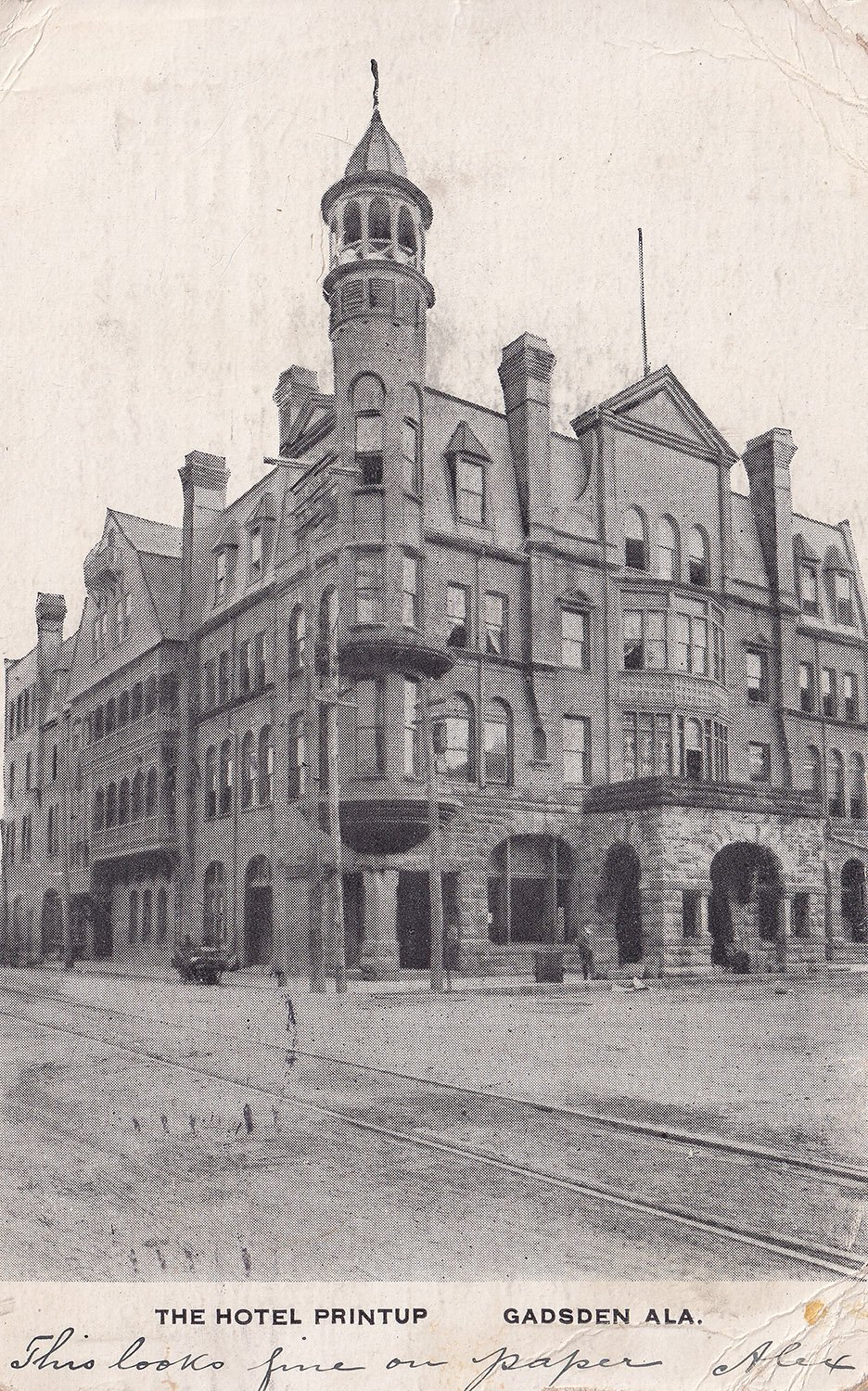
This postcard depicts the Printup Hotel in Gadsden, Alabama, designed by G.L. Norrman and completed in 1888.
“This looks fine on paper,” Alex wrote on the front. Not exactly a ringing endorsement.
Published by the AH Company, the card was postmarked in St. Louis on November 11, 1907, and addressed to Mr. W.A. Yule in Scotforth, Lancaster, United Kingdom.
Alex wrote on the back:
“Have rec’d quite a number of postals from you, which I am glad to have. Pls accept thanks. Glad to hear you are having such a good time. Alex”
The following article, published in The Atlanta Constitution in February 1893, isa biography ofJoseph Hirsch (1845-19141), one of Atlanta’s leading citizens in the 19th century.
Hirsch was a German-born immigrant who came to Atlanta following the Civil War and quickly established himself as one of the city’s most successful Jewish merchants.
He also became an outstanding civic leader who founded some of the city’s most important institutions, notably Grady Memorial Hospital, which he also named.2
G.L. Norrman worked with Hirsch on at least two projects: the Hebrew Orphans Home, completed in 1888, and the Hirsch Building, completed in 1890.
Mr. Joseph Hirsch
A Sketch of the Life of This Well-Known Citizen.
His Work For the Grady Hospital
He Became a Citizen of Atlanta Twenty-Five Years Ago, and Has Been an Active Worker in All Her Enterprises,
No citizen of Georgia is better known or enjoys with his wide acquaintanceship a popular esteem that is meted more closely to his reputation, than Mr. Joseph Hirsch.
This reputation which has come to him within the last few years has been the result of his earnest, steady and persistent work in behalf of the welfare of this city, and especially his efforts in connection with the building of the Grady hospital.
His name, in view of the service which he has rendered to the public in behalf of the establishment of this institution, will always be associated with that of the lamented Georgian in whose honor it was founded.
Mr. Hirsch, by his benevolent and patriotic work, has not only typified the broadest and best spirit of his own race, but has been the exponent of those higher qualities which seem to resent the petty differences of men, and to preach a gospel of a broader and more liberal fellowship.
While thus he has acted from the promptings of a warm, enthusiastic nature, governed by a judgment which has operated from a lofty point of view, he has nevertheless, in the strictest fealty to his own race, been proud of those traditions which are sacred to his people, and has rigidly adhered, in every test, to the faith and teachings of his fathers.
The Hebrews of Atlanta have almost universally been active in the growth and improvement of the city. They have added not only to the wealth and enterprise by infusing their own blood into its arteries, but have likewise added to its culture and refinement. In matters of charity they have always been liberally disposed, and in the assignment of their bounty they have rarely asked the question, “Is he one of us.” Mr. Hirsch is not a citizen of this country, as nearly every one knows, but was born in the German empire in 1845.
His father before him was a merchant and a trader and from his parent, therefore, he acquired that peculiar aptitude for business which has prospered him in his mercantile career in this city.
He developed at a very early age and love for merchandising, and such was his preference for the life and occupation of a merchant that nothing else would suit him. He felt a decided kinship and affinity for those commercial spirits who were engaged to the speculative interests of his native town!
Even while at school his thoughts were in the market place, and his spirit, thus engrossed with the ideas which were slowly germinating in his mind, continually played truant to his books and often made his back the martyr of his mercantile ambition.
Germany at that time, while still the leading empire of the continent, was lacking in those varied charms that appealed to the eye of gain and worldly benefit. A constant stream of emigration was steadily pouring towards the west. It was the popular belief in Germany and many other parts of Europe that fortunes were easily acquired in the new world, which was only an exaggerated statement of the truth that fortune was apt to reward the labors of those who diligently applied themselves to honest work.
This is true of any country where honesty is regarded by the people who endeavor themselves, to cultivate it. It was especially true at that time of this country–for its free institutions were then such and the atmosphere of its government was of such a kind as to encourage and foster a spirit of energetic rivalry.
The idea of easily made fortunes in America, which proved such a powerful influence in stimulating European emigration, was due in a large measure to the character of those emigrants who, prior to that time, had cast their fortunes in the new world.
Happily they were men of strong characters, who, led by the adventurous spirit of the times to cross the ocean, and given up their roving dispositions as soon as they had landed on these shores and acquired that stable quality of application which confined them from that time on within the same horizon of activity.
Many of the German citizens who are living in Atlanta at this time are the representatives of that exodus which set out for this country some twenty-five or thirty years ago.
America, therefore to Mr. Hirsch was the synonym for opportunity. He thought it was a vast country beyond the waves of the Atlantic and pictured it with that imaginary opulence which was then the popular belief not only in Germany, but in many of the other nations of the continent.
Such were the inducements that appealed to Mr. Hirsch when quite a mere lad.
Accordingly when only fifteen years of age he bought a ticket to this country, and with no one to accompany him, he began the long and perilous journey.
The solitude of such a voyage supplied him with the opportunity for thought and meditation. He mused upon his leaving home on such an errand, and his spirit, as was only natural for one of tender years, flew back along the pathway of the vessel, and haunted the familiar places of his fatherland.
But the distance grew between him and his old former home, and after a few days, his thoughts were revolutionized. He began to think less of the country he was leaving and more of the harbor into which he would soon sail. Accordingly he began to “dip into the future” and to think of the sequel of his voyage in that strange and unknown country that would soon extend to him the welcome of its lighthouse on the shore.
He fully made up his mind on that voyage to brave it out as best he could, and if he failed to secure his fortune he would not at least fail to earn it.
It was a very unfortunate time as far as the hospitality of the United States was concerned for a foreigner to land on our shores.
The sections–for it was during the year 1860–were on the verge of civil war, and while they were making it warm for one another, they had little time to extend those social courtesies with which it is customary to greet the stranger.
Arriving in this country he came immediately to Georgia, and settled in the town of Marietta, which was then, as it is now, a charming and beautiful center of culture and refinement.
He remained, however, in Marietta for only a short while, serving while there in the capacity of a clerk. Leaving Marietta he went to Acworth, a few miles further up the State road. His reason for going there was that one of his elder brothers was a citizen of that place.
After leaving Acworth he went to Philadelphia, Penn., where he perfected himself in the study of bookkeeping. When left the business college at that place he was a thorough and accomplished bookkeeper.
He next went to Wheeling, W. Va., where he remained for only a short while, coming from there directly to Atlanta.
He arrived here in 1867. The city was at that time a heap of ashes, but he recognized the fact that Atlanta was a coming city, and he resolved to make it his permanent home.
Together with his brother he entered the clothing business under the firm name of M. & J. Hirsch, which has continued without interruption until the present time.
The brothers remained in the retail business until 1878, when they entered the wholesale trade especially.
They have now two wholesale establishments in this city, one on Pryor street which is known by the old firm name of M. & J. Hirsch, and the other on Whitehall street, which is operated under the simple style of Hirsch Bros.
When Mr. Hirsch went into business he adopted a few simple maxims to which he has rigidly adhered throughout his career as a merchant.
He realized that in order to succeed in business it was necessary to have a good credit with the houses from whom he bought. In order to do this, it was necessary to honor every draft which was presented at maturity.
This he did and never under any circumstances allowed his paper to go to protest. His credit enlarged as he continued to operate his business and he soon found himself in that fortunate position in which he could purchase goods for any amount.
He also adopted the rule of dealing rigidly yet pleasantly with all his customers. In order to pay his bill it was necessary to collect his own debts. This he managed to do even in times of great stringency, and while he collected from his customers he retained their good will and patronage.
These simple rules, in addition to honesty and fair dealings, have not only prospered him in all his enterprises, but have made him the possessor of a large and constantly increasing wealth.
Mr. Hirsch is recognized today as one of the foremost citizens of Atlanta. He takes an active part in all the public meetings of the city, and is a leading spirit in all financial and commercial enterprises.
His first work of any magnitude was the erection of the Hebrew Orphan home. He gave to that enterprise the labor of a whole year in addition to quite a handsome of money.
As soon as that institution was completed and housed in its beautiful and handsome buildings in the southern portion of the city, the movement to erect the Grady hospital was inaugurated.
Mr. Hirsch was a warm friend and personal admirer of Mr. Grady. He considered him as one of the greatest men of Georgia and the whole south, and he thought that a hospital would not only continue the beneficent work of his life, but would be a substantial and fitting monument to his memory.
Therefore, without taking the time to rest after his arduous labors in behalf of the Hebrew Orphans’ home, he applied himself immediately to the enterprise of the Grady hospital.
He started with a liberal subscription as large as that which he had given to his own people. His connection with that work is too recent to need a review at this time and too noble to be ever forgotten by the friends and admirers of Mr. Grady.
He became the leading spirit in the movement, and was so recognized by every one connected with it. He gave it his time both day and night, for nearly two years, and but for his pluck and resolute determination the hospital might today be uncompleted.
Every method that ingenuity could devise was employed to replenish the exchequer and to pay off the laborers. The assistance of the city council was evoked, entertainments were given, and money raised in every conceivable manner. Finally, the hospital was finished, and became at once a dual monument to the memory of Mr. Grady and to the indomitable energy of Mr. Hirsch.
When the institution was thrown open last summer, the praise of Mr. Hirsch was on every lip and not the least among his eulogists was Mr. Thomas Nelson Page, who paid him a glowing and beautiful tribute in one of his lectures..
Mr. Hirsch is a member of the city council, and for a number of years has been a member of the board of education. He has been a great friend to the public schools of this city, and has often visited them in person.
He is connected with many financial enterprises and is at present interested in the continuation of Alabama street, which he hopes to see accomplished.
Mr. Hirsch has an interesting family, composed of a wife and three children. His home life is a picturesque and happy one and while he is proud of the good esteem in which he is held by his fellow citizens, he derives from his home life his highest and best enjoyment. Although a busy man, he is a strong advocate of home culture, and gives much of his time to the social pastimes and amusement of his family.3
References
“Joseph Hirsch Dies In Atlantic City”. The Atlanta Constitution, August 21, 1914, p. 1. ↩︎
“Hebrews Of Atlanta”. The Atlanta Constitution, January 12, 1890, p. 16. ↩︎
“Mr. Joseph Hirsch.” The Atlanta Constitution, February 5, 1893, p. 3. ↩︎