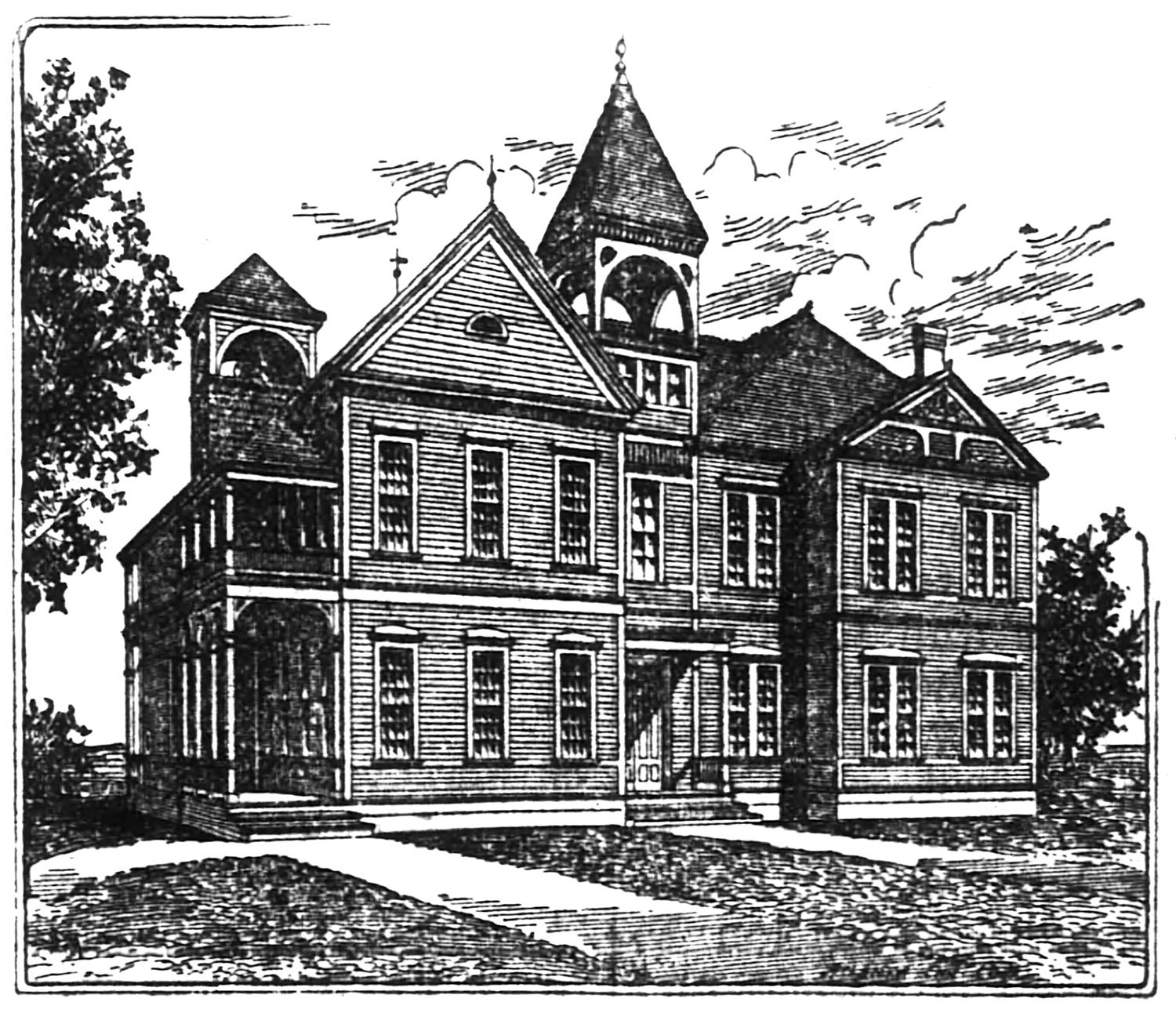
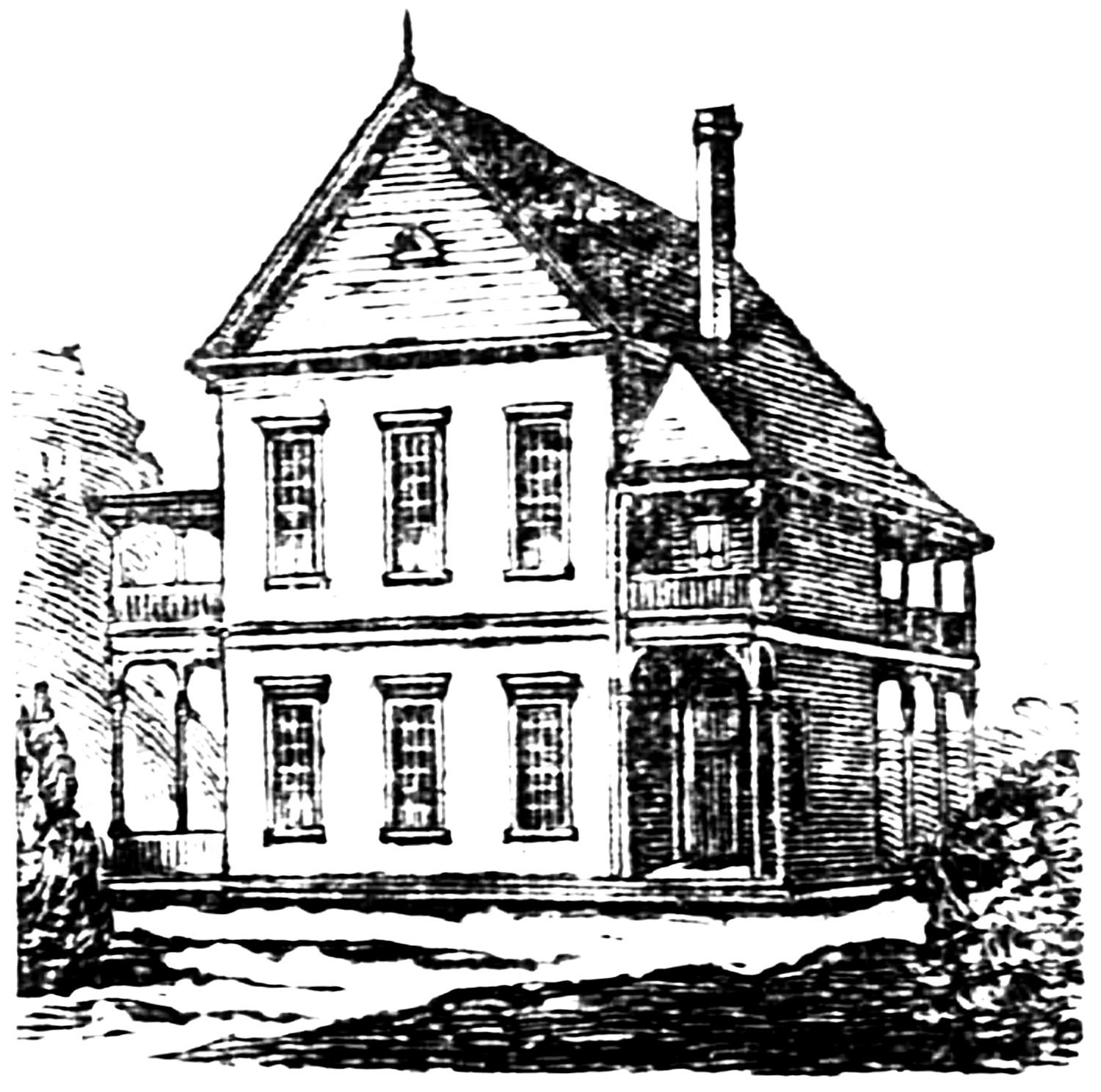
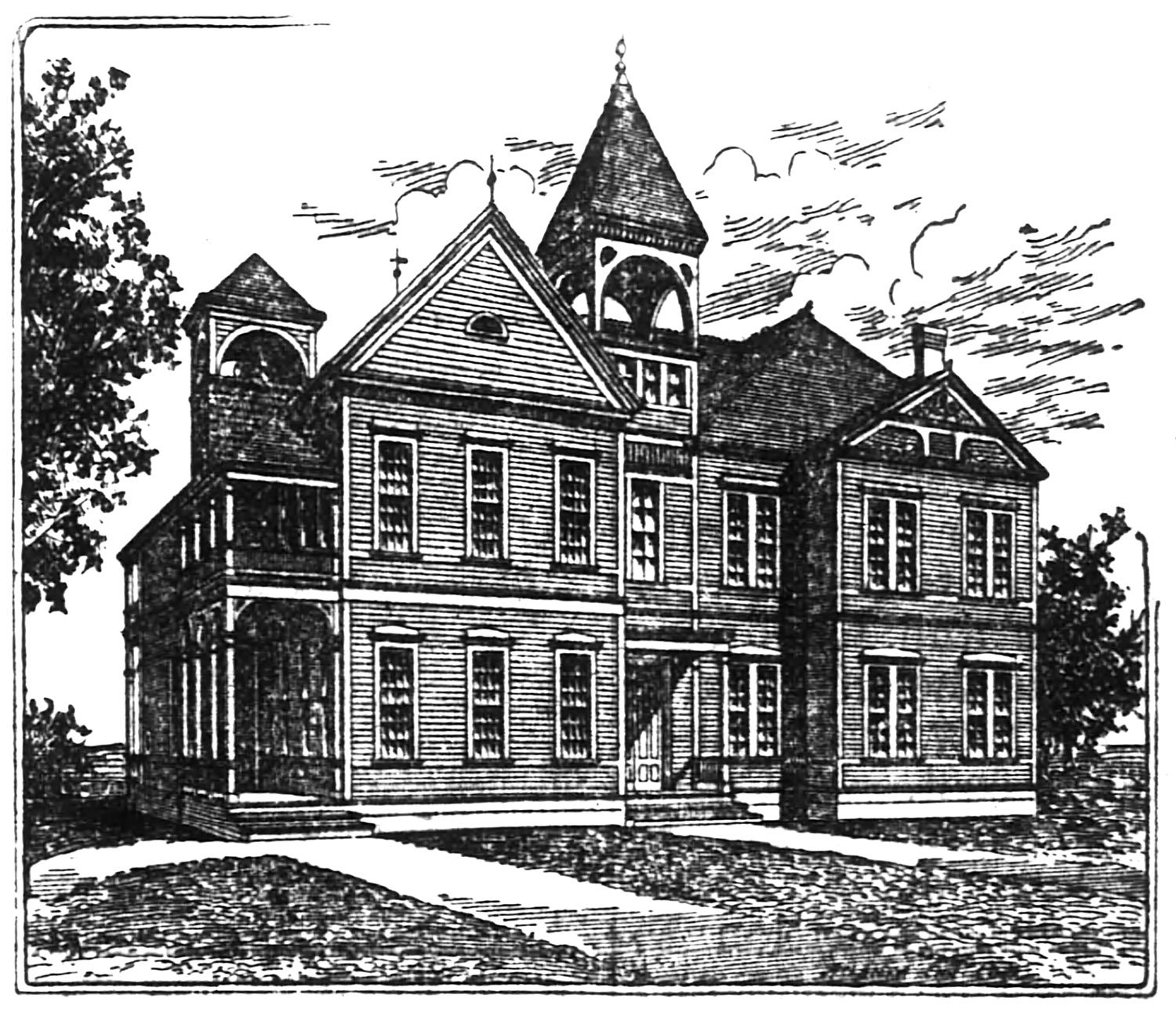
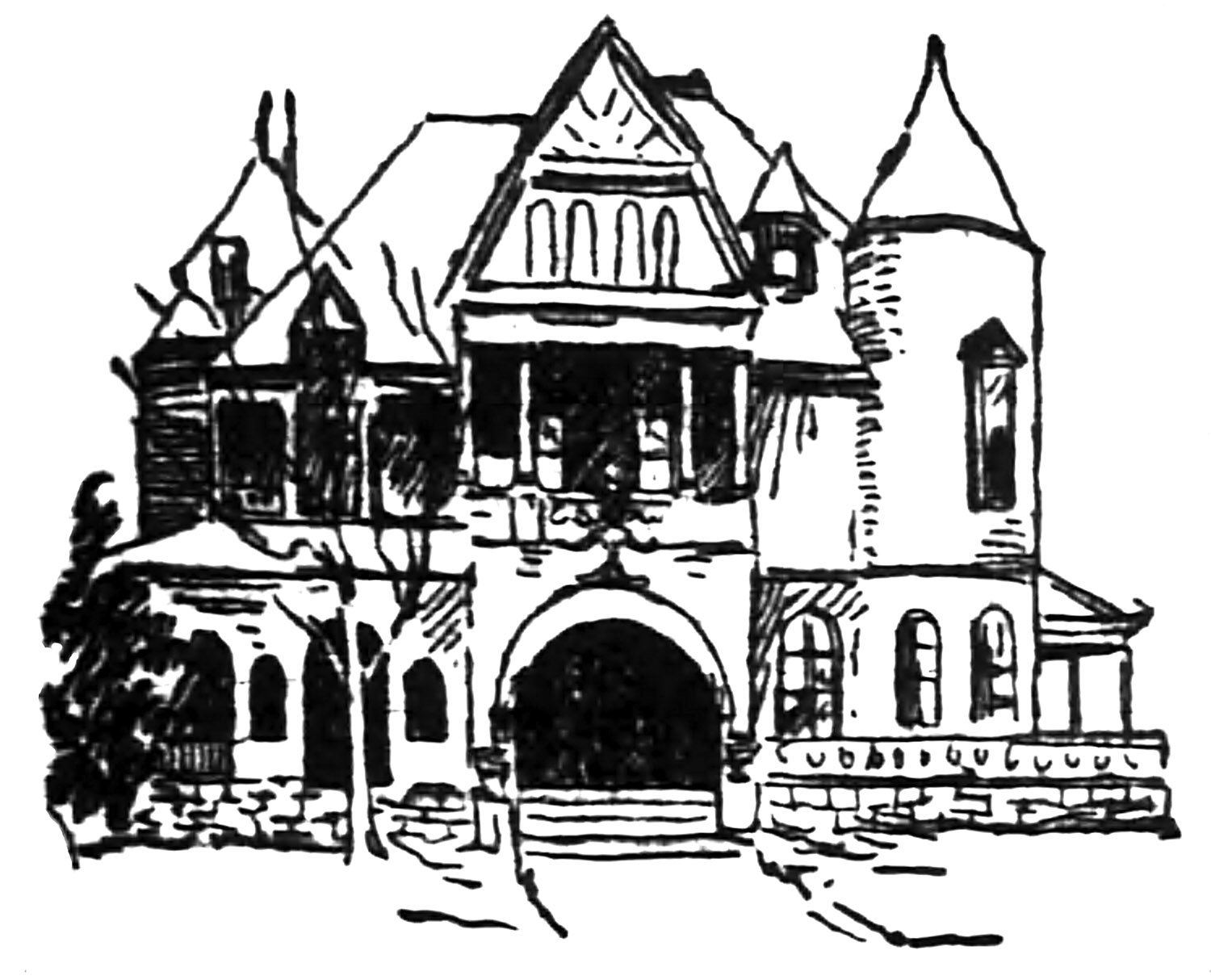
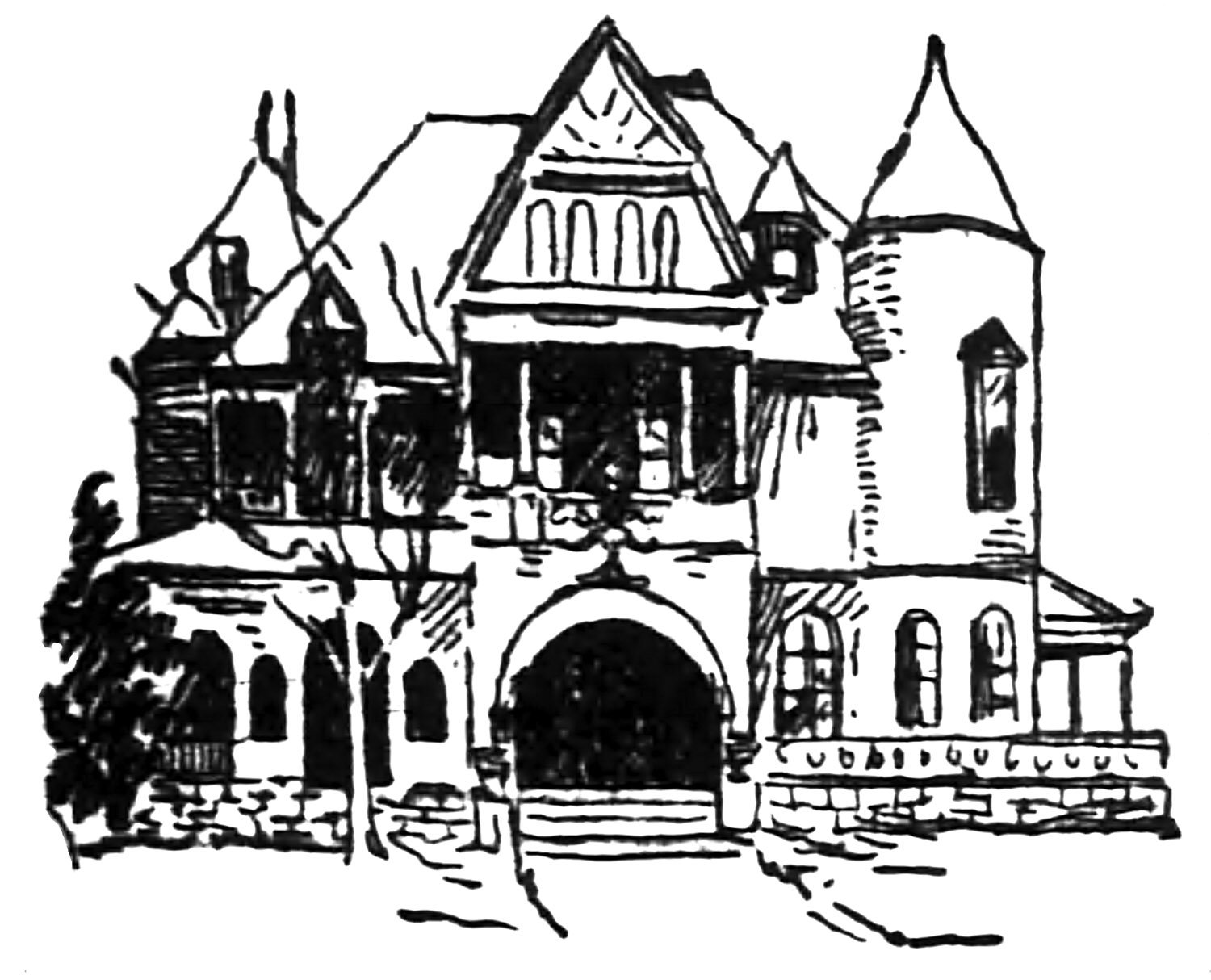
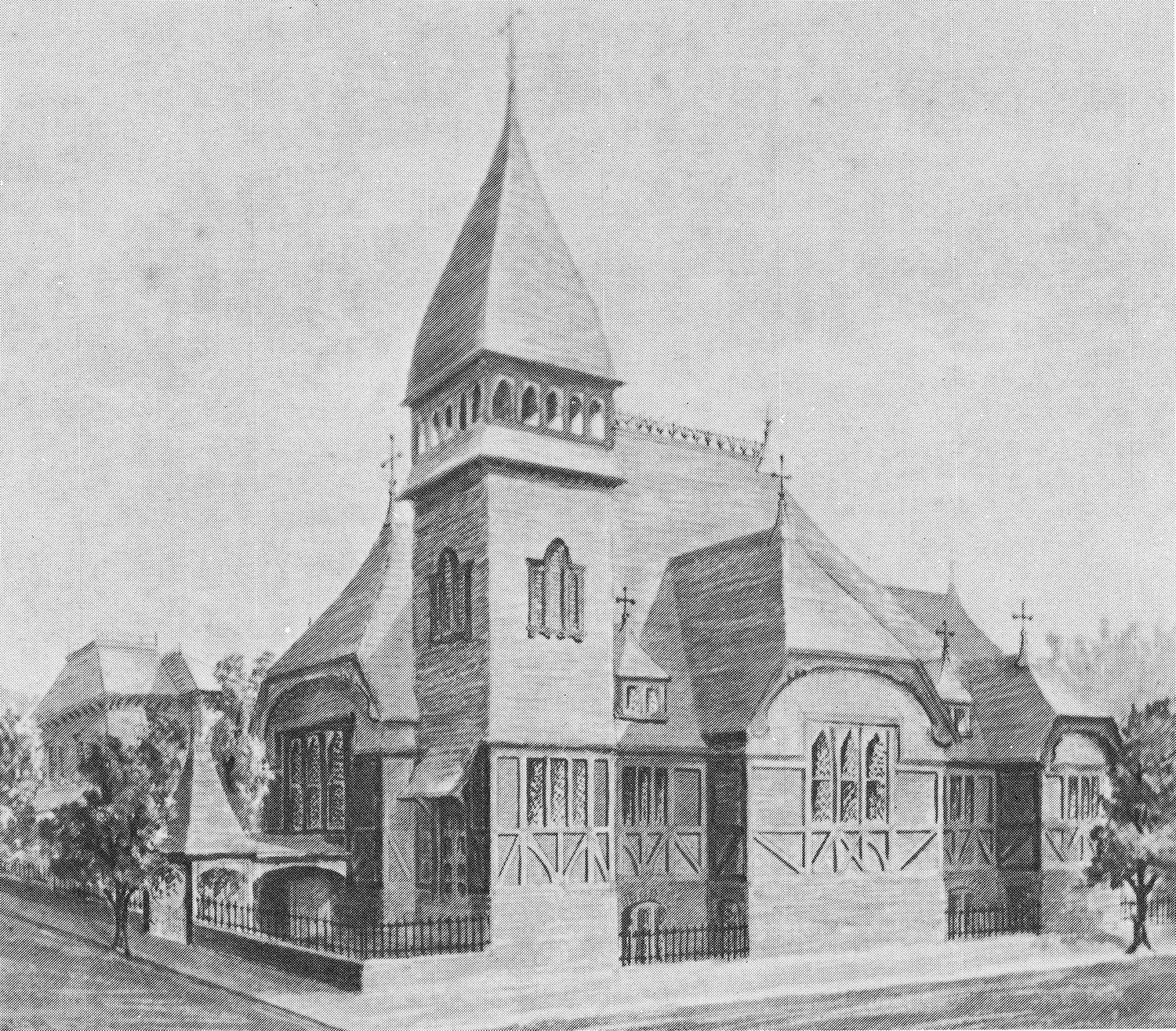
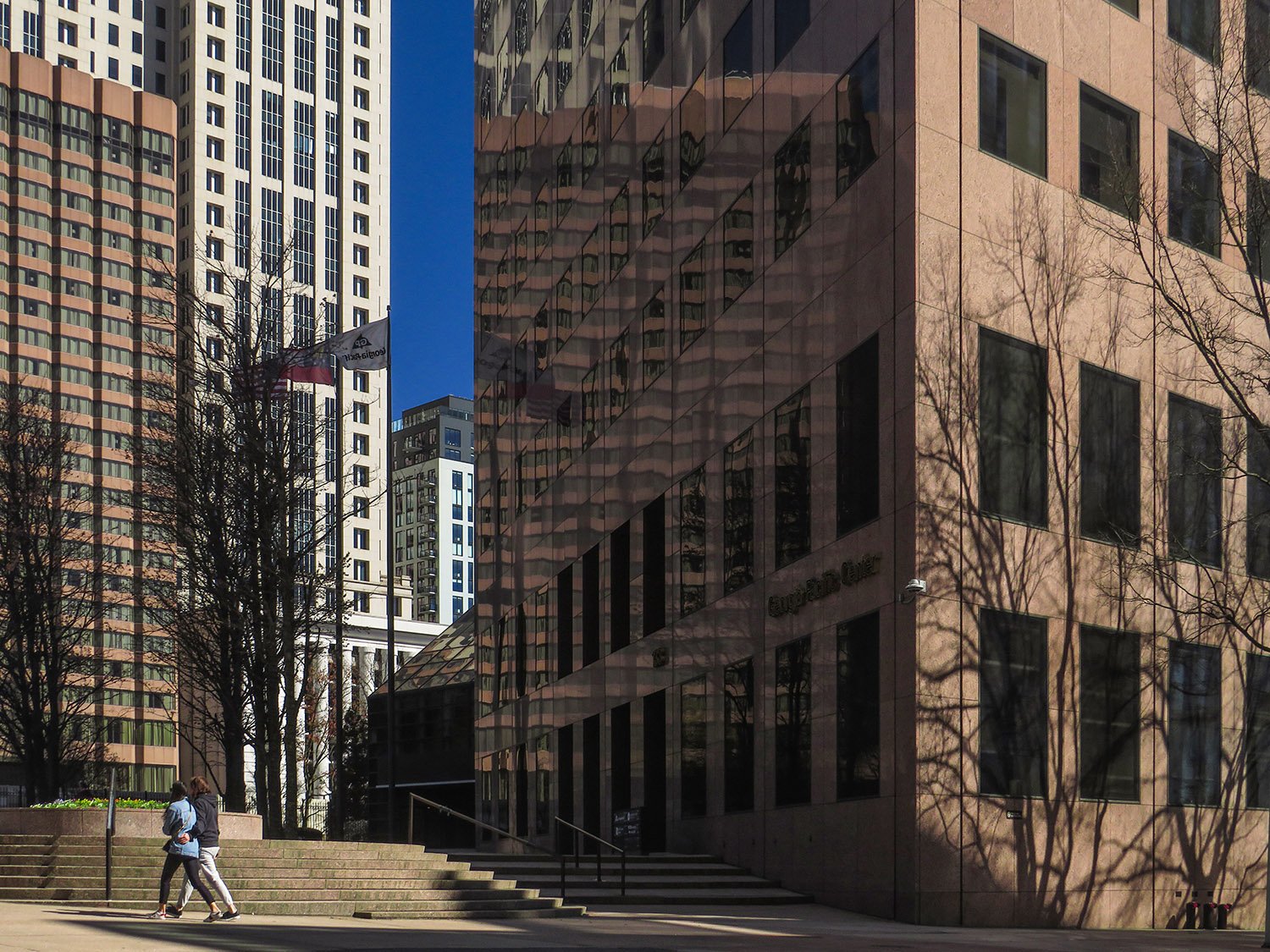
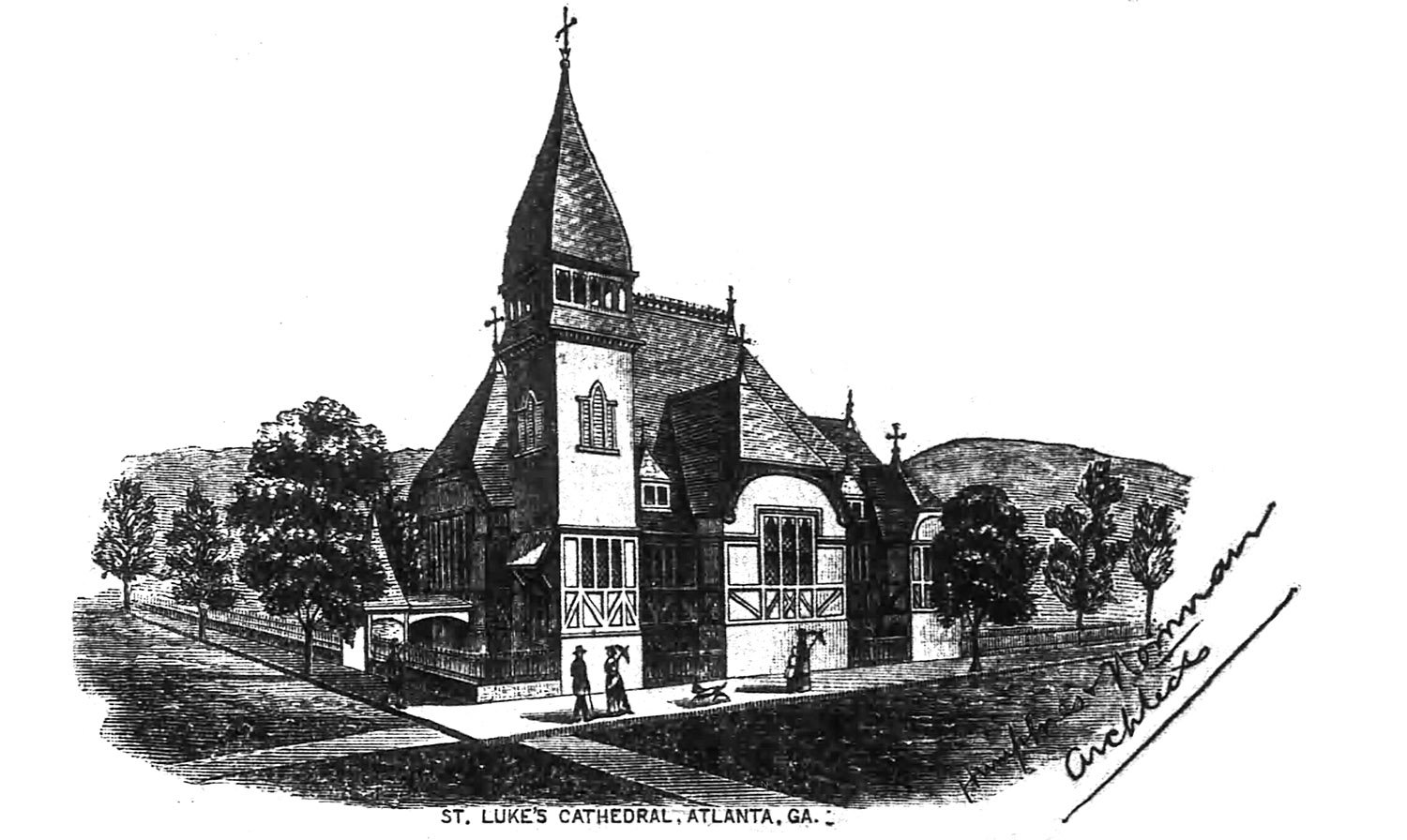
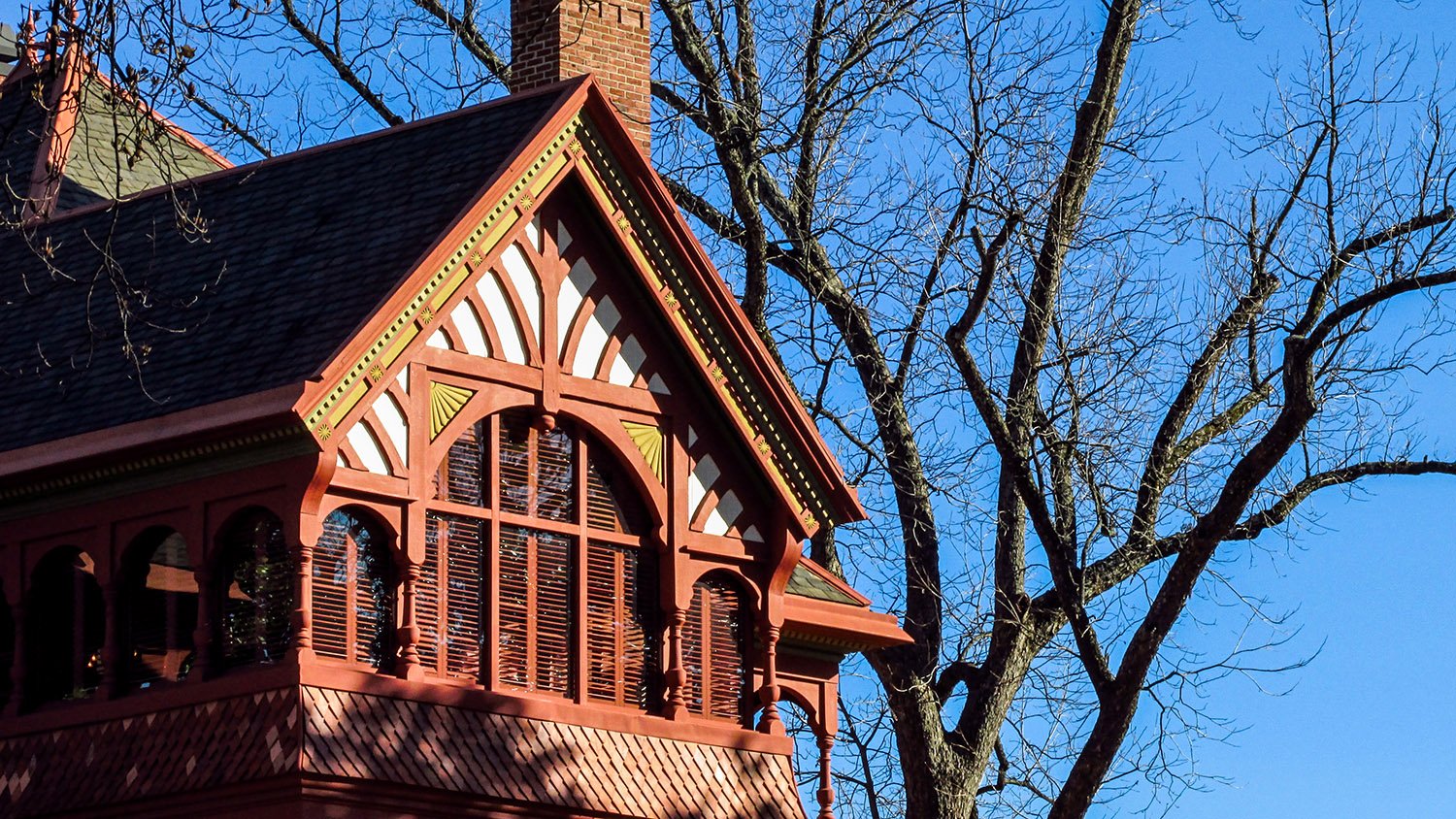
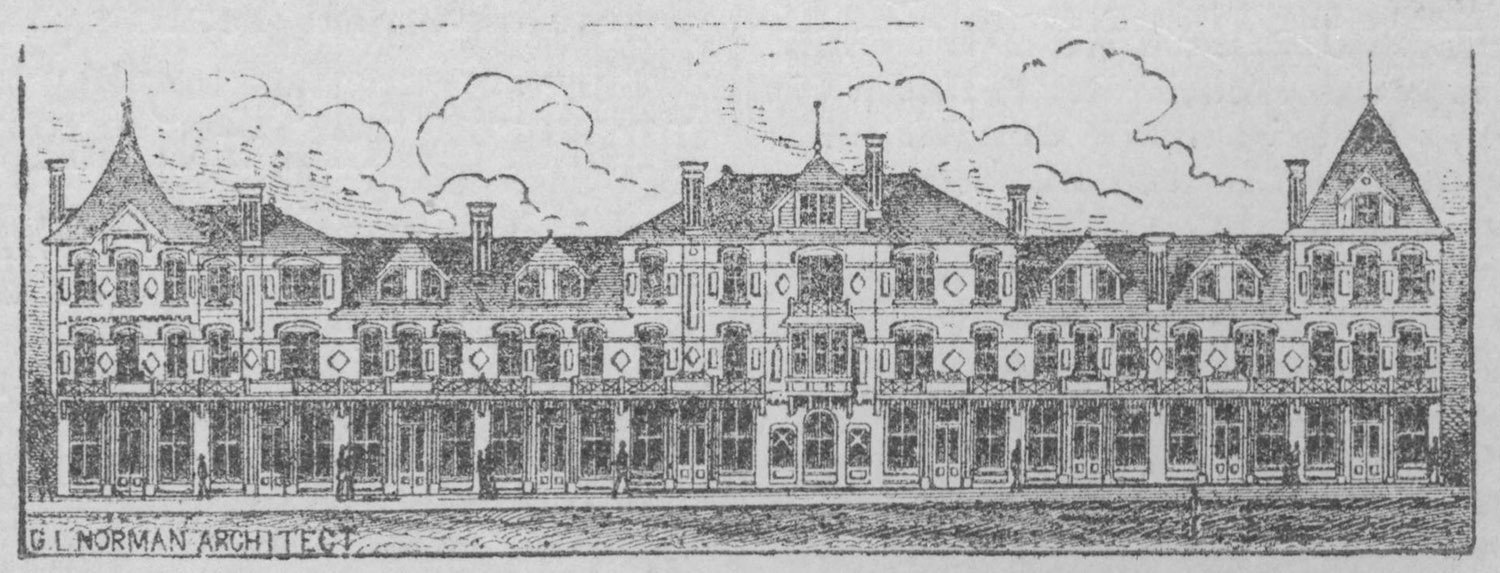
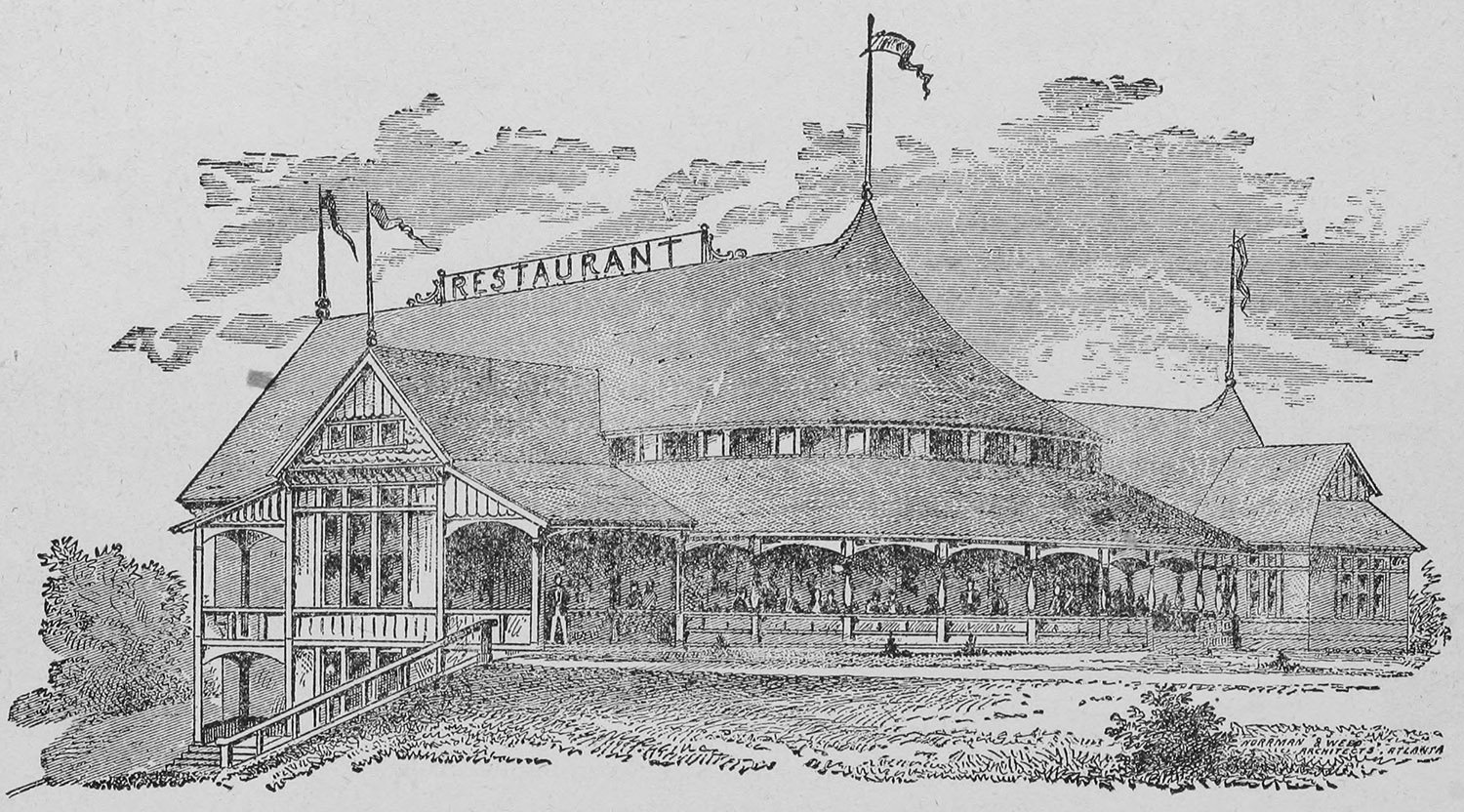
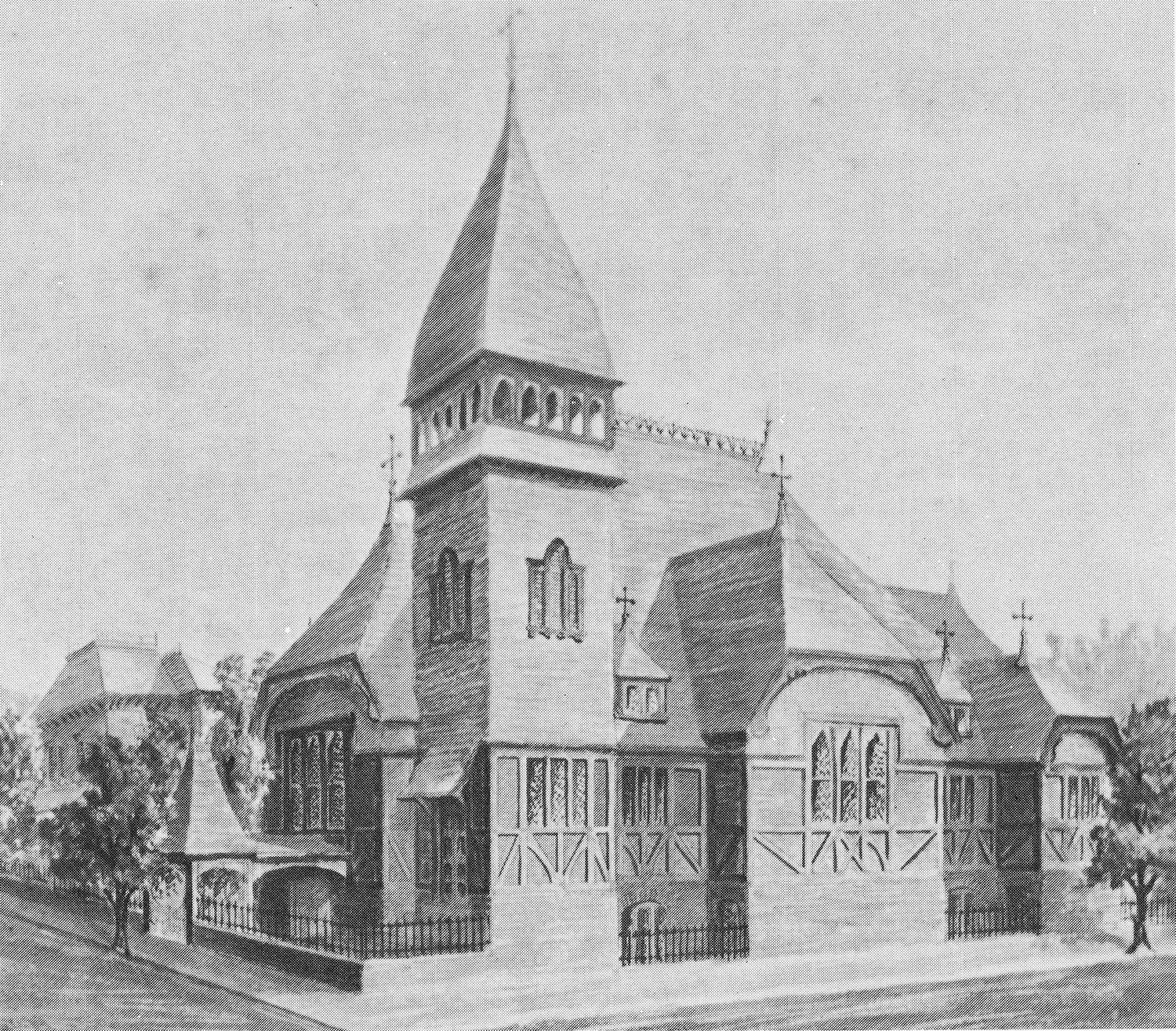
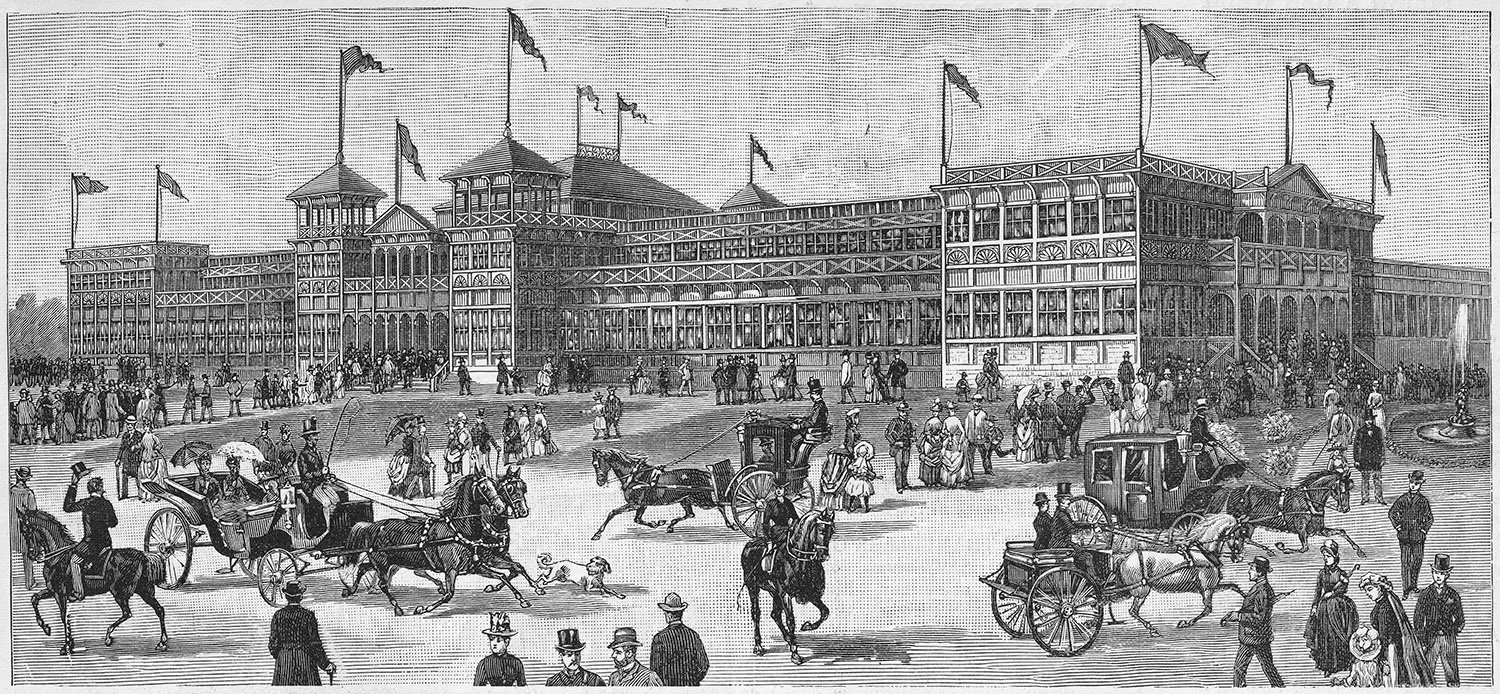
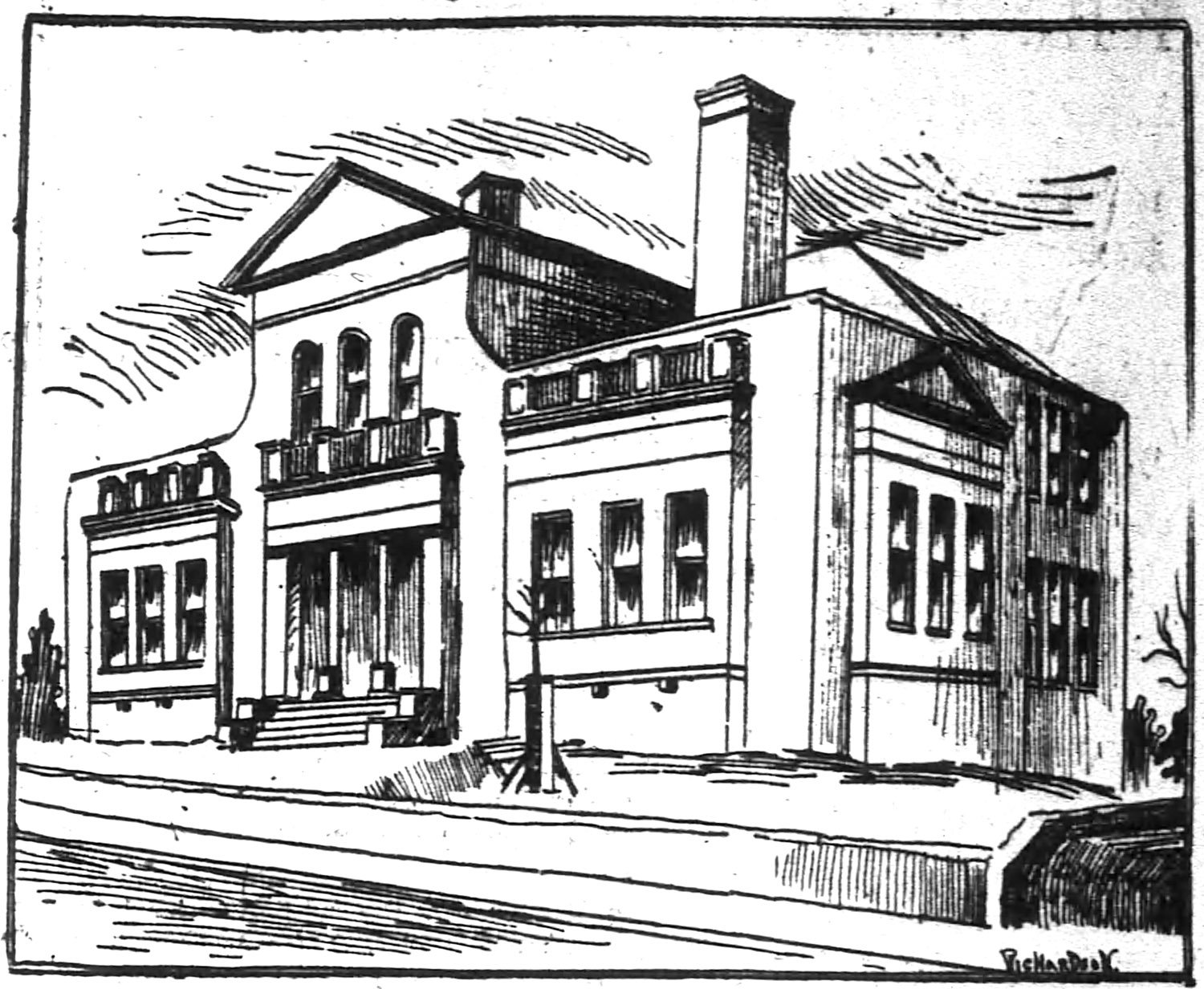
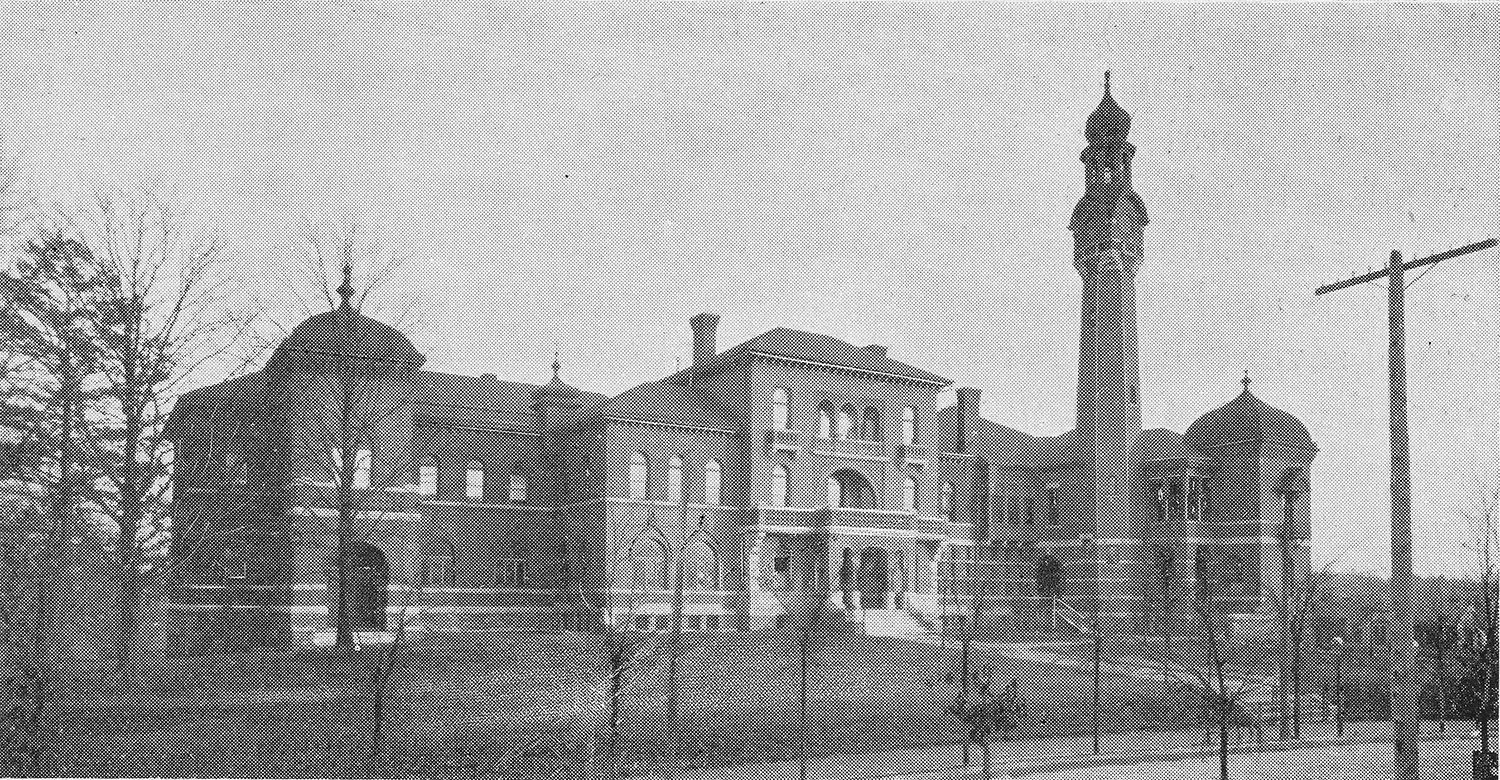
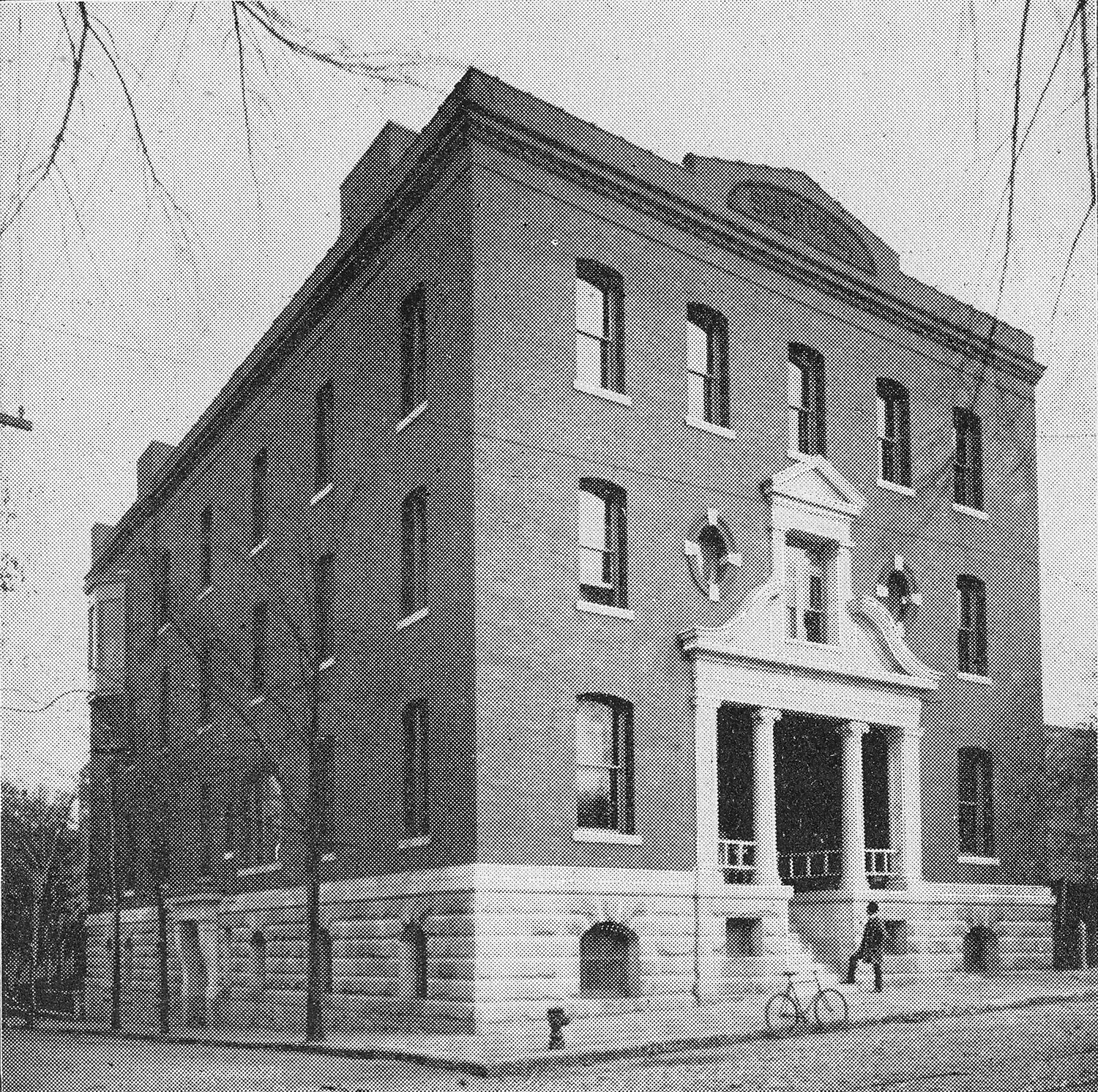
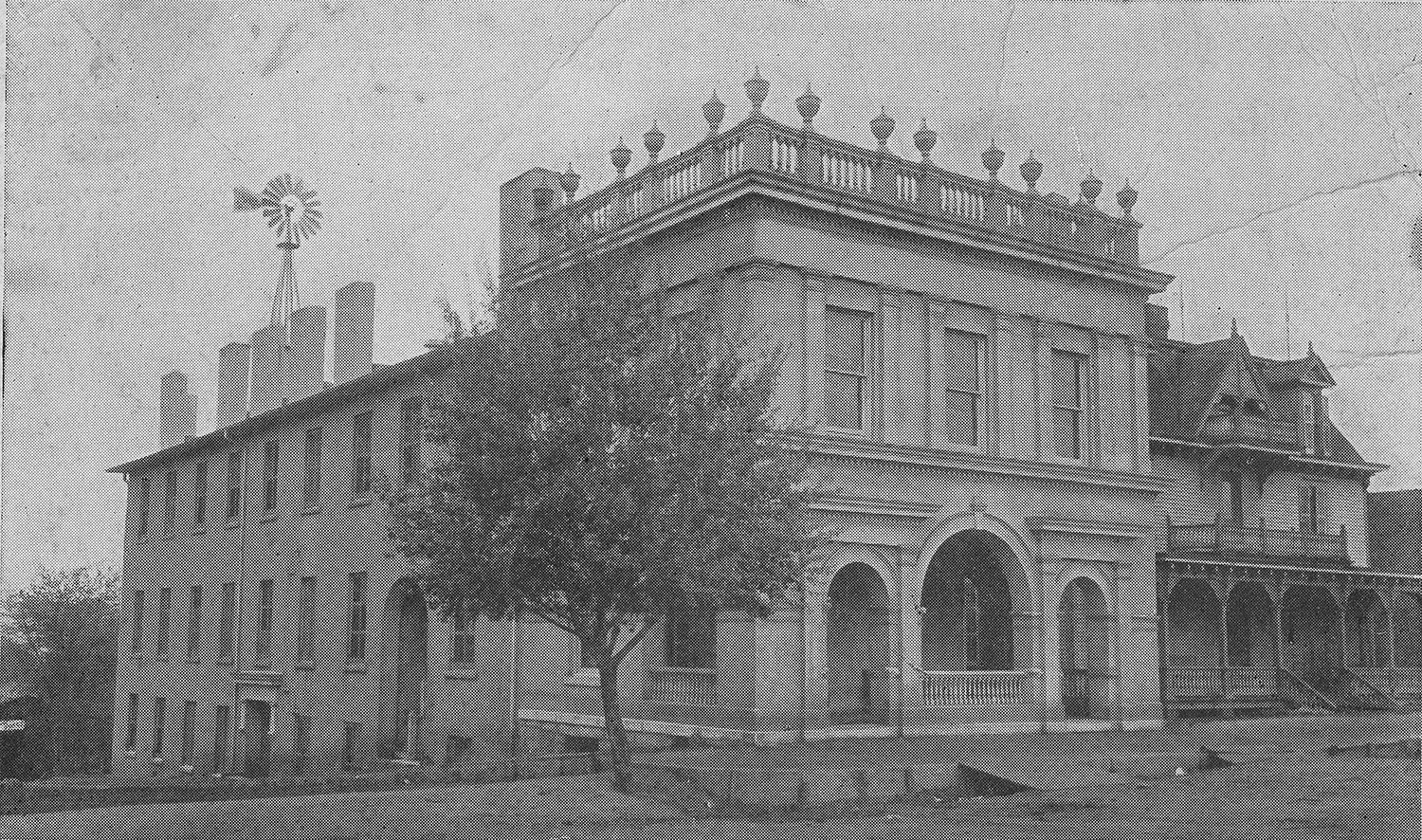
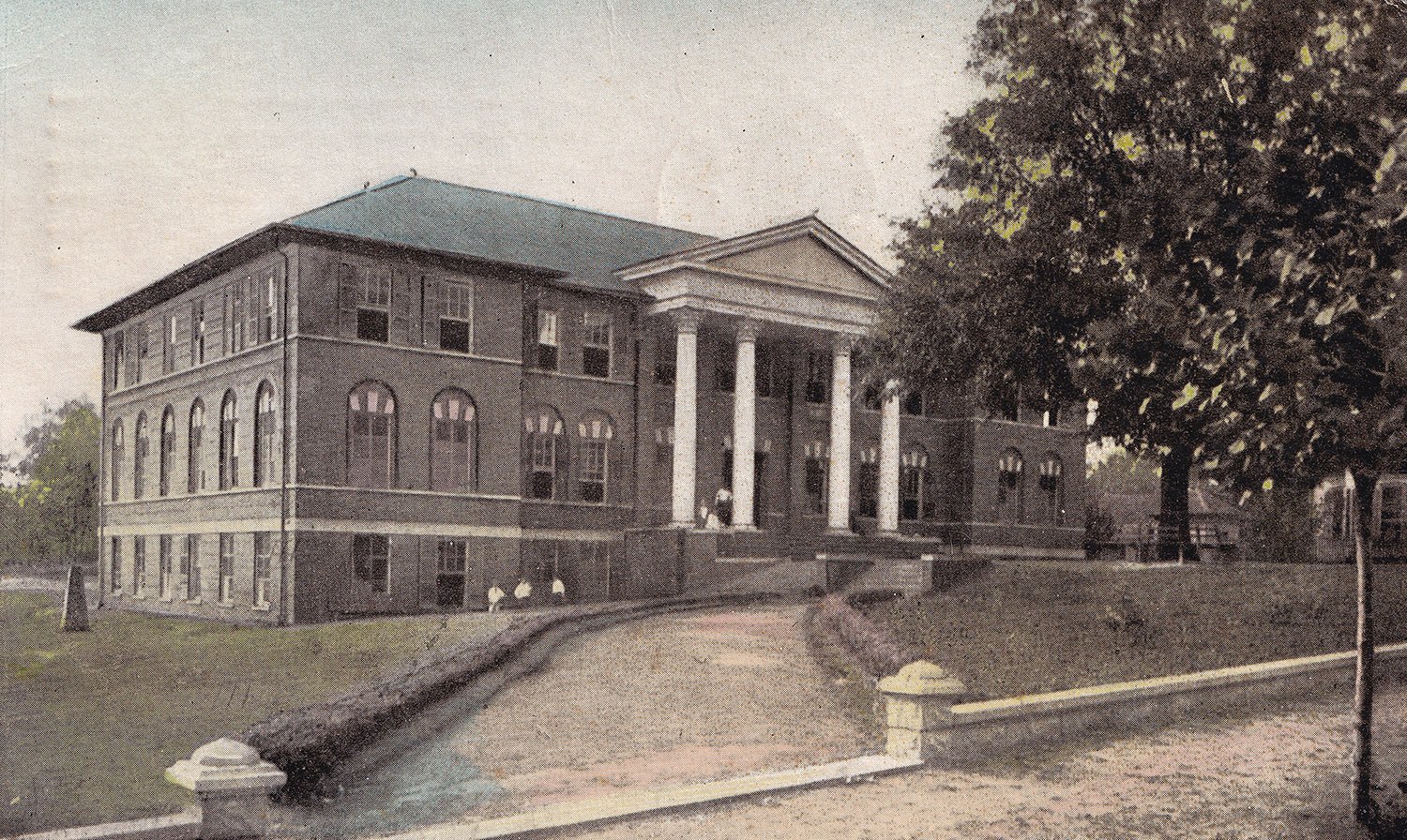
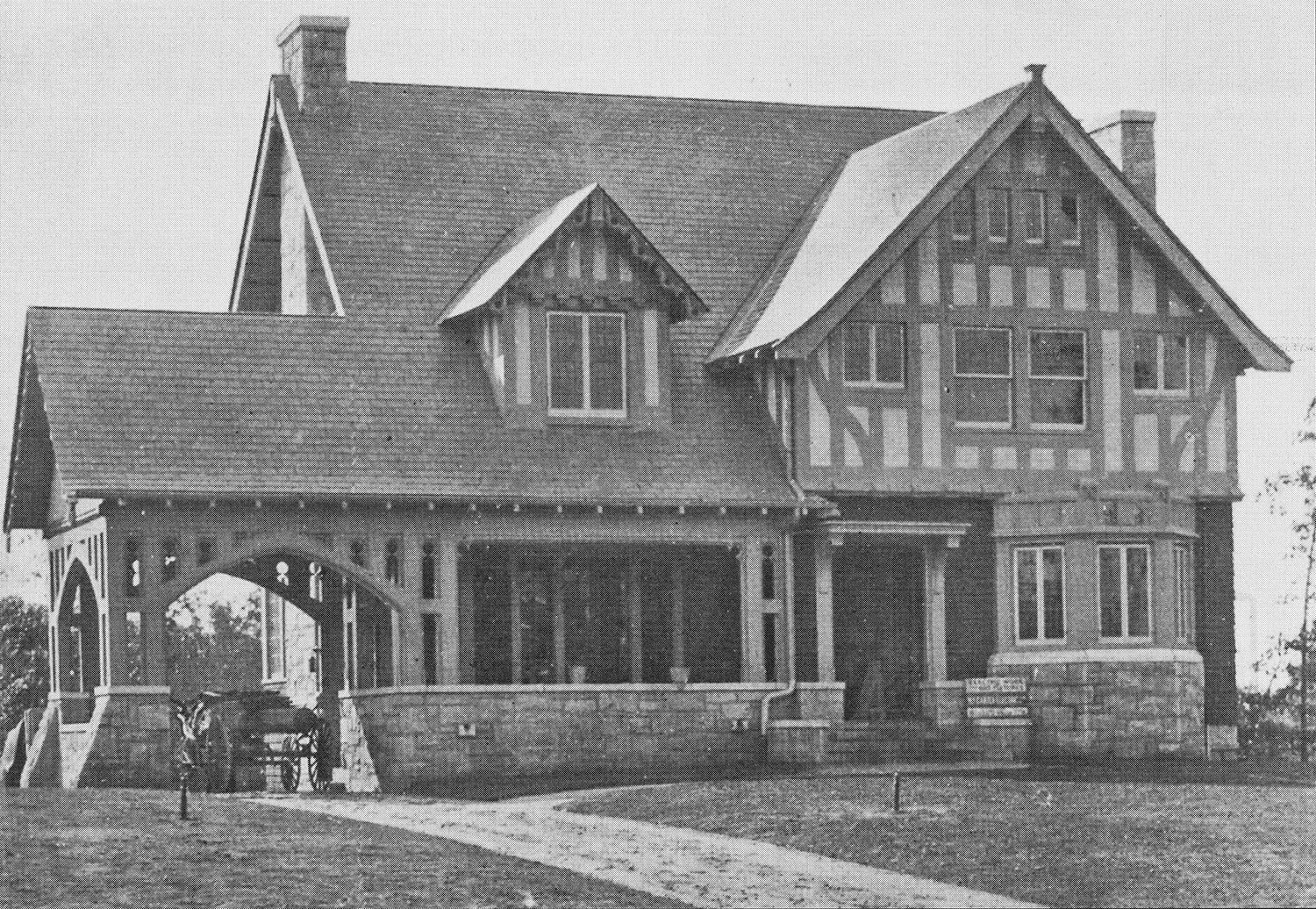
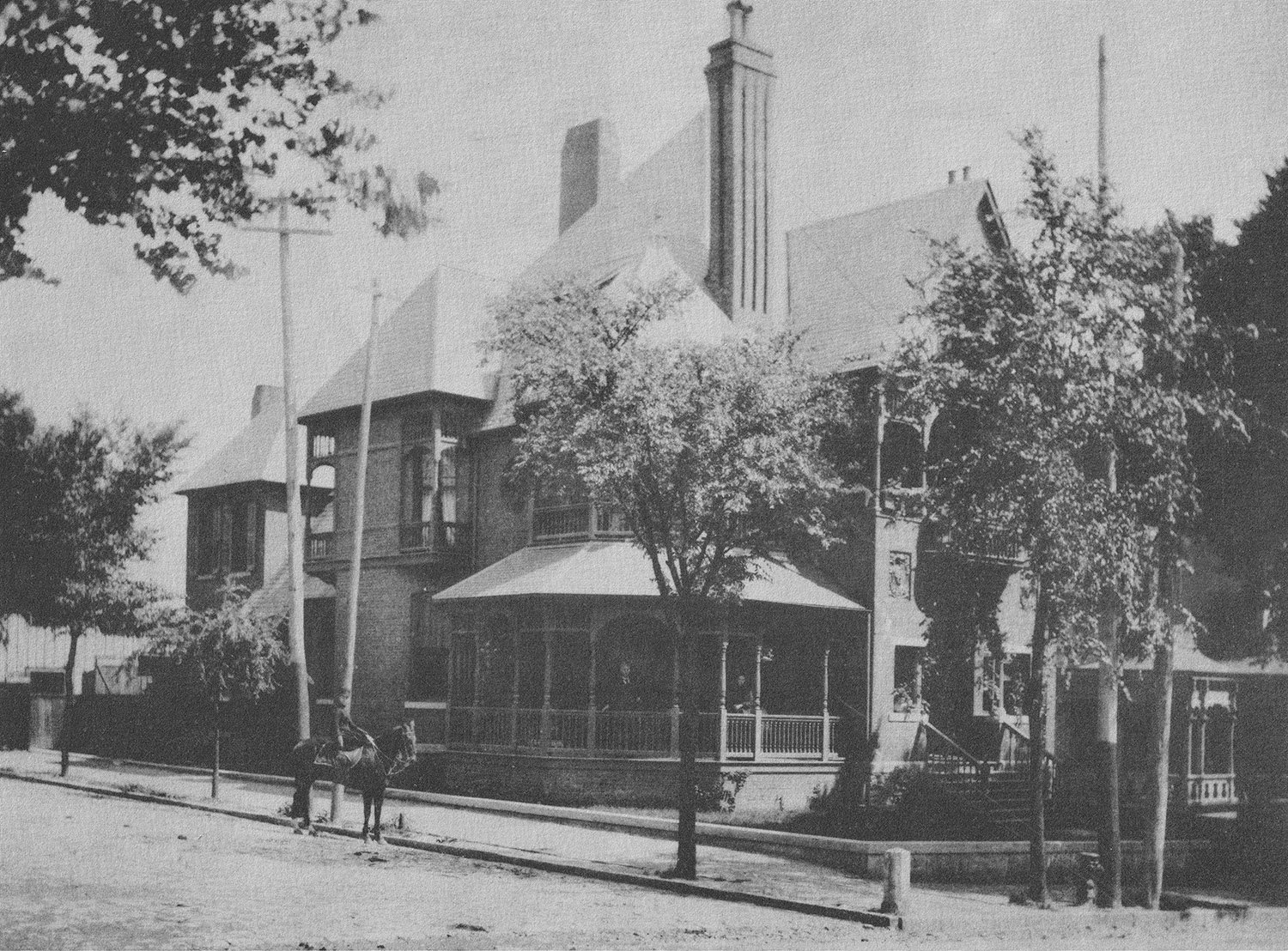
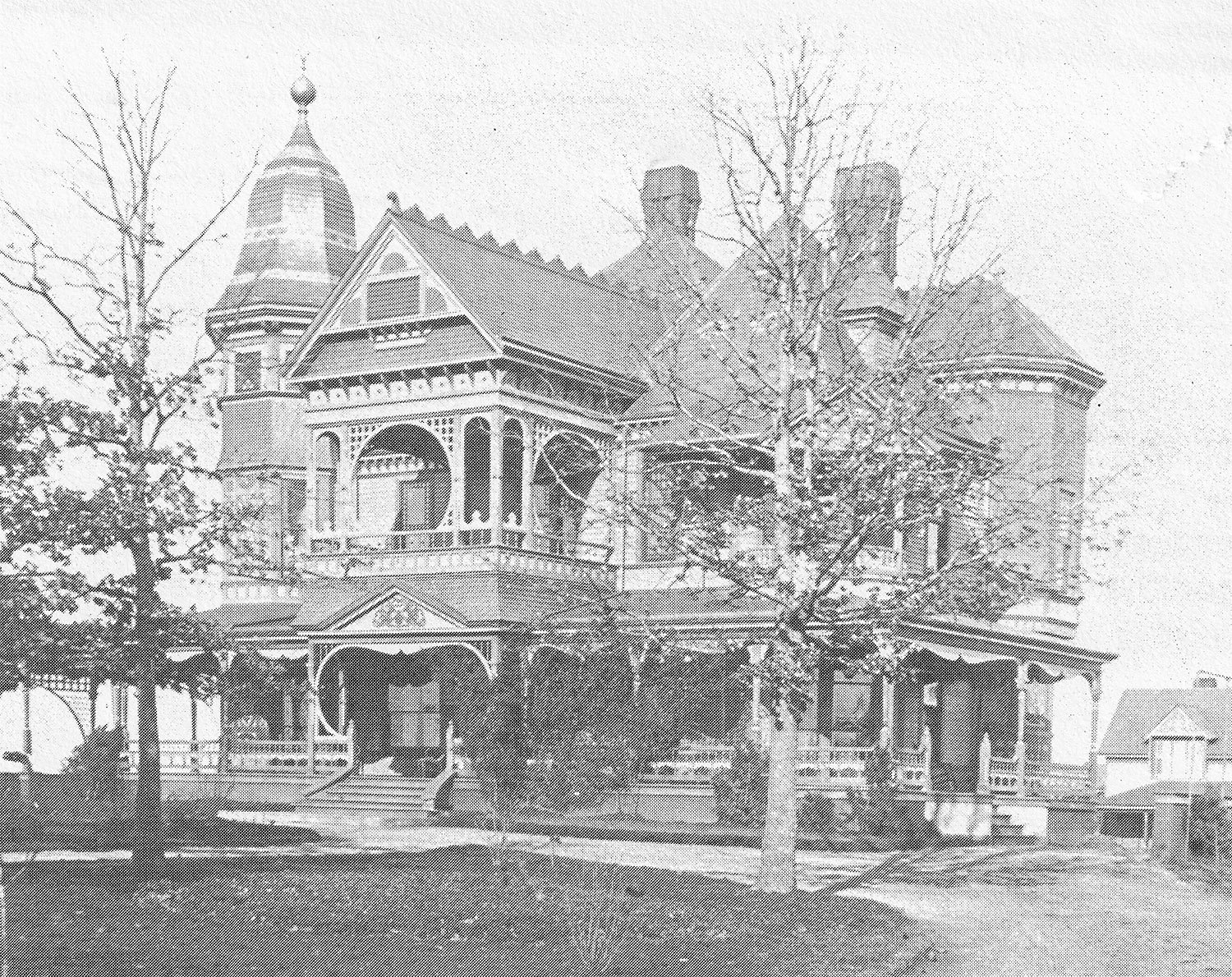
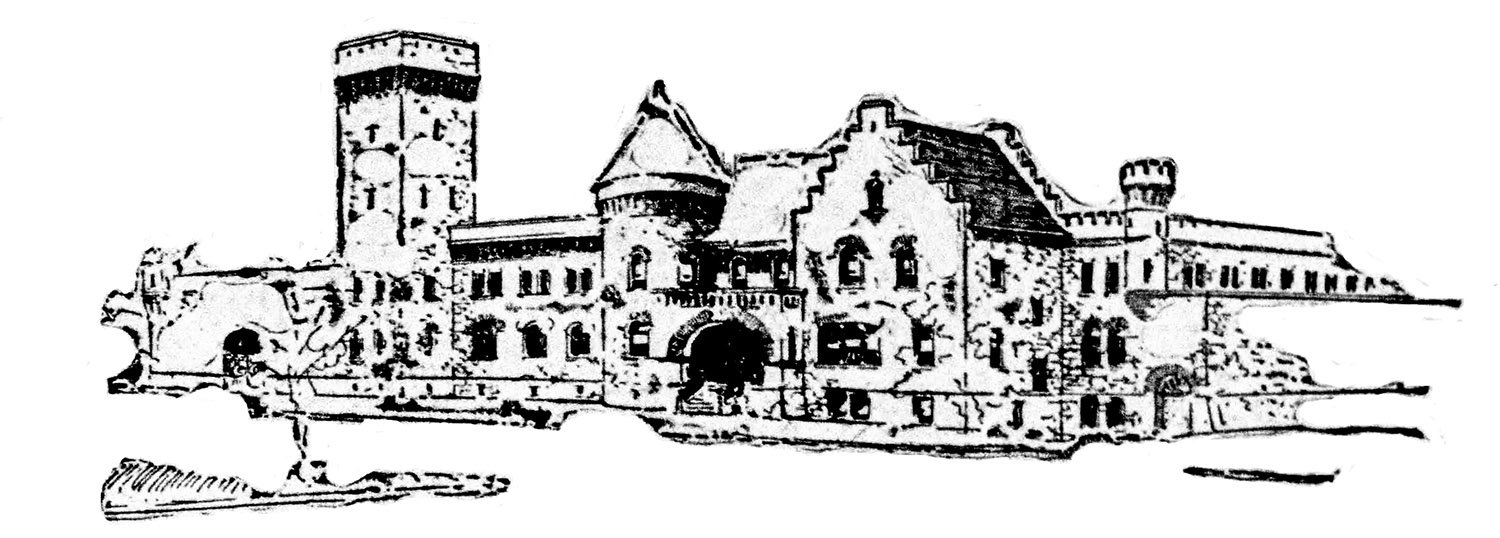
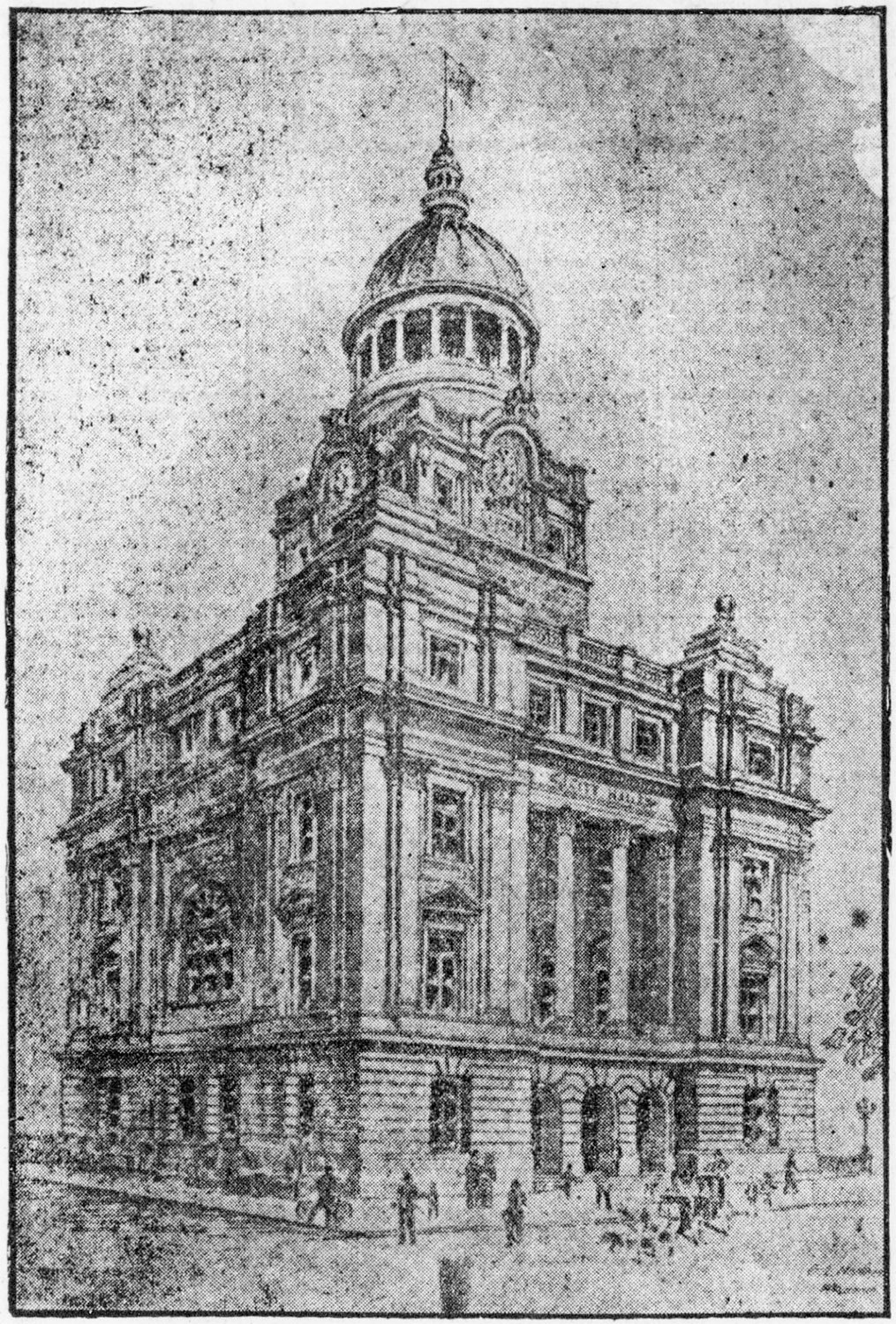
Humphries & Norman. West End Academy (left, 1883-1911). Bruce & Morgan. West End AcademyExpansion (right, 1890-1911). West End, Atlanta.1
The Background
The article below, published in The Atlanta Constitution in November 1890, describes the expansion of the West End Academy in West End, Georgia, completed in 1890 and designed by Bruce & Morgan.
Later absorbed into the city of Atlanta, the school’s property consisted of two acres2 on the west side of Lee Street, just north of Gordon Street (later Ralph David Abernathy Boulevard SW).
Location of West End Academy
West End Academy was originally founded in 1883,34 when West End was still a self-governing municipality separate from Atlanta. Although the academy operated as a public school, tuition was initially charged for each student.5
The originaltwo-story wood-frame structure for West End Academy was designed by Humphries & Norrman,6 and the primary credit likely belongs to George P. Humphries, who was also a West End resident and, it appears, handled most of the firm’s projects there.
After Humphries’ death in August 1885, the West End Academy allowed his children to attend the school tuition-free “in consideration of past services to the town,”7 further suggesting his involvement in the school’s design.
Humphries & Norrman. West End Academy (1883-1911). West End, Atlanta.8
Construction on West End Academy’s first building began in June 18839 and was completed by October 1883. Although the initial estimate for the project was $5,000,101112 a 1884 report stated the final cost as “the round sum of $10,000,”13 while a 1890 article claimed the cost was $6,500.14
There isn’t much information about the original structure’s design or number of rooms, but it was said to be “roomy enough for the pleasant occupation of several hundred pupils, if necessary.”15 In 1884, the school reportedly taught 90 students.16
A Need for Expansion
By 1890, West End Academy had an enrollment of 297 students,17 and despite the earlier claim of it being “roomy enough” for several hundred, a “patron and friend” described the school’s dangerously overcrowded conditions to the Constitution:
“Last fall term not less than seventy pupils were seated in a room of only fifty desks … In the principal’s room there were seventy-five pupils and only fifty desks.”18
The need for expansion was urgent, and in July 1890, the school’s trustees established a building committee for “enlarging and beautifying the academy”, with the imperative to “engage an architect at once to begin work.”19
They weren’t playing around—in just under three weeks, the office of Bruce & Morgan solicited construction bids for the project, with one day’s notice before the deadline and the repeated instruction: “Work to be begun at once.”20
Why Bruce & Morgan?
Since Humphries & Norrman designed West End Academy’s original building in 1884, it’s a little odd that G.L. Norrman wasn’t chosen for the expansion six years later.
However, Bruce & Morgan were undoubtedly a top choice because of the numerous school buildings the firm had recently designed for Atlanta’s public school system, including the Third and Fifth Ward Grammar Schools.
And although he would soon make school buildings a specialty, Norrman had designed comparatively few by 1890, and if the original West End Academy was handled by his deceased partner, it would make sense that he wasn’t consulted.
I also suspect that Norrman didn’t care much for Humphries or his work—it’s just a hunch.
Even if Norrman had been considered, his office was swamped with work in summer 1890, so a $4,500 project may not have been worth his time and effort.
Assuming construction began in late July 1890, West End Academy’sexpansion was completed in about three months, opening in early November 1890.
After the Expansion
When West End was annexed into Atlanta in 1893, ownership of West End Academy was transferred to the City of Atlanta,2122 and the renamed West End School2324became part of Atlanta’s public school system.
By that time, the school had again outgrown its capacity,25 and in 1902, the West End School was described as “probably the worst crowded of the schools.”26 In 1904, a 12-room school was built on nearby Peeples Street to alleviate crowding.2728
With the opening of the new West End School, the old West End School was renamed Lee Street School, with plans to add three or four classrooms,2930 though it’s unclear if that happened.
In May 1906, a fire in the basement of Lee Street School forced over 200 children to evacuate as smoke filled the building.3132
Obviously aware that the all-wood structure was a firetrap, the school’s principal, Eleta A. Mills, was well-prepared for the event and regularly conducted fire drills with the students.33 Remarkably, no one was injured in the fire—except for Mills, who fell down the stairs and hurt her back.34
As the Constitution described the scene:
“From the class rooms the children marched in perfect order. Through the hallways, down the stairs they went, the clouds of smoke rising about them and almost stifling them. Yet they never wavered.
“When the firemen declared that the fire was extinguished, Miss Mills had the children to march back into the school, where they quietly resumed their lessons.
“The children were not more than a minute getting out of the building, and it was about fifteen minutes that they were held in line.”35
While there was no structural damage from the fire, the old West End Academy had clearly become a liability—an unsafe, outdated, and undersized hand-me-down from a bygone city and century.
In 1907, when the Lee Street School reported an enrollment of 320 students,36L.Z. Rosser, the president of Atlanta’s board of education, described the school as “unsanitary and unfit for use”, adding, “In fact, all the old frame buildings have outgrown their usefulness.”37
Rosser repeated his criticism in 1908:
“It is the board’s policy to abolish as rapidly as possible every old school building in the city and whenever we put up a new building it is the safest and most thoroughly equipped that architectural skill can devise. I am frank to say that we still have several old school houses which ought to go, and they will go as fast as the financial appropriation will permit.”38
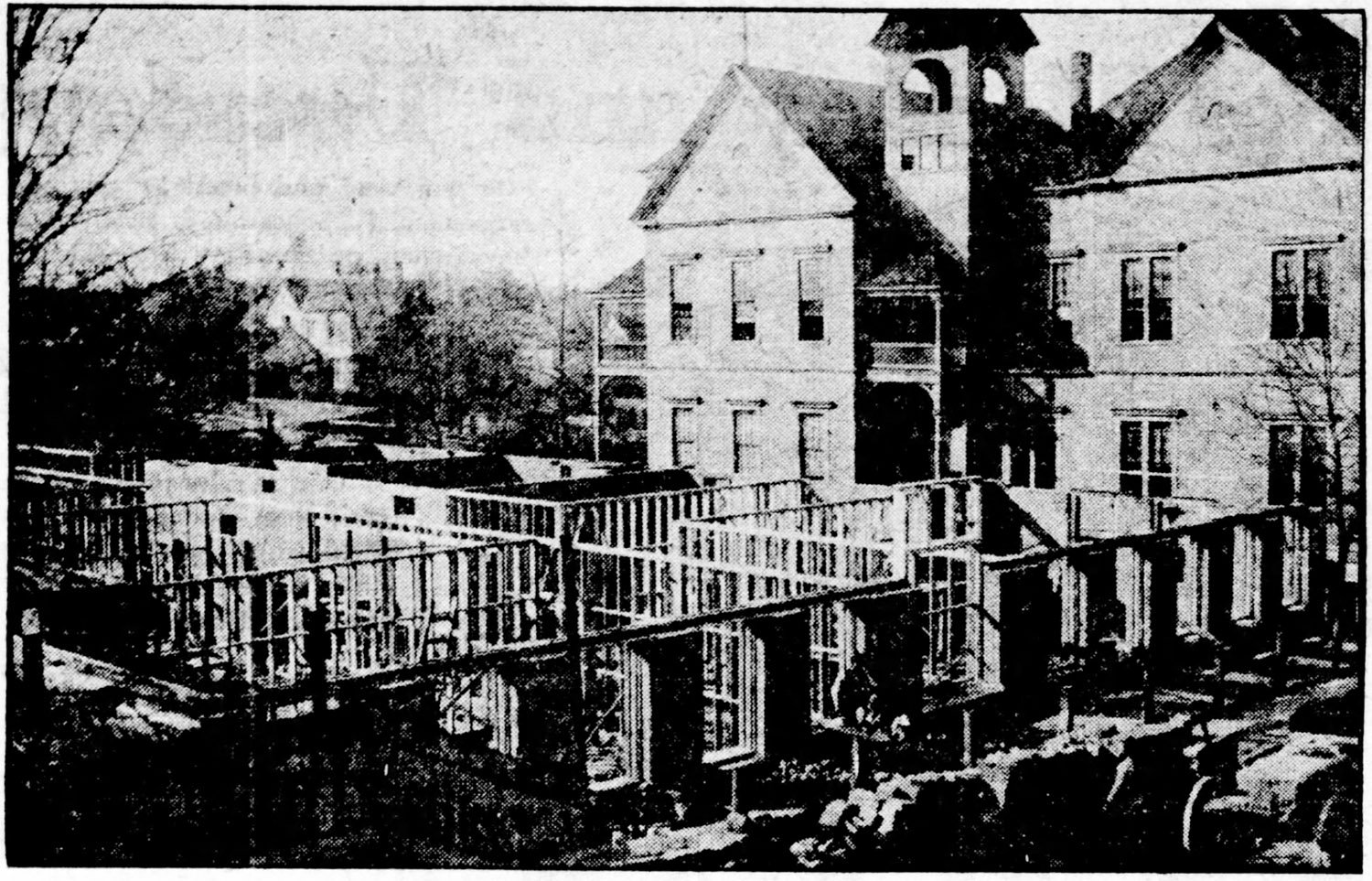
The appropriation finally came, and in summer 1910, the Lee Street School was “rolled back”3940 100 feet to accommodate construction of a new building (pictured below),41 with students using the relocated structure during the interim.424344 That couldn’t have done much for safety.
Former West End Academy during the construction of Lee Street School in 191145
Designed by Edward E. Dougherty, the new Lee Street School was completed in August 191146 and was similar to other schools he designed in Atlanta in the same period, built of brick and containing 12 classrooms.47
The old West End Academy was unceremoniously demolished sometime in 1911, and there’s no evidence anyone objected. A Sanborn map published that year identified the structure as simply “Old School B’ld’g To Be Removed.”48
The replacement school was torn down in 1969 to make way for the Mall West End,49 which itself is slated for demolition in 2026. Nothing is permanent in Atlanta.
The New Academy Building.
How the West End Academy Has Been Improved.
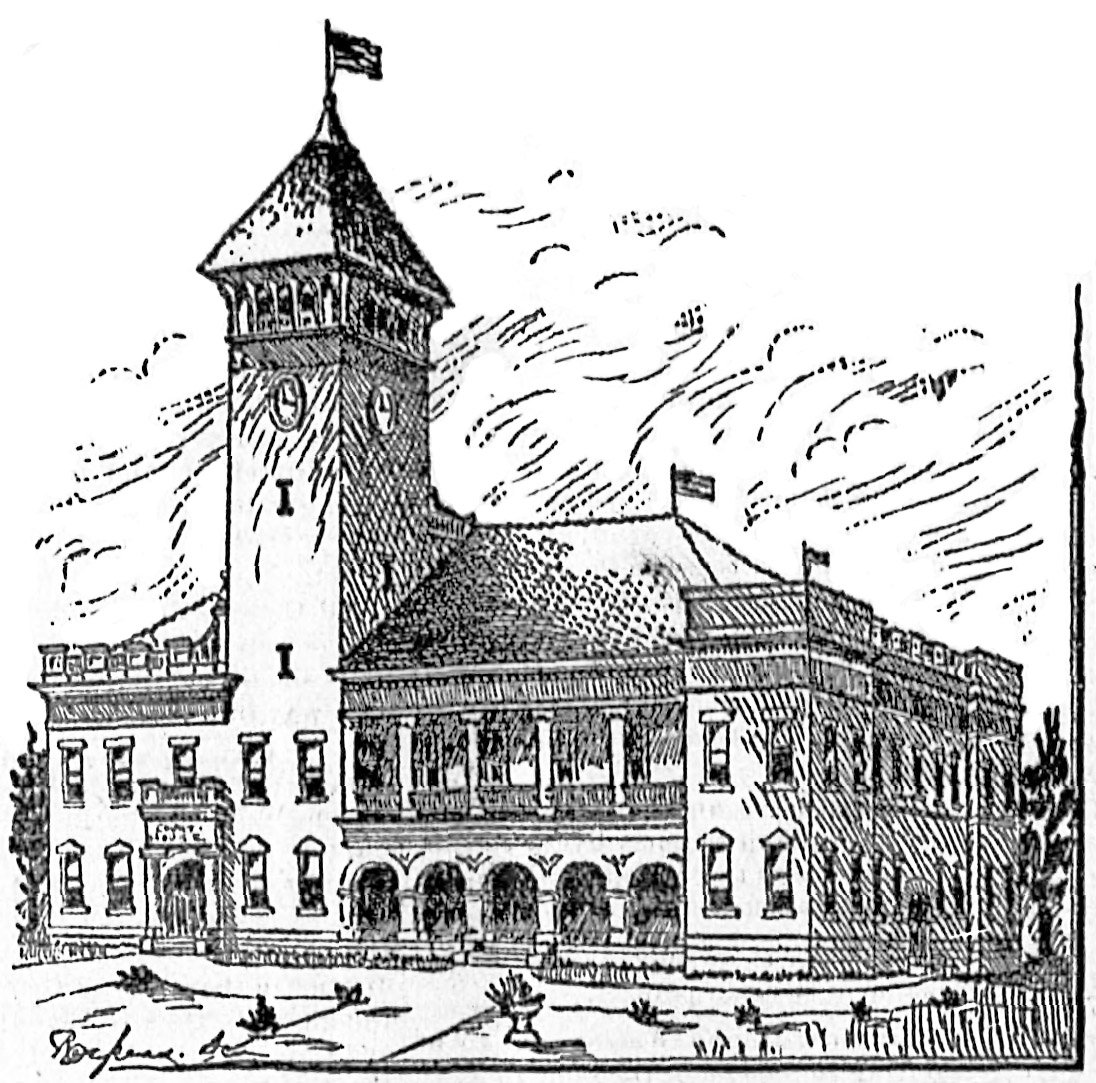
The rapid growth of the little city of West End is illustrated by the fact that she has recently been compelled to double the capacity of her public school building in order to meet the increasing demand for school accommodations. The extensive addition to the old structure has been completed, and the entire building now presents a very handsome and imposing appearance. The new part was planned by Messrs. Bruce & Morgan and harmonizes admirably with the old.
The accompanying cut shows the building as it now stands, and no city of the same size has a more comfortable or better arranged schoolhouse than has West End. The exterior is pleasing to the eye and the interior admirably adapted to school purposes.
On the first floor is a wide hall traversing the building, into which opens three well-appointed schoolrooms. Along a narrower hall leading from this main one are to be found three smaller rooms, which are to be used as a music room, library and principal’s office, respectively. The music room is so situated that the sound of the pianos cannot be heard in any way of the rest of the building. Three wide, easy stairways lead up to the second floor, where are situated two comfortable schoolrooms and a large auditorium. This auditorium is admirably suited for the opening exercises of the school each morning and for public exercises and is so constructed that it may be easily made into two additional schoolrooms when the increased attendance shall require it. All the rooms are well ventilated and lighted and provided with ample hat and cloak closets.
The cost of these improvements is $4,000, and will prove to be money well spent for West End.
The new part of the building was turned over to the school authorities by the contractor last Friday, and that portion of the school which, for the last two months has been occupying the hall over Caldwell’s store, will take possession of their new quarters tomorrow. No doubt the additional room and accommodations offered will be taken advantage of at once by new pupils from West End and vicinity, and by some from Atlanta who have been crowded out of the city schools.
The school has taken assured rank among the best educational institutions of Atlanta. It is operated on the plan of a public school, being supported by appropriations from the city council and from the county public school fund, supplemented by a nominal tuition fee of $1 to $1.50 per pupil per month. This small tuition fee is charged, because if the school were made entirely free the present rate of taxation (which is now 50 cents on the $100) would have to be nearly doubled in order to pay the deficit in the income of the school.
The academy is under the control of a board of trustees, who elect the leaders, lay out the course of study, adopt the textbooks, etc., just as is done in other public school systems. This board at present consists of representative men of the city who enjoy fully the confidence of the community. They are as follows: Malcolm Johnston, Dr. John W. Nelms, Burgess Smith, W.L. Wilson, G.A. Howell, W.A. Culver, W.W. Lambdin, E.C. Atkins, M. Taylor and J.C. Harris.
The principal of the school is Professor E.C. Merry, one of the best equipped teachers of the state. Professor Merry has a splendid reputation in educational circles, and as a disciplinarian and instructor and school manager has few equals. The exercises of the entire school under his skillful management move like clock-work. His assistant teachers, who are Miss Mamie Pitts, Miss Sallie Davis, Miss Mattie Nunnally and Miss Carrie Harden, are all skillful, experienced and enthusiastic. The entire corps seem animated with the single desire to make the West End academy the model school of the state.
There is also an excellent music department connected with the school, which is presided over by Miss Leila G. Hanbury, an accomplished instructress in instrumental music.
The academy was never more prosperous than at present, having an average attendance of about 200 pupils, and bids fair with its increased accommodations to raise that average to 250 to 275 before the scholastic year is ended.
This school in the past has been a powerful factor in West End’s progress, but is now in better shape than ever to contribute towards the growth and upbuilding of that little city.50
References
Illustration credit: “The West End Academy” (advertisement). The Atlanta Constitution, September 9, 1891, p. 10. ↩︎
“West End Splinters.” The Atlanta Journal, March 15, 1883, p. 4. ↩︎
Public notice. The Atlanta Constitution, April 3, 1883, p. 2. ↩︎
“West End Academy.” The Atlanta Constitution, July 8, 1883, p. 9. ↩︎
“The Hill Building.” The Atlanta Constitution, March 16, 1884, p. 4. ↩︎
“West End Notes.” The Atlanta Constitution, August 14, 1885, p. 7. ↩︎
Illustration credit: “West End.” The Atlanta Constitution, February 13, 1887, p. 4. ↩︎
“West End Notes.” The Atlanta Journal, June 25, 1883, p. 4. ↩︎
“West End Splinters.” The Atlanta Journal, May 9, 1883, p. 4. ↩︎
“West End Academy.” The Atlanta Constitution, July 8, 1883, p. 9. ↩︎
“West End Waifs.” The Atlanta Constitution, July 13, 1883, p. 2. ↩︎
“West End Improvements.” The Atlanta Journal, January 11, 1884, p. 4. ↩︎
“West End.” The Atlanta Constitution, April 27, 1890, p. 21. ↩︎
“West End Academy.” The Atlanta Constitution, July 8, 1883, p. 9. ↩︎
“West End Improvements.” The Atlanta Journal, January 11, 1884, p. 4. ↩︎
“The West End Academy.” The Atlanta Constitution, June 20, 1890, p. 4. ↩︎
“Letters From The People.” The Atlanta Constitution, July 10, 1890, p. 4. ↩︎
“West End Academy.” The Atlanta Constitution, July 2, 1890, p. 11. ↩︎
“Notice to Contractors.” The Atlanta Constitution, July 21, 1890, p. 7. ↩︎
“Will Annex.” The Atlanta Constitution, September 14, 1893, p. 5. ↩︎
“Everything In Shape”. The Atlanta Constitution, December 30, 1893, p. 7. ↩︎
“At Atlanta’s Fair.” The Atlanta Constitution, July 27, 1894, p. 10. ↩︎
“Among The Schools.” The Atlanta Constitution, September 9, 1894, p. 4. ↩︎
“Changes To Be Made.” The Atlanta Constitution, March 8, 1893, p. 3. ↩︎
“To Give Room In Crowded Schools”. The Atlanta Constitution, September 13, 1902, p. 8. ↩︎
“Two Schools Will Be Built.” The Atlanta Constitution, October 30, 1903, p. 2. ↩︎
“Mayor Speaks At West End”. The Atlanta Constitution, December 24, 1903, p. 2. ↩︎
“New Schools Completed”. The Atlanta Constitution, July 22, 1904, p. 6. ↩︎
“New School Houses Are Now Complete”. The Atlanta Journal, July 22, 1904, p. 4. ↩︎
“Panic Of Children Is Presented At School When Fire Breaks Out”. The Atlanta Journal, May 11, 1906, p. 1. ↩︎
“Fire Breaks Out In Lee Street School And Panic Is Prevented By Bravery Of Pupils And Faithful Teachers”. The Atlanta Constitution, May 12, 1906, p. 1. ↩︎
“Fire Drills.” The Atlanta Journal, May 12, 1906, p. 6. ↩︎
“Fire Breaks Out In Lee Street School And Panic Is Prevented By Bravery Of Pupils And Faithful Teachers”. The Atlanta Constitution, May 12, 1906, p. 1. ↩︎
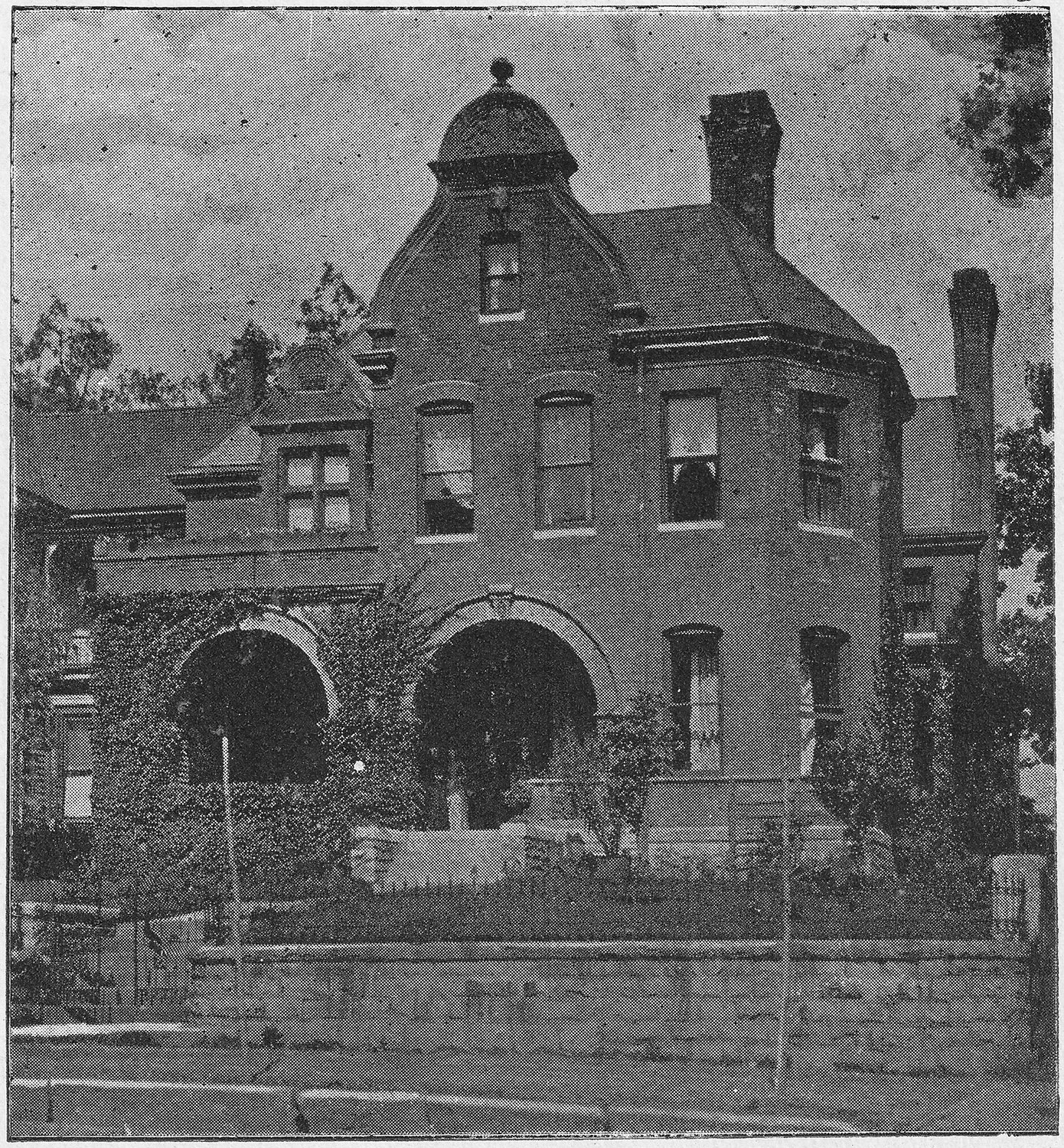
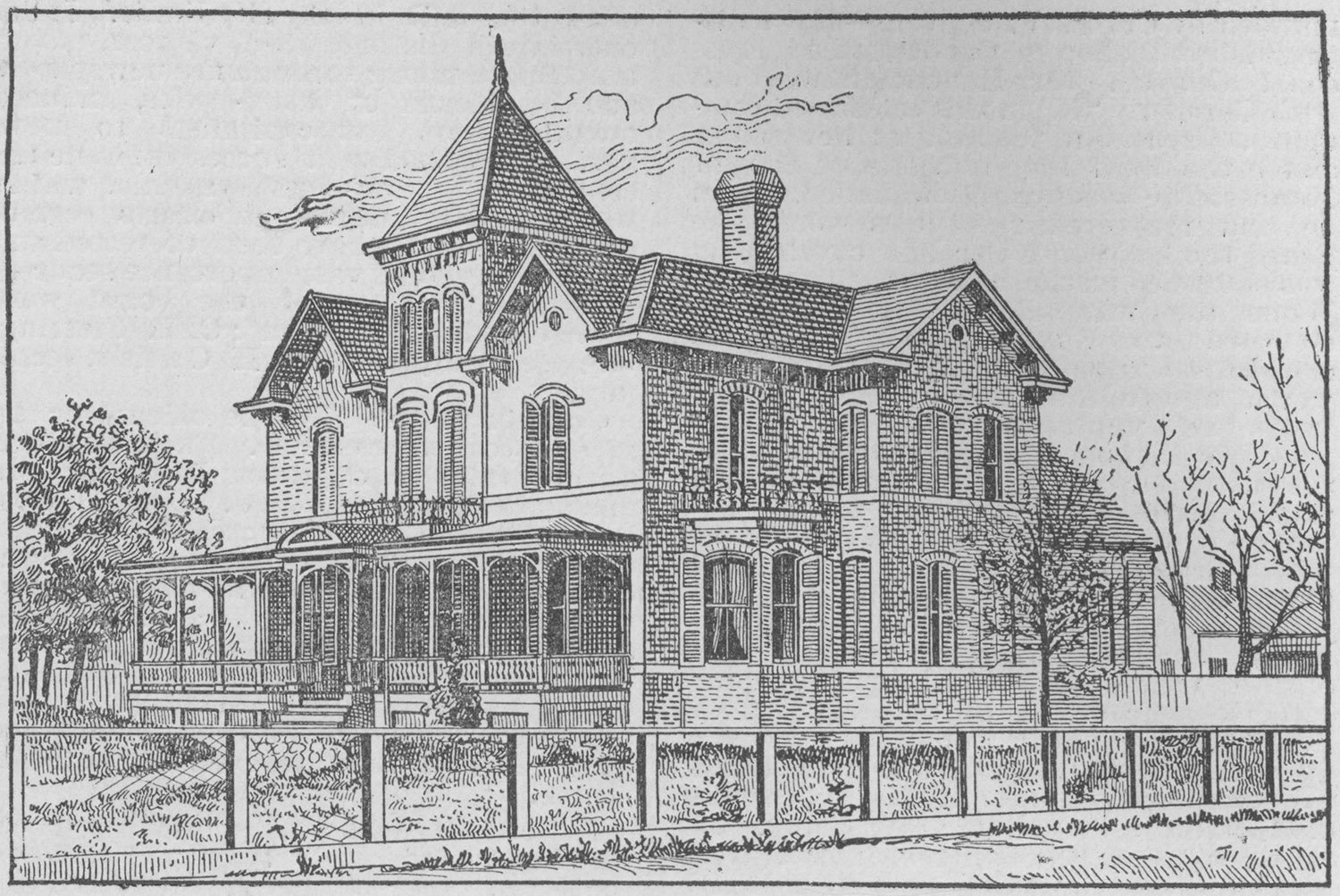
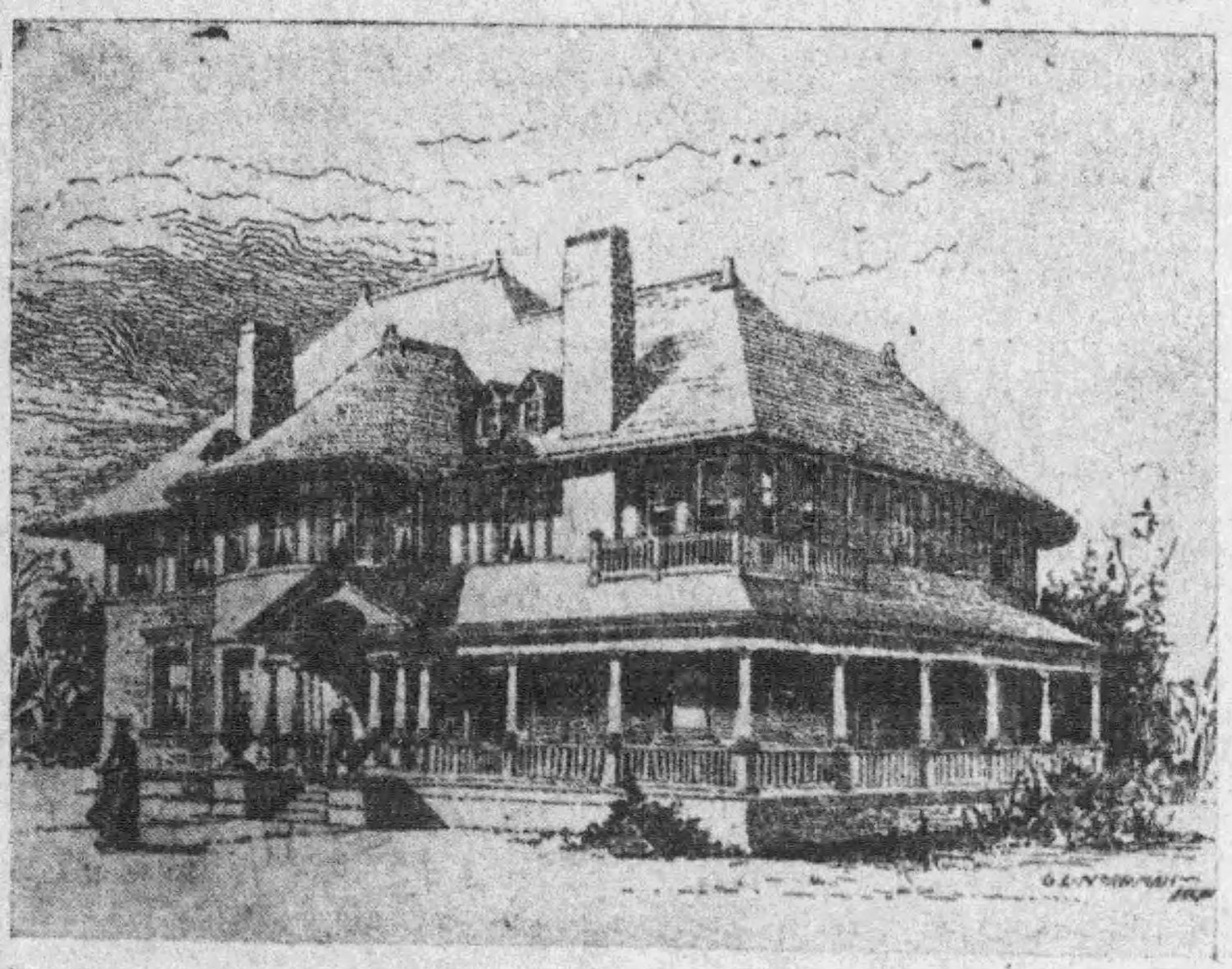
G.L. Norrman. William J. Speer Residence (1890-1911). Atlanta.1
The Background
The following excerpt is from an article published in The Atlanta Constitution in April 1891, and describes the William J. Speer Residence in Atlanta, built in 1890 and designed byG.L. Norrman.
The Speer residence was located on the northwest corner of Peachtree Street and North Avenue, at 544 Peachtree Street23 (later 620 Peachtree Street NE) in what is now Midtown Atlanta.
Location of William J. Speer Residence
About William J. Speer
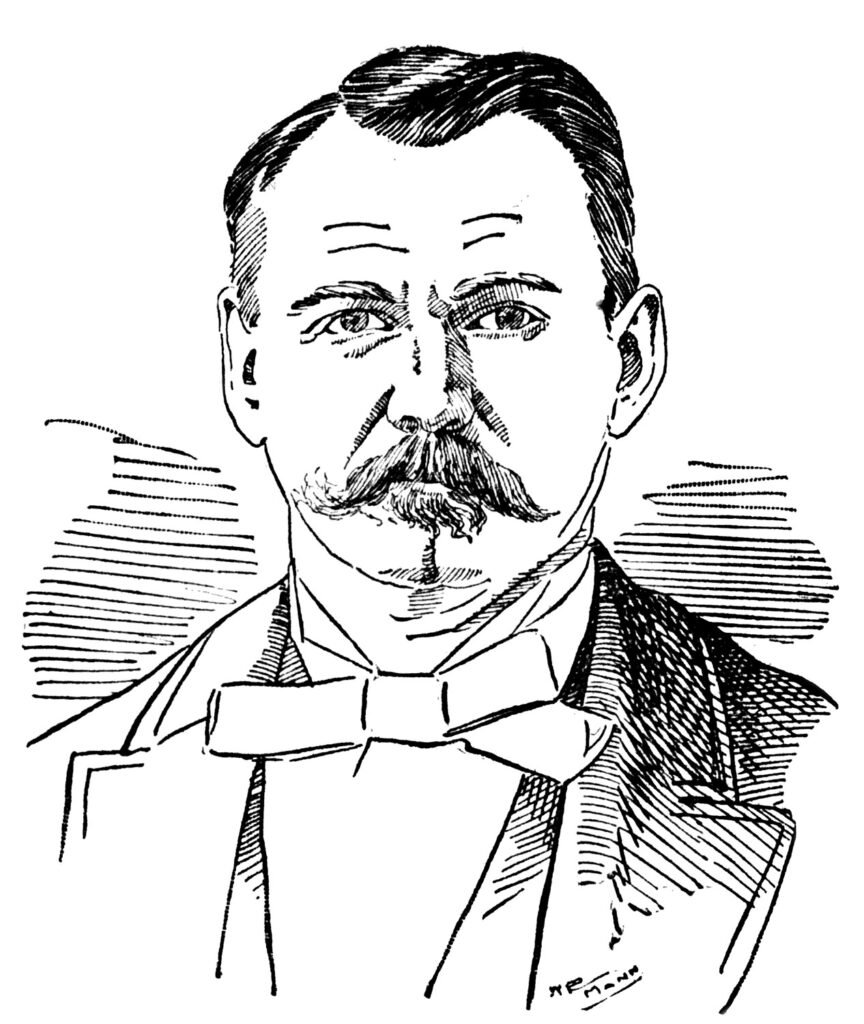
In 1890, William J. Speer (1846-19314, pictured here5) served as assistant treasurer for the State of Georgia, first appointed in 1880 by his brother, Daniel Speer, who was the state treasurer.67 No nepotism there.
William J. Speer was elected state treasurer in 18968 and resigned from the position in 1900, citing unspecified health issues.9 He was re-elected in 1911 and served in the position until two weeks before his death at the age of 85, making him “the oldest state official in point of service.”10
G.L. Norrman was likely well acquainted with the Speer family: one of his earliest projects in Atlanta was for the Peachtree Street residence of Daniel Speer,1112 and Norrman and William J. Speer were both members of the Capital City Club.13
Design and Construction
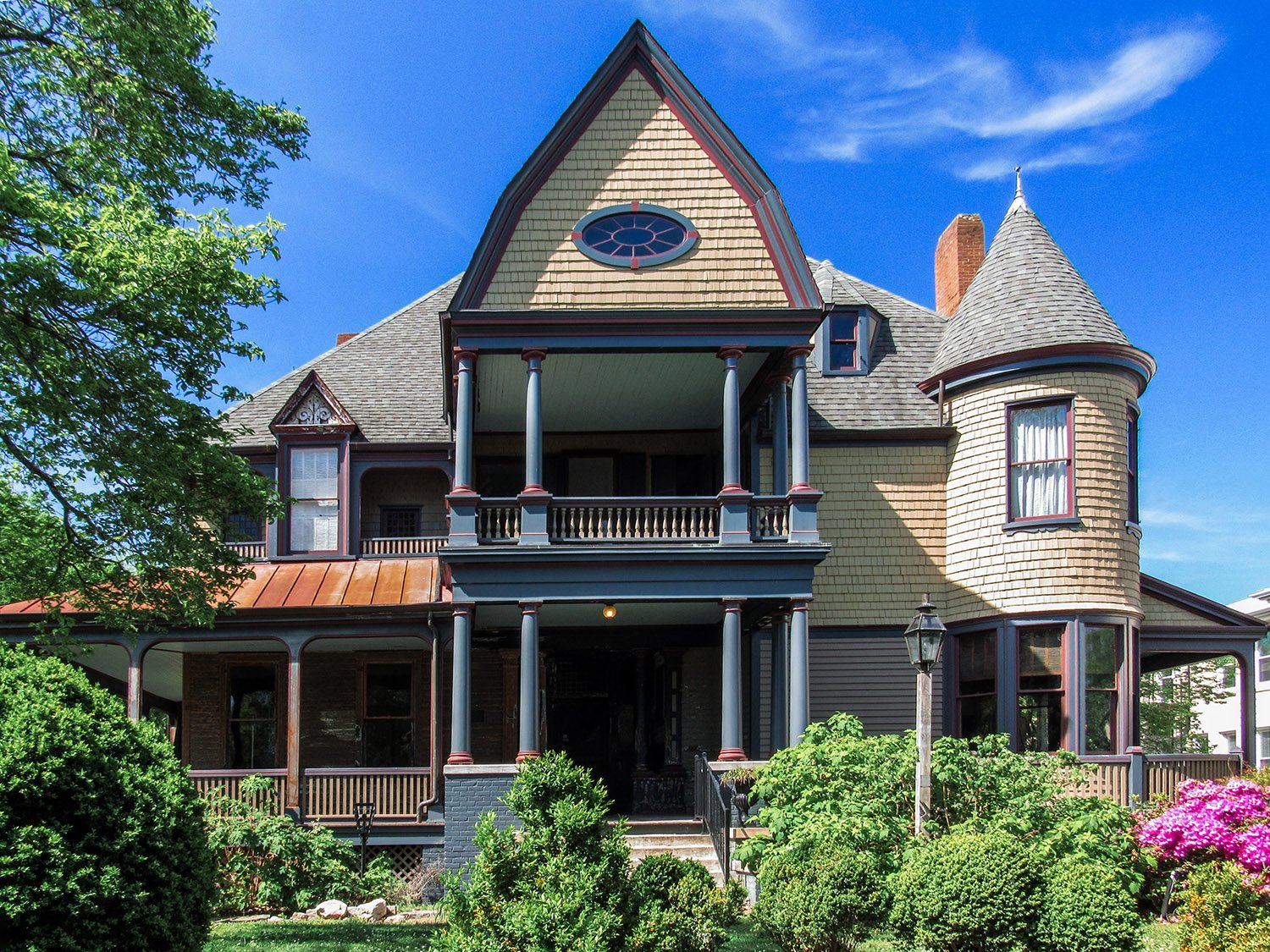
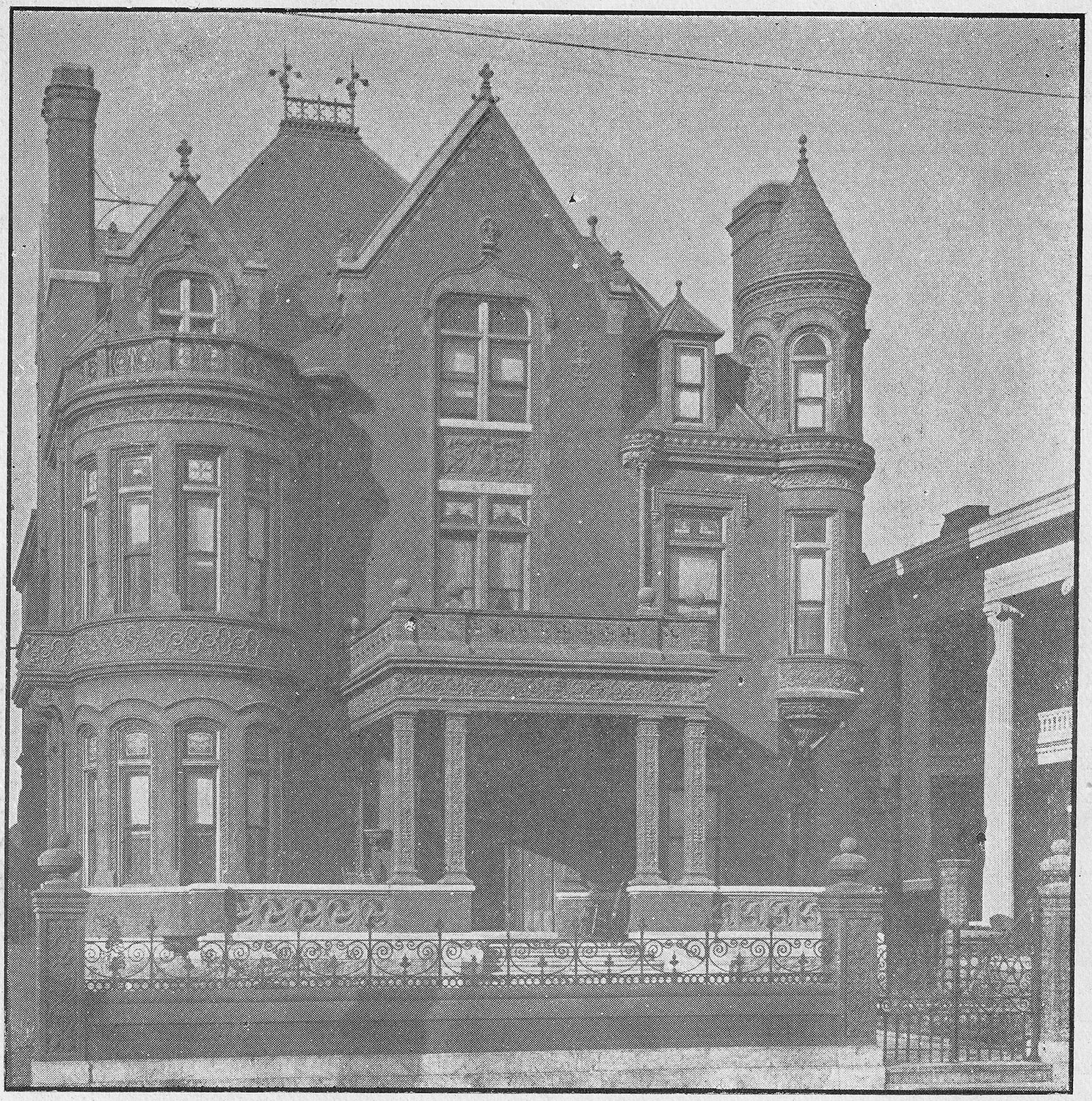
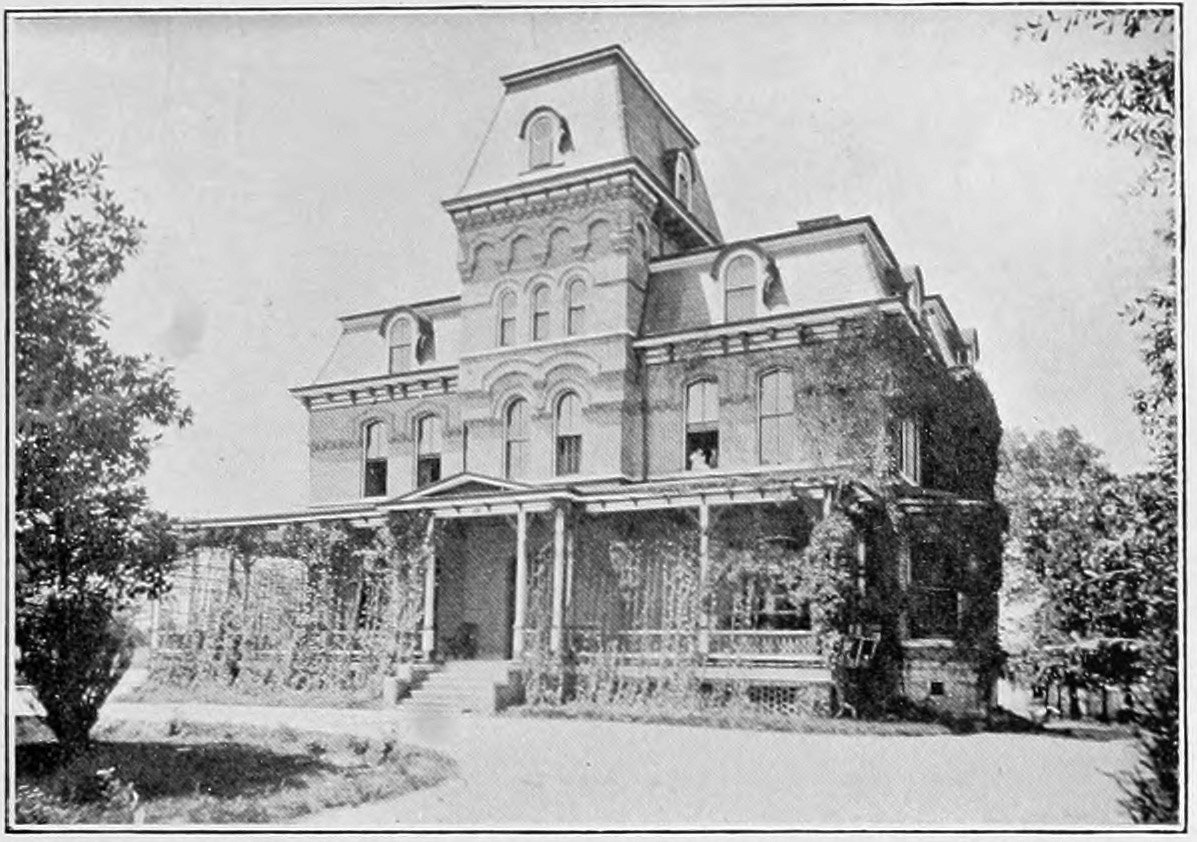
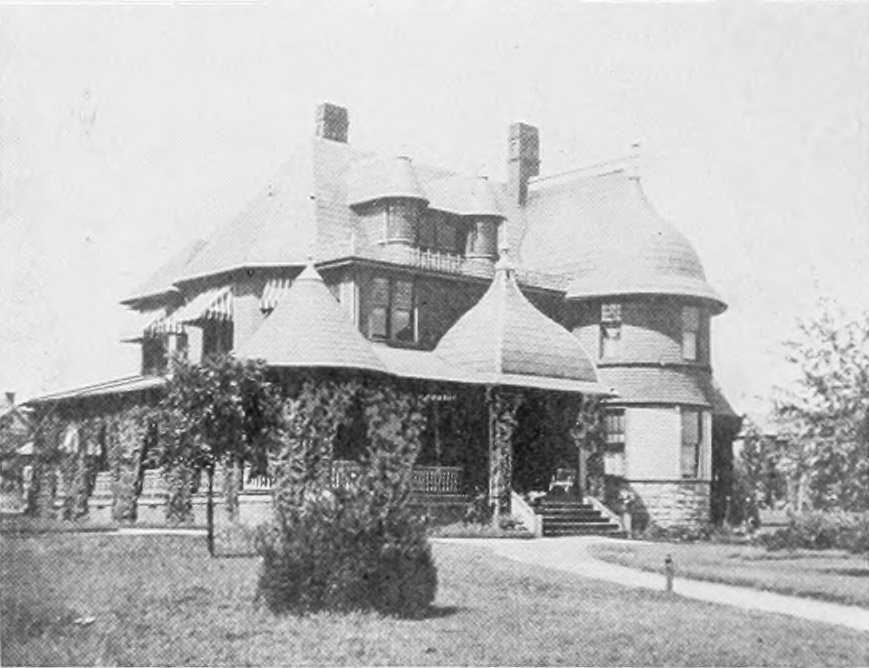
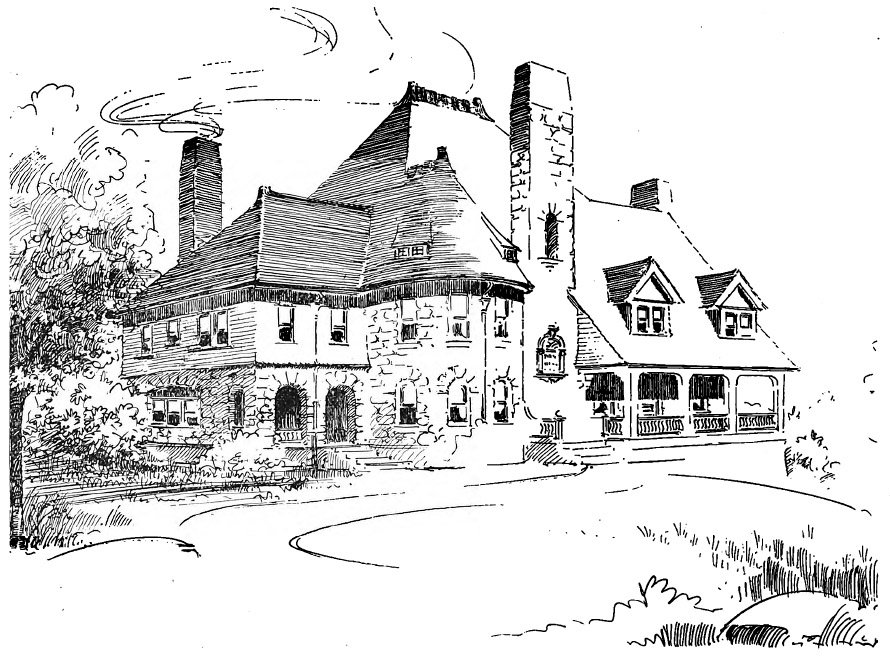
If there’s a surviving photograph of the Speer residence, I’ve never seen it. However, based on the accompanying illustration above, the home appears to be a duplicate of Norrman’s plan for theSamuel McGowan Residence (1889, pictured below) in Abbeville, South Carolina, which still exists.
G.L. Norrman. Samuel McGowan Residence (1889). Abbeville, South Carolina.14
In 1889 and 1890, Norrman’s output rapidly increased, and with several large-scale commissions, his office was clearly swamped with work.
While he was never above reusing plans to save time and money, Norrman was usually savvy about concealing the practice, altering a home’s porches or roofline, for instance, or maybe adding a turret or other stylistic flourishes to differentiate its appearance from a design predecessor.
In this case, however, he didn’t even bother, only swapping out the McGowan house’s Queen Anne and Palladian elements for a nebulous Chateauesque skin on the Speer residence.
The materials also differed substantially: the McGowan house used cheaper wood siding and shingles, while Speer’s “palatial mansion”15 was faced with brick, stone, and terra cotta. Otherwise, besides a few altered windows, the two homes’ facades appear interchangeable.
For an architect whose “designs were noted for originality,”16 Norrman’s copy of his own work posed some reputational risk, yet with 150 miles between Atlanta and Abbeville, the chances were slim to none that anyone from either place would see both homes.
The Speer residence was first announced in March 1889 with an estimated cost of $40,000 to $50,000.1718 While the home was under construction in December 1889, it was said to be “one of the most magnificent and costly on Peachtree.”19 As completion neared in January 1890, the project’s cost was reported as both $20,0002021 and $30,000.22
About the Interior
In October 1890, the Speers hosted their first formal event in the new residence, described as the “first elaborate reception given this season.”23 The party ostensibly celebrated the Speers’ daughter, Annie, who made her formal social debut the previous year.24
Managing the state treasury was obviously lucrative, and the Speers used the event to show off their home’s lavishly appointed interiors, which the Constitution predictably gushed over in exacting detail:
“The guests entered a splendid hallway, with a massive mantel opposite the front portal. On either side the mirrors were superb candelabras of beaten silver, with candles of pale pink and blue. The woodwork is of English oak. The wide hearth has brown tiling, and is finished with beaten bronze. The back of the great fireplace has a superb bronze basrelief [sic]. A carved oak arch on the left and an arched passageway gives a view of the winding, carved oaken stairway, with its wide landing and its rich opaline glass windows. The carpet is in … browns and tans, so is the wall, and the chandeliers are of colored bronze.
“The interior of the house was planned by Mrs. Speer, but Mr. Speer furnished the library, one of the most tasteful and elegant apartments. The window and book case curtains are of yellow Indian silk. The carpet is an Axminster in rich, dull tones, the walls are pale chocolate, the wood work carved English oak and the furniture deliciously comfortable and easy, is of carved oak upholstered in plain and stamped leather.
“Two oak chairs with odd, richly carved backs and seats of handsomely stamped leather are particularly beautiful and unique; the ornaments of bronze and terracotta on the mantel are superb.
“The … drawing room is all in the daintiest tones. The walls and rich carpet are pale blue and cream; the hangings white lace and pale blue India silk, sprinkled with flowers; the chandeliers silver, with white tapers encircling the large center globe light. The superb Louis X furniture was made to order and is upholostered in tapestry stuffs of richest brocade, with center pieces in quaint … designs. The drawing room opens into the dining room, whose carpet and walls are of delicate gray-blue. The furniture and wood work is cherry, the chandeliers silver. The chandeliers are as unique as handsome.”25
An Unhappy Home
Despite the opulence of their home, the Speers appear to have been typical Atlanta trash, and their domestic life was anything but a charmed one.
In September 1903, Speer’s wife, Geraldine, filed for divorce, alleging that her husband was “an habitual drunkard, having been continually drunk for over a year,”26 and that the couple had been effectively separated for three years. Mrs. Speer further claimed that her husband had recently come home in a drunken rage and assaulted their son, John, leaving her fearing for her life.2728
“A handsome residence on Peachtree street is not always enough to make a woman satisfied,” one newspaper quipped.29
And that wasn’t the first violent incident in the home.
The Wood Affair
On the morning of December 20, 1902, Mrs. W.J. Wood entered the parlor of the Speer residence and fired a gun at Mary Ballinger, a seamstress who worked for the family.3031
“You know that you have come between my husband and myself and caused him to abuse me,”32 Wood reportedly screamed at Ballinger as she whipped out a .32 caliber pistol, shooting four times but missing her target.3334
Wood’s husband was a “well known bartender”35 at the Globe Saloon on North Broad Street,36 and she suspected that Ballinger was “responsible for the alienation of her husband’s affections.”37
Wood turned herself in to the authorities shortly after the shooting, declaring, “I have killed her! I have killed her!” Upon learning that Ballinger was unharmed, it was said that Wood’s “only regret is that she did not succeed.”38
An attempt to declare Wood insane failed,3940 and she was released from jail within days.4142 It was hardly surprising when she tried to murder her husband seven months later at his apartment on Marietta Street, shooting him five times, once successfully in the abdomen4344 —apparently her aim improved.
When she was found hiding in a house on Hill Street and subsequently arrested, Wood reportedly said, “Is he dead? I hope he is. He has ruined my life; he has wrecked my hopes. I had to do it. I was forced to do it. I hope he will die; oh! I hope he will die!”45
Atlanta’s hysterical narcissism is exhausting.
A Quiet Demise
Needless to say, a shooting inside a Peachtree Street home “caused a sensation in that neighborhood,”46 and the Speers’ divorce soon afterward must have inflicted irreparable damage on the family’s social standing.
Always objective, the local press reported Geraldine’s claims with a tone of heavy skepticism. “None of his friends here believe the charges…that he has been guilty of drunkenness and cruelty,” one article stated.47 Typical.
Geraldine Speer dropped an alimony suit against her husband when he paid her a lump-sum settlement in September 1903,4849 and the divorce was finalized in 1906.50
After 14 years in the home, in May 1904, Geraldine and her four children moved south of Atlanta to the nearby town of College Park, Georgia,51 a far cry from the tony trappings of Peachtree Street. Her death in January 1909 was barely noted in the Atlanta newspapers.5253
Later biographies of William J. Speer were thoroughly revisionist, omitting any mention of the divorce and falsely claiming he married his second wife following Geraldine’s death.5455 Such are the lies history is built on.
Quiet Passing
The former Speer residence was quietly sold in summer 1904 to Mr. and Mrs. J. Wylie Pope,56 who made $1,500 worth of unspecified “repairs and additions” to the structure in 1905.57 When the Popes occupied the property, it was described as “one of the few homes in Atlanta that has a large and beautiful rose garden attached.”58 So there’s that.
In 1908, the Popes moved into an apartment in Atlanta’s Majestic Hotel, selling the home to J.C. Cooper of Athens, Georgia,59 who, in turn, sold the property to a pair of developers sometime after late 1910.6061
By 1911, Peachtree Street was rapidly transforming into a primarily commercial corridor, and the fussy grand homes built just a decade or two earlier had already become outmoded as Atlanta’s wealthiest citizens either moved out to the suburban developments of Ansley Park, Druid Hills, and Buckhead or began occupying luxury apartments in the city.
With the towering Georgian Terrace Hotel rising one block north of the 21-year-old Speer house, there was barely a peep when the home was demolished in May 1911,6263 and replaced by a one-story building with four retail stores.6465
G.L. Norrman. William J. Speer Residence (1890-1911). Atlanta.
Article Excerpt
The residence of Mr. Speer, built on the corner of North avenue and Peachtree street, is in the early French renaissance style, more commonly known as Chateau. The exterior is composed of brick, stone and terra-cotta. A wide veranda runs the whole front and terminates on each side near the middle elevation. The front entrance is a stone and terra-cotta archway, openings with a wide vestibule with tile floors and archesleading out on verandas on each side. The hall and stairway are finished in oak, and has at one end an octagon bay window with seats, and at the other a large fireplace, with seats and at the other a large fireplace with seats under the arch which runs up to the first landing on the stairs, and from which you can look down into the hall. Sliding doors connect the hall, sitting room, parlor and dining room, so that, when thrown open, the whole front of the first floor is utilized. The parlor is finished in maple with elaborate carvings on mantel and in panels. The dining room is finished in oak, and contains a magnificent sideboard, and aisles so connected as to make all the details of the room correspond and harmonize.
The house is a perfect harmony throughout, and reflects great credit upon Mr. G.L. Norrman, the architect.66
References
Illustration credit: “New Homes On The Peachtrees.” The Atlanta Constitution, April 19, 1891, p. 10. ↩︎
Historical research often yields few clear-cut answers, particularly when it involves small towns or rural areas with scant documentation. Such is the case with the Bartow M. Blount Residence in East Point, Georgia, designed byG.L. Norrman—a structure that likely never existed.
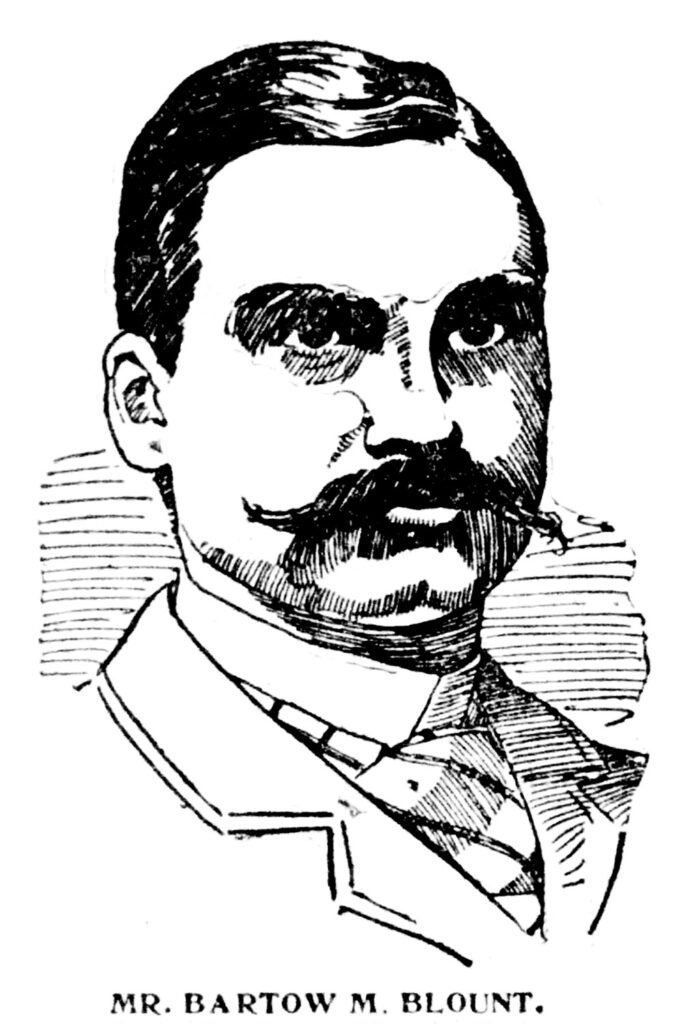
Bartow M. Blount (1859-1942,1 pictured here2) was the president of Blount & Bell (later the White Hickory Wagon Company34), a buggy manufacturing company he established in Atlanta in 1878.56
In 1885, Blount relocated the factory to nearby East Point,78 and in 1891, at the age of 35, he managed 150 employees, with the facility cranking out 6,000 wagons per year.9
East Point is a small suburb of Atlanta that sits on the city’s doorstep, only five miles southwest of West End—don’t even try to figure that one out. In 1890, the town had a population of just 738,10 and Blount was unquestionably its leading citizen, later becoming its first mayor.1112
In August 1889, The Atlanta Constitution reported that Blount bought two acres of “the D’Alvigny property at East Point,” with plans to “erect a handsome residence” on the land.13
Several months later, in January 1890, the Constitution listed a “residence for Mr. Blount, East Point, $5,000” in a description of G.L. Norrman’s planned or ongoing projects.1415
Norrman and Blount were both founding members of the Capital City Club1617 and were undoubtedly on familiar terms, so Norrman would have been a natural choice as the home’s designer. However, there’s no evidence it was actually built.
The East Point Riot
East Point has always had a reputation for being one of Atlanta’s more rough-and-tumble neighbors, and local newspapers at the time were particularly keen on stories of the town’s criminal activity following the “East Point Riot” of September 1889, spurred by the attempted rape of a young White girl by a 14-year-old Black boy, who was subsequently lynched by a masked mob.18
Amid unsubstantiated rumors the next evening that the “negroes were congregating for the avowed purpose of avenging the death of the negro boy,” a group of ten or more White men rode through the streets of East Point and whipped fourteen Black men,19 an act that was harshly rebuked by the state’s governor20 and was lambasted in the pages of the Constitution.212223
One state senator seized the opportunity, pushing for a bill to allow emigration agents to operate in Georgia, saying that he wished “to provide that if any of the northern or western states should see fit to send here for our surplus negroes they may be able to do so…”, citing “the assault of a pure white girl by a negro at East Point, a rendezvous for mean negroes.”24 Doesn’t sound too different from a 21st-century politician.
Ten men were ultimately arrested for the whippings, but their cases were all dismissed by the court because there was—here’s a running theme—”no evidence.”2526 Good ol’ Southern justice.
Back to Blount
Needless to say, you’d have been unlikely to find much of Atlanta’s rich White social set in East Point circa 1890, so the city newspapers didn’t print many stories about elegant dinner parties or tasteful residences in East Point—probably because there weren’t any. With that being said, there aren’t any news items about Blount moving into a new home that year.
Later reports stated that Blount planned to build a residence in East Point in the fall of 1894,2728 although I can’t find any evidence it was constructed then either. Was the home planned in 1894 the same one Norrman had on the boards in 1890, or entirely different? We’ll never know.
City directories often help determine a historic property’s existence, but in this case, they’re useless. By the late 1890s, East Point residents appeared in Atlanta’s city directories, but the town apparently lacked numeric addresses, so Blount’s residence was listed as simply “East Point.”293031
A convoluted entry from a manuscript titled Early History of East Point, Georgia, provides the following information about land along East Point Street:
“Dr. C. D’Alvigny, Sr. was the next purchaser and builder. He bought the property that belongs to Mr. B.M. Blount, at the time, had it cleared up and built a home, part of which is the Blount home, Mr. Blount having added several other rooms, and improvements.”32
Based on that description, it appears Blount never built the homes planned in 1890 and 1894, but instead expanded and renovated an existing dwelling built by D’Alvigny.
Blount and his family moved to Atlanta circa 1900,33 and in 1901, he bought the Milton Dargan Residence on Piedmont Avenue34—also designed by Norrman—becoming the home’s third owner in just four years.
The Atlanta rich changed homes like their underwear back then.
The Dargan house should really be called the Blount Residence, because the Blounts lived in it far longer than the Dargans—by about 30 years—ultimately selling it in 1932,35 when they returned to East Point.
The White Hickory Wagon Company fell into receivership in April 1929 after defaulting on a $70,000 loan3637 —who the hell was still buying wagons at that point?—and with the failure of his company just months before the Depression started, I suspect Blount’s final years were bleak.
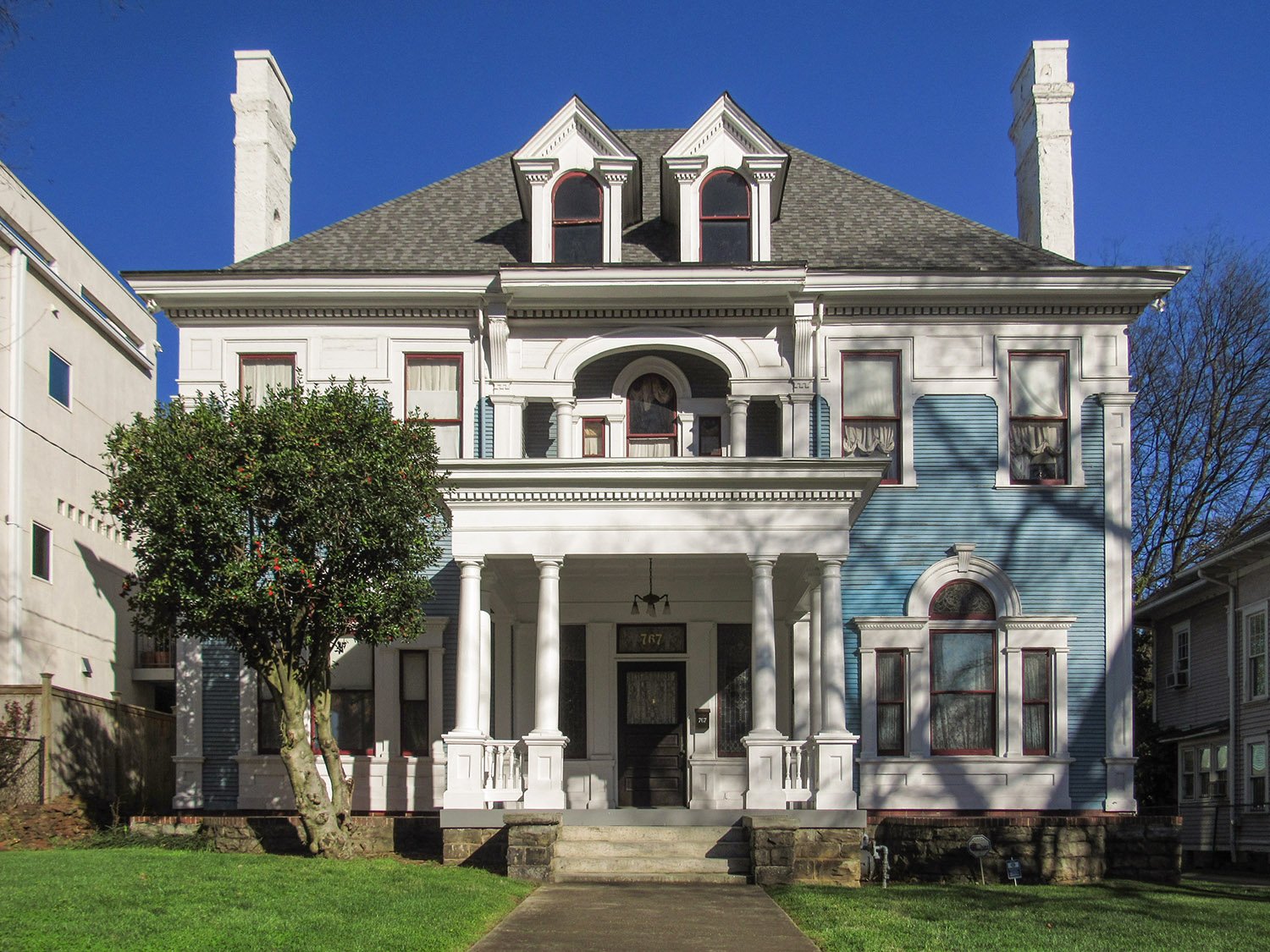
When he died at East Point in 1942, Blount’s residence was listed as 303 East Point Street3839 (later 2861 East Point Street), an ugly little 19th-century cottage that still survives. The structure has a plain vernacular design with a few clumsy embellishments and piecemeal additions, and I assume it’s the same home Blount occupied throughout the 1890s.
References
Bartow Blount Funeral To Be At 11:30 Tuesday”. The Atlanta Journal, April 6, 1942, p. 7. ↩︎
Illustration credit: “The Delegation Which Will Represent Fulton County At The State Convention.” The Atlanta Journal, June 2, 1896, p. 1. ↩︎
“Increasing Capital.” The Atlanta Constitution, April 21, 1893, p. 5. ↩︎
“The Delegation Which Will Represent Fulton County At The State Convention.” The Atlanta Journal, June 2, 1896, p. 1. ↩︎
“Notice of Dissolution.” The Atlanta Constitution, December 21, 1878, p. 2. ↩︎
“A Lovely Suburb.” The Atlanta Constitution, April 26, 1891, p. 7. ↩︎
“Wait For The Wagon.” The Atlanta Constitution, September 26, 1886, p. 2. ↩︎
“A Lovely Suburb.” The Atlanta Constitution, April 26, 1891, p. 7. ↩︎
Thompson, Sam N.Early History of East Point, Georgia, or, “A Historical Sketch of Pioneer Days”. East Point, Georgia: East Point Historical Society (1984). ↩︎
The following article, published in The Atlanta Journal in March 1890, describes a log cabin built outside of Vinings, Georgia, as a summer residence forA.E. Thornton, anddesigned byG.L. Norrman.23
Located in Cobb County, roughly 10 miles northwest of central Atlanta near the Chattahoochee River, Vinings was a tiny rural outpost in the 1890s; today it’s a sprawling suburb of leafy neighborhoods and office parks.
Approximate Location of Thornhurst
In the late 19th and early 20th centuries, many of Atlanta’s prominent citizens maintained “summer homes” in the surrounding countryside, typically only a few miles outside the city for easy access via wagon or train. Vinings, for example, was a stop on the Western and Atlantic Railway.4
And Albert E. Thornton (1851-1907, pictured here5) was as prominent as they got — one of those deep-pocketed men who seemed to have a hand in just about every conceivable business enterprise.
By 1890, Thornton served as president of four cotton oil mills,6 president of the Land Title Warranty and Safe Deposit Company in Atlanta,78 and vice president of the American Pine Fibre Company in Wilmington, North Carolina.9
The Atlanta National Bank,14 founded in 1865 by his father-in-law, Alfred Austell15
Thornton would have been well-acquainted with G.L. Norrman’s work, since Norrman designed the renovation for Atlanta National Bank in 1886,16 as well as residences for one of its chief employees, Paul Romare. Norrman and Thornton were also members of the Capital City Club.17
It was a slow news day when the Journal published this front-page article, which describes nearly every aspect of “Thornhurst”, Thornton’s 600-acre country estate at Vinings, in exhaustive detail —including the family dogs.
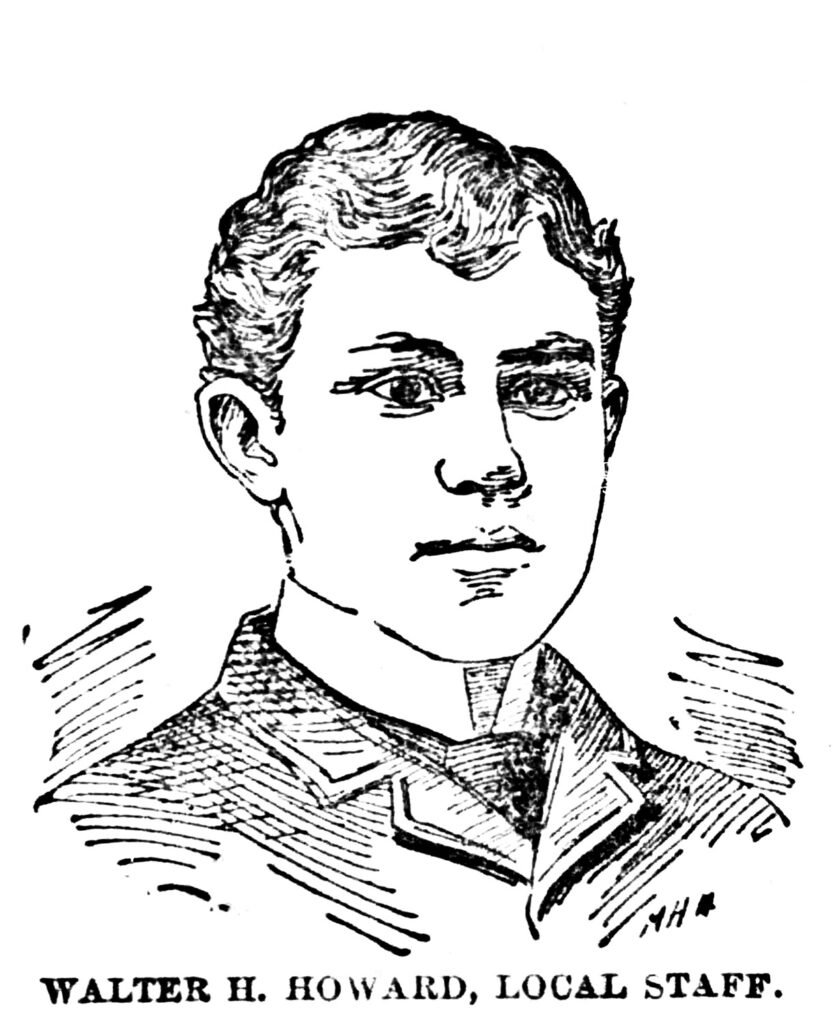
The author of the article was Walter H. Howard (1870-1902, pictured here18), who at 19 was the youngest member of the Journal‘s writing staff.19
Howard eventually became the city editor of the Journal before moving to New York and working for The New York Journal, notably as a war correspondent in Cuba during the Spanish-American War and later as a foreign correspondent in London.20
Howard then returned to Atlanta and served as an editor for the short-lived Atlanta Daily News,21 but like so many hot-shot journalists, he burned out fast, dying at the age of 32 after a years-long battle with tuberculosis.2223
After his death, Howard was described as having “the energy of a dynamo,”24 yet it’s hard to find much of it in this plodding, prosaic piece that has all the rhetorical brilliance of a typical college freshman’s essay. My favorite line: “chimneys that one reads about, or, perhaps, dreams about but never sees.”
Howard’s depiction of Thornhurst as “a log cabin in the mountains” is also amusing: there’s exactly one small mountain at Vinings— Mount Wilkinson—although I would characterize it as a large hill.
Today, the area is as hot and polluted as the rest of Atlanta, but you can be sure it was never a place for “cool draughts of pure mountain air.”
Thoughts on Thornhurst
The construction dates for Thornhurst are unclear, but the project was first announced in December 1889, and the article here was published in March 1890, so the homewaslikely completed in 1890.
Another description of the structure from October 1891—nearly two years after this article was published—revealed that the interior had yet to be fully furnished, and that Thornton and his wife, Leila, spent “some few days out of every week or so there.”25
The same report said the Thorntonsplanned to build an “elegant residence”on the property, at “a point of commanding prominence overlooking the Chattahoochee river and some very rugged country.”26Those plans apparently never materialized, but presumably Norrman would also have been the designer for the larger home.
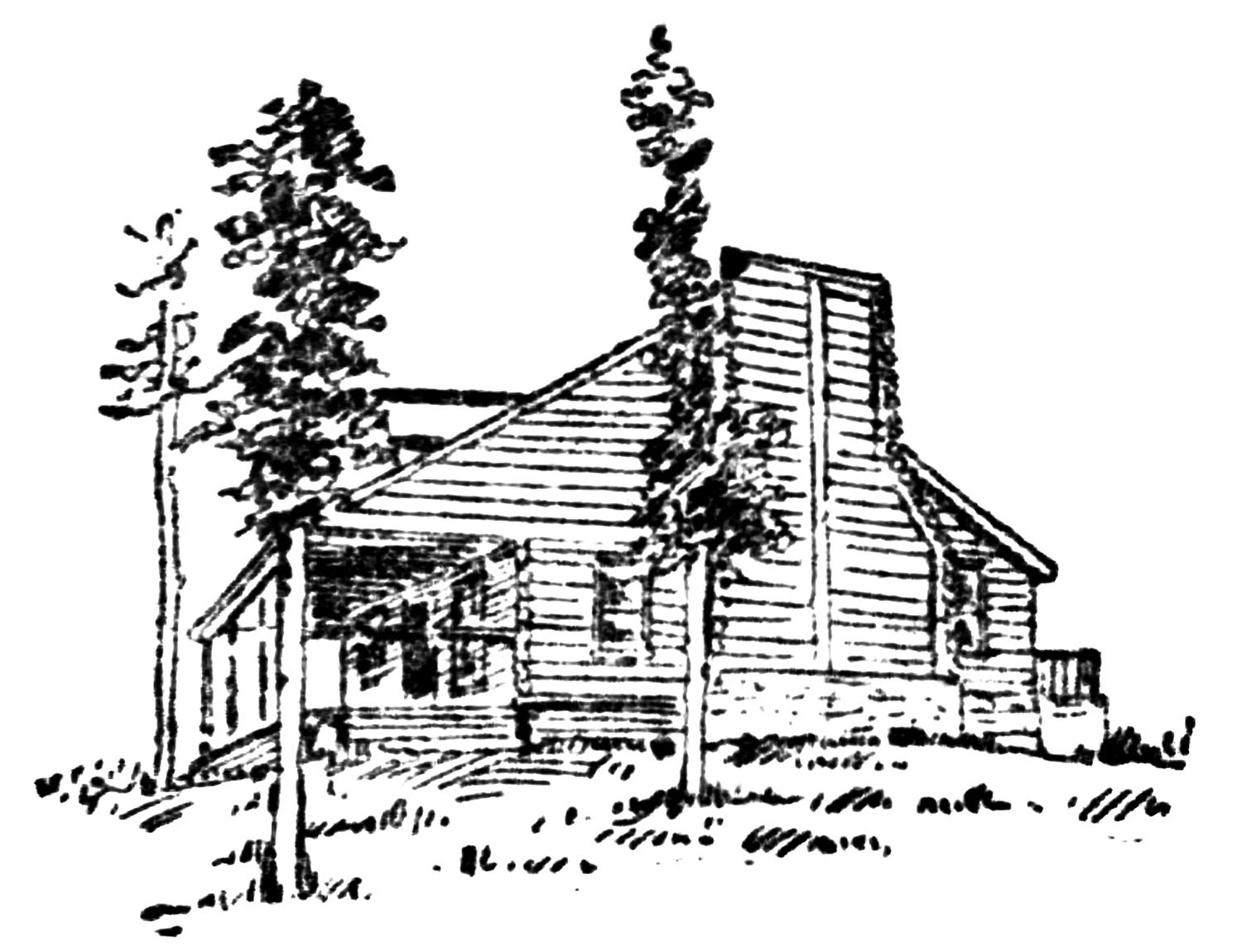
Norman’s specialty was elegant residences, so it must have been a unique challenge for him to design a six-room log cabin that “preserved some characteristics of antebellum days,”27 as the 1891 article put it, using old-fashioned building techniques described as “peculiar to the backwoods.”28
The latter article provided a little more detail about the home’s construction that wasn’t included here, notably the following:
“The space in the walls between the logs are daubed with mud, and the entire surface inside and out is shelaced [sic], adding infinitely both to the beauty and the durability of the structure. The roof is of thatch.
The rustic effect has been carried out in detail on the interiors. Here the mantels are of barked ash poles, notched and rugged. The floors of the cottage are of polished wood.”29
Thornhurst’s Fate
From the 1890s to the 1900s, local social columns regularly reported on the Thorntons’ excursions to Thornhurst, where they often hosted large parties and social gatherings in the summer months, including at least one barbecue in 1906 for the employees of the Atlanta National Bank.30
As the Journal noted in 1900:
“Among the country places of Atlanta persons, “Thornhurst,” owned by Mr. and Mrs. Albert E. Thornton, arouses pleasant memories in the minds of a number of Atlantians who have visited this home during the summer.”31
The last mention of Thornhurst in an Atlanta newspaper appeared in January 1908,32 nearly a year after A.E. Thornton’s death.33 Leila Thornton inherited the entirety of her husband’s estate, including Thornhurst and other real estate holdings, which the Journal said made her “perhaps the wealthiest woman in the state.”34
The final published reference I can find to Thornhurst is in the Summer Social Register of 1911,35 and beyond that, the date of the cabin’s demise is unclear.
When Leila Thornton died in 1931, she was a resident of the Biltmore Hotel in Atlanta,36 and it appears the family’s estate in Vinings had already long been sold off, with the cabin presumably demolished.
Coincidentally, a Log Cabin Drive exists in Vinings today, named after the Log Cabin Community Church, which was founded in 1912 and housed in a log cabin. Based on a photograph of the original church, it wasn’t the same as Thornhurst.
I guess Vinings had more than one log cabin.
A Place Of Beauty.
An Atlanta Gentleman’s Country Home On The Banks Of The Chattahoochee.
Mr. A.E. Thornton’s Country Residence Near Vining’s Station–An Elegant Log House Built on the Top of a Hill Overlooking the River.
Written for The Journal.
There is in course of construction on the banks of the Chattahoochee river, one mile from Vinings station, an ideal country home of a city gentleman.
The place is owned by Mr. A.E. Thornton, president of the Atlanta Cotton Seed Oil company. It consists of six hundred acres of well wooded land among the small mountains to the right of the little station; at a place where the river bends well towards the south in its course.
The house is on the summit of a tall hill near the river side. At the bottom of the hill a clear spring branch threads its way through a mass of undergrowth and finally mingles its waters with those of the Chattahoochee.
The house is nothing more than a log cabin, but it is the most elegant one in the state. It is a story and a half high and contains six rooms, four down stairs and two above.
Every piece of wood that is being used in the construction of this picturesque building is fine, and was cut and prepared for use on the place. For this purpose a small steam saw mill was put up at the foot of the hill by the side of the branch, and all of the logs and planks used on the place are sawed in it.
The House Itself.
The log house is built upon a stone foundation. The first story is built of evenly selected logs, lain one upon the other, and the small crevices between them neatly filled with hardened cement. The upper half story is covered on the outside with fancy shingles.
The bark is scraped off of all the logs, and they are neatly scraped, but unpainted.
And then the chimneys. They are chimneys that one reads about, or, perhaps, dreams about but never sees. There are two of them, one at each end of the house. They are regular old fashioned log chimneys with the cracks stopped up with cement. They are what are called double chimneys, furnishing a fireplace for each of the four down stairs rooms.
These chimneys are four feet deep and sixteen feet wide at the base, and taper gently to the top, where they are four by nine feet. The logs of which they are built decrease in size toward the top so that the appearance of the chimneys is entirely symmetrical.
The Broad Porches.
The house has two very broad porches. The front porch faces the west, giving a magnificent view of the glorious sunsets to be seen in these mountains. The posts supporting the roof of this porch are nicely-selected pine saplings, sawn so that the knotty branches form artistic rustic brackets.
The back porch is a broad, open plaza, fourteen by forty-two feet, without any roof. It is inclosed by rustic banisters and railings of knotty pine branches.
From this porch, through a vista dimmed by intervening trees, is the view of the river, about a hundred yards off. Mr. Thornton’s place has about one mile of river front, and the grounds from the house to the river will be cleared out nicely so that the view will be unobstructed.
Inside The House.
The inside of the house is finished with an exactness and nicety that is charming to observe.
The walls and ceilings of the rooms and hallway are cleanly and smoothly scraped and painted white.
The very broad inviting hallway, leading through the house from one porch to another, gives passage to cool draughts of pure mountain air.
Everything inside the rooms is arranged with the same artistic roughness as on the outside. The mantles are of pine and adorned with rough, knotty brackets. The large, old-fashioned hand-irons in the fireplace, across which are laid large logs of hickory and oak wood complete a picture of one of those comfortable rooms.
The stairway leading to the second floor is constructed in keeping with the rest of the house. The post at the foot and banisters are of the same knot covered pine branches, presenting a very pretty rustic effect.
The interior of the two rooms upstairs is finished with the same comfort and neatness as those below. Amply large closets are set on either side of these rooms and pretty little dormer windows looking out over the mountains on one side, and the river on the other.
The Water Works.
This log house of Mr. Thornton’s will have a complete system of water works in it.
And the water will be the purest spring water, cool and refreshing.
On the top of one of the mountains is the large, clear spring from which the water will flow. At this spring a tank has been placed, the bottom of which is sixteen feet above the top of the house. From this tank pipes will convey the water to the house, about a quarter of a mile distant.
The idea of having waterworks in a log cabin in the mountains is quite something new.
The new waterworks plant of the city of Atlanta will be on the Chattahoochee river just one mile and a half above Mr. Thornton’s place.
The Out Houses.
Just outside the house, near the open plaza, is a neat little kitchen and a servant’s house. The yard is surrounded by a tall picket fence, and will be laid off and planted in nothing but grasses and natural wild flowers.
The place has over a hundred good chickens on it and a separate inclosure [sic] has been built for them.
Then the dogs.
Mr. Thornton has a pack of five little beagle hounds, the smallest, prettiest little fellows imaginable. There are but very few of these dogs around Atlanta, and to follow them in a chase after a rabbit is an interesting experience. The little fellows never get tired. They will run a rabbit all day and never abandon the chase until it is killed or captured.
Besides these there are two fine fox hounds, and several other dogs, setters and pointers, will be taken to the place. A kennel has been built for the dogs as large as a stable, and an inclosure built around it.
The Stable And Orchard.
On the northern slope of the mountain, only a short distance from the house, is the stable.
In this Mr. Thornton will keep his cows and two carriage horses, his carriage, a wagon, and other farm implements. This barn and stable is perfectly arranged.
Below the stable is a newly planted orchard of fine peach, apple and pear trees, grapes and scuppernongs. The orchard is regularly and beautifully laid off and will be sown in clover. It contains about six acres of well-cleared land.
The place is peculiarly picturesque and beautiful. The buildings are all constructed upon a similar style of architecture, and the uniformity with which the work, the designs, and the arrangements of the buildings have been perfected and carried out is an evidence of Mr. Thornton’s excellent taste and good judgment.
Mr. George A. Yarbrough is the polite and efficient contractor who has so ably carried out this beautiful work for Mr. Thornton.
During the approaching summer Mr. and Mrs. Thornton will entertain some of their friends at their country seat in true English style.
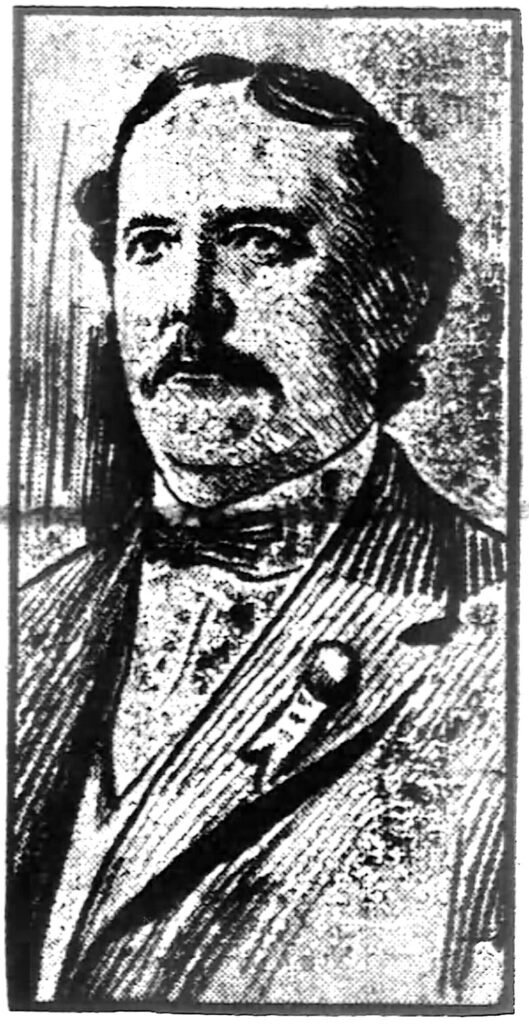
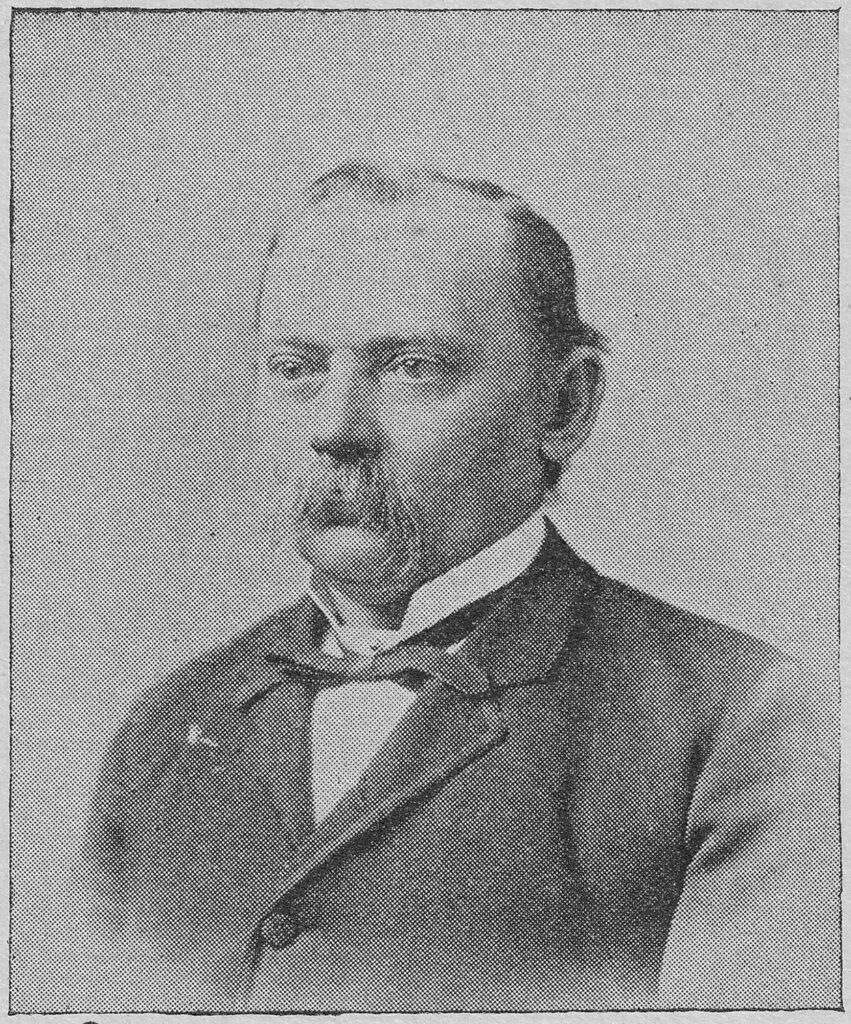
The following autobiographical account was written byPaul Romare (1828-1904, pictured here) of Atlanta and published in 1892-93.
Romare was born in Sweden and raised in a working-class family, butlater became an American citizen and one of Atlanta’s most prominent social figures, serving nearly 40 years at the Atlanta National Bank.
When he wrote this sketch, Romare was the bank’s vice president, but was appointed president in 1903. When he died just a year later, it was reported that “no one had more friends than he.”1
Romare’s story provides a fascinating glimpse into his circuitous journey to the Deep South, an uncommon destination for Swedish immigrants in the 19th century.
The story is particularly interesting because of the many parallels between Romare’s life and that of his younger friend and fellow Swede, G.L. Norrman, whose own coy autobiographical sketch a few years later was much less revealing.
I kinda wish Norrman had taken a cue from Romare and shared more details of his early life, but alas, the man’s enduring mystery is part of his appeal.
Mr. Paul Romare.
Paul Romare, Vice-President of the Atlanta National Bank, whose history being somewhat out of the usual line, may prove a matter of interest to his many friends and the readers of these pages. We give his life and life work in his own words:
I am a Swede, born on the shores of the Cattegat, in the town of Tonkon, Province of Skane, Sweden, November 20, 1928.
I was the youngest of five children, three brothers and one sister. From the age of six to fourteen I attended the village school, where I obtained a knowledge of arithmetic, geography, and history. At fourteen I left school and began life in earnest. My father, Paulus Romare, was Captain of a merchant ship for over thirty years. Too young to launch out for myself, I went with him as cabin boy to New York in 1843.
Of course the impressions of this first sight of America and an American city were not only deep but naturally enchanting to a young lad such as I was. None but a foreigner can appreciate the newness and beauty of a place like New York, and right then I felt that at some time this to me new world must and should furnish a home.
Of course I returned with my father in Sweden, and remained at home one summer. The next fall I sailed again as cabin boy with an older brother, who was the Captain of a ship. We sailed from Stockholm to Marseilles, returning home in the summer of ’45. That same summer I sailed again with a friend of my father’s for the Island of Java, touching Cape of Good Hope going and returning.
Resting a while in Stockholm I sailed with the same Captain for New York once more, and from New York to Rotterdam, Holland. While in this city the First Mate left the ship and I was given his position at the age of eighteen. However, by this time I had considerable acquaintance with the sea and sea-faring, and had gathered some knowledge of navigation from my father, brother, and present Captain. We returned to America, visiting Philadelphia and New York, and while in this city that had for me so many charms an incident occurred which changed my future and indeed my entire life. My Captain and I had a quarrel, and vowed I would never return with him to Sweden. Of course I kept my decision a secret for prudential motives.
Of course I ran considerable risk, but I went at once to see a friend, a Swede who live in New York for some years. I told him I was determined to remain in America. He promised to come to our ship that night in a boat and help me off. Like a true Swede, he kept his word, and I was soon securely hid in his home.
Just at this time, unfortunately for me, my brother’s ship was in the harbor of New York ready for sea. He was duly notified by the Captain of my escapade. He hastened to our mutual friend, feeling sure he knew of my whereabouts. I heard him coming; I knew his step. A closet being near, I opened the door, went in and was secure and out of sight. I could even hear his voice and what he said. My friend was astonished at my leaving; it was all news to him. I knew from what my brother said he did not believe one word, but seeing search in vain he left, and before next morning he was far out on the Atlantic. The ship I had so hastily abandoned also left in a day or two.
Left now absolutely master of myself and fortune at the mature age of eighteen, a stranger in a strange land, not one word of English at my command, I began to turn my thoughts to the serious side of my situation. That America was to be the home of my adoption was absolutely decided. That a knowledge of the English language was absolutely necessary to my progress in the new home was also decided. What to do while gaining that knowledge was the next serious question. This last query was soon settled by my shipping on an American brig as a sailor, bound for Mobile. On that trip I took my first lessons in English. On the vogage I found Dana‘s “Two Years Before the Mast.” Being far more familiar with the sea than I was with the land, the book naturally caught my fancy, being the plain and simple experience of a man who was two years before the mast. How I read it, now after the lapse of so many years, I cannot tell, but that I did read it and enjoyed it I am certain. Having no one near me who knew one word of my native tongue, I soon from sheer necessity had quite a vocabulary at my command.
I made various trips after this, crossing the Atlantic at least a dozen times; also had two or three trips to the West Indies and Mexico–on one of these trips taking army supplies to troops in Mexico. My last trip was from Charleston to Havana and back to Charleston, and in this city I was attacked with rheumatism, upon which my slight misfortune hinged my future plans.
One summer day, stopping at a cigar store on Broad street, I met a gentleman, a Swede, who had recently purchased large interests in the iron works at Cooperville, South Carolina. I had seen him before, and being countrymen, we were mutually drawn to each other. Approaching me, he said in Swedish, “Come, go with me to the iron works; you will soon get well, and I am in need of an interpreter. I cannot speak English, and I need a good man who can help me manage the business. I decided to go, and at the iron works took my first lessons in native business, first clerking at the supply store and then keeping books for the company. I was there from 1850 to 1854. It was then a prosperous concern, working about three hundred hands and manufacturing pig iron, bar iron, and hollow-ware.
In the summer of 1854, having laid aside some money, I resolved to see my native land once more. I left New York the last of April and reached my old home on Sunday, May 15. I notified no one of my coming. Reaching our house I rang the bell, asking for Captain Romare. My father did not know me, but in a little while all the household gathered to rejoice over the long lost and long regretted.
After a most delightful visit I returned to the home of my adoption. That fall I accepted a position in the Bank of Chester from the President, Mr. George S. Cameron, who was a friend of mine as long as he lived. I remained in Chester till the commencement of the war, when I enlisted with the old Chester Blues, the first company that left our place. I remained with that company till I was detailed for service in the War Department at Richmond, and was there till the evacuation, when I left with the retreating army, and in a few weeks the surrender at Appomattox ended the struggle.
In 1863, I was married in Grace Church, Camden, to Miss Lucy Fisher. I returned to Camden, and in the fall came to Atlanta to accept a position in the Atlanta National Bank, offered by my old and true friend, George S. Cameron, who with General Alfred Austell were the founders of that bank immediately after the war. I may mention that I received the first deposit ever made in that bank.
The rise, success, and prosperity of the institution are too well-known to be repeated. My life and life-work I may truly say has been here. For more than a quarter of a century my days have been spent in this bank, and to it has been given my best of life and time. Those who began here when I did are few indeed. I may say that I am the only one of the original officers and stockholders that is still interested in the bank.
I have made my home in Atlanta; here I expect to spend the rest of my life, and departing bequeath to this city and her people my fondest wishes and blessings.2
The following article was published in The Looking Glass on January 22, 1898, and provides what it describes as “an appalling list of openly avowed Atlanta bachelors” at the time, includingG.L. Norrman (1848-1909).
The Looking Glass was a short-lived but notorious tabloid newspaper published weekly in Atlanta from 1895 to 1898, and it’s safe to say that pretty much everyone in the city read it, even if they’d never admit to it.
Chock-full of photographs, oversized illustrations, and comic sketches, The Looking Glass was a visual feast compared to the drab pages of The Atlanta Constitution and The Atlanta Journal.
What really made the publication so sensational was that it regularly dished on the lurid exploitsof what it referred to as “Atlanta’s 400—a sarcastic swipe at the city’s wealthiest citizens, inspired by the Four Hundred of New York.
The members of Atlanta society who were regularly fawned over in the pages of the Constitution and the Journal were mercilessly mocked in The Looking Glass, with irresistible blind items that laid bare their infidelity, divorces, drug and alcohol addictions, and bankruptcies—among other social embarrassments.
Absolutely no one who was anyone in Atlanta was spared by The Looking Glass, which scandalously pushed against every conceivable social taboo of the time—it even had an illustration of a nude woman on its banner.
A few random excerpts will give you an idea of why the newspaper was so popular:
“The interesting rumor that a naked man was in the habit of parading the neighborhood of Grant Park has caused great excitement in the vicinity…”1
“There is a certain high building in Atlanta, the roof of which furnishes an excellent coigne of vantage from which to survey the surrounding country. It is reached–the roof, I mean–by a ladder like flight of stairs leading up from a loft, and it is quite a common thing for lady visitors to repair thither to enjoy the superb view. The offices on the several floors of the building contain a good many young men who are no better than young men usually are, and some of them lately made the discovery that the fair visitors, ascending and descending, like the angels in Jacob’s dream, formed a series of living pictures quite eclipsing anything ever seen on the stage. One of the discoverers owns a hand camera, and with the aid of this instrument he has perpetuated the delectable vision in a number of different views.”2
“One of the numerous divorce cases which will be heard at the ensuing term of the Superior Court will in all probability develop a little story which contains about as many elements of the dramatic as are usually to be found in a single passage of every-day life… Some time ago the husband began to suspect (or so he claims) that his wife was taking more interest than she should in a certain friend of the family who was a frequent visitor at the domestic hearth… he proceeded to lay a trap for his friend and his spouse…”3
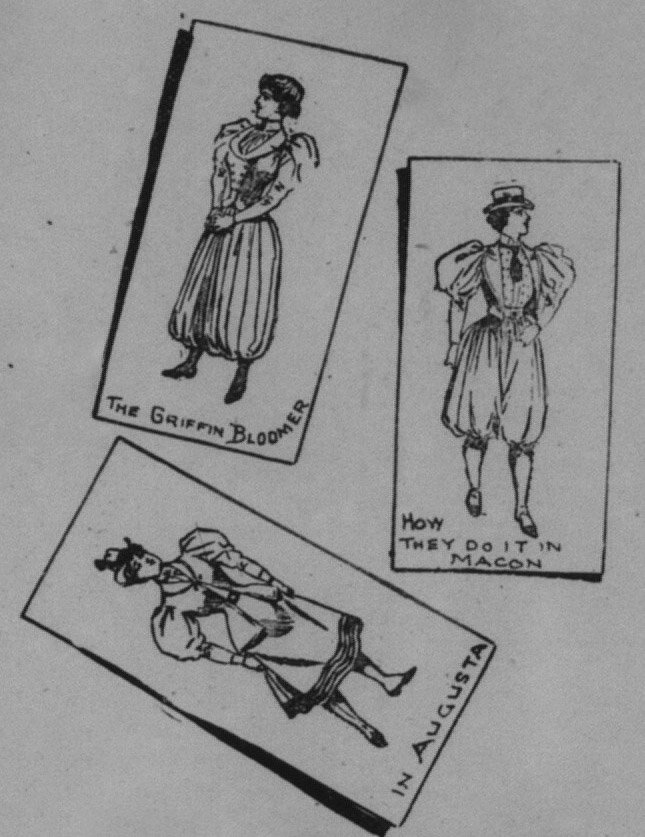
“That there is a prejudice against bloomers is not to be denied, but The Looking Glass begs to doubt whether it is a puritanical prejudice. The objection is not ethical it is aesthetic. Bloomers are unpopular and generally reviled, not because they are immoral, but because they are ugly. They are a clumsy and ineffectual compromise between the graceful, comfortable and artistic knickerbockers and the flapping skirt, and alike all compromises, reproduce the bad points of both extremes, without their redeeming qualities.
“A woman may be as shapely as Venus and as graceful as a fawn, but nothing will prevent her from looking like a guy the moment she thrusts her legs into a pair of meal sacks. A very loose nether garment, gathered in at the ankles, and superabundantly wide at the hips, is inherently grotesque, and neither youth nor beauty can save it from provoking a smile.”4
That’s right, your ancestors were whores and perverts, too.
Needless to say, the tone of the following article is quite tongue-in-cheek, and the pseudonymous writer, a.k.a. “The Spinster”, writes about the Atlanta “men who have long been given up as hopeless by even the most persistent of the managing mammas.”
Many of the “confirmed bachelors” listed here are also named in a somewhat similar article published in the Constitution two years earlier (see “Atlanta’s Attractive Prizes for Leap Year Girls“), and I suspect the writer of each was the same.
But of course, The Looking Glass was much more provocative, and this article may have been at least a partial outing of some of the city’s closeted gay men at the time—God knows Atlanta is still full of them.
Certainly, some of the phrasing here appears to be euphemistic: Jim Nutting is described as the most “impregnable man in bachelordom,” Hugh Boyd Adams is compared to an “old maid,” and Oscar Brown is said to be “one of the most incorrigible of the entire lot.”
As always, history provokes more questions than it provides answers.
Atlanta’s Brigade of Confirmed Bachelors, Young and Old.
Men Who Are Useful in Society, but Who Have Long Since Ceased to Be an Object of Solicitude on the Part of Designing Mammas–An Interesting Roster.
I have noticed that the LOOKING GLASS has from time to time commented on the scarcity of marriages in Atlanta society and has suggested several reasons why this state of affairs exists. Chief among then, if I remember correctly, was the assertion that a majority of our young men look askance at matrimony because they are too poor to properly maintain a wife.
So far as this theory goes it is correct, but it does not entirely cover the ground. I have studied the situation carefully and have come to the conclusion that the idea of matrimony, aside from the necessary additional expense which it entails, is becoming more and more distasteful to society men. Each year the free-to-come-and-go life of the clubs absorbs more and more of our really eligible bachelors, and they are irreclaimably lost so far as the girls and their mammas are concerned.
One has only to look at the appalling list of openly avowed Atlanta bachelors–men who have long been given up as hopeless by even the most persistent of the managing mammas–to realize that I am right. Many of these men are entirely eligible, so far as money, good looks and intellect are concerned, but they are regarded as absolutely incorrigible. They dance attendance on the debutantes of each succeeding season, go to all the different functions and eat the dinners of anxious mammas–but they don’t marry. Neither does anyone expect them to marry; they have been in the swim for years and occupy a distinct place which they have made for themselves. However, such men are extremely useful members of society; they can always be depended upon to accept an invitation or keep an engagement, and they invariably put themselves out to make the debutantes have a good time.
Sam Hall was a typical specimen of the class of which I am speaking. He was seen everywhere, knew every one worth knowing, was an undoubted authority on matters of social import, and led a cotillion gracefully. But who ever seriously thought Sam would marry?
Another confirmed bachelor who has departed from our midst, and who has seen the alternate hope and despair of scores of girls, is Tom Paine. For a number of years he was regarded more or less seriously, and if half I hear is true, he had some very narrow escapes. But he was eventually given up as an irreclaimable, and all hopes of leading him to the altar were abandoned.
At present Jim Nutting enjoys the distinction of being the most impregnable man in bachelordom. Jim has been in society since the time when man’s memory runneth not to the contrary. He has seen scores of his old flames led to the alter, and even assisted in the capacity of best man; on many of these occasions he has stood godfather to countless infants, but if he ever allowed the idea of matrimony to cross his mind, he dismissed it immediately.
Bob Shedden has caused many a heart to beat high in anticipation of the momentous question, but the question was like the letter in the popular ballad–it never came.
Hugh Boyd Adams is another man who has taken the veil, and who would not exchange his home at the club for any consideration. He is as punctilious about his social obligations as an old maid, but if you suggested matrimony to him he would stamped like an untamed broncho at the approach of an express-train.
Godfrey L. Norrman is thoroughly wedded to his books and his artistic pursuits, and never gives marriage a second thought–at least, so he says.
Daniel Rountree has all but dropped out of society, and is applying himself to his profession to the exclusion of all other matters. He is young, rich and good-looking, but he is apt to die in single blessedness.
George Stearns is still young, but he is fast falling in line with the other confirmed bachelors and it is pretty safe to say that he will never marry.
Gordon Kiser is one of the few ideal society men we have left. He has made society a study, and devotes a good deal of time to it, but he is generally regarded as not at all likely to exchange his present contented existence for one beset with doubts and fears. The girls have counted him out of the running.
There was a time when John Ryan was the subject of a good deal of solicitation among enterprising mothers, but they have long since given up trying to hook him and have turned their attention to other directions.
Lieutenant Oscar Brown is an enthusiastic clubman and popular diner-out, but he is also one of the most incorrigible of the entire lot.
Our other confirmed bachelors might be catalogued thus: Harry English, Frank Orme, Charley Ryan, Robert Ryan, John J. Eagan, Fred J. Paxon, Lucius McClesky, Will Black, Peter Grant, Jack Slaton, Isham Daniel, Jim McKeldin, Reuben Hayden, Walter Kirkpatrick and Henderson Hallman.
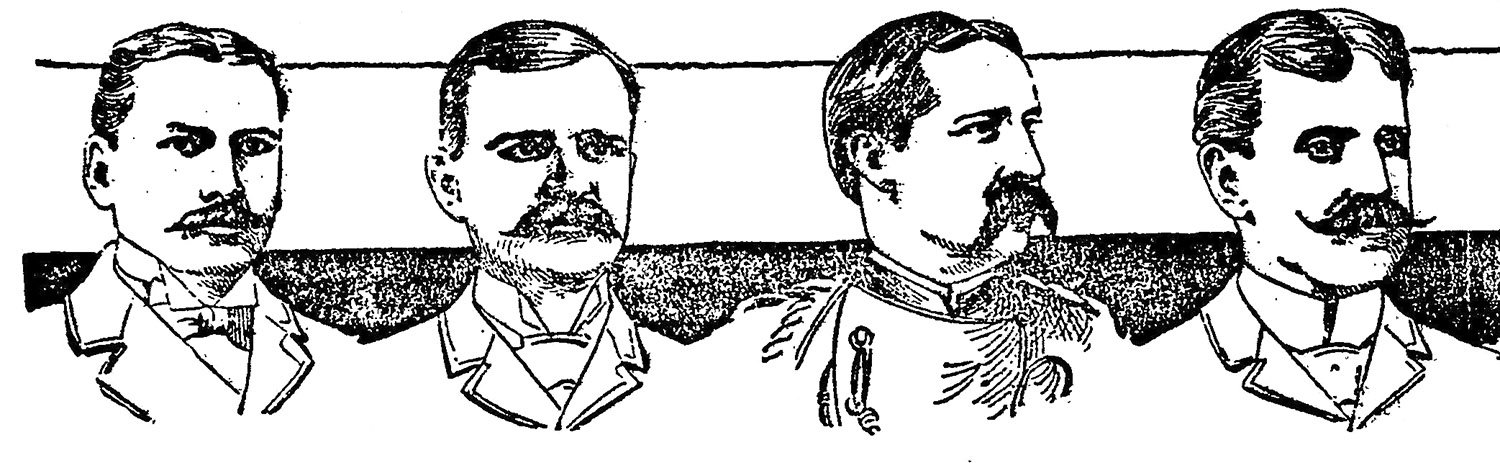
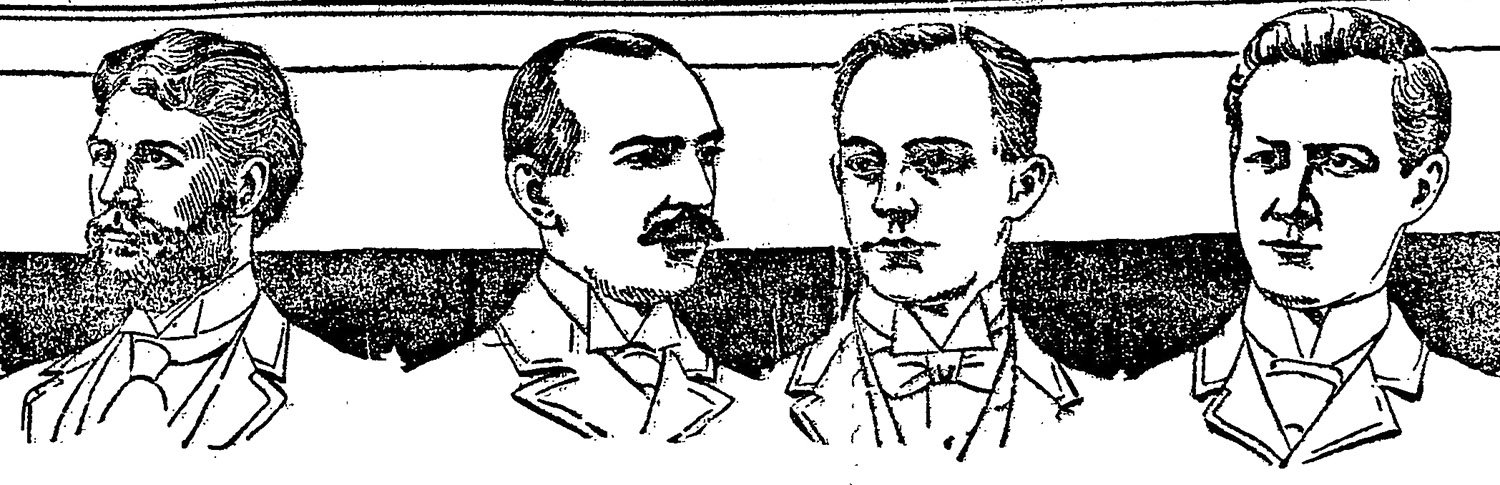
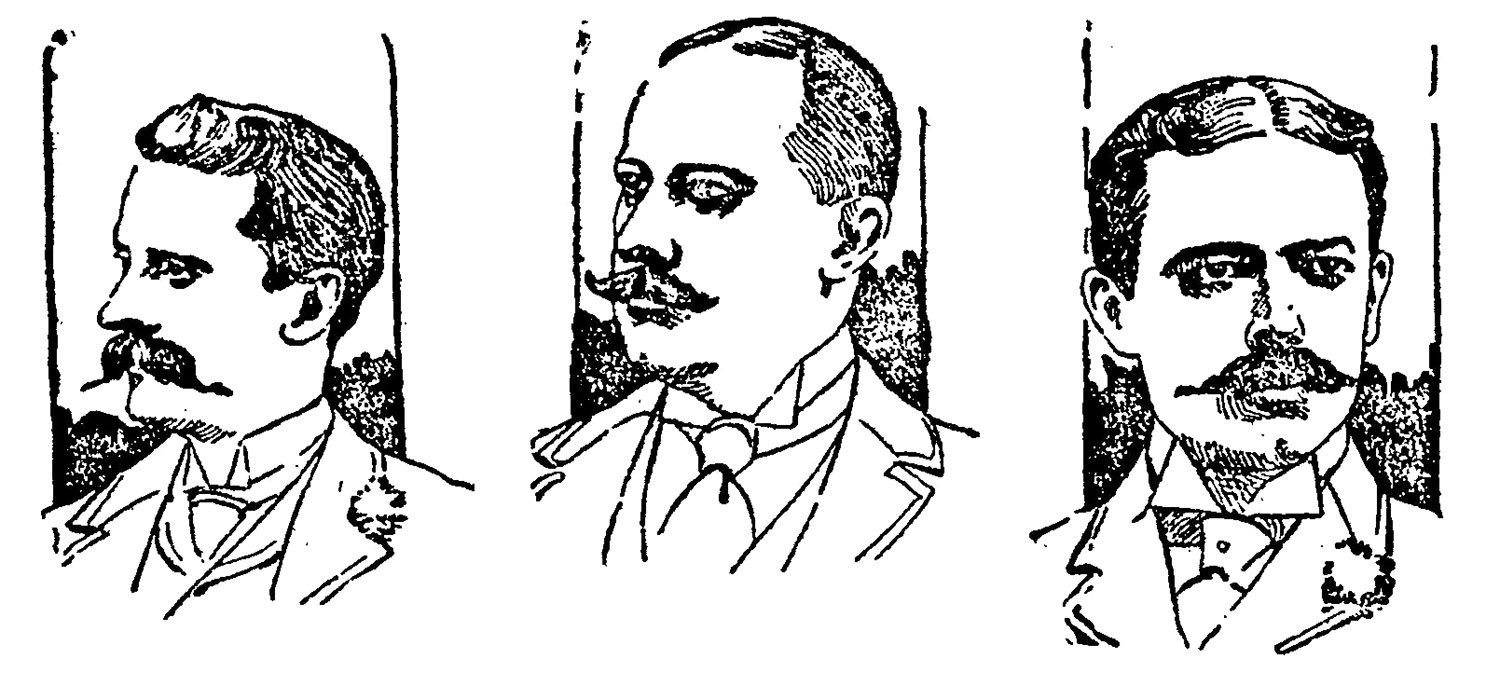
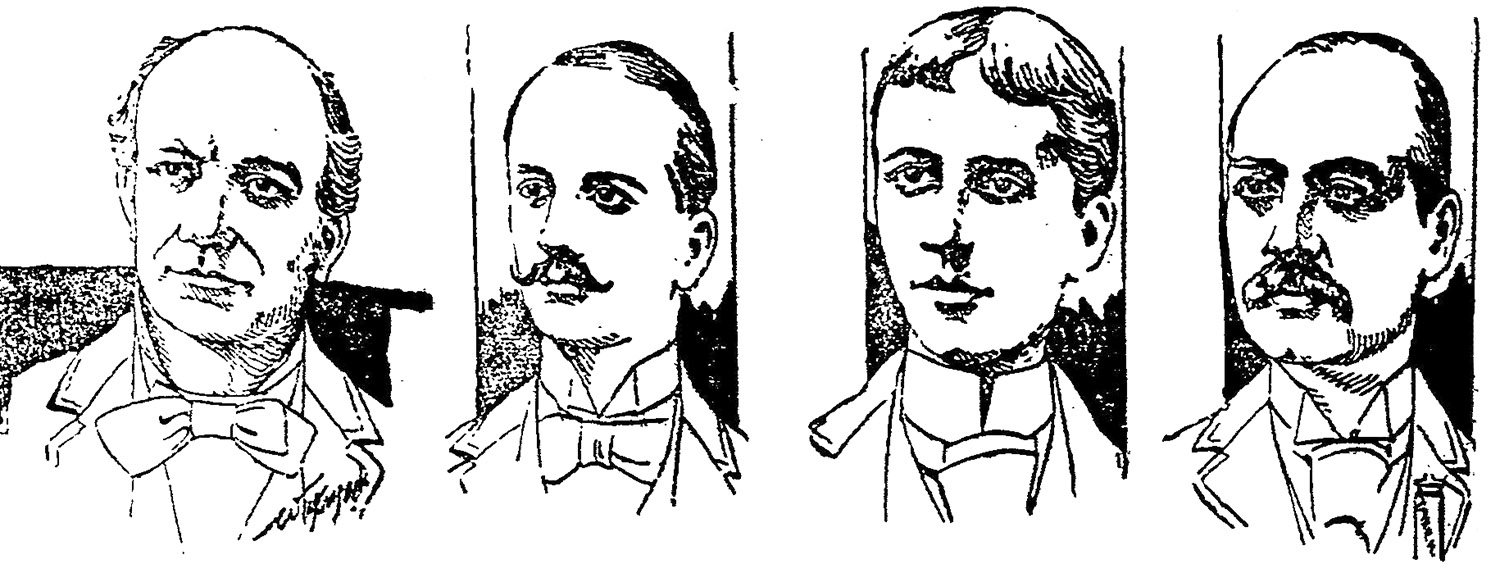
From left to right: Peter Grant, Jim Nutting, Oscar Brown, Lucius McCleskey
The Background
The following article, published in The Atlanta Constitution in 1896, named the city’s well-known “eligible bachelors” of the time—all White, of course—with accompanying illustrations.
The article’s conceit is based on an old Irish tradition called “Bachelor’s Day,” in which women were allowed to propose to men on February 29, a date that occurs only once every four years.
As the article points out, however, the leap year was skipped in 1900, so the next opportunity would have been eight years later, in 1904.
From left to right: Reuben Arnold, J.W. English, Jr., Fulton Coville, John M. Slaton
“The Atlanta maiden with half an eye for a good thing is reveling in the prospect,” the writer says of young ladies proposing to men— albeit in jest.
While restrictive attitudes toward women began loosening in the 1890s, it would have been considered highly improper—and was likely unheard of—for a woman to initiate a romance or marriage, particularly in the patriarchal stronghold of the Deep South.
“The idea of such a thing,” one woman shrieked to the reporter. “A woman never can make any advances to a man. I expect to be just as reserved as ever this year.”
From left to right: Isham Daniel, Thomas C. Erwin, Thos. B. Paine
You have to wonder how many of the men named here were closeted homosexuals, or which ones were frequent visitors to Atlanta’s red-light district. I could certainly hazard some guesses based on the pictures.
It’s also a little odd to see G.L. Norrman included in the list of eligible “young men”: he was 48 at the time and looked every day of it. Sorry, Godfrey.
From left to right: G.L. Norrman, Will H. Black, R.F. Shedden, A.E. Calhoun
This article is an odd, antiquated snapshot of an era whose traditions and values are so far removed from the current age that it’s almost baffling.
The writer (also a woman) frequently describes Atlanta’s “blushing bachelors” as “gallant” and “chivalrous,” and asks if a man is “obligated by chivalry to accept the offer of the first enamored maiden who throws herself at his feet?”
Her parting thought is that “…there are acres of younger men whose thoughts are just ripe for lovemaking.”
…It didn’t mean the same thing back then.
Atlanta’s Attractive Prizes for Leap Year Girls.
Splendid Gallery of Local Bachelors Who are the Legitimate Prey of Our Fair Maidens Who Feel Disposed to Take Advantage of the Year 1896.
Our blushing bachelors are in a state of modest agitation.
The timid ones are keeping themselves close, and the more coquettish and kittenish ones are giving themselves bewitching airs. They suspect the intentions of every pretty girl they meet and not wishing to inflict the pain of refusal not a few of them have had to discourage fair maiden suitors who have shown a decided preference for them.
How can they refuse the dear girls? Does leap year give man woman’s privilege of declining, or is he obligated by chivalry to accept the offer of the first enamored maiden who throws herself at his feet?
These unsettled questions are worrying our Atlanta bachelors and are responsible for much unhappiness among them.
For instance, Jack Slaton, one of the most charming of our local eligible, is in sore perturbation. Being a candidate, how can he refuse the young women? True, women cannot vote, but their influence upon those who do exercise the right of suffrage in this country is not inconsiderable.
Neither is Andy Calhoun enjoying his usual quiet.
“How can a fellow tell a girl that he loves another?” said he. “I wish next year was leap year.”
These gentlemen represent two sample instances of the feeling of unrest among our bachelors. Others are no less disturbed. Conscious of their charms they cannot see how it is possible for them to survive through the year and retain their gallantry. If they would be so fortunate–or unfortunate–as to pull through the year, they would enter upon the coming twelve months with reputations greatly impaired, and they would be cut and tabooed on every side.
The Atlanta maiden with half an eye for a good thing is reveling in the prospect. A fine field is before her. Eligibles of every kind and description are at hand. The bald-headed bachelor who has weathered many seasons and passed through more than one leap year unscathed, and who has never yet been melted into tenderness is plentiful. The younger eligible with less experience but not less invulnerability to women’s charms, but who are not without those engaging charms that make a man valuable in a woman’s eyes is also numerous in this city. Then the younger and fresher ones–the social yearlings–with neither experience nor power of resistance, impressionable youths with an eye for beauty and heart for love–there are armies of these–each waiting for some capturing maiden to come and bear him away. The spectacle must fairly dazzle the eyes of our Atlanta girls. Whole acres of young men, legitimate and desirable prey for pleading and matrimonially inclined young women–what a picture to delight the fancy!
The field is too full of eligibles. Too many of our young men stand as monuments to the philosophy that it is better to live alone than risk the heart in the chances of a modern love affair.
Just a glance at the list:
Fulton Coville, who is bravely and gallantly facing the leap year possibilities.
Judge John Berry, who, too chivalrous to reject a lady, has gone to Florida to escape offers, until his court will convene and occupy all his time.
Jim McKeldin, who never having been refused and never having refused, does not know how to say “no,” and belongs to the first comer.
Isham Daniel, who waits for leap year as a poet waits for spring, in the faith that it will some day bring him a prize.
Thomas B. Paine, who would as leave be captured leap year as any other time.
Andy Calhoun, who is in mortal fear that he will have to say “no” before the month of roses comes and sets him free. He is seriously thinking of putting an explanatory badge on himself to save himself and the young ladies’ embarrassment.
Will Black, who sees no reason why a young woman shouldn’t tell a man so if she loves him.
Hugh McKeldin, who, too modest to press his own claims upon the fairer portion of humanity, fondly hopes that the year will not pass without throwing some appreciative angel in his pathway.
James W. English, Jr., who is such a strong admirer of the other sex that he deems himself fortunate when they smile upon him–leap year or at any other time.
R.F. Shedden, who would like to know how the young woman would put the question.
Hugh Adams, whose popularity during ordinary years is so great as to make him the center of attack during the leap year.
Jim Nutting, who has such a general admiration and regard for the sex that he would gladly accept the first claimant.
Peter Grant, who will either learn to say “no” or be captured early in the year.
G.L. Norrman, who would refuse a lady nothing–not even his hand.
Lieutenant Oscar Brown, who was fighting Indians all through last leap year and is immensely pleased at the thought of what this year may bring him.
And a host of others. There are Lucius McClesky, Percy Adams, Alex Hull, Victor Smith, Preston Arkwright, Jack Slaton, Charles E. Harmon, Thomas C. Erwin, Frank Orme, Howell Peeples and an innumerable company of other attractive young men.
There’s a romance in every name. Each separate man is waiting for the right woman. They are not cynics and they are not certain but that leap year will settle the question for them. Some of them are rather inclined to encourage the leap year girl. Others are less courageous. They are afraid to risk themselves in the hands of a pleading woman.
There can be no prophesying as to the result of the year among our young men and young maidens. Early in the year–before the year begun, in fact–some of the young men put out the report that they were engaged. They industriously caused this rumor to gain circulation, hoping thereby to shut off the applicants for their hands. But the reports have been exploded and the young men stand convicted of base deception, deception in a cause in which there should be nothing but open and frank dealing. The young women have sworn to make the year a bitter one for these young men. The young women know they guilty offenders and they will make the suffer. The men may wreak a deadly vengeance themselves, however, by accepting some lovely suitor and insisting upon carrying the engagement to its culmination.
But on the whole the young men are not averse to leap-year love making. Be it said to their credit, they keenly enjoy the outlook. Most of them have rather put themselves in the way than out of the way of love making. If the young women want to propose they cannot complain that the young men have given them no opportunity. Nearly all of the young men have kept up their calls with the old regularity.
Jim McKeldin says the signs are propitious for a good year for the bachelors.
“I will not furnish any picture for publication,” he stated to The Constitution last week when called on, “because I do not wish it to gain too wide a circulation during leap year.”
The shrewd young women of two states are vieing [sic] with each other in their efforts to capture him. Tennessee and Georgia both want him and he says it’s a toss up between the two states as to chances at present.
Victor Smith is modest. He believes that all things–even proposals–come to him who waits, and while he has not been waiting as long as many of our eligible gentlemen, he hopes that the year will not be entirely unfruitful in a matrimonial way.
Then, there’s Mr. Harman–Charley Harman–whom the ladies all admire. He escaped the past two leap years through some miracle of misfortune which he alone can explain. The young ladies will not let him pass through this without severe trials. They are organized against him and the married ladies unwilling to see such a charming fellow in single harness, are in league with the younger ones. A steady and well-organized siege is to be laid to the heart of the able railroader and good fellow, and there’s not a doubt that he will surrender before the year ends.
And Tom Erwin–best of good fellows. Atlanta young women are too sensible to allow him to escape. If he is too busy running a bank to propose himself during the years that the privilege belongs exclusively to the men, the young ladies will not allow him to evade this year. He’s a marked man among the young ladies. It’s a question which one reaches him first and makes the strongest plea.
“Jim English is lovely,” exclaimed one of Atlanta’s fairest belles last week. “He’s such a good business man above all men. If I make any proposal this year it’ll be to him.”
And so I might go on ad infinitum. There are many that I have not mentioned but who the young ladies have their eyes on. They will not escape and only a lack of space prevents their mention here.
There is quite an array of young men. There are Joe Brown, Otis Smith, George Parrott, Mays Ball, Roger Elliott, Ulrich Atkinson, Harry Stearnes, Will Kiser, Quill Orme, ‘Gene Black, Alf Prescott, Walter Kilpatrick, Dr. Roy and many, many more. These young men, too, are legitimate prey for the leap year girls, and it is safe to prophesy that not a few of them will fall victims to the witchery of some maiden.
And the young women–what do they think about it.
The fairer portion of Atlanta has never yet settled the question whether it is quite the proper thing for them to propose. They say it is tradition, nothing more.
“I don’t suppose any nice girl even proposed to a man,” said one of Atlanta’s fairest maidens the other day. “The idea of such a thing. A woman never can make any advances to a man. I expect to be just as reserved as ever this year.”
And this idea seems all to prevalent. If the women will not exercise their privileges they have only themselves to blame. It is their right to make love to the men this year and the men, like Barkis, are willing. It is the woman’s fault if there is no lovemaking.
To the backward ones I would suggest that this opportunity will not occur again in eight years. The closing of the century cuts the dear girls out of one leap year, and it will be eight long summers before another chance will come to the women to make love to the men. So the young women had best look to their opportunities and improve them.’
A survey of the field here in Atlanta will show at a casual glance that the fair maidens have plenty of excellent timber to choose from. There is a fine army of eligible bachelors, pining and aching for the love and sympathy of some tender soul, and there are acres of younger men whose thoughts are just ripe for lovemaking.1
References
“Atlanta’s Attractive Prizes for Leap Year Girls”. The Atlanta Constitution, March 8, 1896, p. 4. ↩︎
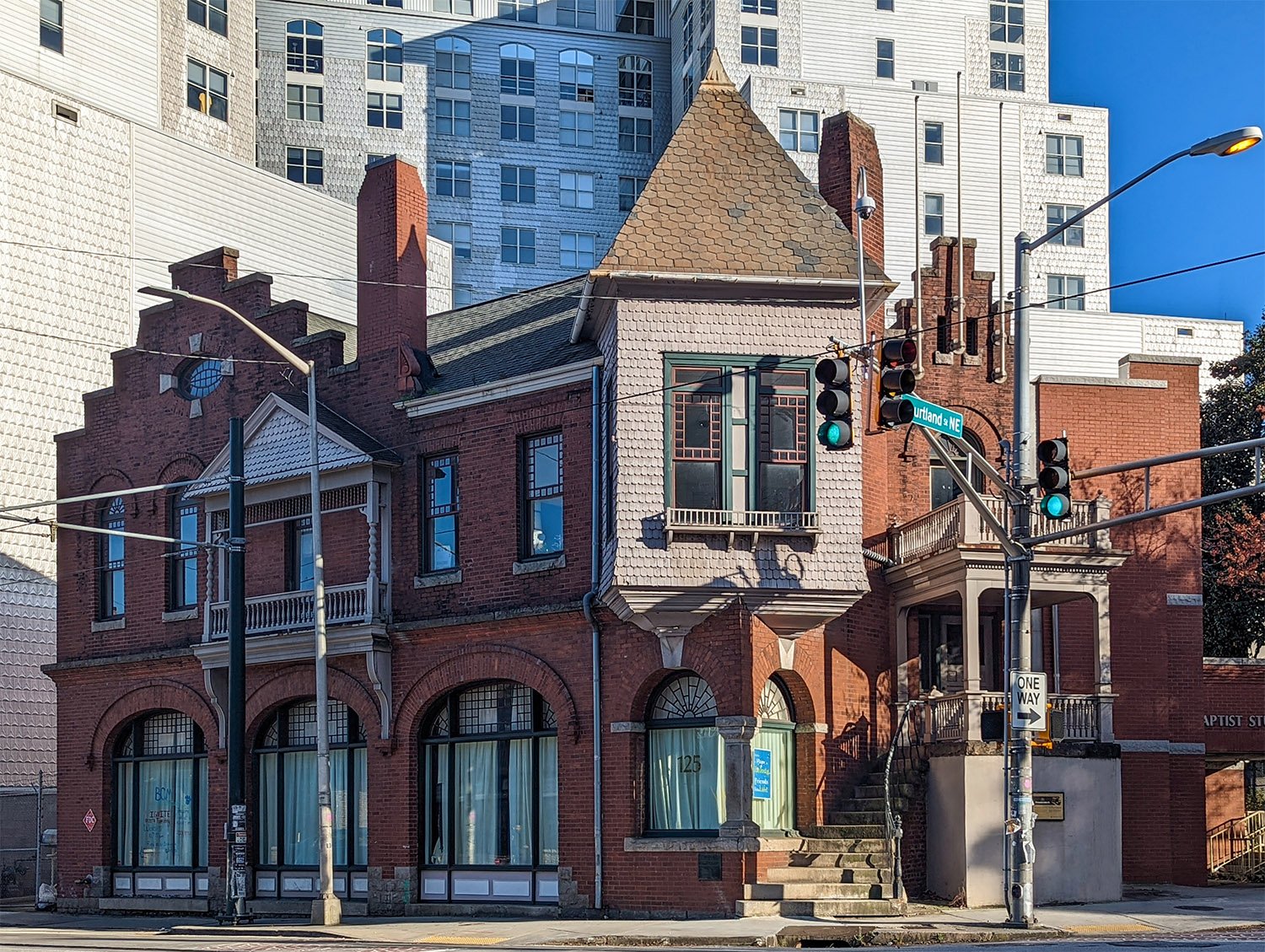
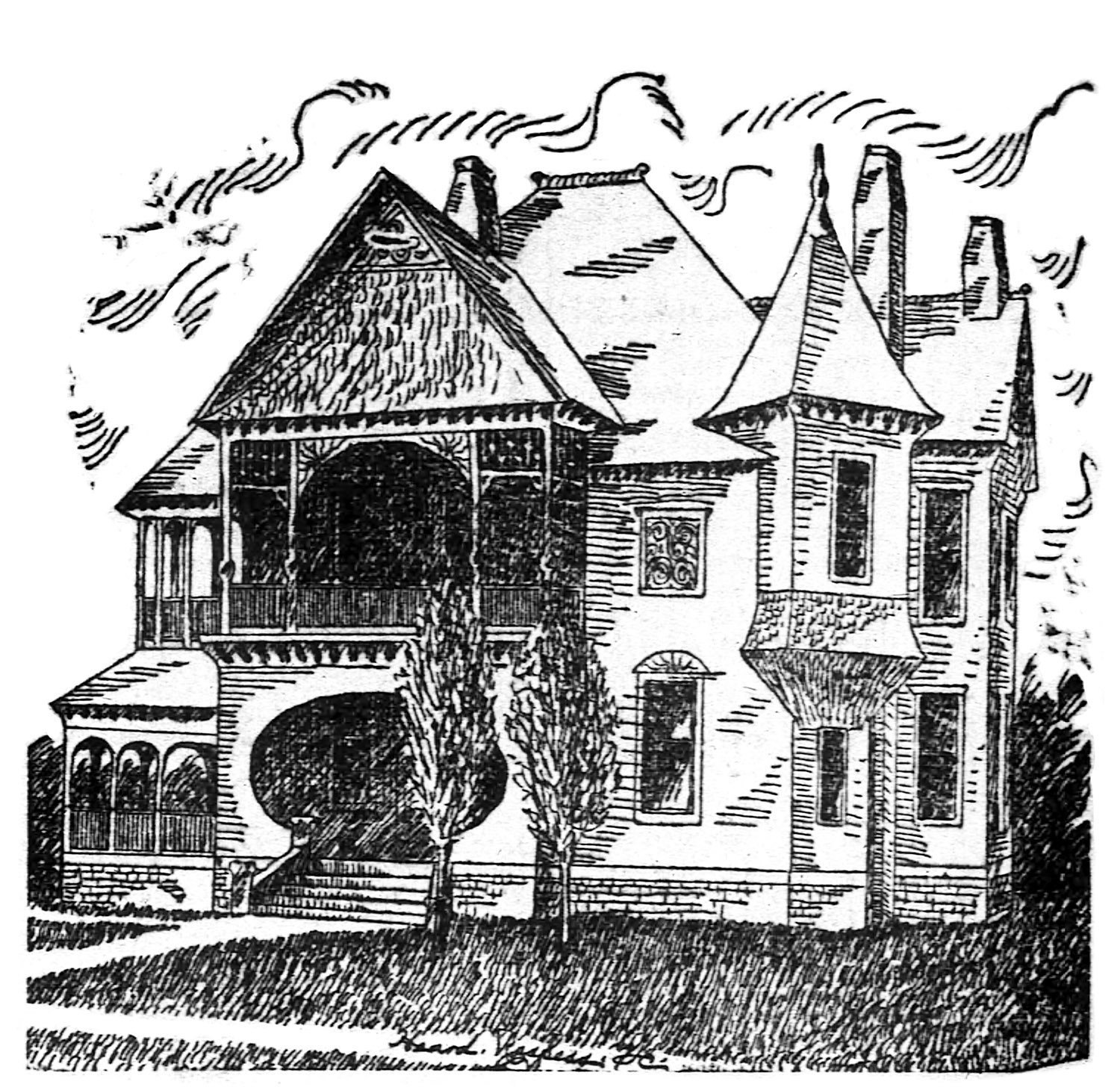
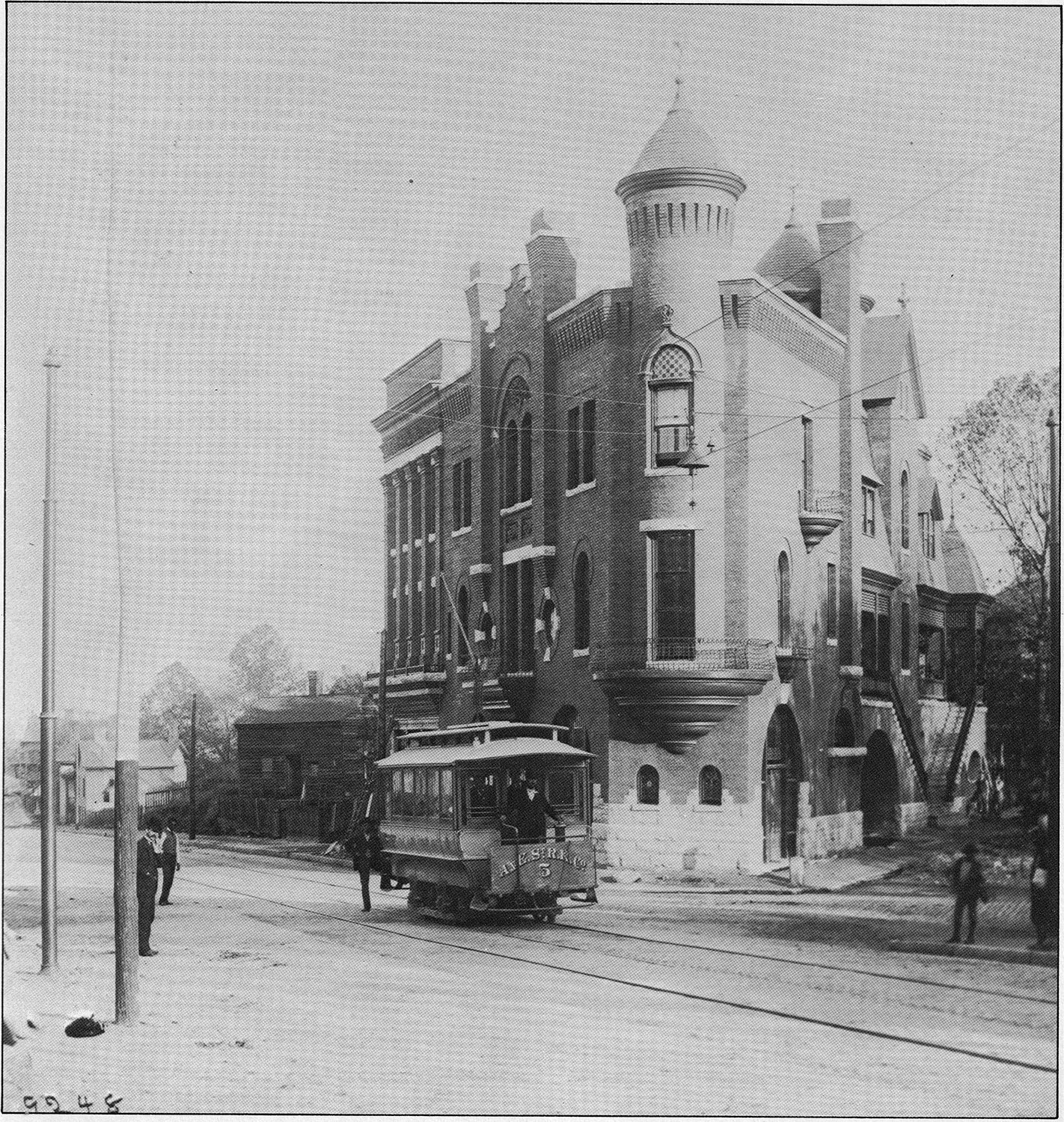
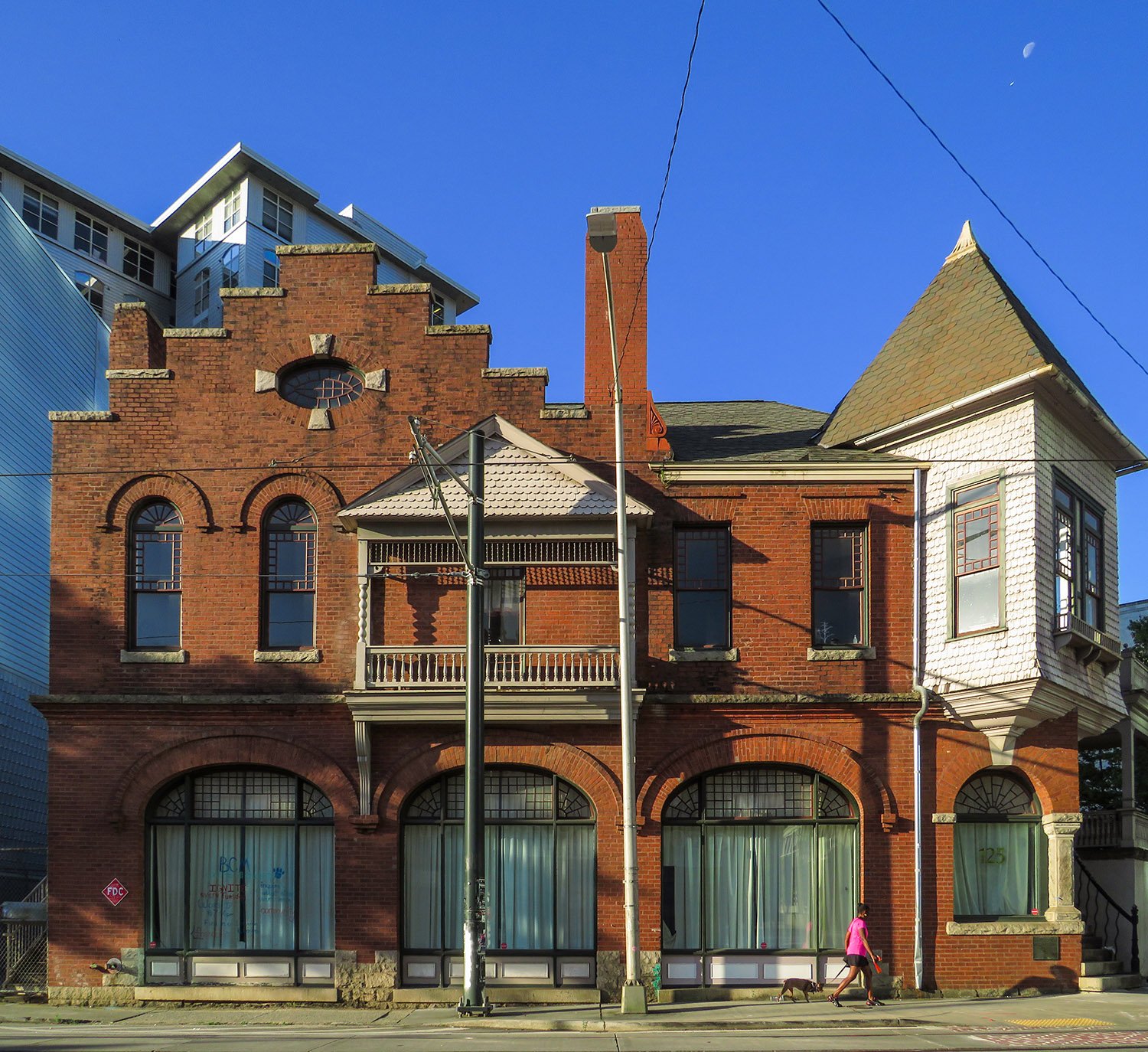
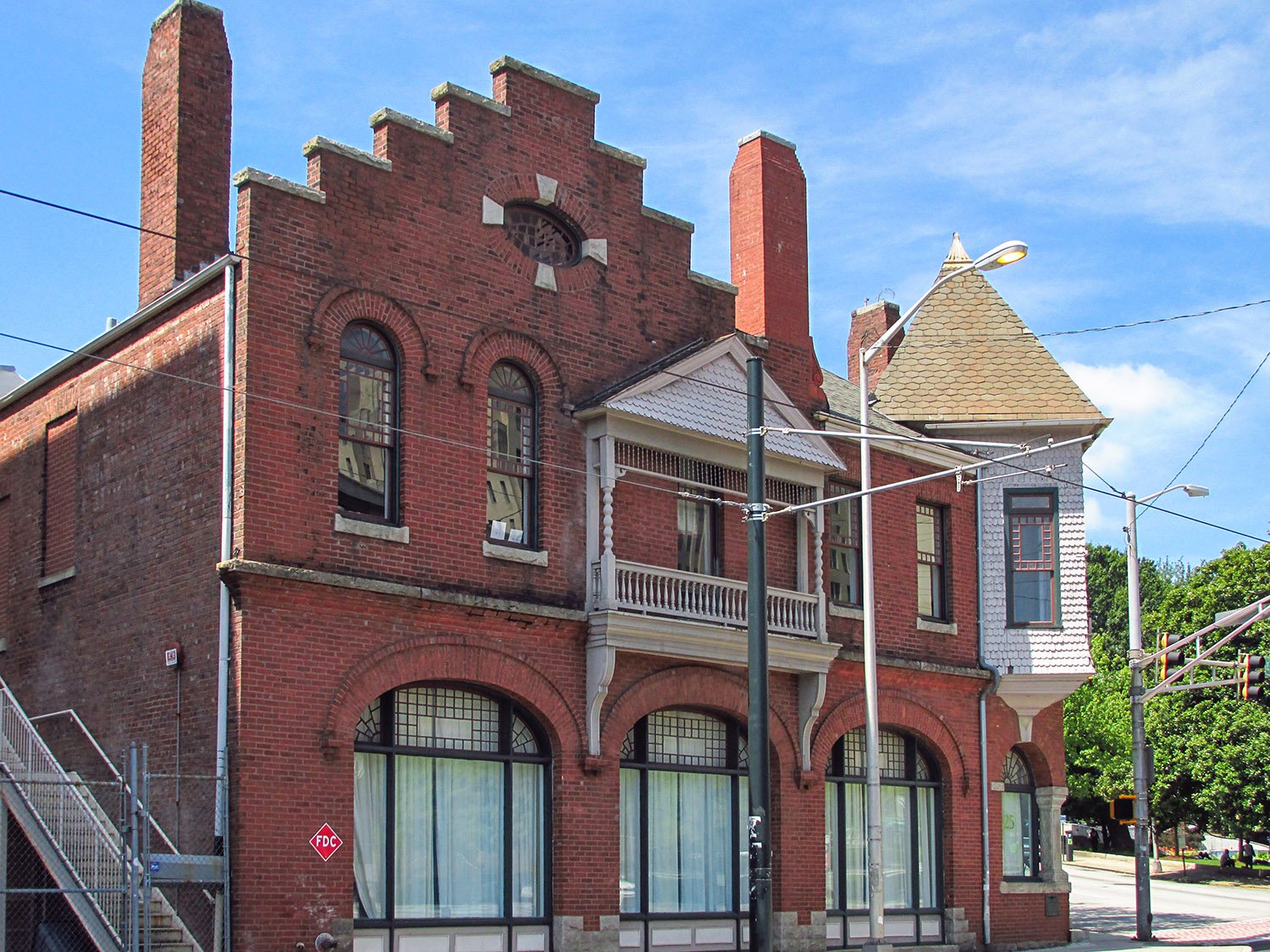
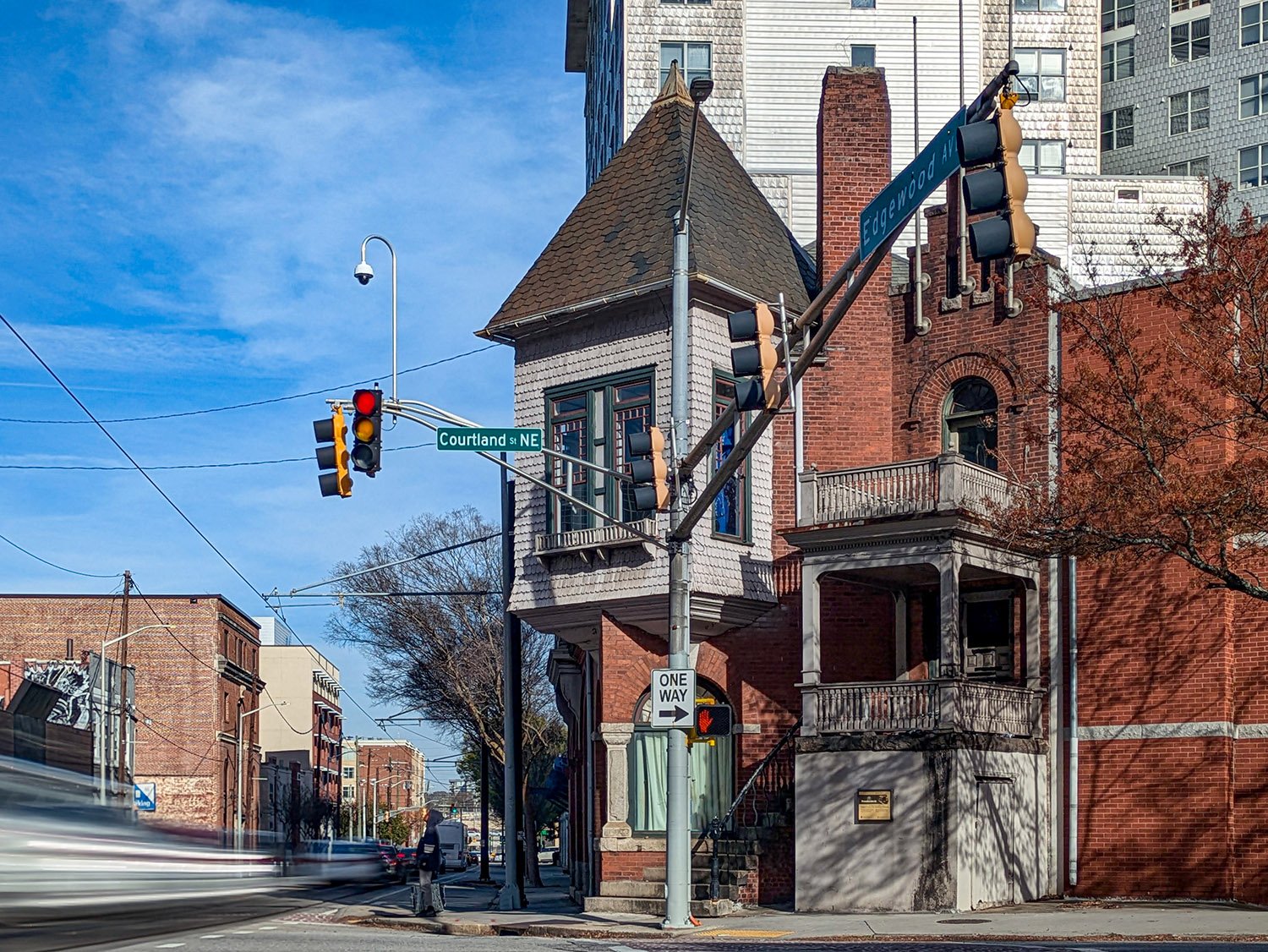
This small commercial building on the southeast corner of Edgewood Avenue and Courtland Street in Downtown Atlanta would have been demolished long ago if it hadn’t served briefly as the first Coca-Cola bottling plant in the city. For that reason, the structure was designatedas a National Historic Landmark in 1983.1
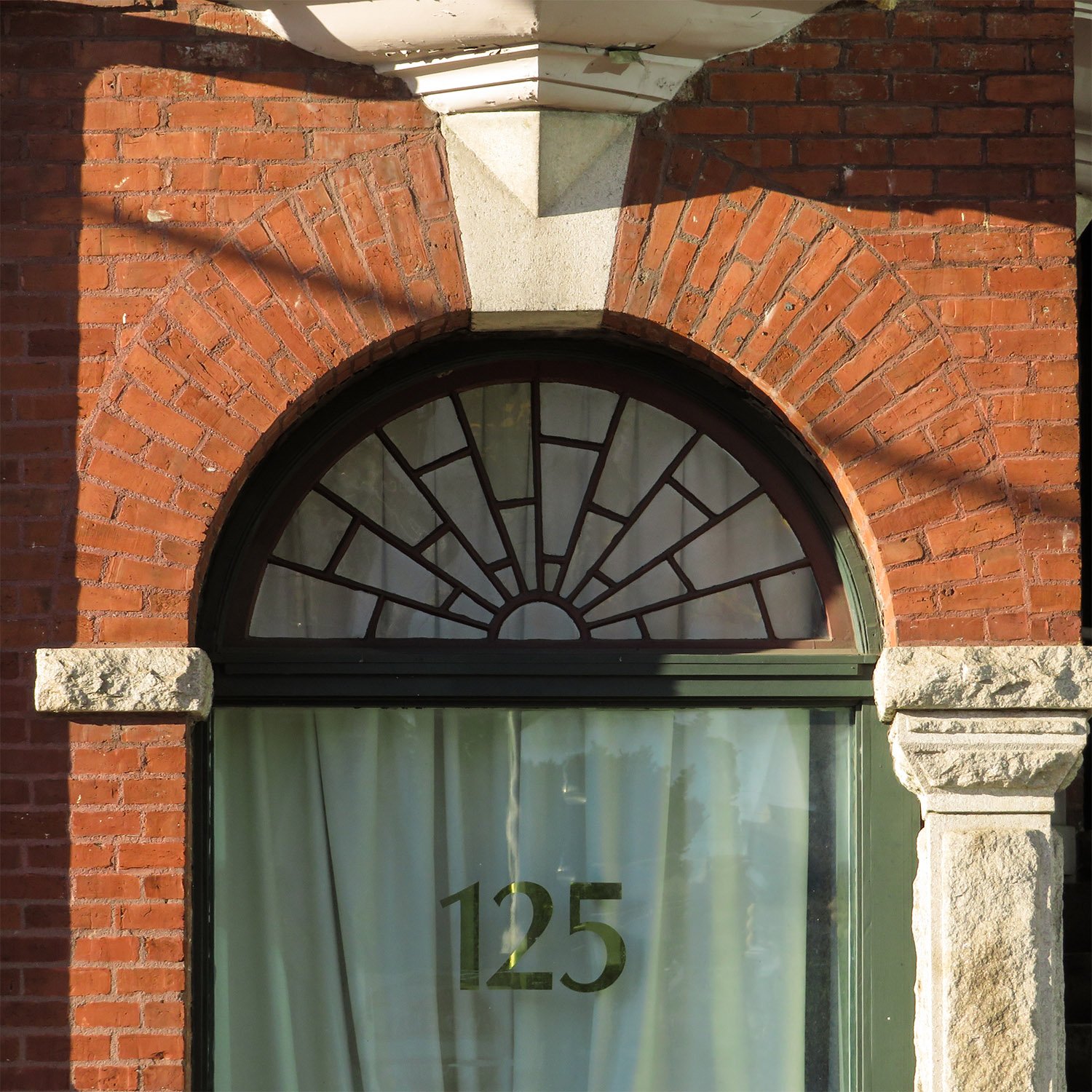
Located at 125 Edgewood Avenue SE, the property is rare in Atlanta for maintaining the same numeric address for its entire existence. Local historians have long claimed the building was constructed in either 1890, 1891, or 1892. However, it’s well documented that the structure was built in 1889 and occupied in January 189023—Atlanta is appallingly ignorant of its own history.
The building consists of two floors over a full basement,45 and is eclectically styled, incorporating Romanesque and Queen Anne elements. The exterior is covered in red brick with light granite trim, and the interior encompasses less than 6,000 square feet. While the architect is not officially known, all evidence indicates that G.L. Norrman was the designer.
Location of 125 Edgewood Avenue
The Design
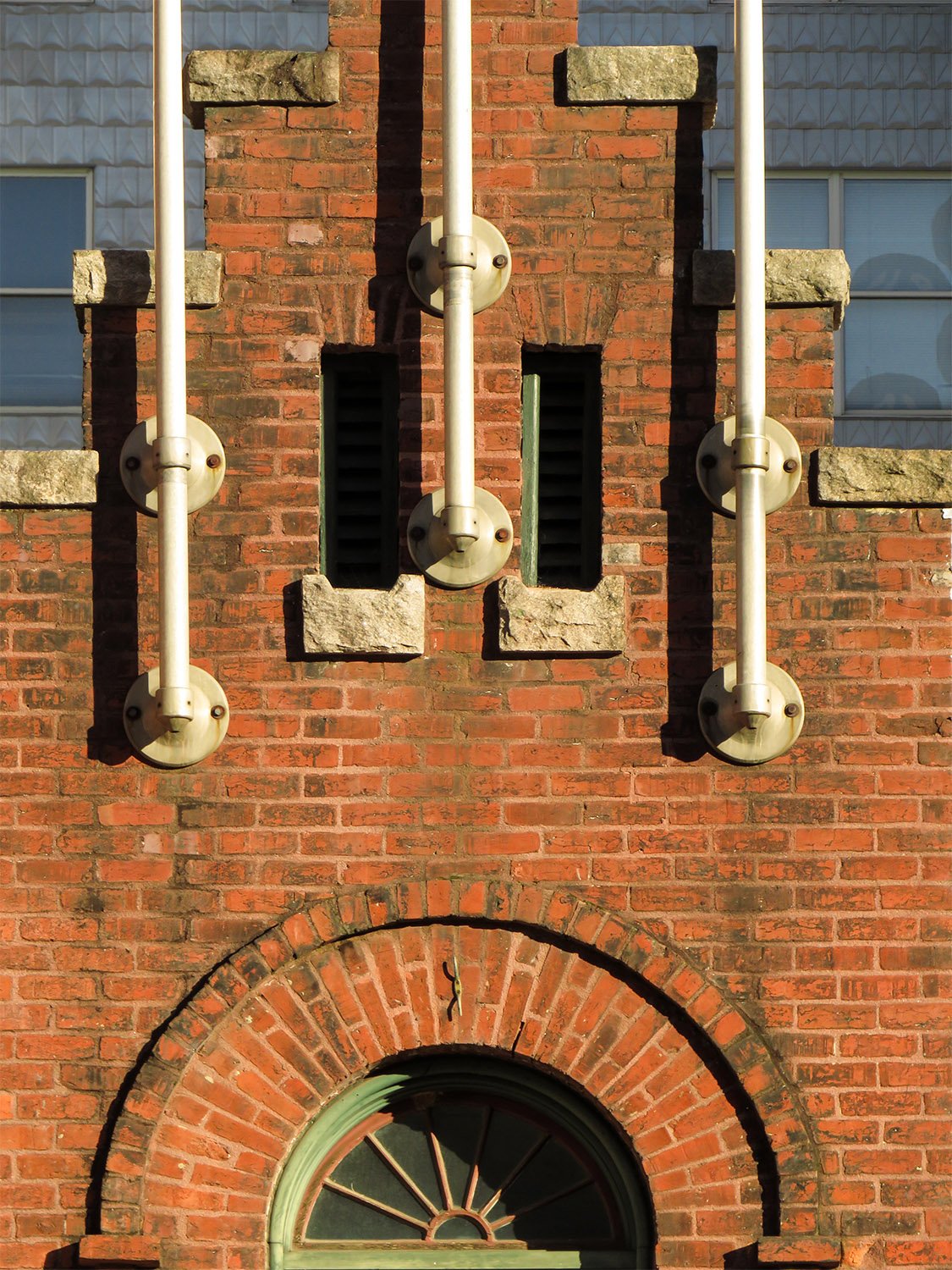
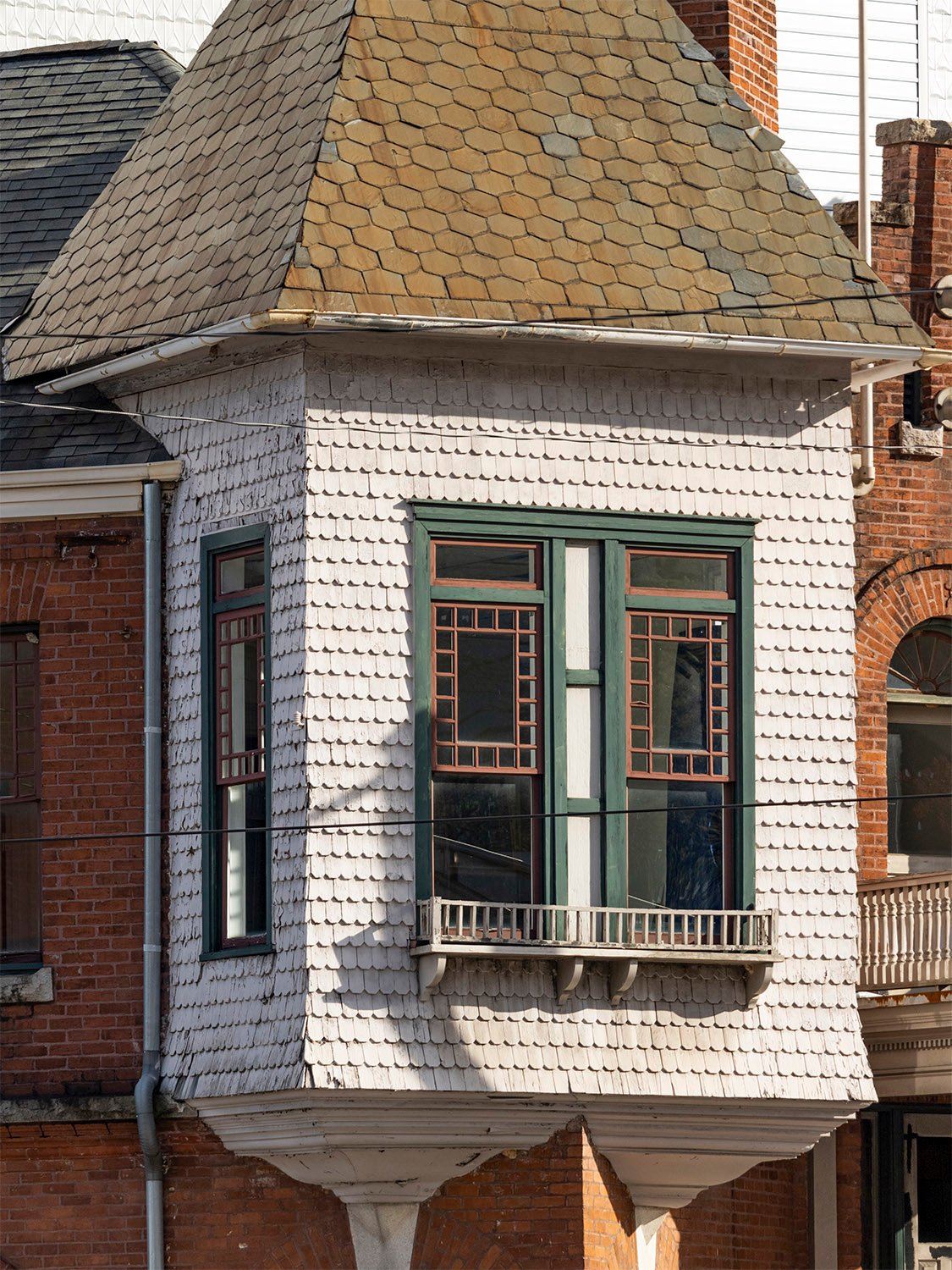
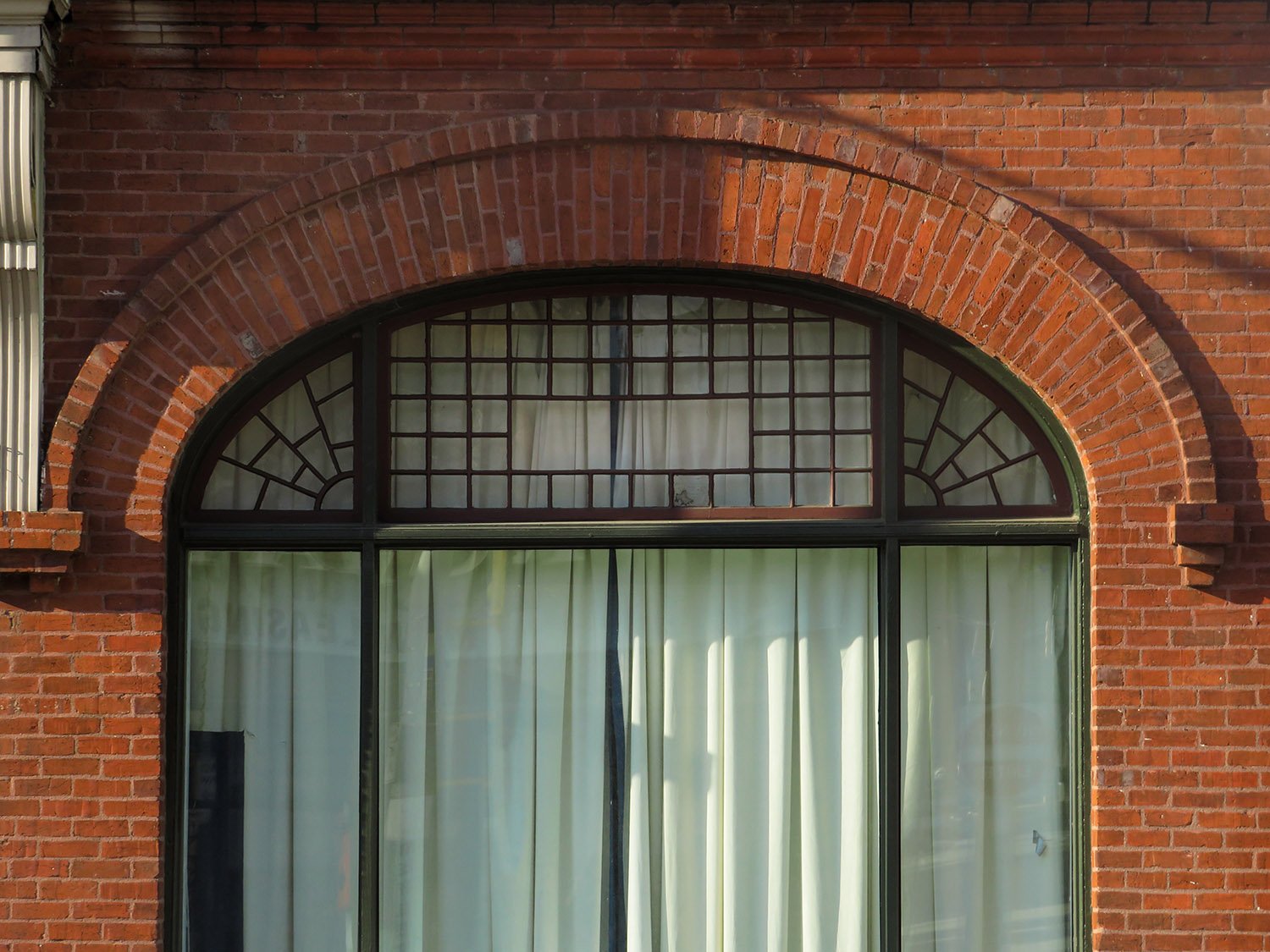
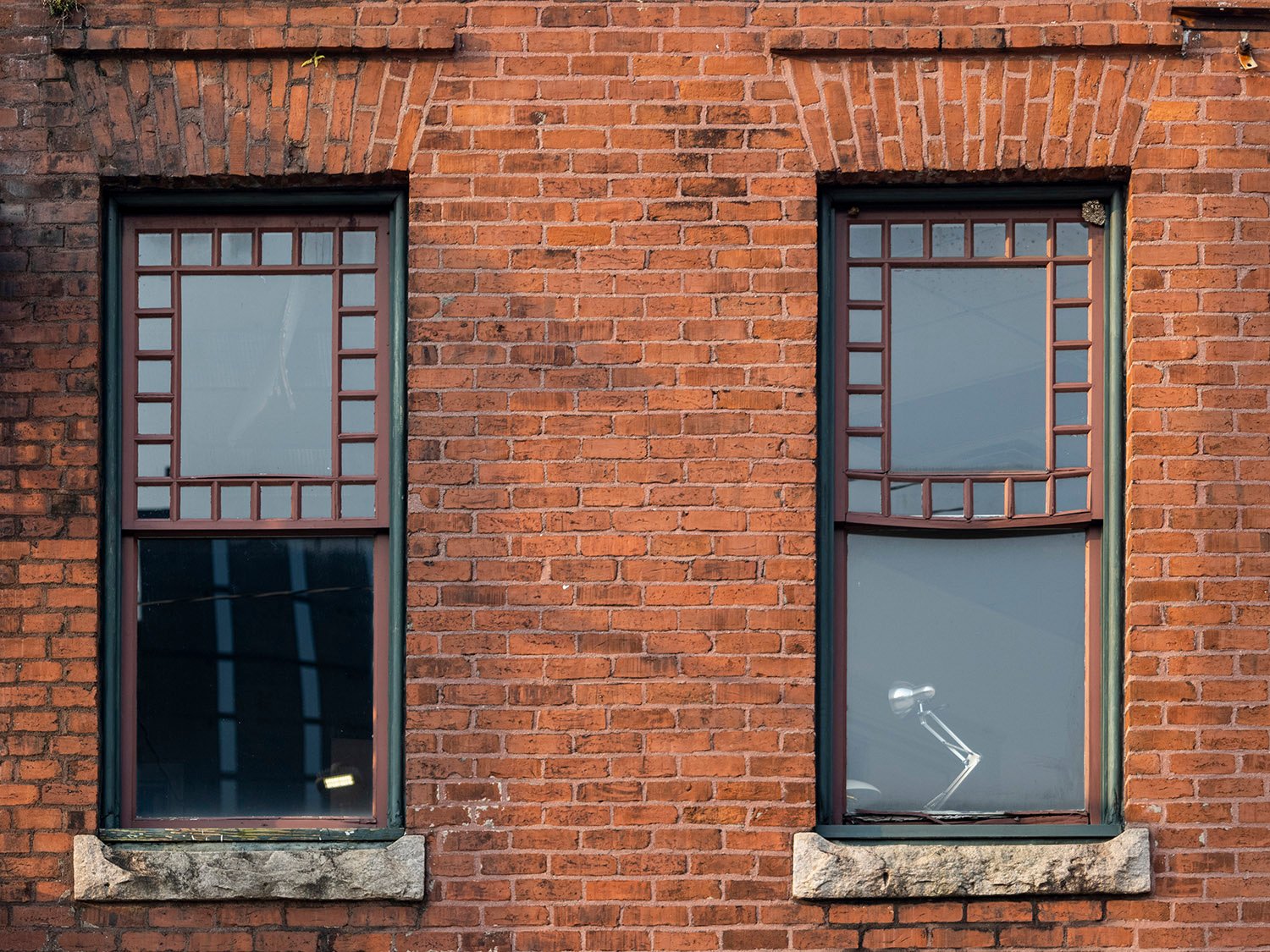
Anyone with an eye for his work would quickly observe that the overall design and massing of 125 Edgewood Avenue are characteristic of Norrman, and many specific elements also suggest his involvement:
The oval window in the north gable was used by Norrman in multiple projects around the same time, including the Samuel McGowan Residence (1889) in Abbeville, South Carolina; the Atlanta & Edgewood Street Railway Shed (1889) and 897Edgewood Avenue (1890) in Inman Park, and most notably, the nearby Exchange Building (1889, pictured below).
Chimneys with tapered tops were a trademark element of Norrman’s in the 1880s and 1890s, and the same chimney designs were used in his 1889 plan for the H.M. Potts Residence (demolished) in Atlanta’s West End.
The central chimney stack on the north side of the building serves as a focal point, visually balancing the elevation’s two incongruent halves—a common technique used by Norrman in his compositions.
A terracotta volute on the central chimney stack is of the same design as those used in Norrman’s designs for the Windsor Hotel (1892) in Americus, Georgia, and the Edgewood Avenue Grammar School (1892) in Atlanta.
The stepped gables on the north and west sides of the building were incorporated in Norrman’s design for the nearby Exchange Building and later used on the Windsor Hotel.
The Romanesque granite column on the northwest corner of the ground floor is a smaller version of one used in Norrman’s design for the Printup Hotel (1888) in Gadsden, Alabama.
The porch on the west side of the building uses the same posts with curved brackets seen in Norrman’s design for the E.A. Hawkins Residence (1890) in Americus, Georgia, and the house at 897 Edgewood Avenue in Inman Park.
The fish-scale shingles used in both the turret and balcony were incorporated into Norrman’s designs for the McGowan Residence, and the T.P. Ivy Residence (1895) in Atlanta, among others.
The most obvious design clue is the square turret on the building’s northwest corner, which is a duplicate of one Norrman used in the H.M. Potts Residence the same year.6
G.L. Norrman. H.M. Potts Residence (1889, demolished). West End, Atlanta.7
The Background
The building at 125 Edgewood Avenue was one of at least three commercial spec structures built along Edgewood Avenue by Joel Hurt’s East Atlanta Land Company—it appears Norrman designed all of them.
Norrman was a preferred architect for Hurt in the late 1880s and early 1890s, with four confirmed projects for Hurt’s companies and family, and four additional structures that can be attributed to him.
He was also one of the opening-day tenants in Hurt’s Equitable Building (completed in 1892 and demolished in 1971), occupying a suite of offices on the top floor.8
The full list of Norrman’s completed projects for the Hurt companies and family follows:
Exchange Building, completed 18899 and demolished 19391011 – intersection of Edgewood Avenue and Gilmer Street, Atlanta [Map]
Commercial Building, completed 1892 and demolished 1939 – 161-165 Edgewood Avenue, SW corner of Edgewood and Piedmont Avenues, Atlanta [Map] – design attributed to Norrman
Three spec houses for the East Atlanta Land Company
Thomas W. Latham Residence, completed 1889 – 804 Edgewood Avenue NE; Inman Park, Atlanta [Map]
Edgewood Avenue Residence, completed 1890 – 897 Edgewood Avenue NE; Inman Park, Atlanta [Map]
Euclid Avenue Residence, completed 1890 – 882 Euclid Avenue, Inman Park, Atlanta [Map]
Atlanta & Edgewood Street Railway Shed, completed 1889 – 963 Edgewood Avenue NE; Inman Park, Atlanta [Map] – design attributed to Norrman
C. D. Hurt Residence, completed 1893 – 36 Delta Place; Inman Park, Atlanta [Map] – design attributed to Norrman
G.L. Norrman. Exchange Building (1889, demolished 1938). Atlanta.12
The Beginning of Edgewood Avenue
The East Atlanta Land Company created Edgewood Avenue to serve as the main artery from Atlanta’s commercial districtto the company’s suburban residential development, Inman Park.13
Joel Hurt was, by all accounts, a miserable bastard. He was also filthy rich, so of course, he felt entitled to receive whatever he wanted, running to the local press—often his sympathetic friends at TheAtlanta Constitution—to whine petulantly when local leaders didn’t bow to his incessant demands.
In 1886, Hurt and his associates began pestering the city council to widen and extend an existing road called Foster Street,1415161718 which ran from Atlanta’s Calhoun Street (later Piedmont Avenue) to the foot of Hurt’s 75-acre property near the Air-Line Railroad (later Belt Line Railroad).
Hurt also wanted the city to extend Foster Street from Calhoun Street westward to Ivy Street (later Peachtree Center Avenue), connecting it with another thoroughfare called Line Street (later Hurt Plaza), ending at the Five Points intersection in the center of the city.
Part of what made the scheme so contentious was that Hurt demandedthe city of Atlanta use eminent domain to remove homes and buildings along the route.
The city council initially rebuffed Hurt’s proposal in June 1886,19 but mysteriously reversed course and approved it in August 1886.2021
Hurt (pictured here) formed the East Atlanta Land Company the following year, with the expressed intention of developing his 75-acre estate and “building a street car line down Foster Street to the Boulevard and on through this suburban property.”22
Hurt’s demands for the project kept growing, and following nearly two years of discussion and revisions, the City of Atlanta and the East Atlanta Land Company finally settled on a deal, the details of which are too tedious to elaborate on.
Ultimately, both parties funded the construction of the street, while Hurt agreed to give ownership to the city, which, in turn, agreed to condemn any property or building along the route that Hurt’s company couldn’t purchase or remove through its own negotiations with property owners.232425262728
As the project was underway, Foster Street was renamed Edgewood Avenue, which the Constitution described as “A Pretty Street with a Pretty Name…And the Men Who Made It Are Also Very Pretty, Etc. Etc.”29 So much for objective journalism.
It should come as no surprise that the area cleared for Edgewood Avenue was largely inhabited by poor and Black residents, a foreshadowing of Atlanta’s widespread clearance of low-income areas for freeways in the 1950s and 60s, the largest act of wholesale destruction in the city’s history (no, it wasn’t Sherman).
For their part, local newspapers had nothing but praise for Hurt’s project. In 1888, the Constitution predictably gushed:
“The objectionable houses that stood on Line Street have been torn down and now Edgewood avenue runs over the very spot where they once stood. The tearing down of these old houses and removing them from the heart of the city is an act the city should thank the company for.”30
“Objectionable houses,” incidentally, was a polite euphemism for brothels.
The Macon Telegraph was a little more explicit, explaining that the brick houses on Line Street “were once notorious resorts”, and that “the inmates [have] been required to move on to Collins Street” (later Courtland Street),31 which became Atlanta’s red-light district.
In a speech from September 1888, Hurt revealed the extent of the clearance:
“We have conducted negotiations with one hundred and thirty two property owners … it has been necessary to condemn the properties of about thirty parties. It has been necessary to move ninety buildings…We have destroyed $70,000 worth of brick and stone buildings alone.”32
Buried in the same speech was the following note:
“There are four properties of private individuals and one of the Atlanta street railroad company, extending slightly in the street, and at these points work has been delayed because of legal difficulties.”33
If Hurt’s description feels conveniently sanitized, a lawsuit filed by a property owner on Edgewood Avenue hints at the true contentious nature of the project.
In September 1888, Dennis F. O’Sullivan sued the East Atlanta Land Company for its seizure and destruction of his property on Edgewood Avenue.34 O’Sullivan alleged that the company:
“took forcible possession of [his] premises, moved two of his houses a considerable distance…and then filled in a strip of land…making it higher than the other part of his property, so that water collects there as in a basin.”35
O’Sullivan additionally sued the City of Atlanta, because he claimed that he was “prevented by interfering from the police.” Cops defending monied interests? Shocker.
By the time Edgewood Avenue formally opened on September 26, 1888,36 the East Atlanta Land Company owned most of the property along the two-mile route, which was accurately described as “the only perfectly straight street of any length in the city,”37 running from Five Points to Inman Park.
Hurt’s Atlanta & Edgewood Street Railroad Company (better known as the A&E) became the first electric street railway in Georgia when it debuted on August 22, 1889.38 Running on double tracks, the “new-fangled street car”39 glided at a cool 18 miles per hour40 along Edgewood Avenue, which city workers finished paving with Belgian block just four days earlier.41
North elevation of 125 Edgewood Avenue, Atlanta
Construction and History
Two weeks before the trolley’s debut, the building permit for 125 Edgewood Avenue was issued in early August 1889, with construction supervised by B.R. Padgett,42 a prolific contractor who in later years marketed himself as an architect (he wasn’t).
Construction on the projectwas swift, with only four months from the date the permit was issued to the building’s opening.
Joel Hurt regularly employed convict labor in his civic projects, and chain gangs loaned by Fulton County were used in the construction of Edgewood Avenue.43 However, Hurt’s nearby Exchange Building was built with paid day labor,44 and 125 Edgewood was likely completed in the same manner.
Even if convicts didn’t work on the building, its distinctive red-clay bricks were almost certainly manufactured by the Chattahoochee Brick Company near Atlanta, which also ran on forced prison labor.45
OpenHouse
Hanye Grocery Companywas 125 Edgewood’s first tenant, opening on the ground floor in January 1890. Advertising itself as “The Prettiest Store and most Complete Grocery House in the South”, and “the finest this side of Baltimore, without any exaggeration”, the store purportedly offered “the finest fancy and domestic goods.”46
The store’s owner was R.M. Hanye, who moved his grocery business from a smaller space on Decatur Street. “I cordially invite the ladies to visit my grocery in the magnificent new brick building…”, Hanye proclaimed in newspaper ads.47
The new store was described as “palatial” by The Atlanta Journal, which noted the “three handsome double entrances” and marveled that:
“A person can enter the door at one end of the store and walk to the other end, taking a good view of the entire stock, and come out at the further entrance on the same street (Edgewood avenue.)”48
Unique in Atlanta, the building was designed so that the business proprietor could reside in the residential space above the store, accessible from Courtland Street via the porch built halfway between the first and second floors.
The concept even received national attention: An 1890 article in Architecture and Building mentioned Norrman’s similar design for the nearby Exchange Building, reporting, “A novel scheme for utilizing a triangular corner lot was evolved by Mr. Norrman, giving two residences over a store.”49
In 125 Edgewood, it appears the second-floor living space consisted of two large rooms and a bathroom, which were quickly divided into one-room apartments, based on a description in an 1896 advertisement.50 According to city directories from 1890 and 1891, Hanye both lived and worked in the building,5152 although future tenants in the retail space lived off-site.
The Hanye Grocery Company was officially incorporated in July 1890,53 with Joel Hurt listed as one of the owners.54A hand-painted sign advertising the grocery is still faintly visible on the east side of the building, although it has long outlasted the business.
R.M. Hanye sign on the east elevation of 125 Edgewood Avenue, Atlanta
In 1891, the Hanye Grocery Company reincorporated itself—without Hanye or Hurt—as the Atlanta Grocery Company,55 which closed by 1893 and was replaced by another grocer, Hosch & Son.56 In 1894, the space was occupied by yet another grocery, operated by Mrs. F.A. Holleran.57
From 1895 to 1898, 125 Edgewood Avenue housed Star Grocery, operated by John M. Waddill,585960 and in 1895, the building also briefly housed a photography studio operated by Hugh Schmidt.6162 In 1899, the building was vacant.63
The essential problem with the building’s location was already apparent in 1890, when Hanye’s ads stressed that his store was “Only three minutes’ ride on the Atlanta and Edgewood electric cars.”64It wassimply too far from the heart of Atlanta’s commercial district, primarily centered three blocks west at the intersection of Whitehall, Decatur, and Marietta Streets.
The East Atlanta Land Company clearly hoped that the building’s tenants would capture the business of trolley riders shuttling to and from Inman Park, yet, despite a wide-scale promotional blitz, early home sales in Inman Park were anemic.
Many of the giant spec houses planned by Atlanta’s leading architects sat empty for years or were rented out before Inman Park was swallowed up by the encroaching city and filled with smaller, cheaper homes in the early 20th century.
Peachtree Street remained the preferred address of the city’s elite for at least 20 years after Inman Park’s opening, and for the old-money families of Atlanta (whatever that meant in a 53-year-old city), the suburb could only have been viewed as a gauche, far-out enclave for the nouveau riche.
Stepped gable and oval window on the north elevation of 125 Edgewood Avenue, Atlanta
The Coca-Cola Year
Beginning circa April 1900,65the Dixie Coca-Cola Bottling Company occupied 125 Edgewood for about eight months, a tenancy so short-lived that the company’s presence isn’t even listed in city directories of the time, although newspaper classified ads confirm it.
One such ad requested: “Three boys about 17 to do rough light work; must be hustlers and willing to work cheap.”66 No comment necessary.
Typical of most Atlanta enterprises, Coca-Cola’s origins are shady and convoluted, but the product debuted in 1886 as a medicinal tonic at Jacobs’ Pharmacy on Marietta Street, and steadily gained regional and national popularity as an alternative to alcohol when Atlanta and other cities began dabbling in prohibition.
“The proper use of it will make a drunken man sober,” the ever-truthful Constitution claimed.67
In 1898, Coca-Cola opened new headquarters one block east of 125 Edgewood Avenue at the intersection of Edgewood and College Street (later named Coca-Cola Place), with a three-story brick building designed by Bruce & Morgan and owned by the East Atlanta Land Company. 68697071
An important distinction is that it wasn’t the Coca-Cola Company that operated from 125 Edgewood Avenue, but an entirely separate bottling company licensed to distribute Coca-Cola’s product in the Southeast.72
Contrary to Coke’s corporate mythmaking, the company has long been a stodgy, insular, and conservative entity with a flair for empty self-promotion—not unlike Atlanta itself.
In Coca-Cola’s early years, the beverage could only be purchased at soda fountains, and the company’s president, Asa G. Candler, didn’t see the value in bottling it.
In 1899, Candler reluctantly agreed to grant bottling rights to J.B. Whitehead and B.F. Thomas, who subsequently established the Dixie Coca-Cola Bottling Company to distribute the soda throughout the Southeast. Starting their first bottling plant in Chattanooga, Tennessee, the men then opened a second plant at 125 Edgewood in Atlanta.73
In 1900, Coca-Cola reportedly sold 51,147 gallons in Atlanta 74—that appears to be separate from the product bottled at 125 Edgewood.
It’s unclear how much of the drink was distributed from the building, but it couldn’t have been substantial. The plant’s output was limited by the size of its marketing territory, which was reportedly measured by how far a mule team could travel in a day.75
By January 1901, the Dixie Coca-Cola plant vacated 125 Edgewood and moved to 35 Ivy Street.76
In truth, Coke’s connection with 125 Edgewood is barely worth noting, but Atlanta has destroyed so much of its history that it has to cling to whatever remnants it can to pretend it has a cultural legacy beyond hype, moneymaking, and oppression.
After Coca-Cola
It’s also unclear when the East Atlanta Land Company sold 125 Edgewood, but with the failure of Inman Park and other projects, coupled with the severe financial depression of the mid-to-late 1890s, the company shed its assets in multiple auctions over the next decade.
Hurt seemingly lost interest in the company as he threw his energy and attention into the management of the Atlanta Consolidated Street Railway Company, formed in 1891 by the merger of the A&E and 5 other street railway companies,7778 as well as the establishment that same year of the bank that would become the Trust Company of Georgia.79
The East Atlanta Land Company auctioned off the bulk of its Edgewood Avenue commercial property in 1903 80818283— including its Exchange Place property and the Coca-Cola headquarters84—followed by a final sale of its remaining assets in 1906.8586878889 It appears that 125 Edgewood was likely sold in 1903, as the property wasn’t listed in the 1906 auction.90
Looking at 125 Edgewood Avenue from the northeast
For the next 20 years, 125 Edgewood hosted a revolving door of short-lived businesses:
In December 1901, a grocery store operated by a man named Charles with the last name of either Charalambedis, Charalambitis,91or Charalampe92 declared bankruptcy, selling a “stock of groceries and fixtures…including counters, show cases, and two soda founts…”93
In May 1902, an entirely different grocery store, operated by I. Goldberg, also declared bankruptcy, selling its stock of “staple and fancy groceries fresh and in good condition, show cases, computing scales, coffee mill and other fixtures usually belonging to such business.”94
In 1903, the space was occupied by L.C. Johnson and Company, described as “retail grocers and restaurant.”95
In 1904, a cigar business owned by Henry I. Palmer was listed at the address.96
In October 1904, a drug store at the location went into receivership, selling off “one stock of drugs and fixtures, stock bottles and show cases, one soda fount and all attachments; also one carbonator, filler, and Crown machine, almost new.” The store was advertised as “A splendid opportunity for a live young man.”97
A drug store operated by George C. Mizell operated at the address in 1905.98
In 1906, the ground floor of the building was occupied by Central Pharmacy, with Virgil A. Jones, a barber, on the second floor.99 In January 1906, a “12-syrup soda fount, A1 condition, cheap, if sold at once”, was advertised at the address.100
Central Pharmacy was still in business in 1907, operated by Henry F. Askam, although the barber shop was replaced by a “pressing club” operated by John R. Thomason.101
By 1908, Central Pharmacy had become the Askam & Alford pharmacy, operated by Askam with N.E. Alford.102 The business was again called Central Pharmacy in 1909.103
In 1909, J.B. Peyton applied for a transfer of a near-beer license at the address from J. Bigler.104 Georgia enacted Prohibition in 1907, so saloons at the time only served non-alcoholic beverages. Ahem.
Peyton’s saloon was still in operation in 1910, occupying the ground floor,105 but Peyton transferred the license to George N. Weekes in December 1910.106 That year, the top-floor apartment was occupied by two men: James Lindsey and William T. Culbreath.107
In 1911, the structure was owned by the Adair family’s local real estate empire, and a building permit was issued for $220 in fire- damage repairs.108
In 1912, the building housed another saloon, operated by William T. Murray.109
From 1913 to 1916, a saloon and pool room operated by Louis Silverman was located in the building,110111112113
In 1917, the Turman & Calhoun real estate company advertised the building’s “clean storeroom”, noting it was “within three minutes of Peachtree.”114
Directories from 1918 list the building space as vacant,115 but by August of that year, the building housed the Atlanta Screen and Cabinet Works, owned by J.W. Biggers.116
In 1920 and 1921, the space was occupied by a dry goods store operated by Harris Roughlin.117118
In 1922, the Mazliah & Cohen dry goods store operated in the space,119 and by 1923, it had been replaced with a dry goods store owned by Joe Horwitz.120
In 1924, a “well-established millinery business” at the address was listed for sale.121
Ground floor window on the northeast corner of 125 Edgewood Avenue, Atlanta
The Briscoe-Morgan Murder-Suicide
The ground-floor space at 125 Edgewood was occupied by B. and B. Clothing Company122—a store owned by J.W. Biggers of Atlanta Screen and Cabinet Works fame—when it was the scene of a murder-suicide in 1924.123124
On August 7, 1924, Fannie Briscoe, a 36-year-old saleswoman at the business, was shot to death by W.R.L. Morgan, a 52-year-old insurance salesman who had reportedly been in a relationship with Briscoe. Immediately after killing her, Morgan turned the pistol around and shot himself in the head, “falling dead at Mrs. Briscoe’s feet.”125
The scene was witnessed by a man repairing his tire outside the store, who reported that Briscoe screamed “Don’t do that! Don’t do that” in the moments before she was killed.126
Newspapers at the time described a typical Atlanta romance: Briscoe had divorced her first husband and was separated from her second when she began a relationship with Morgan. The two “became infatuated with each other” and lived together in an apartment on Pryor Street, but had recently broken up.127
A police investigator explained that “Morgan’s mind seemed to have become somewhat unbalanced following this separation and he became deeply depressed at times.”128
Three letters found in Morgan’s pocket addressed various aspects of post-mortem business, with such tedious and clichéd phrasing as: “I am tired of life. The world has gone back on me.”
Apparently fond of morose prose, Morgan left another letter in his apartment, in which he moaned: “Fannie Briscoe is the cause of it all. I can’t stand the way she has done me. That’s all. Good by to all.”129
Even in death, Atlantans are narcissistic and boring.
Stepped gable on the west elevation of 125 Edgewood Avenue, Atlanta
Crime and Seediness
Early claims that Edgewood Avenue would “attract the rich and fashionable to live upon it”130 were pure Atlanta bullshit, and while never a prestige address, it’s clear that 125 Edgewood quickly became just as seedy and crime-ridden as the properties demolished for the street’s construction a few years earlier.
Recall that in 1889, the “inmates” of the former Line Street had simply been pushed over to Courtland Street, so of course, the location was destined to draw an unsavory element.
In October 1906, the building’s second floor was raided by police for housing an illegal gambling establishment. Twelve men were arrested during a game of poker,131 in which “it was found necessary to break in one or two doors”, according to the Journal, which added: “it is said that Sergeant Lanford swung a sledge hammer like a veteran blacksmith.”132
In 1916, Louis Silverman, the proprietor of a pool room and saloon in the building, was ordered to appear in court for allowing minors to play,133 apparently leading to the closure of the business.
In 1924, less than a month after the murder-suicide, the B. and B. Clothing Company was robbed of a satin dress.134
In 1925, the space housed a store operated by Morris Jackson, which was robbed in an overnight burglary that resulted in the loss of 15 dozen pairs of hosiery, 13 shirts, 12 pairs of suspenders, and 23 necklaces.135
In September 1928, the building was occupied by the Atlas Dry Goods Store when it was robbed again—this time of 20 dresses. 136 Three months later, the store’s “show window” was smashed in during an overnight robbery attempt.137
One 1982 article from the Constitution said of the property: “There is even evidence to suggest that, at one down-at-the-heels juncture in its past, the second story was a house of ill repute disguised as a boarding home.”138 The mind boggles.
Squared corner turret on 125 Edgewood Avenue, Atlanta
Occupants in the Mid-20th Century
Following the 1924 murder-suicide, 125 Edgewood hosted a few more short-lived businesses, although occupancy at the location stabilized through mid-century:
In October 1925, a “candy kitchen, fully equipped” was auctioned off at the location.139
In December 1925, a restaurant owned byO.G. Hughes operated from the building, where his 2-year-old son was severely scalded by a pot of boiling water.140141
The Warner Heating and Plumbing Company operated from the building, circa 1930-1936.142143
A shop selling “sandwiches and drinks, doing nice business” with “low rent” was advertised in the Business Opportunities section of the Constitution classifieds in 1935.144
The Shepard Decorating Company was owned by Virgil W. Shepard, who bought the building from the Metropolitan Life Insurance Company in 1939145 and operated the business there until 1951.146147148
Brown Radio Sales & Service, a Philco dealership, operated at 125 Edgewood from 1952 to 1969.149150
Ground floor window on the north side of 125 Edgewood Avenue, Atlanta
Reassessment
After years of neglect, in 1966151the Atlanta Baptist Association purchased 125 Edgewoodwith plans to demolish it, but when Georgia State University identified the property as one it intended to include in its campus expansion plans, the organization instead kept the building to sell to the university.152
While it waited for Georgia State to purchase the property, in 1969, the association opened theBaptist Student Union at 125 Edgewood.153 You gotta stash the kids somewhere, right?
What started as a temporary tenancy became the building’s longest single occupancy.
Georgia State abandoned its plan to purchase 125 Edgewood circa 1976, when the building was nominated to the National Register of Historic Places.154
In 1978, the building was additionally nominated as a National Historic Landmark. The Historic Preservation Section of Georgia’s Department of Natural Resources submitted the nomination,155 citing the building’s connection to Coca-Cola, although the company’s executives—ensconced in their dreary concrete fortress on North Avenue—apparently wanted nothing to do with it.
“The Coca-Cola people weren’t overjoyed by the nomination,” recalled a historian from the DNR, adding: “Perhaps they didn’t want such a tacky little building representing them.”156
A Coca-Cola spokesperson responded with bland corporate diplomacy: “I don’t think we would object to it being on the list, but I don’t think we would have pushed it either.”157 Is it any wonder Atlanta never saves a damn thing?
Second-story windows on the north elevation of 125 Edgewood Avenue, Atlanta
Constrained by the building’s new historic designations, the Atlanta Baptist Association decided to renovate 125 Edgewood, which by the early 1980s was in a visible state of disrepair but described as “extremely sound.”158
Photographs from 1976 reveal the many alterations that occurred over the years: the building’s brick facade had been painted, the ground-floor corner windows were boarded over, and the original porch and balcony had been removed.
“One of the things about the building is that it looks like it’s not occupied,” explained one of the student union’s leaders. “You can walk by and think no one’s here.”159
A renovation and expansion plan was completed in 1980 by Cavender/Kordys Associates Inc.,160 a small architectural firm from nearby East Point, Georgia.161 The firm estimated the project would cost $475,000, and the association began a fundraising campaign to pay for it.162
By 1987, the renovation had yet to begin, and the building’s structural integrity had so deteriorated that it was reported to the United States Congress as a Threatened National Historic Landmark.163
Renovation and Addition
Renovation of 125 Edgewood began in 1989,164165 including a reconstruction of the porch and a shortened version of the second-floor balcony, using a 1893 photograph of the building as a design reference.166
The building’s windows were replaced with replicas of the originals, the paint was removed from the brick, and the broken chimney stack on the north side was rebuilt.
For the modern addition, a small, unobtrusive wing was attached to the south side of the building, with matching brick and granite stringcourses to complement the historic structure and provide the student union with extra space.
The project restored the building’s outer shell, but no attempt was made to restore the interior to its former appearance—the original stairwells were ripped out, walls were removed to create open meeting space, and the ceilings were covered in standard 1980s acoustic tile.
A 2003 update to the building’s landmark nomination form explained that the renovation, combined with 100 years of previous interior changes, had “altered the original floor plan to where it is virtually indiscernible.”167
Reconstructed porch on the west elevation of 125 Edgewood Avenue, Atlanta
Return to Dilapidation
Atlanta abhors maintaining its historic buildings—or anything, for that matter—and in the early 21st century, 125 Edgewood again shows signs of long-term neglect.
Visible issues in 2025 included a broken window in the corner turret covered with a flimsy tarp, rotting wood on the porch and balcony, missing shingles, and a mysterious dark stain running down the side of the porch. Images from the same year revealed the interior’s dilapidated state, including major flooding in the basement.168
Nearly 60 years after it moved into the building, in December 2024, the BCM at Georgia State (formerly the Baptist Student Union) vacated 125 Edgewood,169 and the property was placed for sale, marketed as ‘one of the last “true” relatively untouched Victorian mansions left downtown’,170 an erroneous statement in every conceivable fashion. The building is currently abandoned.
An Uncertain Future
As of 2026, the future of 125 Edgewood Avenue is anything but certain.
The building’s National Historic Landmark status doesn’t amount to much, as proven by Atlanta University Center’s Stone Hall (1882), also designed by Norrman and designated as a National Historic Landmark.
Abandoned in 2003, Stone Hall has been heavily vandalized and in a state of rapid deterioration for years, with no meaningful funding or plans to return it to viable use.
Because 125 Edgewood is designated as a City of Atlanta Landmark, the structure is well protected from demolition,171 but it’s unclear how the building could be suitably repurposed, as it’s too small and poorly positioned for a public-facing business.
Parking at the location is also limited, and Atlantans value their vehicles more than their lives, so if a business isn’t within feet of cheap, abundant parking, it has no chance of survival.
The building appropriately sits on the route for the revived Atlanta Streetcar, although that, too, doesn’t count for much. Atlanta’s streetcar is an absolute failure of a vanity project that’s barely used by anyone—that is, if it’s even running at all.
The one certainty about the property is this: despite its unique design and historic significance, 125 Edgewood has never been a good place for a business.
Gallery
Looking at 125 Edgewood Avenuefrom the westTurret finial and tapered chimney on the west elevation of 125 Edgewood Avenue, AtlantaTapered chimney on 125 Edgewood Avenue, AtlantaTerracotta volute on the facade of 125 Edgewood Avenue, AtlantaBrick and granite stringcourse on the facade of 125 Edgewood Avenue, AtlantaWindow and fish-scale shingles on the corner turret of 125 Edgewood Avenue, AtlantaSecond-floor arch windows on the facade of 125 Edgewood Avenue, AtlantaFormer ground-floor shop entrance on the facade of 125 Edgewood Avenue, AtlantaSecond-floor arch window and brickwork on the facade of 125 Edgewood Avenue, AtlantaCorbelled brick on the facade of 125 Edgewood Avenue, AtlantaLooking toward the second-floor porch and door on the west elevation of 125 Edgewood Avenue, AtlantaGranite column on the northwest corner of 125 Edgewood Avenue, AtlantaDouble windows on the corner turret of 125 Edgewood Avenue, AtlantaWinding stairs to the porch on the west elevation of 125 Edgewood Avenue, Atlanta
G.L. Norrman. St. Luke’s Cathedral (1883-1906). Atlanta.1
The Background
The following article was published in The Atlanta Constitution in February 1883, and celebrated the completion of one of the first major works by G.L. Norrman (1848-1909) in Atlanta: St. Luke’s Cathedral.
Although the project was credited to the firm of Humphries & Norrman, it appears Norrman was the primary designer—the illustration included with the article is even signed in his handwriting.
St. Luke’s Episcopal Church was founded in 1864, with its first building destroyed by the Union army in the burning of Atlanta.2
The church’s second structure was located at the southeast corner of Spring and Walton Streets,3 but in 1882, the congregation was forced to sell the property after it failed to pay for furnishings from a local store owner, who in turn sued the church and won.4 Pay for your pews, damn it.
Humphries & Norrman began working on plans for a new building in July 1882, although it wasn’t clear if the project would even be executed, as the church also considered moving its old structure to their new property5 at the northeast corner of Houston and Pryor Streets, just off Peachtree Street.
Location of St. Luke’s Cathedral
The plans were ultimately accepted, and the building of the sanctuary was quick—about four months.
Construction had “begun only a few weeks ago” when the cornerstone was laid on October 21, 1882,6 and the first service was held in the church’s basement on Christmas Day 1882,7 although the interiors were completed in February 1883.
The article below describes the building’s interior in exacting detail, but doesn’t say anything about its exterior, which was clad in brick and topped with a 60-foot-high steeple.8 The final cost of the project was just $5,500.9
When the church was constructed, it was barely within the city limits and towered over the one- and two-story homes around it.
Within ten years, Atlanta’s ever-expanding commercial district engulfed the building, and in 1892, when the church lost its cathedral designation to nearby St. Philip’s,10 the St. Luke’s sanctuary was overshadowed by the rise of its new next-door neighbor: DeGive’s Grand Opera House, a seven-story entertainment palace.
One year later, Atlanta’s first “flatiron” structure, the three-story commercial Peck Building, designed by G.L. Norrman, was erected on a sliver of land across from St. Luke’s entrance, blocking the church’s exposure to Peachtree Street.
In 1906, only twenty-three years after the sanctuary’s completion, St. Luke’s sold out to DeGive,11 and the congregation moved further up Peachtree Street into a new building designed by P. Thornton Marye,1213 which still stands.
Georgia-Pacific Center (1982), the former site of St. Luke’s Cathedral. Atlanta.
The old St. Luke’s was demolished in October 1906, with materials from the structure salvaged to build a home on Gilmer Street,14 also long since destroyed. The former church property was replaced with a block of single-level stores15 and is now the site of theGeorgia-Pacific Center in Downtown Atlanta.
After the sanctuary was demolished, “M.S” commented on the church’s move in the “Women and Society” column of The Atlanta Journal:
“In olden times if a congregation wished to build a new church and leave the old building for the new it was looked upon by other congregations with distress and disapproval, and the next thing to giving up their religion itself. This no doubt was only sentiment; but it seems to me if we of this day would cultivate a little more of the true sentiment and love for the pure and beautiful and less of the worldlier sentimental we would live sweeter and more wholesome lives, nearer in a true sense to one another, to nature and to nature’s God.”16
Bitch, please, this is Atlanta.
St. Luke’s Cathedral.
Was yesterday finished and will be opened to-day to the public, and is one of the handsomest churches in the city.
It is located on the corner of Houston and Pryor street, facing Peachtree. The plans were drawn by Messrs. Humphreys and Norman [sic], architects. Under their personal supervision it has been built and they have reason to feel proud of it. The contractors, Messrs. Oliver and Carey, and their foreman, Mr. Edward Edge, deserve much credit for the construction. It is of the old English architecture and is much admired. The interior finish in ceiling is Georgia pine left in its natural color, all other woodwork walnut, except the pews which are ash ends and poplar seats and backs, all upright walls are plastered and will be frescoed by Messrs. Sheriden & Bro.
The chancel furniture is being made the Gate City Planing company and will be finished within two weeks and will consist of the bishop’s chair with canopy, altar table with eight foot arch, credance table, two priest’s chairs, two priest’s stalls and kneeling desks, pulpit, two lectern, all walnut except the credence tables, which is made of Virginia pine from the old Blankford church, near Petersburg, Virginia, built in colonial days over one hundred fifty years ago.
The chancel will be enclosed with a brass rail now being made in New York.
The church will be lighted with gas, having one large 20 light chandelier and 12 two light brackets. The organ will be a very fine one and built by Messrs. Pilcher & Co., of Louisville, Ky. Negotiations are now progressing for its constrnction [sic]. The font will be of Tennessee marble and be located at the intersection of the aisles in the body of the church.
A cathedral is the principal church in a diocese and is where the bishop presides and has a seat is the center of his authority.
Atlanta is the residence of the bishop of Georgia and St. Luke’s has been built for the bishop as the cathedral
Space forbids a more detailed description of the new church. The following sessions will be held therein commencing this morning at seven o’clock and continue during Lent:
The Rev. Mr. Beckwith will preach to-day at 11 o’clock, and the Rev. Mr. Williams this evening at 7:30 o’clock.17
References
Illustration credit: Lyon, Elizabeth A.Atlanta Architecture: The Victorian Heritage, 1837-1918. The Atlanta Historical Society (1976), p. 43. ↩︎
“St. Luke’s Church Now For Sale By Owner”. The Atlanta Journal, July 29, 1906, p. 12. ↩︎
“Auction Sale of Central Property.” The Atlanta Constitution, August 6, 1882, p. 3. ↩︎
“A Verdict Against a Church.” The Atlanta Constitution, June 22, 1882, p. 4. ↩︎
“Real Estate and Industrial Notes.” The Atlanta Constitution, July 28, 1882, p. 7. ↩︎
“The Corner-Stone”. The Atlanta Constitution, October 22, 1882, p. 6. ↩︎
“St. Luke Episcopal Church To Build At Once”. The Atlanta Journal, March 9, 1906, p. 7. ↩︎
Stone Hall, completed 1882 – Morris Brown College, Atlanta University Center [Map]
Edward C. Peters Residence, “Ivy Hall”, completed 1883 – 179 Ponce de Leon Avenue NE, Midtown, Atlanta [Map] [Video: Visit Ivy Hall with Paula Wallace]
Christ Church, built 1886 – 305 East Central Avenue, Valdosta, Georgia [Map]
All Saints Church (altered), built 1886 – Sylvania, Georgia. Moved to 530 Greenwood Street, Barnesville, Georgia [Map]
College Inn (altered), completed 1892 – 2 Epworth Dorm Lane, Duke University, Durham, North Carolina [Map]
Edgewood Avenue Grammar School, completed 1892 – 729 Edgewood Avenue NE, Inman Park, Atlanta [Map]
John W. Wheatley Residence, expansion and renovation (attributed) of home built circa 1860, completed 1892 – 128 Georgia Highway 49 North, Americus, Georgia [Map]
John T. Taylor Residence (attributed), completed 1892 – 603 South Lee Street, Americus, Georgia [Map]
George W. Williams Residence, Jr. expansion and renovation (attributed) of home built circa 1770, completed 1892 – 15 Meeting Street, Charleston, South Carolina [Map]
Fannie Lou Cozart Residence renovation and expansion of home built circa 1825, completed 1893 – 211 East Court Street, Washington, Georgia [Map]
J.C. Simonds Residence, renovation and expansion of home originally built in 1856, completed 1893 – 29 East Battery Street, Charleston, South Carolina [Map] [Related Video:29 E Battery Porcher-Simons house Charleston]
W.B. Chisolm Residence, expansion and renovation (attributed) of home built circa 1816, renovation circa 1893 – 68 Meeting Street, Charleston, South Carolina [Map]
Piedmont Driving Club renovation and expansion (altered), originally designed by Norrman in 1887, built from a home constructed in 1868; partially destroyed by fire on January 11, 1906; rebuilt and expanded to Norrman’s design from 1906-07 – 1215 Piedmont Avenue NE, Atlanta [Map]
Palmer Apartments, completed 1908 – 81 Peachtree Place NE, Midtown, Atlanta [Map]
E.S. Ehney Residence, completed 1908 – 223 15th Street NE, Ansley Park, Atlanta [Map]
Central Methodist Church, transepts and renovation, completed 1910 by Hentz & Reid – 233 North Church Street, Spartanburg, South Carolina [Map]
Lost Works by G.L. Norrman
G.L. Norrman. Spartan Inn (1880-1910). Spartanburg, South Carolina.
The following projects are listed by date of construction. Addresses use original street names, and for Atlanta projects, the addresses use the original numbers designated before the citywide renumbering in 1926.
St. Mary’s Catholic Church, built 1876 – SE corner of Hampton and Lloyd Streets, Greenville, South Carolina. Norrman was the supervising architect, with the design credited to an unnamed Charleston architect. The building was moved in 1885 to 438 West Washington Street, then moved 50 yards in 1902 and rechristened Columbus Hall. The building was later demolished. [Map]
Dr. C.A. Henderson Residence, built 1876 – West McBee Avenue (likely 142 West McBee Avenue), Greenville, South Carolina [Map]
Franklin Coxe, Jr. Residence, built 1876-77 – NE Corner of Tryon and 9th Streets, Charlotte, North Carolina [Map]
John J. Blackwood Residence, built 1876 – Greenville, South Carolina
George P. Wells Residence, built 1877 – Buncombe Street, west of Academy Street, Greenville, South Carolina [Map]
Frank Coxe, Jr. Residence, built 1877-78 – Greenville, South Carolina
L.A. Mills Residence, built May 1879 – Main Street, Spartanburg, South Carolina – later site of Mills Avenue, location of Ella B. Wofford Residence [Map]
Merchant’s Hotel/Spartan Inn, built May 1879 to January 1880; destroyed by fire on April 22, 1910 – Spartanburg, South Carolina [Map]
Spartanburg Opera House, built 1880 and demolished 1907 – Spartanburg, South Carolina [Map]
Methodist Mission Church, “St. Annie’s Chapel”, built 1879-1880 – Church Street; Spartanburg, South Carolina [Map]
Residence at Tryon, North Carolina, building date unknown. Referenced by Norrman on January 14, 1892: “I built … a house on the mountain side at Tryon, S.C. and it was struck by a storm and carried away. The chimney was demolished, but the house rolled down the mountain side without breaking.”
Norrman & Weed. ExpositionRestaurant at International Cotton Exposition (1881). Atlanta.
Norrman & Weed (1880-1881)
John B. Steele Residence, built 1880 and destroyed by fire on December 24, 1890 – 71 White Pine Street, Asheville, North Carolina [Map]
Faith Cottage at Thornwell Orphanage, built 1880-81 – Clinton, South Carolina [Map]
Main Building at International Cotton Exhibition, built in 1881 and destroyed by fire on August 5, 1971 – Oglethorpe Park, Atlanta. W.H.H. Whiting was the architect, and Norman & Weed were supervising architects. [Map]
Art and Industry Pavilion at International Cotton Exhibition, built 1881 and demolished by 1971 – Oglethorpe Park, Atlanta [Map]
Carriage Annex at International Cotton Exhibition, built 1881 and demolished by 1971 – Oglethorpe Park, Atlanta [Map]
Agricultural Annex at International Cotton Exhibition, built 1881 and demolished by 1971 – Oglethorpe Park, Atlanta [Map]
Department of Public Comfort at International Cotton Exhibition, built 1881 and demolished by 1971 – Oglethorpe Park, Atlanta [Map]
Depot at International Cotton Exhibition, built 1881 and demolished by 1971 – Oglethorpe Park, Atlanta [Map]
Exposition Restaurant at International Cotton Exhibition, built 1881 and demolished by 1971 – Oglethorpe Park, Atlanta [Map]
Press Pavilion at International Cotton Exhibition, built 1881 and demolished by 1971 – Oglethorpe Park, Atlanta [Map]
Nathaniel P.T. Finch Residence, built 1881 – 388 Peachtree Street, Atlanta [Map]
Humphries & Norrman. St. Luke’s Cathedral (1883-1906). Atlanta.
Humphries & Norrman (1882-1883)
Daniel N. Speer Residence, built 1882 – 486 Peachtree Street, SW corner of Peachtree and Linden Streets, Atlanta – later site of Emory University Hospital Midtown [Map]
C.T. Swift Residence, built 1882 and likely demolished circa 1928 for the construction of Fox Theatre – 38 Kimball Street, Atlanta. This is not the home C.T. Swift built on Capitol Avenue in 1885, designed by L.B. Wheeler of Atlanta. [Map]
John Milledge Residence, built 1883 – 120 East Peters Street, NE corner of East Peters Street and Capitol Place, Atlanta – later site of 2 Capitol Square SW, Downtown [Map]
Block of 3 tenement houses for John Milledge, built 1882 – Cooper Street, Atlanta
John H. Glover Residence, built 1882 – 135 South Pryor Street, near NW corner of Pryor and East Peters Streets, Atlanta [Map]
William D. Ellis Residence, built 1882 and demolished for construction of Atlanta Expressway (I-75/85) – 193 Washington Street, Atlanta [Map]
Unitarian Church of Our Father, built 1883 – SW corner of Church and Forsyth Streets, Atlanta – later site of Atlanta-Fulton Public Library, Central Library, Downtown [Map]
Paul Romare Residence, built 1883 – 117 South Pryor Street, SW corner of South Pryor and Peters Streets [Map]
James C. Daniel Residence, built 1883 – 196 Gordon Street, West End, Atlanta [Map]
St. Luke’s Cathedral, built 1883 and demolished 1906 – NE corner of North Pryor and Houston Streets, Atlanta – later site of Georgia-Pacific Center, Downtown [Map]
Gate City National Bank, built 1883 – SW corner of Alabama and Pryor Streets, Atlanta – later site of Underground Atlanta, Downtown [Map]
Alteration of front exterior for J.M. High & Company store, built 1883 – 46-48 Whitehall Street, Atlanta [Map]
William Dickson Residence, built 1884 and likely demolished for construction of Atlanta Expressway (I-75/85) – 378 Peachtree Street, Atlanta. William Halsey Wood of New York was the architect; Humphries & Norman were supervising architects.
Charles W. Crankshaw Residence, built 1883 – 119 Nelson Street, Atlanta [Map]
Freeman & Crankshaw jewelry store, built 1883 – 31 Whitehall Street, Atlanta [Map]
Thomas H. Blacknall Residence, built 1883 and likely demolished for construction of East-West Expressway (I-20) – 56 Park Avenue, SE corner of Park and Lee Streets, West End, Atlanta [Map]
Dr. Spalding Residence, built 1883 – 484 Peachtree Street, NE corner of Peachtree and Howard Streets, Atlanta – later site of Emory University Hospital Midtown [Map]
William H. Venable Residence, built 1883 – 19 Forrest Avenue, Atlanta [Map]
Ponce De Leon Springs pavilion, built 1883 and demolished circa 1914 – later site of Sears, Roebuck & Company Building, Atlanta. [Map]
West End Academy, built 1883-4 and demolished circa 1911 – Lee Street, West End, Atlanta [Map]
Dr. E.W. Roach Residence, built 1883 and likely demolished for construction of Atlanta Expressway (I-75/85) – 95 Capitol Avenue, Atlanta [Map]
Horace Bumstead Residence, “Bumstead Cottage”, built 1883 and demolished by 1929 – 169 Vine Street, NE corner of Vine Street and University Place, Atlanta [Map]
William S. Everett Residence, built 1884 – 278 Peachtree Street, Atlanta – later site of Atlanta Expressway (I-75/85) [Map]
Homer G. Barber Residence, built 1884 – 147 Forrest Avenue, Atlanta – later site of Georgia Power Company, Old Fourth Ward [Map]
Robert A. Hemphill Residence, built 1884 – 231 Peachtree Street, Atlanta – later site of SunTrust Plaza, Downtown [Map]
Grant Park pavilion, built 1884 – Grant Park, Atlanta [Map]
William A. Osborn Residence, built 1884 – 194 Jackson Street, Atlanta
Benjamin F. Abbott Residence, built 1884 – 171 Peachtree Street, Atlanta – later site of Peachtree Center, Downtown. Moser & Lind of Atlanta designed plans for this home in 1883, although it appears Norrman was responsible for the completed project. In 1892, Abbott moved to a new home built on “far-out Peachtree”, also likely designed by Norrman. In 1895, he married Josephine Richards, widow of R.H. Richards, moving into the Richards home on Peachtree Street, designed by Norrman in 1885. [Map]
Willard H. Nutting Residence, built 1885 – 45 Merritts Avenue, Atlanta – later site of Renaissance Park, Old Fourth Ward [Map]
Dr. James B. Baird Residence and Office, built 1885 – 105 Capitol Square, Atlanta – later site of Paul D. Coverdell Legislative Office Building, Downtown [Map]
Block of 2 stores for Major Bridwell, built 1885 – 160 and 162 Decatur Street, NE corner of Decatur and Butler Streets, Atlanta [Map]
Herman Franklin Residence, built 1885 and likely demolished for construction of East-West Expressway (I-20) – 239 Rawson Street, Atlanta [Map]
Cheshire Residence, built 1885 – Peachtree Street, Atlanta
Willis F. Peck Residence, built 1885 – 335 Peachtree Street, Atlanta [Map]
R. H. Richards Residence, built 1885 and demolished 1925 for construction of Davison-Paxon-Stokes Company building – 190 Peachtree Street, Atlanta [Map]
Residential duplex for Miles & Horn, built 1885 – SE corner of Walton and Spring Streets, Atlanta – later site of Centennial Tower, Downtown [Map]
Pavilion and landscape improvements, built 1885 – Salt Springs, Georgia – later Lithia Springs, Georgia [Map]
Kennedy Free Library, built 1885 – NE corner of Public Square; Spartanburg, South Carolina [Map]
Atlanta National Bank renovation, 1886 – 15 East Alabama Street, Atlanta – later site of Underground Atlanta, Downtown [Map]
Arthur H. Locke Residence, built 1886 and demolished circa 1911 for the construction of Davis-Fischer Sanatorium – 19 Cox Street, Atlanta [Map]
Willis E. Ragan Residence, built 1886 and demolished circa 1928 for the construction of Fox Theatre – 574 Peachtree Street, Atlanta [Map]
S.H. Phelan Residence, built 1886 – 304 Peachtree Street, Atlanta [Map]
James Akers Residence, built 1886 and likely demolished circa 1919 for United Motors Building – 333 Peachtree Street, Atlanta [Map]
Martin Grahame Residence, “Muirdrum”, built 1886 – Carlier Springs, near Rome, Georgia – later site of Callier Springs Country Club [Map]
Sweet Water Park Hotel, built 1886-87 and destroyed by fire on January 12, 1912 – Lithia Springs, Georgia [Map]
G.L. Norrman. Main Building at Piedmont Exposition (1887). Atlanta.
Main Building at Piedmont Exposition, built 1887 and converted into Transportation Building for Cotton States and International Exposition, 1895; destroyed by fire on November 15, 1901 – Piedmont Park, Atlanta [Map]
Machinery Hallat Piedmont Exposition, built 1887 and demolished February 1895 – Piedmont Park, Atlanta [Map]
Agricultural Hall at Piedmont Exposition, built 1887 and demolished 1895 – Piedmont Park, Atlanta [Map]
Depot at Piedmont Exposition, built 1887 and demolished 1895 – Piedmont Park, Atlanta [Map]
Restaurant at Piedmont Exposition, built 1887 and demolished 1895 – Piedmont Park, Atlanta [Map]
Public Comfort Building at Piedmont Exposition, built 1887 and demolished 1895 – Piedmont Park, Atlanta [Map]
Main Entrance for Piedmont Exposition, built 1887 and demolished February 20, 1895 – Piedmont Park, Atlanta [Map]
Capital City Bank, built 1887 – 23 Whitehall Street, NW corner of Whitehall and Alabama Streets [Map]
J.H. Nunnally Residence, built 1887 and likely demolished for construction of Atlanta Expressway (I-75/85) – 285 Peachtree Street, SE corner of Peachtree and Currier Streets, Atlanta [Map]
Renovation of F.T. Powell Residence, completed 1887 and likely demolished for construction of Atlanta Expressway (I-75/85) – 281 Peachtree Street, Atlanta [Map]
Andrew M. Bergstrom Residence, built 1887 – 114 South Pryor Street, Atlanta [Map]
Bath house, built by 1887 – Salt Springs, Georgia (now Lithia Springs, Georgia)
Jack King Residence, built 1887 – Howard Street (later East 2nd Avenue), Rome, Georgia
George Lewis Residence, built 1887 and demolished before 1963 – 601 East Park Avenue, NE corner of Park Avenue and North Gadsden Street, Tallahassee, Florida [Map]
DeForest Allgood Residence, built 1887 and destroyed by fire on February 24, 1903 – Trion, Georgia
G.L. Norrman. Armstrong Hotel (1888-1934). Rome, Georgia.
Armstrong Hotel, Opened October 1, 1888, and demolished in 1934, with a portion of the ground floor incorporated into the new building – East 2nd Avenue, Rome, Georgia [Map]
Hebrew Orphans’ Home, completed 1889 and demolished circa January 1974 following construction of Our Lady of Perpetual Help Home – 478 Washington Street, Atlanta [Map]
George V. Gress Residence, built 1889-90 – 301 Peachtree Street, Atlanta – later site of SunTrust Plaza, Downtown [Map]
Block of 4 tenement houses for Robert Winship, built 1889 – SE or NE corner (possibly both) of Cain and Ivy Streets, Atlanta [Map]
T.A. Hammond Residence, built 1889 – 151 Spring Street, Atlanta – later site of Atlanta Merchandise Mart, Peachtree Center [Map]
Double tenement house, built 1889 – Forsyth Street, Atlanta
Willard H. Nutting Residence, built 1889 – 51 Merritts Avenue, Atlanta [Map]
J.R. Nutting Residence, built 1889 – 46 Merritts Avenue, Atlanta [Map]
Willis E. Venable Residence, built 1889 — 182 Gordon Street, West End, Atlanta [Map]
Double houses for Jacob Haas, built 1889 — 285-303 Washington Street [Map]
Exchange Building, built 1889 – intersection of Edgewood Avenue and Gilmer Street, Atlanta [Map]
George V. Gress Zoo, built 1889 – Grant Park, Atlanta – later site of Zoo Atlanta [Map]
Dr. W.D. Bizzell Residence, additions built 1889 – 53 Forrest Avenue, Atlanta [Map]
H.M. Potts Residence, built 1889 – 248 Gordon Street, SE corner of Gordon Street and Gordon Place, West End, Atlanta [Map]
Joseph P. Thompson Residence, “Brookwood”, built 1889 and demolished 1907 – Peachtree Street, Atlanta [Map]
G.L. Norrman. Belleveue Hotel (1890-1912). Gadsden, Alabama.
Bellevue Hotel, completed in 1890 and destroyed by fire on June 4, 1912 – Bellevue Drive, Gadsden, Alabama [Map]
Hirsch Building, completed 1890; top 3 floors demolished and lower floors altered 1935 – 40-44 Whitehall Street, Atlanta [Map]
Isaac Liebman Residence, built 1890 – 248 Washington Street, NE corner of Washington and Richardson Streets, Atlanta [Map]
Augustus O.M. Gay Residence, built 1890 and likely demolished for construction of Atlanta Expressway (I-75/85) – 323 Spring Street, NE corner of Spring and West Pine Streets, Atlanta
Harvey Johnson Residence, built 1890 – 730 Peachtree Street, SW corner of Peachtree and 7th Streets, Atlanta [Map]
Edmund Berkeley Residence, built 1890 – 311 West Peachtree Street, SE corner of West Peachtree and 3rd Streets, Atlanta [Map]
James C. Daniel Residence, built 1890 – 196 Gordon Street, West End, Atlanta [Map]
G.L. Norrman. Brady-Miller Feed & Sale Stables (1890-1936). Atlanta.
Alexander King Residence, built 1890 – 894 Peachtree Street, Atlanta [Map]
Residence constructed for Crankshaw & Company, built 1890 – Corner Edgewood Avenue and Jackson Street, likely NE corner lot at 342 Edgewood Avenue, Atlanta [Map]
Jackson Street School, originally built 1859, renovation and addition of new north and south classroom wings designed by Norrman in 1890; demolished May 1914 for construction of Furlow Grammar School – NW corner of South Jackson and College Streets, Americus, Georgia [Map]
Cottage at 36 Powers Street for Porter Brothers and Black, and resided in by John Black, built 1890 – SW corner of Powers and Spring Streets, Atlanta [Map]
Cottage at 38 Powers Street for Porter Brothers and J.R. Black, built 1890 – near SW corner of Powers and Spring Streets, Atlanta [Map]
Cottage at 42 Powers Street for Porter Brothers and J.R. Black, built 1890 – near SW corner of Powers and Spring Streets, Atlanta [Map]
Cottage at 46 Powers Street for Porter Brothers and J.R. Black, built 1890 – near SW corner of Powers and Spring Streets, Atlanta [Map]
Cottage at 48 Powers Street for Porter Brothers and J.R. Black, built 1890 – near SW corner of Powers and Spring Streets, Atlanta [Map]
Cottage at 50 Powers Street for Porter Brothers and J.R. Black, built 1890 – near SW corner of Powers and Spring Streets, Atlanta [Map]
Cottage at 228 Spring Street for Porter Brothers and J.R. Black, built 1890 – near SW corner of Powers and Spring Streets, Atlanta [Map]
Cottage at 232 Spring Street for Porter Brothers and J.R. Black, built 1890 – near SW corner of Powers and Spring Streets, Atlanta [Map]
Guy Louis Winthrop Residence, built 1890 – 610 North Monroe Street, Tallahassee, Florida
William J. Speer Residence, completed 1890 and demolished May 1911 – 544 Peachtree Street, NW corner of Peachtree Street and North Avenue, Atlanta [Map]
James C. Freeman Residence, built 1890 – 759 Peachtree Street, NE corner of Peachtree and 8th Streets, Atlanta [Map]
G.L. Norrman. Duncan Building (1891-1975). Spartanburg, South Carolina.
Latta Park Pavilion, also known as “4 C’s Pavilion” (Charlotte Consolidated Construction Company), opened May 20, 1891, and was demolished in 1911 – Dilworth, Charlotte, North Carolina [Map]
Thompson & Anderson jewelry store interiors, opened October 1, 1891, inside Windsor Hotel and closed March 17, 1893 – 404 Jackson Street, Americus, Georgia [Map]
Hotel Carrolina, built 1891 and demolished 1907 – NE corner of Corcoran and Peabody Streets; Durham, North Carolina [Map]
Duncan Building, built 1891, gutted by fire on March 3, 1975, and demolished in September 1975 – NE corner of Morgan Square and Magnolia Street; Spartanburg, South Carolina [Map]
Dime Savings Bank, building renovated and given a new facade, 1891-92; the structure still exists, but all elements of Norrman’s design have been removed – 280 King Street, Charleston, South Carolina [Map]
St. Mary’s Catholic Church, built in 1892, demolished in February 1961 for a new sanctuary – 332 South Lee Street; Americus, Georgia [Map]
Police station adjoining city hall, completed September 1891 and demolished 1948 – North Lee Street, Americus, Georgia [Map]
College Hall at West Florida Seminary (now Florida State University), built 1891 and demolished 1912 – Tallahassee, Florida [Map]
Ware County Courthouse, built 1891 and demolished 1957 – Waycross, Georgia [Map]
G.L. Norrman. John D. Turner Residence (1892). Atlanta.
Office of G.L. Norrman, built 1892 – Suites 801, 802, and 804, Equitable Building, Atlanta [Map]
Atlanta Police Headquarters, built 1892 and demolished 1959 – 171-179 Decatur Street, Atlanta [Map]
Paul Romare Residence, completed 1892 – 17 East North Avenue, Atlanta – later site of Bank America Plaza, SoNo [Map]
T. Howard Bell Residence, built 1892 – 665 Peachtree Street, NE corner of Peachtree and Fifth Streets, Atlanta [Map]
Renovation of Chamber of Commerce building, 1892 – NE corner of Hunter and Pryor Streets, Atlanta [Map]
Dr. John D. Turner Residence, built 1892 – 50 Cone Street, west corner of Cone and Luckie Streets, Atlanta [Map]
Hebrew Benevolent Congregation, originally built in 1875, renovated according to Norrman design in 1892 – SE corner of South Forsyth and Garnett Streets, Atlanta – later site of Garnett Station, Downtown [Map]
Sumter County Jail, built in 1892 and demolished in 1959 for a parking lot – North Lee Street, Americus, Georgia [Map]
City Hall, built 1893 – SW corner of Tryon and 5th Streets; Charlotte, North Carolina [Map]
Peck Building, built 1893 and demolished 1941 – Intersection of Peachtree, Pryor, and Houston Streets, Atlanta [Map]
G.L. Norrman. Formwalt Street School (1893-1969). Atlanta.
Formwalt Street School, built 1893 and demolished 1969 – NE corner of Formwalt and Eugenia Streets [Map]
Young Men’s Library Association Library, renovation and expansion of existing residential structure in 1893, demolished 1923 – 101 Marietta Street, NW corner of Marietta and Cone Streets, Atlanta – later site of Centennial Tower [Map]
John Silvey & Company Building, built 1893-94 and demolished 1936 for construction of Olympia Building – 6-8 Decatur Street and 5-7 Edgewood Avenue, Atlanta [Map]
Southern Bell Telephone & Telegraph Building, built 1893-94 and demolished 1952 – 78 South Pryor Street, NE corner of Mitchell and Pryor Streets, Atlanta – later site of Fulton County Civil-Criminal Court Building [Map]
Atlanta National Bank, built 1893 – 15 East Alabama Street, Atlanta – later site of Underground Atlanta [Map]
Merchants Bank – existing building remodeled with new facade to Norrman’s design 1893, demolished 1909 for construction of Third National Bank – 45 North Broad Street, Atlanta [Map]
Hugh L. McKee Residence, built 1893 and demolished before 1990 – 701 Piedmont Avenue, SE corner of Piedmont Avenue and 7th Street, Atlanta [Map]
William Alanson Gregg Residence, built 1893 and demolished 1958 for construction of East-West Expressway (I-20) – 176 Capitol Avenue, Atlanta [Map]
E. C. Merry Residence, built 1893 and likely demolished for construction of East-West Expressway (I-20) – 144 Lee Street, West End, Atlanta [Map]
G.L. Norrman. Southern Bell Telephone & Telegraph Building (1894-1952). Illustration by W.L. Stoddart.
Norcross Building, built 1894 and destroyed by fire on December 9, 1902 – 2-4 Marietta Street and 12-20 Peachtree Street, SW corner of Peachtree and Marietta, Atlanta [Map]
R.L. Foreman Residence, built 1894 – 130 Peeples Street, SE corner of Peeples and Oak Streets, West End, Atlanta [Map]
Dr. J.S. Todd Residence, built 1894 – 322 Peachtree Street, Atlanta [Map]
Hotel Jackson – existing office building constructed in 1889, renovated and converted to a hotel in 1895 according to Norrman’s design – NE corner of Pryor and Alabama Streets, Atlanta – later site of Underground Atlanta [Map]
Georgia Manufacturers’ Building at Cotton States and International Exposition, built 1895 and demolished January 18, 1896 – Piedmont Park, Atlanta [Map]
Chinese Village at Cotton States and International Exposition, built 1895 and demolished January 1896 – Piedmont Park, Atlanta [Map]
New York Herald Building at Cotton States and International Exposition, built 1895 and demolished January 1896 – Piedmont Park, Atlanta [Map]
G.L. Norrman. Hebrew Orphans’ Home, original building (right, 1889-1974) and addition (left, 1895-1974). Atlanta.
Hebrew Orphans’ Home addition, built 1895 and demolished circa January 1974 following construction of Our Lady of Perpetual Help Home – 478 Washington Street, Atlanta [Map]
Charles A. Read Residence, built 1895 – 309 West Peachtree Street, near SE Corner of West Peachtree and 3rd Streets, Atlanta [Map]
Preston Arkwright Residence, built 1895 – SW corner of Juniper and 7th Streets, Atlanta [Map]
Preston Arkwright servants’ house, built 1895 – SW corner of Juniper and 7th Streets, Atlanta [Map]
Frederick Wagner Residence, built 1895 – 270 Gordon Street, SE corner of Gordon and Peeples Streets, West End, Atlanta [Map]
St. Julien Ravenel Residence, built 1895 – 159 East North Avenue, SW corner of North Avenue and Myrtle Street [Map]
Virgil O. Hardon Residence, built 1895 – 283 Peachtree Street [Map]
St. Mary’s Chapel, built 1891-96 – SE corner of 3rd Avenue and 17th Street, Columbus, Georgia [Map]
Restaurant at Kimball House Hotel – existing structure renovated according to Norrman’s design in 1896, demolished June 1959 – Block bound by Peachtree, Wall, Lloyd, and Decatur Streets, Atlanta [Map]
W.D. Ellis, Jr. Residence, built 1896 – 46 West North Avenue, Atlanta [Map]
Dr. Logan M. Crichton Residence, built 1896 and demolished before 1959 – 680 Piedmont Avenue, Atlanta [Map]
Grady Hospital Children’s Ward, built 1896-7 and demolished 1959 – North Butler Street, Atlanta [Map]
Joseph H. Leinkauf Residence, built 1896 – 242 West Peachtree Street, Atlanta (later site of Life of Georgia Tower, Midtown) [Map]
Apartment house for Harry English, built 1896 – 70-72 Spring Street, Atlanta [Map]
Jacobs’ Pharmacy, designed in 1896 and demolished in 1930 for the expansion of First National Bank – 6-8 Marietta Street, Atlanta [Map]
Southern Agricultural Works factory expansion, built in 1896 and destroyed by fire on August 29, 1905 – NW corner of Marietta and Jones Streets, Atlanta [Map]
William H. Clark Residence, built 1896 – SW corner of East Main Street and Pine Street, Spartanburg, South Carolina [Map]
George Washington Scott Residence, “Gulf Haven”, built 1896 – NE corner of Osceola and Pierce Avenues, Clearwater Harbor, Florida [Map]
G.L. Norrman. Elkin & Cooper Sanitorium (1897). Atlanta.
Moore & Marsh Building renovation, existing structure built 1881 and designed by Calvin Fay, renovated according to Norrman’s design in 1897, demolished May 1972 for construction of Woodruff Park – NW corner of Edgewood Avenue and Pryor Street, Atlanta [Map]
Markham House Company Block, built 1897 and destroyed by fire on February 21, 1901 – 20 Loyd Street [Map]
Elkin & Cooper Sanitorium, built 1897 and demolished circa 1916 for construction of Southern Express Building – 29 Luckie Street, NE corner of Luckie and Fairlie Streets, Atlanta [Map]
Seamen’s Bethel for Savannah Port Society, built 1897 and demolished 1953 – 301-307 East Saint Julian Street, SW corner of East Saint Julian and Lincoln Streets, Savannah [Map]
Oregon Hotel, built in 1898 and destroyed by fire on March 3, 1912 – Greenwood, South Carolina [Map]
W.E. Hawkins Residence, built 1898 and destroyed by fire on December 10, 1986 – 635 Piedmont Avenue, Atlanta [Map]
Christian Science Church, built 1898-9 – 17 Baker Street, Atlanta [Map]
The Fairfax, apartment building for Dr. Hunter P. Cooper, built 1899 and demolished circa 1925 – 220 Peachtree Street, Atlanta [Map]
Bertha Rich Residence renovation, completed 1899 – 324 South Pryor Street, Atlanta [Map]
Eugene R. Black Residence, built 1899 and demolished circa 1930 for construction of a gas station – 893 Peachtree Street, SE corner of Peachtree and 12th Streets, Atlanta [Map]
James William Thomas Residence, built 1899 and demolished circa 1927 – 568 Spring Street, SW corner of Spring and 5th Streets, Atlanta [Map]
Atlanta Police Barracks, rebuilt in 1899 according to Norrman’s same design from 1892 – Butler Street, Atlanta [Map]
N.P. Pratt Chemical Laboratory, built 1899 and demolished 1926 – 88-90 Auburn Avenue, NW corner of Auburn Avenue and Courtland Street, Atlanta [Map]
G.L. Norrman. Hardman Sanitorium (1899). Harmony Grove (Commerce), Georgia.
Hardman Sanitorium, built 1899 and demolished after 1960 – 57 North Elm Street, SW corner of North Elm Street and Central Avenue, Commerce, Georgia [Map]
Bostwick Hall at North Georgia Agricultural College (later University of North Georgia), built 1900 and destroyed by fire on September 25, 1912 – Dahlonega, Georgia [Map]
Florida Soap Works, built 1900 – Corner of Evergreen Avenue and Eighth Street – Jacksonville, Florida
S.H. Phelan Residence, built 1900 and demolished circa April 1915 for Phelan Apartments – 790 Peachtree Street, SW corner of Peachtree Street and Peachtree Place, Atlanta [Map]
Bienville Hotel, built in 1900 and demolished by 1969 – St. Francis and St. Joseph Streets, Mobile, Alabama [Map]
A.R. Colcord Residence, built 1901 and demolished circa 1949 for the construction of a Sears store – 197 Gordon Street, West End, Atlanta [Map]
Markham House Company Block, rebuilt 1901 after fire on February 21, 1901 destroyed the previous building designed by Norrman in 1897, demolished circa 1946 for construction of Centra Avenue Viaduct – 20 Loyd Street, Atlanta [Map]
G.L. Norrman. Bisbee Building (1902, left) and West Brothers Building (1902-1970, right). Jacksonville Florida.
Leon D. Lewman Residence, built 1901 – 31 Peachtree Place, NW corner of Peachtree Place and Columbia Avenue, Atlanta [Map]
Lewis C. Fletcher Residence, built 1901 – 172 Juniper Street, Atlanta [Map]
Joseph Van Holt Nash Residence, built 1901 and demolished circa 1946 – 524 Spring Street, NW corner of Spring and 4th Streets, Atlanta [Map]
John Moreland Speer Residence, built 1901 and demolished after 1975 for a parking lot – 430 South Pryor Street, SE corner of Pryor and Glenn Street, Atlanta [Map]
Julius Peek business block, built 1901 and demolished circa 1960 for a parking lot – 381-384 Main Street, Cedartown, Georgia [Map]
West Building, built 1901 and demolished circa 1970 for construction of Independent Life Building – 48-56 West Bay Street, SE corner of West Bay and Laura Streets, Jacksonville, Florida [Map]
Baldwin Building, built 1901 and demolished circa 1970 for construction of a parking garage – 11-25 West Bay Street, Jacksonville, Florida [Map]
James L. Munoz Residence, built 1901 and demolished before 1963 – 1101 Riverside Avenue, SW corner of Riverside Avenue and Post Street, Jacksonville, Florida [Map]
Lawrence Haynes Residence, built 1902 and demolished by 1953 – 399 West Duval Street, NE corner of West Duval and Cedar Streets, Jacksonville, Florida [Map]
P. Dell Cassidey Residence, built 1902 and demolished September 1937 – 34 West Church Street, Jacksonville, Florida [Map]
James H. Nunnally Residence, “Woodlawn”, built 1902 and demolished June 1958 for construction of Burke Dowling Adams, Inc. offices – 1470 Peachtree Road, Atlanta [Map]
G.L. Norrman. Graded School (1904). Troy, Alabama.
Milton Dargan Residence, built 1903 and demolished November 1947 – 58 Ponce de Leon Avenue, NW corner of Ponce de Leon and Piedmont Avenues, Atlanta [Map]
Pierce Hall at Emory College (later Emory University), built in 1903 and demolished in 1961 for the construction of the present Pierce Hall – Oxford, Georgia [Map]
Citizens Bank, Liberty Street Branch, built 1903 and demolished circa 1965 for a parking lot – NW corner of Liberty and Montgomery Streets, Savannah, Georgia [Map]
Graded School, built 1903-04 and demolished after 1976 – NW corner of West Walnut and Cherry Streets, Troy, Alabama [Map]
Harvey M. Smith Residence, built 1904 – 278 West Peachtree Street, SW corner of West Peachtree and West Kimball Streets, Atlanta [Map]
Benjamin H. Abrams Residence, built 1904 and demolished after 1973 – 660 Piedmont Avenue, NW corner of Piedmont Avenue and 5th Street, Atlanta [Map]
Residential duplex for Christine and Louise Romare, built 1906 and demolished circa 1946 – 487-89 Spring Street, SE corner of Spring and West 3rd Streets, Atlanta [Map]
Office of G.L. Norrman, completed 1906 – Suites 330 and 331, Candler Building, Atlanta
First Baptist Church, completed 1906 and demolished January 1929 for construction of Regenstein’s store – 209 Peachtree Street, SE corner of Peachtree and Cain Streets, Atlanta [Map]
Norrman & Falkner. James O. Wynn Residence (1908-1958). Atlanta.
Norrman & Falkner (1906-1908)
“The Avalon”, apartment building for E.M. Yow, built 1906 and demolished 1929 for construction of a gas station – 249 West Peachtree Street, SE corner of West Peachtree Street and East North Avenue, Atlanta [Map]
Marion Hotel Annex – built 1907 and destroyed by fire in the Terminal District Conflagration on May 8, 1908 – 55-57 West Mitchell Street, Atlanta [Map]
Double apartment houses for J.T. Hall, Jr., built 1907 – 25-31 West Baker Street, NE corner of Baker and Spring Streets, Atlanta [Map]
Apartment house for Jennie Golden, built 1907 – 174-178 South Pryor Street, NE corner of South Pryor and Brotherton Streets, Atlanta [Map]
Dormitory at North Georgia Agricultural College (now University of North Georgia), built 1907 – Dahlonega, Georgia
Trinity Methodist Church Annex/Atlanta Boys’ Club building, renovation and expansion of former parsonage completed 1907 and demolished December 1912 – SW corner of Whitehall Street and Trinity Avenue, Downtown [Map]
W.M. McKenzie Residence at “Brookwood”, former property of Joseph P. Thompson, built 1908, Atlanta
Commercial building for David Woodward, built 1908 and demolished after 1971 – 262-268 Peters Street, SE corner of Peters Street and Curtis Alley, Atlanta [Map]
James O. Wynn Residence, built 1908 and demolished circa 1958 – 1126 Peachtree Street, Atlanta [Map]
Henry E. Harman Residence, “Mildorella”, built 1909-10 and demolished after 1926 (plans credited to Norrman & Falkner) – Likely located south of Glenwood Avenue opposite East Lake Golf Club, East Lake, Atlanta
G.L. Norrman
John Slaughter Candler Residence, built 1909 and demolished September 1952 for construction of Druid Hills Methodist Church – 850 Ponce de Leon Avenue, NE corner of Ponce de Leon and Moreland Avenues, Atlanta
Norrman, Hentz & Reid (1909-10)
A.G. Rembert Residence, built 1909 – 267 North Church Street, SE corner of North Church and East Charles Streets, Spartanburg, South Carolina [Map]
G.L. Norrman (attributed). C.E. Fleming Residence. Spartanburg, South Carolina.
Lost Works Attributed to G.L. Norrman
Mrs. E. E. Evins Residence, built 1879 – North Liberty Street, Spartanburg, South Carolina. The January 7, 1880, issue of The Spartanburg Herald described this and 2 other recently completed homes as “three of the nicest residences in town”, adding that “They do credit to the architect who drew the plans.” As Norrman was the only architect in Spartanburg at that time, the home was likely of his design. [Map]
Mr. Holtzclaw Residence, built 1879 – North Liberty Street, Spartanburg, South Carolina. The January 7, 1880, issue of The Spartanburg Herald described this and 2 other recently completed homes as “three of the nicest residences in town”, adding that “They do credit to the architect who drew the plans.” As Norrman was the only architect in Spartanburg at that time, the home was likely of his design. [Map]
W.I. Harris Residence, built 1879 – North Liberty Street, Spartanburg, South Carolina. The January 7, 1880, issue of The Spartanburg Herald described this and 2 other recently completed homes as “three of the nicest residences in town”, adding that “They do credit to the architect who drew the plans.” As Norrman was the only architect in Spartanburg at that time, the home was likely of his design. [Map]
G.L. Norrman (attributed). Jesse Cleveland Residence (1882-1938). Spartanburg, South Carolina.
Dr. Jesse Cleveland Residence, built in 1882 and demolished in November 1938 for the construction of Cleveland Junior High School – SW corner of Howard and Franklin Streets, Spartanburg, South Carolina. Jesse Cleveland and his brother, John B. Cleveland, built identical Second Empire-style homes in the 1880s, with the first built by Jesse Cleveland in 1882. Although unconfirmed, the plan for both homes was likely designed by Norrman, based on a strong similarity to the architect’s other works at the time, including Stone Hall in Atlanta, also built in 1882. As additional evidence of Norrman’s involvement, an article in the April 29, 1990, issue of the Spartanburg Herald-Journal stated that the architect of Bon Haven also designed the Cleveland Law Range in Spartanburg — Norrman was almost certainly the designer of that building. [Map]
John B. Cleveland Residence, “Bon Haven”, built 1884 and demolished September 2017 – Church Street, Spartanburg, South Carolina. A duplicate of the earlier home designed for Jesse Cleveland, the home was given an extensive renovation and Neoclassical-style overlay circa 1920. After many years of abandonment, the home was demolished by the Cleveland family in September 2017, despite extensive public efforts to spare the structure. [Map]
C.E. Fleming Residence, built before 1884 – Main Street, Spartanburg, South Carolina. Based on photographs of this residence, its design can be easily attributed to Norrman, based on its similarity to his other home designs in the late 1870s and early 1880s.
Albert H. Twichell Residence, built in 1882 and demolished in 1979 – 235 South Pine Street, Spartanburg, South Carolina. With a prominent central tower and 2-story porch on the front elevation, this rambling Queen Anne-style home appears to have been the forerunner of numerous residential designs by Norrman in the 1880s and 90s, including the T.A. Latham Residence in Atlanta and the R.O. Barksdale Residence in Washington, Georgia. [Map]
T.B. Neal Residence, built 1887 and likely demolished for construction of East-West Expressway (I-20) – 78 Washington Street, SE corner of Washington and Fair Streets, Atlanta. A photograph of this home reveals a strong resemblance to several of Norrman’s residential designs of the 1880s, including the Edward C. Peters Residence in Atlanta and the George A. Noble Residence in Anniston, Alabama. [Map]
Thomas Sumner Lewis Residence, built circa 1889 and destroyed by fire on May 21, 1917 – 246 North Jackson Street, Atlanta. This home can be easily attributed to Norrman based on its characteristic massing and distinct resemblance to other works by the architect; the structure appears to have been destroyed in the Great Atlanta Fire of 1917. [Map]
Andrew P. Thompson Residence, built 1889 and demolished circa 1910 – 76 North Spring Street, Atlanta. The building permit for this home was issued in August 1889, and while its designer is not officially known, based on an aerial photograph of Atlanta circa 1895, the structure appeared very similar to other Norrman homes from the time, and included the distinctive round tower the architect incorporated in designs such as the W.W Duncan Residence in Spartanburg, South Carolina; and the E.B. Hawkins Residence and Windsor Hotel in Americus, Georgia. [Map]
John S. Paden Residence, built in 1891 and demolished in the 1960s – 906 Forrest Avenue, SW corner of Forrest Avenue and 9th Street, Gadsden, Alabama. This handsome Colonial Revival-style home was likely one of 2 houses Norrman reportedly designed in Gadsden circa 1890. [Additional image] [Map]
T.S. Kyle Residence, building date unknown and demolished in the 1960s – 834 Forrest Avenue, SE corner of Forrest Avenue and 9th Street, Gadsden, Alabama. Built across the street from the John S. Paden Residence, this Queen Anne-style home was likely one of 2 houses Norrman reportedly designed in Gadsden circa 1890. [Additional image] [Map]
G.L. Norrman (attributed). Dexter E. Converse Residence (1891), Spartanburg, South Carolina.
Dexter E. Converse Residence, completed March 1891. This elaborate Queen Anne-style home included several distinctive features of a Norrman design. Converse was also the brother-in-law of A.H. Twichell, likely a former client of Norrman’s.
Max Kutz Residence, built 1892 and demolished circa 1958 – 245 Washington Street, Atlanta. This home was built for a leading Jewish merchant who also served on the board of directors for the Hebrew Orphans’ Home, which Norrman designed. Despite its unusual Gothic inspiration, the striking residence had the unmistakable massing of a Norrman design. The home was demolished for the construction of the 106-acre Capitol Avenue Interchange (now I-75/85/20 Interchange). [Map]
Commercial building for East Atlanta Land Company, built 1892 and demolished 1939 – 161-165 Edgewood Avenue, SW corner of Edgewood Avenue and Piedmont Avenue, Atlanta. This was one of at least 3 speculative commercial buildings constructed by the East Atlanta Land Company along Edgewood Avenue — Norrman was the confirmed designer for one (Exchange Building), and likely designed the other two, based on their similarity to his other works from the time. First occupied by the Klouse & Cheny Meat Market, this 3-story building was demolished for the construction of Hurt Park. [Map]
G.L. Norrman (attributed). Benjamin H. Wilson Residence (1892-1952). Spartanburg, South Carolina.
Benjamin H. Wilson Residence, built 1892 and demolished 1952 – 570 East Main Street, NW corner of East Main Street and North Fairview Avenue, Spartanburg, South Carolina. This home was built for B.H. Wilson — the president of Converse College — on land that adjoined the college property. The home’s massing and Moorish-inspired design clearly indicate Norrman’s involvement. The home was later owned for many years by J.H. Sloan, a local industrialist. [Map]
Benjamin F. Abbott Residence, built 1892 — Peachtree Road, Atlanta. In October 1891, Abbott sold his existing home on Peachtree Street — designed by Norrman in 1884 — to Dr. W.S. Elkin, who would later become a client of Norrman’s. Abbott built a new “country home” in the English View area of Peachtree Road, close to the Joseph P. Thompson Residence, also designed by Norrman. The second Abbott home was completed in September 1891, and a photograph of the structure suggests that Norrman was likely its designer.
U.S. Army Headquarters, Atlanta. 1904 alteration to Leyden House, built in 1858 and designed by John Beutell – 124 Peachtree Street, Atlanta. This landmark 2-story Greek Revival mansion was built for H.H. Tarver in 1858 and notably served as the Union Army’s headquarters during its occupation of Atlanta in 1864. The structure was converted into a boarding house in the 1870s and was substantially rebuilt after being gutted by fire in February 1885. Norrman himself rented a room in the home circa 1894-95. The December 25, 1903, issue of The Atlanta Constitution reported that Willis R. Biggers, “with J.R. Norman, architect”, was in charge of renovating and expanding the home for its temporary use by the United States Army’s Department of the Gulf. Biggers had worked as a draughtsman for Norrman in 1893 and 1894 and was employed by multiple Atlanta architects before establishing a solo career in the 20th century. Assuming “J.R. Norman” refers to G.L. Norrman, it appears Biggers was once again working for Norrman circa 1903-04. The renovation of the Leyden House included the conversion of the front rooms to offices, the addition of a private bathroom in each bedroom, carpeting, tiling, and painting. The renovation was completed in January 1904, and the Department of the Gulf occupied the building until February 1906. The home was demolished in 1914. [Map]
G.L. Norrman. Dougherty County Courthouse (1892, unbuilt). Albany, Georgia.
Unbuilt Projects by G.L. Norrman
First Presbyterian Church in Anderson, South Carolina. Norrman submitted plans for a sanctuary as described in a letter dated July 12, 1878, sent from Norrman to W.W. Humphreys of the church’s building committee. The completed project was built from 1879 to 1882 and designed by “Architect Russell” of Charleston, South Carolina, and Jeptha F. Wilson of Anderson.
Watkins Institute in Nashville, Tennessee. Norrman & Weed was one of six architectural firms that submitted plans on October 6, 1881, for an educational facility including a library and lecture hall. The contract was awarded to Bruce & Morgan of Atlanta. A.C. Bruce (with T.H. Morgan as his draftsman) had originally practiced in Nashville, and the pair designed several works in that region.
Jack W. Johnson Residence in Atlanta. The March 1, 1882, issue of The Atlanta Constitution reported that Humphries & Norrman were designing a home for Jack Johnson, which it predicted would be “the tastiest building on Peachtree street”. It appears the home was never built, as Johnson continued living in hotels and apartment houses before moving to Birmingham, Alabama, in 1887. In March 1883, Johnson bought a lot on the “upper end of Peachtree” next to William Dickson and Willis Ragan, with the stated intention of building a residence. Dickson and Ragan both began building homes designed by Norrman, but Johnson sold his lot to Ragan in August 1883.
Lewis Beck Residencein Atlanta. The Atlanta Constitution reported in April and May 1882 that Humphries & Norrman were planning a home for Lewis Beck, following his purchase of half of the W.H. Venable lot on Peachtree Street. Beck apparently never built the home and continued his residence for many years in the Kimball House Hotel.
Julius Brown Residence in Atlanta. Norrman was originally hired to design this home, but after he and Brown violently feuded, Bruce & Morgan of Atlanta took over the project. Brown later falsely claimed sole credit for the home’s design.
Chamber of Commerce Building in Atlanta. An open competition was held in 1883, with designs submitted by Humphries & Norrman, Bruce & Morgan, E.G. Lind of Atlanta, and Fay & Eichberg of Atlanta. The winning proposal was designed by Fay & Eichberg.
Swift Specific Company in Atlanta. In 1883, Humphries & Norrman were hired to design a $12,000 factory building for this company, but E.G. Lind ultimately designed the project.
Georgia State Capitol in Atlanta. Humphries & Norrman was one of 9 firms that submitted plans for the state capitol building in January 1884. Following a contentious examination process, the building committee narrowed down their selection to just 3 designs, one of which was Norrman’s. The committee asked George B. Post, an architect of New York, to examine the 3 plans. Post dismissed Norrman’s plan as “very picturesque” and favored the design by Chicago’s Edbrooke & Burnham, who were awarded the project in February 1884.
Chatham County Jail in Savannah, Georgia. The October 2, 1885, issue of Savannah Morning News reported that Norrman and E.G. Lind — using the name Lind & Norrman — submitted plans for a county jail in an open competition. Based on this project’s absence from Lind’s personal records, it appears that Norrman was the designer, and this may have been an attempt to form a partnership between the 2 architects after the dissolution of Humphries & Norrman. Thirteen plans were submitted in the competition, and on January 13, 1886, McDonald Brothers of Louisville, Kentucky, were selected to design the jail. Norrman and Lind did not enter into a partnership.
Five stores in Atlanta, circa 1885. The November 22, 1887, issue of The Atlanta Constitution published a quote from Norrman claiming that he “had some drawings made for five stores, two years ago, but they were not built, as the owner did not think it would pay to build them after prohibition started”.
$40,000 business block in Gadsden, Alabama. The March 8, 1888, issue of The Gadsden Weekly Times and News reported that Norrman bought a lot for $1500 at the corner of Locust and 4th Streets in Gadsden — across from the Printup Hotel — with the intent of building a block of businesses on the property. This report was further confirmed in the March 21, 1888, issue of The American Engineer. Based on Sanborn maps, the project was never executed.
Renovation and expansion of Screven House Hotel in Savannah, Georgia. The December 8, 1888, issue of The Morning News reported that Norrman was drawing plans for a $100,000 renovation and expansion of the Screven House Hotel, which opened in 1854 and was enlarged in 1857 and 1860. The hotel was located on the southeast corner of Congress and Bull Streets at Johnson Square. With a planned start date of May 1, 1889, the expansion project designed by Norrman does not appear to have been executed, and the entire complex was demolished in 1923.
G.L. Norrman Residence in Inman Park, Atlanta. The May 9, 1889, issue of The Atlanta Journal reported that Norrman had “bought a lot in Inman Park, on Waverly Way, opposite Crystal Lake, and will build there during the summer.” Norrman planned to build his own home on the property, but he never developed the lot, and the city marshal’s office sold it for unpaid taxes in November 1896.
Hotel in Vicksburg, Mississippi. In May 1889, Norrman was invited by officers of the Vicksburg Hotel Company to submit plans for building a large hotel of four or five stories in that city, citing his recent work on the Armstrong Hotel in Rome, Georgia. Later named the Carroll Hotel, the project was awarded to Thomas Sully of Sully, Toledano & Patton in New Orleans and opened in 1893.
Confederate Soldiers’ Home in Atlanta. In September 1889, Norrman submitted plans for this project in competition with Bruce & Morgan and L.B. Wheeler of Atlanta. Bruce & Morgan won the commission.
George V. Gress business blockin Atlanta. In early 1890, plans were announced for a five-story building designed by Norrman at the site of the existing Gress Building (89-91 Whitehall Street). It appears the project never materialized, and the existing 2-story structure remained.
Renovation and expansion of Tryon Street Methodist Church in Charlotte, North Carolina. In June 1890, Norrman inspected the church to draw plans for a possible expansion and renovation. The project began in 1891, but E.C. Gardner of Atlanta appears to have been the architect.
Americus Social and Athletic Club in Americus, Georgia. The October 17, 1890, issue of the Americus Recorder reported that plans by Norrman had been accepted for a 2-story club building with “an elegant basement, a ground floor, and a dancing hall above”. Construction began that month at the southwest corner of Jackson and Church Streets, but the project was abandoned when the club disbanded in November 1890, and the lot was sold in November 1892. In 1893, the R.L. McMath home, designed by T.A. Kluttz of Americus, was constructed on the club’s foundations.
W.E. Murphey Residence in Americus, Georgia. The October 29, 1890, issue of the Americus Recorder reported that Norrman had drawn plans for a $16,000 home, “colonial style, two story, with pretty alcoves and verandahs” for W.E Murphey. Earlier reports stated that the home would be built on the corner of Lee and Furlow Streets. Murphey instead bought an antebellum residence in the Brooklyn Heights suburb of northwest Americus, and the home was not built. In 1892, a home attributed to Norrman was built for John T. Taylor, on the same lot at the corner of Lee and Furlow. The home was also designed in Colonial Revival style, and may have been based on the original plans for the Murphey residence.
Expansion and renovation of 1871 Union Station in Atlanta. The February 23, 1896, issue of The Atlanta Constitution published an illustration and description of a plan submitted by Norrman in 1890 for a possible expansion of the city’s second Union Station, built in 1871. The project did not materialize, and the depot was finally replaced by Atlanta’s third Union Station in 1930.
Savannah Volunteer Guards Armory in Savannah, Georgia. Norrman was initially hired to design this structure, with an illustration of the building published in the January 31, 1892, issue of The Morning News, and construction bids were solicited the same month. Contractors were selected, with construction set to begin in February 1892. For unclear reasons, the structure was ultimately designed by W. G. Preston of Boston, who previously designed the DeSoto Hotel and Chatham County Courthouse in Savannah.
Joel Hurt Residence in Inman Park, Atlanta. The April 20, 1891, issue of The Atlanta Journal reported that Norrman was making plans for “a fine house” for Joel Hurt, president of the East Atlanta Land Company, to be located at the corner of Elizabeth Street and Euclid Avenue in Inman Park. Hurt didn’t build a residence on the property until 1904, and that structure was designed by W.T. Downing of Atlanta.
Floyd County Courthouse in Rome, Georgia. The May 13, 1891, issue of Chattooga News reported that Norrman presented plans for the Floyd County courthouse in competition with 4 other architectural firms. None of the initial bidders was chosen, and the project was awarded to Bruce & Morgan in June 1891 and completed in 1893.
G.L. Norrman. Georgia Building at World’s Columbian Exposition (1893, unbuilt). Chicago. Illustration by W.L. Stoddart.
Georgia Building at World’s Columbian Exposition in Chicago. In January 1892, Norrman was appointed by Georgia’s governor to design a $10,000 Classical Revival-style building to represent the state at the 1893 Chicago World’s Fair. The plans were abandoned in March 1892 when Norrman reported that the location provided at the exposition was too small and too far from the main attractions, and because the project lacked sufficient funds.
Inman Park church in Atlanta. In a summary of Norrman’s recent work, the July 13, 1892 edition of The Atlanta Constitution listed “Inman Park church, $30,000.” This was likely the Edgewood Methodist Church, which, in 1891, had been donated property by the East Atlanta Land Company at the NE corner of Edgewood Avenue and Waverly Way, with W.W. Goodrich of Atlanta designing plans for a sanctuary to cost $10,000 to $15,000. The building was not constructed, and in January 1892, the congregation split into 2 different churches: Epworth Methodist Church and Edgewood Methodist Church. In February 1892, Edgewood Methodist Church announced plans to build a $25,000 sanctuary on the donated lot in Inman Park, with “work to commence in early spring”. However, that structure wasn’t built either, and in 1899, the Ernest Woodruff Residence was constructed on the property, designed by W.T. Downing.
Dougherty County Courthouse in Albany, Georgia. In July 1892, Norrman won an open competition for the renovation and expansion of the county’s existing 1856 courthouse, winning over submissions from Bruce & Morgan, McDonald Brothers, and W.R. Gunn of Albany. An illustration of Norrman’s design for the courthouse was published in the July 16, 1892, issue of the Albany Weekly Herald, but the project had already been halted due to local opposition over the county commission’s plan to fund the estimated $20,000 project without voter approval. The plans were never executed, and the courthouse was finally demolished in 1902 for a new structure designed by T.F. Lockwood of Columbus, Georgia.
G.L. Norrman. Fulton County Jail (1892, unbuilt). Atlanta.
Fulton County Jail in Atlanta. In August 1892, Fulton County commissioners met with Norrman to request plans for a new jail on the site of the aging and overcrowded prison on Fraser Street. Norrman estimated that the project would cost around $100,000 and stated that the new facility would incorporate portions of the old building. The plans were not executed, and news of the meeting spurred a public petition by residents who lived near the existing jail, requesting that the county build a new facility at a different site.
Jefferson Hotel in Richmond, Virginia. The February 14, 1893, issue of The Times in Richmond, Virginia, reported that Norrman was one of 12 architectural firms to submit qualifying plans for the design of the Jefferson Hotel in that city. The winning plan was submitted by Carrere & Hastings of New York, and the hotel opened in 1895.
Dormitory at Georgia Normal and Industrial College in Milledgeville, Georgia. In May 1893, both The Atlanta Constitution and Atlanta Journal stated that Norrman promised to donate plans for a dormitory to house Fulton County girls at the Georgia Normal and Industrial College, which had become overcrowded, reportedly housing 8 girls to a room. In the January 14, 1894, issue of The Atlanta Constitution, Mrs. M.L. McLendon of the Fulton County Industrial Loan Association noted that: “We are anxious to build a dormitory college at Milledgeville, and Mr. Norman, the architect, has promised to give … the plan when we secure the money to build it.” The project wasn’t executed, and a new dormitory designed by Bruce & Morgan was built in 1896.
Standard Southern Cotton Warehouse Plan. The June 23, 1893, issue of The Atlanta Journal reported that Norrman was one of nearly 100 designers — seven were from Atlanta — who submitted designs for a cotton warehouse plan to be built in towns throughout the Southeast, in a competition held by the German-American Insurance Company. The winning bid was submitted by a layman: James A. Beasley of Memphis, Tennessee.
Boys’ High School in Atlanta. In July 1894, Norrman and 7 other architectural firms submitted plans in an open competition for the design of a new high school building. The winning proposal was selected in September 1894, designed by Golucke& Stewart of Atlanta. Norrman publicly derided the plans as “an architectural monstrosity” — among other things — and compared the chairman of the building committee to an “assistant hog drover”. The building was indeed hideous, and after a long delay, construction began in February 1896 and was completed by September 1896.
Robert F. Maddox Residence in Atlanta. The February 23, 1894, issue of Manufacturer’s Record reported that Norrman was designing a “residence of brick and stone” for Robert F. Maddox for $15,000. The completed home at 183 Peachtree Street was built in 1895 and designed by W.T. Downing; the structure was demolished on August 30, 1915.
Armistead Residence in Atlanta. The March 24, 1895, issue of The Atlanta Constitution reported that Norrman had drawn plans for a home for “Mrs. Armstead” [sic] at the corner of Williams and 5th Streets, with a projected cost of $4,000. City directories from the time show a few people with the name Armistead, but none named Armstead — and none of the Armisteads lived near Williams and 5th Streets. A short street called Armstead Place was originally known as Armistead Place, and still exists one block east of Williams and 5th Streets.
Joel Hurt Residence in Inman Park, Atlanta. The April 13, 1895, issue of The Atlanta Journal reported that Norrman had made plans for a $25,000 residence for Joel Hurt, who would build on “one of the most strikingly beautiful lots in Inman Park”. This was the second time in 4 years that Norrman had made plans for Hurt’s residence, and as in 1891, the plans were not executed. Hurt did not build a residence until 1904, and that structure was designed by W.T. Downing.
Morris Hirsch Residence in Atlanta. The April 13, 1895, issue of The Atlanta Journal reported that construction would “proceed at once” on an $11,000 home designed by Norrman for “Morris Hisch” [sic], located on Washington Street, “a few doors beyond Ormond”. It appears that Hirsch did not build the home, as city directories from the time indicate that he continued living in his existing residence on South Forsyth Street for many years.
Carraway Residence in Atlanta. The April 13, 1895, issue of The Atlanta Journal reported that Norrman made plans for a $12,000 residence for “Mrs. Carroway” [sic], which was “to be built at once” on the north corner of Peachtree and Poplar Streets. The information given about the home’s planned location appears to be incorrect, as the intersection of Peachtree and Poplar was primarily a commercial area by 1895, and the English-American Building (Flatiron Building) was built on the site in 1897. In July 1895, M.C. Carraway was reported to be building a home on Ponce de Leon Avenue, with a design by W.T. Downing.
Holliday Residence in Atlanta. The April 13, 1895, issue of The Atlanta Journal reported that Norrman had made plans for an $8,000 residence on “Jackson boulevard” (likely Jackson Street). This is likely the S.H. Holliday Residence, which was constructed on Forrest Avenue in 1895 and designed by W.T. Downing.
Colonial Building at theCotton States Exposition in Atlanta. The June 10, 1895, issue of The Atlanta Journal reported that the “colonial committee” for the upcoming Cotton States Exposition determined that the space allotted in the Women’s Building for a Colonial exhibit was insufficient, and a separate structure would need to be constructed, contingent on funding. According to the article, “Several plans for the colonial building have already been submitted, one of them recently drawn by Mr. Norman would be a reproduction of the earliest colonial house in America.” The building was not constructed, and the Colonial exhibit remained in the Women’s Building.
G.L. Norrman. Hotel Venable (1895, unbuilt). Atlanta.
Hotel Venable/Venable Building in Atlanta. In April 1895, the Venable Brothers announced plans for a new 10-story hotel made of Stone Mountain granite, to be designed by Norrman and built on their property at the SW corner of Marietta and Forsyth Streets, with a projected completion date of September 1895. The foundations were laid, but the project was abandoned. In January 1896, the Venable Brothers claimed the hotel would begin construction in June 1896, but in April 1896, the hotel concept was dropped in favor of a 10-story office building on the same site, also designed by Norrman. The Venable Brothers convinced the Atlanta city council to sign a lease agreement for the building, which would serve as the new Atlanta city hall, with a projected completion date of March 1897. In January 1897, when construction still hadn’t begun on the project, the city dropped its agreement with the Venables. Finally, on March 3, 1898, The Atlanta Constitution reported that the Venable Brothers would begin construction on the office building “within the next four weeks”. To the surprise of no one, the project never started.
Mecklenburg County Courthouse in Charlotte, North Carolina. In May 1895, Norrman and over a dozen other architects submitted plans for a courthouse building in what was advertised as an open competition. Instead, each plan was examined separately, “the architects being admitted one at a time to the counsel room”, according to The Charlotte Observer. After 2 days of deliberation with no decision by the examining committee, Norrman withdrew his plans. As the Mecklenburg Times explained, Norrman and W. Chamberlain of Knoxville, “got into a huff Tuesday afternoon, picked up their plans and told the committee good day.” The Observer reported that “several of the architects got offended and withdrew their plans”, adding that “Mr. Normann [sic] favored open competition, not a private seance with each architect”. The winning bid was designed by Frank P. Milburn of Winston, North Carolina, and built in 1896.
Renovation and expansion of theMuscogee County Courthouse in Columbus, Georgia. The July 16, 1895, issue of the Daily Enquirer-Sun reported that Norrman submitted plans for this project in competition with Golucke & Stewart, A.J. Bryan of Atlanta, R.L. Jones of Atlanta, R.H. Hunt of Chattanooga, Tennessee, Lockwood Brothers, and T.W. Smith & Company of Columbus, and Charles Wheelock & Company of Birmingham, Alabama. A.J. Bryan’s design was ultimately selected.
Fulton County Jail in Atlanta. In May 1896, the Fulton County Commission held an open competition for a new “model jail”. Norrman refused to submit plans because the winning design was to be supervised by Grant Wilkins, a local engineer who was not a trained architect. In June 1896, the commission rejected all 5 bids for being too expensive and handed the contract for the jail’s design to Wilkins. After the bids were rejected, Norrman privately shared his own plans for a $150,000 jail design with a member of the commission, likely hoping to curry favor. Norrman was rebuffed, and in July 1896, he and 4 other architects issued a formal protest against the commission, but the Wilkins plans were accepted later that year. Norrman publicly criticized Wilkins’ design for the jail, which was completed in 1898.
Mississippi State Capitol in Jackson, Mississippi. The July 15, 1896, issue of the Daily Clarion-Ledger reported that Norrman had registered at the Edwards House Hotel in Jackson. The visit was concurrent with an open competition requesting designs for a new state capitol, with a $1,000 prize offered for the winning submission. The Vicksburg Post later confirmed Norrman’s participation, identifying him as “A.H. Noorman”, competing with 13 other architectural firms. The winning plan by Weathers & Weathers of Memphis was finally selected in December 1896, but in May 1897, the state legislature unexpectedly adopted a new set of plans by James Riely Gordon of San Antonio. Those plans were vetoed by the governor within days, based on widespread allegations that Gordon was a fraud and that his plans for the capitol were actually designs for a courthouse in Texas. Another open competition was held in 1900, and the state didn’t receive a new capitol until 1903. Mississippi is a mess.
Monument for Georgia Confederate soldiers at Chickamauga Battlefield in Georgia. In August 1896, Norrman submitted plans in open competition for a $25,000 monument at the Chickamauga Battlefield in northeast Georgia. Of the 30 to 35 designs submitted, Norrman’s was selected as one of the top 9 contenders, described by The Atlanta Journal as “a granite arch on which is the coat of arms of Georgia”. Muldoon and Company of Louisville, Kentucky, won the bid.
Atlanta Paper Company building facade in Atlanta. The March 5, 1897, issue of The Atlanta Constitution reported that the city building inspector had condemned a 5-story warehouse building at the southwest corner of South Pryor and East Mitchell Streets, stating that the front wall was built too thin and had subsequently disintegrated, making it “dangerous and likely to collapse”. The building’s owner, Moses Adler, was reportedly conferring with Norrman about designing a new front, and the building was undergoing repairs on April 23, 1897, when 3 sides of the structure — not including the front wall — collapsed. The structure was subsequently demolished.
Masonic Temple in Atlanta. The February 24, 1898, issue of The Atlanta Journal reported that Norrman had submitted plans for a new Masonic temple, in competition with Bruce & Morgan, Golucke & Stewart, J.A. LeSuer, James H. Dinwiddie, and Land & Cox, all of Atlanta. Bruce & Morgan won the commission for the $50,000 project in March 1898, but the plans were abandoned, and the Masonic lot at the northwest corner of Auburn Avenue and Pryor Streets remained vacant until it was sold in 1905.
Isolation ward and ambulance barn at Grady Memorial Hospital, Atlanta. The February 25, 1898, issue of The Atlanta Constitution reported that Norrman was designing plans for an isolation ward and ambulance barn to be built behind the hospital’s main building. “With a few slight changes yet to be made the plans made by Architect Norman [sic] will be approved and the work of building the ward will begin at once” the report claimed. The March 6, 1898, issue of the Constitution reported that Grady trustees had been granted $5,000 for the project, but requested an additional $3,000 from the city council’s finance committee, “asserting that it was absolutely necessary to complete the ward”. The committee refused the request, and the project was not constructed.
Shoe factory in Atlanta. Among the lowest points of Norrman’s career, in April 1898, plans were announced in both The Atlanta Constitution and The Atlanta Journal for a $225,000 shoe factory of 7 to 8 floors that would be built in Atlanta and designed by Norrman. The project’s representative, a W.B. McBride of Chicago, also claimed that a tannery would be constructed in Chattanooga, Tennessee, to supply the Atlanta factory. The May 19, 1898, issue of Engineering News reported that Norrman “informs us that the proposition to construct a new shoe factory in this city has not been consummated and probably will not be.” The May 18, 1898, issue of Boot and Shoe Recorder gave more detail, reporting that McBride had similarly promised a $200,000 8-story hotel in Nashville, and “a brewery in some other Southern city”. The journal explained: “He tried to work his friends here [in Atlanta] for several sums of greater or less amount, and went off leaving his board bill at the Kimball [House Hotel] unpaid, G.L. Norrman, the well-known architect, had to foot the bill.”
Fulton County Courthouse Annex in Atlanta. The August 3, 1899, issue of The Atlanta Constitution reported that Norrman was one of seven architects who submitted plans for a proposed $100,000 courthouse annex in Atlanta, competing with B.A. Pugin; Bruce & Morgan; Grant Wilkins; Golucke & Stewart; Hayden, Wheeler & Schwend; and A.J. Bryan. Wilkins won the competition, and the annex was completed in 1900. Later described by the Constitution as “an inexcusable botch of a building”, the structure was demolished in 1911 for the construction of a new courthouse designed by A. Ten Eyck Brown and Morgan & Dillon of Atlanta.
Hotel in Birmingham, Alabama. The October 29, 1899, issue of the Birmingham Age-Herald reported that Norrman, “who but two days ago moved to Birmingham”, had secured a commission to convert the Walker Building at the northeast corner of First Avenue and 21st Street into a hotel consisting of more than 100 rooms, with 2 new floors planned to be added to the structure. The hotel was not constructed, and the Walker Building was used as an event space until September 1900, when it was leased to a dry goods establishment; the structure is now demolished.
Hotel and business block in Augusta, Georgia. The January 5, 1900, issue of The Atlanta Constitution reported that Norrman was in Augusta to meet with Bryan Lawrence, J.B. White, and Thomas W. Coskery about designing a hotel and business block to replace buildings that were destroyed by fire on December 10, 1899. The article stated: “Mr. Norrman has had several conferences with them, and it is quite likely that he will make plans for the new block.” In March 1900, the project was awarded to Willis F. Denny of Atlanta.
School building for Chatham Academy in Savannah, Georgia. The March 3, 1900, issue of The Morning News reported that Norrman had submitted a plan to the president of the local school board for a new building to replace the city’s aging public school, Chatham Academy. In a joint meeting of the school board and the trustees of the academy, Norrman’s plan was rejected, with the stated objection that the design would cost more than $100,000 to build, although Norrman estimated the project would cost no more than $45,000.
Union Depot in Savannah, Georgia. The October 27, 1900, issue of The Morning News reported that Norrman submitted a design for a new depot in Savannah, in competition with Grant Wilkins, Frank Pierce Milburn of Charlotte, North Carolina, and Bradford L. Gilbert of New York. Milburn was awarded the design in November 1900 — the project was built in 1902 and demolished in 1963.
Masonic Temple in Mobile, Alabama. The December 16, 1900, issue of the Mobile Daily Register reported that Norrman made plans for a 6-story Masonic temple to be built on St. Joseph Street. The newspaper described the proposed structure as being “in composite style of architecture, partaking mostly of the fifteenth century features.” Make of that what you will. The building was constructed in 1902, but the final design was by Stone Brothers of New Orleans.
Classroom building for State Normal College in Athens, Georgia. The July 20, 1901, issue of The Atlanta Constitution reported that Norrman was preparing plans for a 2-story building at the State Normal College, 6 months after he was awarded the contract for a dormitory and mess hall at the nearby University of Georgia. Designed with a “classical and imposing front”, the building was to contain classrooms, a library, and an auditorium, with construction set to begin in September 1901, contingent on the school receiving the necessary funds. The building was not constructed, and in 1903, the school opened a 3-story “practical school” building and the Winnie Davis Memorial Hall, both designed by Charles Edward Choate of Augusta, Georgia.
Duval County Courthouse in Jacksonville, Florida. In September 1901, Norrman submitted plans in competition with 13 other architects for the design of the Duval County Courthouse, following the destruction of the previous courthouse in the Great Fire of 1901. The September 24, 1901, issue of The Evening Metropolis reported that 5 county officials wrote a letter to the county commission endorsing Norrman’s plan, but there were reportedly objections to Norrman’s proposal to cover the building in stucco. Norrman wrote a letter defending his choice, concluding that “All the old buildings of Charleston, Savannah and New Orleans are finished in stucco… In my own practice I had been using stucco on buildings for the past twenty-five years, with very satisfactory results.” Norrman’s plan was rejected in favor of a clumsy stone structure designed by Rutledge Holmes.
W.B. Owen Residence in Jacksonville, Florida. The October 13, 1901, issue of The Sunday Times-Union and Citizen published an illustration and description of a proposed 2-story, 8-room frame residence designed by Norrman, to be “started as soon as Judge and Mrs. Owen return from their Western trip.” A blend of several past designs, including the W.L. Reynolds Residence in Atlanta and the R.O. Barksdale Residence in Washington, Georgia, the proposed structure was very typically Norrman, with Romanesque massing, a tented roof, an exposed chimney on the front, and a wraparound vaulted porch with Tuscan columns. As the newspaper explained: “No special style of architecture has been adopted other than the picturesque…”, although the primary influence was Colonial Revival. The Owens returned from their trip, but the home was not constructed. In 1903, Owen built a home on Laura Street designed by a local contractor.
Confederate Soldiers’ Home in Atlanta. The October 4, 1901, issue of The Atlanta Constitution reported that Norrman had offered to donate plans “free of cost” for the rebuilding of the Confederate Soldiers’ Home, which was destroyed by fire on September 30, 1901. Despite Norrman’s offer, an open competition was held with 4 architectural firms participating — Norrman did not take part, and the winning plan was designed by Bruce & Morgan, who also planned the previous structure. The building was demolished in February 1965.
Hotel Victoria in Macon, Georgia. The March 31, 1902, issue of The Macon News reported that Edward A. Horne was in Atlanta consulting Norrman about plans for a 6-story hotel, which the April 22, 1902, issue of the Engineering Record stated would cost “about $225,000.” Horne first announced his intention to build a hotel in February 1902, with a planned location on Cherry Street in Macon, between 3rd and 4th Streets, calling the new hotel the “Victoria”. The project was contingent on the Winn-Johnson Company vacating its existing building on the property; the firm refused to move, and the hotel was not built.
Bourbon County Courthouse in Paris, Kentucky. The May 13, 1902, issue of The Bourbon News reported that Norrman and 13 other architects had submitted plans for a new courthouse; the winning plan was designed by Frank Pierce Milburn.
Hotel in Savannah, Georgia. The September 17, 1902, issue of The Philadelphia Real Estate Record & Guide reported that Norrman had “prepared plans for a large hotel to be erected at Savannah, Ga.” This project does not appear to have been constructed.
Southern Railway Depot in Asheville, North Carolina. In November 1902, Norrman visited Asheville, North Carolina, to survey the site of a planned depot for the Southern Railway. Described as “one of the Southern’s architects”, Norrman was reported to be designing a train station “entirely different from anything of the kind ever undertaken”. In December 1902, the railway announced new plans by Frank Pierce Milburn; the depot finally opened in 1905, designed by “Architect Elvin of Columbia, S.C.”
Germania Bank Building in Savannah, Georgia. The July 17, 1902 issue of Savannah Morning News reported that Norrman was one of 9 architects who submitted plans for the design of an 8-story office building at the corner of Bull and Congress Streets in Savannah. Frank Pierce Milburn was initially hired for the project, but his plans were rejected as too costly. The job was ultimately awarded to Bruce & Morgan, with H.W. Witcover of Savannah as supervising architect. The Germania Bank Building opened in 1904 and was demolished in 1975.
Edward H. Inman Residence in Atlanta. The January 16, 1903, issue of The Southern Architect reported that Norrman was soliciting bids for a home on West Peachtree Street for Edward Inman, described as “strictly ‘Normanesque’ but picturesque as well”. The January 30 issue reported that Norrman had received bids, but the home was apparently never built.
Terminal Station in Atlanta. The April 18, 1903, issue of The Atlanta Constitution reported that Norrman was one of 15 architects who submitted plans for the Terminal Station passenger depot in Atlanta. In May 1903, the project was awarded to P. Thornton Marye of Washington, D.C., who subsequently moved his practice to Atlanta. The Terminal Station opened in 1905 and was demolished in 1972, replaced by the Richard B. Russell Federal Building.
G.L. Norrman. City Hall (1903, unbuilt). Savannah, Georgia.
City Hall in Savannah, Georgia. In May 1903, Norrman submitted plans in open competition for a new city hall in Savannah, and the May 20, 1903, issue of Savannah Morning News reported that members of the committee choosing the plans considered them “the best of the fourteen plans submitted”. It was a puzzling development when all 14 submissions were rejected by the building committee — led by the mayor, Herman Myers — and the job was awarded to H.W. Witcover. The January 5, 1907 issue of The Searchlight later explained that “The plans the City liked best, were those of Mr. G.L. Norrman of Atlanta, but he had no pull with the machine.” The newspaper alleged that Norrman’s plans were handed over to Witcover — “a friend of the administration” — who was paid over $10,000 to design plans nearly identical to Norrman’s. The city hall was completed in 1906 and is indeed nearly identical to Norrman’s design.
National Bank of Savannah. The May 19, 1903, issue of Savannah Morning News reported that Norrman was one of 6 architects who submitted plans “by invitation” for a 4-story office building at the corner of Bull and Broughton Streets in Savannah. H.W. Witcover was ultimately awarded the project, which was completed as a 10-story building in 1905 and demolished in 1975.
Chinese Village at The Louisiana Purchase Exposition in St. Louis. The June 20, 1903, issue of The Chattanooga News reported that Norrman had been employed to design the buildings for the Chinese exhibit at the Louisiana Purchase Exposition, held in 1904. This claim was further supported by a report in the July 2, 1903, issue of Construction News-Record, but it appears that Norrman’s involvement in the fair never materialized. The October 1903 issue of World’s Fair Bulletin explained that the original plans for the exhibit, designed by Atkinson & Dallas of Shanghai, were “incomplete”, and that Charles Dietering of St. Louis was later hired as supervising architect for the project, “drawing the working plans of the structure after the American fashion”.
Marion M. Jackson Residence in Atlanta. The September 11, 1904, issue of The Atlanta Constitution reported that Jackson “had Mr. Norman prepare handsome plans for a home on his lot in English View”, a residential subdivision on Peachtree Road developed on the former property of James W. English. It appears Jackson did not build the home, as he continued living in his existing home at Capitol Square, and in July 1909, purchased a home on West Peachtree Street.
Second Baptist Church in Augusta, Georgia. The October 29, 1904, issue of The Augusta Chronicle reported that Norrman visited the city the previous day to submit plans for the Second Baptist Church. The church had previously accepted plans by J.F. Leitner of Columbia, South Carolina, in September 1904, and the project was ultimately constructed in 1907, with a design by MacMurphy & Story of Augusta.
Renovation of the Capital City Club in Atlanta. The January 1905 issue of The Builder reported that “Extensive alterations and improvements to the Capital City Club…is now in Mr. Norrman’s office.” Norrman had just suffered a stroke, and the plans were not executed, nor was the club renovated. In March 1906, the members of the club were still debating whether to conduct a $100,000 renovation of the existing building or build an entirely new one. The Capital City Club finally moved into a new building in 1911, designed by Donn Barber of New York and P. Thornton Marye.
High school building in Tifton, Georgia. The December 1, 1905, issue of The Tifton Gazette reported that the Tifton city council had considered plans for a new high school building submitted by Norrman, along with a competing plan by Lockwood Brothers; the Lockwood design was chosen.
H.T. Inman Residence in Ansley Park, Atlanta. The March 25, 1906, issue of The Atlanta Constitution reported that Norrman had been consulting with H.T. Inman “for some time” about a new home on “Inman hill”, an area in Ansley Park bound by Peachtree Circle, 17th Street, and the Prado; the residence was not built.
First Baptist Church pastorium in Montgomery, Alabama. The March 9, 1905, issue of The Mongtomgery Advertiser reported on a pastorium to be built in conjunction with the sanctuary for the First Baptist Church, designed by Norrman: “Work will immediately begin in the erection of the handsome church edifice which will front on Perry Street and the Pastorium which will front on Lawrence Street.” The sanctuary was completed in 1916, but the pastorium was not constructed.
City Armory-Auditorium in Atlanta. The September 30, 1906, issue of The Atlanta Constitution published preliminary plans by Norrman for a prospective military armory and city auditorium, stated as a necessary addition following the Atlanta race massacre. “The citizens as well as the members of the state troops are taking hold of the proposition with a vim and vigor characteristic of the Atlanta spirit,” the paper reported. In February 1907, plans designed by Morgan & Dillon of Atlanta were formally accepted, and the project was completed in 1909.
Church building for St. Philip’s Cathedral in Atlanta. The January 15, 1908 issue of The Atlanta Georgian and News reported plans for a 3-story “church home” designed by Norrman & Falkner, to contain a lecture room, Sunday School room, parish school, dormitories and offices, stating that it would be “one of the largest, most modern and costly buildings of the kind in the city”, with construction set to begin “within the next month or so.” However, no other references to the project have been found, and fire maps from 1911 do not show a building matching that description at the church property, located on the NE corner of Washington and Hunter Streets.
G.L. Norrman. “Design For Residence.”
Projects by G.L. Norrman with Unknown Status
Six-room houses in Spartanburg, South Carolina, built in 1880. In the January 14, 1892, issue of The Atlanta Constitution, Norrman shared the following anecdote in a letter about the construction of cheap houses: “Twelve years ago I built a number of … houses, with six rooms each at Spartanburg, S.C., at an expense of $350 each, including material and labor. They are still standing. It is remarkable how cheap you can build a comfortable house.”
Town hall in Union, South Carolina. The November 13, 1880, issue of The American Architect and Building News reported that Norrman was making plans for a $9,000 town hall for this location. The town charter, as published in the January 14, 1881, issue of The Weekly Union Times, indicated that the building would contain a public hall, council chamber, fire engine, jail, and town clock. No further information can be found about the construction of a town hall, and an 1884 fire map of the town does not show the structure.
Residence in Union, South Carolina. The November 13, 1880, issue of The American Architect and Building News reported that Norrman was designing a home for this location, set to cost $6,000. It is not clear if the home was ever built, and there are no existing homes in Union that appear to be of Norrman’s design.
J.B. Davis Residence, 1882. The August 26, 1882, issue of The American Architect & Building News referenced this home as “being erected” by Humphries & Norrman. However, no other information has been found about this project, and no person by that name is listed in Atlanta city directories from that time.
Two-story frame building in Columbia, South Carolina. The April 7, 1885, issue of The Atlanta Constitution reported that “M.L. Morman” was building a two-story frame building for “Mr. Bev. K. Wright” in Columbia, South Carolina. This reference is undoubtedly a misspelling of G.L. Norrman, and the client was likely George K. Wright, a prominent insurance agent and real estate broker. The project may have been for Wright’s residence, which was located at the southwest corner of Blanding and Pickens Streets; the home was later operated for many years as the Blanding Tourist Home and was destroyed by fire in the 1970s. Wright’s office was a one-story brick building on N. Richardson Street.
Brick store building in Rome, Georgia. The March 1, 1886, issue of The Atlanta Journal reported that Norrman was making plans for a $10,000 brick store building in Rome, Georgia. It is unclear if the project was built, and there are no existing store buildings in Rome that appear to be of Norrman’s design.
Residence in Rome, Georgia. The March 1, 1886, issue of The Atlanta Journal reported that Norrman was building 3 residences in Rome, Georgia. It’s unclear if all 3 homes were built, as only 2 residences are confirmed to have been built by Norrman in Rome, both demolished:
Jack King Residence – built 1886
Martin Grahame Residence – built 1886
W.P. Lay Residence in Gadsden, Alabama. The December 3, 1887, issue of The Chattanooga Daily Times reported that W.P. Lay, founder of the Alabama Power Company, was having Norrman prepare plans for his home in Gadsden. No evidence has been found that Norrman’s plans were implemented, and the W.P. Lay Residence pictured at the link does not appear to be of Norrman’s design.
Thomas H. Kennedy Residence in Atlanta. The January 14, 1890, issue of The Atlanta Constitution reported that Norrman had plans for a $5,000 home to be built by Thomas H. Kennedy on Simpson Street. However, Kennedy lived in the same home at 20 Powers Street for many years, on property known as “Elm Grove”, which fronted on both Powers and Simpson Streets. It’s possible that a new home was planned for the Simpson Street side of the property, but was not constructed.
Two residences in Americus, Georgia, circa 1890. The October 3, 1890, issue of The Atlanta Constitution reported that Norrman had 6 homes “on hand” in Americus. However, only 4 homes in Americus at that time can be accounted for as Norrman designs:
E.A. Hawkins Residence – confirmed design by Norrman, completed October 1890
W.E. Murphey Residence – confirmed design by Norrman, not built
W.L. Glessner Residence – attributed to Norrman, began construction in June 1890
M.B. Council Residence – attributed to Norrman, began construction circa October 1890 and completed circa April 1891
Three residences in Spartanburg, South Carolina, circa 1890. The October 3, 1890, issue of The Atlanta Constitution reported that Norrman was designing 4 residences in Spartanburg, although only one home has been found from this time that was likely designed by Norrman:
Dexter E. Converse Residence – completed March 1891
Residence in Charlotte, North Carolina. The October 3, 1890, issue of The Atlanta Constitution reported that Norrman had plans for a Charlotte residence “in hand”. This may be the “keepers’ house” in Latta Park, referenced in the September 20, 1890, issue of Charlotte Chronicle as being designed by Norrman. No other information has been found about residential work by Norrman in Charlotte, and there are no existing structures in the city that appear to be of his design.
Public library building in Tallahassee, Florida. The October 3, 1890, issue of The Atlanta Constitution reported that Norrman was building “a schoolhouse, a public library building, and a residence in Tallahassee, Fla.” The “schoolhouse” was College Hall at West Florida Seminary, and the residence was the Guy Louis Winthrop Residence. No record has been found of a library constructed in that city during that time, although this may refer to the library located inside College Hall.
Schley County Jail in Ellaville, Georgia. The July 9, 1891, issue of the Schley County News reported that “Architect Norman from Atlanta, was at commissioners court consulting about the new jail. As soon as the plan is agreed on bids will be had for the contract and work commenced at once.” Advertising for bids began 2 weeks later; construction on the jail building began in October 1891 and was completed in March 1892. The building still exists but has been altered [Map]. Nothing about the structure’s design indicates that Norrman was the architect, and no further information about any other possible designer can be found.
3-story brick building in Atlanta. The July 13, 1892, issue of The Atlanta Constitution reported that Norrman was furnishing plans for “a three-story brick building for Mrs. Phillips”, although it’s unclear if the building was constructed. The name likely refers to Mary S. Phillips, the widowed wife of Colonel W.R. Phillips, a prominent Atlanta citizen. Mrs. Phillips’ 2-story home at the SE corner of North Forsyth and Luckie Streets was sold at auction in late 1891, converted to a boarding house and later an office and retail complex, standing through the early 20th century. An additional lot owned by Phillips at the NE corner of Fairlie and Poplar Streets contained a residential duplex that was built before 1886 and demolished in 1912.
J.R. Dyson Residence in Washington, Georgia. The March 1893 issue of The Southern Architect reported that plans drawn by Norrman for this project had been accepted; it is unclear if the home was built.
Marble house in Atlanta. The February 23, 1894, issue of Manufacturers’ Record reported that Norrman was preparing plans for a residence to be built of marble, with an estimated cost of $15,000. No further details of this project can be found.
Unidentified residence. The March 1898 issue of The Southern Architect published an illustration of an unidentified residence designed by Norrman. The project was likely planned circa 1893, based on 2 factors:
The illustration appears to have been drawn by W.L. Stoddart, who worked for Norrman from 1893 to 1894.
The central chimney depicted in the illustration includes the same classically-styled niche element used in the Paul Romare Residence, designed by Norrman, and the C.D. Hurt House, attributed to Norrman. Both homes were built in 1893.
L.G. Hardman Residence in Commerce, Georgia. The July 1899 issue of The Southern Architect reported that Norrman was drawing plans for a residence for L.G. Hardman of Harmony Grove, Georgia (later Commerce, Georgia). Norrman designed the Hardman Sanitorium for L.G. Hardman that same year, but no information has been found about a possible residence. The existing L.G. Hardman House in Commerce was built in 1921.
Decorations for Admiral Schley Celebration in Birmingham, Alabama. The October 28, 1899, issue of The Age-Herald reported that Norrman had “furnished the citizens’ committee with some handsome designs for decorating the city in honor of Admiral Schley.” Rear Admiral Winfield Scott Schley visited Birmingham from November 6-7, 1899, and was widely feted during his 2 days in the city; it is unknown if Norrman’s designs were ultimately used.
One or more structures in Macon, Georgia. An article in the January 5, 1900, issue of The Atlanta Constitution stated: “Mr. Norrman is one of the most prominent architects in the state, having erected buildings in Savannah, Macon, Atlanta, and many other places…” While Norrman’s work in Atlanta and Savannah is well-documented, there is no specific information about projects he may have completed in Macon.
Residential duplex for Lucy A. Romare in Atlanta. The May 13, 1904, issue of The Southern Architect reported that Norrman was designing a residential duplex for Mrs. Paul Romare, newly widowed, on Peachtree Place in Atlanta. However, no building permit or other supporting evidence has been found to indicate that the project was built.
“Peachtree House”, referenced in the June 23, 1904, issue of The Southern Architect.
“Atlanta Residence” referenced in the July 15, 1904, issue of The Southern Architect.
Addition to Bienville Hotel in Mobile, Alabama. The August 23, 1904, issue of The Montgomery Advertiser reported that plans had been drawn — presumably by Norrman — for a 6-story annex to be connected to the existing Bienville Hotel, which Norrman designed. The annex was to be built “directly to the rear of the present structure, having an entrance on St. Michael street”. It’s unclear if the project was ever executed.
“Atlanta Residence” referenced in the September 16, 1904, issue of The Southern Architect.
“Atlanta Residence” referenced in the November 12, 1904, issue of The Southern Architect.
Possible works in New Orleans, Mobile, Alabama, Montgomery, Alabama, and Birmingham, Alabama. Following Norrman’s stroke in January 1905, a widely-circulated news report by the Associated Press claimed that he had “erected a number of public buildings in [Atlanta] and other Southern cities, notably New Orleans, Mobile, Montgomery and Birmingham.” The report seems to be based in part on an article from the January 11, 1905 issue of The Atlanta Journal which made several erroneous claims, crediting Norrman as the architect for the J.R. Hopkins House in Atlanta, designed by Nixon & Lindsey; the Hotel Hillman in Birmingham, Alabama, designed by Thomas Sully; and “a large number…of county court houses in Georgia and elsewhere”, although Norrman only designed one. Norrman’s known associations with each of the 4 cities are:
New Orleans: No evidence has been found to confirm that Norrman worked in New Orleans, but he made at least four visits to that city between 1893 and 1894: twice in December 1893, including a visit that lasted from Christmas Eve to mid-January; once in June 1894; and finally in November 1894 to attend the wedding of Walter D. Welborn, formerly of Atlanta, who then lived in New Orleans. “He will be absent several weeks,” The Atlanta Journal noted.
Mobile, Alabama: In 1900, Norrman designed the Bienville Hotel, which is his only known project completed in that city. A plan by Norrman for the Masonic Temple was not executed, and a 6-story annex for the Bienville Hotel was planned in 1904, although it is unclear if Norrman was the designer or if the project was constructed.
Montgomery, Alabama: Norrman’s stroke occurred 2 months before construction began on his design for the First Baptist Church of Montgomery. No record has been found to indicate he designed any other buildings in that city.
Birmingham, Alabama: Norrman spent significant time in Birmingham between 1899 and 1900, and was considering moving his practice there. His one known project for that city, a proposed hotel, was not constructed.
Mrs. Lena F. Fitzsimmmons Residence in Atlanta. The April 25, 1909, issue of The Atlanta Journal reported that Norrman was designing a $7,000 2-story frame residence “on Piedmont Avenue in front of the Piedmont Driving Club”. A permit for the home was issued in June 1909, with an estimated cost of $8,500, although it’s unclear if Norrman was the designer. The home still exists at 1198 Piedmont Avenue NE, and has been altered.
Home on Fifth Street near Williams Street, Atlanta. The April 25, 1909, issue of The Atlanta Journal reported that Norrman was “planning a $6,000 home for Fifth street, near Williams”. It is unclear if the structure was built.