After his earlier letter extolling Southwest Georgia’s advantages for Northern emigrants, W.H. Parkins (1836-1894), Atlanta’s first architect, wrote the following letter to The Albany News (Albany, Georgia) in May 1879.
In his second letter, Parkins repeated the central argument from his first—it’s no more convincing here.
“Where is the country… that can present a better field for intelligent immigration than this?” Parkins asked rhetorically. Clearly, Atlanta’s masturbatory boosterism had rubbed off on him.
Wallace Putnam Reed(1849-1903) later described Parkins as “a straightforward man,” and you can detect a matter-of-fact sensibility in his words despite the obligatory bullshit. Certainly, Parkins acknowledged the region’s shortcomings, albeit indirectly:
“They may say there is no society, no schools, no markets close at hand.”
That’s still a fairly accurate assessment of Southwest Georgia.
Parkins was neither a great architect nor a good debater, and his rebuttals in this letter were pitifully weak. On the suggestion of Southwest Georgia having “no society,” he retorted:
“I have always found that so far as society was concerned it regulated itself.”
The hell does that even mean?
Parkins made no attempt to defend the area’s substandard educational options, conceding:
“As to schools, there is a deficiency…”
His response to the region’s remoteness was similarly flaccid:
“My own plantation is twelve miles from the nearest Railroad station, still I do not consider that any particular disadvantage.”
Parkins also noted, rather vaguely, that “the New Jersey people are not altogether satisfied with their situation in Georgia.”
That apparently referred to a New Jersey farmer and 16 of his neighbors who bought 5,000 acres in Ware County, Georgia, in early 1879.1 Before moving south, the farmer told a reporter from The Atlanta Constitution:
“…the average opinion throughout New England is that the southern states are about the same as Mexico, in point of morals, society and lawlessness. It is believed that the people are barbarians, and the state of society utterly lawless and desperate.”2
Surely Ware County did nothing to change their opinion—the place is a shithole.
It’s also located in Southeast Georgia, not Southwest Georgia, but the two regions are equally awful: both are unsightly, sweltering cesspools of hatred, oppression, ineptitude, and arrogance.
Can you tell how much I detest South Georgia?
I also question Parkins’ description of “generous hearted… Southern planters,” and his assertion that:
“I have never had any trouble in finding friends any where in the South. It depends upon the man.”
Even today, the people of Southwest Georgia are deeply suspicious of outsiders, if not outright hostile.
Ironically, the region’s largest city, Albany, was largely shaped by three Northerners:
Nelson Tift (1810-1891), a Connecticut native who founded and developed the city.
Francis Flagg Putney (1837-1928), a New Hampshire native3 who founded Phoebe Putney Memorial Hospital, now the region’s largest employer.
James H. Gray, Sr. (1916-1986), a Massachusetts native who edited and published The Albany Herald, founded the region’s first TV station, WALB, and served as the city’s longtime mayor. Gray’s local media empire has since grown into one of the largest media companies in the United States.
Of course, the rules are different when money is involved: if a rich Yankee arrives in Bumfuck, the locals roll out the red carpet and crowd around with their hands out.
But for a middling Atlanta architect like Parkins? Somehow, I doubt Southwest Georgia received him so graciously.
Credit him for optimism, though. In touting the region’s potential greatness, Parkins proclaimed:
“It will be, in my estimation, a great boom to this country, when men will awake from their lethargy and drowsiness, and see the drawbacks that attend them face to face, and then go to work to avert it.”
Spoken like a man who had yet to be worn down by the place.
Southwest Georgia.
Advantages—Advice From A Northern Settler To His Northern Friends.
Editors Albany News: In my letter to the Southern Enterprise (which you were kind enough to copy) I was anxious that the facts which Gen. Sherman said in regard to North Georgia might be extended, and that Southwest Georgia should reap her share of the benefits, for, in my opinion, she is justly entitled to honorable mention at least, and if the people who live on the fat of the land, on level rich lands, don’t speak out in her behalf Gen. Sherman’s red hills and deep gullies of North Georgia and Tennessee will soon be peopled with such an industrious class of farmers and mechanics that it will cause us to look with envy upon them, hence the necessity of blowing your horn, and blow it loud.
A few days ago I was traveling through the upper portion of Calhoun county, and I have no doubt Baker, Lee, Dougherty and others are in the same category, and as I saw the many hundreds of acres—yes, thousands, I fancied what a country this would be if those broad acres and 3,000 acre plantations were divided up into 200 acre farms and people with those intelligent, industrious, hard working farmers of the North, what a picture it would present. Where is the country (I was about to say on the globe) that can present a better field for intelligent immigration than this? What is there that cannot be raised, and where else the country that can grow something every month in the year? Now, I do not desire that any of my northern friends should be mislead [sic] as to the character of the soil, climate, people, or anything else, for what I say here I can prove, so far as the capacity of the soil is concerned. Can anything more be wanted or desired than to say that we can raise anything that grows out of the soil. Is it not better to live in a country where it is not nine months winter and three months late fall?
You may travel the world over and you cannot find a more generous hearted people than these Southern planters. They may say there is no society, no schools, no markets close at hand. So far as the first is concerned, that depends upon where one locates, and whether they come singly or by ten, twenty or fifty families. I have always found that so far as society was concerned it regulated itself. I have never had any trouble in finding friends any where in the South. It depends upon the man. As to schools, there is a deficiency, but the State is gradually working to the front in that respect; her State superintendent is indefatigable and is working hard to establish good free schools wherever there is a demand. As to the markets, they are in some respects, far away from some portions of the county. My own plantation is twelve miles from the nearest Railroad station, still I do not consider that any particular disadvantage. It must be borne in mind that people make the markets, settle up this country, and it will not be long before Railroads and produce buyers will be at your gates.
I notice an article in the Philadelphia Times where it says the New Jersey people are not altogether satisfied with their situation in Georgia. I do not know which particular portion of the State they allude to, but of one thing I am satisfied, that Northern people coming South cannot run things as they would North; their ideas and principles in agriculture and manufactures are good, most excellent, but they must adopt those ideas and principles to the situation when coming South. The climate is different, the people are different, things have to be managed differently to attain the same end; labor is not so well skilled, which I find is one of the great drawbacks.
But I am digressing. I am firm in the conviction that if Northern farmers will come here in Southwest Georgia, and come to stay, that after five years, eight out of ten will not go back North, and if the other two go back they will return in less than twelve months. I have known hundreds of Northern men to come South and stay, and I can count on my fingers all that ever returned, I mean on my acquaintance. It will be, in my estimation, a great boom to this country, when men will awake from their lethargy and drowsiness, and see the drawbacks that attend them face to face, and then go to work to avert it. Many farmers cannot get out of the old rut, and seek to run their farms and labor as they did during slavery; this cannot be done successfully. Labor has got to be treated differently and should be made interesting, which can be done in many ways.
I am confident that if the people of Southwest Georgia will divide up some of their large waste places, and, if necessary, give away every alternate farm of 100 acres, that the time is not far distant when they would be taken up and would enhance the value of their remaining acres double the cost. I know of a tract of land in one of the Northern States that was sold this way and the owner made an independent fortune. Those to whom the land was given got a clear title after five years, provided he put certain improvements on the land that was required of him in the start.
If these waste lands were in proper cultivation, and cotton be made a surplus crop, and some improved stock were introduced, it is my impression that the time is not far distant when Southwest Georgia would take a leap ahead, and lead the van so far as good lands, good society and good crops is concerned, and if my northern friends want to get into a country that has the easiest farming in the world let them come down here and be convinced.
Even the Constitution noted that “with respect to immigration, the remarks of General Sherman in regard to north Georgia may be applied to any part of the state, especially to southern and southwestern Georgia.”1
If you know anything about South Georgia, Sherman’s oversight isn’t surprising. Even now, the bottom half of Georgia is a sort of no-man’s land: primarily rural, sparsely populated, and largely ignored by those in Atlanta and the northern part of the state.
Today, the region is also deeply impoverished, but before the Civil War, Southwest Georgia was one of the richest sections of the United States—for a handful of White landowners, anyway.
By 1860, the Deep South produced two-thirds of the world’s cotton,2 and most of it grew in a swath of fertile country stretching from Southwest Georgia to lower Alabama and Mississippi, later called the Black Belt.
The fighting of the Civil War never even came close to Southwest Georgia, but in the early 1860s, most of the state’s 460,000+ slaves3 were bound there, and because the region’s plantations were so productive, the slaves far outnumbered the landowners.
Take, for example, Dougherty County, which includes the region’s largest city, Albany. In 1860, 150 landowners in the county owned 6,000 slaves, in what W.E.B. Du Bois later described as “perhaps the richest slave kingdom the modern world ever knew.”4
At the height of the Civil War, with the Confederate States Army struggling for food and supplies, the state legislature forced the plantations of a dozen Southwest Georgia counties, including Dougherty, to switch from cotton to food crops, and for two years the region became the army’s primary food supplier, lending it the title of the “Egypt of the Confederacy.”56
By the time Sherman wrote his letter to the Constitution, King Cotton’s reign in Southwest Georgia had collapsed as cotton production largely shifted to Texas in the 1870s.78 With slavery abolished, most of the old plantations were abandoned, although former slaves still tended the land as tenant farmers.
In 1878, W.H. Parkins (1836-1894), Atlanta’s first architect, purchased a plantation in Calhoun County, Georgia, just west of Albany. Given the area’s depleted condition, he must have paid dirt for the place.
Prompted by Sherman’s letter to the Constitution, Parkins wrote his own response in February 1879 to The Southern Enterprise of Greenville, South Carolina. Why Greenville? No clue.
Parkins’ letter was reprinted two months later in The Albany News, and is now reproduced here.
In the letter, Parkins lamented that Sherman had “left out the garden spot of Georgia entirely,” and extolled Southwest Georgia’s virtues for potential Northern transplants, namely: “delightful climate, rich loamy soils, plenty of streams, good society, plenty of land for all that want to come, and cheap.”
Contrast that with Du Bois’ harsher assessment of the region nearly 25 years later: “The whole land seems forlorn and forsaken.”
Of course, Parkins was White and had Atlanta money, so his perspective was bound to be a little rosier than the Black farmers Du Bois documented, who were still effectively shackled to the land by low cotton prices and high debt to absentee landlords.
I also wonder if Parkins had experienced a Southwest Georgia summer when he wrote this letter, given his boast that “We have winters without being froze up four or five months in the year—flowers in midwinter…”
He may have felt a little differently around June to September, when the place swelters like the portal to hell. Du Bois put it best:
“It gets pretty hot in Southern Georgia in July,—a sort of dull, determined heat that seems quite independent of the sun”9
What a Northern Settler Thinks of Southwest Georgia
Calhoun Co., Ga., Feb. 14, 1879.
Editors Southern Enterprise:
I have been reading over General Sherman’s letter published in the Atlanta Constitution, and it is plain to see that he speaks facts concerning the great drawback on immigration to Georgia and the South. What impresses me most, and what I take the greatest interest in, is the settling up of this portion of our State, also which to my mind is the best agricultural portion of Georgia. Now, Gen. Sherman’s letter will be read by thousands, and those who contemplate moving South will take his letter as an Index or guide as to the best portion of this State, Tennessee and Virginia; and as the General has been through the country three times, they think he ought to know. We feel that we have equally as good, if not the best, agricultural district in the State, and it should be made known far and wide. While Gen. Sherman does justice to the country he passed through, yet we consider he left out the garden spot of Georgia. He does not particularly mention this, so we desire to add our testimony, and cannot do it better than to herald it through such valuable and reliable papers as the Enterprise. We want your co-operation, for friend Jenkins knows whereof we speak.
Let it be known that here we can cultivate the land every month in the year, and get something to eat every day; delightful climate, rich loamy soils, plenty of streams, good society, plenty of land for all that want to come, and cheap.
I want to state for the benefit of my Northern friends (I am a New Yorker,) that if they knew, actually knew, what these lands would produce, with the same energy and push and intelligence they put into the lands North, they would be surprised at the results, and would soon be moving southward. We have winters without being froze up four or five months in the year—flowers in midwinter.—While I am writing hyacinths are in bloom.
This has been a great cotton growing section, but corn, wheat, oats, barley, &c., can be grown equally as well and with profit. I have traveled in North and Northeast, and Middle Georgia last year in search of a farm; finally, with prejudices on my mind, was induced to visit this section, and was not long in deciding what to do. I am delighted not only with the lands, but with the people, and the climate. If these lands were cleared of their stumps and old dead trees, they would look like the Western prairies. I can’t for my life see why so many people will go West and Northwest in those cold climates, when here is a stretch of country, that so far as climate is concerned, is unequaled in my estimation. And if manufactures be the object there is plenty of the very best water power.
This letter is already too long, as the General has in a manner advertised a belt of country from Lynchburg to Atlanta, let us keep the facts before the people who contemplate migrating South, that they can extend their trip beyond Atlanta and find better lands, and more equable climate further down. As I am interested in the building up and peopling of the agricultural portions of Southwest Georgia, I will take pleasure in giving the result of my observations to any of my Northern friends who will write me at Morgan, Calhoun county.
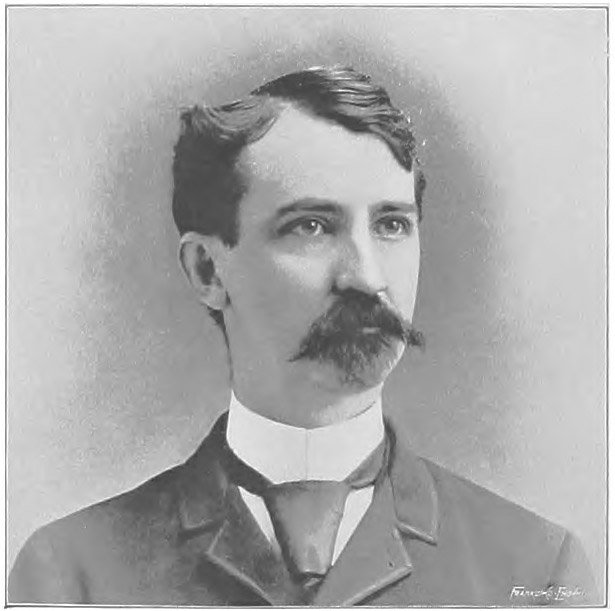
The following article was published in The Atlanta Constitution in 1899 and was written byWallace Putnam Reed (1849-1903), a writer and historian who regularly contributed to the Constitution and other newspapers in the Southeastern United States.
In this article, Reed (pictured here1) recounted the events that led to the 1889 publication ofHow I Escaped, a semi-autobiographical novel written byW.H. Parkins, Atlanta’s first architect.
Five years after Parkins’ death, Reed was much more honest about the architect’s writing ability than in his gushing review of the novel ten years earlier. Funny how that works.
Reed also claimed to have edited the original version of Parkins’ manuscript—now housed at the Atlanta History Center—and that Parkins sent the manuscript toH.I. Kimball, the owner and developer of Atlanta’s Kimball House Hotel.
The Kimball connection was omitted in Reed’s 1889 review of the novel, possibly because Kimball left Atlanta in 1886 amid some controversy,2 which would still have been fresh in local readers’ minds.
By the time he died of stomach cancer in 1895, however, Kimball had become a distant memory in the city—the Journal noted at his death that “little was known of him since he went north a few years ago.”3
As Reed recounted here, Kimball forwarded Parkins’ manuscript to Archibald Clavering Gunter, who turned Parkins’ biographical narrative into a substantially altered work of historical fiction, leading Parkins to eventually conclude that he “had done himself an injustice.”
Reed described Parkins as “a straightforward man, eminently sincere and truthful,” and lamented that his “truthful narrative of adventure was lost to the reading world.”
Conversely, his characterization of Gunter was quite damning: “He cared nothing for history.”
Article Excerpt:
About ten years ago the late William H. Parkins was among the leading architects of this city. He was a man of talent, and had some natural literary gifts which would have attracted attention if they had been cultivated.
One day Mr. Parkins paid me a visit, and placed in my hands a bulky manuscript.
“I have written a book,” he said, “and I want you to revise it. You see I wrote it with a pencil, at odd moments, and I know that it is not in proper shape for the printer. The arrangement of the chapters and the paragraphs requires attention, and perhaps some portions of the book should be condensed.”
I glanced over the work, and found that it was a graphic narrative of the author’s adventures during the war, when his devotion to the union cause led him to face many dangers. Leaving his home in South Carolina, he walked through the forests and mountains of western North Carolina and east Tennessee, and after passing through many perils he finally succeeded in reaching the federal lines.
It was an exciting chronicle, realistic and true, and the rattle and clash of sabers and the roar of the big guns made it a veritable prose epic of war.
I gladly agreed to transcribe the manuscript, making such changes as I thought necessary. The task occupied many long nights, and when it was finished, the result was a pile of copy which would have made a volume of about 350 pages.
The question of publication then came up. It was difficult for an unknown writer to find a good publisher, and Mr. Parkins knew it.
After some unsatisfactory correspondence, the author sent his manuscript to his friend, Mr. H.I. Kimball, who was then in New York.
Mr. Kimball was not a very busy man, and literary matters were not in his line. But a happy thought struck him. He heard people everywhere talking about Gunter and his novels, and he saw on every news stand big stacks of yellow-covered volumes bearing the titles “Mr. Barnes of New York” and “Mr. Potter of Texas.”
Inquiry brought out the fact that Gunter was his own publisher–a pushing, active man who knew how to get before the public and sell his books.
So the package from Mr. Parkins was turned over to the story writer and publisher for examination.
One evening Mr. Gunter found it hard to employ an idle hour. He had absolutely nothing to do, and, picking up the Parkins manuscript, he decided to glance over a few pages.
At the end of fifteen minutes he settled down in a quiet place and began to read critically and closely. An hour rolled by and he was still reading.
He was summoned to supper, but he did not move. A second summons came.
“I am not going to supper,” said Mr. Gunter, “this is the most fascinating thing I have seen in a long time, and I can’t lay it down until I have finished it.”
The reader was then left undisturbed, and at a late hour that night he carefully replaced the manuscript in its pasteboard box, and then sat down to write a letter to Mr. Parkins.
With a keen eye to business, the New Yorker offered to publish the book, provided the author would allow him to introduce a few sensations, and make it a novel instead of a matter-of-fact record. He also stipulated that the title page should read as follows: “How I Escaped; by William H. Parkins. Edited by Archibald Clavering Gunter.”
If these conditions were accepted, the publisher agreed to bring out the book in yellow covers and push its sale, paying the author a liberal royalty.
The Atlantian gave his consent to this arrangement, and in the course of a few weeks a new novel was on sale everywhere.
It had a big circulation in this country, Canada and England. Doubtless at least 100,000 copies were sold.
This was a brilliant success for an Atlanta novel, but Mr. Parkins was not entirely satisfied.
He was a straightforward man, eminently sincere and truthful, and after he had naturally considered the matter, he came to the conclusion that he had done himself an injustice in allowing a really valuable contribution to our war history to be spiced with thrilling fiction and published as a story.
He was seriously contemplating the publication of his manuscript in its original form when his last illness caused the idea to be abandoned.
It is a pity that this truthful narrative of adventure was lost to the reading world. As a picture of every day life in the confederacy and between the lines, it has never been equaled, and it would have been regarded as a work of permanent historical value.
Of course Mr. Gunter did his best from his point of view. He cared nothing for history. With him a sensational novel–one that would make the reader’s hair stand on end–beat history out of sight.
Then, his idea was to secure large and rapid sales for the book, and if facts stood in the way, he was ready to smash them at once and substitute his lurid fictions.
It must be admitted that he did his work well in the changes which he made in “How I Escaped.” Some of his scenes and incidents would have done credit to Dumas himself.
Mr. Gunter has been conspicuously successful as a popular writer, and he has made a fortune from his books. Yet it is a singular fact that he had no literary training and he was a middle-aged man when he came to the front with his first novel.4
W.H. Parkins. Main Building at Atlanta Baptist Seminary, later Samuel T.Graves Hall at Morehouse College (1890). Atlanta.123
The Background
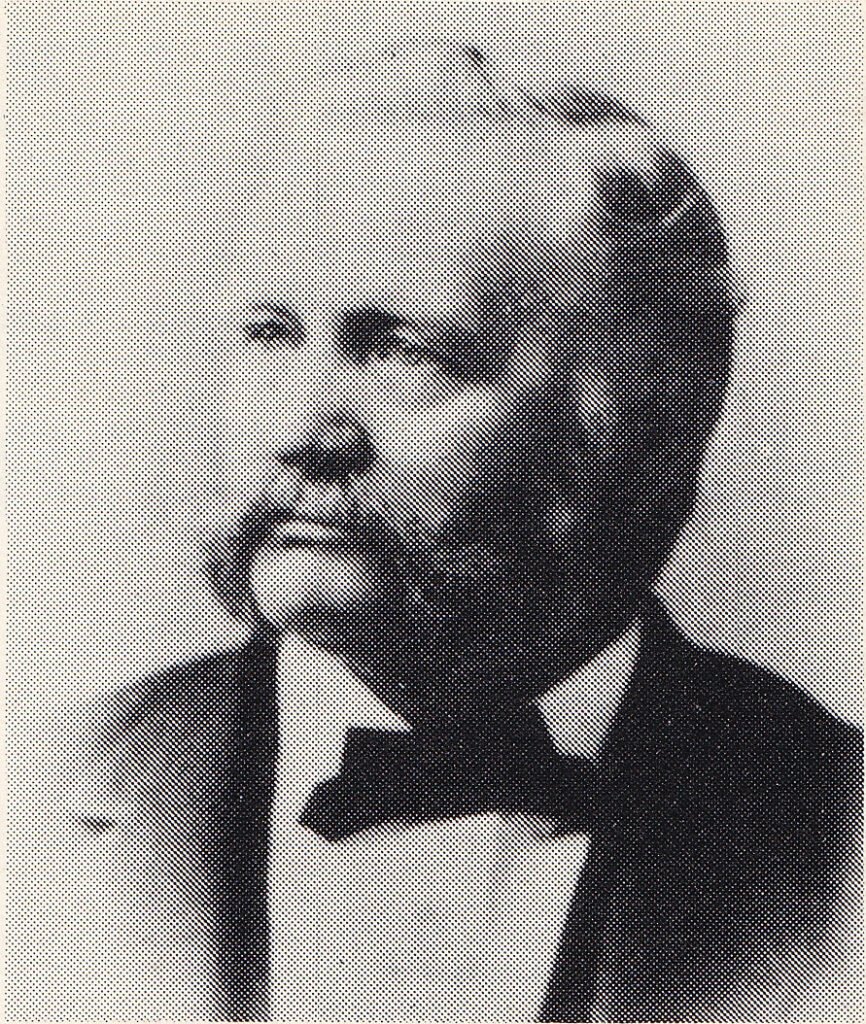
The following article was published in The Atlanta Constitution in 1889 and reviews a semi-autobiographical novel written byWilliam Henry Parkins (1836-1894),45 known professionally as W.H. Parkins.
Parkins (pictured here) was Atlanta’s first architect, establishing a firm in the city by 1868.67
Before moving to Atlanta, Parkins worked as a carpenter in Columbia, South Carolina, in 1860,8 and was previously employed as a railroad engineer.
There’s no evidence that Parkins received any formal training before offering his services as an architect, although that was typical for Southern designers at the time.
Less typical was that Parkins was born in New York and was a Union sympathizer during the Civil War. When fighting began in South Carolina, he fled through North Carolina and Virginia to reach Federal lines, but was captured by Confederate forces and conscripted into the Confederate army.9
Following imprisonment in Richmond, Virginia, Parkins escaped again and fled with a group of men across North Carolina and Tennessee, aided by a covert network of Union supporters in the Appalachians, which was later said to be “thick with Unionists.”10
Parkins ultimately entered the Union-friendly state of Kentucky and later reached New York, returning to the Deep South after the War.11
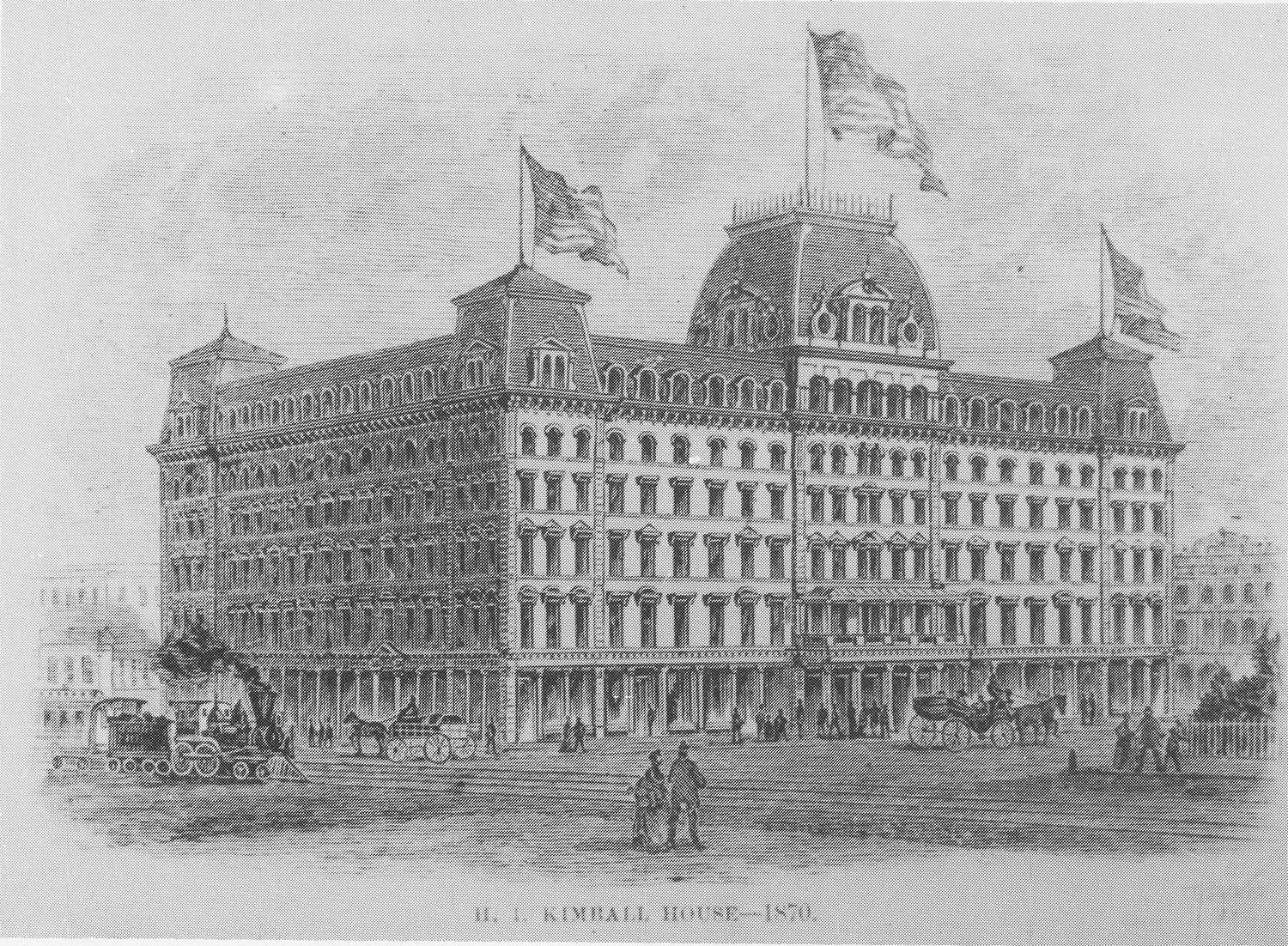
Griffith Thomas with W.H. Parkins. Kimball House Hotel (1870-1883). Atlanta.121314
Parkins’ loyalty to the Union seems to have had little to no impact on his business as a Reconstruction-era architect in Atlanta, but one reason the city rebounded so swiftly after the War was that Atlantans have always valued money and status over personal conviction.
Whereas most Southerners reviled carpetbaggers, Atlanta openly courted Northern capital.
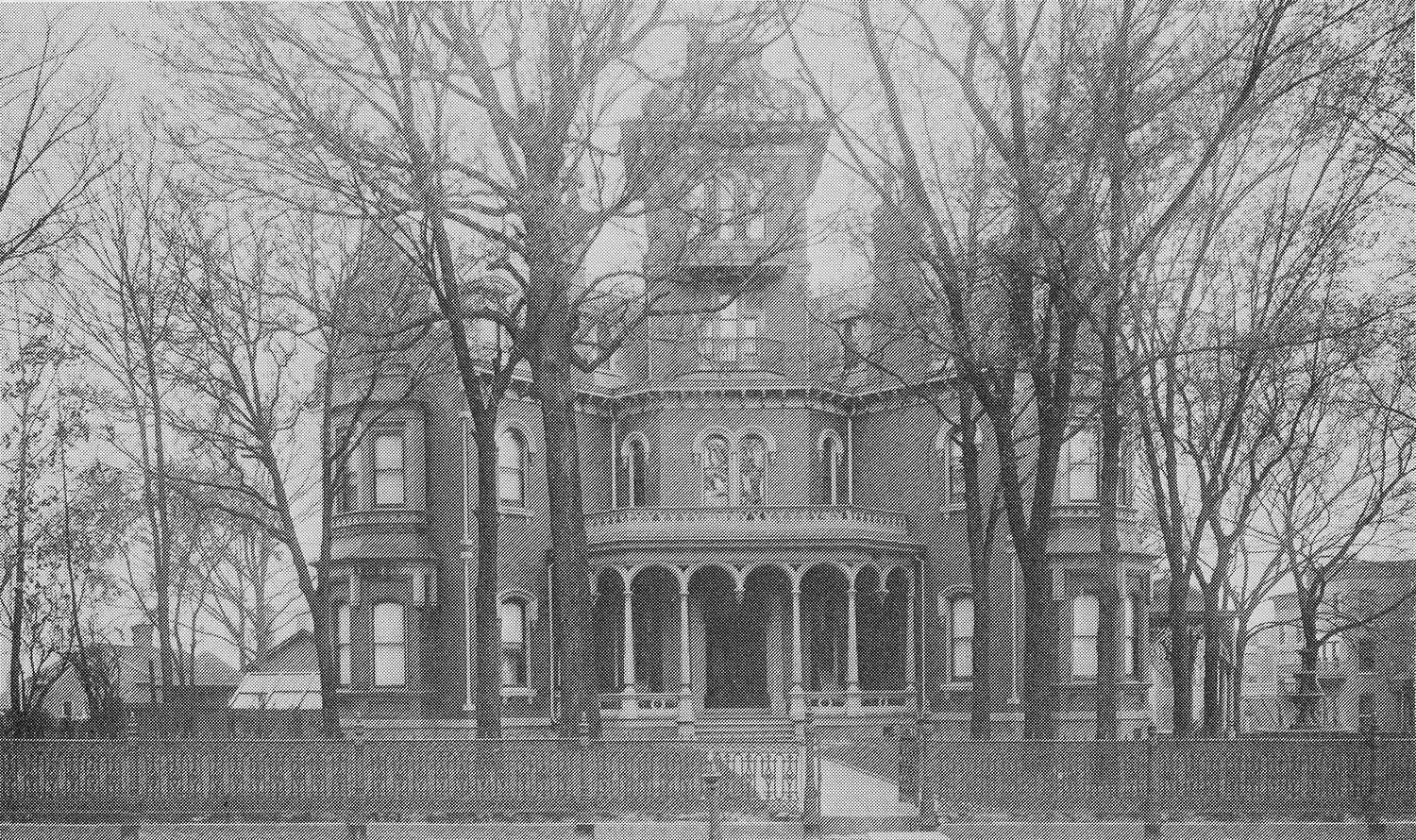
It also didn’t hurt that there were only two or three practicing architects in Atlanta through the 1870s, and a lack of competition allowed Parkins to secure several choice commissions, including the Peachtree Street residence that later became the Governor’s Mansion (1869-1922),15 and construction supervision of the original Kimball House Hotel (1870-1883),16 designed by Griffith Thomas of New York.17
Based on illustrations and images, Parkins was Atlanta’s most talented designer at the time, but that’s not saying much. At best, his early designs appear to have been competent vernacular executions of the Gothic, Italianate, and Second Empire styles, comparable to those found in any Southern city.
W.H. Parkins. John H. James House, later Governor’s Mansion (1869-1922). Atlanta.181920212223
Parkins began contending with health issues in the early 1880s, but he also struggled to adapt to changing architectural tastes.
For the second half of his career, his attempts at the more sophisticated styles of the late 19th century were regrettable.
In 1879, Parkins formed a brief partnership withA.C. Bruce,2425 a Confederate veteran who had already established a successful solo practice in eastern Tennessee. Based on the firm’s surviving works, Bruce appears to have handled most of the design duties.
The firm disbanded in 1882, when Parkins’s ill health forced him to retire to southwest Georgia, where he operated a former plantation located outside the town of Morgan.26Parkinspurchased the farm circa 18782728 and was later described as a “well-to-do planter.”29
W.H. Parkins. Frank Pulaski Residence (1881). Cuthbert, Georgia.3031323334
His initial retirement only lasted a few years, and in 1885, Parkins rented out his farm35 and returned to Atlanta to practice withL.B. Wheeler,363738 another architect from New York, forming a two-year partnership.
Parkins’s association with Wheeler resulted in his design for the Randolph County Courthouse (1886)39 in the southwest Georgia town of Cuthbert, and culminated with his work on the Oglethorpe County Courthouse (1887) in Lexington, Georgia.40
Parkins left the firm to establish the Atlanta Construction Company,4142 which collapsed six months later,43 although he maintained a solo practice in Atlanta until 1890, living part-time in the city to conduct business, while spending the remainder of his time at his farm.
W.H. Parkins. Terrell County Courthouse (1893). Dawson, Georgia.4445
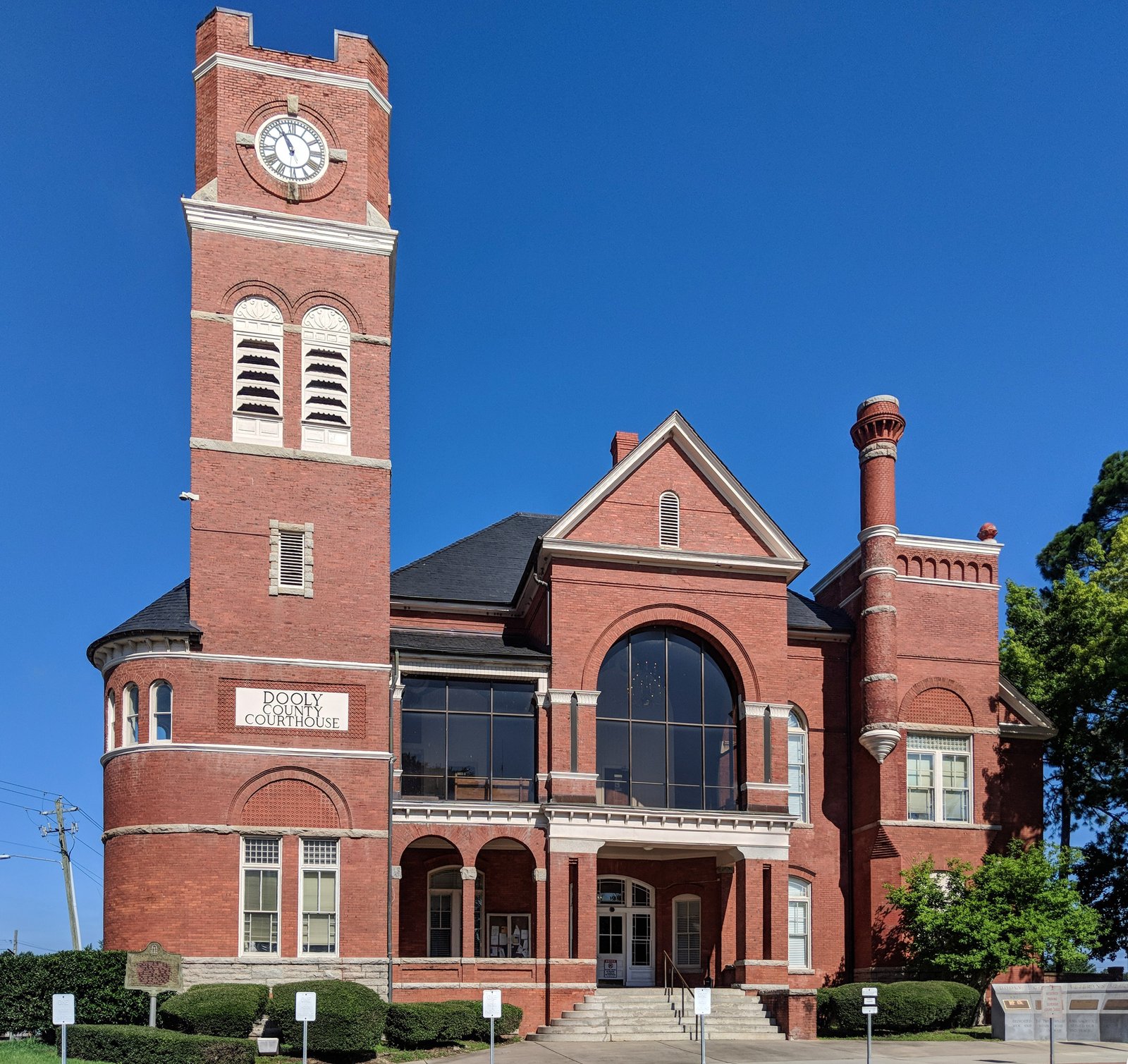
As construction finished on his last known work in Atlanta, the Atlanta Baptist Seminary (1890, pictured at top), Parkins permanently relocated to southwest Georgia,4647 where he designed the final projects of his career, including the Dooly County Courthouse (1891) in Vienna and the Terrell County Courthouse (1891) in Dawson, both atrocious, fumbling attempts at the Romanesque Revival.
Even before Parkins died in 1894, he had become a relic of another era in Atlanta—many of his buildings in the city had already been destroyed, and since he hadn’t been a permanent resident for several years, his death received brief coverage in the local newspapers.
On the campus of Atlanta’s Morris Brown College stands the shell of Gaines Hall (1869), a building Parkins supervised based on a Cincinnati firm’s design.48 The structure was gutted by fires in 2015, 2023, and 2024,495051 and is currently collapsing into a pile of bricks.
W.H. Parkins. Dooly County Courthouse (1891). Vienna, Georgia.5253
In the 1880s, Parkins wrote a manuscript detailing his experiences during the Civil War, which he titled Hiding Out or the Adventures of a Confederate Conscript: A Thrilling Narrative of the War Between the States.54
Unfortunately, Parkins was as skilled at writing as he was at architecture, and he convinced Wallace Putnam Reed of Atlanta to edit the manuscript.
Reed later charitably recalled that Parkins “had some literary gifts which would have attracted attention if they had been cultivated,” and reported that Parkins sent the edited manuscript toH.I. Kimball, the New York-based owner and developer of Atlanta’s Kimball House Hotel, with whom he was briefly associated in the firm of Kimball, Wheeler & Parkins.
Kimball then forwarded the manuscript toArchibald Gunter, a popular author and playwright of the late 19th century. Although virtually unknown today, Gunter had recently published two massive best-selling fiction books, Mr. Barnes of New York and Mr. Potter of Texas, and was eager for quick follow-up success.
Gunter asked Parkins’s permission to publish his biographical story as a novel, with the provision that Gunter could serve as an “editor”, adding “a few dramatic and fictive flourishes and some bright dialogue,” according to the article included here.
The resulting novel, How I Escaped, was published in the United States and England in 1889. As editor, Gunter substantially altered Parkins’s biographical narrative by adding multiple characters and subplots, which led Parkins to ultimately regret his decision.
The exact sales numbers are difficult to determine, but it doesn’t appear to have been the success Gunter hoped for, especially compared to his previous releases. In 1899, Reed claimed the novel sold “at least 100,000 copies”—a respectable figure, but hardly remarkable.
W.H. Parkins of Parkins & Bruce. James Fricker Residence (1879). Americus, Georgia.55
Critical reviews of How I Escaped were also decidedly mixed. The World in New York wrote a glowing review of the novel and singled out the story’s “remarkable race-freak, the red-headed negro”—an invention of Gunter’s—as “a beacon of fun and frolic”.56
The People of London dismissed the novel’s trite plotting and was especially critical of the black servant character, named Caucus, using an offensive term to summarize his portrayal:
“Mr. Parkins is not to blame . . . for treading again the well-trodden ground, but he might have hit upon a more novel device than the troubles of a couple of lovers whose families are arrayed on opposite sides. The n****r element, too smacks of the stale; ever since Uncle Tom appeared the public in both hemispheres have been surfeited with the “colored gemman.” . . . We do hope and trust that we shall never again come across a novel in which a faithful and upright, but terribly tiresome, negro everlastingly exclaims “Golly!”57
The Glasgow Herald was equally scathing: “The author’s mechanical method is ill-concealed… the pieces are joined badly, producing the effect of one of those children’s picture puzzles which, when put together, present a surface intersected by ragged lines.”58
Of course, Atlanta’s newspapers in the 19th century were absolutely incapable of objectivity, existing primarily to extol the city’s self-proclaimed preeminence in the New South.
It’s no surprise, then, that the following review of How I Escaped is absolutely gushing, written by Wallace Putnam Reed under the pen name of “The Old Colonel”.59
“How I Escaped.”
Mr. Parkins, Of Atlanta, Writes A War Novel.
A Story of a Book’s Evolution, Showing How the Author Turned a Stirring Historical Narrative Into a Thrilling Romance of Southern Life in the Sixties, and Rivalled “Mr. Barnes, of New York.”
An architect and an author!
The two lines of business are dissimilar and yet it is possible to combine them.
Mr. W.H. Parkins, the well known and popular Atlanta architect, has tried the experiment, and he has no reason to feel dissatisfied.
Some time ago it occurred to Mr. Parkins that a narrative of his adventures during the war in South Carolina, giving an account of his unpleasant experiences as a union man in a secession community, his sufferings and trials and final escape, would be of some interest to the public.
After thinking the matter over, Mr. Parkins decided to write a book. When his manuscript was ready a judicious friend placed it in the hands of Mr. Archibald Clavering Gunter, the famous author of “Mr. Barnes, of New York,” and “Mr. Potter, of Texas.” Then our Atlanta writer patiently awaited the result. Ninety-eight times out of a hundred publishers return manuscripts. But it was not so in this case.
Mr. Gunter is a man of business, as well as a literary man. He is president of the Home Publishing company of New York, and is always on the lookout for something bright and fresh in the book line. He picked up the manuscript sent by Mr. Parkins, and turned over its pages carelessly one evening while waiting for supper.
“Supper is ready,” said Mrs. Gunter.
“All right,” was the reply; “will be there in a moment.”
Mrs. Gunter went to supper, and her husband remained behind reading the manuscript.
“Supper is ready,” said a servant, five minutes later.
“In a few minutes,” answered the reader.
“Mrs. Gunter sent me to see if you are coming to supper,” said the servant, a little later.
“Tell her,” replied Mr. Gunter, “that I can’t come. I am so much interested in this Atlanta man’s adventures that I must read on to the end.”
So Mr. Gunter sat up supperless and read some four hundred pages of legal cap paper before he went to bed. The next day he wrote to Mr. Parkins and suggested that the work would sell better in the shape of a novel.
Mr. Parkins answered that he had confidence in Mr. Gunter’s judgment, and would be guided by him. Mr. Gunter then made some suggestions to Mr. Parkins, and Mr. Parkins made some suggestions to Mr. Gunter. A few dramatic and fictive flourishes and some bright dialogue were added by Mr. Gunter, and the result is now before the public in the novel published last week under the title of “How I Escaped,” by W.H. Parkins, edited by Archibald Clavering Gunter.
In advance of publication, Mr. Gunter sent out circulars containing the following synopsis of the novel: “Book 1.—How I Stayed for Her. Book 2. —How I Fled from Her. Book 3.—How I Won Her. Book 4—How I Came Back and Fought for Her.” The heads of each chapter were also advertised as follows:
“Got Your Carpet Bag Packed? Amos Pierson, Love or Duty, The Empty Sleeve, A Confederate Detective, The Provost Marshal, The Blockade Runner, The Shovel or the Rifle, The Night Attack, She Came, The Redheaded Negro, The Honeymoon in the Blue Ridge, When Girl Meets Girl, Into the Dark Country, Through the Gaps, Through the Lines, The Letter of Life, The Fight for the Bridge, Where Was She? The Little Hostage.”
Arrangements were made to copyright the book in England, and have it appear there on the day of its publication here. The orders began to pour in, and before a single copy had been issued from the press 20,000 orders had been received.
This means a handsome profit for both author and publisher, and is a flattering success in an age when some of the best novels do not sell to the extent of more than 5,000 copies.
“How I Escaped” is a war novel, and it is one of the best, and perhaps the best, of its kind. Of course it is fiction, but it has the advantage of being founded on facts—facts in Mr. Parkins’s own experience, or the experience of others.
It would not be doing the story justice to synopsize it fully, but here is a faint outline. Just as South Carolina seceded, Lawrence Bryant, a young northerner residing in Columbia, became engaged to Laura Peyton, in spite of his rivals, Harry Walton, a gallant South Carolinian, and Amos Pierson, a crafty, scheming old speculator from Savannah.
The war came on, and Bryant’s sweetheart and family and his best friends tried to win him over to the cause of the confederacy, but his loyalty to the union never wavered. His acquaintances grew cold, and at last he was ordered to report for duty as a soldier. Bryant’s efforts to leave the country, dogged all the time by Bassett, the confederate detective make several thrilling chapters. At last he concealed himself in the hold of a blockade runner at Wilmington, but was discovered and taken prisoner by the confederates. For a long time he suffered every possible hardship, but by the aid of Laura Peyton effected his escape, and the two met in the Blue Ridge, where they were married.
The honeymoon was rudely interrupted by the appearance of Laura’s sister and Bassett, both of whom desired Bryant’s arrest. The hunted man gave the detective an ounce of cold lead, and made a break for the mountains. His adventures during his wanderings among the bushwhackers in western North Carolina and East Tennessee are told in a graphic and spirited manner that keeps the reader’s interest on the stretch from page to page. He reached Knoxville, went to New York, and thence to Nassau, where he tried to communicate with his wife without success. Then he returned to New York, and started for Atlanta after Sherman had captured the city. He went with the army to the sea, and on to Columbia, where he arrived just in time to save his wife and child from the dangers of that ill-fated capital.
Bryant’s persecution, it seems, was all due to the animosity of his rival, Amos Pierson, who had influence with the confederate government. This man Pierson comes to grief after the burning of Columbia, and gets soundly pummeled by Bryant. Harry Walton, the other suitor for Laura Peyton’s hand, was a chivalric southerner. In the chapter on “The Fight for the Bridge,” occurs the following description of Walton’s death, after holding the bridge for hours with a single regiment against a division of federals:
The captain of artillery, aided by a couple of pioneers, had rapidly dug a hole in the center pier of the bridge. Into this four men running down, placed four kegs of gunpowder. Walton turned from his men, and he and the artillery officer both stayed and to this mine deliberately attached a fuse. Then they coolly waited until the rear guard had crossed the bridge, and reached the little breastwork on the other side of the river. Before this was done there was another heavy volley, and several of the men sank dying as they crossed the stream, while Walton himself gave a start that indicated he had received another wound, and the captain of the battery fell down upon the bridge. Coolly striking no less than three matches to get a light, under this fusillade that became more deadly every moment, Walton deliberately lit the fort fire that led to the mine; then shouldering the wounded artillery officer, staggered across and took position behind the breastwork to check the federal advance for the last time. Both the batteries of artillery limbered up and started off after the confederate infantry. A division had been saved—a regiment almost annihilated.
But all this meant little to Caucus and myself now—we looked only at the smoking fuse that would explode the bridge under which we were concealed. The black’s face had become ashen. His chattering teeth said: “Golly, when dis blows up we blow up, too!” The crossfire from the federals and confederates made it certain death to venture on the bridge. Caucus, before I know what he was doing, plunged into the stream, and, in twenty or thirty vigorous strokes, reached the center pier. Up this he climbed, for it was not more than five feet high, and sheltered by the heavy log cribbing from the confederate musketry, deliberately pulled out the lighted fuse from the mine. For a moment the South Carolinians did not notice it, but a second after a cry from Walton came across the river. Cursing the black, he called to his men to follow him, and, firing his revolver at Caucus, ran across the bridge.
The confederates rose up, but the fire from the approaching federals was too heavy. A few of them fell wounded; the rest dropped again behind the breastwork.
A dozen strides brought Walton to the center of the bridge. He pulled out another fuse, and attached it to the powder, this time cutting it off very short.
His revolver firing had driven Caucus into the river, where he swam back to me.
As the colonel was about to light the fuse, he paused, staggered, clapped his hand to his side, reeled and sank upon the bridge, the lighted port fire from his hand falling sizzling into the river. The federal advance was already at our end of the bridge.
With a yell of rage for their fallen commander, the South Carolinians rushed from their breastwork, charged across the bridge, and at the center the blue and gray met. Clubbed muskets, bayonets and even fists were used in the struggle.
Swept back by overwhelming numbers across the bridge, the confederates bore with them the dead body of their officer—another hero fallen for that lost cause whose banner had already begun to droop, and whose stars began to fade.
As I gazed at this, a wave of blue surged round me. I had not come to the federal lines—the federal lines had come to me.
But there are other fighting episodes equally as stirring as this incident. Fortunately, however, war is not the main staple of the book. There is a charming love story running all through it, and this tones the gunpowdering element down delightfully.
To give fuller details would be to interfere with the reader’s enjoyment of the novel, It should be said just here that “How I Escaped” has no tinge of sectional bitterness or prejudice. It is simply a vivid, rushing torrent of incident and dialogue, punctuated with the rattle of musketry and the booming of cannon. The author has given his story the true local coloring, and made it in the main a faithful picture of certain phases of life in the south during a period that tried men’s souls, and developed all that was best and worst in human nature. Some minor flaws—some little blemishes—appear on the surface, but very few American novelists have produced a first book so full of interest and excitement.
Some idea will be given of the impression produced by the book when it is stated that a stranger in New York wrote to the author, offering him a large sum, cash down, for his interest in the profits. The offer was promptly refused, as it is confidently believed that the sale will reach at least 100,000 copies.
It is more than likely that the reading public will hear from Mr. Parkins again. He has not exhausted his material—he has merely thrown out a few nuggets as a sample of the wealth waiting to be developed and shaped when there is a demand for it. The success of “How I Escaped” will doubtless induce Mr. Parkins to carry out his original plan, and give the world a history of the inside of the confederacy, from the standpoint of a non-combatant who was a close observer of the social, political, military and industrial aspects of the situation.
It is hoped that Mr. Parkins will carry out his purpose, He has done so well in his first flight through the airy realm of fiction that there will be a general desire to see him make another excursion—this time in the field of history, where he can utilize the facts—the reminiscences of which his novel has given us a foretaste.
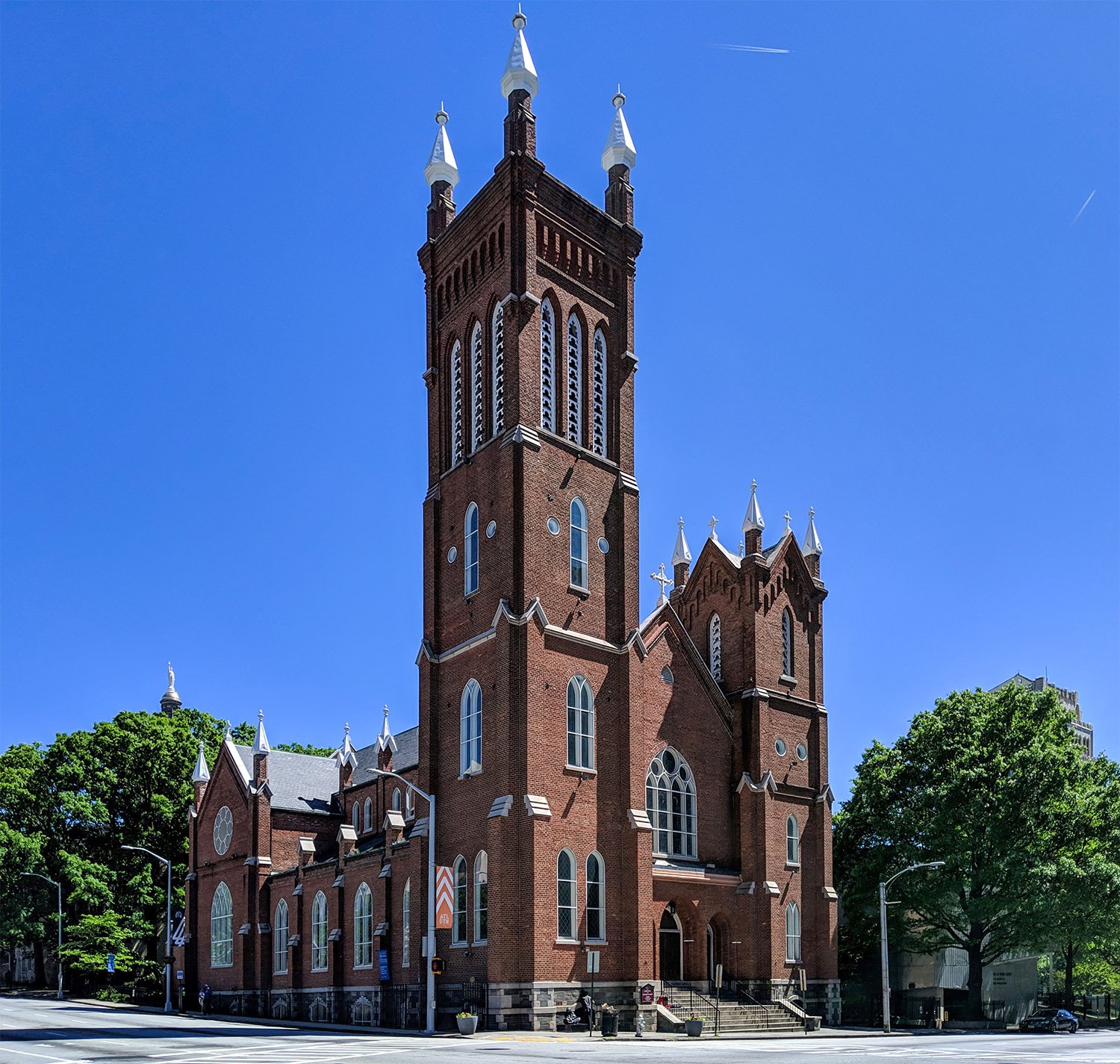
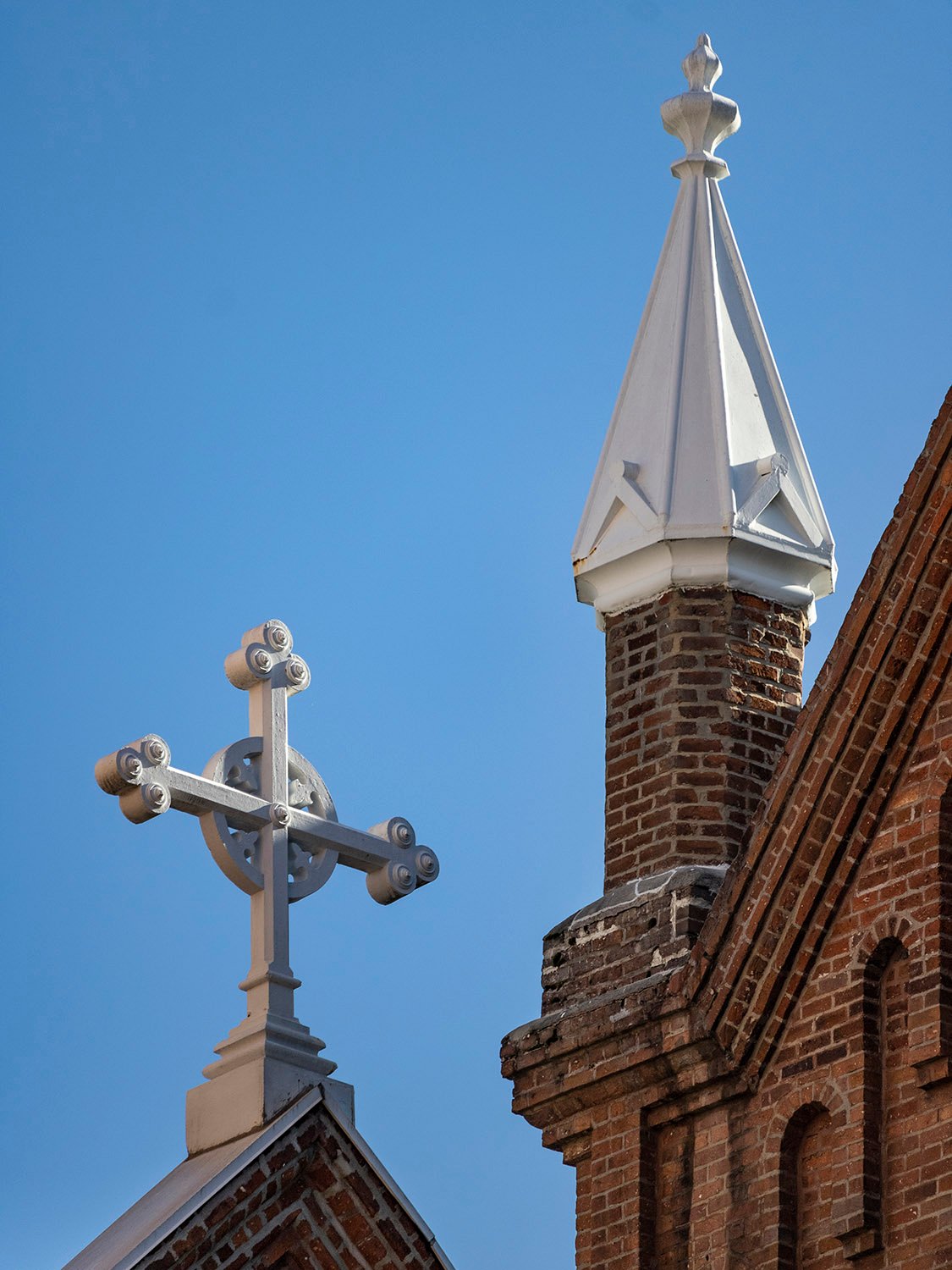
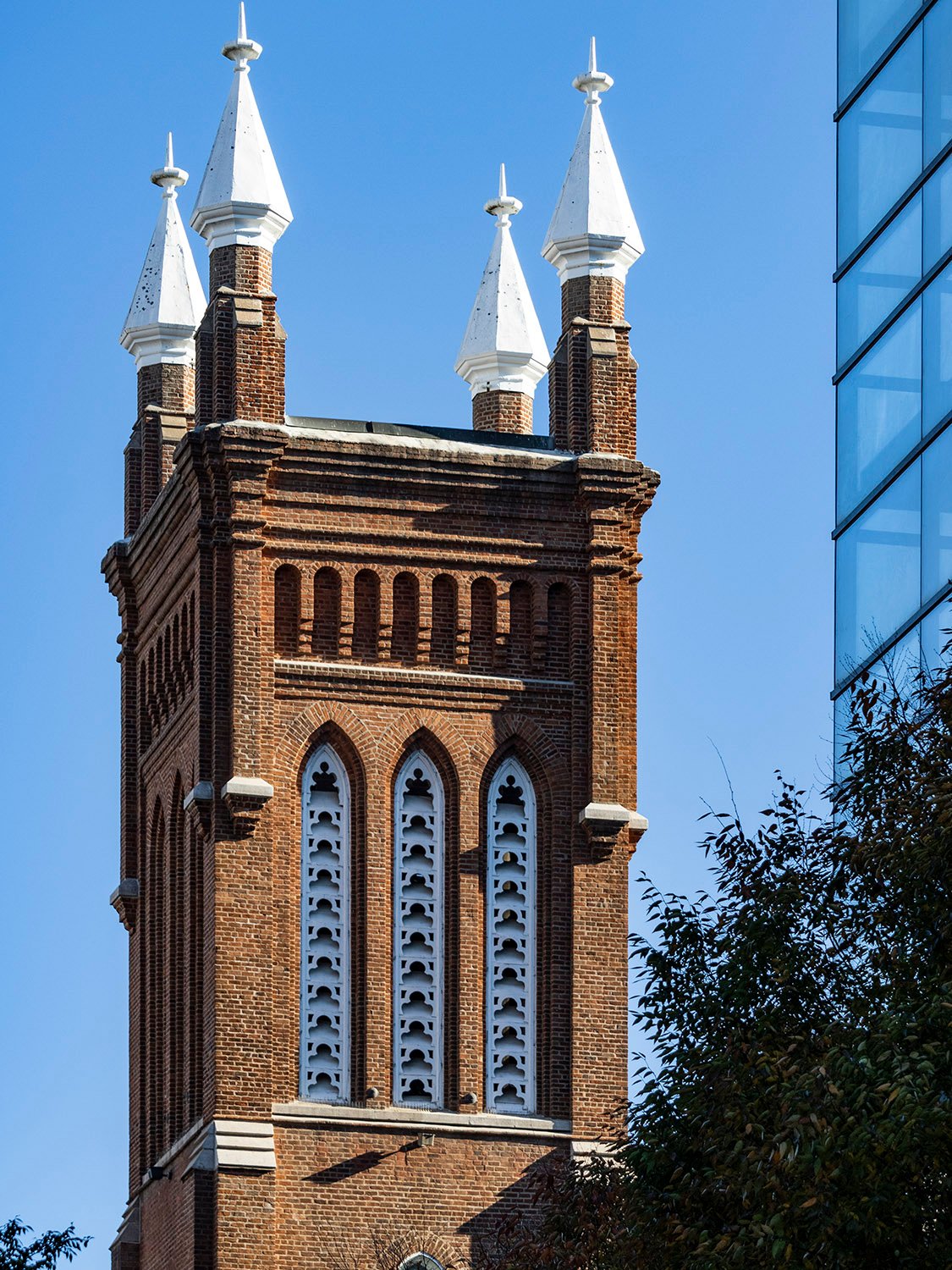
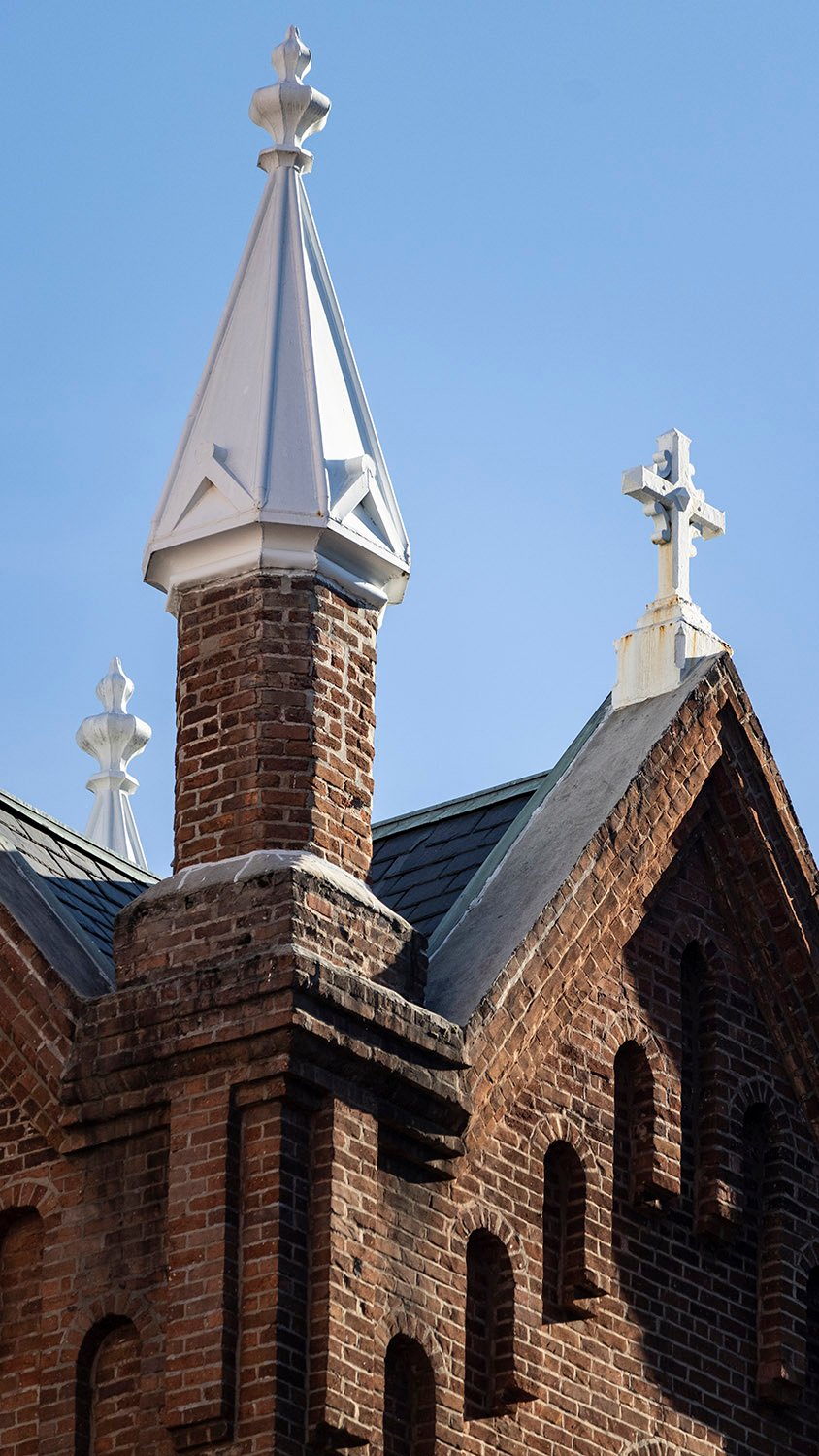
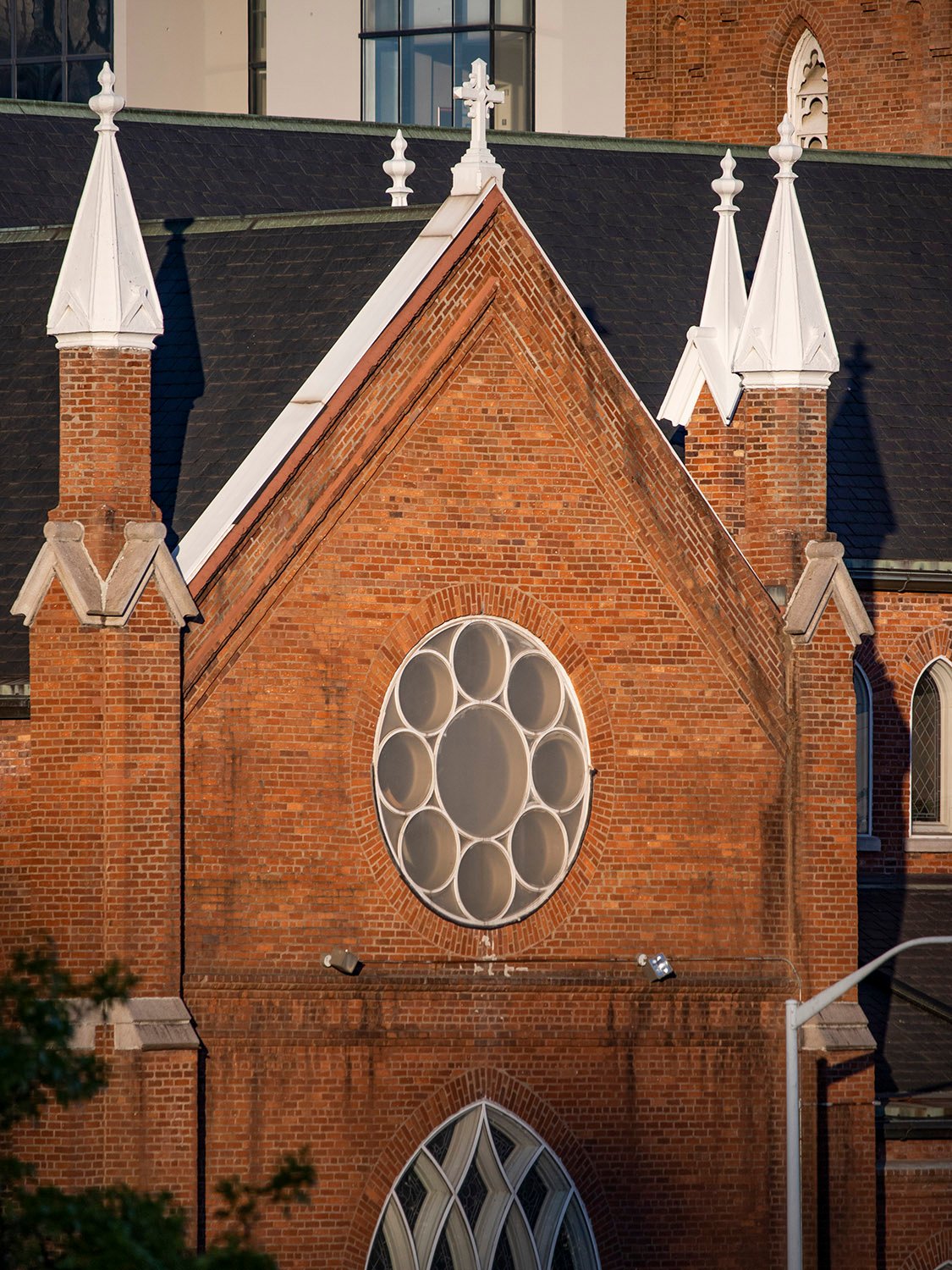
W.H. Parkins. Catholic Shrine of the Immaculate Conception (1873). Atlanta.123Entrance of the Catholic Shrine of the Immaculate Conception, AtlantaNorth elevation of the Catholic Shrine of the Immaculate Conception, AtlantaTransept on the north elevation of the Catholic Shrine of the Immaculate Conception, AtlantaBell tower on the Catholic Shrine of the Immaculate Conception, AtlantaFirst-floor windows on the Catholic Shrine of the Immaculate Conception, AtlantaWindows on the east elevation of the Catholic Shrine of the Immaculate Conception, AtlantaWindows on the facade of the Catholic Shrine of the Immaculate Conception, AtlantaLooking toward the Catholic Shrine of the Immaculate Conception from the southCross and spire on the Catholic Shrine of the Immaculate Conception, Atlanta Buttress on the Catholic Shrine of the Immaculate Conception, AtlantaLooking at the south elevation of the Catholic Shrine of the Immaculate Conception, AtlantaButtresses on the Catholic Shrine of the Immaculate Conception, AtlantaBell tower on the Catholic Shrine of the Immaculate Conception, AtlantaTower on the southwest corner of the Catholic Shrine of the Immaculate Conception, AtlantaLooking at the towers of the Catholic Shrine of the Immaculate Conception from the northeastWindows on the bell tower of the Catholic Shrine of the Immaculate Conception, AtlantaSecond-floor window on the bell tower of the Catholic Shrine of the Immaculate Conception, AtlantaSpires and cross on the Catholic Shrine of the Immaculate Conception, AtlantaTransept on the north elevation of the Catholic Shrine of the Immaculate Conception, AtlantaCross and spire on the Catholic Church of the Immaculate Conception, Atlanta
References
“Notice!” (advertisement). The Atlanta Constitution, April 25, 1869, p. 2. ↩︎
“Dedication of the New Roman Catholic Church.” The Atlanta Constitution, December 7, 1873, p. 8. ↩︎
“A Brilliant Day.” The Atlanta Constitution, January 13, 1880, p. 4. ↩︎