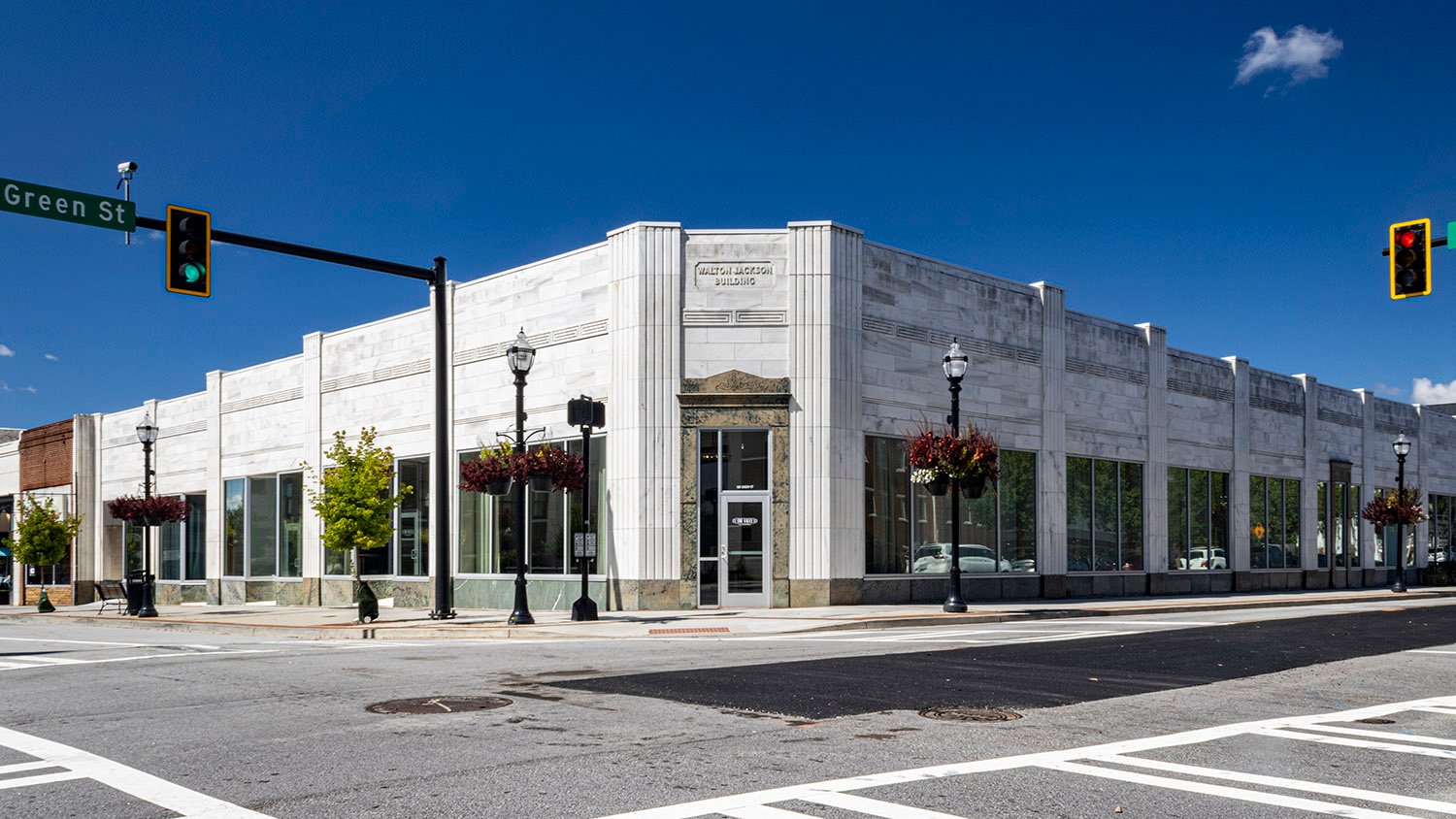
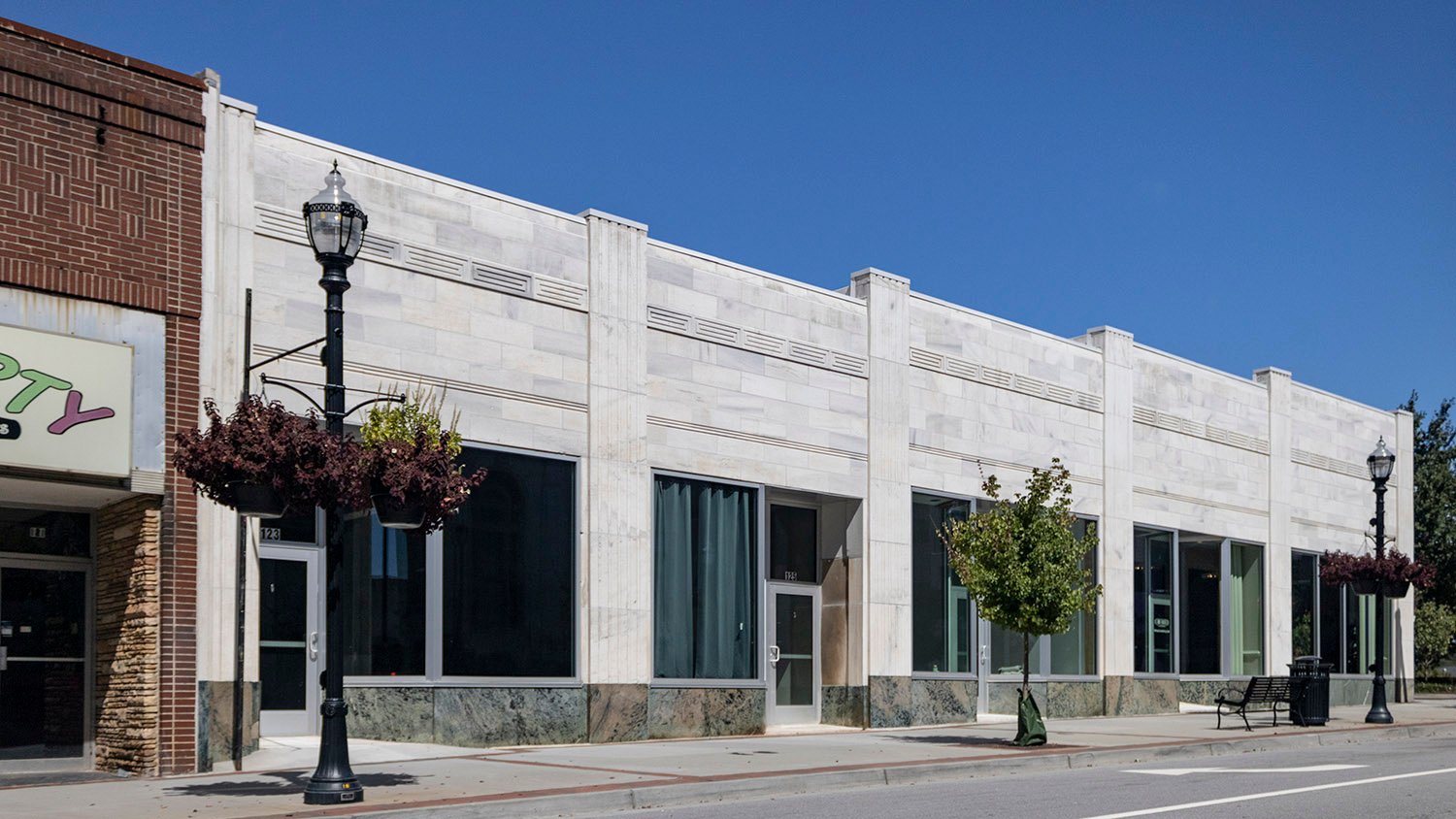
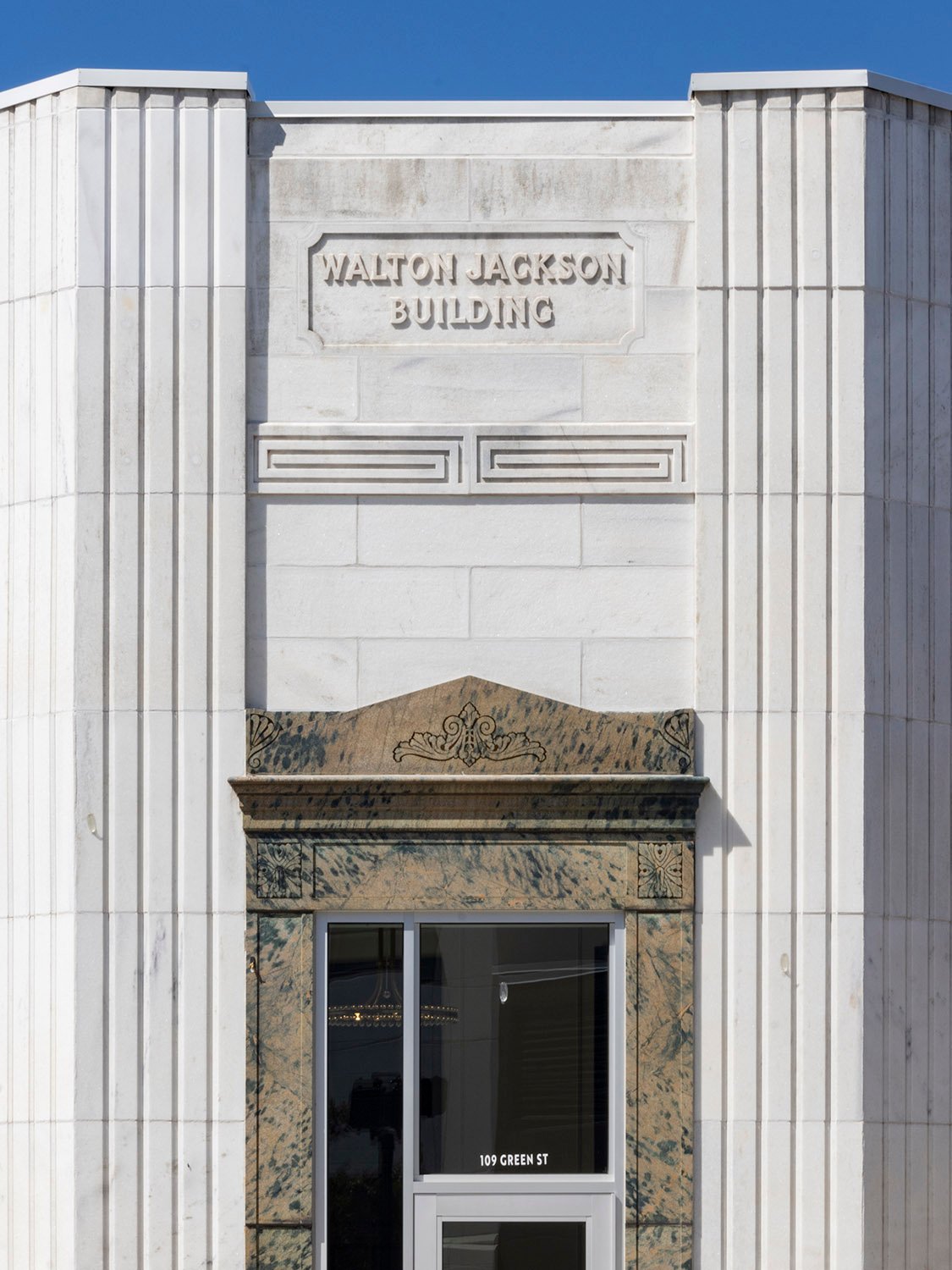
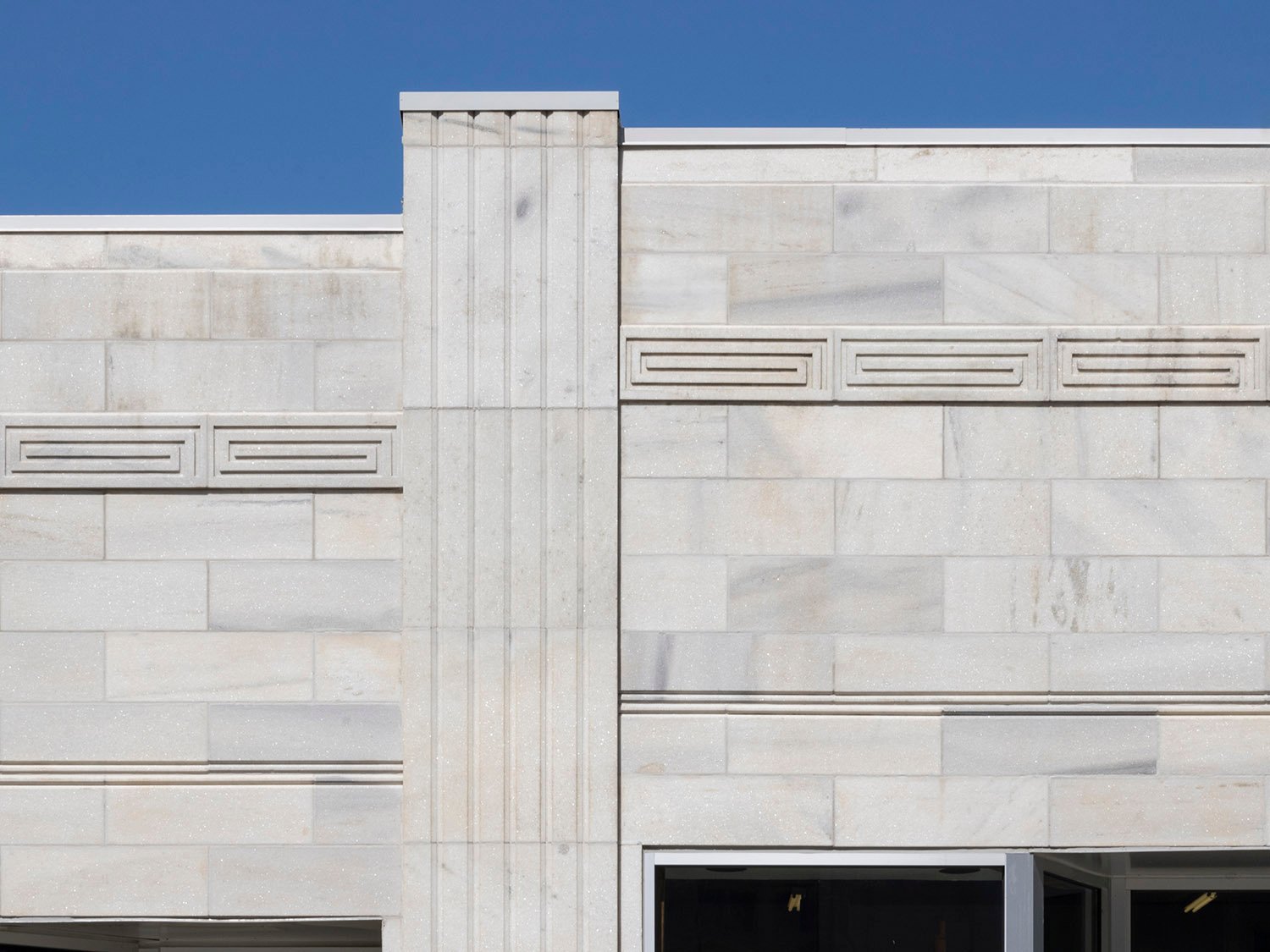
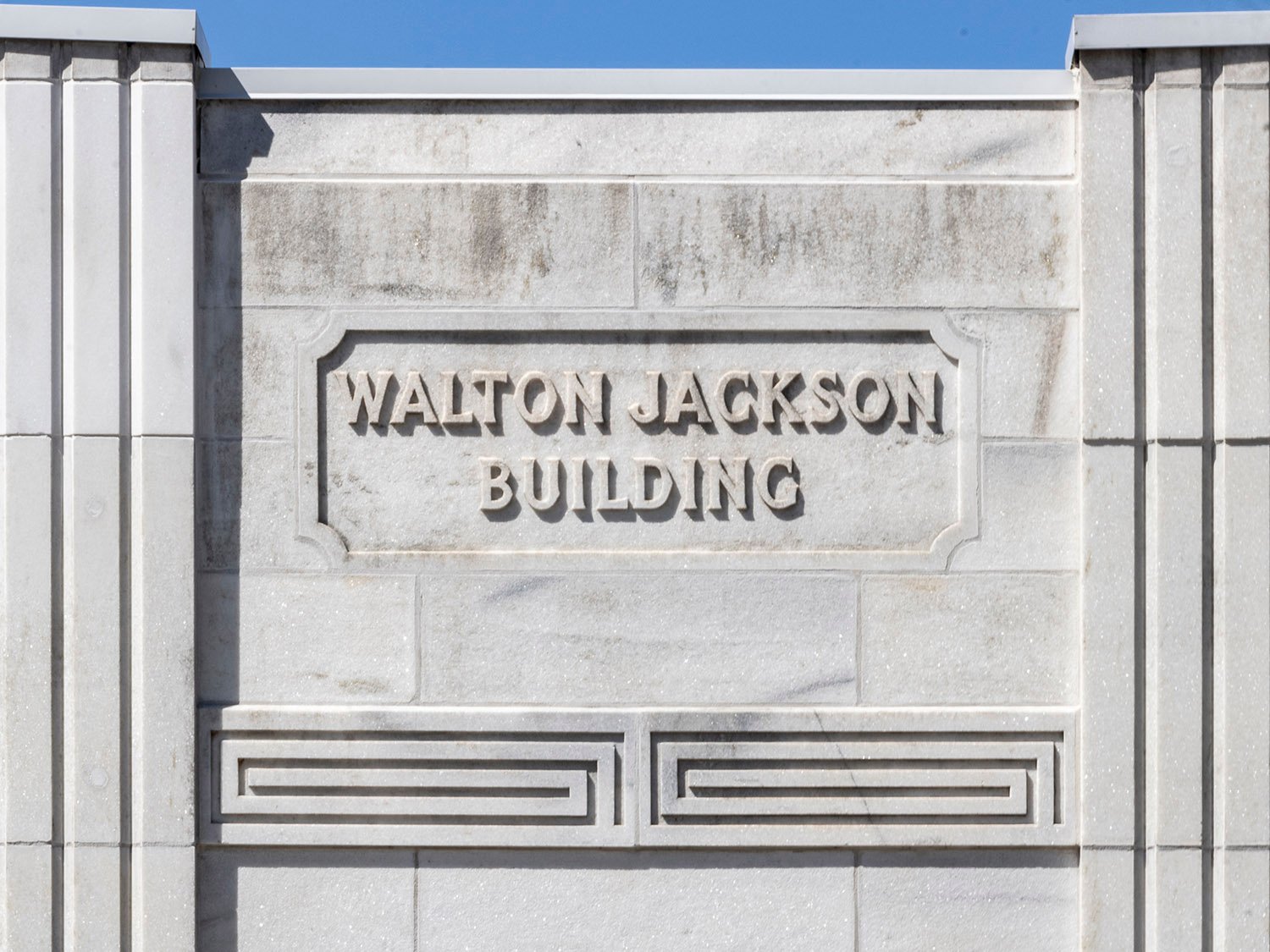
Walton Jackson Building (1936). Gainesville, Georgia.1
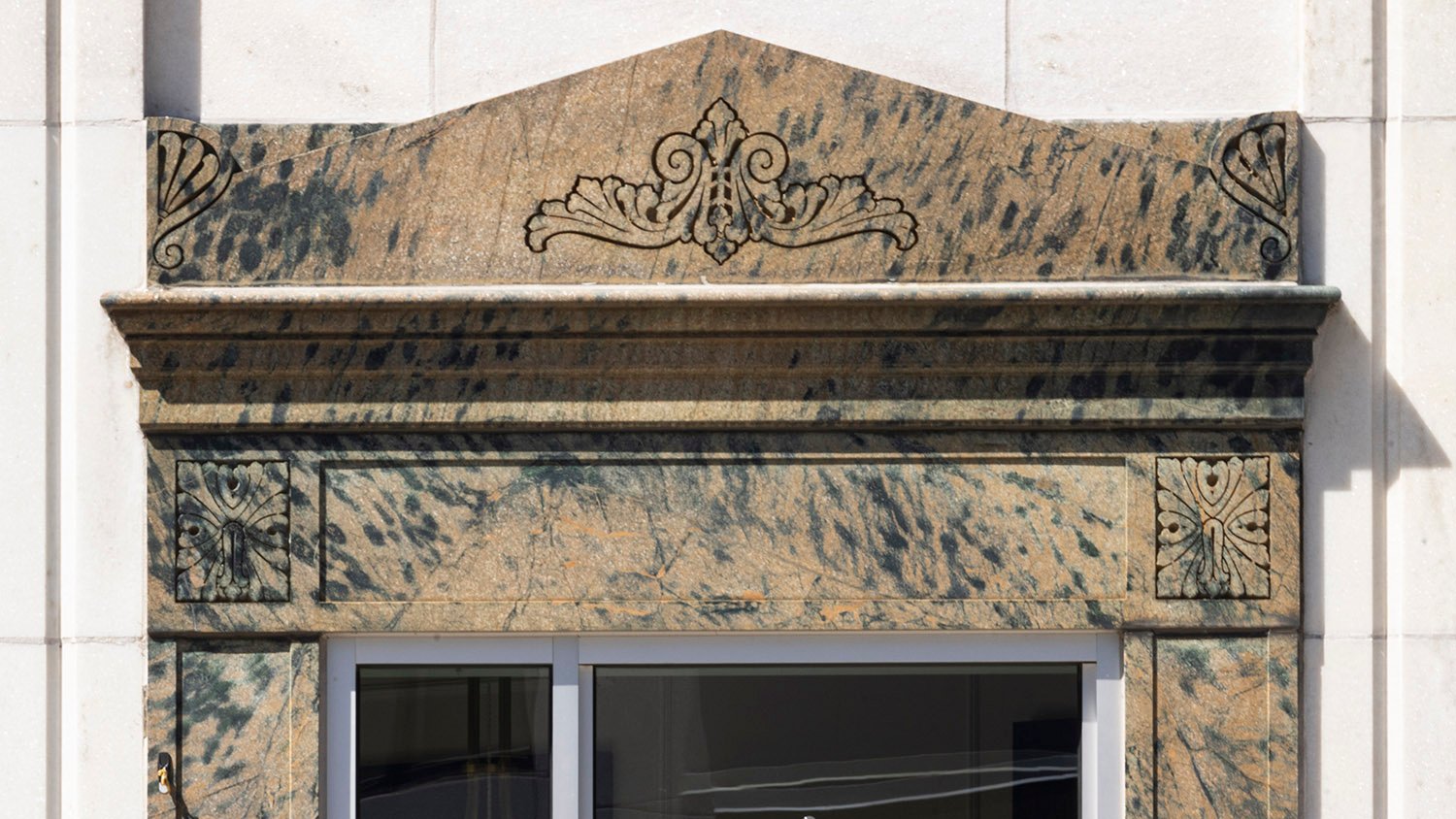
We’ll go with 1936 as the date for this fine building in Gainesville, Georgia, designed in the Classical Moderne style and elegantly clad in marble.
I suspect the structure was designed by Daniel & Beutell of Atlanta, who profited handsomely after Gainesville’s commercial district was substantially destroyed by a tornado in April 1936.23
Daniel & Beutell designed the nearby Hall County Courthouse and Gainesville City Hall—both are similar in style and appearance to this building. The firm also designed another project for Walton Jackson in 1936.4
Gallery
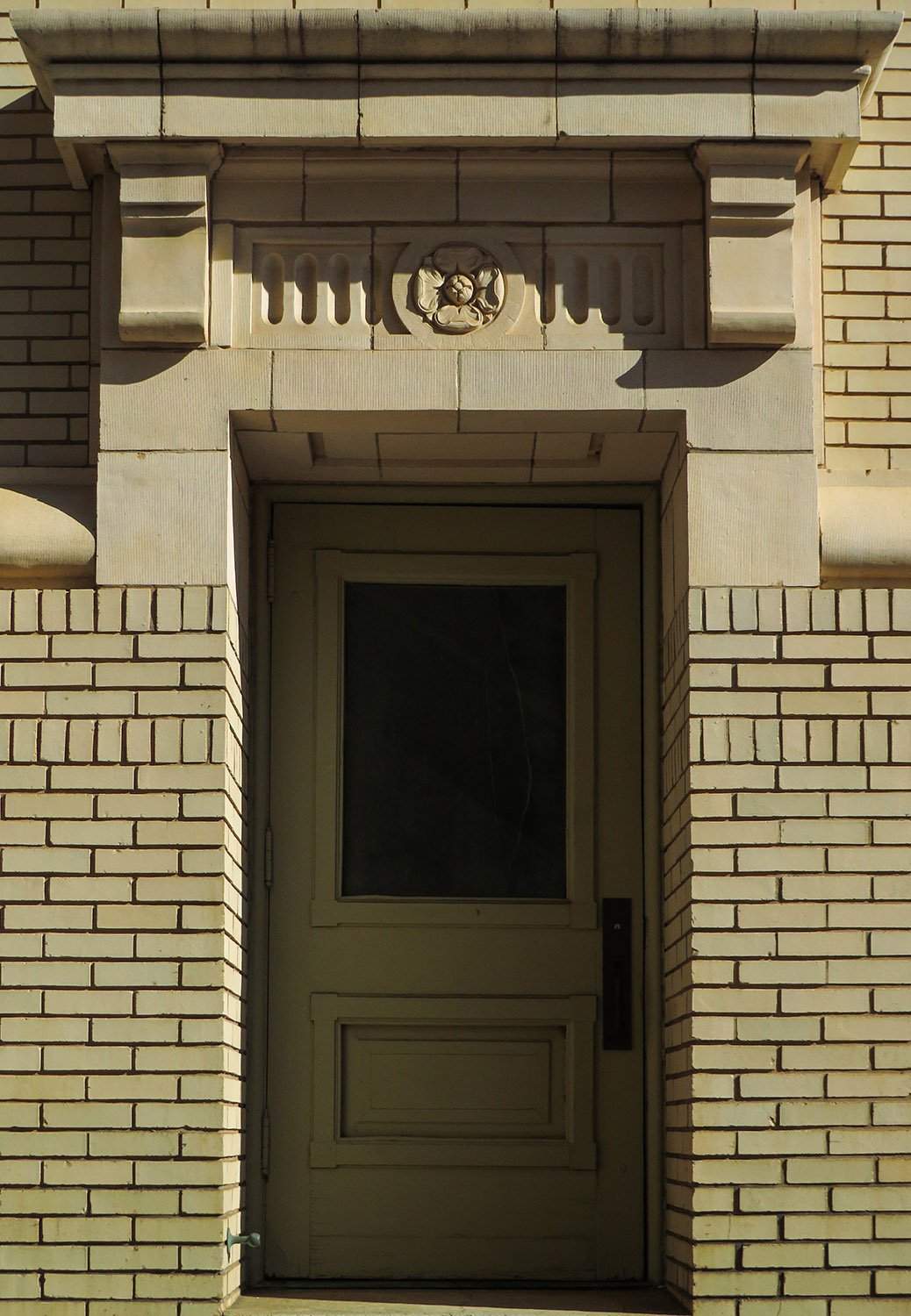
Southeast elevation of the Walton Jackson Building, Gainesville, GeorgiaMain entrance of the Walton Jackson Building, Gainesville, GeorgiaPilaster and stringcourse on the southeast elevation of the Walton Jackson Building, Gainesville, GeorgiaInscription on the Walton Jackson Building, Gainesville, GeorgiaPediment on the Walton Jackson Building, Gainesville, Georgia
References
“Gainesville Lot Sold For $37,500”. The Atlanta Journal, April 29, 1936, p. 14. ↩︎
“43 Known Dead, Others Feared Lost In Debris, Hundreds Are Injured In Gainesville Tornado”. The Atlanta Journal, April 6, 1936, p. 1. ↩︎
“150 Are Known Dead At Gainesville; Fires Ravaging City Are Controlled”. The Atlanta Constitution, April 7, 1936, p. 1. ↩︎
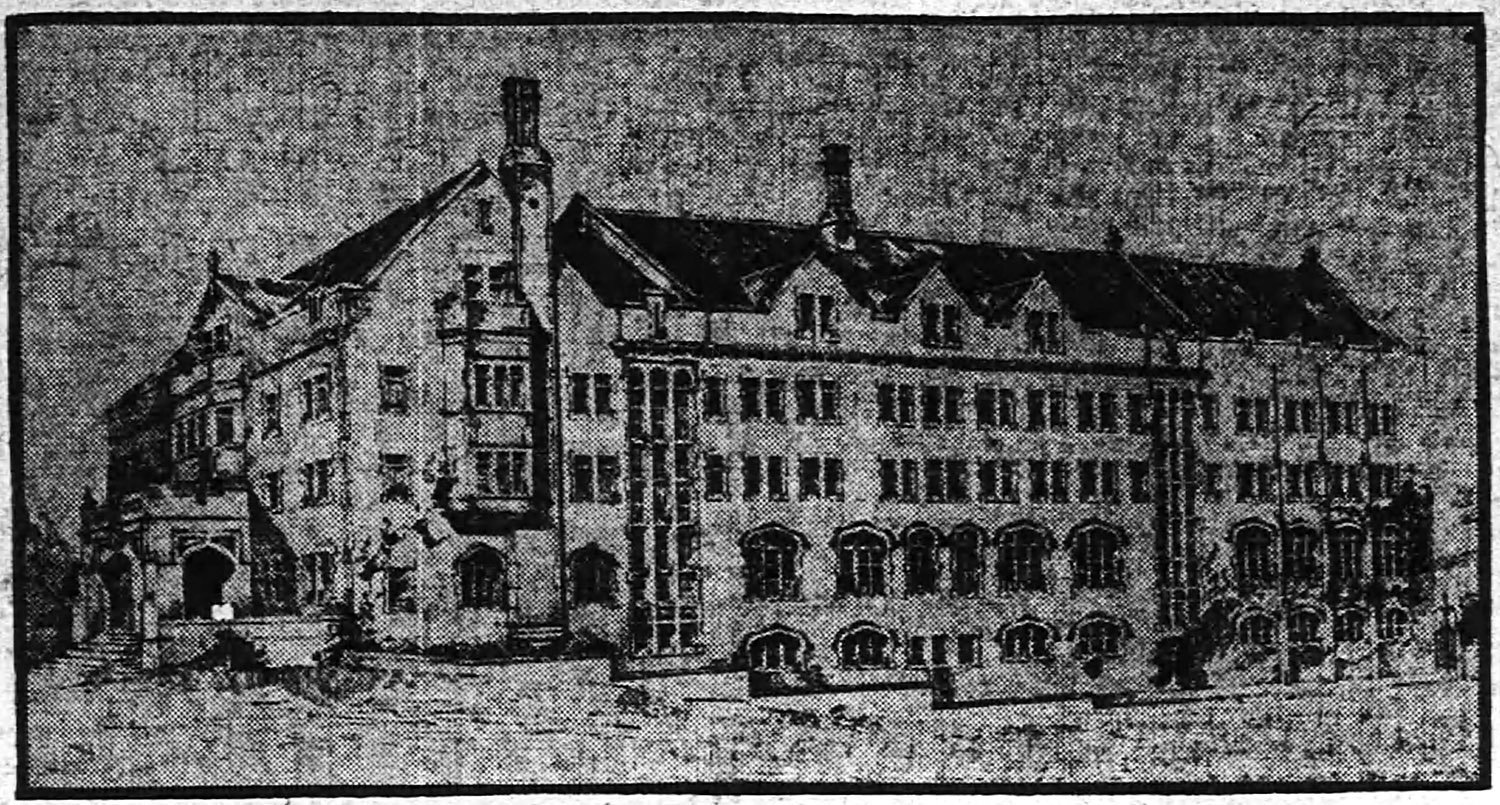
Henrietta C. Dozier. Nelson Hall (1910, unbuilt). Atlanta. Photograph by Abananza Studio of Atlanta.1
The Background
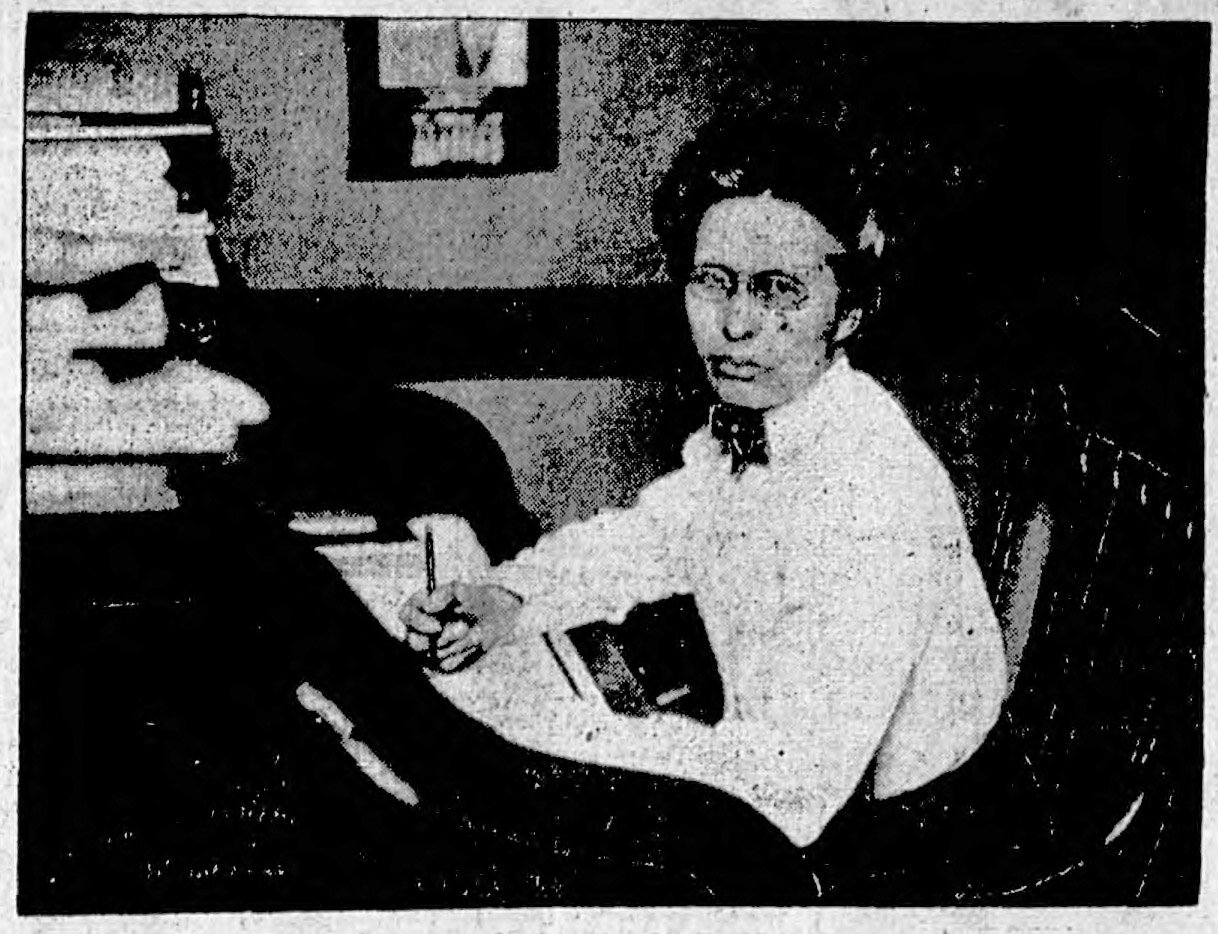
The following article appeared in The Atlanta Georgianand News in 1910, and includes a profile of Henrietta C. Dozier, the first female architect in Atlanta and the Southeastern United States.
While Dozier is the primary subject of the article, another “woman architect” of Atlanta is mentioned, Leila Ross Wilburn, as well as a feisty, anonymous attorney who apparently designed homes as a hobby.
Wilburn was a self-taught designer and unlicensed architect who started her own practice eight years after Dozier, although she is sometimes erroneously credited as the South’s first female architect.
Her designs were unremarkable, but Wilburn found success by following the lead of architects like George F. Barber, publishing a series of pattern books for those looking to build their own homes inexpensively.
While Dozier is largely forgotten in Atlanta, Wilburn’s work is still widely touted by local residents, particularly in nearby Decatur, Georgia, where many homes of her design survive. You will find no such celebration of Wilburn here.
As Dozier notes in this article, the Diocese of Georgia, headed by Bishop C.K. Nelson, commissioned her to design a project called Nelson Hall (pictured above), a three-story school for girls planned for Atlanta’s Peachtree Street.23456
Dozier was a devout Episcopalian, and the diocese was her most faithful client in Atlanta:7 among other projects for the organization, she designed the first chapel for Atlanta’s All Saints Episcopal Church,89 a two-story building known as the Southern Ruralist Building (1912, demolished),1011121314 and St. Michael’s Episcopal Church in Fitzgerald, Georgia, which still survives.
Had Nelson Hall been completed, it would have been one of the major works of Dozier’s career, but the project never materialized.
Henrietta C. Dozier, 1910. Photograph by Abananza Studio of Atlanta.15
The Woman Invasion? Here Are Two Women Architects in Atlanta, and They Plan Sure-Enough Houses, Too
Miss Henrietta C. Dozier Talks of Her Work–She Designs Factories and Churches and Any Sort of Building.
By Dudley Glass.
“Why, anything from a chicken coop to a church. But my favorite line? The big things with lots of money in them, of course.”
Miss Henrietta C. Dozier leaned back in her office chair and smiled in a friendly way. She seemed to think it odd that any one should be surprised at a woman’s success in architecture. But, then, women are giving their brothers a race in every line nowadays, except steeple climbing, and it wouldn’t surprise me to see one start that. Why, there’s even a woman—but that’s good enough for a story of its own, so I’ll save it.
“Why not?” asks Miss Dozier. “There’s very little difference between men and women. There’s a lot more difference between individuals. I studied architecture in college, served a long apprenticeship for practical experience and had my ups and downs in the school of practical work. Why shouldn’t I be a good architect? I don’t ask any favors because I am a woman. Can I give satisfaction? That’s the main point.“
No Fashion Plates There.
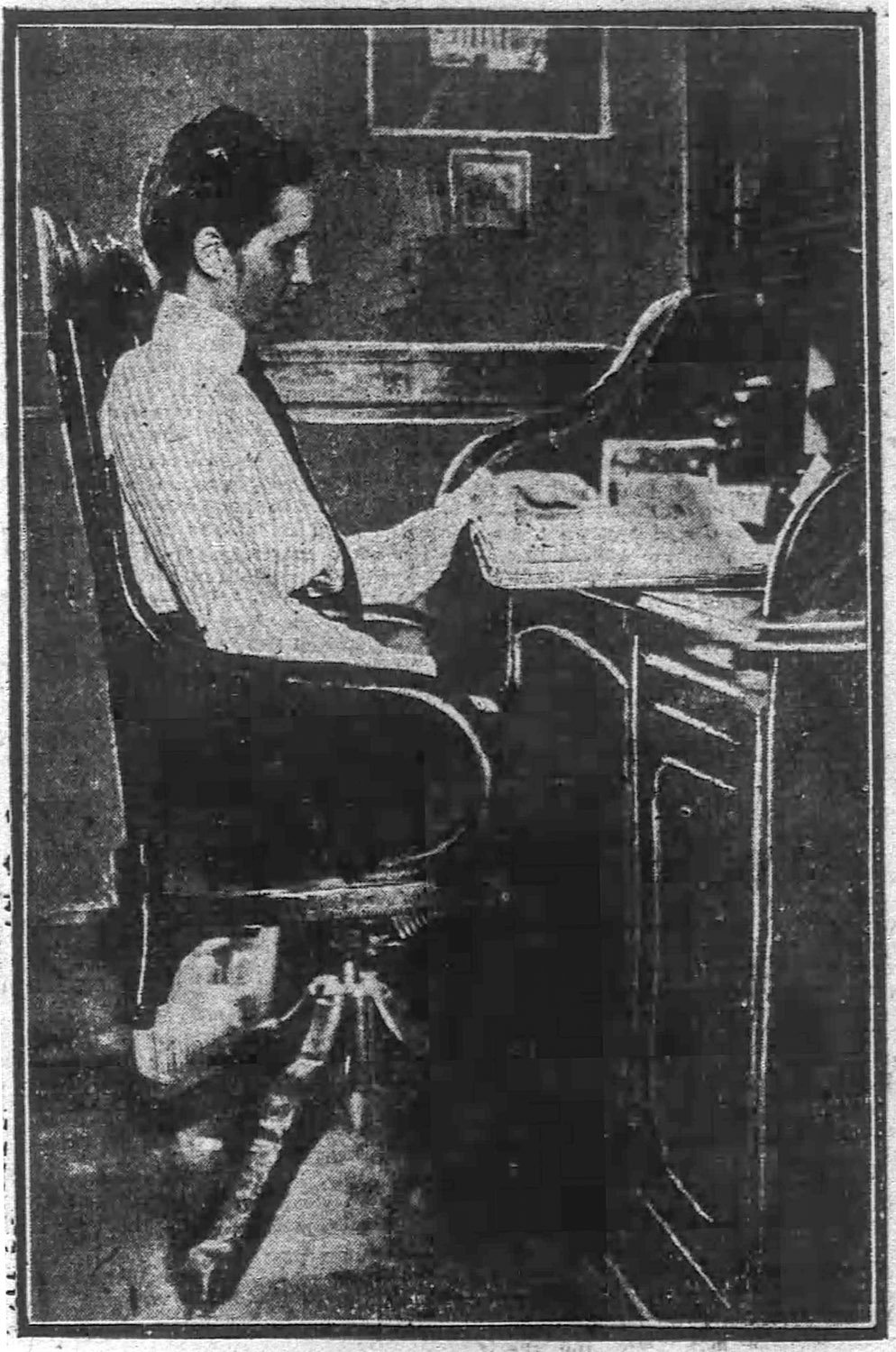
Certainly she seemed to have sunk the woman in the architect during business hours at least. Her desk, a big roll-top with a hundred pigeon-holes, was well covered with papers and plans. I took a peep at a stack of magazines on the corner and instead of fashion plates and The Ladies’ Home Journal, I found only The Architectural Record and The Engineering Review. There were no Christy sketches on the wall of her office in the Peters building, but a dozen front elevations of handsome buildings, a glimpse or two of the Parthenon and the Coliseum and, in the place of honor over the desk, a big plate of the Boston Atheneum.
No, she isn’t an imported product. Boston furnished some of the science, but Miss Dozier is of the South Southern. You couldn’t chat with her for five minutes without learning that. But she would rather talk of her work than her personality, anyway.
She’s Building Nelson Hall.
“The biggest thing I ever tackled?” repeated the woman architect after a question. “Why, that, I suppose,” pointing at a drawing on the wall. “That” was an elevation of Nelson Hall, the splendid Episcopal school for girls which is soon to be erected on Peachtree-st. by Bishop C.K. Nelson and his diocesan workers.
“That’s been keeping me pretty busy lately,” she continued. “Nice of them to give me such a fine piece of work, isn’t it. Yes, it’s Tudor architecture. It’s going to be very handsome.”
“But I’ve built all sorts of things. There were some little houses at first—you know a beginner takes what she can get—but that was a long time ago. I’ll take a contract for any character of structure, factory, church—I’ve built several churches—homes, but I like the big things best, of course.”
“Do you really get out in the weather and climb over the half-finished buildings and boss contractors and all that sort of thing?” I was wondering if this neatly groomed woman had her troubles with workmen like ordinary folk or if she did all her directing from a steam-heated office.
A Woman as a “Boss”.
“Of course,” she replied. “No, I don’t ‘boss’ anybody much. That isn’t necessary. Every contractor I have known—with one exception—has been nice to me. All I need do is show them what I want.”
Miss Dozier smiled as she recalled the exception. A contractor had used some inferior laths against her express direction. There had been a letter or two, a telephone message, an ultimatum from the architect—and those laths came off again and new ones went in their place. The recollection seemed to amuse her.
“Sometimes they think a woman doesn’t know,” resumed the architect. “I drew plans for a big factory not long ago and had the weights all supported by—” (here she gave a brief but graphic description of her plans.) “The owners insisted that the idea wouldn’t do. No mill had ever been built that way, therefore it wasn’t the right way. And now, right in that late magazine, I find a big factory of the same kind using exactly the same idea I proposed. I’m glad to be vindicated—tho I knew I was right all the time.
“Women clients? No, they are no more trouble than the men. No, I can’t say that women are any more disposed to give another woman work than are the men. You remember I told you men and women were mightily alike. I’ve done lots of work for both.“
And then Miss Dozier begged me to excuse her a moment while she stopped for an animated discussion with a contractor whom she had summoned by phone. The cataract of technical terms that overflowed from the inner office while they bent over plans and blueprints gave me a feeling that I’d been trying to talk a strange language, and I slipped away.
She’s Not the Only One.
But Miss Dozier isn’t the only woman architect in Atlanta, even tho she is perhaps the best known, a natural consequence of her seven years’ service here and her degree from the American Institute of Architects. Just below her in the same building on the third floor, is the office of Miss Leila Ross Wilburn, a young woman who was too busy with pencil and compass when I entered to give much more than a pleasant smile and a promise of a talk some other time. Miss Wilburn, who lives in Decatur, has graduated from drafting for other architects into a nice business of her own, and has pluck and energy enough to accomplish wonders. She did the Goldsmith apartments on Peachtree and Eleventh-sts., the fine gymnasium at the Georgia Military academy and the academy’s Y.M.C.A. chapel and recreation halls, and has successfully completed a number of Atlanta buildings.
And there’s still another—a woman who draws plans and builds houses for herself. I met her in Inman Park, where she was making a hard-headed carpenter hang a door according to her ideas instead of his own.
“Are you an architect?” I asked.
“No,” she said. “I’m a lawyer, and if you write me up in the paper I’ll sue you.”
She wasn’t deceiving me. She really is a full-fledged lawyer, and builds houses merely because she likes the work and the results. But remembering her threat, I’m not going to write her up, not even give you her name.16
References
“Nelson Hall, The New Episcopal School”. The Atlanta Constitution, March 19, 1910, p. 7. ↩︎
“Bishop Nelson Will Head School For Young Women”. The Atlanta Journal, July 13, 1909, p. 3. ↩︎
‘”Nelson Hall” Charter Granted By Court’. The Atlanta Constitution, July 14, 1909, p. 7. ↩︎
“History of All Saints’ Parish and Church Just Complete”. The Atlanta Constitution, April 8, 1906, p. 2. ↩︎
“All Saints’ Episcopal Church Will Be Formally Opened This Morning With Beautiful And Impressive Service”. The Atlanta Journal, April 8, 1906, p. S1. ↩︎
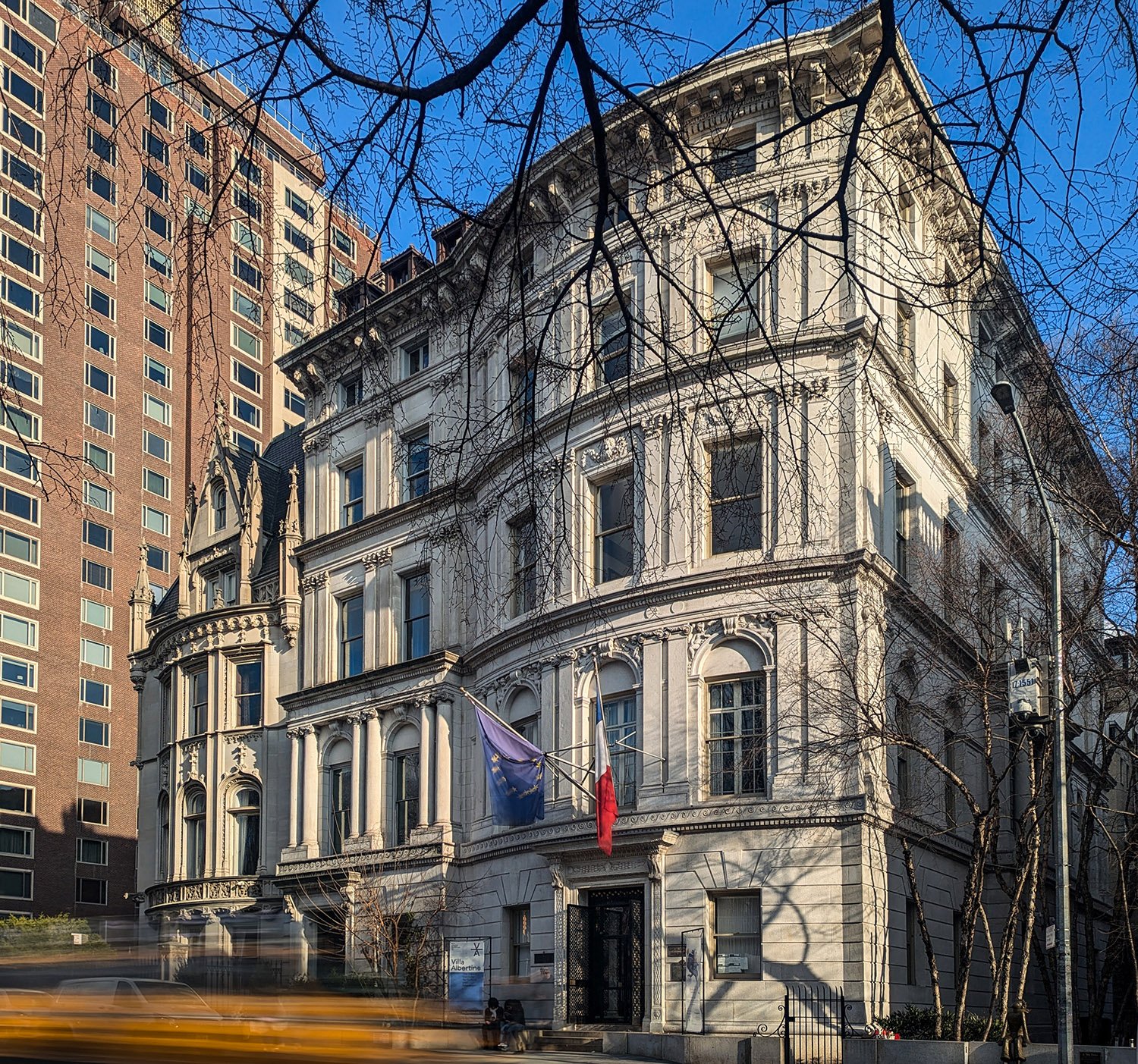
Stanford White of McKim, Mead & White. Henry Cook Residence (1907, left) and Payne Whitney Residence (1907, right). New York.
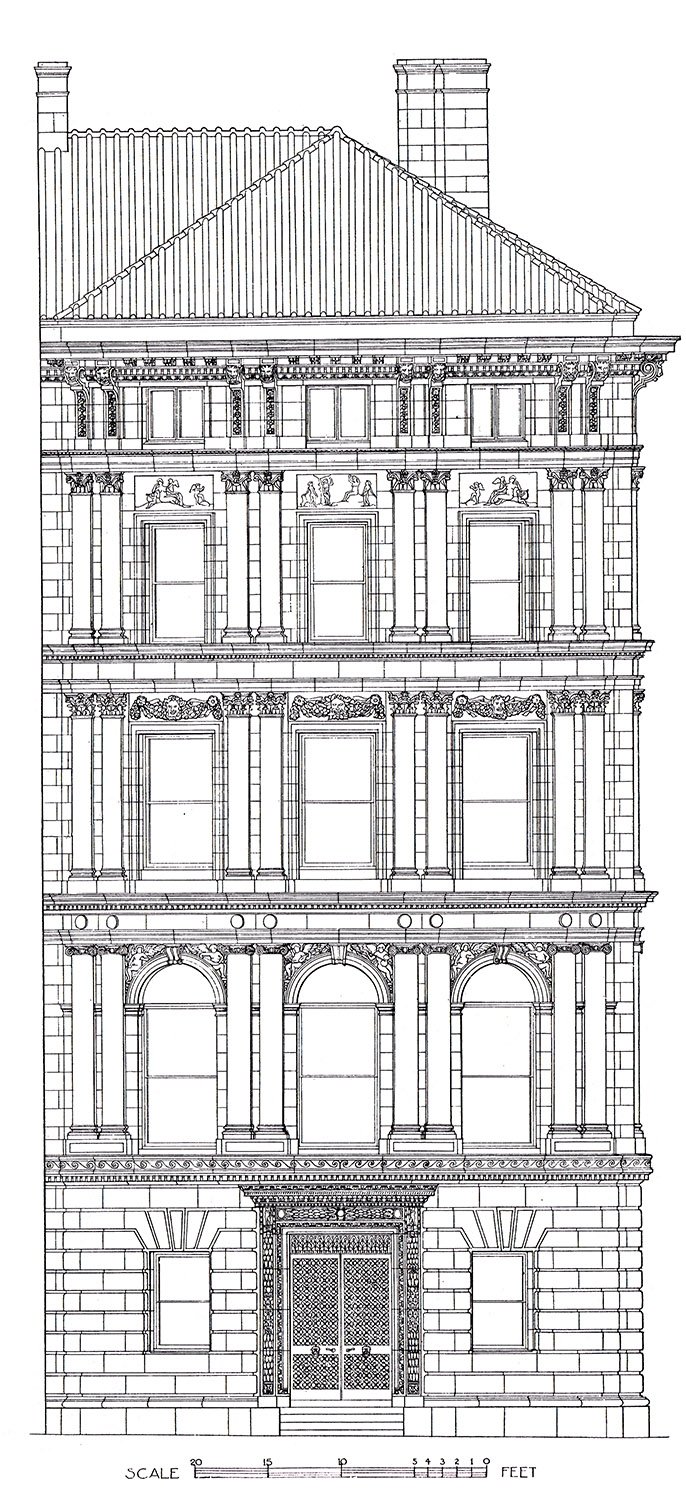
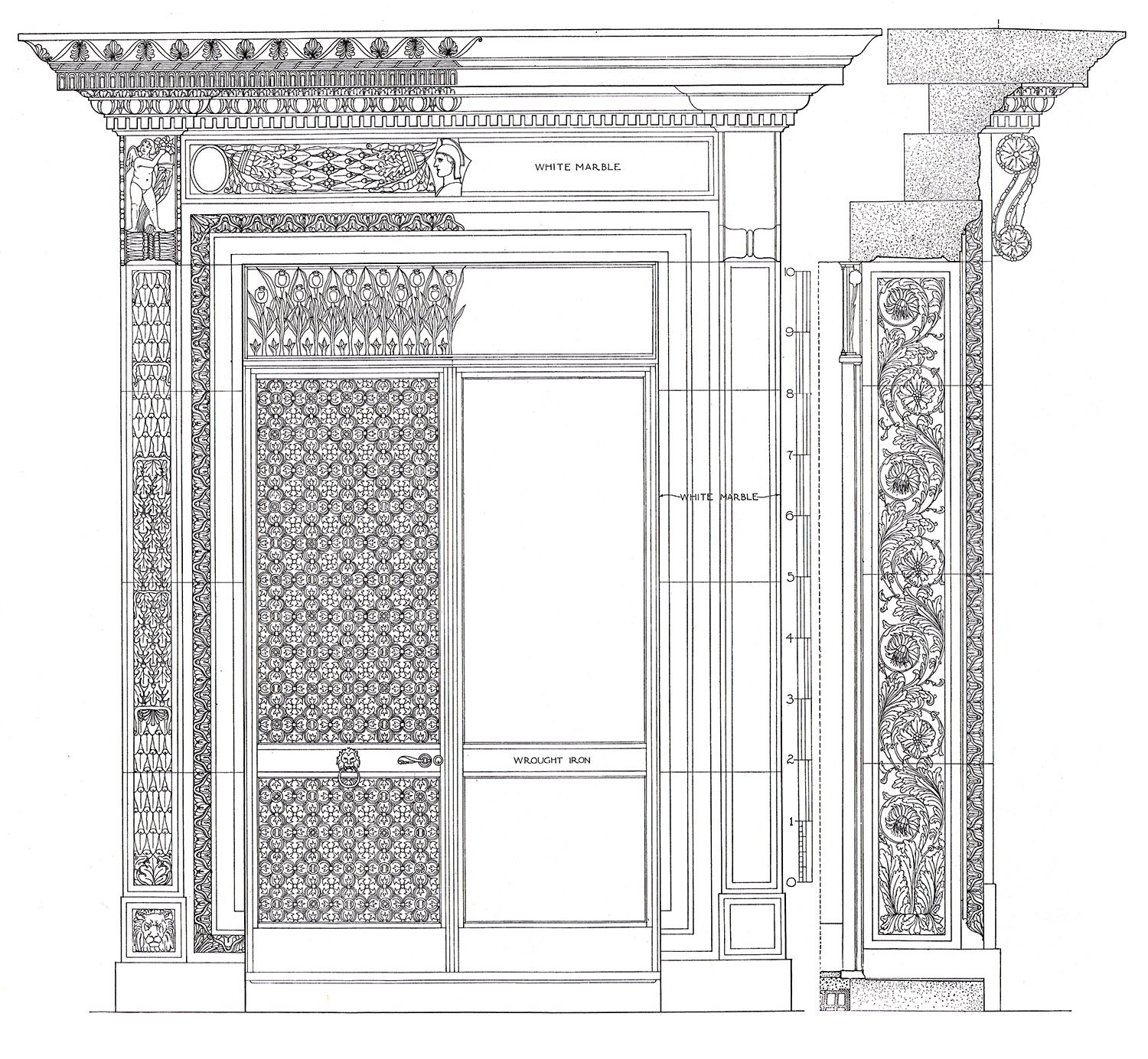
You’d be forgiven for thinking these two homes overlooking Central Park are actually one.Stanford White (or his assistants, more like it) designed the residences simultaneously, cladding the exteriors in elegant white Vermont granite and matching them with the same stacked Classical orders.1
Location of the Henry Cook and Payne Whitney Residences
They aren’t my favorite projects by McKim, Mead & White: the firm’s work had become quite derivative by 1907, and the designs here feel overprocessed, as if sketched and refined by too many different hands. It doesn’t help that White was murdered before the homes were completed.
What makes this pair of structures important, though, is that they are among the handful of old mansions that survive in New York. Built too late for the Gilded Age, they were nonetheless conceived in its shadow—remnants of an era that will never return.
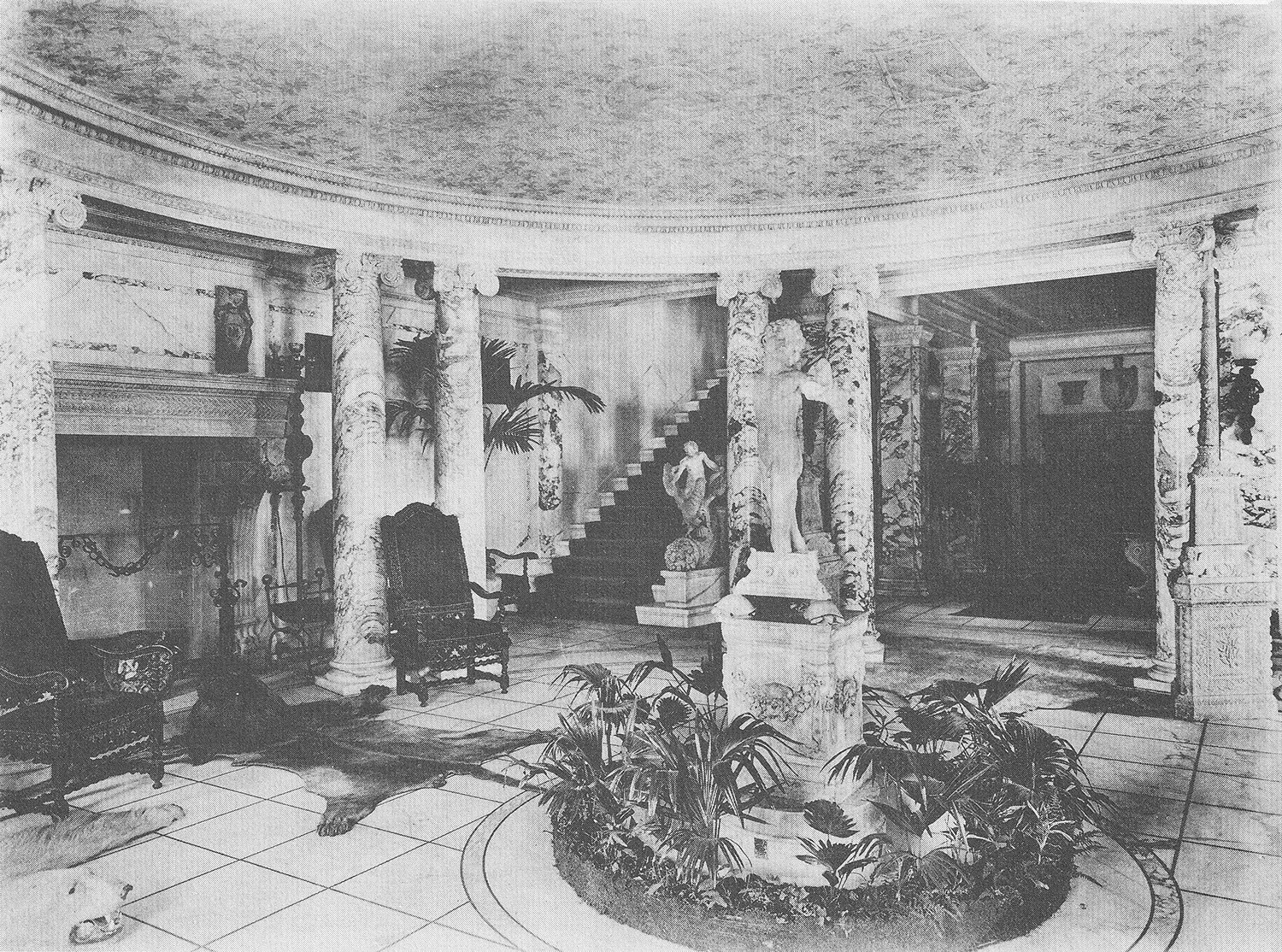
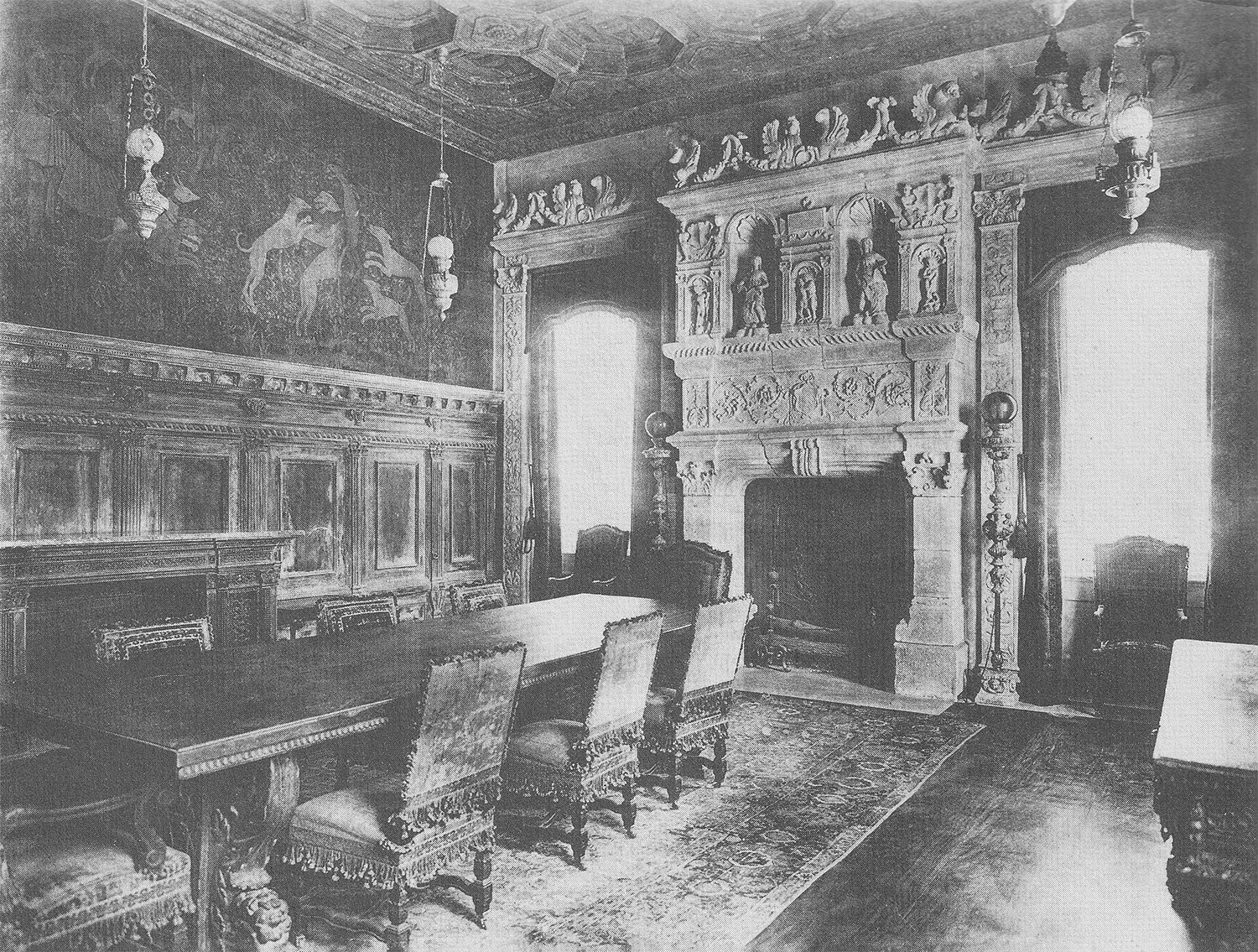
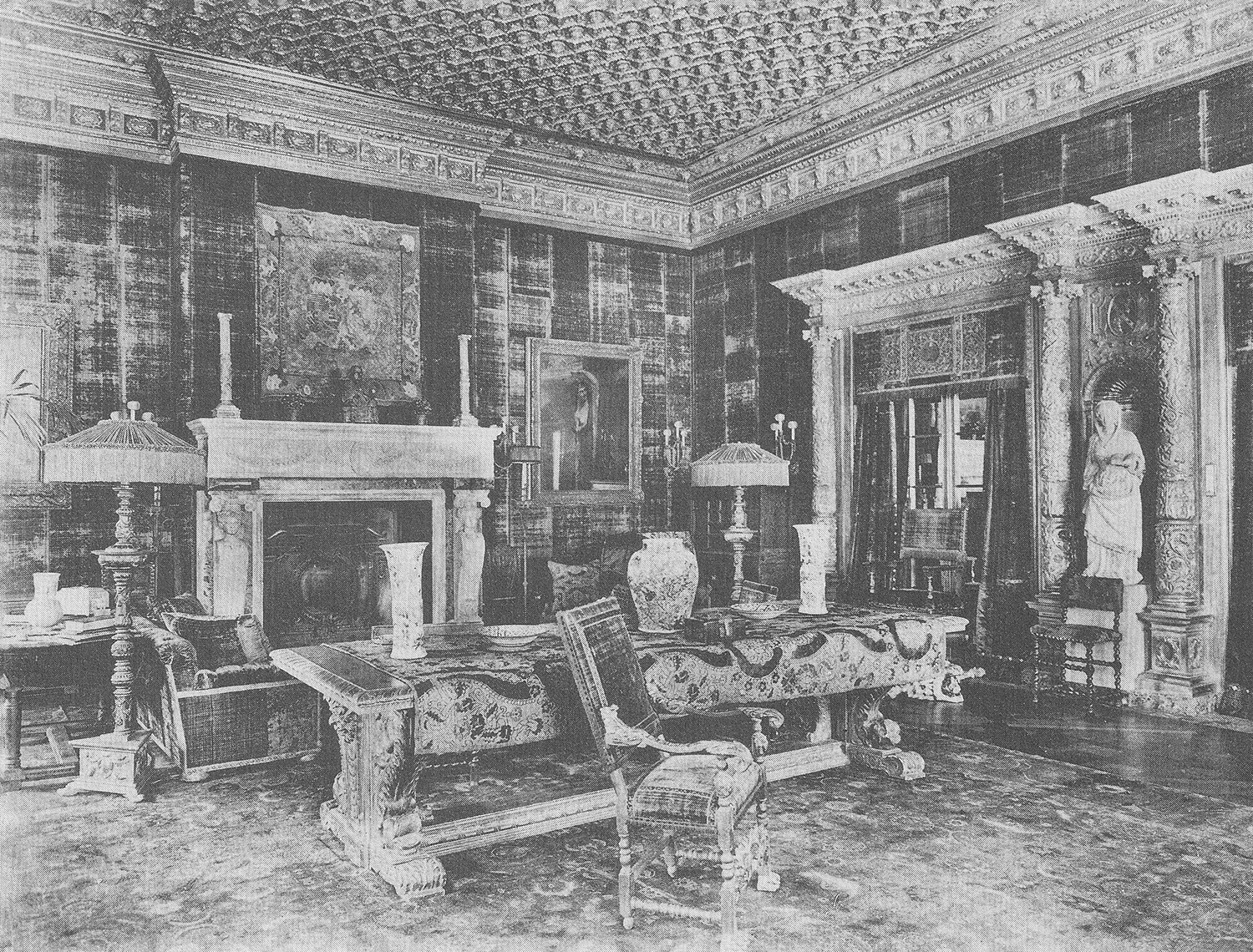
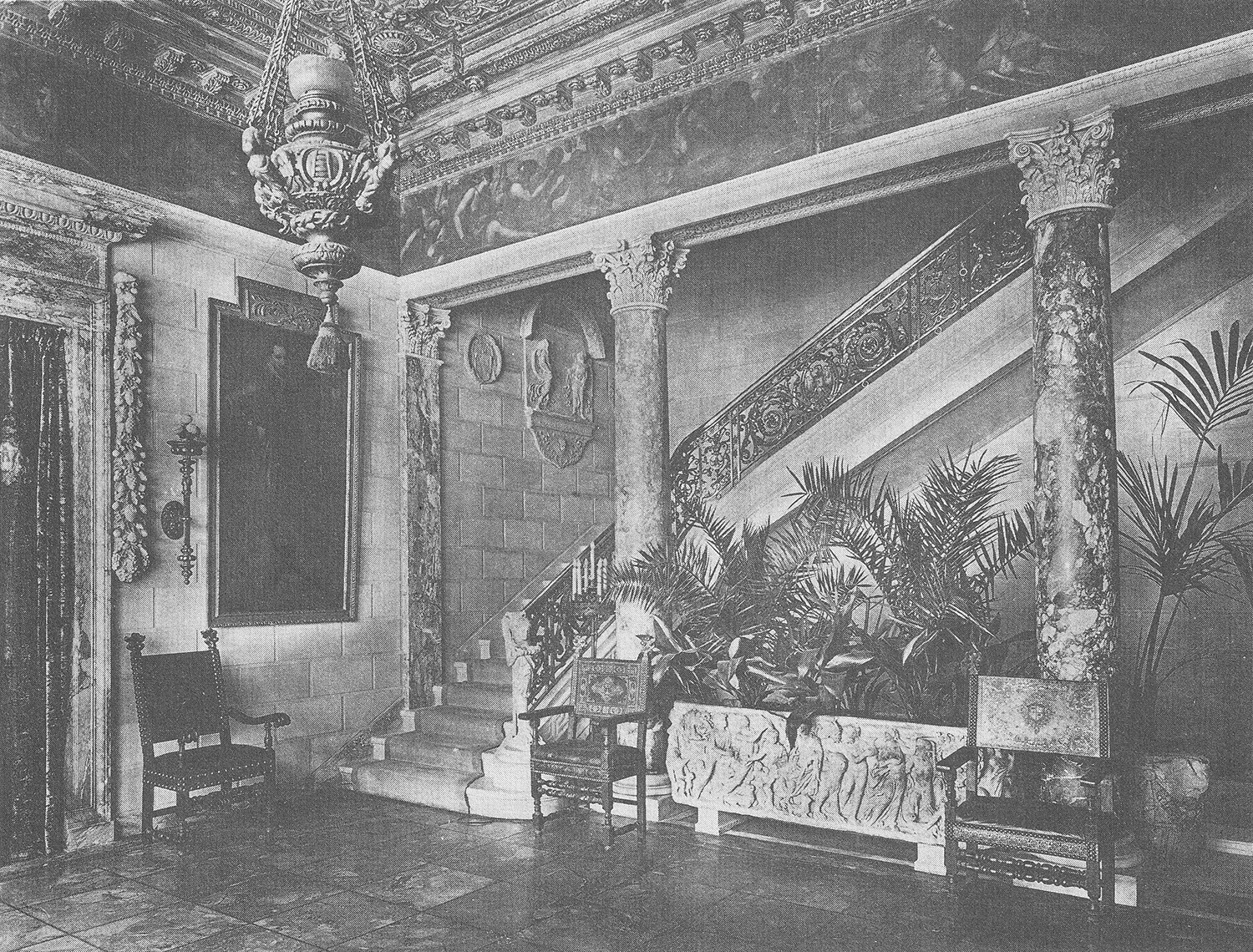
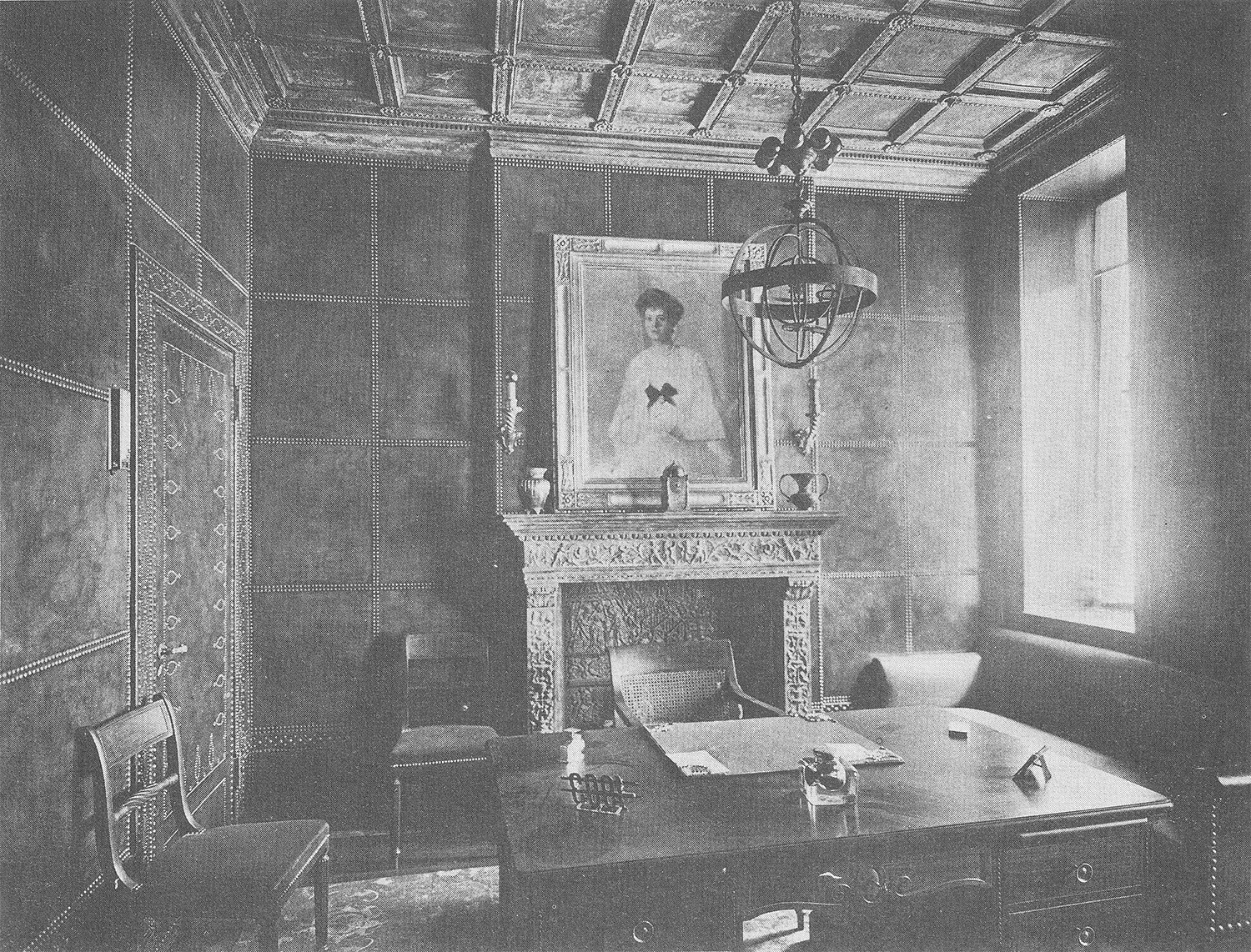
Entrance hall of the Payne Whitney Residence, New YorkDining room of the Payne Whitney Residence, New YorkLiving room of the Payne Whitney Residence, New YorkStair hall of the Payne Whitney Residence, New YorkOffice in the Payne Whitney Residence, New York
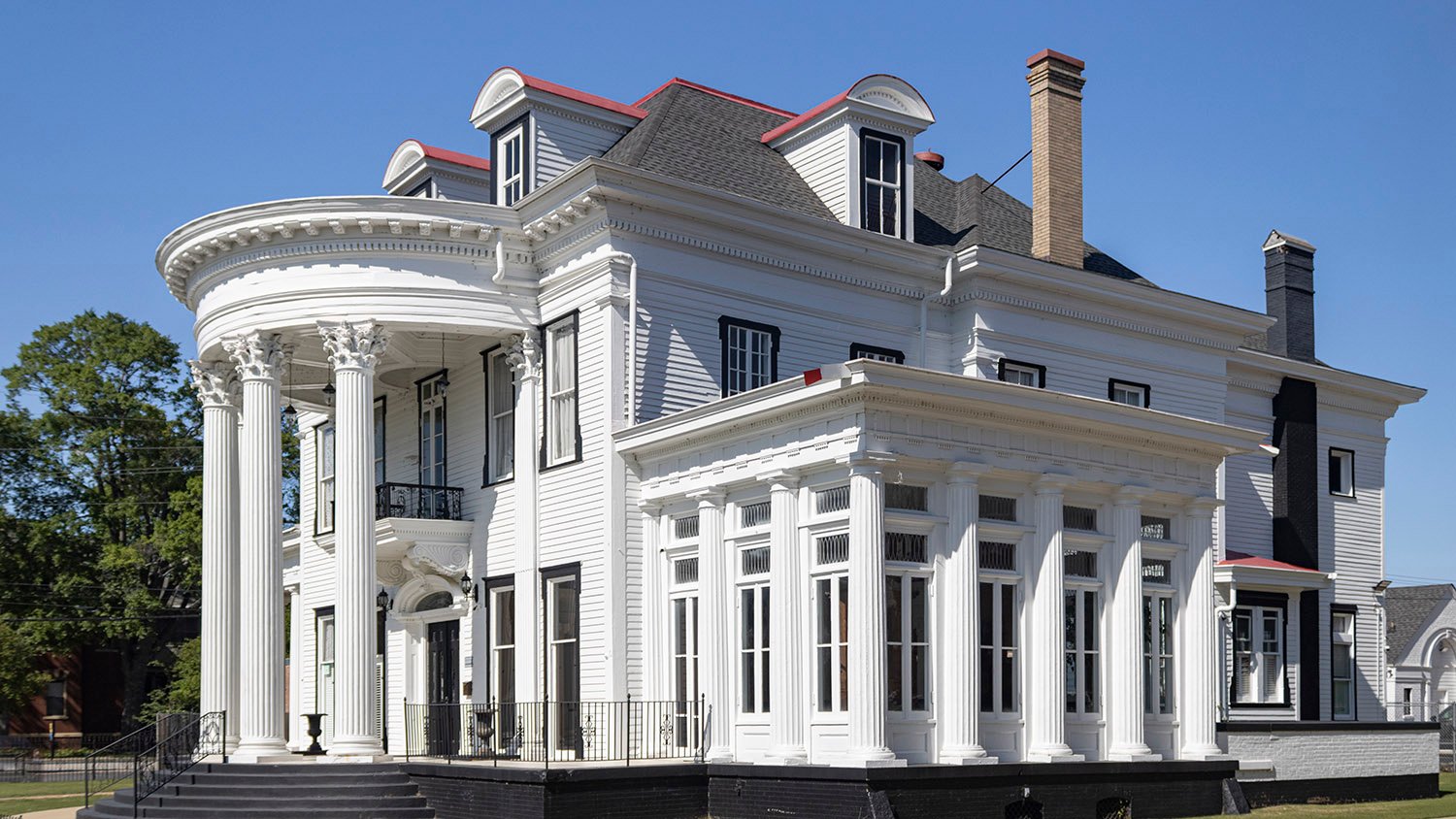
Henrietta C. Dozier. John Blackmar Residence (circa 1910 renovation and expansion). Columbus, Georgia.123
The Background
The following article, published in The Atlanta Journal in 1908, features an interview with Henrietta C. Dozier (1872-1947), the first female architect in Atlanta and the Southeastern United States.
In 1908, Dozier was chosen by the Atlanta chapter of the American Institute of Architects as its delegate to the International Congress of Architects in Vienna.
Dozier padded out her visit by spending four weeks in Paris, followed by visits to Venice, Florence, Rome, Naples,456 and other destinations.
A European excursion was an obligatory rite of passage for any American architect of the era—at least, those who were serious about the profession.
The United States was then in the throes of the Beaux-Arts movement, and architects were expected to draw inspiration from the works of their European forebears.
“Strange to say, the architecture of Europe did not particularly interest me,” Dozier later recalled in a 1939 interview, which mirrored her remarks here.
The writer of this article (also a woman) wanted an architect’s impressions of Europe, and she got them—Dozier found Vienna “disappointing” and Brussels “not very interesting”.
On the flip side, she thought Antwerp was “perfectly fascinating” and enjoyed the fashions of the “chic Parisiennes”, although she barely mentioned Paris’ architecture. Priorities.
Dozier inserted some interesting observations about American indifference toward architecture, and she pointedly criticized the preferential treatment given to her male colleagues at the conference:
“I don’t mind adding that the men had altogether the best of it when it came to getting particular good from the congress, as on especial meetings the women were packed off on some excursion…”
Given her unorthodox character, it’s entirely fitting that Dozier broke away from those excursions (“I did my own sight-seeing in my own way…”), and that she got “forbidden snapshots” with her Kodak camera “in spite of the signs and guards”.
My kind of woman.
Miss Henrietta C. Dozier, Architect, Talks of Congress in Vienna
“I have been interviewed several times and I don’t think the interviewer ever got what he wanted from me.”
This from Henrietta Dozier, architect, in answer to a question regarding her recent trip abroad.
[Reporter:] “Perhaps I am not as hard to please as those others; I only want to know something about the purpose of your journey.”
[Dozier:] “I was a delegate to the National Congress of Architects which met in Vienna, a congress representing Italy, France, Germany, Russia, England and America. There were about five hundred delegates, several hundred of them women. I don’t mind adding that the men had altogether the best of it when it came to getting particular good from the congress, as on especial meetings the women were packed off on some excursion about the town or its environments. None of that for me, however. I did my own sight-seeing in my own way and got a world of good out of my half loaf of travel. As for the purpose of the congress it is primarily to arouse greater interest on the part of the different governments for a purer architecture to appoint a commission by the government to make laws whereby it will be impossible for an unsightly building to be built by one ranking in the thousands; to have some rules so that in time each country will show not only a few perfect buildings but that there will be a harmony in the whole. It seems a gigantic undertaking but in Europe architects have an important share in the making of the cities and in the brighter and more hopeful interest taken in civic improvement it may not be long before they will come into their own in America.”.
“What do I think of Vienna? I found it disappointing. It is all so new—the best of their buildings are modeled from the classic—there is nothing original in them. The best thing except for St. Stephens‘, are the new parliament buildings, but they are distinctly similar to the new university at Athens, and Greece has accomplished nothing better than the ancients and know enough to cling to their ideals. St. Stephens’ is delightful and quite, to my mind, the best thing in Vienna. The rest of the city I found German,” (which, parenthetically, would arouse the ire of both Austrians and Germans could they hear it.)
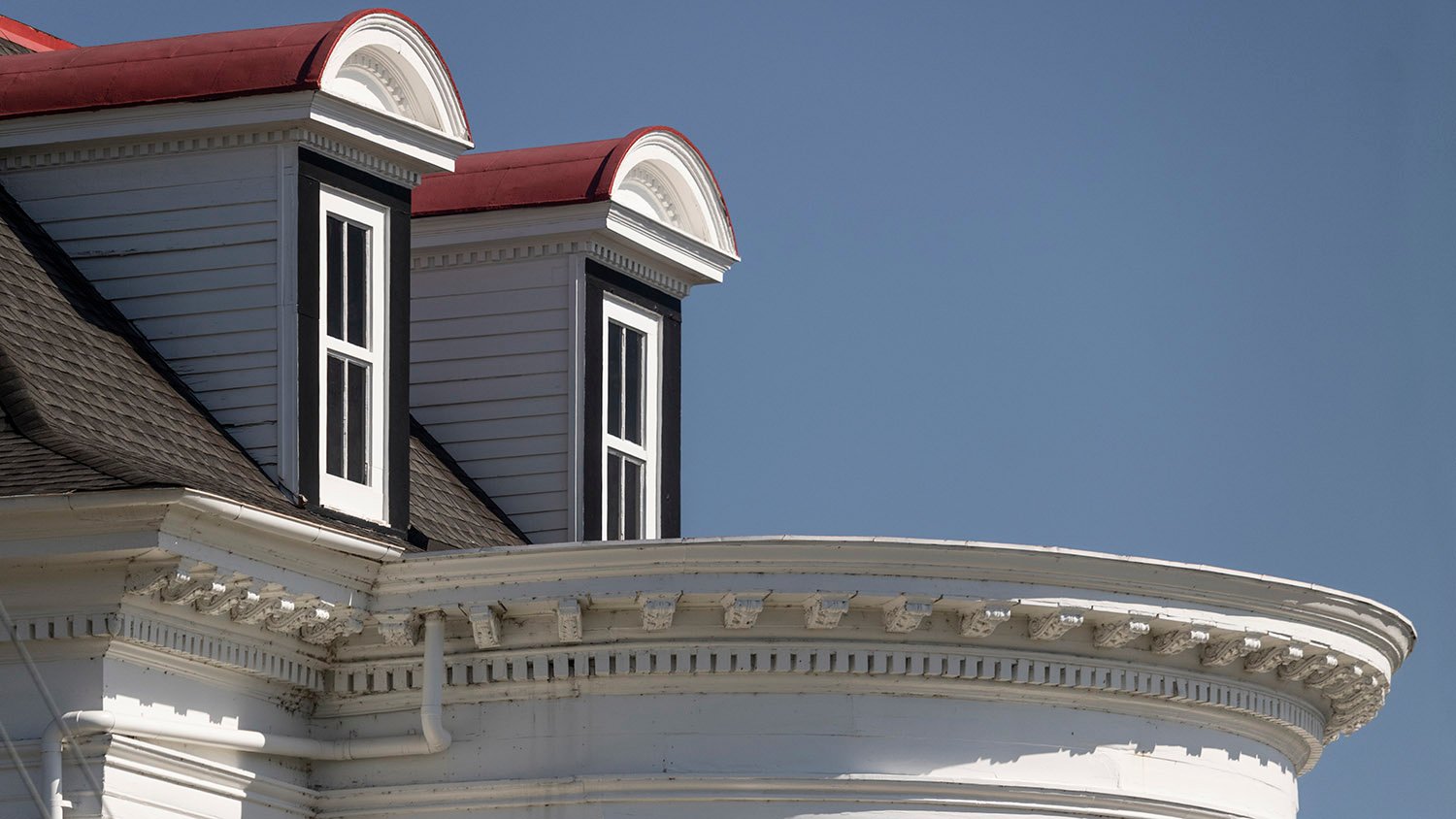
Dormers and cornice on the John Blackmar Residence, Columbus, Georgia
Miss Dozier, builder though she is, in brick and stone, is not above a weakness for the creations in less lasting fabrics, and confesses to a keen admiration for the chic Parisiennes and fashions of the Rue de la Paix, Paris.
But in Paris she found the best in architecture.
“They are clever, those Frenchmen, nobody is their equal in planning and proportion. One of the finest things I have ever seen in my life is Napoleon’s tomb, and it took a Frenchman to do it—that marvelous management of lighting, the effect of moonlight gained by the use of pale yellow and blue glass there is nothing like it in the world. It is only in their detail that they overdo. I don’t understand why they do it. Planned and proportioned perfectly they will stick a lot of silly detail on that will come near to ruining their entire piece of work.”
“Perhaps that is as characteristic as the stolidness you find in German architecture.”
“Perhaps it is the super adornment, the ornateness, the extra trimming both in manner and building, but oh, they are so clever.
“I saw an architectural exhibit in the Salon and there was nothing like it for beauty of outline or plan.”
“No the Salon was not particularly interesting. Of course there were some good things, but I was surprised at the acceptance of some of the pictures; they were far below the usual standard.”
[Reporter:] “That wouldn’t be if all artists had the ideals of Monet.”
“No, indeed, it must have taken nerve to destroy £20,000 worth of pictures without taking into consideration the time and effort he must have put into them. Coming back to architecture, it hurts so to see the prevailing indifference of America to what architecture really means, so little realization of what a telling criticism a building of stone is on generations of the past. How ignorance endures in stone and how, when well done, what a monument to knowledge and culture.
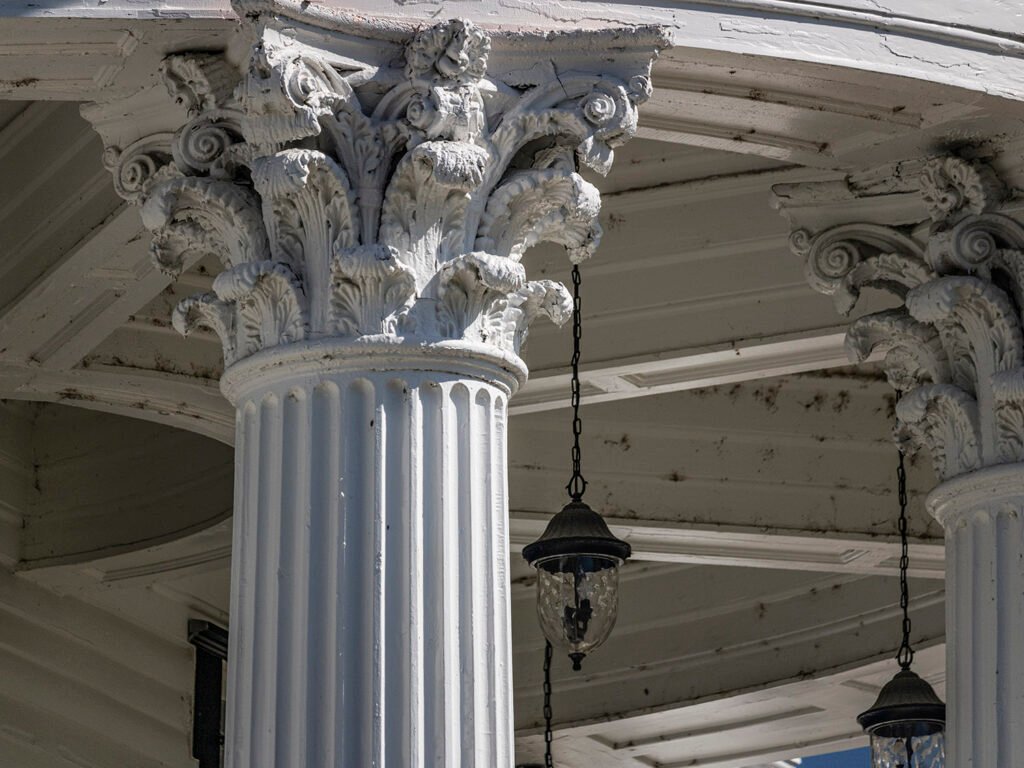
Corinthian capital on the John Blackmar Residence, Columbus, Georgia
[Reporter:] “Don’t you think, architecturally speaking, that the south has deteriorated since the [Civil] war instead of growing?”
“Oh, no; not at all, the people as a whole, are building better and more harmonious homes than ever before.
“Of course in the ante-bellum south the homes were modeled, many of them, from places already old when America was young. Built by men who wanted to bring with them the atmosphere of England to the new world—cultured students—men who knew the difference between cornices and capitals and who knew better than to confuse Gothic with Doric. A great deal of trouble comes from magazines. Not that I wish to underrate the undeniable good that magazines do, for they do a great deal in bringing to the people a broader, better view on homes and home surroundings. If the readers were only educated enough to differentiate between the bad and the good. But a little knowledge is as dangerous in architecture as it is in most things and people who have not made it a study and who wish to build would do well to leave it some one who has made it a specialty. Atlanta has made a great stride forward in the appointment of a civic improvement commission and we can hope for a more beautiful, a more harmonious Atlanta.
“And it is along these lines that the commission of the International Congress is working.
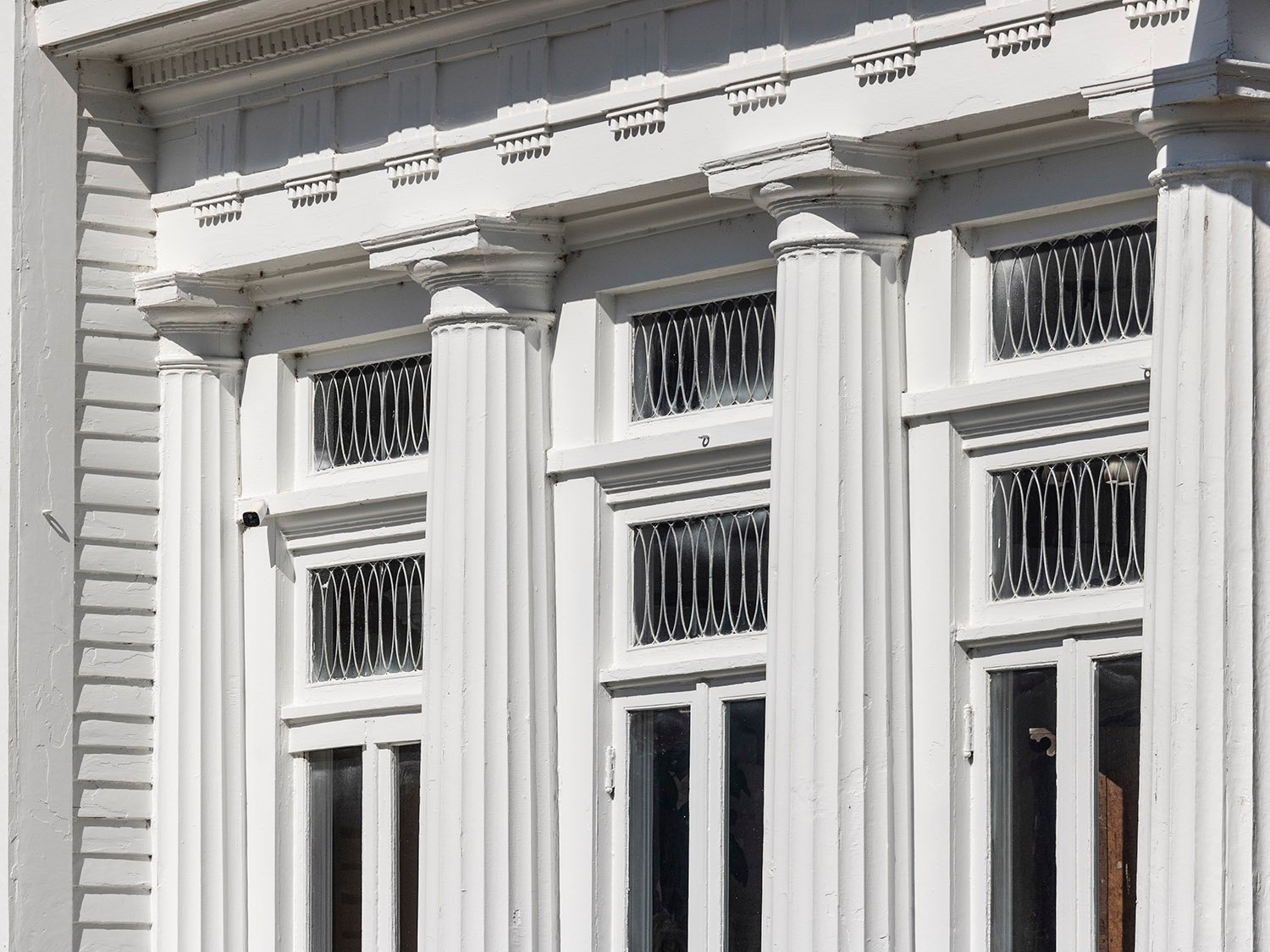
Enclosed porch on the John Blackmar Residence, Columbus, Georgia
“The meeting in Vienna was the eighth which has been held and there were delightful social features in connection with the more interesting business ones. A reception at which Frances Joseph [sic] entertained the delegates, another charming one at Sehonbrun [sic], the summer palace, carriage drives on the Ringstrasse [sic] and out into the Danube valley and a number of formal affairs at private homes.
“About the rest of my trip? There was the landing and a stay of several days at Antwerp that I found perfectly fascinating. Antwerp is a place you could stay and long time in and not get tired of it. Then from there to Brussels which is not very interesting to me, and I only stayed for a short time on the way to Paris, where I spent three weeks, and to where I am going back at my first opportunity. Basle was attractive and I had a delightful stay in Salzburg and Munich, then Linz, where I took the boat for Vienna on the Danube. From Vienna I went to Venice, Rome and Naples from which point I sailed. It was a nice half-loaf, but it made me hungry for the other half, and the next time I go I hope to stay longer and see more.”
Miss Dozier took a number of interesting kodak pictures and in spite of the signs and guards, got views of San Angelo, interior details of St. Peter’s and a series of forbidden snapshots in the French capital.
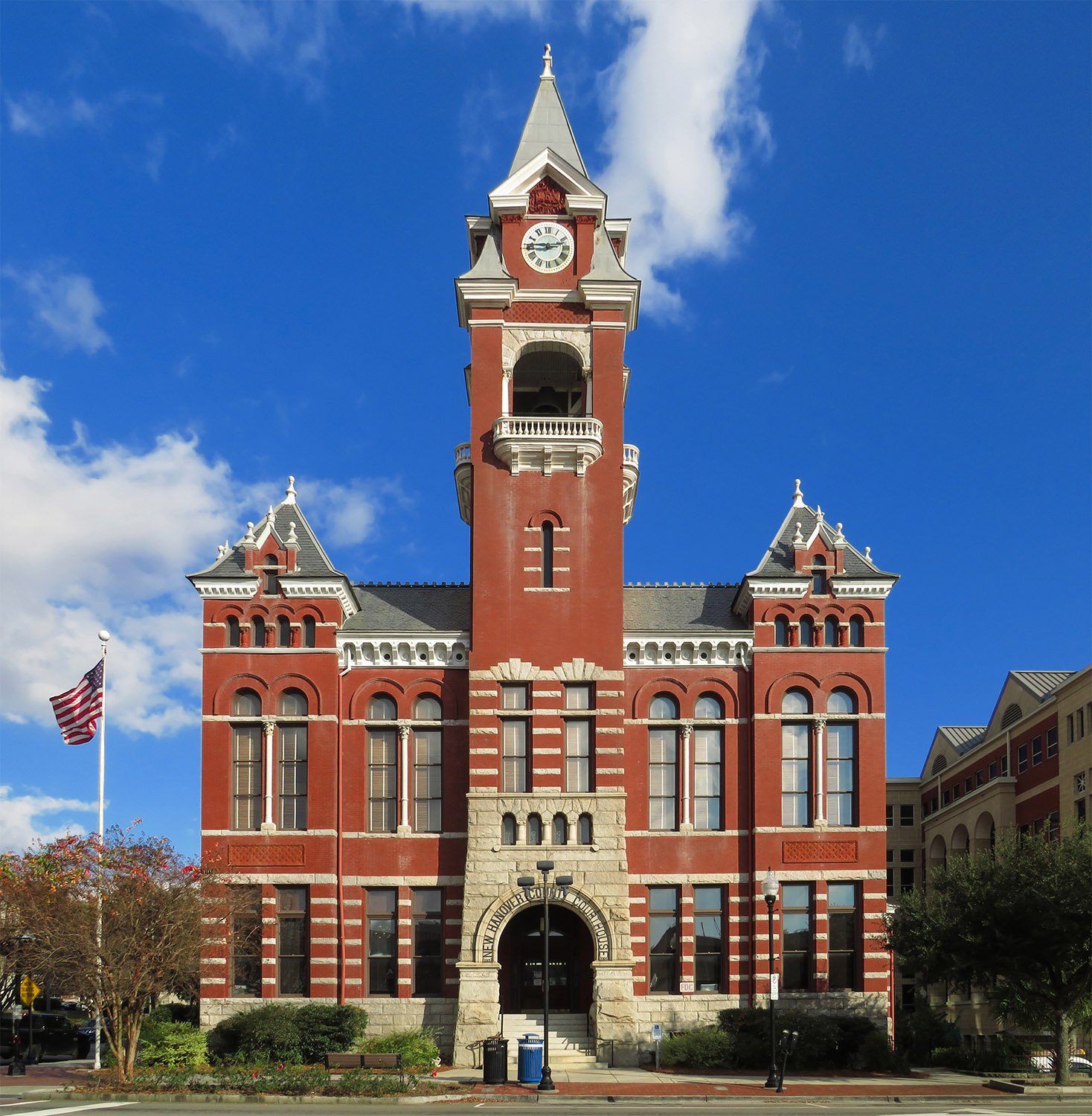
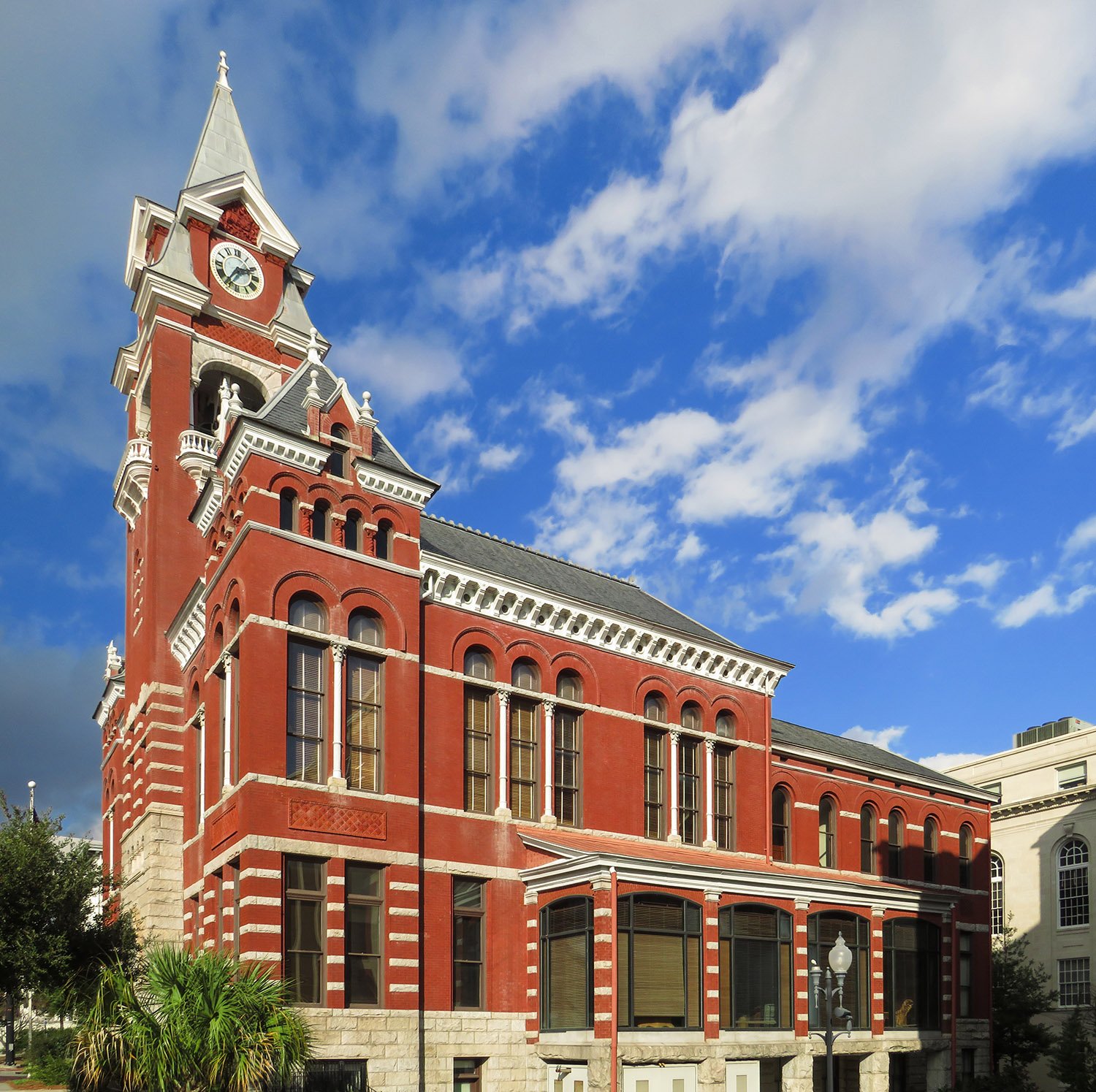
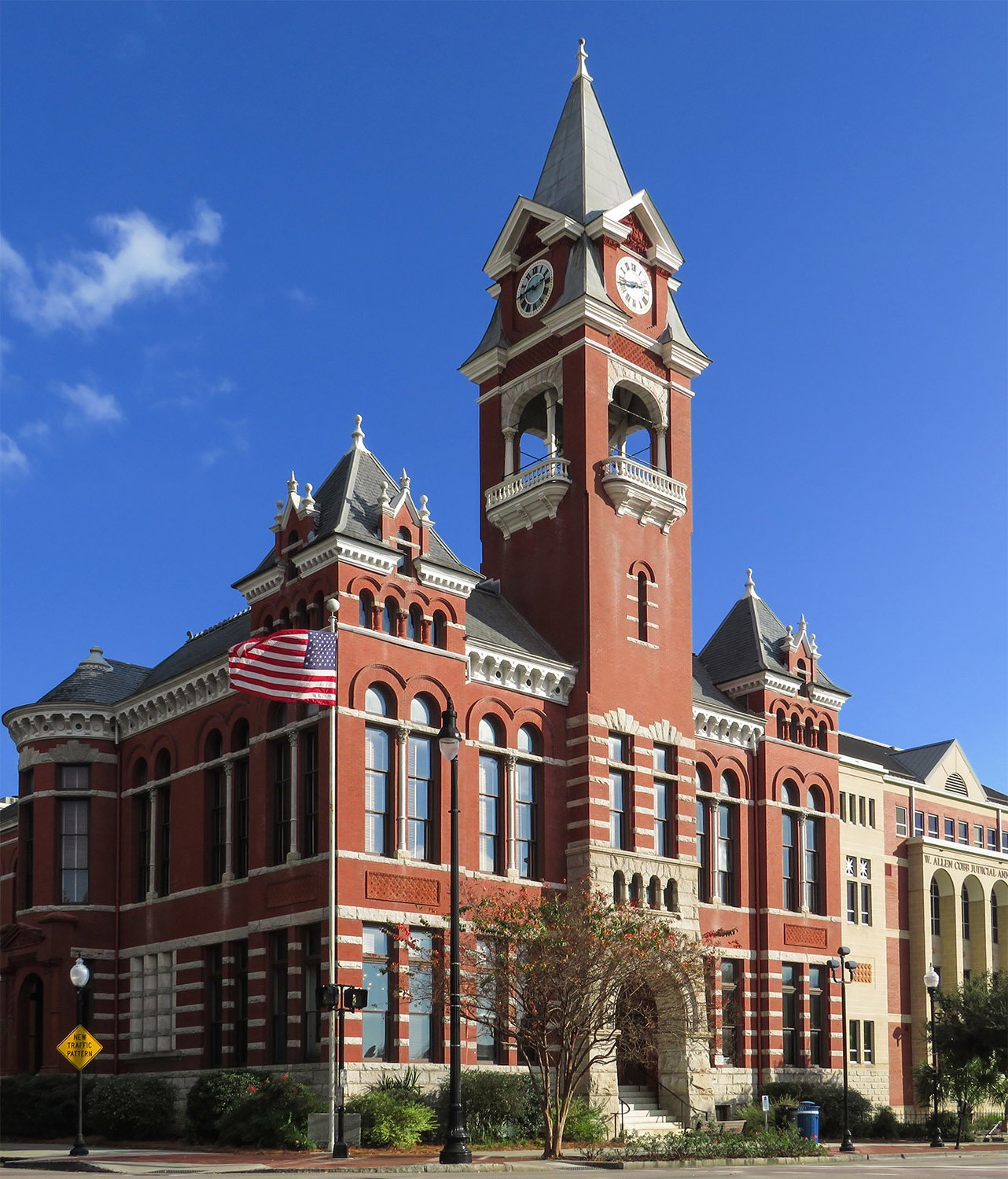
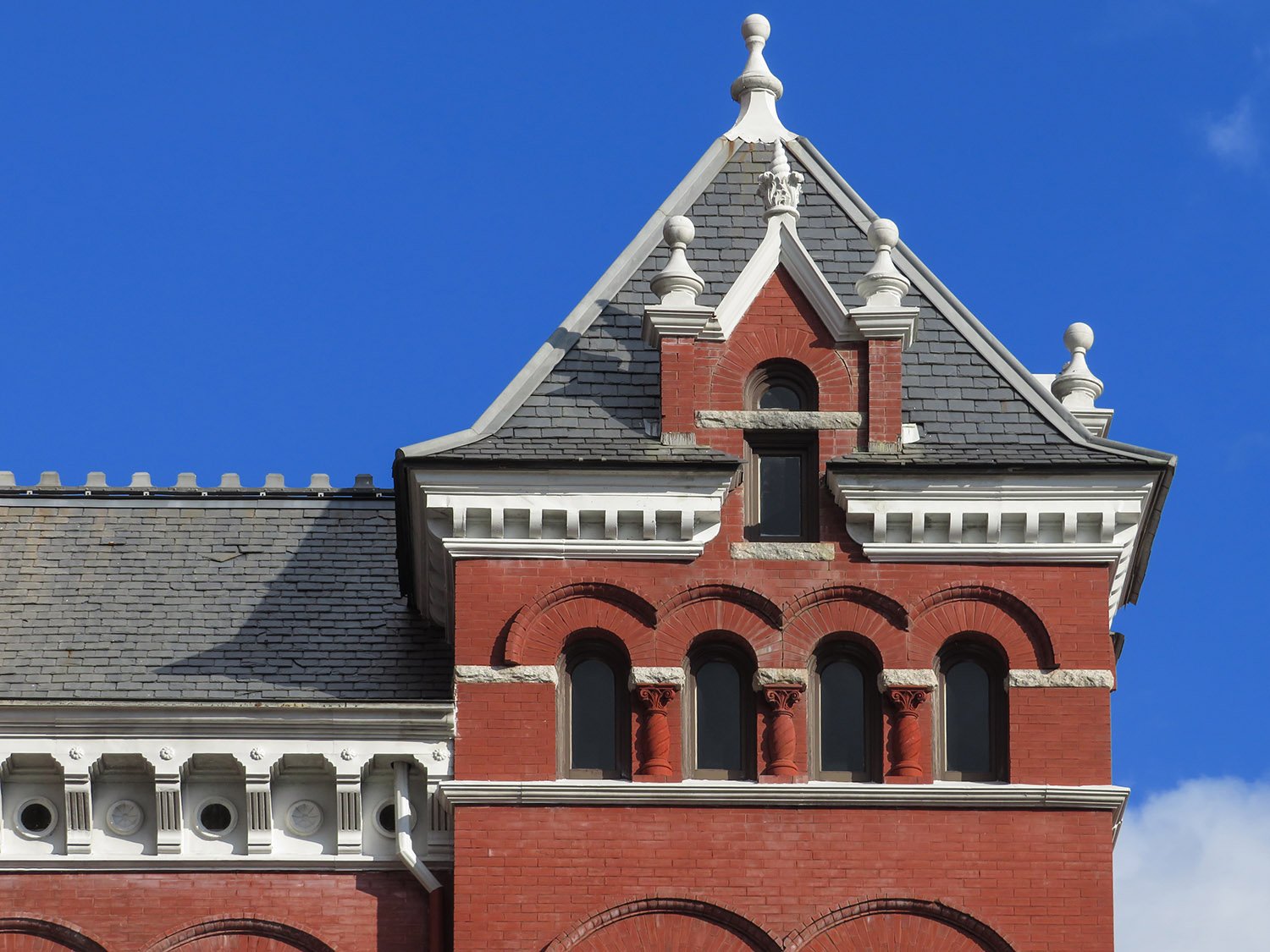
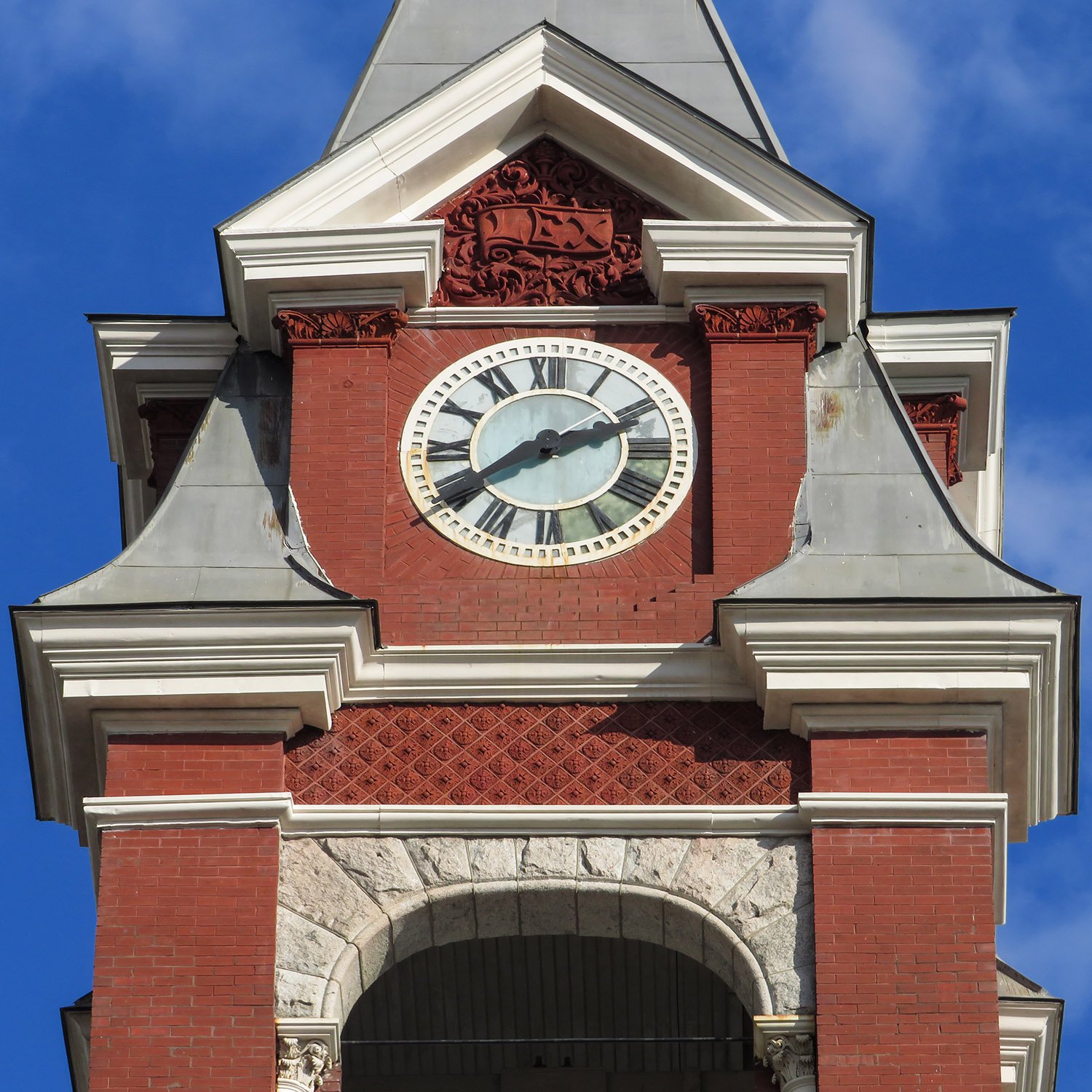
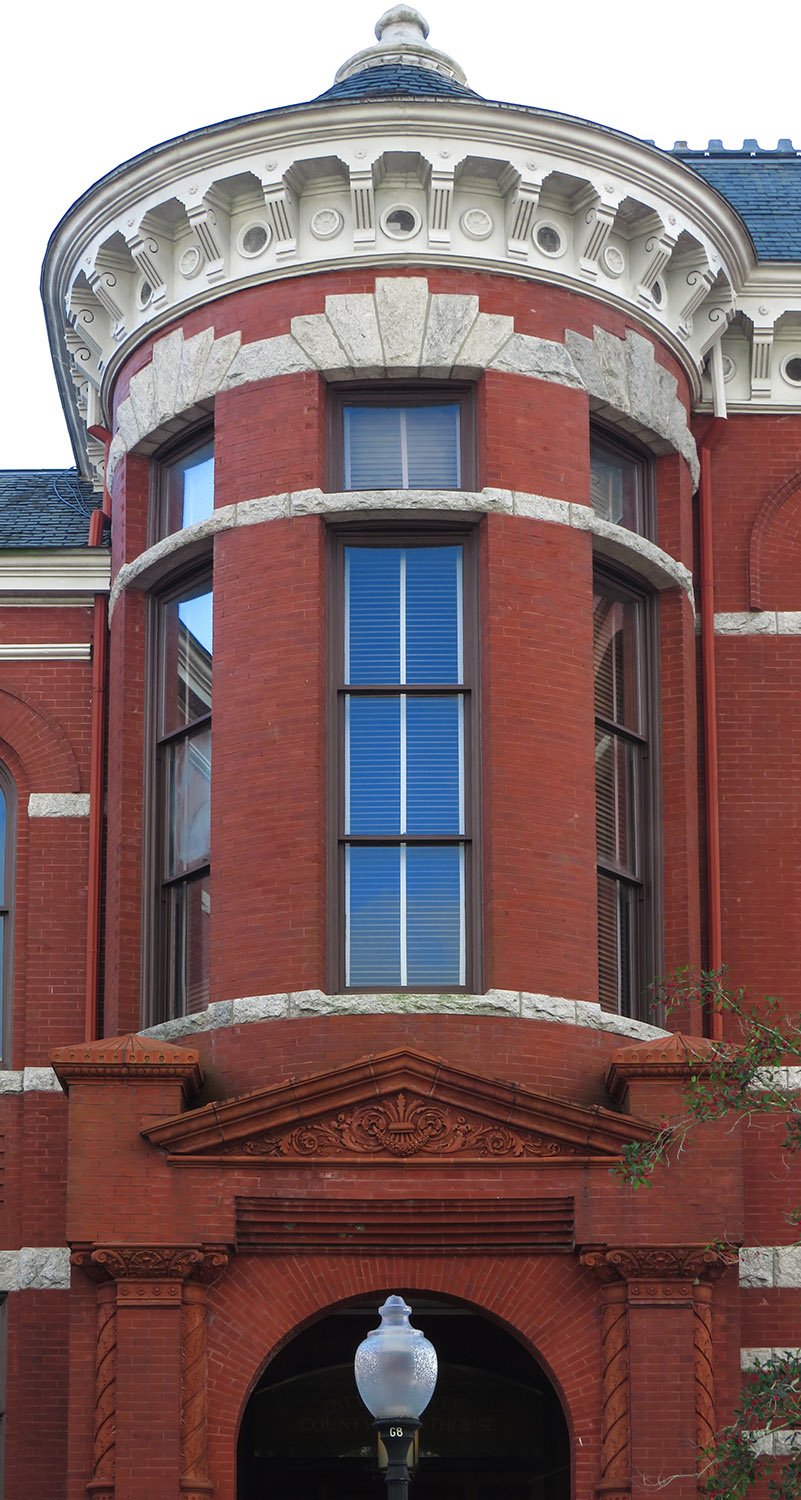
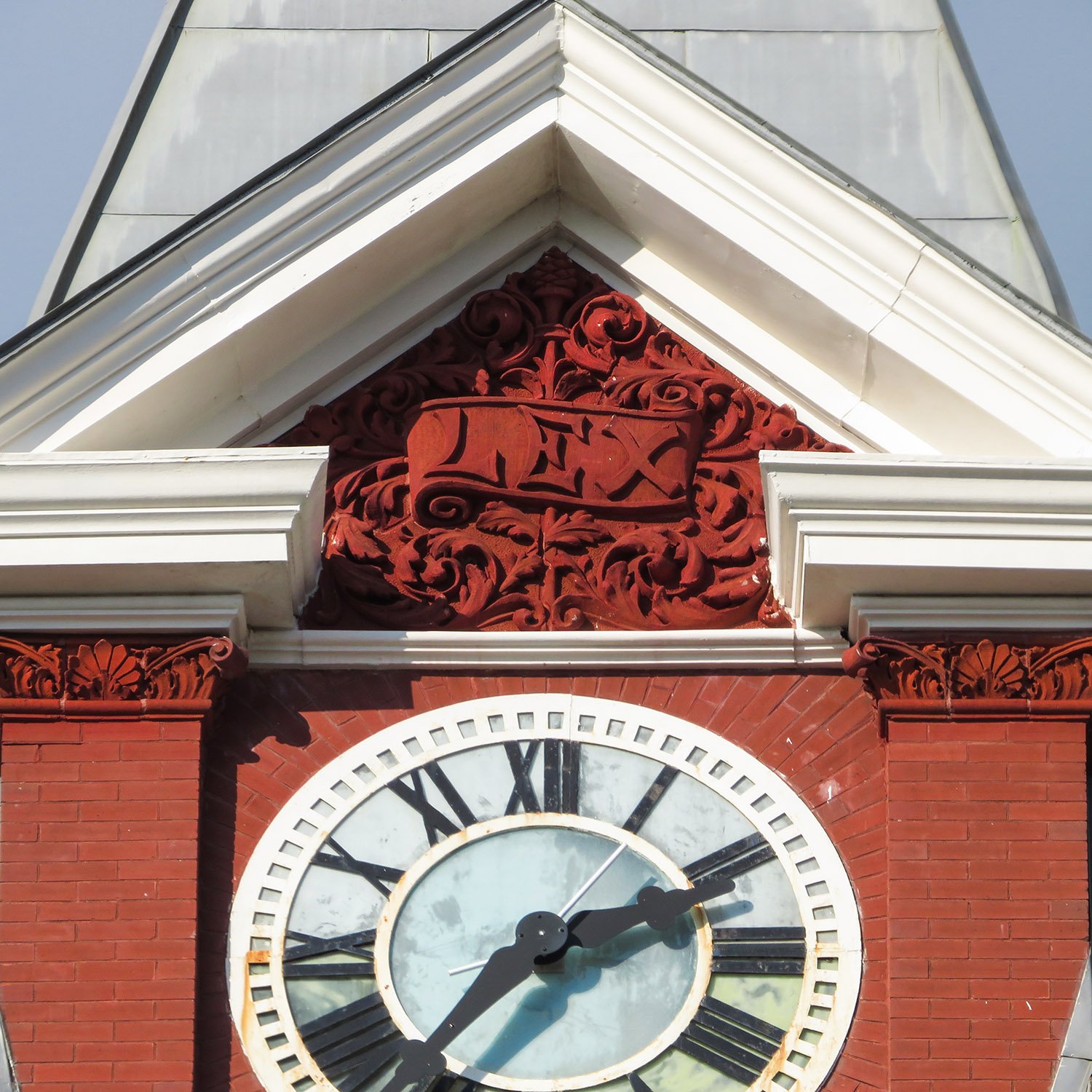
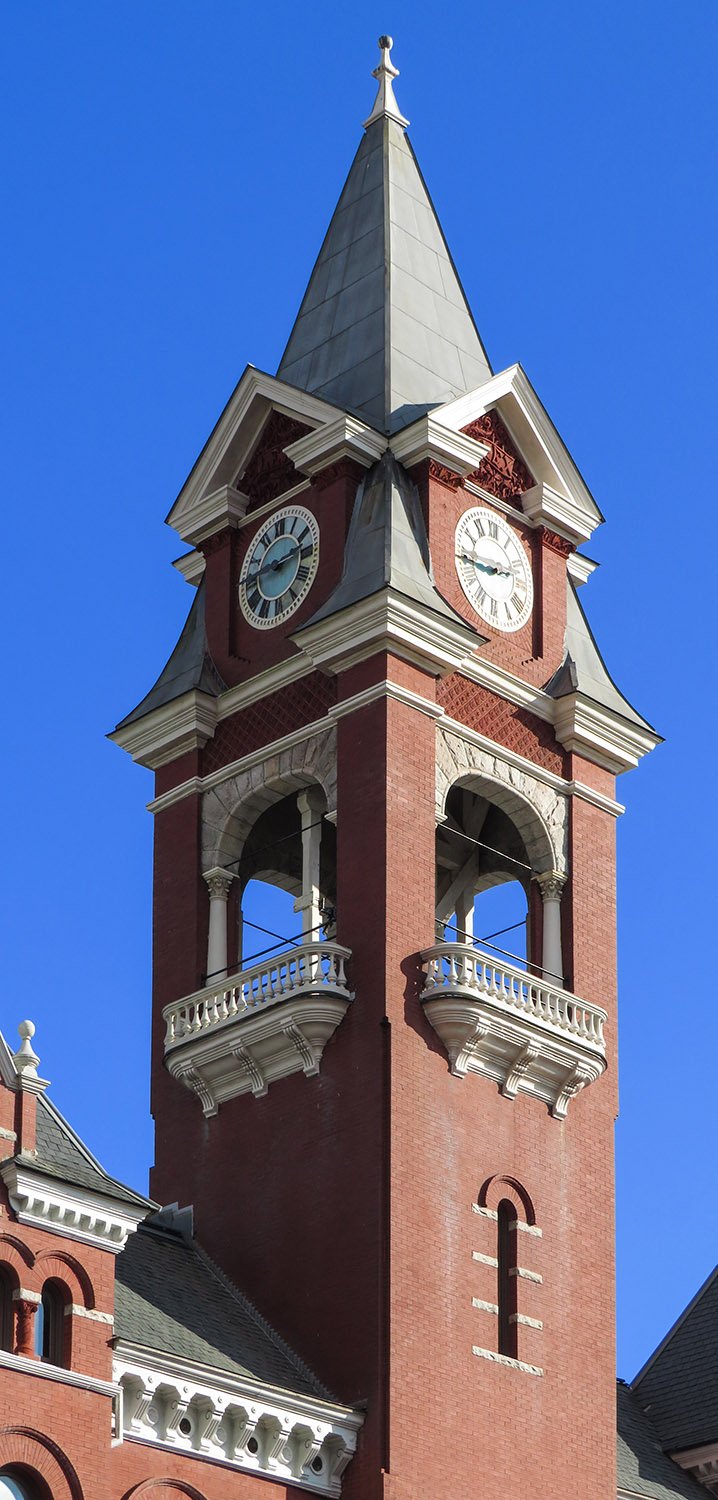
A.S. Eichberg. New Hanover County Courthouse (1893). Wilmington, North Carolina.12South elevation of the New Hanover County Courthouse, Wilmington, North CarolinaLooking at the New Hanover County Courthouse from the northwestAttic windows and gable dormer on the facade of the New Hanover County Courthouse, Wilmington, North CarolinaTerracotta spandrel between the first- and second-floor windows on the New Hanover County Courthouse, Wilmington, North CarolinaConsoles, frieze, and second-floor windows on the facade of the New Hanover County Courthouse, Wilmington, North CarolinaArch windows and granite block over the entrance of the New Hanover County Courthouse, Wilmington, North CarolinaLooking up at the clock tower on the New Hanover County Courthouse, Wilmington, North CarolinaClock and belvedere on the New Hanover County Courthouse, Wilmington, North CarolinaRounded bay on the north elevation of the New Hanover County Courthouse, Wilmington, North CarolinaClock and terracotta ornamentation on the New Hanover County Courthouse, Wilmington, North CarolinaClock tower on the New Hanover County Courthouse, Wilmington, North Carolina
References
“The New Court House.” The Wilmington Messenger (Wilmington, North Carolina), June 11, 1891, p. 4. ↩︎
“New Hanover County’s New Court House.” The Wilmington Messenger (Wilmington, North Carolina), April 9, 1893, p. 4. ↩︎
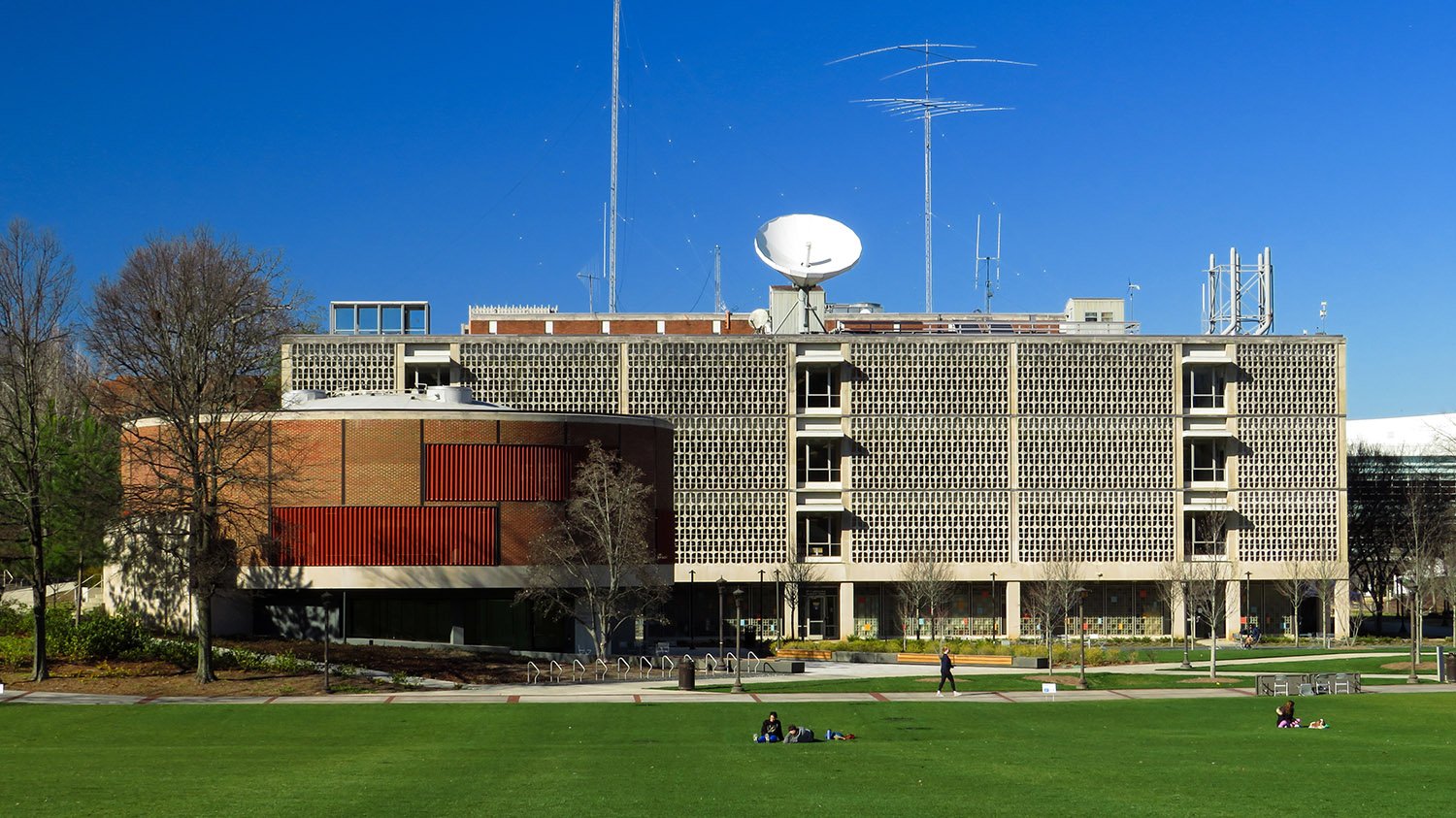
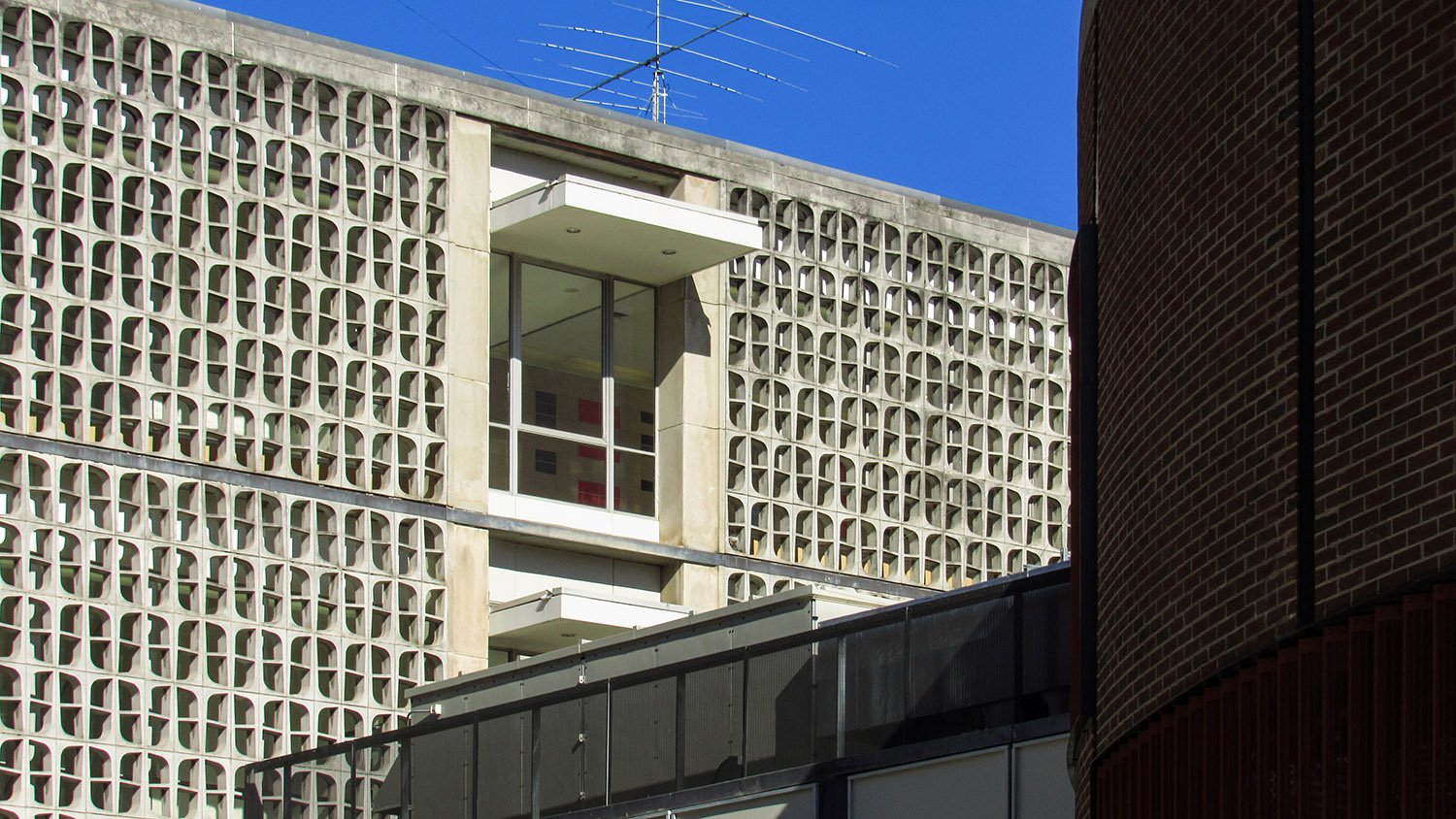
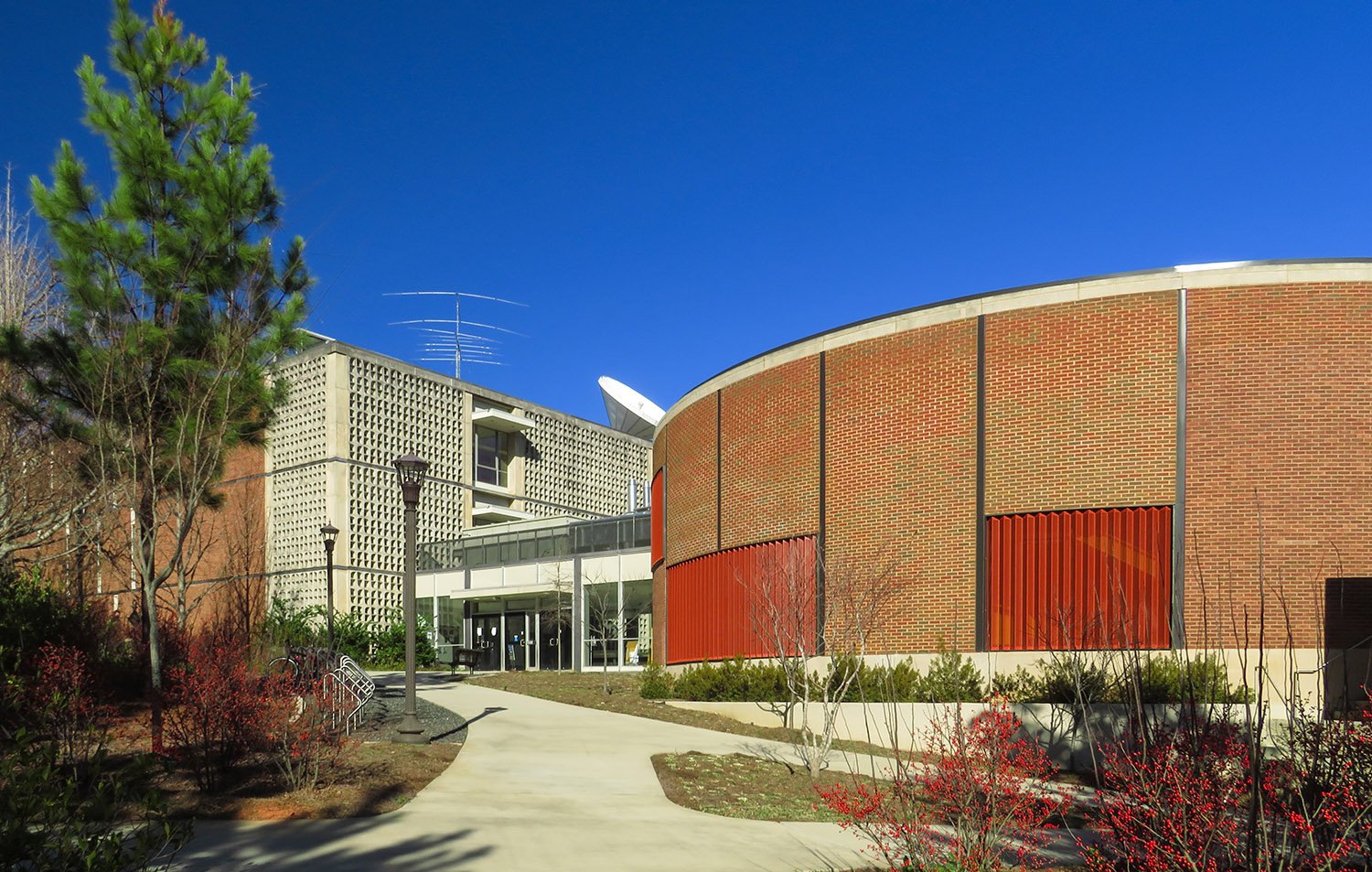
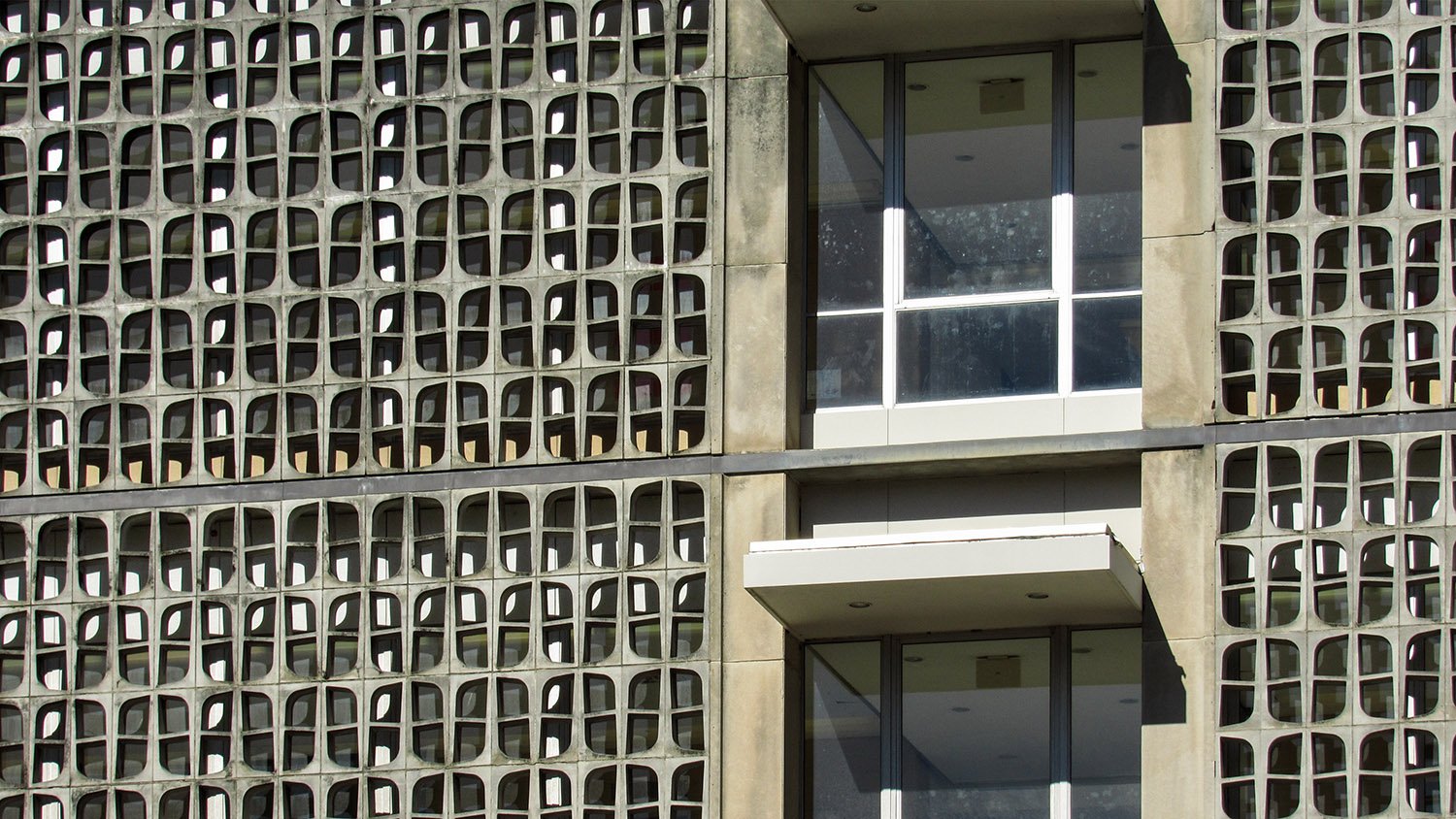
Robert and Company. Van Leer Building (1961). Georgia Institute of Technology, Atlanta.12Looking at the Van Leer Buildingfrom the southwestApproaching the Van Leer Building from the southwestScreen wall on the south facade of the Van Leer Building, Atlanta
“The genuine lover of learning, then, must make every possible effort, right from earliest childhood, to reach out for truth of every kind.” – Plato3
References
“New Building for Georgia Tech”. The Atlanta Constitution, April 13, 1962, p. 25. ↩︎
Henrietta C. Dozier (attributed). G.W. Gignilliat Residence. Seneca, South Carolina.1
The Background
Henrietta Cuttino Dozier (1872-1947), professionally known as Henrietta C. Dozier, was the first female architect in the Southeastern United States, practicing in Atlanta from 1901 to 1914, and then in Jacksonville, Florida, for the remainder of her life.
The United States had 22 female architects by 1895,2 increasing to more than 200 by 1920.3
Starting in the 1890s, the slow but steady rise of women in male-dominated professions, including architecture, spurred a flurry of press articles, with claims of a “woman invasion” stoking fierce public reaction—keep in mind, women weren’t even allowed to vote until 1920.
Atlantans’ first exposure to a “lady architect” came during the development of the Cotton States and International Exposition in 1894, when plans for the Women’s Building were solicited exclusively from female designers—a radical idea at the time.
Upon seeing the submitted plans, Thomas H. Morgan of Bruce & Morgan reportedly remarked with surprise: “Why, these buildings are bold enough to have been drawn by men.”4
When the competing plans were later exhibited in New York, Charles McKim of McKim, Mead & White was equally incredulous: “Of course the young ladies did the drawing, and it is very well executed, but whose idea was the design? Their teacher’s, I suppose?”5
Elise Mercur of Pittsburgh, Pennsylvania, secured the commission for the Women’s Building, winning over 12 other submissions, including one by Dozier, who was then studying at the Pratt Institute in New York.67 Dozier entered Pratt as its only female student, ranking second in her class.8
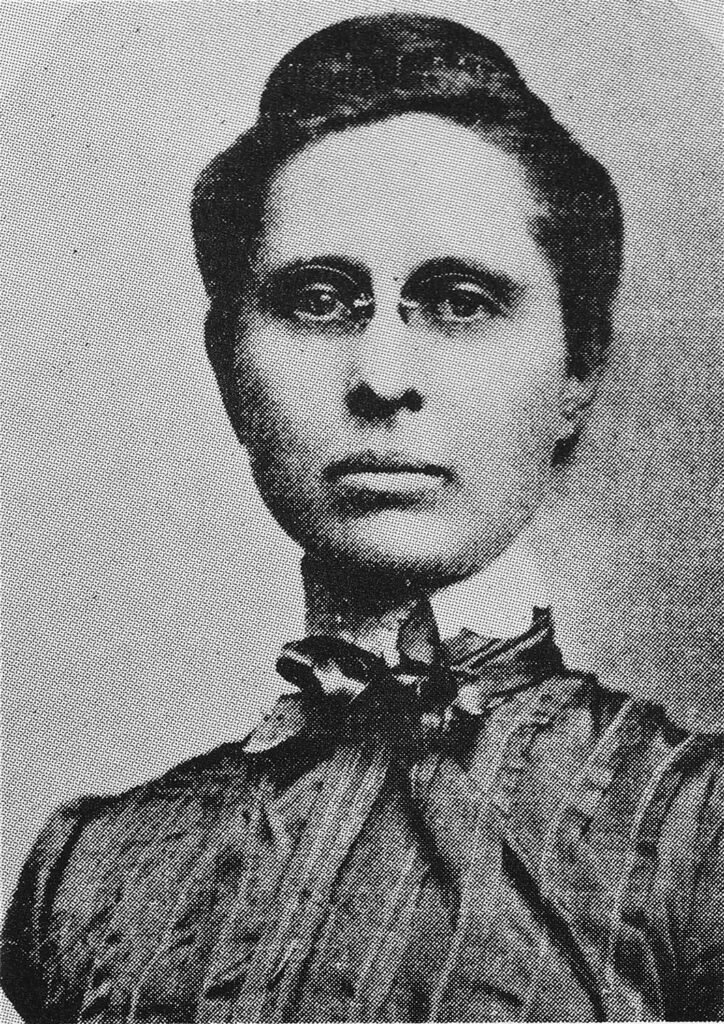
Dozier (pictured here9) was born in Fernandina Beach, Florida, but raised in Atlanta by her single mother—her father died four months before she was born.10
She attended the Atlanta public schools before heading north, where she studied at Pratt and later the Massachusetts Institute of Technology (MIT), graduating in 1899 with a B.S. in Architecture11—one of just three women in a class of 176 students.12
An unconventional woman for her era, Doziernever married, reportedly dressed in men’s clothing, and was known to her friends and family as “Harry” and “Uncle Harry”131415—draw your own conclusions.
In 1893, The Atlanta Journal described “Harry Dozier” as “a young girl of unusual force and mental determination. She is quite young, and quite handsome…”16
Dozier learned to fly airplanes in her 60s,17 and following her death, her relatives were surprised to discover a manuscript she had written for an unpublished romance novella. Sample text:
“Men do not get what they deserve in life, they get what they go after,” said Elizabeth. “So? My dear, I think women do a lot of going after what they want also … At least, you know how to get what you want.”18
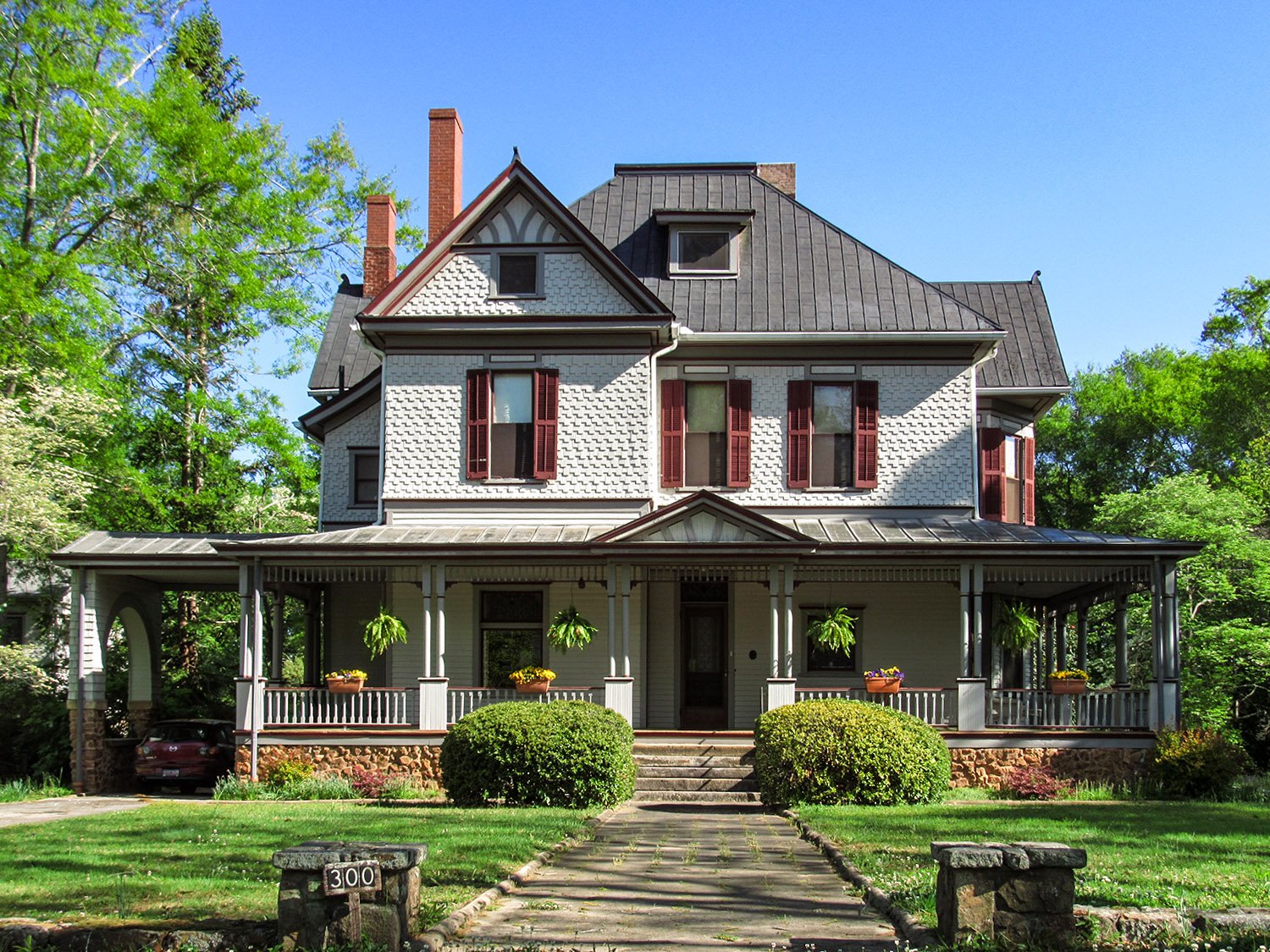
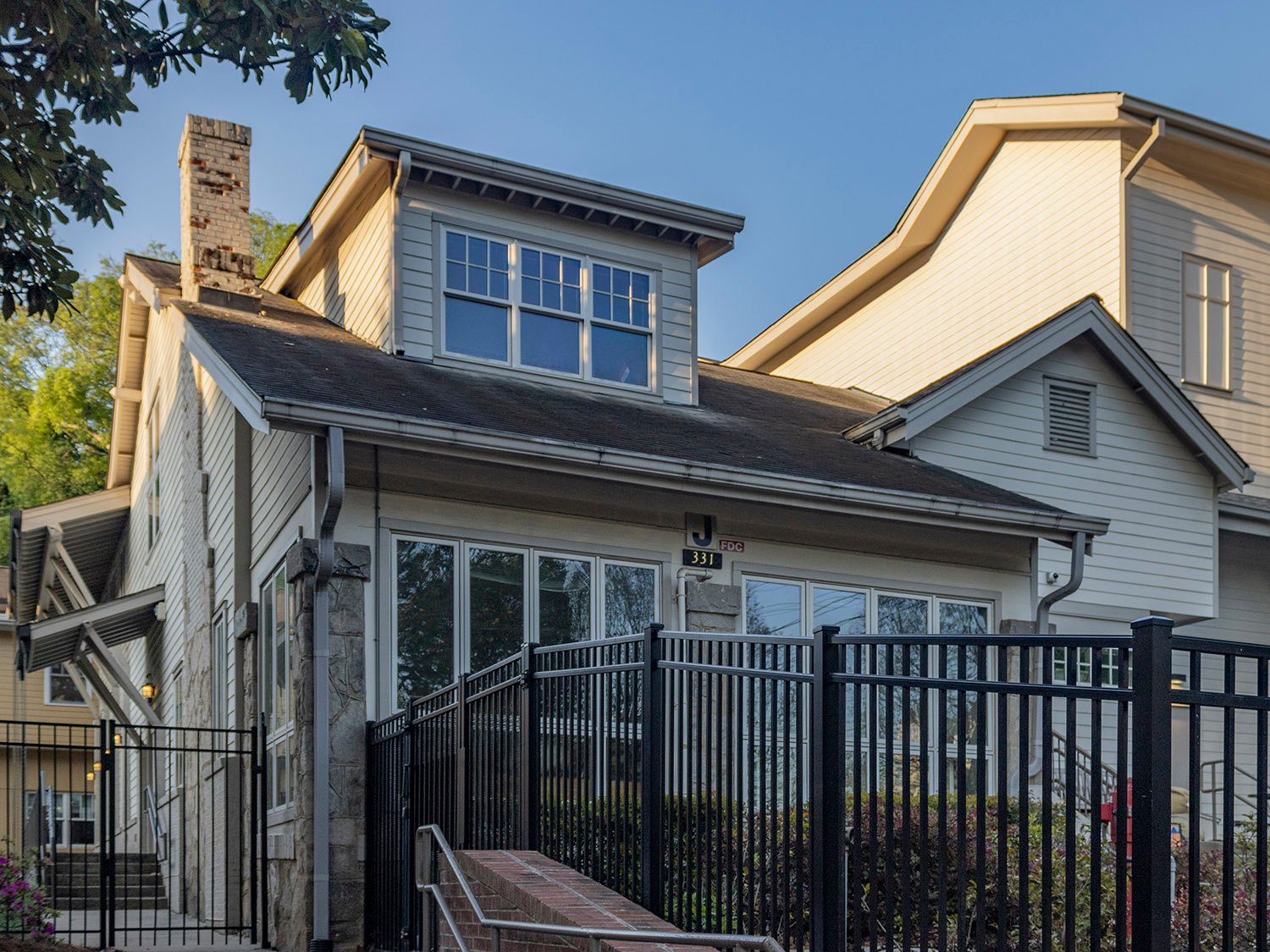
Only one of Dozier’s known works survives in Atlanta: a residence she designed for Mrs. O.K. Slifer on 10th Avenue overlooking Piedmont Park. The structure now serves as a school building and has been altered.
Henrietta C. Dozier. O.K. Slifer Residence (1912, altered). Atlanta.1920
Although Dozier often downplayed her professional difficulties in interviews, there is ample evidence that she faced severe discrimination in a field that largely remains an old boys’ club.
As one article noted in 1903: “It is only recently that the men in the profession began to regard women architects as other than a huge joke.”21
Dozier wasn’t a spectacular designer by any means, but she also wasn’t given nearly as many opportunities to refine her skills as her male counterparts, securing few large-scale commissions throughout her career.
In a 1939 interview, she noted: “…in the last few years, I have done nothing but small residential homes.”
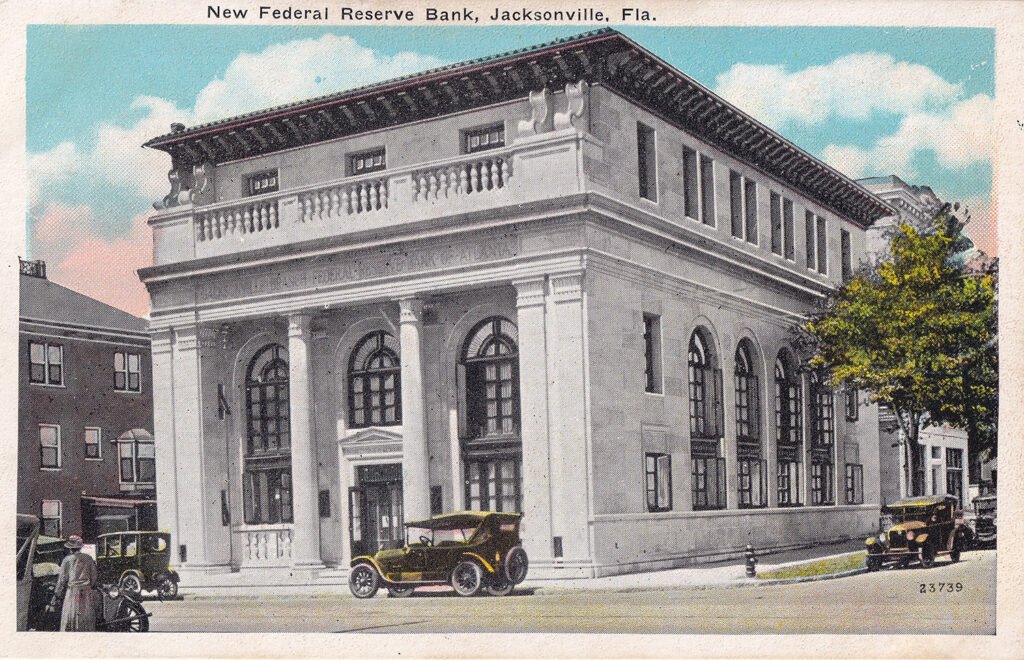
Dozier added that she was “always very proud” of her work on the Jacksonville branch of the Federal Reserve Bank of Atlanta,22 which can easily be considered her finest effort.
She was officially credited as supervising architect for the project, working under A. Ten Eyck Brown of Atlanta. However, Brown often claimed credit for projects he had little to no hand in designing, and it appears Dozier did most of the work.
A. Ten Eyck Brown with Henrietta C. Dozier. Federal Reserve Bank of Atlanta, Jacksonville Branch (1924), Jacksonville, Florida.23 Photograph from an undated postcard.
In 1905, Dozier was elected an Associate of the American Institute of Architects (AIA), only the third woman to be accepted into the organization.24 Dozier’s election directly led to the establishment of the Atlanta chapter of the AIA,25 which later became AIA Georgia.
As T.H. Morgan recounted, a minimum of five AIA associates were required to form an AIA chapter, and Dozier, along with Harry Leslie Walker, became the fifth and sixth architects in the city elected as associates, prompting the chapter’s organization.26
During her life, Dozier’s work was barely acknowledged by the local press—in either Atlanta or Jacksonville. The handful of news stories written about her often conveyed a tone of curious skepticism, if not outright ridicule.
The following article, published in The Atlanta Constitution in 1902, is the first of just a few that were written about Dozier during her time in Atlanta, and it’s about as sexist and condescending as it gets.
Dozier had been in practice less than two years, and the reporter (obviously male) depicted her interest in architecture as some girlish lark before settling into marriage, claiming that she:
“…makes plans for a future fair with promise, where she may realize a woman’s dreams of ease and mental and domestic pleasure, surrounded by the friends she loves—nature and children and dumb things.”
Maybe that’s what Dozier told the reporter to keep him happy, but she clearly had other ideas for herself.
This Georgia Woman Stands High in Profession of Architecture
Of all the branches of work into which women are entering there is none which shows so small a percentage of the really successful as that of architecture, and this is particularly true in the south. Two reasons deter the young woman casting about for something upon which to settle. In the first place, it is hard work; in the second, there is the probability of marriage—the state few on the sunny side of twenty-five or thirty could be brought to regard as anything but the ultima thule to which woman existence tends. And when one there is who from choice enters seriously upon a real profession the world might as well see at once, what sooner or later it will have to see, that she will succeed.
When Miss Henrietta C. Dozier entered as apprentice in an architect’s office she set herself to work as a man does—not simply to bridge over a year or two until the time when she would marry—she began at the beginning and held on to the finish. A year of apprenticeship was followed by two at Pratt Institute; then after some months in New York she went to the Massachusetts Institute of Technology, remaining four years. Coming south, she opened an office in Jacksonville, Fla., where she was in business six months, but in compliance with solicitations from friends in Atlanta decided to remove to this place, where she is permanently located and established, doing business with a man’s understanding and knowledge and a woman’s thoroughness and regard for detail.
Architecture is peculiarly suited to woman from the fact that her ideas on the requirements of a house are more practical than those of a man. Too, if she has first an all-round knowledge of mechanics her artistic instinct will serve her well. Miss Dozier, realizing what a woman wants and knowing how to go about having it, has built her own house—a unique and picturesque cottage, modern and complete, and meeting her needs as nobody else could have planned for her.
Here, in her hours of recreation, she enjoys with her mother and sister the sweetness of home, and makes plans for a future fair with promise, where she may realize a woman’s dreams of ease and mental and domestic pleasure, surrounded by the friends she loves—nature and children and dumb things.
Miss Dozier, like Dorothy Manners, has “the generations” back of her. Her forbear, Thomas Smith, of South Carolina, was landgrave in 1663, or there abouts, and a long line of ancestors have bequeathed to this young woman the intrepid spirit which no mere circumstance can daunt, and placed in her slender hand the key which unlocks every door—a will that brooks no thwarting.
As an architect she is a success; she has mastered her profession and she makes it pay.27
References
Wells, John E. and Dalton, Robert E.The South Carolina Architects, 1885-1935: A Biographical Dictionary. Richmond, Virginia: New South Architectural Press (1992), p. 42. ↩︎
“Uncle Sam And The New Woman.” St. Louis Post-Dispatch, June 30, 1895, p. 32. ↩︎
“Current Events From A Woman’s Point Of View.” The Atlanta Constitution, December 2, 1894, p. 6. ↩︎
“Their Plans Are Complete.” The Atlanta Journal, November 26, 1894, p. 6. ↩︎
“Plans By Fair Hands”. The Atlanta Constitution, November 28, 1894, p. 5. ↩︎
“Tiffany Will Be Here.” The Atlanta Journal, November 28, 1894, p. 6. ↩︎
“Society”. The Atlanta Journal, March 18, 1893, p. 2. ↩︎
Photo credit: Wood, Wayne W.Jacksonville’s Architectural Heritage: Landmarks for the Future. Jacksonville, Florida: University of North Florida Press (1989), p. 9. ↩︎
P. Thornton Marye. Greenville County Courthouse (1918). Greenville, South Carolina.123Bay on the facade of the Greenville County Courthouse, Greenville, South CarolinaLooking at the Greenville County Courthouse from the southeastDoor and pediment on the south elevation of the Greenville County Courthouse, Greenville, South CarolinaCornice and columns on the east facade of the Greenville County Courthouse, Greenville, South CarolinaArchitrave on the facade of the Greenville County Courthouse, Greenville, South Carolina
References
“Atlanta Architect Honored.” The Atlanta Constitution, June 13, 1915, p. 12 B. ↩︎
“Invitation For Proposals.” The Greenville Daily News (Greenville, South Carolina), November 21, 1915, p. 6. ↩︎
“First Court In New Court House”. The Greenville Daily News (Greenville, South Carolina), March 26, 1918, p. 5. ↩︎
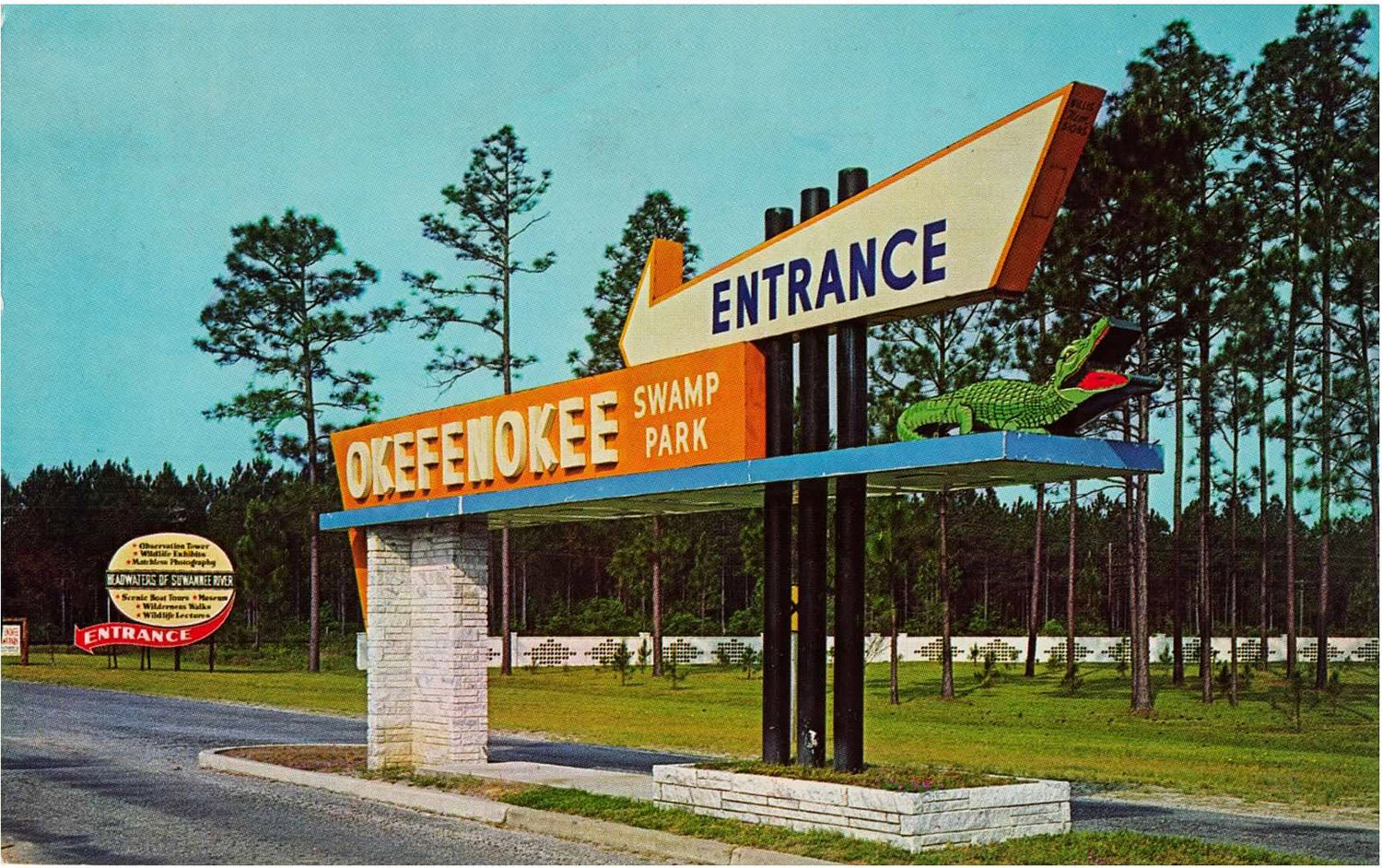
Okefenokee Swamp Park entrance sign. Photograph by Gene Aiken from an undated postcard.
Year by year, more disappear: the quirky, colorful business signs of the 20th century that once littered the United States with their kitschy, eye-catching designs, luring visitors to stores, restaurants, lounges, theaters, shopping centers, tourist attractions, and, of course, motels.
The synthesis of folk art tradition and cold-hard commercialism, these signs followed the growth of the American highway system, and were perhaps the most prominent symbols of the cynical and disposable culture of convenience and impulse that wholly consumed the United States in the 20th century.
The signs functioned as both advertisements and wayfinding tools, and could never be classified as high art: even in their prime, they were widely criticized as crass and unsightly markers to rampant consumerism and unfettered sprawl. Yet one era’s trash becomes another era’s treasure, and these signs attracted wider appreciation as their numbers began to dwindle.
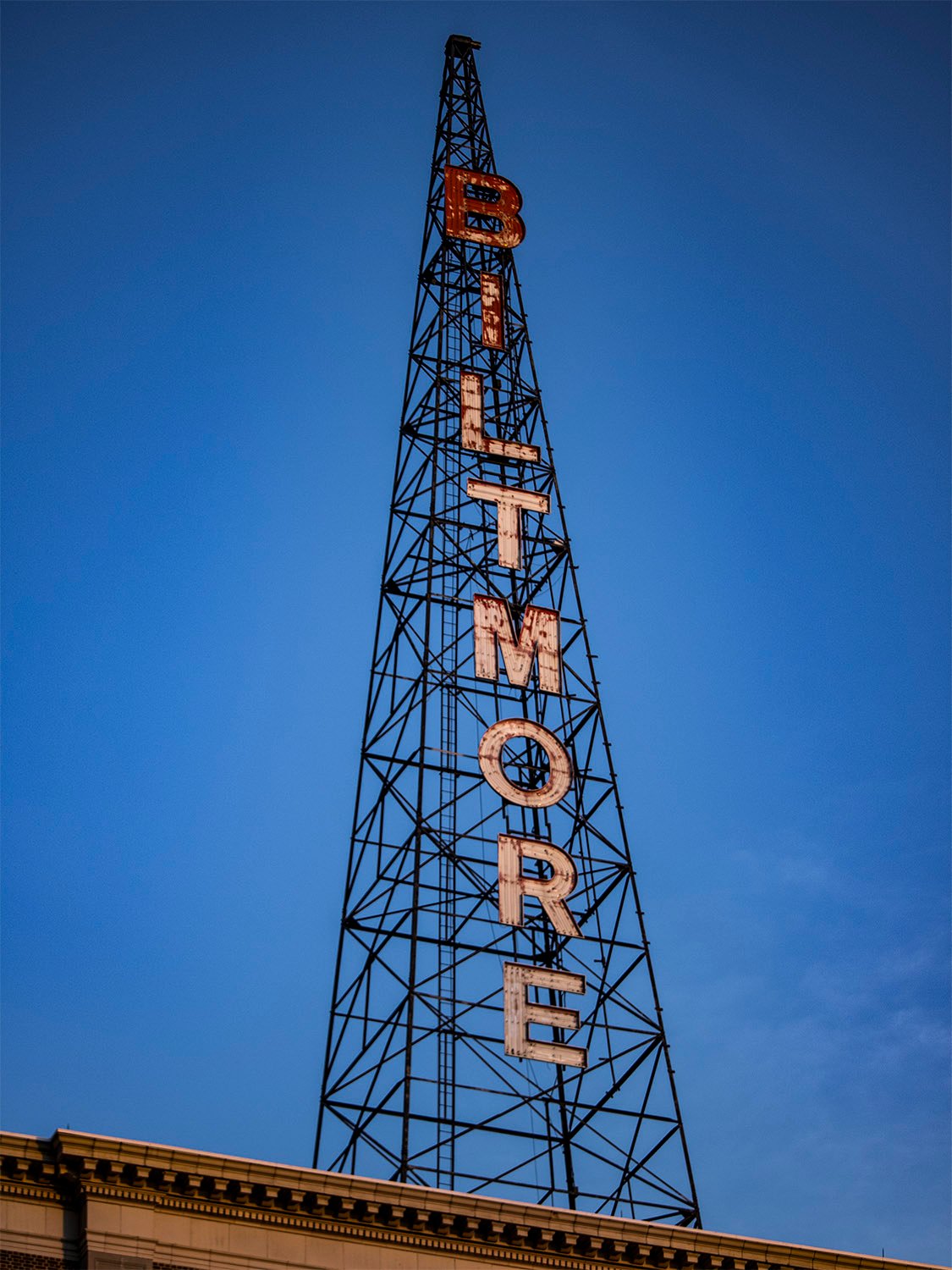
Hand-painted, two-dimensional signs on the outer walls of buildings were a ubiquitous feature of the American landscape starting in the late 19th century, but by the 1920s, sign-making reached new heights and three-dimensional form with “sky signs”, now known as scaffold signs.
Sky sign on Biltmore Hotel (1924). Atlanta.
Often perched atop towering hotels or other tall buildings in city centers, these machine-produced signs were attached to steel scaffolding and lit by electricity, still a novelty in many places.
As Americans began driving the first automobiles across a patchwork network of highways, sky signs served as bright, beckoning beacons that could be easily spotted from miles around.
Neon lights also debuted in the 1920s, and their distinctive glowing colors quickly became a standard feature of commercial signage, seemingly overnight.
Used by everyone from mom-and-pop shops to department stores, by the 1940s, neon signs were synonymous with nightlife entertainment and what is now referred to as Streamline Moderne architecture.
Clubs, diners, and movie theaters of the era often prominently incorporated neon elements into their sleek, curvaceous designs inspired by an increasingly mobile world of planes, trains, and automobiles.
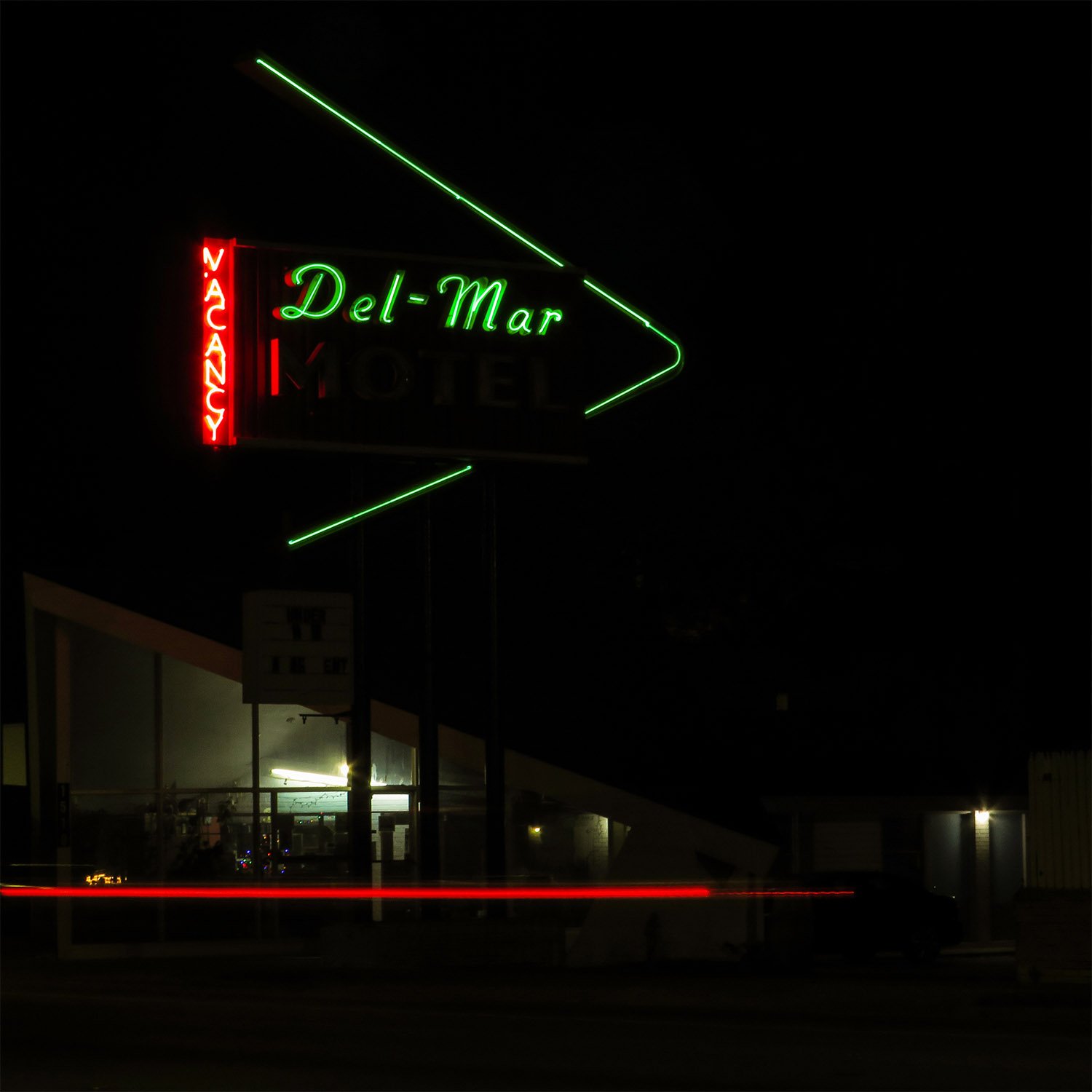
Del-Mar Motel (1955). Valdosta, Georgia. Designed by Joe Bright.
The creative zenith of signmaking emerged with the advent of the Interstate Highway System in the mid-20th century.
Far-out, futuristic signs inspired by the Space Age and the Atomic Era dominated in the 1950s and 60s, today closely associated with Googie architecture, which originated in southern California and spread unevenly throughout the country.
Popular elements of Googie-derived signs included:
starbursts
shooting stars
exploding atoms
orbiting satellites
giant boomerangs
oversized arrows
Many signs of the era were more down-to-earth in their inspiration: roadside business signs often incorporated symbols that were evocative of their specific locale or region — a chomping alligator on the entrance sign for Okefenokee Swamp Park in Georgia, for instance (pictured above).
Round Up Motel. West Yellowstone, Montana.
Other signs were more exotic in flavor, capitalizing on the Tiki culture that emerged in the White middle class following World War II, using symbols and typefaces that were stereotypically Polynesian, Hawaiian, or Pan-Asian.
Typically designed by local sign makers, vernacular roadside signs were often used as distinctive focal points for structures that were otherwise unremarkable and interchangeable — see one hole-in-the-wall motel, for instance, and you’ve seen them all. It was the sign that was memorable, not the building.
Vernacular signs were already falling out of fashion when Robert Venturi and Denise Scott Brown, a husband-and-wife architectural team from Philadelphia, galvanized the architectural world with the 1972 publication of Learning from Las Vegas, in which they praised vernacular road signs for their “architecture of communication over space”1and presented them as a legitimate art form worthy of analysis.
Venturi and Scott Brown accused architects of designing to suit “their own particular upper-middle-class values, which they assign to everyone” and admonished them to “gain insight from the commonplace”.2
Yet even as architects began drawing inspiration from them, by the 1970s, vernacular roadside signs were steadily supplanted by standardized signs that became more subdued, less conspicuous, and more homogenous.
Weiss Liquors (circa 1966). Nashville, Tennessee.
Today, roadside signs from the mid-20th century are nearly extinct, often regulated out of existence by restrictive sign ordinances or demolished when their associated businesses close or succumb to redevelopment. Those that remain are either in a state of decay or have been well-maintained and, in some cases, skillfully restored.
If you’re hunting for relic roadside signs in the United States, there are a few good places to start:
Neglected or run-down urban neighborhoods or rural towns.
Nostalgic destinations such as long-running local restaurants, theaters, and stores, or tourist areas near beaches, mountains, or national parks.
Shopping centers built in the 1950s, 60s, or 70s that have retained elements of their original design.
These relic signs are quaint reminders of a time when the appeal of travel lay in the freedom of its uncertainty and little surprises, when Americans weren’t so embedded in the illusion of control, merely navigating from one planned destination to the next on routes prescribed by machine, coddling our consumed minds with the bland promise of comfort, safety, and familiarity.
Or, perhaps, that time never existed at all.
The map below charts the location of every vintage sign I’ve photographed so far, with accompanying images. Many of the signs have since been removed.
References
Venturi, Robert; Scott Brown, Denise; Izenour, Steven. Learning from Las Vegas, Revised Edition: The Forgotten Symbolism of Architectural Form. Cambridge, Mass.: MIT Press (1977). ↩︎
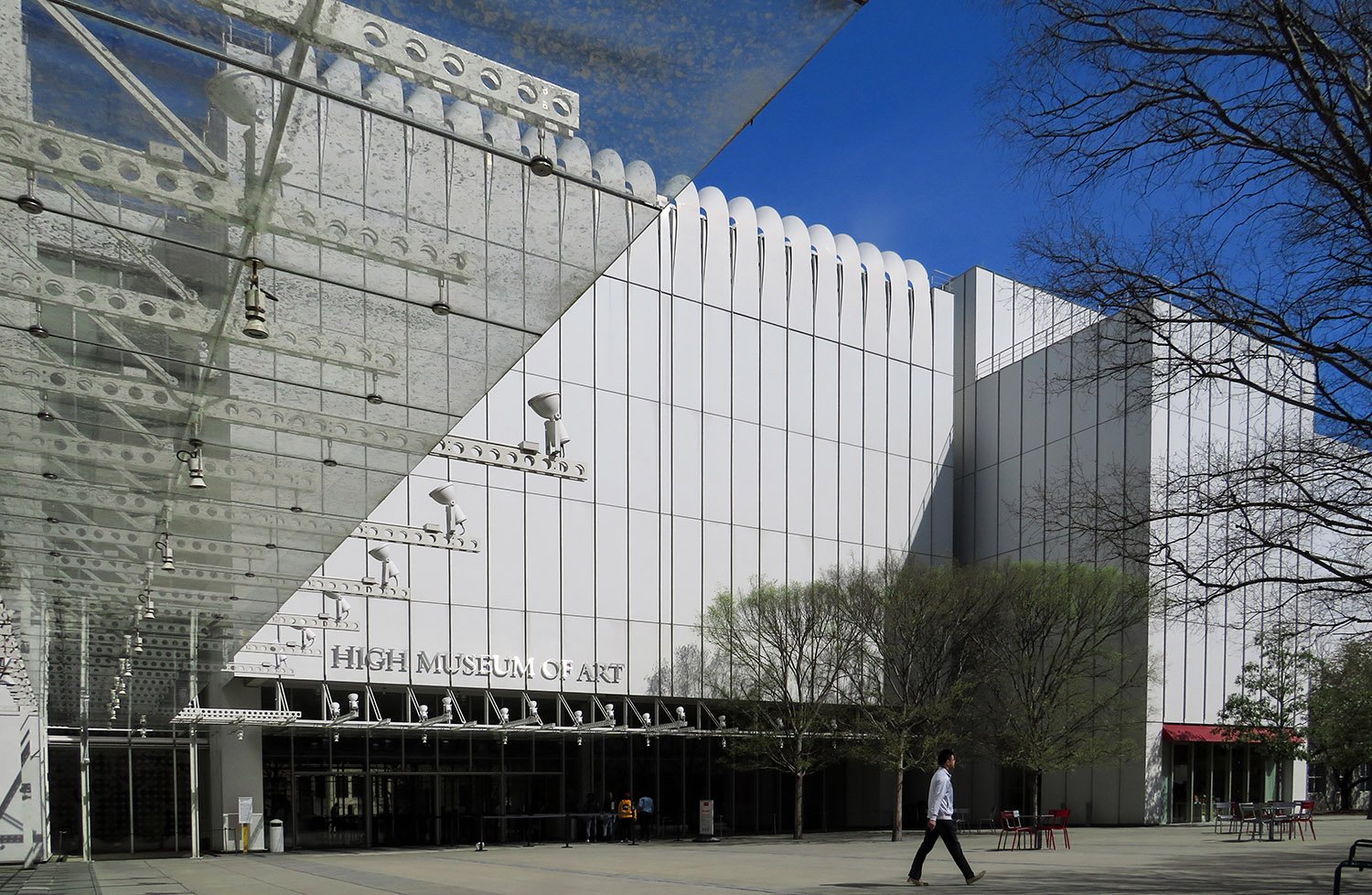
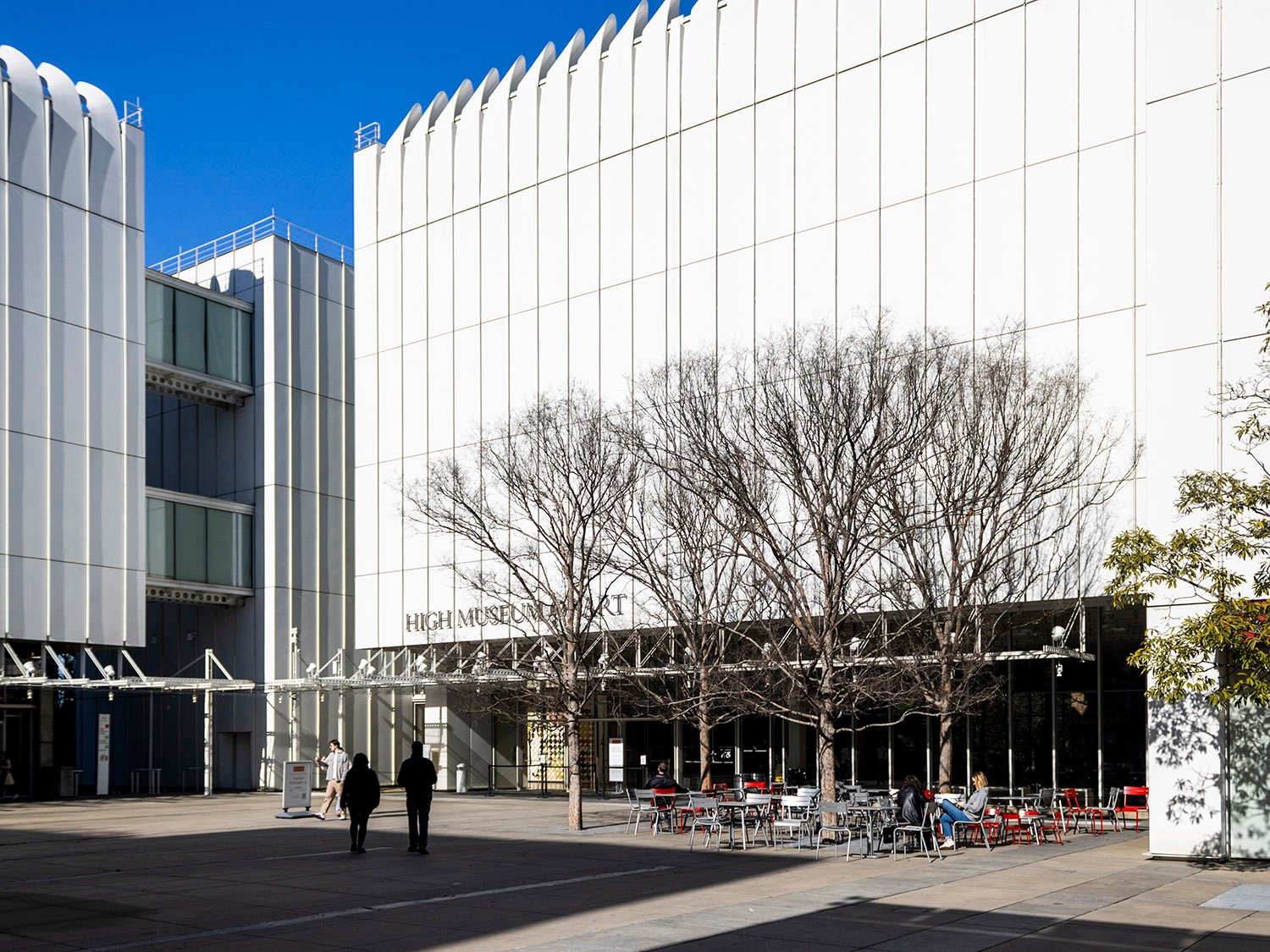
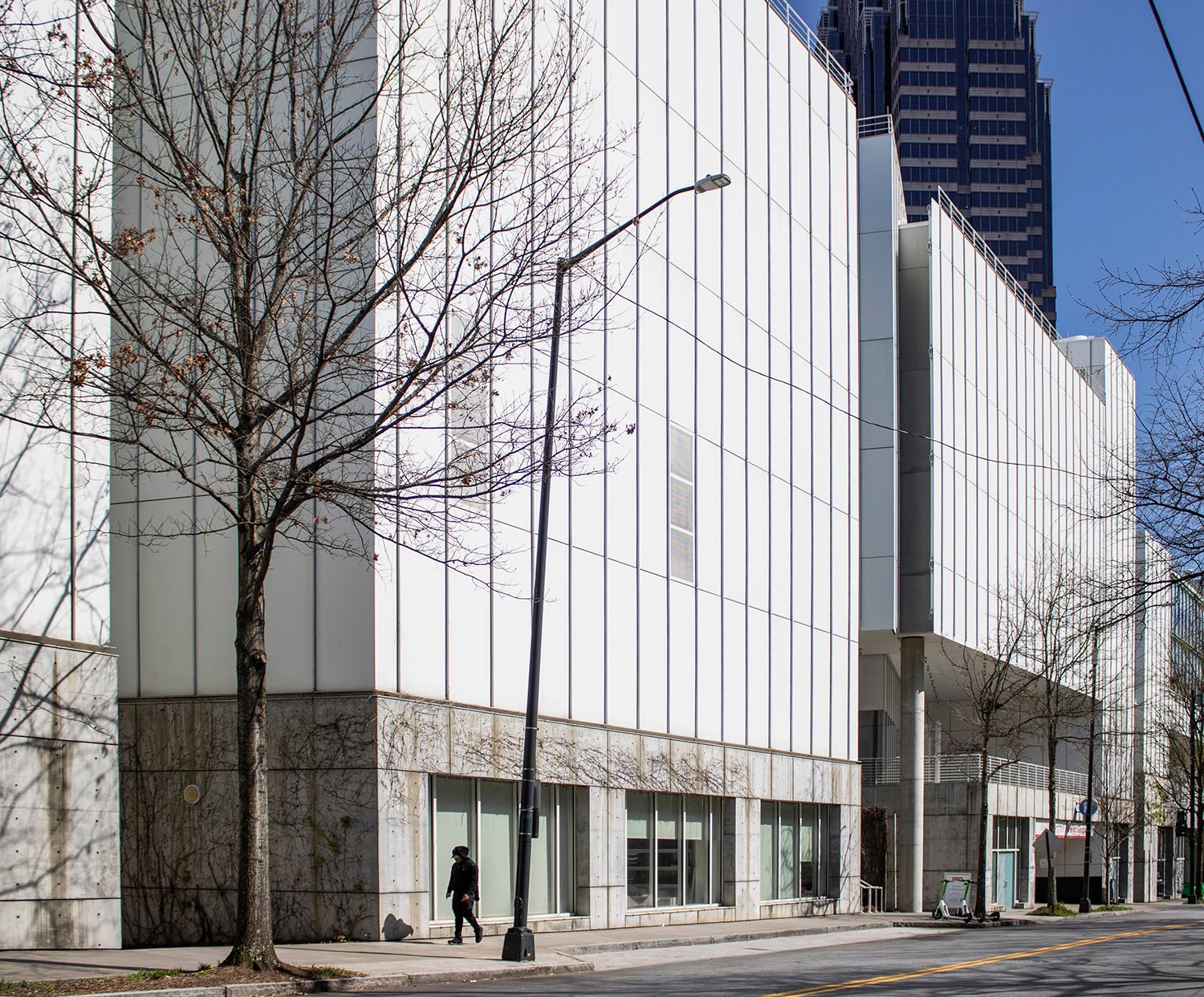
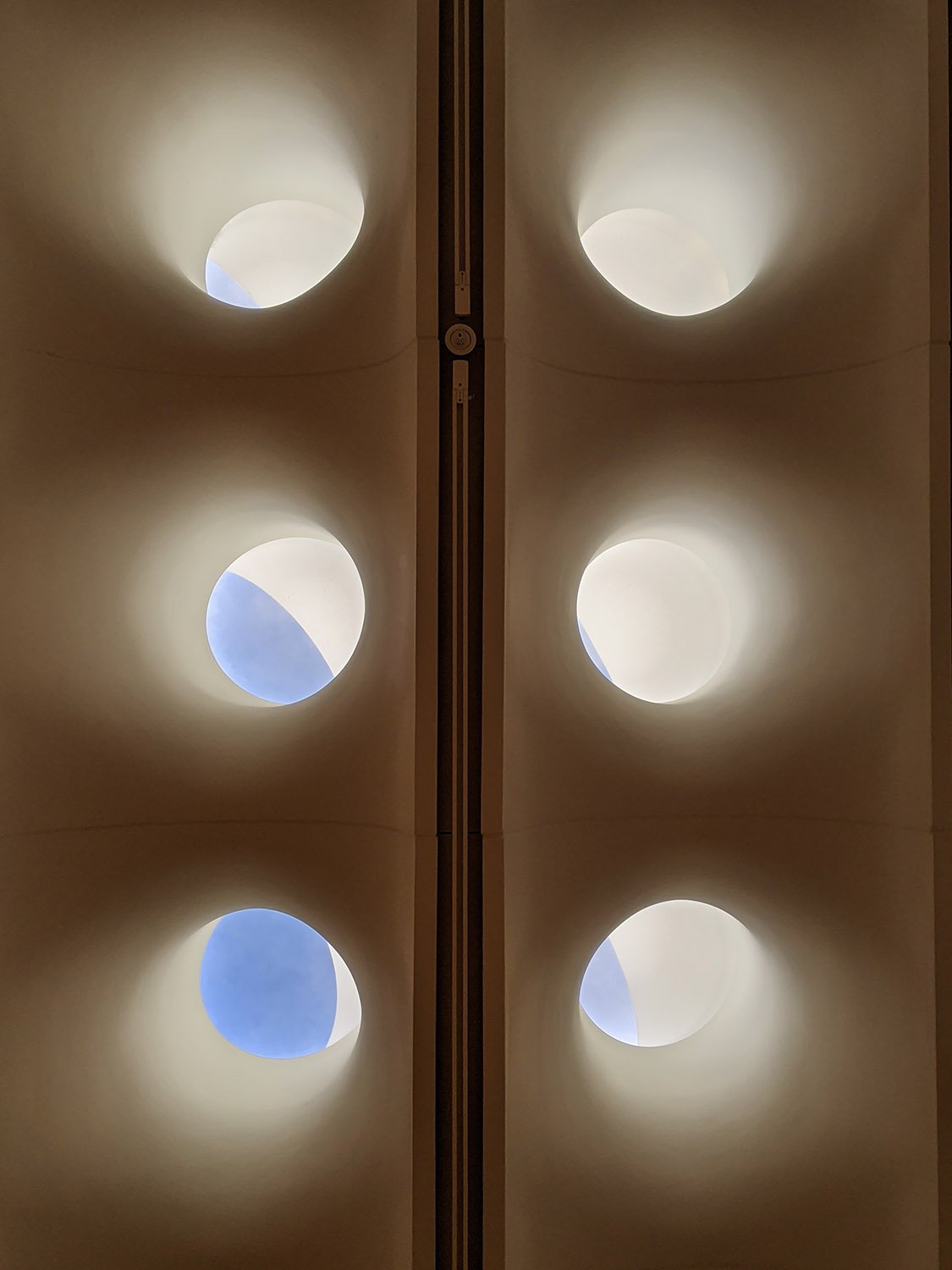
Renzo Piano Building Workshop with Lord, Aeck & Sargent, Inc.High Museum of Art Expansion (2005). Midtown, Atlanta.12Aluminum panels on the facade of the High Museum of Art Expansion, AtlantaLooking northwest toward the entrance of the High Museum of Art Expansion, AtlantaWest elevation of the High Museum of Art Expansion, AtlantaWest elevation of the High Museum of Art Expansion, AtlantaLooking toward the Anne Cox Chambers Wing of the High Museum of Art Expansion, AtlantaEntrance to the Anne Cox Chambers Wing of the High Museum of Art Expansion, AtlantaThird-floor gallery in the High Museum of Art Expansion, AtlantaSkylights in the High Museum of Art Expansion, Atlanta