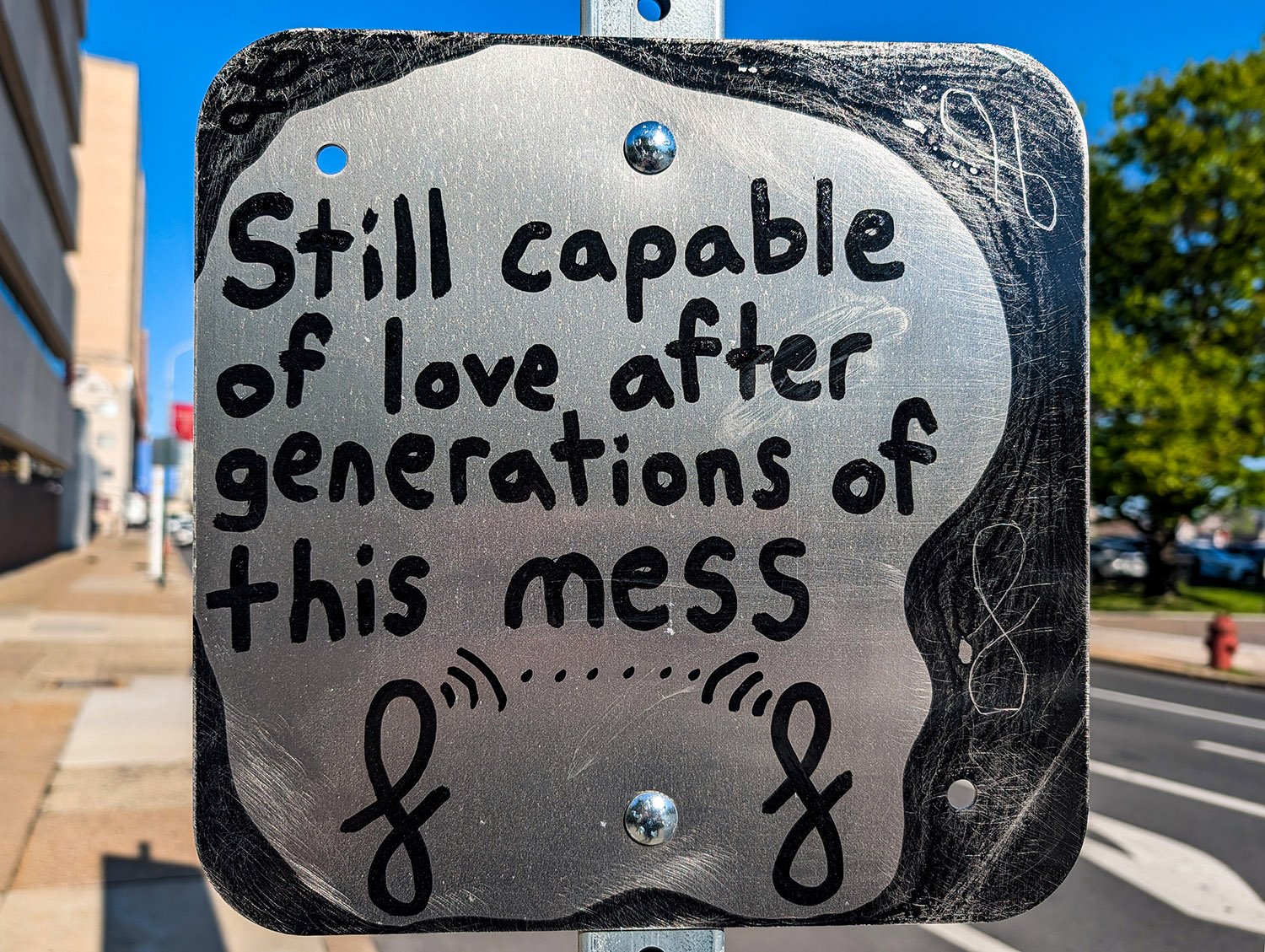
It fills my deepest wound:
That well of love and compassion that stirs for those who will never return it.
I’ll try not to bore you with psycho-babble, but it naturally formed in my youth, as the deepest wounds do for all of us.
I can vividly remember being a child who pined for the love and closeness of an absent father—
Not physically absent, at first, but certainly emotionally.
As a little boy, I wanted so badly to hold his hand and be skin-to-skin with him, but he was cold and distant, apparently uninterested in me.
It wasn’t a surprise when he later confessed that his life would have been better if I hadn’t been born—tough words to hear from a parent, but at least he was honest.
He was apparently shocked when I cut off communication with him years ago and never looked back. Such arrogance.
My mother cloaks herself in a veneer of warmth and compassion as a means of survival, but she’s just as disinterested in anyone else unless they indulge her infantile sense of helplessness.
She smothers her enablers to keep them close, but invariably drives them away with her petulant demands and domineering behavior that become more apparent over time.
In many ways, I find her selfishness even more pernicious than my father’s—his was blatant, but hers deceived me for years as genuine concern and nurturing.
We’re all amateur psychologists these days, so you can probably guess that I’ve wasted most of my life pursuing one-sided, dead-end relationships with people who don’t give a fuck about me—or are incapable of doing so—repeating the old pattern established between myself and my parents.
From the perspective of middle age, I have to acknowledge that none of my so-called friendships in adulthood have been reciprocal or satisfying.
There was the cagey online buddy who only wanted to talk in chat and threatened suicide once to get my attention. There was the raging narcissist who emotionally tormented me and then nearly killed me—I moved over 200 miles to get away from him. There was the smooth-talking coworker who kept me around to help him with his projects, but dropped me like a hot rock when his position changed.
Then there are all the people I’ve desperately wanted as my friends and companions, but it was abundantly clear they just weren’t interested. In my wild imagination, I could picture us embraced in some epic, earth-shaking partnership, but none of them shared that vision. Most of them probably never gave my existence a half-second of thought.
Always haunting my relationships are the questions of my sexuality. Am I gay? Am I asexual? Who the fuck knows? Do I want a friend or a lover? I’ve never fully understood that myself, and while I’ve grown to accept the ambiguity, I’ve never found anyone else who could handle it.
I used to think it was a weakness that I could fall head over heels for people who would never do the same for me. I used to be ashamed of it. I’m not anymore.
I may have been the boy who idealized and defended their parent as a way to cope with the absence of affection, but as a man, it’s given me the ability to not just passionately love people, but to deeply cherish them with a child-like simplicity and purity—even when they don’t deserve it.
Experience has given me the ability to recognize when I’m being lured into another unrequited relationship—the signs are all familiar to me now.
I know when my baby brain wants to elevate a flawed mortal into a peerless daddy god with whom to form a perfect union, and I’ve become adept at ruthlessly scrutinizing a person’s life and character for misalignments with my own.
What’s different about me now from even a few years ago is that I don’t dismiss the tender feelings of the little boy inside me.
Rather, I gently take his hand, and we take a walk together. I listen to him intently as he talks excitedly about that special person who, in the moment, means the absolute world to him. I pick him up, hold him close, and kiss his forehead, thanking him for his sweetness, innocence, and kindness.
Then I harness that essential eros for a moment of culmination and truth delivered expressly for that person—it may be a favor, a conversation, or just a passing remark.
The form of the message is unimportant: what matters is that it was especially made for one with whom I have become so enamored, packed with such a concentrated force of love and grace that it cuts through their soul like a blade.
When the message is delivered, it’s as if some spell has been broken inside of me, and with a sudden jolt, I realize, That’s it. You’re done. And I walk away, thanking God for that person whose life may be entwined with another’s—but it isn’t mine.
It could be that I wasn’t built for genuine relationships. That’s a sobering reality I’ve come to terms with in the last few years.
Maybe my purpose on this earth is to deliver a seed of love to those who are otherwise impenetrable to receive it, never seeing its effect, or even knowing if it has an effect at all.
That could be my childish way of coping with the absence of affection in adulthood, but I do know that every transmission of grace deepens my soul’s capacity for love—for myself more than anyone else.
.