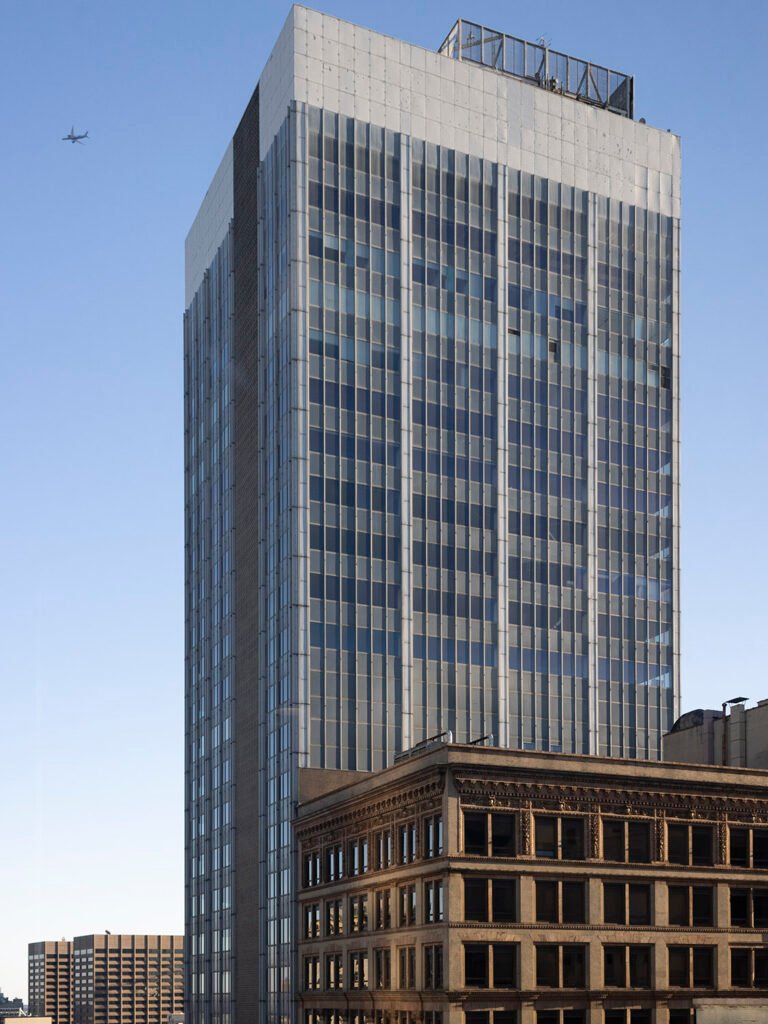
This 31-story International-style tower was arguably the first “modern” skyscraper in Atlanta, although it’s now pushing 70 years old and looks every day of it.
The tower opened in 1961 as the home of The Bank of Georgia and was purported to be the “tallest structure south of Baltimore,”4 surpassed a few years later by Atlanta’s First National Bank,5 6 built one block away.
It’s telling that the Bank of Georgia had to hire an out-of-town firm, Hedrick & Stanley of Dallas, to design the building — none of Atlanta’s architects at the time had the chops for such a large-scale project.

For the first 11 years, the 30th floor of The Bank of Georgia tower was occupied by the Top O’ Peachtree restaurant and “lookout lounge”, later described as ‘”the” place to go for dinner or drinks in its beginning.’7
Based on photographs, Top O’ Peachtree was no doubt an ideal rendezvous for married bank executives and their secretaries. Oh, come on, you know it happened.
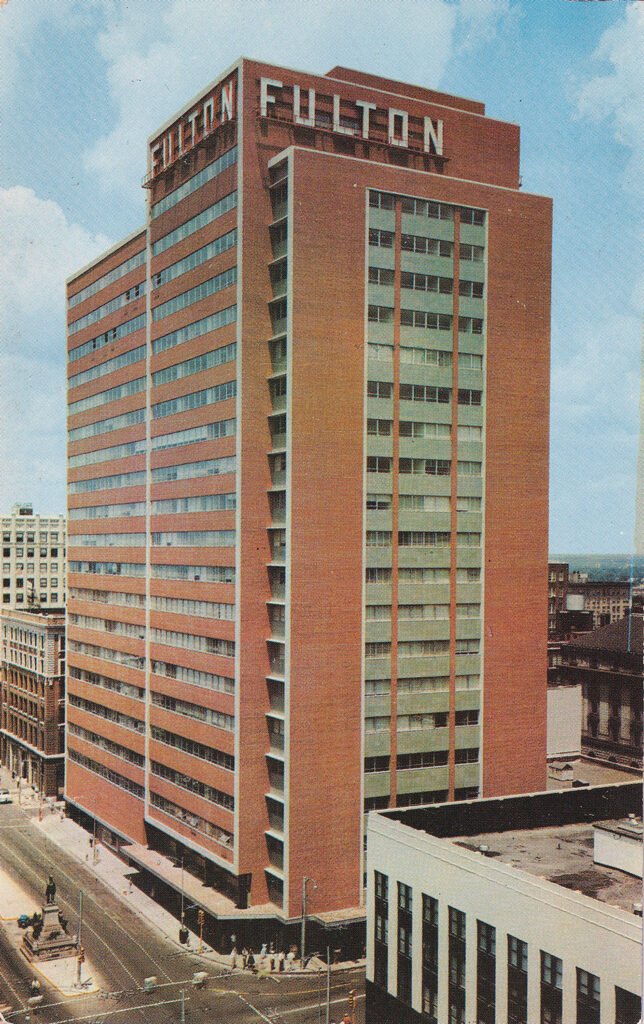
When the Bank of Georgia tower was sold in 1979, it was described as one of “the two homeliest buildings in town,” along with the nearby Fulton National Bank building (1955),10 which was entirely accurate — then and now.
Designed by Wyatt C. Hedrick Company of Dallas,11 which later became Hedrick & Stanley, the Fulton National Bank building has been renamed 55 Marietta and remains in active use, now serving as a data center. The Bank of Georgia, however, hasn’t fared as well.

Later renamed 34 Peachtree, the former Bank of Georgia has passed through a succession of owners and is currently vacant, with missing windows on the upper floors and its street-level retail spaces obscured by brown paper.
A peek through the doors and windows at night reveals the dead escalators in the lobby and dangling ceiling tiles in the office spaces.
In 2017, pieces of the building’s facade fell to Peachtree Street during a bout of high winds, prompting the closure of several streets.12

There have been empty promises to convert 34 Peachtree into residential units,13 but that’s just typical Atlanta bullshitting, quite unlikely to transpire, as the cost to renovate such behemoths is overwhelmingly prohibitive.
Office buildings are rapidly becoming a relic of the past, and as more skyscrapers begin to deteriorate, it will be interesting to see what cities like Atlanta do with them, particularly as the United States plunges headfirst into inevitable social and economic decline.
I suspect that in decades to come, many American cities will be filled with vacant, crumbling towers that no one will have the money to demolish or renovate — unsightly monuments from an age of decadence and arrogance best left forgotten.

References
- Erwin, George. “Bank Plans 31-Story Building At 5 Points, Costing 10 Million”. The Atlanta Journal, March 1, 1959, p. 1. ↩︎
- The Atlanta Journal and The Atlanta Constitution, April 2, 1961, Bank of Georgia Section. ↩︎
- “Bank of Georgia To Open Monday”. The Atlanta Journal, March 28, 1961, p. 33. ↩︎
- Veale, Frank. “35,000 Expected At Gala Opening Of New Building”. The Atlanta Journal, April 2, 1961, p. 2-F. ↩︎
- Crown, John. “40-Story Bank Building to Rise in Atlanta”. The Atlanta Journal, August 11, 1963, p. 1. ↩︎
- “Atlanta Reaches for the Sky–More Giants on Way”. The Atlanta Journal, May 17, 1966, p. 12. ↩︎
- Henderson, Barry. “Top O’ Peachtree Sale Set”. The Atlanta Constitution, September 23, 1972, p. 8. ↩︎
- “Equipment Came From All Over U.S., Materials From All Over The World”. The Atlanta Journal, October 18, 1955, p. 3-F. ↩︎
- “It’s the tops” (advertisement). The Atlanta Constitution, October 19, 1955, p. 2-F. ↩︎
- Kossoff, Evan. “New Owner Giving 2 Downtown Buildings a Facelift”. The Atlanta Constitution, December 10, 1979, p. 9-D. ↩︎
- “Company Completes 26-story Fulton National Bank Building on schedule!” (advertisement). The Atlanta Journal, October 18, 1955, p. 18-F. ↩︎
- Judd, Alan. “Georgia: Irma set to arrive today.” The Atlanta Journal-Constitution, September 11, 2017, p. A1-A6. ↩︎
- Torpy, Bill. “Can office conversions save downtown?” The Atlanta Journal-Constitution, July 31, 2023, p. A9. ↩︎