The Background
The following article was published in The Atlanta Constitution in 1899 and was written by Wallace Putnam Reed (1849-1903), a writer and historian who regularly contributed to the Constitution and other newspapers in the Southeastern United States.
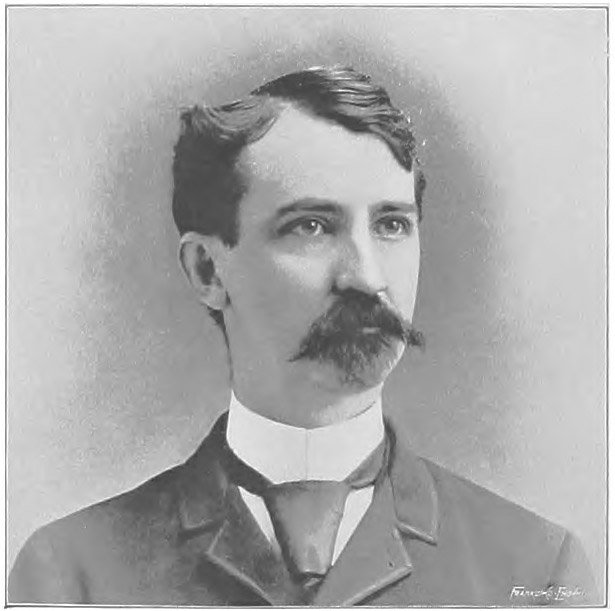
In this article, Reed (pictured here1) recounted the events that led to the 1889 publication of How I Escaped, a semi-autobiographical novel written by W.H. Parkins, Atlanta’s first architect.
Five years after Parkins’ death, Reed was much more honest about the architect’s writing ability than in his gushing review of the novel ten years earlier. Funny how that works.
Reed also claimed to have edited the original version of Parkins’ manuscript—now housed at the Atlanta History Center—and that Parkins sent the manuscript to H.I. Kimball, the owner and developer of Atlanta’s Kimball House Hotel.
The Kimball connection was omitted in Reed’s 1889 review of the novel, possibly because Kimball left Atlanta in 1886 amid some controversy,2 which would still have been fresh in local readers’ minds.
By the time he died of stomach cancer in 1895, however, Kimball had become a distant memory in the city—the Journal noted at his death that “little was known of him since he went north a few years ago.”3
As Reed recounted here, Kimball forwarded Parkins’ manuscript to Archibald Clavering Gunter, who turned Parkins’ biographical narrative into a substantially altered work of historical fiction, leading Parkins to eventually conclude that he “had done himself an injustice.”
Reed described Parkins as “a straightforward man, eminently sincere and truthful,” and lamented that his “truthful narrative of adventure was lost to the reading world.”
Conversely, his characterization of Gunter was quite damning: “He cared nothing for history.”
Article Excerpt:
About ten years ago the late William H. Parkins was among the leading architects of this city. He was a man of talent, and had some natural literary gifts which would have attracted attention if they had been cultivated.
One day Mr. Parkins paid me a visit, and placed in my hands a bulky manuscript.
“I have written a book,” he said, “and I want you to revise it. You see I wrote it with a pencil, at odd moments, and I know that it is not in proper shape for the printer. The arrangement of the chapters and the paragraphs requires attention, and perhaps some portions of the book should be condensed.”
I glanced over the work, and found that it was a graphic narrative of the author’s adventures during the war, when his devotion to the union cause led him to face many dangers. Leaving his home in South Carolina, he walked through the forests and mountains of western North Carolina and east Tennessee, and after passing through many perils he finally succeeded in reaching the federal lines.
It was an exciting chronicle, realistic and true, and the rattle and clash of sabers and the roar of the big guns made it a veritable prose epic of war.
I gladly agreed to transcribe the manuscript, making such changes as I thought necessary. The task occupied many long nights, and when it was finished, the result was a pile of copy which would have made a volume of about 350 pages.
The question of publication then came up. It was difficult for an unknown writer to find a good publisher, and Mr. Parkins knew it.
After some unsatisfactory correspondence, the author sent his manuscript to his friend, Mr. H.I. Kimball, who was then in New York.
Mr. Kimball was not a very busy man, and literary matters were not in his line. But a happy thought struck him. He heard people everywhere talking about Gunter and his novels, and he saw on every news stand big stacks of yellow-covered volumes bearing the titles “Mr. Barnes of New York” and “Mr. Potter of Texas.”
Inquiry brought out the fact that Gunter was his own publisher–a pushing, active man who knew how to get before the public and sell his books.
So the package from Mr. Parkins was turned over to the story writer and publisher for examination.
One evening Mr. Gunter found it hard to employ an idle hour. He had absolutely nothing to do, and, picking up the Parkins manuscript, he decided to glance over a few pages.
At the end of fifteen minutes he settled down in a quiet place and began to read critically and closely. An hour rolled by and he was still reading.
He was summoned to supper, but he did not move. A second summons came.
“I am not going to supper,” said Mr. Gunter, “this is the most fascinating thing I have seen in a long time, and I can’t lay it down until I have finished it.”
The reader was then left undisturbed, and at a late hour that night he carefully replaced the manuscript in its pasteboard box, and then sat down to write a letter to Mr. Parkins.
With a keen eye to business, the New Yorker offered to publish the book, provided the author would allow him to introduce a few sensations, and make it a novel instead of a matter-of-fact record. He also stipulated that the title page should read as follows: “How I Escaped; by William H. Parkins. Edited by Archibald Clavering Gunter.”
If these conditions were accepted, the publisher agreed to bring out the book in yellow covers and push its sale, paying the author a liberal royalty.
The Atlantian gave his consent to this arrangement, and in the course of a few weeks a new novel was on sale everywhere.
It had a big circulation in this country, Canada and England. Doubtless at least 100,000 copies were sold.
This was a brilliant success for an Atlanta novel, but Mr. Parkins was not entirely satisfied.
He was a straightforward man, eminently sincere and truthful, and after he had naturally considered the matter, he came to the conclusion that he had done himself an injustice in allowing a really valuable contribution to our war history to be spiced with thrilling fiction and published as a story.
He was seriously contemplating the publication of his manuscript in its original form when his last illness caused the idea to be abandoned.
It is a pity that this truthful narrative of adventure was lost to the reading world. As a picture of every day life in the confederacy and between the lines, it has never been equaled, and it would have been regarded as a work of permanent historical value.
Of course Mr. Gunter did his best from his point of view. He cared nothing for history. With him a sensational novel–one that would make the reader’s hair stand on end–beat history out of sight.
Then, his idea was to secure large and rapid sales for the book, and if facts stood in the way, he was ready to smash them at once and substitute his lurid fictions.
It must be admitted that he did his work well in the changes which he made in “How I Escaped.” Some of his scenes and incidents would have done credit to Dumas himself.
Mr. Gunter has been conspicuously successful as a popular writer, and he has made a fortune from his books. Yet it is a singular fact that he had no literary training and he was a middle-aged man when he came to the front with his first novel.4
References
- Photo credit: The Atlanta Exposition and South Illustrated ↩︎
- Reagan, Alice E. H.I. Kimball, Entrepreneur. Atlanta: Cherokee Publishing Company (1983). ↩︎
- “Death Of H.I. Kimball”. The Atlanta Journal, April 29, 1885, p. 5. ↩︎
- Reed, Wallace Putnam. “An Atlanta Novel Edited by Gunter”. The Atlanta Constitution, March 23, 1899, p. 4. ↩︎