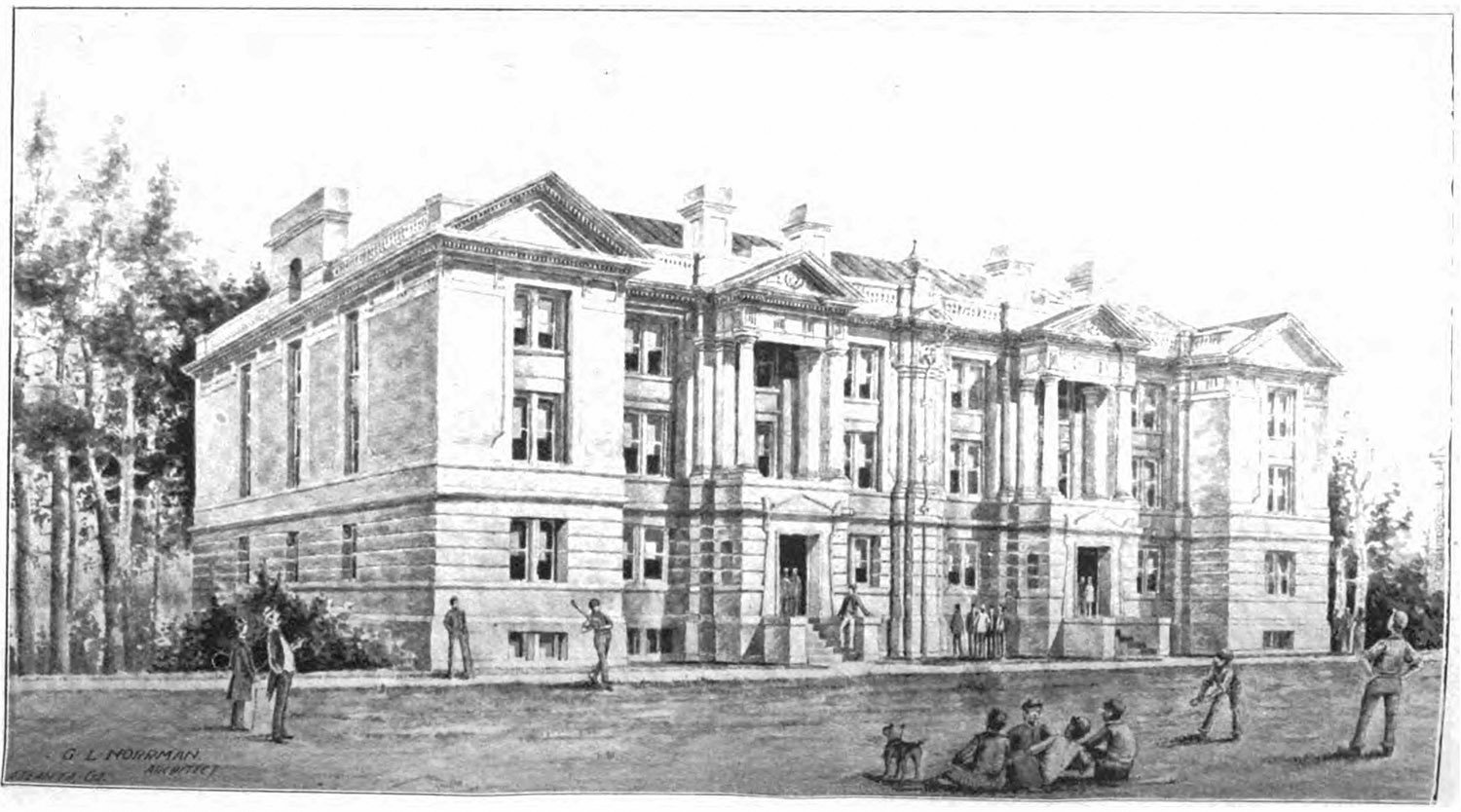
G.L. Norrman.Projected design ofCandler Hall (1901). University of Georgia, Athens.1
The Background
Following a similar article in The Savannah Press, in May 1901, Wallace Putnam Reed wrote the following sketch of G.L. Norrman for his “Random Atlanta Gossip” column in The Macon Telegraph.
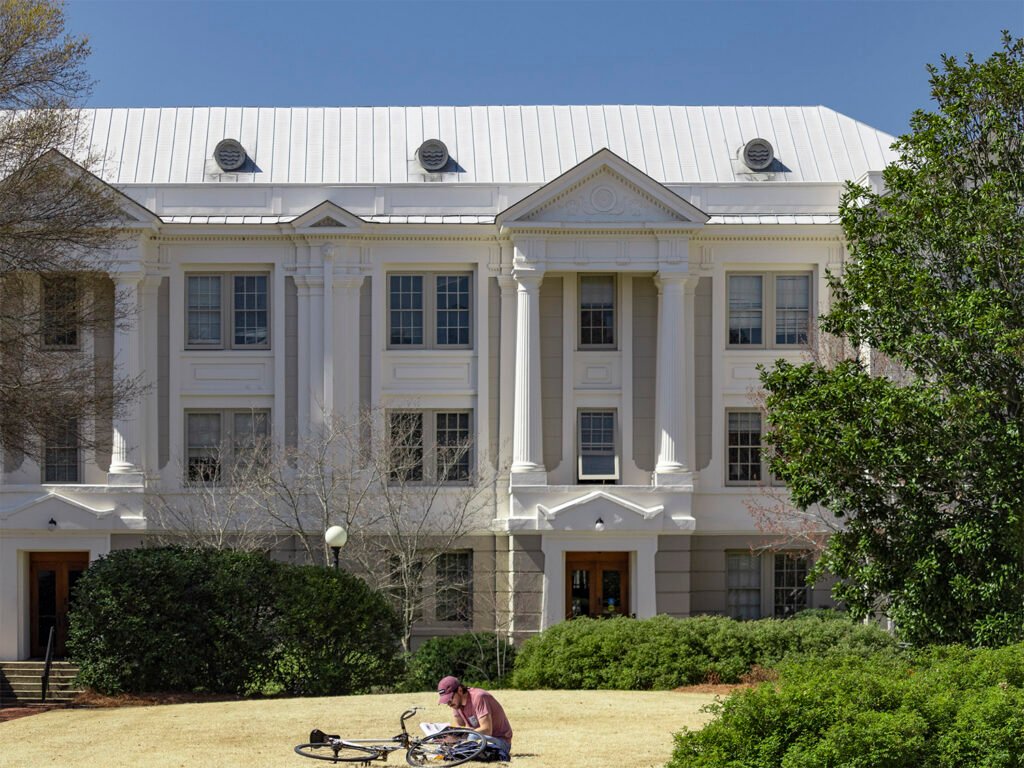
Reed recounted remarks attributed to a man from Birmingham, Alabama, about Norrman’s recent work, including the Bienville Hotel in Mobile, Alabama, and Candler Hall at the University of Georgia in Athens (pictured above).
One interesting aspect of the conversation is the speaker’s claim that “we are trying to induce Norrman to move to Birmingham”. Norrman considered moving to Birmingham, Alabama, in 1899,234 but ultimately remained in Atlanta.
Article Excerpt:
A Birmingham man who is a graduate of the University of Georgia called my attention, this morning, to the new dormitory, and mess hall of that institution, designed by Mr. G.L. Norrman, an Atlanta architect, who is somewhat famous throughout the South.
“These will be the handsomest buildings on the campus,” said the visitor from Birmingham, as he pointed to their pictures on the first page of the Constitution. “I don’t know anything of the kind in Europe or America, at the same cost, which is equal to these structures, measured by the standards of beauty and utility. By the way, we are trying to induce Norrman to move to Birmingham. The new Hotel Bienville in Mobile is his work, you know, and it has made him the most popular man in Atlanta. There is something in fine architecture that appeals to the heads and hearts of all classes. I would rather be a great architect than almost anything else.”
In the meantime Mr. Norrman who was standing within hearing walked off without waiting to be introduced to his admirer. Like most men of the genuine artistic temperament, he gets his satisfaction out of the work and cares less for compliments than any man I know.
If he cares for distinction he can easily make himself recognized as one of the foremost architects of this country. The late John Wellborn Root of Atlanta, enjoyed that distinction, but in some lines Mr. Norrman is regarded as his superior.5
G.L. Norrman. Candler Hall (1902). University of Georgia, Athens.
The Background
In April and May 1901, Wallace Putnam Reed wrote at least 3 similararticles about G.L. Norrmanthat were published in different newspapers throughout the Southeast. The first article is included below, written by Reed for his weekly column in The Savannah Press.
Here, Reed identified Norrman as “A Swedish gentleman of aristocratic ancestry”, but that appears to be inaccurate. All evidence indicates he came from an ordinary middle-class family, and if Norrman falsely claimed himself as a descendant of Swedish nobility, it was entirely unnecessary — he was remarkable enough on his own merits.
Article Excerpt:
Mr. G.L. Norrman, the well known Atlanta architect, has a legion of friends in Savannah who will be delighted with his splendid designs for the State University dormitory and mess hall, which were the most notable illustrations in The Constitution the other day.
Mr. Norrman is in love with his profession.He is an original thinker, a scholar, and a traveler who has studied on their sites the best examples of the world’s ancient and modern architecture. When I do not find it convenient to spend a leisure hour in a big library I hunt up Norrman. He is a favorite with our brightest men, and the south is dotted with churches, public buildings, and residences which bear testimony to his skill and artistic taste.
This man is worth a column here if we had the time and space. A Swedish gentleman of aristocratic ancestry, he has made himself the master of our language, and few writers have his happy gifts of expression. Though comparatively a young man, he is a type of our old-fashioned gentleman in his notions of honor, chivalry, and personal responsibility. It is gratifying to me to see his name imperishably linked with our university. His work will help it in more ways than one.1
References
Reed, Wallace Putnam. “Random Georgia Gossip.” The Savannah Press (Savannah, Georgia), April 27, 1901, p. 4. ↩︎
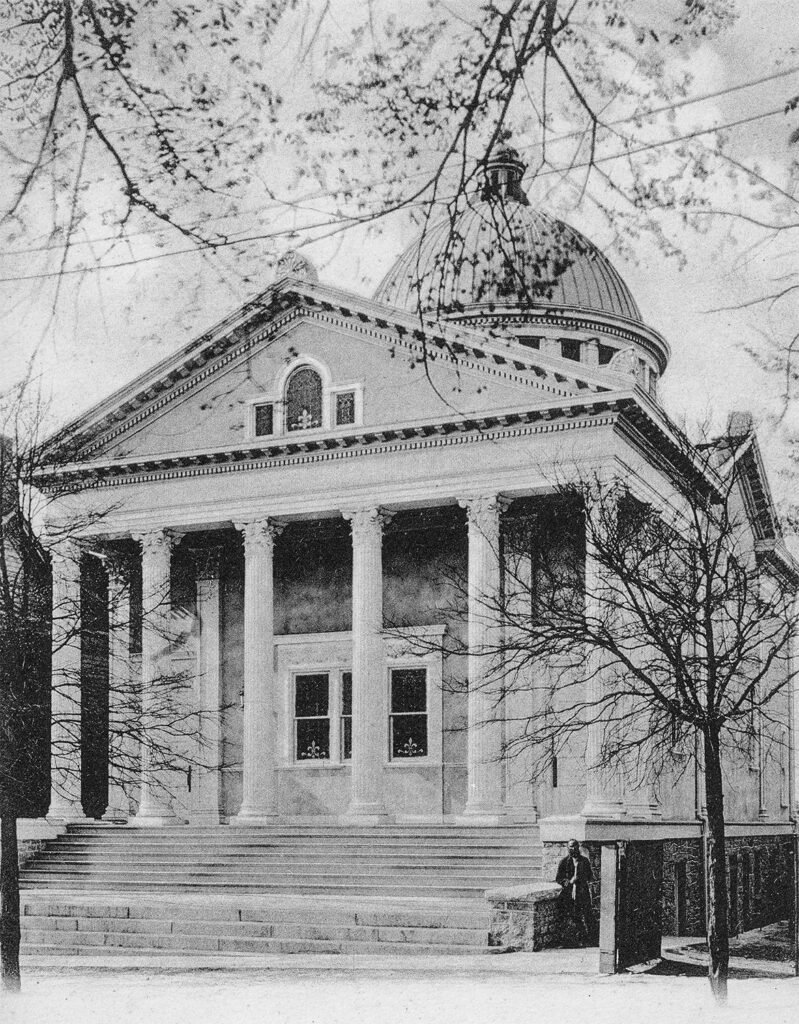
G.L. Norrman. First Church of Christ Scientist (1899, demolished). Atlanta. Photograph from an undated postcard published by Witt Brothers of Atlanta.
The Background
Five months after Wallace Putnam Reed’sanecdote about G.L. Norrman and Mrs. Mims, a much-expanded version of the tale made its way to Washington, D.C., where the story was reported in the “One Woman’s View” column of The Washington Post.
The new version included an additional detail about windows, andreduced Norrman to something of a buffoonish caricature, affecting an exaggerated Scandinavian accent and playing on the “dumb Swede” stereotype that was prevalent in the 19th century.1
Norrman was anything but dumb, of course, speaking at least 3 languages and later described as “one of the best read men in the country and well informed on any and all subjects.”2 But why let truth get in the way of a humorous story, eh?
The revised story was subsequently published in newspapers across the United States.
Article Excerpt:
They have been building a Christian Science church down in Atlanta—I think it’s Atlanta—so a man from Georgia tells me, and the architect they selected to do the thing is a Scandinavian who is as frank in manner as he is artistic in practice. When the building was nearly completed, one of the leading women of the church, mother of a very famous Georgia belle, came to look at it.
“Ah, Mr. Blank,” said she, “it is very beautiful: but you musn’t take too much credit to yourself. Thought has played a great part in bringing this to pass. Not work, but thought. I have put my mind on it since it began to be. I have given you absent treatment to help you. That is why you have been so successful. I have helped you greatly, with my thought.”
“Dank you, madam; I dank you much,” responded the architect. “But I wish you had told me about dis sooner yet. I vould haf tole you what to do. Myself, I can build churches. I do not need your thoughts. But it is that man that puts in the glass. Why you not put your mind on him? He haf put in the most tam bad glass whatever I did see.”
When that Christian Science church in Atlanta was completed, the chief woman member of the congregation gazed at it admiringly.
“It is a thought of God materialized,” she said—I don’t pretend, by the way, to have her phraseology exactly, but I think I convey her meaning. “It is thought made manifest. It is mind made visible. What a pity it is not in marble.”
“Ach, madam,” said the architect, “whose fault is that? I haf no thought; I haf only bricks. I build it with bricks. You haf the thoughts. Why did you not think marble while you were thinking?”3
Thomas Morgan of Bruce & Morgan once claimed that G.L. Norrman “made friends easily,”1 but it could also be said that he made enemies easily.
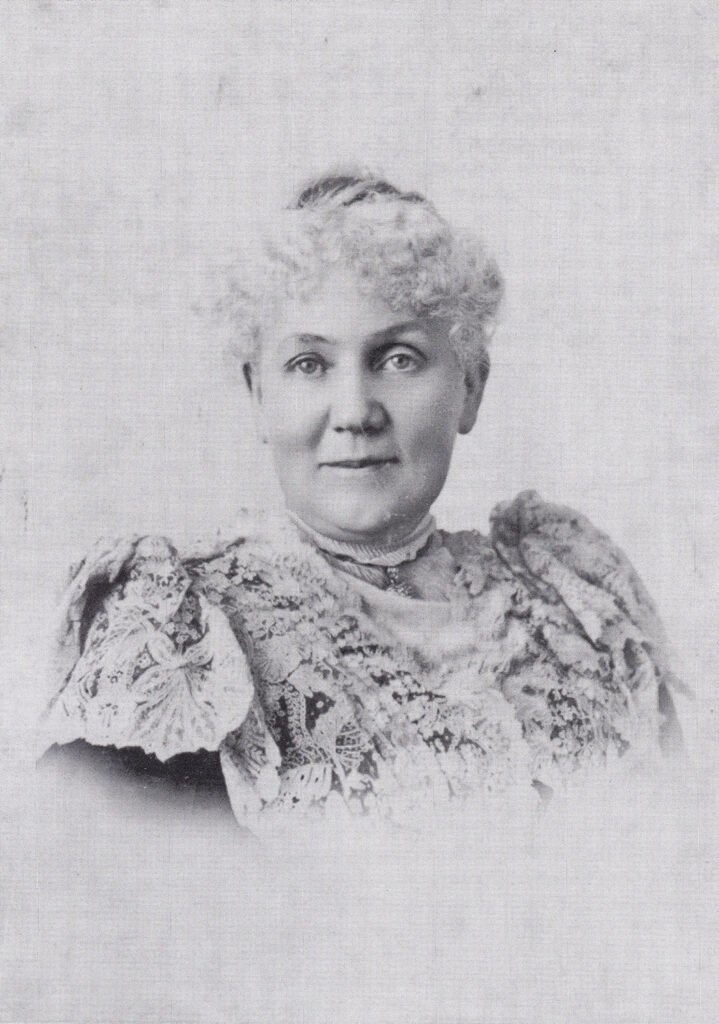
Norrman’s rivals were as colorful as he was, but none were as endearingly antagonistic as Sue Harper Mims (1842-1913, pictured here), a prominent Atlanta socialite and the leader of the city’s Christian Science congregation.
Between 1898 and 1899, when he designed and oversaw construction of the church’s sanctuary, Norrman — who worshiped Norse gods — made several audaciously disparaging remarks about Christian Science beliefs, drawing rebuke from Mrs. Mims.
It’s hard to determine if Norrman and Mims were truly adversaries or if they just enjoyed taunting each other — perhaps it was a little of both.
Here, Norrman’s friend Wallace Putnam Reed recounted a humorous exchange between Norrman and Mrs. Mims, published in January 1900 for his weekly column in The Augusta Chronicle.
“I see that Architect Godfrey L. Norrman, of Atlanta, has been in Augusta in consultation with the owners of the burned district. Mr. Norrman is not only an accomplished architect, but has a fine sense of humor. He was the architect for the Christian Science Temple in Atlanta, which was erected by Mrs. Livingston Mims. It is a beautiful building of pure white, built after the pattern of the Parthenon, and is made of white plaster over brick walls. When the work was completed and Mrs. Mims was looking at the pretty structure, she exclaimed, “It is beautiful, but I wish it was marble,” whereupon Architect Norrman promptly replied: “Well, Mrs. Mims, you just think it marble, and it will be marble.” It seems that several times during the building of the Temple Mr. Norrman had complained of some indisposition and the Christian Scientist said to him: “Mr. Norrman, just think you are well, and you will be well.” The architect desired her to apply her doctrine to the temple.”2
Continuing an apocalyptic theme established in his previous article about G.L. Norrman, in May 1899, Wallace Putnam Reed of The Atlanta Constitution wrote the following article entitled “A Scientist’s Dream and Its Terrors”.
In the story, Norrman and a friend — undoubtedly Reed himself — discussed the potential cataclysmic effects of an earthquake in the Isthmus of Panama. The conversation was spurred by Norrman’s interest in the 1692 Jamaica earthquake, as he was said to “devote considerable attention to such exceptional freaks of nature”.
Norrman then went to sleep and experienced what he described as “the worst dream I ever had”, picturing his own slow, agonizing death — a curious foreshadowing of his actual death by suicide 10 years later.
The story was published by several other newspapers throughout the United States.
A Scientist’s Dreams and Its Terrors
Some time ago Mr. Godfrey L. Norrman read a thrilling account of the great earthquake which destroyed the old city of Port Royal in the West Indies.
The narrative interested him, and he could not dismiss it from his mind.
His fondness for scientific studies had caused him to devote considerable attention to such exceptional freaks of nature, and the story of the Port Royal disaster led him to speculate upon the possibilities of similar calamities in future.
One evening the matter came up while he was conversing with a friend who took a deep interest in such subjects, and in the course of their talk some startling theories and suggestions were discussed.
“What would be the result if an earthquake should up tear up the Isthmus of Panama?” asked Mr. Norrman’s friend.
“It would be far-reaching in its effects,’ was the reply, ‘and it would doubtless make the region we live in uninhabitable.”
“You are right,” said the other. “I have studied the matter for years, and I have formed some very positive opinions about it. The great earthquakes of the past in the tropics may be repeated. Possibly they will occur in new localities, and on a gigantic scale. the Panama isthmus is only about fifty miles wide. Now, it would be easy for a big earthquake to tear a chasm several miles wide through that narrow strip of land.”
“Just so,” assented Mr. Norrman.
“Very well,” continued the prophet of evil. “It is understood that the Pacific is perhaps fully two inches lower than the Atlantic. You know what would happen.”
“Yes,” answered the interested listener, “the gulf stream would change its course.”
“Change is no name for it,” said the talker. “The gulf stream would rush with fearful velocity through the chasm into the Pacific and where would we be?”
“Buried under mountains of snow and ice,” replied the other.
“No doubt about that,” said the man who was predicting future horrors. “The loss of the gulf stream would suddenly change our climate. The gulf would freeze into a solid mass of ice. Florida would be covered with snow-clad glaciers, and Georgia would be bleak and cold as Alaska. The change would kill almost every living thing, but after some years this frozen territory would have a suitable animal and vegetable life. Polar bears would be numerous and perhaps tribes of hardy people like the Eskimos would live here. Other quarters of the globe would send exploring expeditions in this direction, and new Pearys and Andrees would try to discover traces of our buried civilization.”
“Do you really believe all of this?” asked Mr. Norrman.
“Yes, don’t you?”
“Some of it—I hardly know to what extent,” was the response, “but I am inclined to agree with you that such a convulsion as you suggest would suddenly revolutionize our climate and make it impossible for us to live here. The diversion of the gulf stream would probably give us conditions similar to those of the arctic region.”
There was more talk on the same line, and at a late hour Mr. Norrman went to bed with his head full of some very sensational theories, facts and predictions.
Naturally, he had a dream, and it goes without saying that it was a holy terror. He was ripe for it—in the very state of mind for a nightmare.
At first the dreamer found it very pleasant. He was on one of the islands near the Florida peninsula, and the glories of that flowery land and the summer sea dazzled and delighted him.
Suddenly he staggered and came near falling. He felt dizzy and sick. The waves began rolling mountain high, and the island seemed to be rocking.
What was the matter?
A telegraph operator rushed out of his office and shouted to a group of tourists:
“An earthquake has torn the isthmus of Panama wide open from sea to sea!”
The tourists hurried away to carry the news to their families.
Mr. Norrman was left alone on the beach.
He had been watching numerous ships at a distance as they moved slowly over the waters.
All at once their speed increased. They began to move rapidly, and in a short time they darted by in the direction of the Isthmus, so quickly that the spectator wondered how those on board could breathe. The vessels seemed to fly like arrows.
The stiff breeze, growing stronger very moment, was getting colder.
The solitary watcher on the beach felt too weak to walk to in a place of shelter, and he was glad to sit down where a huge rock shielded him from the gale.
He remained there some two or three hours. The ships were no longer visible. Great masses of white fog advanced from every quarter, and a heavy snow began falling.
The white fog began freezing, and big masses of ice could be seen in the gulf, circling around the island, while in the distance icebergs loomed up all in their white and awful splendor.
Unable to move, the man by the rock felt that he was rapidly and surely freezing to death. The ground about him was covered with ice and snow. He was chilled to the very narrow, and shivered like an aspen leaf.
No human being ever suffered more than Mr. Norrman during that frightful ordeal. Certain death apparently was his doom, and he gave up all hope. His tortures were so unbearable that he was anxious to die and end his misery. His ears, nose, feet and hands were frozen, and it was impossible for him to crawl.
Yet his mind was abnormally active. He recalled all that he had ever read and heard about the horrors of arctic life, and he felt the keenest curiosity about the extent of the earthquake and its effects upon the south Atlanta and gulf states.
Even in those moments of excruciating pain his thoughts turned to Georgia, and he laughed deliriously when he pictured to himself the astonishment of the promenaders in their spring costumes on Peachtree street when they lost their climate at one fell swoop, and found the snow drifts piling up around them.
But human endurance has its limit.
A tremendous howl exploding from his own throat awoke Mr. Norrman, and leaping from his bed, with chattering teeth and shaking limbs, he made a rush for the grate, and got as close as he possibly could to the fire.
It was a pleasant spring night, but he was nearly frozen, and it took an hour to restore its circulation.
“That was the worst dream I ever had,” said Mr. Norrman, “and it makes me shiver to think of it.“
Atlanta and the United States were in the throes of the Great Blizzard of 1899 when Wallace Putnam Reed, a friend of G.L. Norrman‘s, wrote the following article as part of his weekly column in TheAtlanta Constitution.
Two days before the article’s publication, Atlanta received 6.5 inches of snow and recorded its all-time low temperature of nearly -9 °F12 in a cataclysmic nationwide cold snap.
Described by one forecaster as “probably the most remarkable in the history of the country”,3 the blizzard left hundreds of Atlantans stranded without food and fuel for heat,456 and caused more than $1 million of crop losses in Georgia and $100,000 of pipe damage in Atlanta.78
With the ice and snow still melting, Reed asked a timely question: “Is our climate changing?”, and introduced his readers to Norrman’s belief that Earth’s geographic poles cataclysmically shifted at earlier points in its history, a debunked pseudo-scientific theory that was first hypothesized in the late 19th century.
Here, Reed referred to the infamous “Cold Friday” of 1833, which was previously reputed as the coldest day on record in the Atlanta area,9 although the city didn’t even exist at that point. Reed also mentioned Terminus and Marthasville — both were early names for Atlanta.10
Our Polar Weather And Its Suggestions
Is our climate changing?
Occasionally this question is asked in a humorous way by some old-timer who takes the position that the war ruined everything down this way, including our weather.
But the suggestion has a serious aspect.
A few exceptionally cold winters in the course of a century, or a dozen centuries, would not be conclusive proof of a permanent change of climate.
This globe of ours is very old. According to the scientists, it is at least 100,000 years old, and in that period many remarkable physical revolutions have occurred.
Of course we have had very cold spells in Georgia before the present age. Everyone of my older readers is ready right now to remind me of that memorable and destructive freeze two generations ago, along the thirties, shortly before the big panic.
That was bad enough, but there were fewer people here to suffer in those days, and Atlanta escaped entirely, because there was then no Atlanta—not even Marthasville or Terminus; and I doubt whether Hardy Ivey [sic] had built his solitary cabin on the site of our metropolis.
It was a terrible visitation—that cold Friday. Fruit trees, vegetation and crops were ruined. Thousands of forest trees exploded–bursting wide open.
The people had not recovered when the panic came. then, cotton fell 3 or 4 cents, and many farmers lost everything. Their creditors pushed them to the wall, and sold them out, not sparing even their beds, pots and kettles and cheap tableware.
Some scientific men maintain that in the remote past this was a very cold region. Mr. G.L. Norrman touches upon the subject very entertainingly in his recent pamphlet, entitled “Architecture as Illustrative of Religious Belief.”
Mr. Norrman accounts for the flood by suggesting that sometime during the earth’s existence the accumulation and congealing of the vapors at the poles made them the largest diameter of the globe, and, when this took place, the earth naturally found its equilibrium on a different axis, and turned about 90 degrees.
This is a very startling suggestion, and there is a sufficient basis of fact for it to attract the attention of the thoughtful.
The pamphlet referred to in the foregoing paragraphs says that the poles were perhaps changed from some points near the present equator, taking the place of the former equator at points near the present poles. If such a change in the poles occurred, it would account for many curious phenomena on this sphere.
Such a change would of course change the beds of the oceans.
What are now productive valleys may have been the bottom of the ocean, and the present bed of the ocean may have been tilled valleys, ages and ages ago.
This change of the oceans would have caused a tremendous rush of the waters, destroying everything in their way.
It would account for the phosphate beds, where animals of every kind—lions, tigers, elephants, fish and reptiles—are piled together, as firmly as if a million Niagaras had rammed them in the crevices where they are found.
The coal beds, also, may have had a similar origin, though they may be traced to other causes.
Only some such catastrophe as the changing of poles will satisfactorily account for the remains of tropical plants and animals under the ice and snow in Siberia and Greenland, and the existence of glaciers at the equator.
Remains of tropical animals and plants could hardly have been in the arctic regions, unless that part of the earth had been tropical at some time, and unless a very sudden change in the temperature had taken place.
Whatever power caused the phosphate beds, the coal beds and the existence of tropical plants and animals under the ice and snow of the arctics was necessarily a power sufficiently great to destroy nearly every vestige of life and civilization.
Only on isolated mountain tops could life have been preserved.
People do not like to think of such gigantic convulsions of nature, and contemplate the possibility of their repetition.
Yet, the pendulum always swings backward. Its return may be delayed, but sooner or later it must come.
It is possible, therefore, that sometime in the future another violent shock will cause the present poles and the equator to change places; or again reoccupy their former localities.
The human mind can hardly grasp the full meaning of such a change.
Under such conditions the now frozen regions around the poles would be transformed into productive garden spots, while our south Atlantic and gulf states would be buried under mountains of perpetual snow and ice.
Intrepid explorers would probably make their way to Georgia, Florida and Cuba, and return to their tropical Greenland homes with big stories of the polar bears and reindeers seen in this locality.
Fortunately, there is no immediate danger, unless a tremendous earthquake should unexpectedly bring about the change.
For hundreds, and possibly thousands of years to come, this will probably remain the sunny south, with a delightful climate, and a rapidly increasing productive capacity.
The speculations of the scientists will not justify anybody in knocking off work and neglecting the improvement of their real estate.
If Georgia ever becomes an arctic territory again, it will probably be thousands of years hence. By that time our history will have been forgotten. New races may then live here. Perhaps not a vestige of our present civilization will remain.
So we need not concern ourselves bout these matters.
Some years ago there was a very brilliant Atlantian of a scientific turn of mind who was greatly worried over the idea that an earthquake or a canal across the isthmus of Panama might divert the gulf stream from its course, and turn this region into a frozen waste, where no human beings could exist, but his warnings did not alarm many people.
Let us leave the calamities of the future to those who will have to bear them. In the meantime we have our hands full taking care of ourselves and the sufferers at our doors during our occasional blizzards.
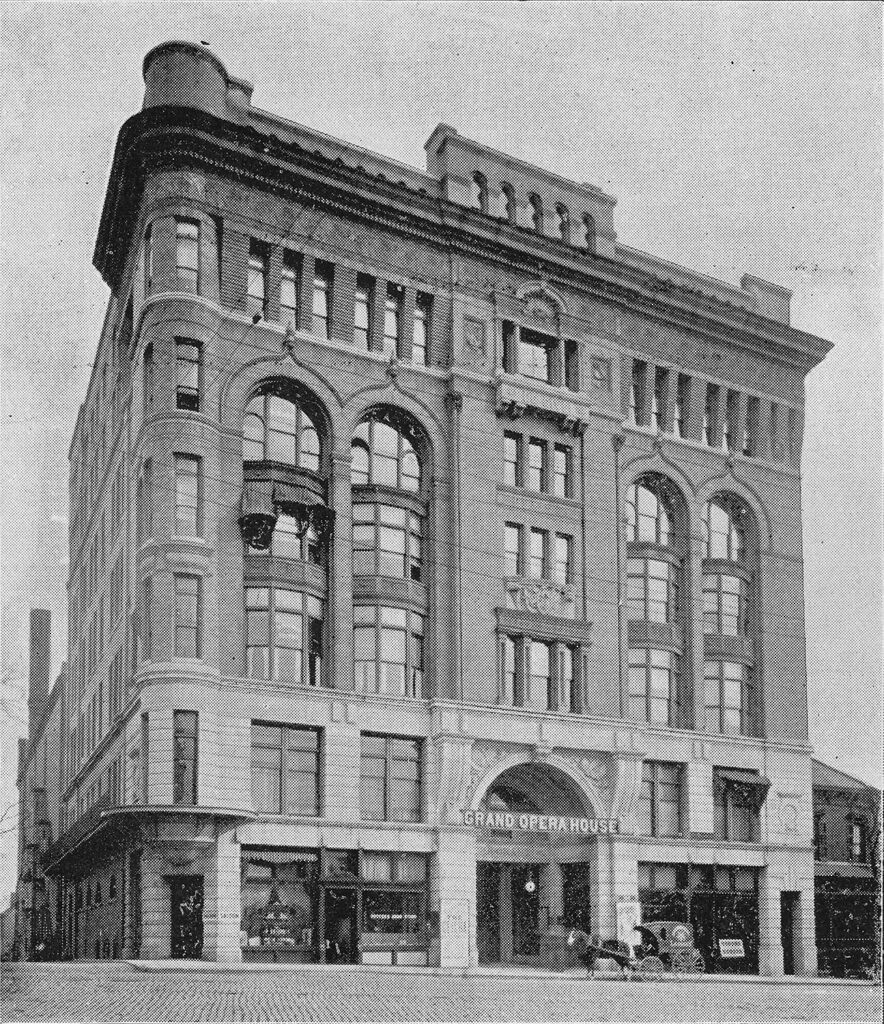
J.B. McElfatrick & Sons with Nixon & Lindsey.DeGive’s Grand Opera House (1893, burned January 30, 1978). Atlanta.123456
The Background
The following treatise was written by A. McC. Nixon, an architect who practiced in Atlanta from 18887 to 1896.8
The paper was read at the Second Annual Convention of the Southern Chapter of the American Institute of Architects, held in Birmingham, Alabama, in January 1893, and later published in the February 1893 edition of The Southern Architect.
Here, Nixon lamented a lack of expertise in the architectural profession, a dearth of “practical knowledge” in the construction industry, and the general public’s need to understand the “principles of taste and scientific building”.
None of those complaints were uncommon among architects at the time, but Nixonadditionally called for the establishment of a national University of Architecture, outlining a regimented training program of 8 to 9 years that would be required before a designer was allowed to practice as an architect.
Ironically, there is no evidence that Nixon had any formal training in architecture himself, although that was certainly the norm for Southern architects at the time, and the need for architectural education in the region was acute.
The first school in the Deep South to offer architectural study was Tuskegee University in 18929 — available to Black students only. Atlanta’s first wave of trained architects appeared in the late 1890s and early 1900s, although they were all educated in the Northeast or abroad. The school of architecture at Georgia Tech in Atlanta was finally established in 1908.10
Nixon included two references in this paper that would be unfamiliar to modern readers, alluding to the “unscrupulous attempts by Buddensieck” and the “fruitless efforts of the Albany State capitol of New York”.
Charles A. Buddensiek was a New York contractor who was said to be “notorious as a builder of cheap edifices.”11 In April 1885, he was overseeing the construction of eight 5-story tenement houses that collapsed, killing one worker and injuring at least 16 others.121314 The buildings were hastily assembled and used substandard materials and labor at Buddensieck’s insistence, leading to his eventual conviction for manslaughter.1516
The New York State Capitol building was still under construction in 1893, nearly 30 years after the project began in 1867. The project was plagued by cost overruns and political meddling, with design and construction handled by a succession of 4 different architects before it was finally completed in 1899.
The Problem of Architectural Education.
In preparing this paper on such a problem I am fully aware that architectural education has been fully outlined by the various institutes of the country purporting to teach the students various branches of the study of architecture in a one, two or three year’s course. But the question before us is, what shall constitute the architectural student’s course in the practitioner’s office so as to combine practice with theory and fit our young men as efficient assistants?
The wealth and luxury of the American nation is fast pushing to the front the architectural excellence of its structures, and it behooves us to look ahead and examine closely whether there may not be some remedy for evils existing.
I will endeavor, in a contemplative way, to discover and lay bare the defects and principal causes.
First – There is a great want of sufficient practical, theoretical and scientific education of the architectural student of to-day.
Second – A want of practical knowledge in the contractor.
Third – A want of acquaintance on the part of the public in the principles of taste and scientific building.
It is too plain to the profession that the limited knowledge displayed by some, claiming to be practitioners in the execution of their work, leads them into absurd extravagances, and who labor under the mistaken-structural meanness for economy, and thus mislead and often discourage the many projects for fine buildings from even being placed in the hands of the more skilled.
The builder, lacking the proper practical and scientific knowledge, enters now upon the work to attempt to carry out these gross absurdities, or further tries to induce and influence the minds of those building to break confidence with the skilled architect and execute the work from haphazard conglomeration of his confused mind, from what the plans were intended to convey, evidence of which appears too often in the preposterously inconvenient and grotesque masses of folly, totally devoid of all taste and architectural structure in our chief cities.
There are some extenuating circumstances sometimes surrounding all this, such as the proprietor attempting to build with insufficient funds, and the employment of a builder without reputation or knowledge.
Of course, we admit that there are competent and honorable members of the building fraternity and the architectural profession are ready to recognize such and are indeed much indebted to them.
The public universally are ready to admit, too, that they lack the essential knowledge necessary, in a certain measure, to make them understand just what they want, and to what extent they ought to place reliance upon the architectural services employed. They certainly know when to appreciate a well designed and executed building when the proper care has been bestowed upon it. Why, how much of the detail of many of our buildings of to-day are worthy of imitation? But take the buildings of the Greeks, Romans and Europeans of the early and middle ages, and you will find a delightful field of research. But with all this it is a fact that the architect of to-day has less control, or is less able to influence the employer in his design, arrangements or material of the structures put into his hands for skillful manipulation, just as a physician would have in building up the physical condition from the patient’s own prescribing. Take for instance the unscrupulous attempts by Buddensieck [sic], and the fruitless efforts of the Albany State capitol of New York, endangering life and property as well as squandering of public and private funds; I ask is it reasonable to expect comfort and credit from investment?
Knowledge, tradition and science have to be employed in designing and in the execution of edifices, and yet it is often expected from the heterogeneous mass of opinions to combine some daring innovations with ill-contrived plans for an experimental attempt to produce something out of nothing.
Now, all this goes to prove that the architect, builder and public must possess the necessary essential knowledge to be qualified for any undertaking. Integrity must take a hand too, and must characterize the dealings between architect and employer, and acknowledged skill and taste must be recognized for the honorable fulfillment of the work. The public will then pronounce the verdict at completion of the building. Public opinion is respected in this; and must be in all matters. It is the voice of the people, let us respect it in the higher arts and furnish suggestions for a necessary course of instruction and in acquiring such knowledge that will characterize the buildings of a nation.
It is proposed, therefore, that a National College of Architecture shall be established in the United States for the acquirement of architecture and the practice regulating it, as follows:
That after an examination, and the student is found to possess sufficient grounding in common school education, a term of two or three years shall be devoted to a thorough study of free-hand model and perspective drawing, geometry, mensuration and mechanics which shall enable the student to enter an architect’s office as pupil, and after three years’ apprenticeship, during which term he shall study and qualify himself in the principles of classic architecture and the styles of the middle ages, and practically delineate and trace scaled drawings and visit the various works in course of construction, he shall, after prescribed examination at the college, be acknowledged a member of the Architectural Association with a certificate to such effect, issued him by said college, which shall entitle him to accept a junior position in an architect’s office at a stipulated remuneration.
That after a further term of three years with additional practice as a junior, he shall pass an examination which shall qualify him as senior draughtsman. And after passing a still further examination in the nature and strength of materials, hydrostatics, prices, economy of construction and design and a higher knowledge of mathematics, construction, archaeology, ventilation and heating, he shall be entitled to practice as an architect.
By this means I think we should insure excellence as a whole and avoid rudeness in design and premature decay and failure.
That every contractor, foreman or clerk of works shall be required to show his certificate of having passed the full course in his trade at one of the acknowledged technological institutes of the country and exhibit a practical knowledge of building in all its branches, and shall pass an examination at said college testifying to his ability in managing all classes of building, after which he shall be entitled to carry on and enter into contracts for the execution of public and private works.
That at our public schools and other places of learning the privilege shall be granted to the student of a course in designing and color (as well as music), that the general public by this means shall imbibe the spirit of taste and skill.
That all persons who shall have received their certificates or qualification shall be deprived of the privilege of performing their function in either an architect’s office, or as senior draughtsman, junior assistant or builder, foreman or clerk of works, by reason of unskilled handling of work, if it is proved that they lack the information as herein prescribed, and shall be reinstated only upon a further examination by said college.
That the Board of Examiners shall be appointed annually to conduct all examinations, chosen from among the members of the profession in good standing, which shall also act as referees in public competitions.
In connection with all the foregoing suggestions, there are numerous theories to be considered, such as the maintenance and governance of such a national college, the studies taught, the library, collection of prize drawings and the minutiae too voluminous to enter into detail now; but suffice it to say, that by the formulation of this institution of architectural learning it is proposed to insure to the public and to the individual the greatest economy, advanced taste, science and skill in building, that will be a credit to the nation and a profitable return for the great outlay of wealth, as well as providing the best means for a thorough, systematic and speedy education in the science and art of building, and which will tend to draw out the best and most honorable talent of the country, and will also insure the builder against the discredit of failure, and will inspire confidence to the investor; and chiefly it will be the means of encouraging proper friendly relations in all business enterprises to the benefit of the laborer, artisan, builder, architect and the public, all working together for the noble purpose of leaving behind standing monuments worthy of the country’s pride.
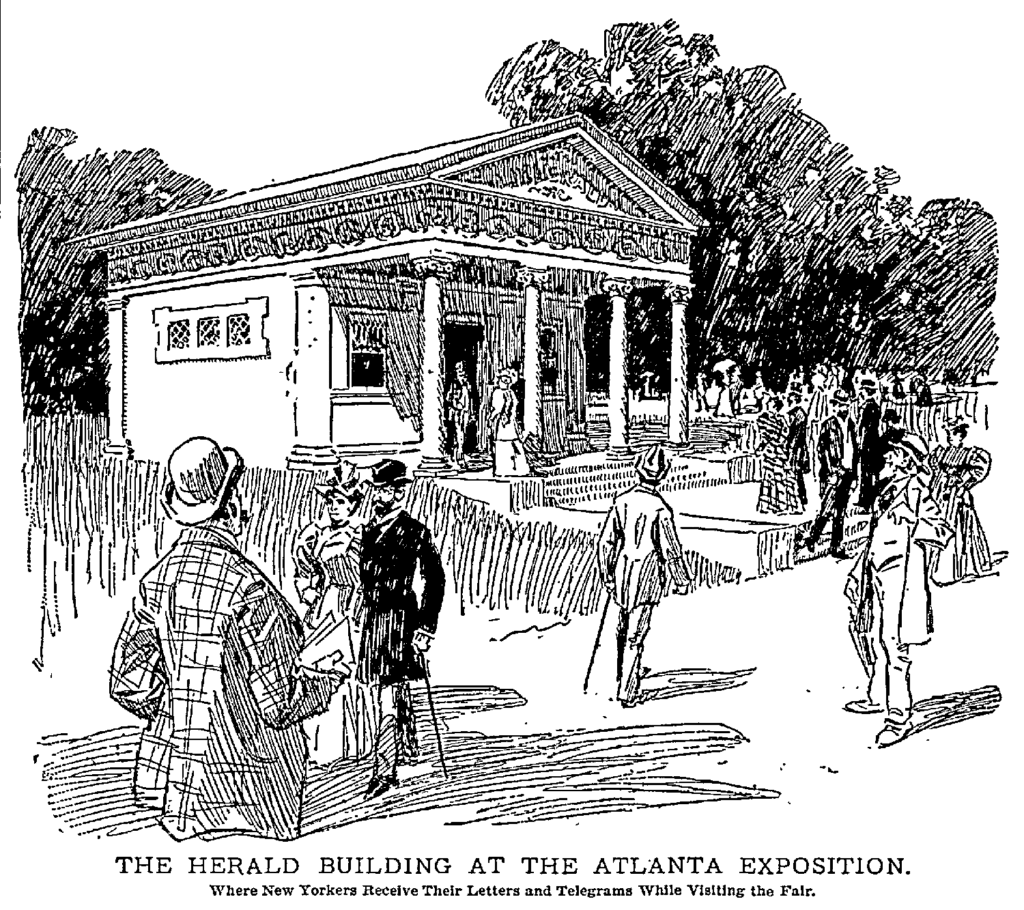
G.L. Norrman. New York Herald Building, Cotton States and International Exposition (1895). Atlanta.1
A good idea never dies, as proven by G.L. Norrman‘s design for the New York Herald Building at the 1895 Cotton States and International Exposition in Atlanta.
More of a booth than a building, the structure’s primary purpose was to distribute copies of the New York Herald to exposition visitors, with the added service of delivering letters and telegrams sent to tourists from their friends and family in the North.2
The structure was built of cheap woodand intended to last for the duration of the exposition: a little over 3 months.3 But Norrman rarely did anything by half, so the booth was designed as a tiny tetrastyle temple — complete with a raised podium, a porch with 4 Ionic columns, and a decorative frieze and pediment. The entire building was also painted white,4 giving it the full classical effect.
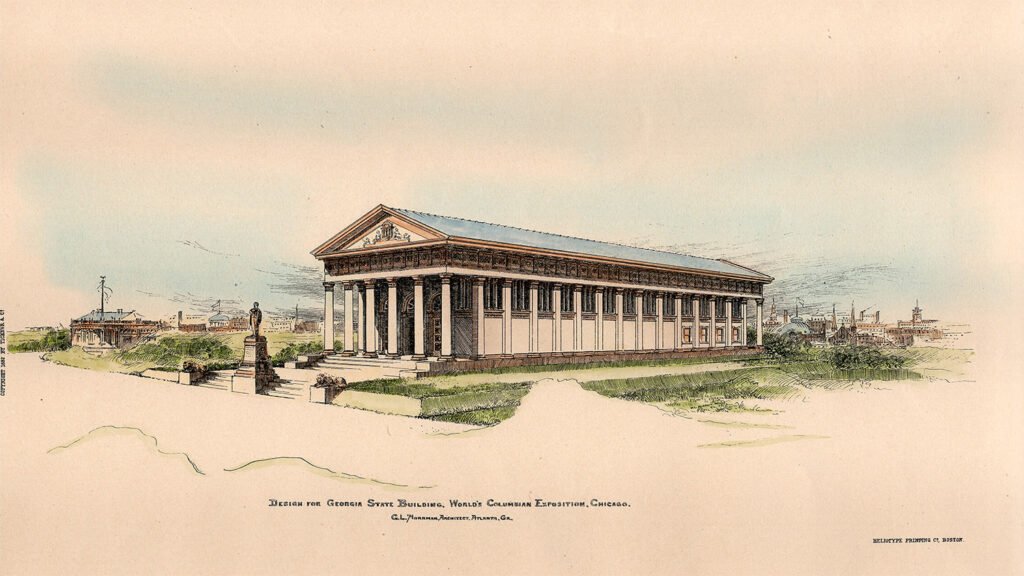
G.L. Norrman. Georgia State Building, World’s Columbian Exposition (1892, unbuilt). Illustration drawn by W.L. Stoddart.5
Norrman’s inspiration for the project clearly came from his own 1892 design for the Georgia State Building at the World’s Columbian Exposition in Chicago.
As conceived by Norrman, the Georgia State Building was to be a 50-by-150-foot hexastyle temple made entirely of Georgia materials,6 including “liberal use of parti-colored marbles”,7 marble tile floors, a terra cotta roof,8 and “dressed wood effects” to “remind the traveled beholder of the sublime artistic effects so frequently produced in Venetian and Florentine buildings”.9
The project wasn’t executed, as the state of Georgia couldn’t secure enough space for it at the exposition.1011 Additionally, the estimated $10,000 building12 had to be funded entirely by private donations, which failed to materialize.13
Norrman was obviously pleased with his design, however: Early in the project’s development, he suggested that the Georgia State Building be “lithographed and copyrighted”, with proceeds funding its construction.14
And the building was indeed lithographed — Norrman’s then-assistant, W.L. Stoddart, drew an exquisite pen-and-ink wash of the proposed design (pictured above), which was published in the American Architect and Building News in July 1892.
An illustration of the building was also entered into the Architectural League of New York’s 8th annual exhibition in January 1893, which included designs from the World’s Columbian Exposition. In describing the show, The Architectural and Building Monthly singled out Norrman’s design from 15 other state entries, writing somewhat inaccurately:
. “…the Georgian design by G.L. Norrman, of Atlanta, is the only one which can be considered an exponent of a type. The design is characteristic of the Sunny South, where the public buildings have always been more ornate and graceful than in the more material North. It is of the Grecian temple style, but there is enough originality and boldness in the treatment to defend the architect from any suggestion of a too slavish conservatism. There is a beautiful proportion carried out in the details, and the whole is a harmonious picture.”15
Given its positive reception in New York, it’s fitting that Norrman adapted his world’s fair design for a New York newspaper, no matter how short-lived its use: Following the close of the Cotton States Exposition, the New York Herald Building was demolished in January 1896.1617
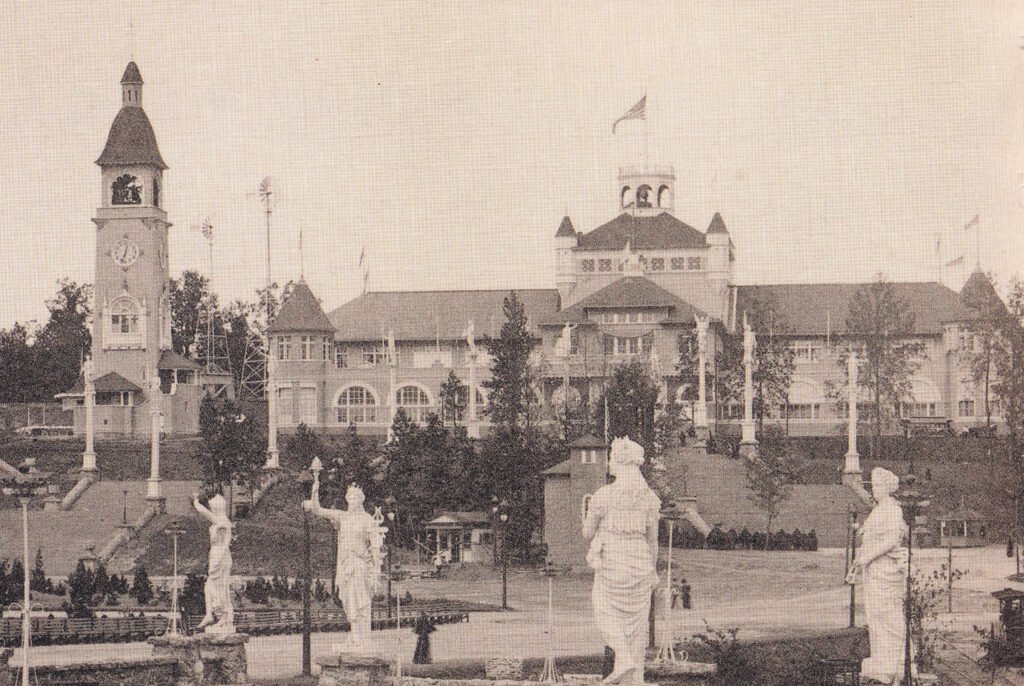
View of Cotton States and International Exposition with New York Herald Building under construction (visible between 2nd and 3rd statues).18
References
“Herald’s Booth At Atlanta”. New York Herald, October 20, 1895, p. 10. ↩︎
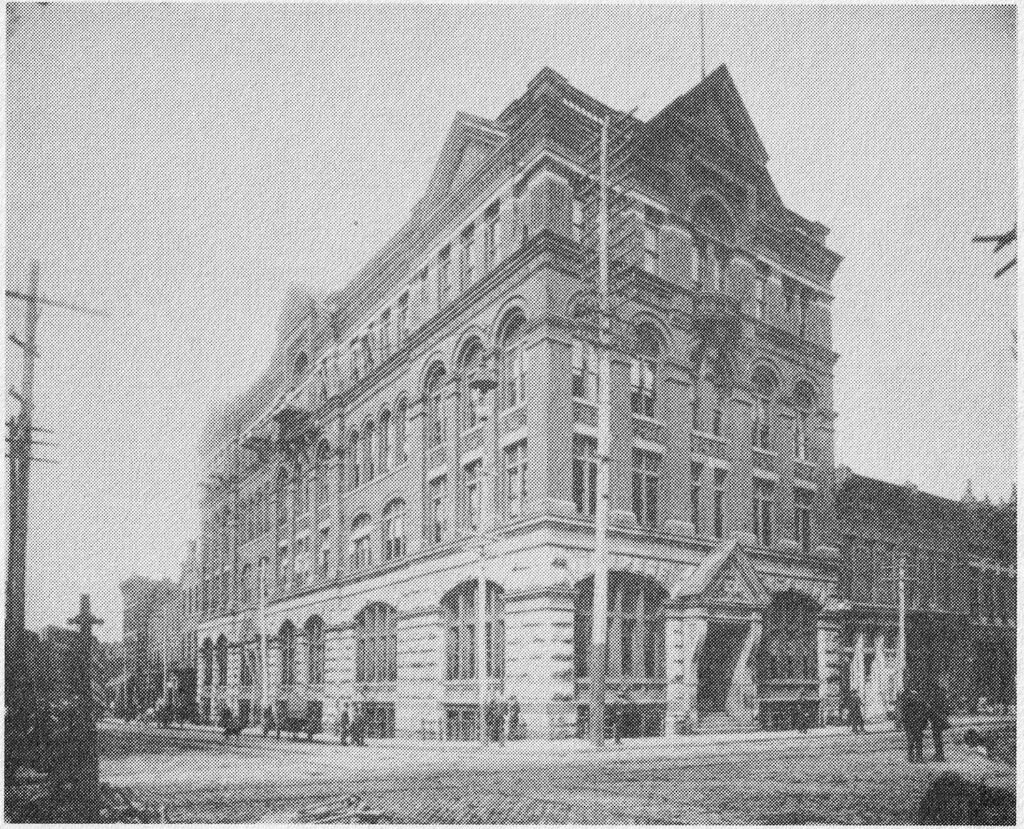
Humphries & Norrman. Gate City National Bank (1884, demolished May 1929). Atlanta.1
The Background
The following biographical sketch, published in 1884, is one of just a few sources with details about the early life of G.L. Norrman, including an interesting anecdote about a violent outburst in his youth — a forerunner of many to follow.
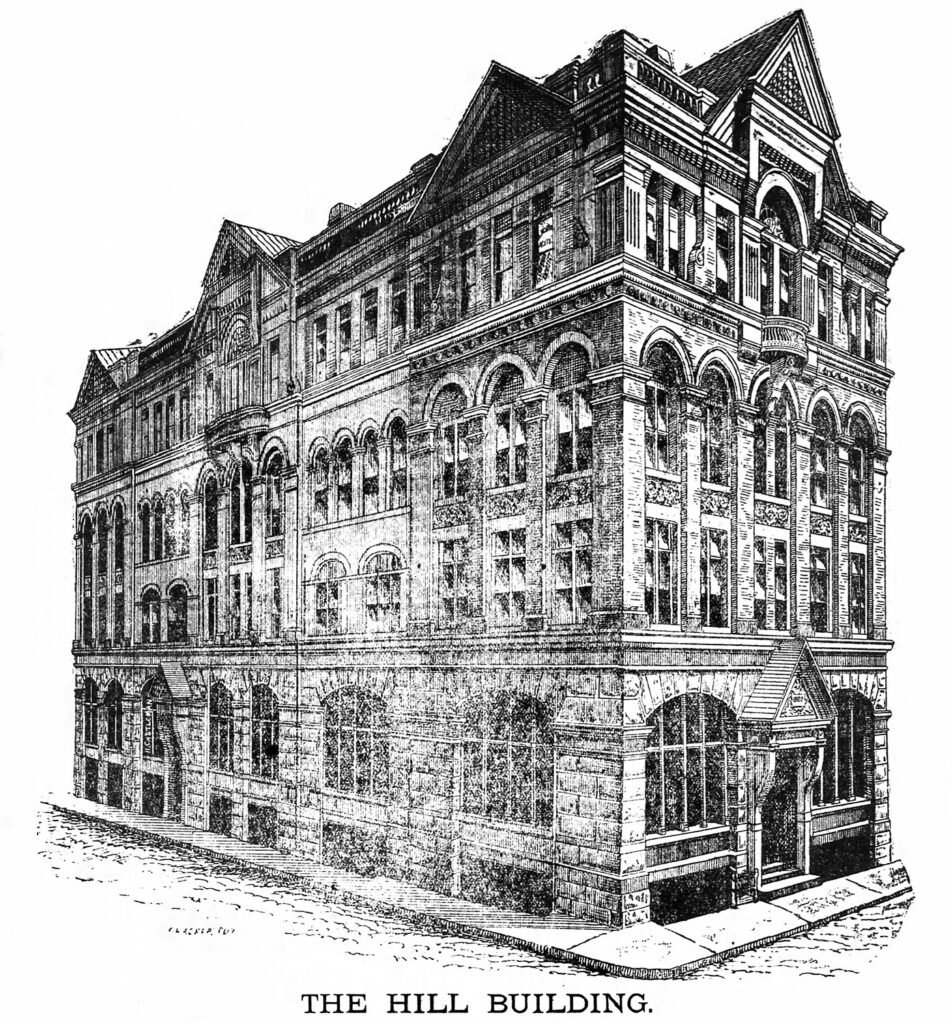
The sketch appeared as part of an article in The Atlanta Constitution heralding the completion of the first “modern” office building in the city, which was designed by Norrman and owned and anchored by the Gate City National Bank.
Located at the southeast corner of Alabama and Pryor Streets, the 5-story structure was one of Norrman’s most important early works, designed in the “metropolitan style”, with Stone Mountain granite for the foundation, Tennessee limestone on the lower floors, and pressed brick on the upper floors.
Location of Gate City National Bank
The building’s entrance porticoes were made of Ohio freestone and carved by a mysterious Mr. Ruckle, who was said to be a graduate of the “national school of fine arts at Munich”.2 Inside, the building included an elevator,3 among the earliest in Georgia (the first one debuted at Atlanta’s J.F. & M.C. Kiser department store in 18774).
The project took nearly 2 years to complete5 and was officially credited toHumphries & Norrman.6 However, George P. Humphries left the firm shortly before its completion,7 and it appears Norrman was the primary designer, assisted by his first known draughtsman, Aug Petersen.
L. J. Hill, president of the Gate City National Bank, praised Norrman’s design for the building, saying: “…no finer architect need be wanted by anyone than Mr. Norrman.”
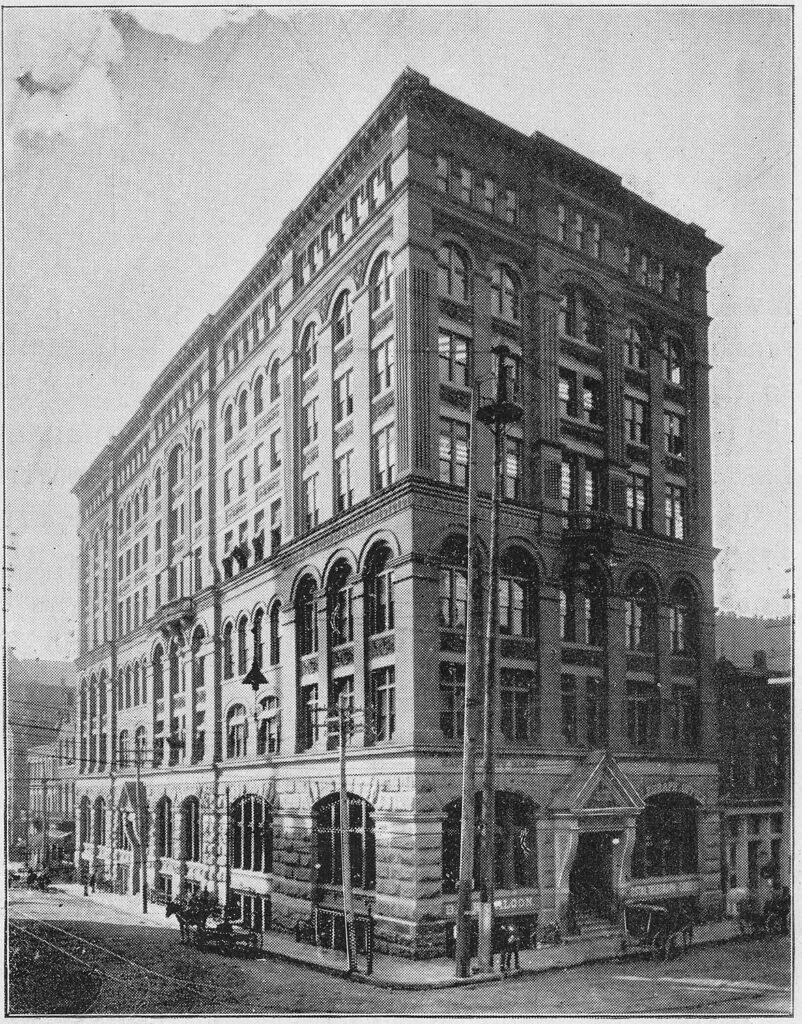
Although the article calls it the “Hill building”, the structure was typically referred to as the Gate City National Bank until the institution abruptly closed its doors and was sold in 1893,89 after an employee embezzled over $100,000 from its coffers.1011
“Temple Court”, Gate City National Bank, after 1895 expansion.12
Seizing the opportunity for prime real estate, the Venable Brothers of Atlanta purchased the building,13 and in 1895, added 3 floors14 with a roof garden,15 installed “two swift modern elevators”,16 renovated the interior,17 and renamed the structure Temple Court (pictured above).18
Billed as “Taller than the Equitable“,19 the 8-story Temple Court gave the structure a new lease on life, as it was already becoming outmoded by Atlanta’s first “skyscrapers” of the 1890s, which topped out at a whopping 10 floors by the end of the decade.
The Temple Court addition was reportedly designed by another architectural firm,20 but while work was underway on the project,21 Norrman was also hired by the Venables to design the 10-story Hotel Venable (unbuilt).2223242526 Whoever was responsible for the Temple Court addition (I suspect Bruce & Morgan27), it appears to have seamlessly matched Norrman’s original design.
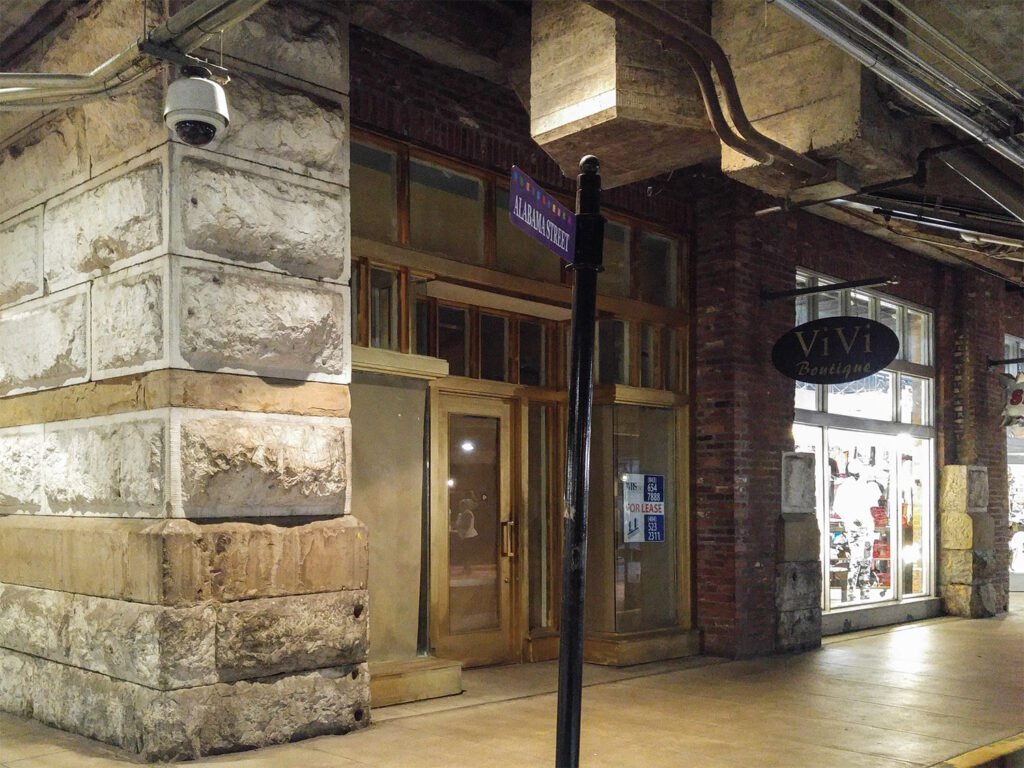
Temple Court was demolished in May 1929 for a 3-story hotel,2829 shortly after its ground floor and basement were stripped of their ornamentation and sealed beneath the Alabama Street viaduct, then under construction.30 The new structure was simply built on top of the old building’s ground floor, vestiges of which can still be seen in whatever remains of Underground Atlanta.
Vestiges of rusticated limestone facade from Gate City National Bank, Underground Atlanta.
This need for fact-checking is strong in this biographical sketch, which appears to have been hastily written: it’s chock-full of run-on sentences, overlong paragraphs, and numerous mangled names. It also makes several claims that merit further attention. Among them:
I haven’t been able to confirm that Norrman served 3 years in the “royal navy”, but in the mid-19th century, all Swedish males between the ages of 20 and 25 were required to serve in the military for 4 weeks every 2 years.31 At Norrman’s death, a photograph was also found of him “in full dress suit of a marine”.32
The “government engineer corps” mentioned in the article could be the Pontonjärbataljonen, a battalion stationed in Stockholm that primarily built bridges.
Norrman and his first partner in Atlanta, M.B. Weed, can only be partially credited with the design of the main building at the International Cotton Exposition. The original plan wasdesigned byW.H.H. Whiting of Boston,3738 and it appears Norrman & Weed designed multiple expansions of the building during its construction.3940 The firm also designed 5 accessory buildings at the exhibition, with Fay & Eichberg of Atlanta designing two.4142
In addition to the exposition buildings, 19 of Norrman’s other works are mentioned in the sketch, although many are given incorrect names or locations. Only one of those, the Edward C. Peters House, remains standing — Atlanta does love the wrecking ball. The correct names, dates, and locations for each project are:
St. Luke’s Cathedral, built 1883 and demolished 1906 – NE corner of North Pryor and Houston Streets, Atlanta – later site of Georgia-Pacific Center, Downtown [Map]
Unitarian Church of Our Father, built 1883 and demolished 1900 for construction of Carnegie Library – SW corner of Church and Forsyth Streets, Atlanta [Map]
Edward C. Peters Residence, “Ivy Hall”, completed 1883 – 179 Ponce de Leon Avenue NE; Midtown, Atlanta [Map]
William H. Venable Residence, built 1883 – 19 Forrest Avenue, Atlanta [Map]
William S. Everett Residence, built 1884 – 278 Peachtree Street, Atlanta – later site of Atlanta Expressway (I-75/85) [Map]
William D. Ellis Residence, built 1882 and demolished for construction of Atlanta Expressway (I-75/85) – 193 Washington Street, Atlanta [Map]
John Milledge Residence, built 1883 – 120 East Peters Street, NE corner of East Peters Street and Capitol Place, Atlanta – later site of 2 Capitol Square SW, Downtown [Map]
Horace Bumstead Residence, “Bumstead Cottage”, built 1883 and demolished by 1929 – 169 Vine Street, NE corner of Vine Street and University Place, Atlanta [Map]
Thomas H. Blacknall Residence, built 1883 and likely demolished for construction of East-West Expressway (I-20) – 56 Park Avenue, SE corner of Park and Lee Streets, West End, Atlanta [Map]
West End Academy, built 1883-4 and demolished circa 1911 – Lee Street, West End, Atlanta [Map]
Ponce De Leon Springs pavilion, built 1883 and demolished circa 1914 – later site of Sears, Roebuck & Company Building, Atlanta. [Map]
Robert A. Hemphill Residence, built 1884 – 231 Peachtree Street, Atlanta – later site of SunTrust Plaza, Downtown [Map]
Daniel N. Speer Residence, built 1882 – 486 Peachtree Street, SW corner of Peachtree and Linden Streets, Atlanta – later site of Emory University Hospital Midtown [Map]
Dr. Spalding Residence, built 1883 – 484 Peachtree Street, NE corner of Peachtree and Howard Streets, Atlanta – later site of Emory University Hospital Midtown [Map]
Nathaniel P.T. Finch Residence, built 1881 – 388 Peachtree Street, Atlanta [Map]
R. H. Richards Residence, built 1885 and demolished 1925 for construction of Davison-Paxon-Stokes Company building – 190 Peachtree Street, Atlanta [Map]
Homer G. Barber Residence, built 1884 – 147 Forrest Avenue, Atlanta – later site of Georgia Power Company, Old Fourth Ward [Map]
William A. Osborn Residence, built 1884 – 194 Jackson Street, Atlanta [Map]
Grant Park pavilion, built 1884 – Grant Park, Atlanta [Map]
G.L. Norrman, Architect.
Probably no man in Atlanta is more widely or favorably known than Mr. G.L. Norrman. He has only been here about three years, but in that time has furnished designs for fully $2,000,000 worth of buildings of every character, including of course, the time when he had Mr.Humphries associated with him as partner.
Mr. Norrman now occupies rooms 58 and 59 on the fourth floor, and is nicely equipped with all the appurtenances of a first class architect. He is a Swede by birth, and held a position for three years in the royal navy. He has ever been a man of great nerve and pluck an amusing incident which occurred while he was in the navy going to prove this fact. A superior officer having given him some very insolent words, had the pleasure of being straightened out on deck by a blow from Mr. Norrman’s fist. He soon after resigned from the marine service, and took a position in the government engineer’s corps where he distinguished himself for his ability. Mr. Norrman was educated in architecture at the Academy of Design in Stockholm. His first work after reaching Atlanta was to draw up plans for the great cotton exposition buildings in 1881, which were accepted and will be remembered by everyone, of course. He also designed the St. Luke’s cathedral and the Unitarian church, which are universally admired. The great characters [sic] which Mr. Norrman’s work always shows, has made it popular among those who appreciated individuality, and the fact that within three years he has done $2,000,000 in houses, is sufficient evidence of his merit as an architect. He designed Colonel Richard Peter‘s fine house on Peachtree [sic] , Mr. W.H. Venabla‘s [sic], Mr. Everett‘s, Mr. Ellis‘, on Washington; Captain Milledge‘s, Professor Bumbstead‘s [sic], Major Blacknall’s at West End; the West End academy buildings, the Ponce de Leon pavilion, Mr. R.A. Hemphill‘s, Colonel Dan Speer‘s, Mr. Spaulding‘s [sic], Mr. Finchs‘s [sic] and many others not necessary to mention. Mr. Norman now has a number of homes in hand, among them Mr. Richard‘s [sic] fine residence on Peachtree, which is to cost $40,000; Mr. Barber‘s, Mr. Osborne‘s [sic] on Jackson street, and many others. He has also the designs for a very neat pavilionto be placed inGrant’s park.
Perhaps the great monument to Mr. Norrman’s architectural skill and ability is the Hill building, the subject of this sketch. The cut herewith presented does not give an adequate idea of the perfection of the building, but it serves to show in a measure its graceful, massive proportions. Mr. Hill expresses himself more than satisfied. Said he, “I consider my building one of the best constructed in the country, and I take pleasure in saying that no finer architect need be wanted by anyone than Mr. Norrman. His work here far exceeded may expectations.” Mr. Aug Peterson, also from Sweden, is associated as assistant with Mr. Norrman. He studied architecture at the institute of technology in Norkpoking [sic]. It gives The Constitution pleasure to add its own praise to Mr. Norrman’s value to the architectural worth of Atlanta.43
References
Photo credit: The Atlanta Historical Society. Atlanta in 1890: “The Gate City”. Macon, Georgia: Mercer University Press (1986).↩︎
“The Hill Building.” The Atlanta Constitution, March 16, 1884, p. 4. ↩︎
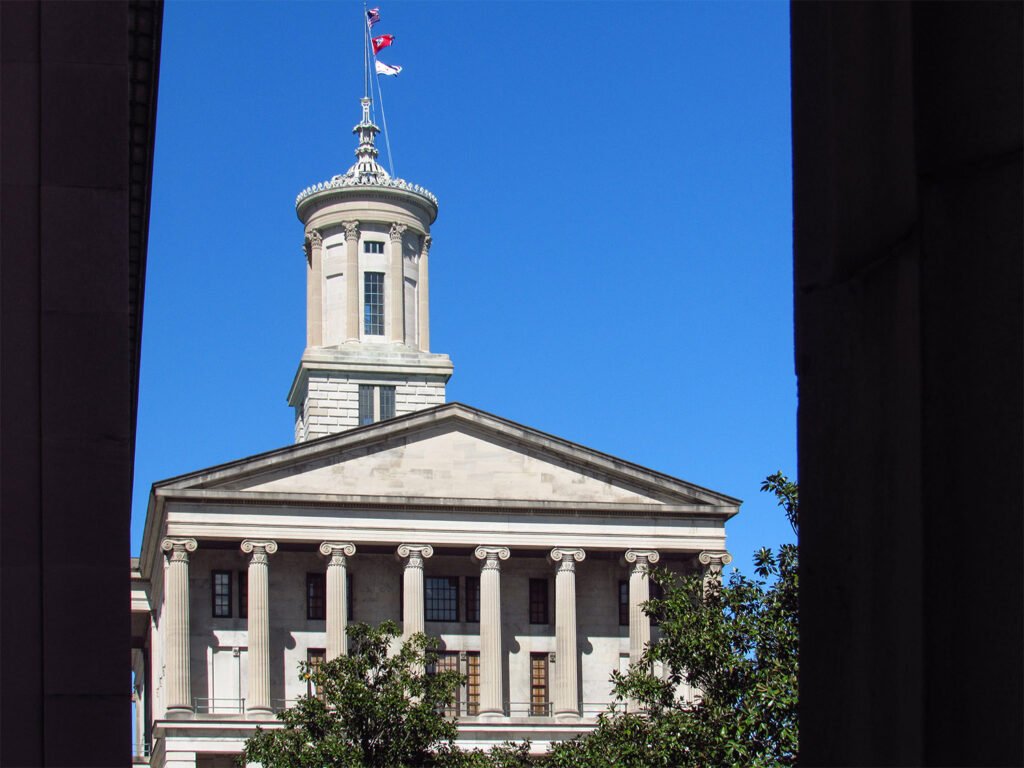
William Strickland. Tennessee State Capitol (1859). Nashville, Tennessee.
The Background
A.C. Bruce (1835-1927) was a founding partner ofBruce & Morgan, the most prolific architectural firm in Atlanta and the Southeast in the late 19th century.
The following article was written by Bruce in 1896for the Southern Trade Review, a short-lived business journal that was published in Nashville between 1896 and 1897.12 The article was then reproduced in the Nashville Banner, and now, reproduced here.
In the article, Bruce provides a brief history of the antebellum architects of Nashville, where he grew up and trained in the profession before establishing a solo practice in Knoxville, Tennessee,3 later moving to Atlanta in 1879.4
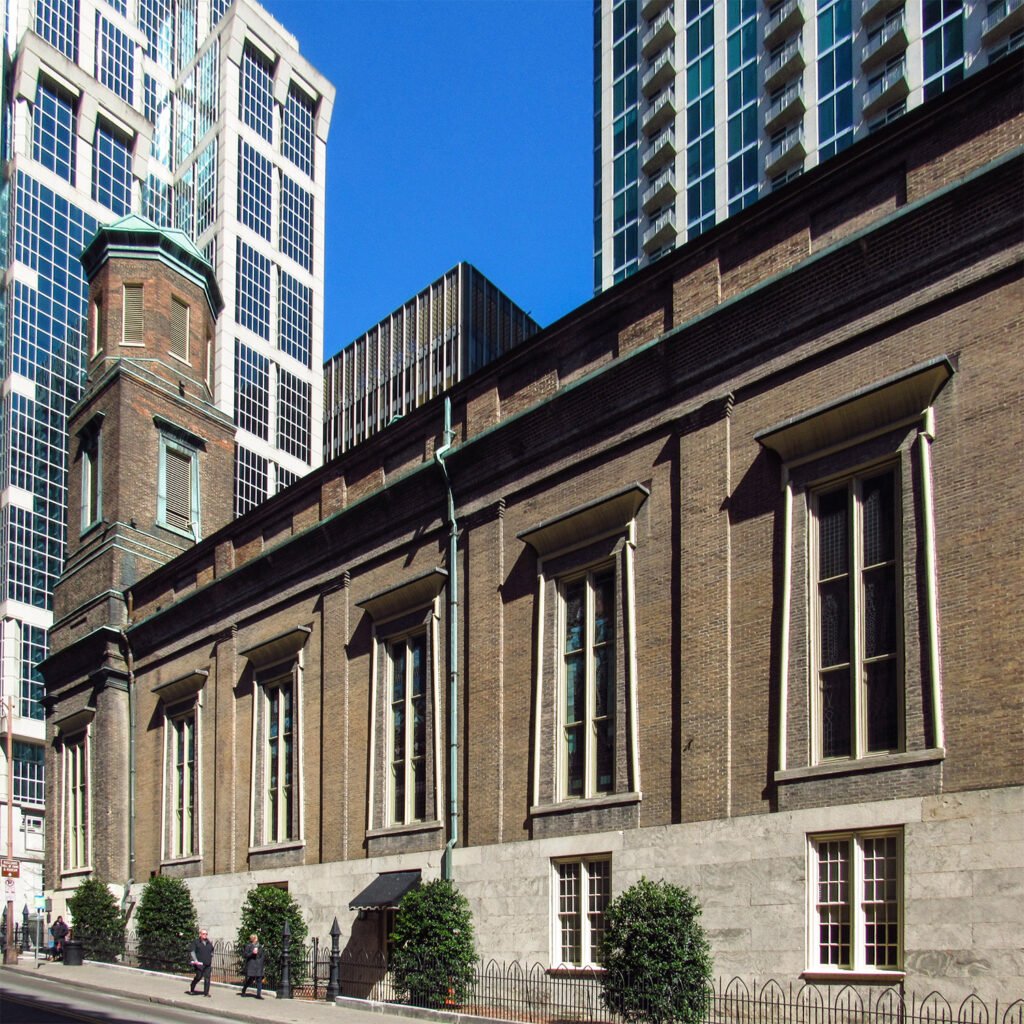
Although the article mentions several local Nashville architects, Bruce had particularly high praise — and justly so — for William Strickland, a Philadelphia architect who designed the Greek Revival style Tennessee State Capitol (1859) and the Egyptian Revival style First Presbyterian Church (1851), both of which survive and are among the better buildings in a city that is fairly lacking in quality architecture.
Bruce was 61 years old when he wrote this article, and apparently relied entirely on memory, so there are some understandable errors to note:
H.M. Akeroyd — Bruce repeatedly misspelled his last name as “Akeroid” — moved from Nashville to Augusta, Georgia, not New York, where he died in October 1867.56
The original Louisiana State Capitol (1852) was designed by James H. Dakin, not Adolphus Heiman.7
The article also mentions P.J. Williamson‘s design for the Deaf and Dumb Asylum in Knoxville, Tennessee, without noting that Bruce himself designed a 1873 addition for the building,8 which still survives.
Nashville’s Builders
Of Early Days And Something About Them.
The First Professional Architect Was Col. Adolphus Heinan–William Strickland, Who Planned the State Capitol–Other Men of Note.
(A.C. Bruce, in Southern Trade Review.)
After reading the very interesting letter of W.C. Smith, architect on the subject of “Architecture in the South,” I thought possibly that your paper, as a technical journal, would like to know something about Nashville’s older architects, who directed the building operations in the 40’s and early 50’s. Although of a local nature, it may be interesting to some of your readers and bring to their minds some of the incidents long since passed.
Being reared in the building business by my father, who was for many years a well-known contractor, and for thirty-five years a resident of Nashville, my early impressions of architecture were directed to its studies by coming in contact with the leading, I believe, the only architects, professionally as such, at that time. I will mention first Mr. James Hughes, who no doubt is still remembered by many of the older citizens. The old bank buildings, many of which have been either torn away or remodelled [sic], were planned and built by him. He could be seen daily on the corner of Union and Cherry streets–and the Public Square and College street–with a neat roll of paper under his arm, possibly some newly made drawing. Among his first work was the Second Presbyterian Church on North College street, ministered to at that time by Rev. Dr. Lapsley. A few years later he built the present Catholic Church on the corner of Cedar and Summer streets, which up to this time is a fine study of church architecture, with a very effective treatment in Italian style, which fully characterized all his important work. About the same time he built the old Commercial Hotel, on the corner of Cedar and Cherry streets.
One of the masterpieces of his church work was the magnificent church built by the Christian Church during the pastorate of the Rev. Jesse B. Ferguson, on Cherry street, between Cumberland alley and Church street. It was burned to the ground in a few years after building. Many of his elegant country residences are yet standing in Davidson, Maury and Giles Counties, beautiful examples of the Southern palatial homes found in nearly every important city in the South, so truly spoken of in Mr. Smith’s paper when he said: “The most of the buildings, therefore, were, up to within a few years of that period, designed by builders, and were to a great extent modelled after the old Colonial work, indicating a more refined taste and a more thorough knowledge of the principles of design than is to be found in much later work.”
Many of the older citizens remember the old McNairy residence, which stood on the corner of Cherry and Church streets, once used for the postoffice, those large, fluted columns, the dentilled entablature, heavy projecting cornices. It was one of the finest and best buildings of that day. In the march of progress it had to give way for the new present occupied by the The Nashville American Printing Company. For many years Mr. Hughes directed the architecture of the city as the leading architect and builder. He died in Nashville sometimes in the 50’s.
Contemporary with Mr. Hughes there came from New Orleans the first professional architect to locate in Nashville, Col. Adolphus Heiman (afterward Gen. Heiman, killed in the civil war in Mississippi), whose skilled hand designed many of the public educational structures about Nashville, and many of its residences. A fine piece of his work can be seen in the old collegiate Gothic building on the University grounds, South Nashville. I think he also built the Atheneum at Columbia and the old Shelby residence now in the limits of East Nashville, but at that time a far-off country residence. He also planned the jail built in the ’50’s, the first insane asylum near Nashville and was the architect and engineer for the first suspension bridge. I have been told that Col. Heiman was the architect of the State capitol of Louisiana, at any rate it bears a strong resemblance to his work about Nashville. Many private residences were also designed by him. He was a graduate of a Prussian school of engineering and architecture. Col. Hughes graduated from the work bench after years of architectural study and practical application, each masters of the profession in their day.
William Strickland. West elevation of First Presbyterian Church (1851).Nashville, Tennessee.9
Nashville was growing in wealth and population, a new State capitol was to be erected, finer buildings were being proposed, and the capitol commission called William Strickland, a prominent architect from Philadelphia, to build the capitol. He came and his monument stands yet on Capitol Hill, one of the finest proportioned architectural structures in the United States, the pride of every Tennessean. Many other noted structures built by him are yet standing, principally the First Presbyterian Church, corner of Summer and Church streets, designed in the Egyptian style of architecture with its peculiar details carried out both in its exterior and interior treatment. None but a master hand in architecture would have suggested such a radical change in church architecture as he made in the Presbyterian Church design. The massive Kirkman residence on the corner of Summer and Cedar streets was one of his most artistic designs, elaborately worked out in every detail regardless of cost.
I remember when a boy going in the building with one of the workmen to look at the elaborate ornamental plaster work, which I think was done by men imported for that work and to carry out his special designs. After a few years work in Nashville he, too, passed away and was buried in a catacomb prepared in the erection of the capitol for his body. I remember well attending the funeral services of this distinguished architect this month forty-two years ago.
Shortly after the death of Mr. Hughes and Mr. Strickland there came to Nashville an old English stair-builder, Mr. Samuel Moore, with his son Joseph, who, being expert workmen in the building lines, soon found work with a leading contractor in that day, Mr. Jesse Warren, who did so much in the building up of Nashville. The young man, Joe, as he was familiarly called, soon took the lead in directing the architectural work, and shortly became a partner under the firm name of Warren & Moore. Business increased, still greater demand for architectural services were required by the wealthy citizens, and the above firm sent to New York and engaged the services of Mr. H.M. Akeroid [sic], a professional architect of ability and experience. Soon his chaste and ornate designs were seen on many important streets, elaborate carvings, massive columns and arches altogether different in style from his predecessors above mentioned. His work showing an educated style peculiar to the English school, from which he had just graduated, and throughout his architectural career in Nashville he kept up with the advanced ideas of his clientage, producing the best architectural effects in all his studies. (Allow me to say here that under Mr. H.M. Akeroid [sic] I received much valuable instruction and gratuitous teaching, which impressed me with the study of architecture in addition to my practical training to follow architecture as a profession, and I am satisfied that whatever success I have had in the twenty-five years of practice was, in a measure, due to the advice of him whom I am ever pleased to remember most pleasantly.) After a few years, Mr. Akeroid [sic] returned to New York, and, I think, died there.
During the stay of Mr. Akeroid [sic] in Nashville the demand for wood carving was greatly increased, and a young, artistic workman, gifted with the pencil and skilled in the execution of elaborate designs of carving, was found in the person of W.K. Dobson. His training had been along the lines of architectural carving; we soon seen [sic] in him an architect of exquisite design and practical training, which fitted him for the successful work and extensive practice he enjoyed in Nashville for a number of years. I can only mention a few of the finer pieces of his work. The St. Cecilia Academy, in North Nashville, many of the older school buildings and of Nashville’s handsomest storehouses erected in the later 50’s were the result of his handiwork.
Many of the citizens will remember Nashville’s first Exposition, held in the year 1880, erected on the corner of Broad and Vine streets, where the custom-house and postoffice now stand, from design by Mr. Dobson. Many other important structures throughout the city are yet standing to attest his skill and ability. Several years before the war, Mr. P.J. Williamson came to Nashville, and, being experienced in the profession, soon entered upon a large and extensive practice, erecting many of the handsomest and most costly buildings during that period, principally the Deaf and Dumb Asylum at Knoxville, Tenn., the Blind Asylum at Nashville and a number of the recent church edifices throughout the city. Soon after his arrival a partnership was entered into with himself and Mr. Dobson under the firm name of Dobson & Williamson, and continued for a number of years. Mr. Dobson moved to Texas, and Mr. Williamson has, I think, retired from active practice, making way for the younger men who now hold the architectural business of the city in its present metropolitan advancement. It is not my purpose to speak of them, as that will be left to some one in the twentieth century to write of them as I have attempted to do of those in this letter.10
References
“Southern Trade Review.” Nashville Banner (Nashville, Tennessee), February 14, 1896, p. 1. ↩︎
“An Attractive Publication.” The Times (Richmond, Virginia), May 5, 1897, p. 5. ↩︎
“A.L. Jonas, Surveyor” (advertisement). April 14, 1870, p. 2. ↩︎
“Mr. A.C. Bruce.” The Chattanooga Daily Times (Chattanooga, Tennessee), January 7, 1879, p. 2. ↩︎
“Death of Mr. H.M. Akeroyd.” The Vincennes Weekly Western Sun (Vincennes, Indiana), December 21, 1867, p. 3. ↩︎