Category: Architecture

  • Words About G.L. Norrman: On His Early Life and the Gate City National Bank (1884)

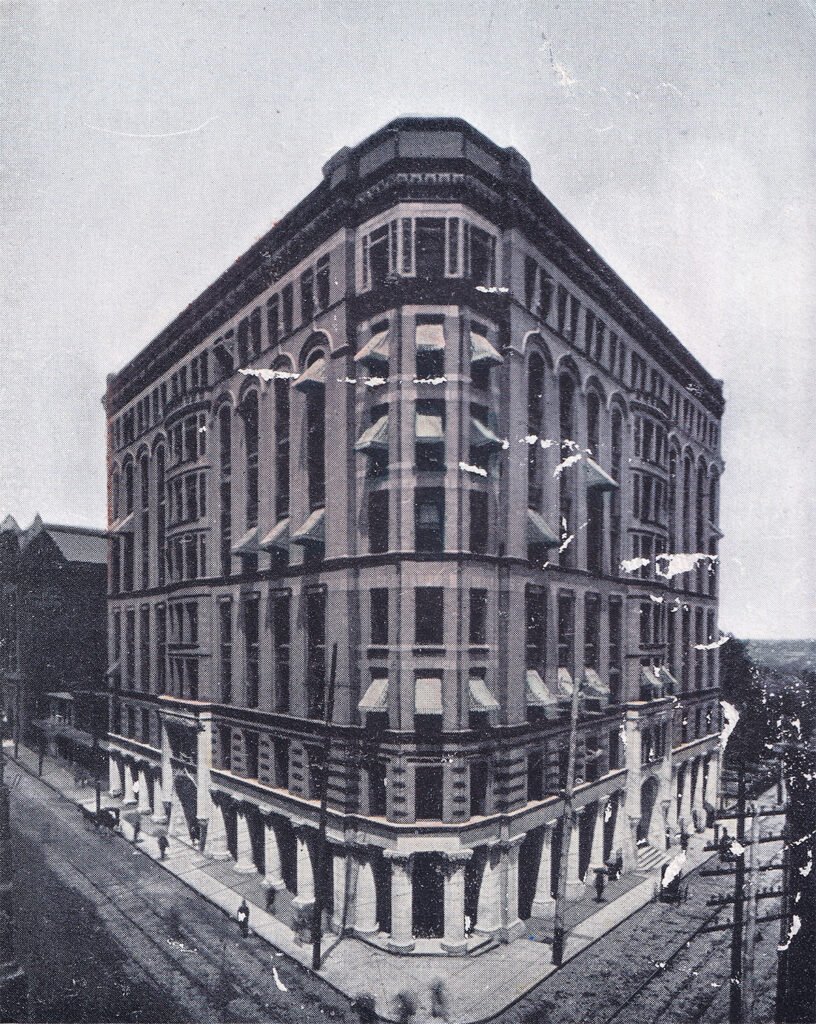
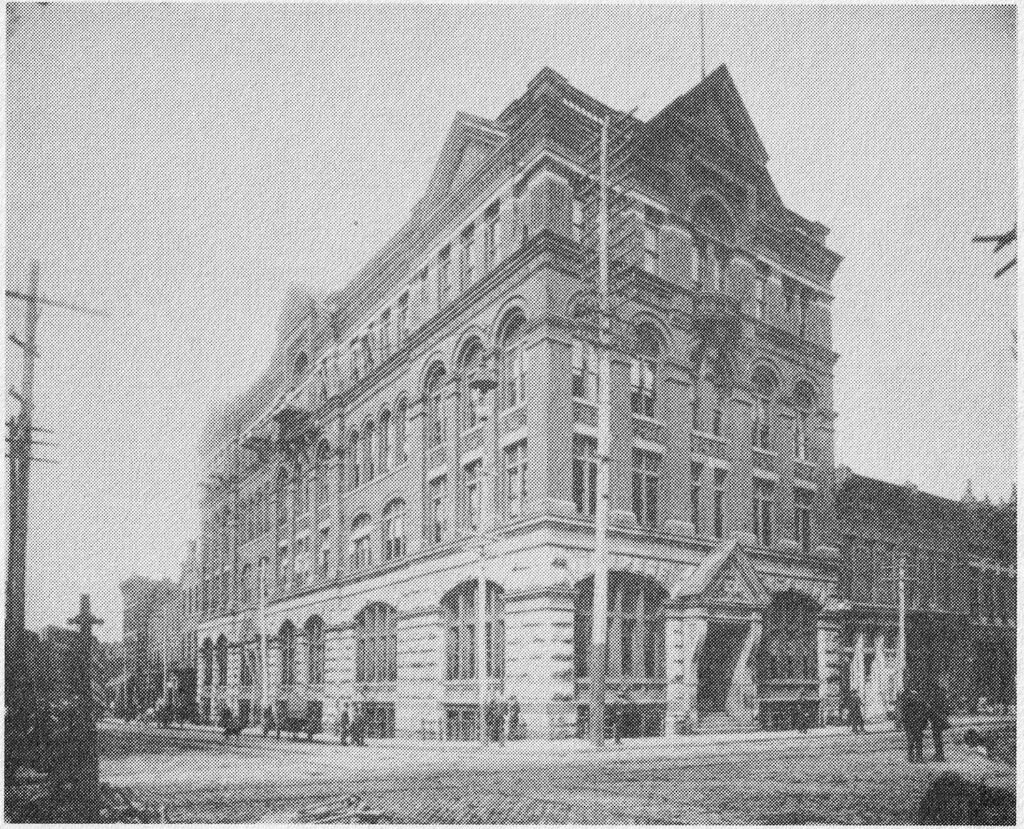
    Humphries & Norrman. Gate City National Bank (1884, demolished May 1929). Atlanta.1

    The Background

    The following biographical sketch, published in 1884, is one of just a few sources with details about the early life of G.L. Norrman, including an interesting anecdote about a violent outburst in his youth — a forerunner of many to follow.

    The sketch appeared as part of an article in The Atlanta Constitution heralding the completion of the first “modern” office building in the city, which was designed by Norrman and owned and anchored by the Gate City National Bank.

    Located at the southeast corner of Alabama and Pryor Streets, the 5-story structure was one of Norrman’s most important early works, designed in the “metropolitan style”, with Stone Mountain granite for the foundation, Tennessee limestone on the lower floors, and pressed brick on the upper floors.

    Location of Gate City National Bank

    The building’s entrance porticoes were made of Ohio freestone and carved by a mysterious Mr. Ruckle, who was said to be a graduate of the “national school of fine arts at Munich”.2 Inside, the building included an elevator,3 among the earliest in Georgia (the first one debuted at Atlanta’s J.F. & M.C. Kiser department store in 18774).

    The project took nearly 2 years to complete5 and was officially credited to Humphries & Norrman.6 However, George P. Humphries left the firm shortly before its completion,7 and it appears Norrman was the primary designer, assisted by his first known draughtsman, Aug Petersen.

    L. J. Hill, president of the Gate City National Bank, praised Norrman’s design for the building, saying: “…no finer architect need be wanted by anyone than Mr. Norrman.”

    Although the article calls it the “Hill building”, the structure was typically referred to as the Gate City National Bank until the institution abruptly closed its doors and was sold in 1893,8 9 after an employee embezzled over $100,000 from its coffers.10 11
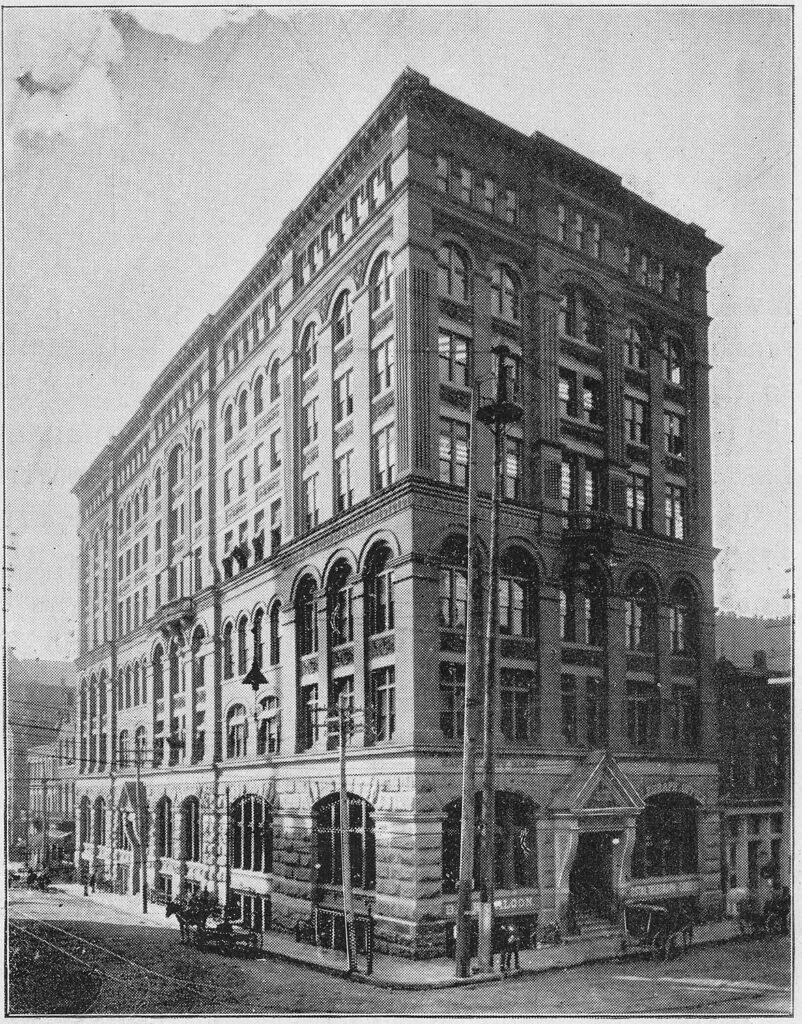
    “Temple Court”, Gate City National Bank, after 1895 expansion.12

    Seizing the opportunity for prime real estate, the Venable Brothers of Atlanta purchased the building,13 and in 1895, added 3 floors14 with a roof garden,15 installed “two swift modern elevators”,16 renovated the interior,17 and renamed the structure Temple Court (pictured above).18

    Billed as “Taller than the Equitable“,19 the 8-story Temple Court gave the structure a new lease on life, as it was already becoming outmoded by Atlanta’s first “skyscrapers” of the 1890s, which topped out at a whopping 10 floors by the end of the decade.

    The Temple Court addition was reportedly designed by another architectural firm,20 but while work was underway on the project,21 Norrman was also hired by the Venables to design the 10-story Hotel Venable (unbuilt).22 23 24 25 26 Whoever was responsible for the Temple Court addition (I suspect Bruce & Morgan27), it appears to have seamlessly matched Norrman’s original design.

    Temple Court was demolished in May 1929 for a 3-story hotel,28 29 shortly after its ground floor and basement were stripped of their ornamentation and sealed beneath the Alabama Street viaduct, then under construction.30 The new structure was simply built on top of the old building’s ground floor, vestiges of which can still be seen in whatever remains of Underground Atlanta.
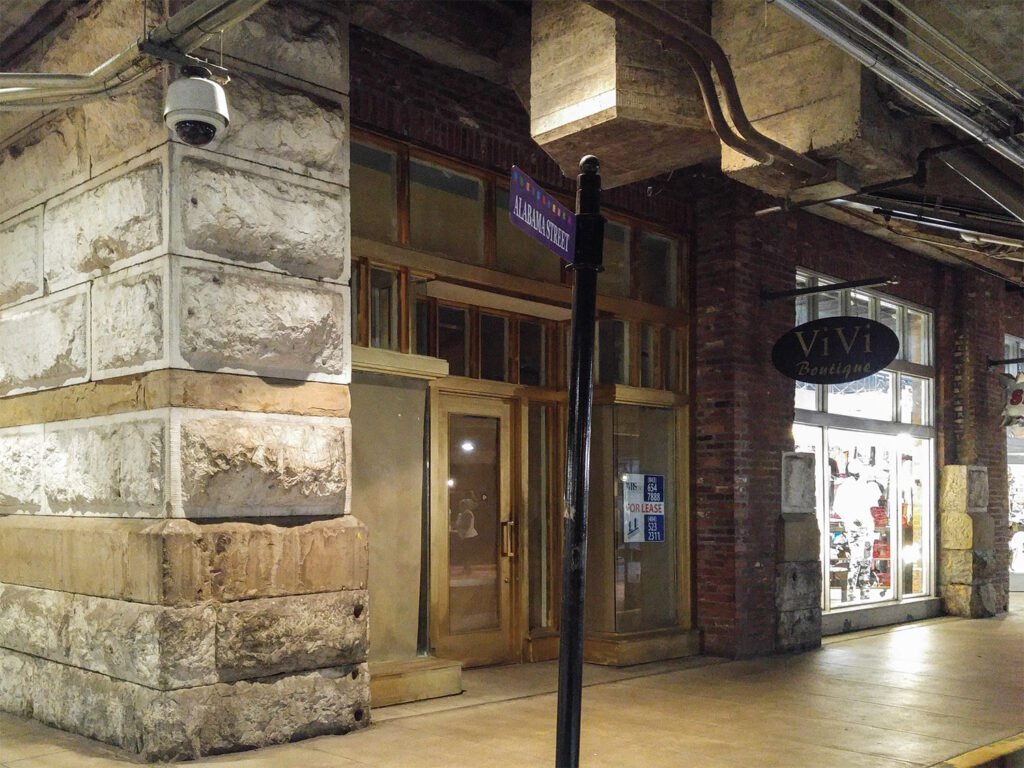
    Vestiges of rusticated limestone facade from Gate City National Bank, Underground Atlanta.

    This need for fact-checking is strong in this biographical sketch, which appears to have been hastily written: it’s chock-full of run-on sentences, overlong paragraphs, and numerous mangled names. It also makes several claims that merit further attention. Among them:

    • I haven’t been able to confirm that Norrman served 3 years in the “royal navy”, but in the mid-19th century, all Swedish males between the ages of 20 and 25 were required to serve in the military for 4 weeks every 2 years.31 At Norrman’s death, a photograph was also found of him “in full dress suit of a marine”.32
    • The “government engineer corps” mentioned in the article could be the Pontonjärbataljonen, a battalion stationed in Stockholm that primarily built bridges.
    • The “Academy of Design” could refer to the Teknologiska institutet in Stockholm. However, it could also reference the Royal Danish Academy of Fine Arts in Copenhagen, as papers found at Norrman’s death33 indicated he attended “the famous University of Copenhagen”34 and a German technical university.35 36 Adding to the confusion, a 1892 profile claimed Norrman “finished his regular educational course in the finest school of Stockholm.” It does seem likely that he was educated in that city, as Swedish church records show that Herr Gottfrid Leonard Norrman left his home parish for Stockholm at the age of 18.
    • Norrman and his first partner in Atlanta, M.B. Weed, can only be partially credited with the design of the main building at the International Cotton Exposition. The original plan was designed by W.H.H. Whiting of Boston,37 38 and it appears Norrman & Weed designed multiple expansions of the building during its construction.39 40 The firm also designed 5 accessory buildings at the exhibition, with Fay & Eichberg of Atlanta designing two.41 42
    • In addition to the exposition buildings, 19 of Norrman’s other works are mentioned in the sketch, although many are given incorrect names or locations. Only one of those, the Edward C. Peters House, remains standing — Atlanta does love the wrecking ball. The correct names, dates, and locations for each project are:
      • St. Luke’s Cathedral, built 1883 and demolished 1906 – NE corner of North Pryor and Houston Streets, Atlanta – later site of Georgia-Pacific Center, Downtown [Map]
      • Unitarian Church of Our Father, built 1883 and demolished 1900 for construction of Carnegie Library – SW corner of Church and Forsyth Streets, Atlanta [Map]
      • Edward C. Peters Residence, “Ivy Hall”, completed 1883 – 179 Ponce de Leon Avenue NE; Midtown, Atlanta [Map]
      • William H. Venable Residence, built 1883 – 19 Forrest Avenue, Atlanta [Map]
      • William S. Everett Residence, built 1884 – 278 Peachtree Street, Atlanta – later site of Atlanta Expressway (I-75/85) [Map]
      • William D. Ellis Residence, built 1882 and demolished for construction of Atlanta Expressway (I-75/85) – 193 Washington Street, Atlanta [Map]
      • John Milledge Residence, built 1883 – 120 East Peters Street, NE corner of East Peters Street and Capitol Place, Atlanta – later site of 2 Capitol Square SW, Downtown [Map]
      • Horace Bumstead Residence, “Bumstead Cottage”, built 1883 and demolished by 1929 – 169 Vine Street, NE corner of Vine Street and University Place, Atlanta [Map]
      • Thomas H. Blacknall Residence, built 1883 and likely demolished for construction of East-West Expressway (I-20) – 56 Park Avenue, SE corner of Park and Lee Streets, West End, Atlanta [Map]
      • West End Academy, built 1883-4 and demolished circa 1911 – Lee Street, West End, Atlanta [Map]
      • Ponce De Leon Springs pavilion, built 1883 and demolished circa 1914 – later site of Sears, Roebuck & Company Building, Atlanta. [Map]
      • Robert A. Hemphill Residence, built 1884 – 231 Peachtree Street, Atlanta – later site of SunTrust Plaza, Downtown [Map]
      • Daniel N. Speer Residence, built 1882 – 486 Peachtree Street, SW corner of Peachtree and Linden Streets, Atlanta – later site of Emory University Hospital Midtown [Map]
      • Dr. Spalding Residence, built 1883 – 484 Peachtree Street, NE corner of Peachtree and Howard Streets, Atlanta – later site of Emory University Hospital Midtown [Map]
      • Nathaniel P.T. Finch Residence, built 1881 – 388 Peachtree Street, Atlanta [Map]
      • R. H. Richards Residence, built 1885 and demolished 1925 for construction of Davison-Paxon-Stokes Company building – 190 Peachtree Street, Atlanta [Map]
      • Homer G. Barber Residence, built 1884 – 147 Forrest Avenue, Atlanta – later site of Georgia Power Company, Old Fourth Ward [Map]
      • William A. Osborn Residence, built 1884 – 194 Jackson Street, Atlanta [Map]
      • Grant Park pavilion, built 1884 – Grant Park, Atlanta [Map]

    G.L. Norrman, Architect.

    Probably no man in Atlanta is more widely or favorably known than Mr. G.L. Norrman. He has only been here about three years, but in that time has furnished designs for fully $2,000,000 worth of buildings of every character, including of course, the time when he had Mr. Humphries associated with him as partner.

    Mr. Norrman now occupies rooms 58 and 59 on the fourth floor, and is nicely equipped with all the appurtenances of a first class architect. He is a Swede by birth, and held a position for three years in the royal navy. He has ever been a man of great nerve and pluck an amusing incident which occurred while he was in the navy going to prove this fact. A superior officer having given him some very insolent words, had the pleasure of being straightened out on deck by a blow from Mr. Norrman’s fist. He soon after resigned from the marine service, and took a position in the government engineer’s corps where he distinguished himself for his ability. Mr. Norrman was educated in architecture at the Academy of Design in Stockholm. His first work after reaching Atlanta was to draw up plans for the great cotton exposition buildings in 1881, which were accepted and will be remembered by everyone, of course. He also designed the St. Luke’s cathedral and the Unitarian church, which are universally admired. The great characters [sic] which Mr. Norrman’s work always shows, has made it popular among those who appreciated individuality, and the fact that within three years he has done $2,000,000 in houses, is sufficient evidence of his merit as an architect. He designed Colonel Richard Peter‘s fine house on Peachtree [sic] , Mr. W.H. Venabla‘s [sic], Mr. Everett‘s, Mr. Ellis‘, on Washington; Captain Milledge‘s, Professor Bumbstead‘s [sic], Major Blacknall’s at West End; the West End academy buildings, the Ponce de Leon pavilion, Mr. R.A. Hemphill‘s, Colonel Dan Speer‘s, Mr. Spaulding‘s [sic], Mr. Finchs‘s [sic] and many others not necessary to mention. Mr. Norman now has a number of homes in hand, among them Mr. Richard‘s [sic] fine residence on Peachtree, which is to cost $40,000; Mr. Barber‘s, Mr. Osborne‘s [sic] on Jackson street, and many others. He has also the designs for a very neat pavilion to be placed in Grant’s park.
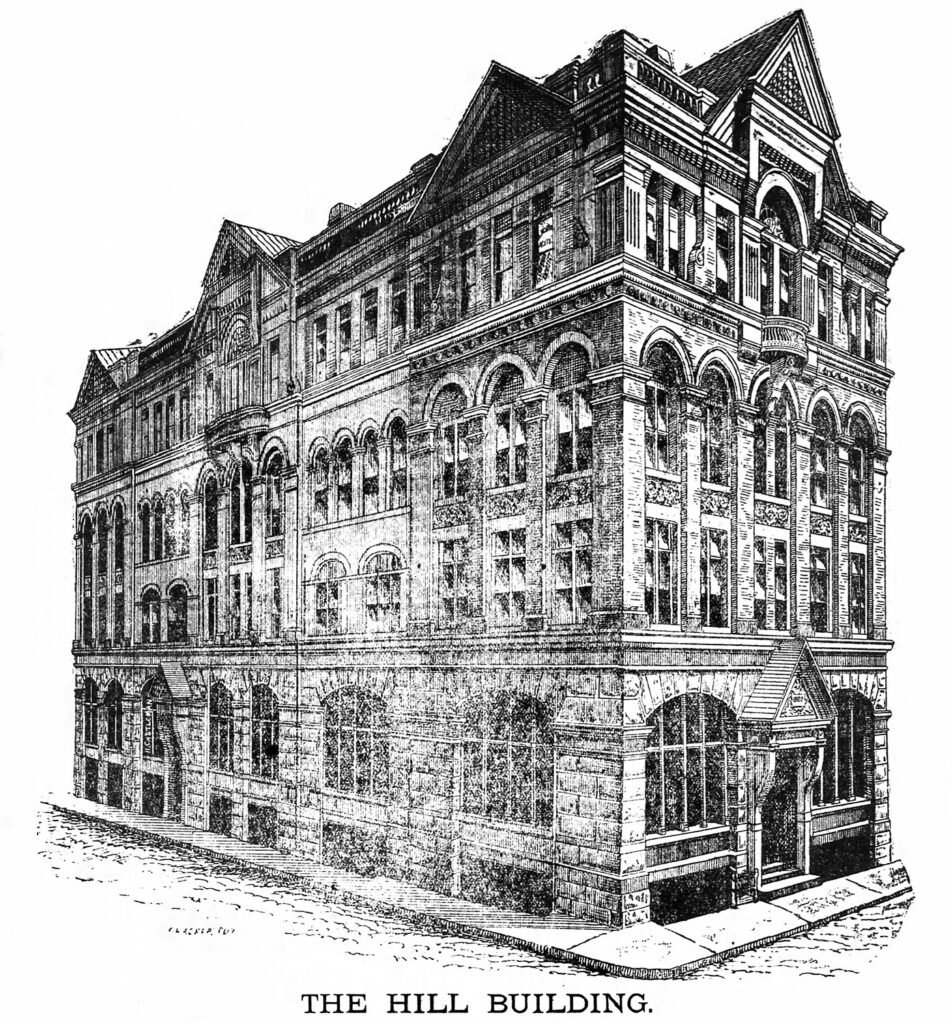
    Perhaps the great monument to Mr. Norrman’s architectural skill and ability is the Hill building, the subject of this sketch. The cut herewith presented does not give an adequate idea of the perfection of the building, but it serves to show in a measure its graceful, massive proportions. Mr. Hill expresses himself more than satisfied. Said he, “I consider my building one of the best constructed in the country, and I take pleasure in saying that no finer architect need be wanted by anyone than Mr. Norrman. His work here far exceeded may expectations.” Mr. Aug Peterson, also from Sweden, is associated as assistant with Mr. Norrman. He studied architecture at the institute of technology in Norkpoking [sic]. It gives The Constitution pleasure to add its own praise to Mr. Norrman’s value to the architectural worth of Atlanta.43

    References

    1. Photo credit: The Atlanta Historical Society. Atlanta in 1890: “The Gate City”. Macon, Georgia: Mercer University Press (1986). ↩︎
    2. “The Hill Building.” The Atlanta Constitution, March 16, 1884, p. 4. ↩︎
    3. ibid. ↩︎
    4. “A Bounding Business”. The Atlanta Constitution, August 2, 1877, p. 2. ↩︎
    5. ibid. ↩︎
    6. “Real Estate Notes.” The Atlanta Constitution, May 8, 1882, p. 7. ↩︎
    7. “Dissolution.” The Atlanta Constitution, February 28, 1884, p. 3. ↩︎
    8. “It Is Closed.” The Atlanta Journal, February 24, 1893, p. 1. ↩︎
    9. “The Building Is Sold.” The Atlanta Journal, April 27, 1893, p. 1. ↩︎
    10. $65,000!” The Atlanta Journal, February 22, 1893, p. 1. ↩︎
    11. “Redwine $103,148 Short”. The Atlanta Journal, March 16, 1893, p. 1. ↩︎
    12. Photo credit: Atlanta City Council and the Atlanta Chamber of Commerce. Handbook of the City of Atlanta: A Comprehensive Review of the City’s Commercial, Industrial and Residential Conditions (1898). ↩︎
    13. “The Highest In Atlanta”. The Atlanta Journal, September 28, 1894, p. 8. ↩︎
    14. “Three Stories Higher”. The Atlanta Journal, February 4, 1895, p. 5. ↩︎
    15. ‘It Will Be “Temple Court.” The Atlanta Journal, June 24, 1895, p. 7. ↩︎
    16. ibid. ↩︎
    17. “Three Stories Higher”. The Atlanta Journal, February 4, 1895, p. 5. ↩︎
    18. ‘It Will Be “Temple Court”.’ The Atlanta Journal, June 24, 1895, p. 7. ↩︎
    19. “The Highest In Atlanta”. The Atlanta Journal, September 28, 1894, p. 8. ↩︎
    20. “G.L. Norrman Ends His Life In Room In the Majestic”. The Atlanta Journal, November 16, 1909, p. 1. ↩︎
    21. “By the Venables.” The Atlanta Constitution, May 1, 1895, p. 5. ↩︎
    22. “Ten Stories High”. The Atlanta Constitution, April 4, 1895, p. 5. ↩︎
    23. “Hotel Venable Goes Up”. The Atlanta Journal, April 4, 1895, p. 6. ↩︎
    24. “‘Twill Be a Big Hotel”. The Atlanta Constitution, April 5, 1895, p. 5. ↩︎
    25. “It Will Be Built”. The Atlanta Constitution, April 6, 1895, p. 5. ↩︎
    26. “The Proposed Hotel Venable.” The Atlanta Journal, April 8, 1895, p. 10. ↩︎
    27. “New Buildings.” The Atlanta Constitution, July 13, 1895, p. 9. ↩︎
    28. “Plan for Hotel on Temple Court Site Announced”. The Atlanta Journal, April 28, 1929, p. D8. ↩︎
    29. “Building Material”. The Atlanta Constitution, May 26, 1929, p. 7C. ↩︎
    30. Rubin, Ernest. “Property Owners See Bright Future For Viaduct Area”, The Atlanta Constitution, December 23, 1928, pp. 1, 6. ↩︎
    31. Allotment system – Wikipedia ↩︎
    32. “Architect G.L. Norrman Speeds a Fatal Bullet Through Right Temple”. The Atlanta Constitution, November 17, 1909, p. 1. ↩︎
    33. “G.L. Norrman Ends His Life In Room In the Majestic”. The Atlanta Journal, November 16, 1909, pp. 1-2. ↩︎
    34. ibid. ↩︎
    35. ibid. ↩︎
    36. “Architect G.L. Norrman Speeds a Fatal Bullet Through Right Temple”. The Atlanta Constitution, November 17, 1909, p. 1. ↩︎
    37. The International Cotton Exposition of Products, Machinery and Manufactures. Atlanta: Jas. P. Harrison & Co. (1881). ↩︎
    38. “Exposition Notes.” The Atlanta Constitution, November 12, 1881, p. 11. ↩︎
    39. “Spreading Out.” The Atlanta Constitution, September 11, 1881, p. 7. ↩︎
    40. “Cotton.” The Atlanta Constitution, October 5, 1881, p. 10. ↩︎
    41. The International Cotton Exposition of Products, Machinery and Manufactures. Atlanta: Jas. P. Harrison & Co. (1881). ↩︎
    42. “Cotton.” The Atlanta Constitution, October 5, 1881, p. 10. ↩︎
    43. “The Hill Building.” The Atlanta Constitution, March 16, 1884, p. 4. ↩︎
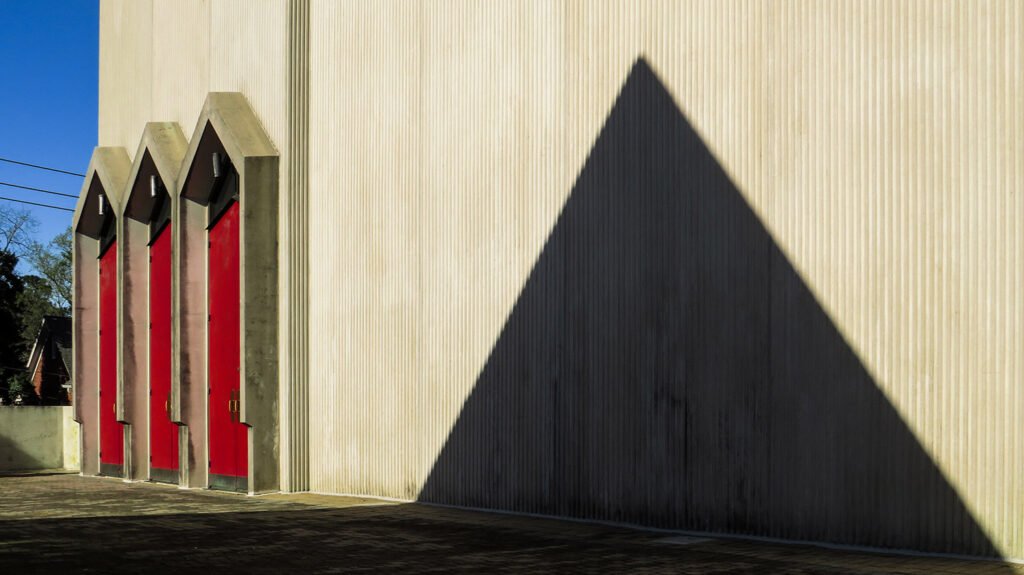
  • Holy Trinity Parish Episcopal Church (1971) – Decatur, Georgia

    Louis H. Swayze. Holy Trinity Parish Episcopal Church (1971). Decatur, Georgia.1

    References

    1. “Trinity Dedication Scheduled”. The Atlanta Constitution, September 25, 1971, p. 12-A. ↩︎
  • “Nashville’s Builders” (1896) by A.C. Bruce

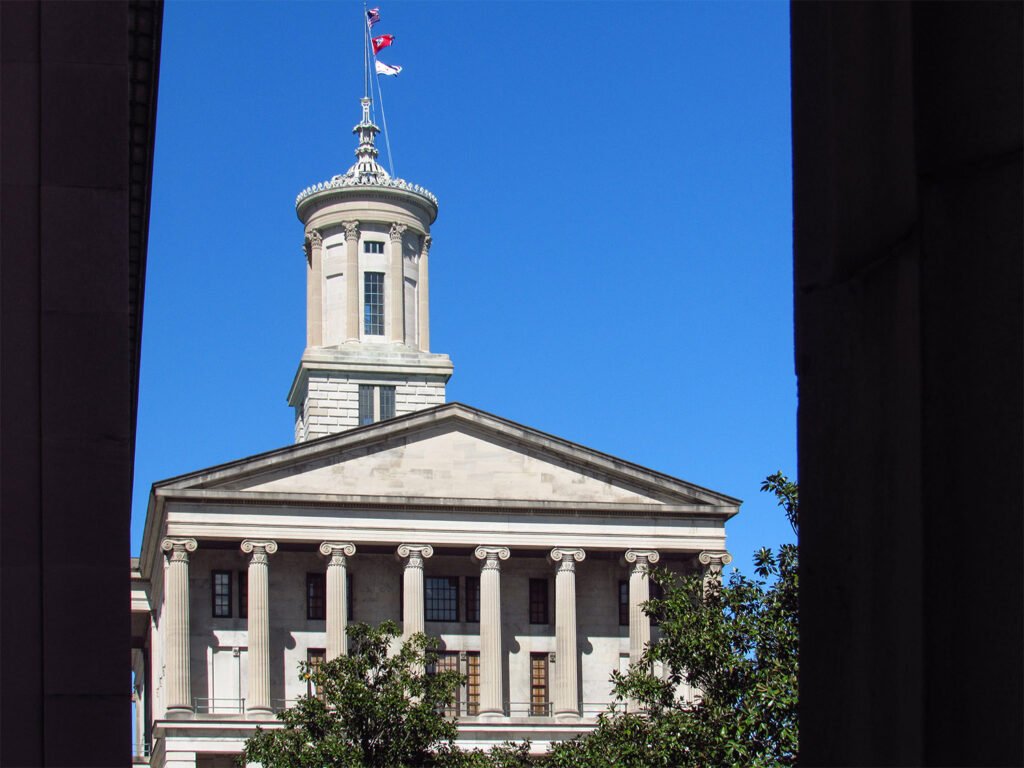
    William Strickland. Tennessee State Capitol (1859). Nashville, Tennessee.

    The Background

    A.C. Bruce (1835-1927) was a founding partner of Bruce & Morgan, the most prolific architectural firm in Atlanta and the Southeast in the late 19th century.

    The following article was written by Bruce in 1896 for the Southern Trade Review, a short-lived business journal that was published in Nashville between 1896 and 1897.1 2 The article was then reproduced in the Nashville Banner, and now, reproduced here.

    In the article, Bruce provides a brief history of the antebellum architects of Nashville, where he grew up and trained in the profession before establishing a solo practice in Knoxville, Tennessee,3 later moving to Atlanta in 1879.4

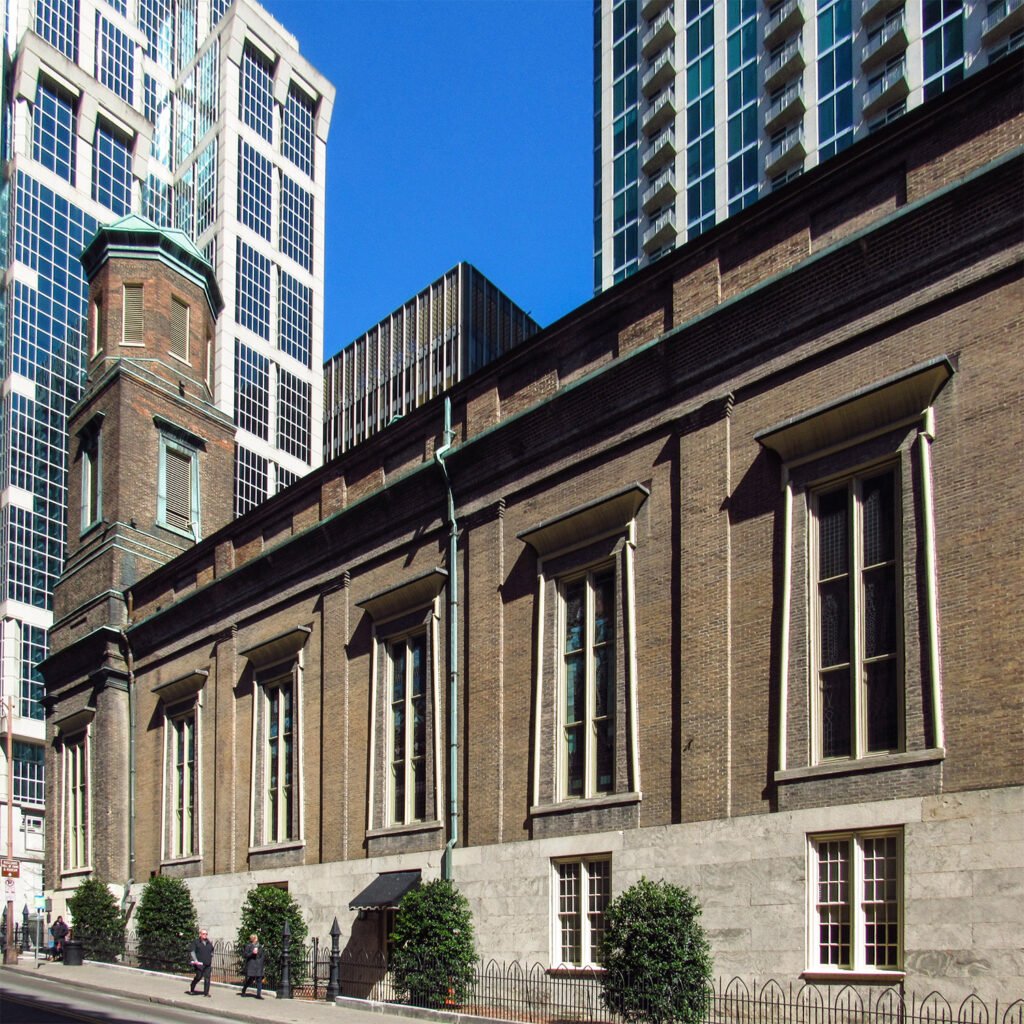
    Although the article mentions several local Nashville architects, Bruce had particularly high praise — and justly so — for William Strickland, a Philadelphia architect who designed the Greek Revival style Tennessee State Capitol (1859) and the Egyptian Revival style First Presbyterian Church (1851), both of which survive and are among the better buildings in a city that is fairly lacking in quality architecture.

    Bruce was 61 years old when he wrote this article, and apparently relied entirely on memory, so there are some understandable errors to note:

    • H.M. Akeroyd — Bruce repeatedly misspelled his last name as “Akeroid” — moved from Nashville to Augusta, Georgia, not New York, where he died in October 1867.5 6
    • The original Louisiana State Capitol (1852) was designed by James H. Dakin, not Adolphus Heiman.7

    The article also mentions P.J. Williamson‘s design for the Deaf and Dumb Asylum in Knoxville, Tennessee, without noting that Bruce himself designed a 1873 addition for the building,8 which still survives.


    Nashville’s Builders

    Of Early Days And Something About Them.

    The First Professional Architect Was Col. Adolphus Heinan–William Strickland, Who Planned the State Capitol–Other Men of Note.

    (A.C. Bruce, in Southern Trade Review.)

    After reading the very interesting letter of W.C. Smith, architect on the subject of “Architecture in the South,” I thought possibly that your paper, as a technical journal, would like to know something about Nashville’s older architects, who directed the building operations in the 40’s and early 50’s. Although of a local nature, it may be interesting to some of your readers and bring to their minds some of the incidents long since passed.

    Being reared in the building business by my father, who was for many years a well-known contractor, and for thirty-five years a resident of Nashville, my early impressions of architecture were directed to its studies by coming in contact with the leading, I believe, the only architects, professionally as such, at that time. I will mention first Mr. James Hughes, who no doubt is still remembered by many of the older citizens. The old bank buildings, many of which have been either torn away or remodelled [sic], were planned and built by him. He could be seen daily on the corner of Union and Cherry streets–and the Public Square and College street–with a neat roll of paper under his arm, possibly some newly made drawing. Among his first work was the Second Presbyterian Church on North College street, ministered to at that time by Rev. Dr. Lapsley. A few years later he built the present Catholic Church on the corner of Cedar and Summer streets, which up to this time is a fine study of church architecture, with a very effective treatment in Italian style, which fully characterized all his important work. About the same time he built the old Commercial Hotel, on the corner of Cedar and Cherry streets.

    One of the masterpieces of his church work was the magnificent church built by the Christian Church during the pastorate of the Rev. Jesse B. Ferguson, on Cherry street, between Cumberland alley and Church street. It was burned to the ground in a few years after building. Many of his elegant country residences are yet standing in Davidson, Maury and Giles Counties, beautiful examples of the Southern palatial homes found in nearly every important city in the South, so truly spoken of in Mr. Smith’s paper when he said: “The most of the buildings, therefore, were, up to within a few years of that period, designed by builders, and were to a great extent modelled after the old Colonial work, indicating a more refined taste and a more thorough knowledge of the principles of design than is to be found in much later work.”

    Many of the older citizens remember the old McNairy residence, which stood on the corner of Cherry and Church streets, once used for the postoffice, those large, fluted columns, the dentilled entablature, heavy projecting cornices. It was one of the finest and best buildings of that day. In the march of progress it had to give way for the new present occupied by the The Nashville American Printing Company. For many years Mr. Hughes directed the architecture of the city as the leading architect and builder. He died in Nashville sometimes in the 50’s.

    Contemporary with Mr. Hughes there came from New Orleans the first professional architect to locate in Nashville, Col. Adolphus Heiman (afterward Gen. Heiman, killed in the civil war in Mississippi), whose skilled hand designed many of the public educational structures about Nashville, and many of its residences. A fine piece of his work can be seen in the old collegiate Gothic building on the University grounds, South Nashville. I think he also built the Atheneum at Columbia and the old Shelby residence now in the limits of East Nashville, but at that time a far-off country residence. He also planned the jail built in the ’50’s, the first insane asylum near Nashville and was the architect and engineer for the first suspension bridge. I have been told that Col. Heiman was the architect of the State capitol of Louisiana, at any rate it bears a strong resemblance to his work about Nashville. Many private residences were also designed by him. He was a graduate of a Prussian school of engineering and architecture. Col. Hughes graduated from the work bench after years of architectural study and practical application, each masters of the profession in their day.

    William Strickland. West elevation of First Presbyterian Church (1851). Nashville, Tennessee.9

    Nashville was growing in wealth and population, a new State capitol was to be erected, finer buildings were being proposed, and the capitol commission called William Strickland, a prominent architect from Philadelphia, to build the capitol. He came and his monument stands yet on Capitol Hill, one of the finest proportioned architectural structures in the United States, the pride of every Tennessean. Many other noted structures built by him are yet standing, principally the First Presbyterian Church, corner of Summer and Church streets, designed in the Egyptian style of architecture with its peculiar details carried out both in its exterior and interior treatment. None but a master hand in architecture would have suggested such a radical change in church architecture as he made in the Presbyterian Church design. The massive Kirkman residence on the corner of Summer and Cedar streets was one of his most artistic designs, elaborately worked out in every detail regardless of cost.

    I remember when a boy going in the building with one of the workmen to look at the elaborate ornamental plaster work, which I think was done by men imported for that work and to carry out his special designs. After a few years work in Nashville he, too, passed away and was buried in a catacomb prepared in the erection of the capitol for his body. I remember well attending the funeral services of this distinguished architect this month forty-two years ago.

    Shortly after the death of Mr. Hughes and Mr. Strickland there came to Nashville an old English stair-builder, Mr. Samuel Moore, with his son Joseph, who, being expert workmen in the building lines, soon found work with a leading contractor in that day, Mr. Jesse Warren, who did so much in the building up of Nashville. The young man, Joe, as he was familiarly called, soon took the lead in directing the architectural work, and shortly became a partner under the firm name of Warren & Moore. Business increased, still greater demand for architectural services were required by the wealthy citizens, and the above firm sent to New York and engaged the services of Mr. H.M. Akeroid [sic], a professional architect of ability and experience. Soon his chaste and ornate designs were seen on many important streets, elaborate carvings, massive columns and arches altogether different in style from his predecessors above mentioned. His work showing an educated style peculiar to the English school, from which he had just graduated, and throughout his architectural career in Nashville he kept up with the advanced ideas of his clientage, producing the best architectural effects in all his studies. (Allow me to say here that under Mr. H.M. Akeroid [sic] I received much valuable instruction and gratuitous teaching, which impressed me with the study of architecture in addition to my practical training to follow architecture as a profession, and I am satisfied that whatever success I have had in the twenty-five years of practice was, in a measure, due to the advice of him whom I am ever pleased to remember most pleasantly.) After a few years, Mr. Akeroid [sic] returned to New York, and, I think, died there.

    During the stay of Mr. Akeroid [sic] in Nashville the demand for wood carving was greatly increased, and a young, artistic workman, gifted with the pencil and skilled in the execution of elaborate designs of carving, was found in the person of W.K. Dobson. His training had been along the lines of architectural carving; we soon seen [sic] in him an architect of exquisite design and practical training, which fitted him for the successful work and extensive practice he enjoyed in Nashville for a number of years. I can only mention a few of the finer pieces of his work. The St. Cecilia Academy, in North Nashville, many of the older school buildings and of Nashville’s handsomest storehouses erected in the later 50’s were the result of his handiwork.

    Many of the citizens will remember Nashville’s first Exposition, held in the year 1880, erected on the corner of Broad and Vine streets, where the custom-house and postoffice now stand, from design by Mr. Dobson. Many other important structures throughout the city are yet standing to attest his skill and ability. Several years before the war, Mr. P.J. Williamson came to Nashville, and, being experienced in the profession, soon entered upon a large and extensive practice, erecting many of the handsomest and most costly buildings during that period, principally the Deaf and Dumb Asylum at Knoxville, Tenn., the Blind Asylum at Nashville and a number of the recent church edifices throughout the city. Soon after his arrival a partnership was entered into with himself and Mr. Dobson under the firm name of Dobson & Williamson, and continued for a number of years. Mr. Dobson moved to Texas, and Mr. Williamson has, I think, retired from active practice, making way for the younger men who now hold the architectural business of the city in its present metropolitan advancement. It is not my purpose to speak of them, as that will be left to some one in the twentieth century to write of them as I have attempted to do of those in this letter.10

    References

    1. “Southern Trade Review.” Nashville Banner (Nashville, Tennessee), February 14, 1896, p. 1. ↩︎
    2. “An Attractive Publication.” The Times (Richmond, Virginia), May 5, 1897, p. 5. ↩︎
    3. “A.L. Jonas, Surveyor” (advertisement). April 14, 1870, p. 2. ↩︎
    4. “Mr. A.C. Bruce.” The Chattanooga Daily Times (Chattanooga, Tennessee), January 7, 1879, p. 2. ↩︎
    5. “Death of Mr. H.M. Akeroyd.” The Vincennes Weekly Western Sun (Vincennes, Indiana), December 21, 1867, p. 3. ↩︎
    6. H.M. Akeroyd (unknown-1867) – Find a Grave ↩︎
    7. Old Louisiana State Capitol – Wikipedia ↩︎
    8. “Addition to the Deaf and Dumb Asylum”. Knoxville Weekly Chronicle (Knoxville, Tennessee), October 22, 1873, p. 5. ↩︎
    9. “Dedication.” Daily Nashville Union (Nashville, Tennessee), April 18, 1951, p. 2. ↩︎
    10. Bruce, A.C. “Nashville’s Builders”. The Nashville American (Nashville, Tennessee). May 24, 1896, p. 3. ↩︎

  • City Hall (1901) – Philadelphia

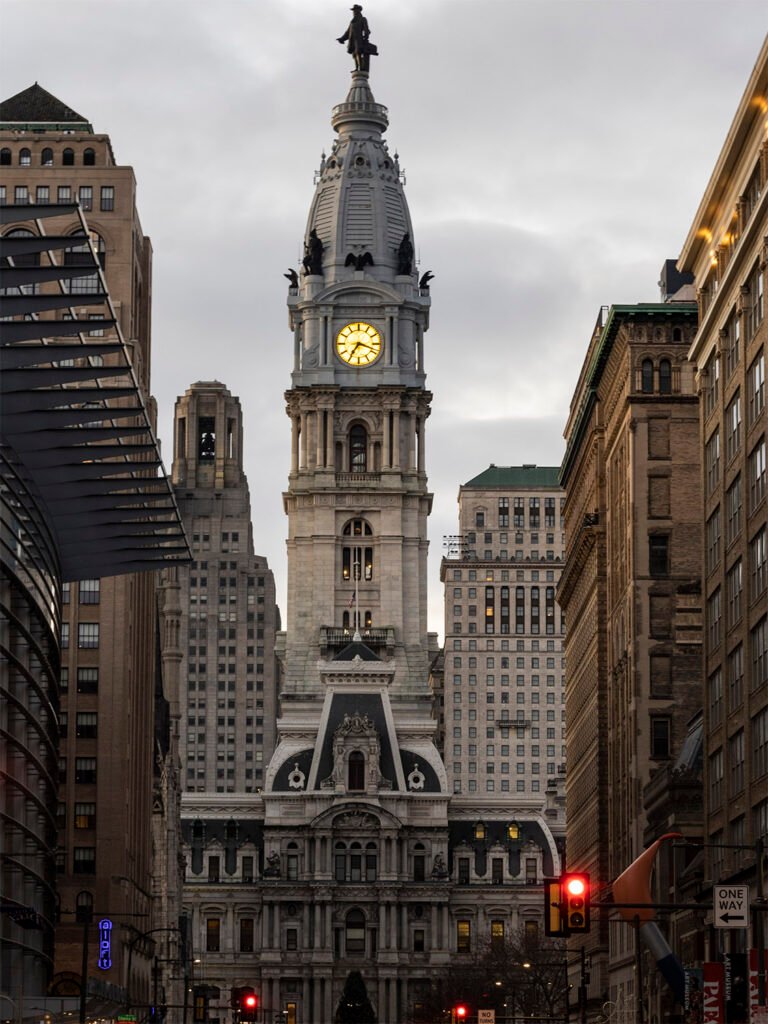
    John McArthur, Jr., John Ord, and W. Bleydden Powell. City Hall (1901). Philadelphia.1 2 3 4 5 6

    References

    1. “The Public Buildings Commission In Session.” The Philadelphia Inquirer, September 16, 1870, p. 2. ↩︎
    2. “Proposals For The Erection Of Public Buildings.” The Daily Evening Telegraph (Philadelphia), November 5, 1870, p. 8. ↩︎
    3. “Architect Ord Explains”. The Philadelphia Times, February 1, 1894, p. 3. ↩︎
    4. “Grip’s Latest Victim”. The Philadelphia Inquirer, January 9, 1890, p. 2. ↩︎
    5. “Ord’s Successor”. The Philadelphia Inquirer, February 7, 1894, p. 1. ↩︎
    6. “The City Hall Changes Hands”. The Philadelphia Times, June 27, 1901, p. 3. ↩︎
  • Relic Signs: YWCA – Birmingham, Alabama

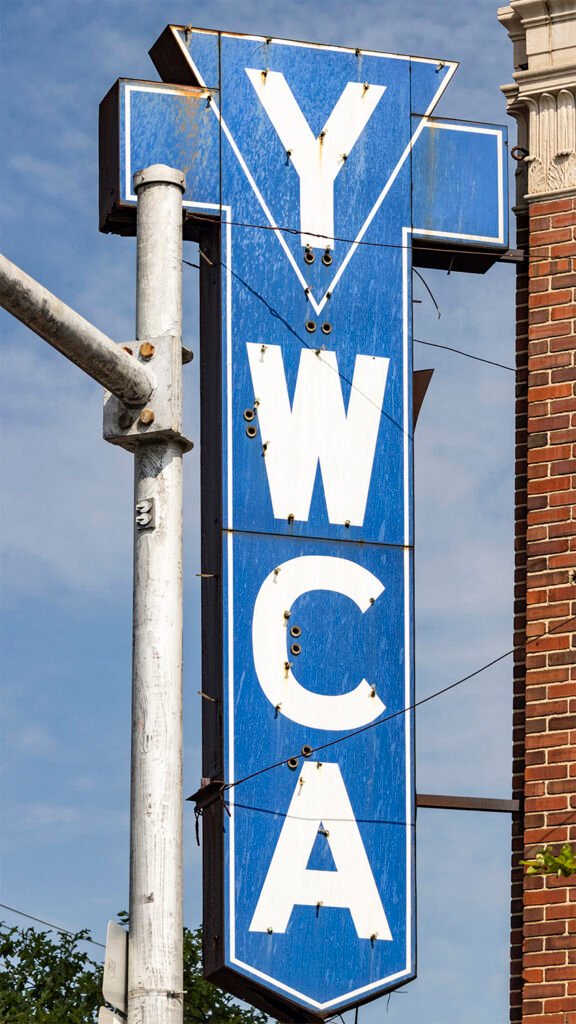
    YWCA (circa 1948). 309 23rd Street North, Birmingham, Alabama.

    The YWCA in downtown Birmingham, Alabama, has occupied the former Birmingham Athletic Club (1925)1 since 1948.2 This fine vintage sign, sans its original neon, hangs on the building’s southwest corner (3rd Avenue North and 23rd Street North) and appears to date from that time.

    References

    1. “Birmingham Athletic Club Moves Into Its New Home”. The Birmingham Age-Herald, August 1, 1925, p. 14. ↩︎
    2. “YWCA To Purchase Dixie Carlton As $400,000 Home”. The Birmingham Post, February 20, 1948, p. 1. ↩︎
  • Words About G.L. Norrman: An Educated Architect (1892)

    Burnham & Root. Equitable Building (1892, demolished 1971). Atlanta.1 Photograph from an undated postcard published by E.C. Kropp of Milwaukee.

    The Background

    The 8-story Equitable Building was Atlanta’s first “skyscraper” when it opened in 1892. Built by Joel Hurt’s East Atlanta Land Company — a major client of G.L. Norrmans at the time — the Equitable wasn’t designed by Norrman but by John Wellborn Root of Burnham & Root2 in Chicago, one of the leading American architects of the era and a Georgia native.

    Riding high on his own commercial and creative success of the early 1890s, Norrman was one of the Equitable Building’s original tenants3 and had perhaps the best view in Atlanta with a top-floor studio that spanned multiple suites,4 described as “brilliantly lighted, opening eastward”.5

    On December 17, 1892, Norrman was profiled as part of an Atlanta Journal article about the building’s occupants, appropriately titled “The Equitable”.

    The profile, published below, provides a few previously undisclosed details about Norrman’s early life, primarily regarding his education in Sweden and his international travels. It also indicates that Norrman emigrated to the United States in 1874, which he confirmed in the 1900 census,6 although in his 1897 passport application, he claimed to have entered the country in the fall of 1872.7

    Norrman’s reluctance to reveal his age is also pointedly mentioned, and it seems he was self-conscious about the subject — in both the 1880 and 1900 censuses, Norrman reported himself as 2 years younger than his actual age.8 9 Given the fudging on his passport application, perhaps he just liked being mischievous with dates.

    The article’s emphasis on his training is also notable, as Norrman was the only Atlanta architect at the time who had any formal education. The city’s other architects were all either self-taught or trained under other designers, and the difference is apparent when you compare their often crude vernacular creations to Norrman’s more sophisticated designs.

    The profile has several minor errors, including misspelling Norrman’s name (3 times), erroneously stating that he came to Atlanta in 1882 (it was 188110), and referring to his first partnership as “Weed & Normann”, although it was Norrman & Weed.

    The sketch also mentions the “Charlotte Hotel, Charlotte, N.C.”, although I’m not aware of any hotel designed by Norrman in that city. The name likely refers to Norrman’s design for the Hotel Carrolina (1891) in Durham, North Carolina, or it could also refer to the City Hall (1893) in Charlotte, then under construction.


    “An Educated Architect”

    Some men are born great, some achieve greatness, others have bachelorhood thrust upon them.

    Now, the gentleman who occupies 829 on the eighth floor of the Equitable building is not only the architect of his own fortunes but the fortunes of a vast many others.

    He is a lover of the beautiful, but has never been able to satisfy himself as to which style of architecture he would prefer in a wife.

    In Southern Sweden his honest eyes first saw the light. He elected to be a designer and architect.

    He finished his regular educational course in the finest school of Stockholm.

    Then he made a tour of southern Europe and spent a time in Great Britain, studying all the different styles of architecture and the technique of different designers, from the age of sixteen until he proved himself one of the best draftsmen and one of the most ardent lovers of artistic architecture. He then spent a time in South America.

    He has been at work for twenty-five years—eighteen in America—but he refuses, or rather, declines to make his age known because of the fact that he is still a bachelor of marriageable age and still hopes to meet with a companion of the opposite sex who would be willing to share his lot in a cottage of his own.

    After coming to this country eighteen years ago this gentleman served as a draughtsman under various architects. He came to Atlanta in 1882 [sic], and was with his partner, Mr. Weed, under the firm name of Weed & Normann [sic], one of the architects of the Cotton Exposition buildings.

    Of course you know who he is now—Mr. G.L. Normann [sic], whose splendid work as a finished architect is of national repute.

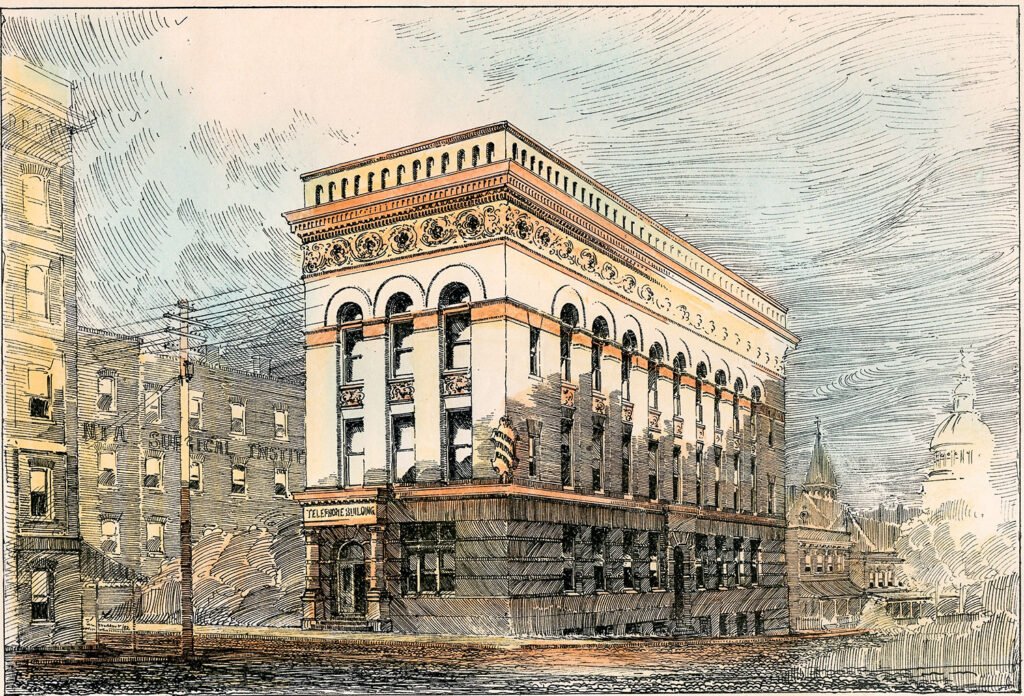
    G.L. Norrman. Telephone Exchange Building (1893, demolished 1952). Atlanta.11 Illustration by W.L. Stoddart.12

    Among his finest tasks are some of the buildings that are monuments in Atlanta as well as other southern cities. He designed the Gate City bank building, the Piedmont exposition buildings, the beautiful Hebrew Orphan’s home, the elegant Hirsch building, the Edgewood school building, many of the handsome business houses and dwellings on Peachtree street and Edgewood avenue, and is now engaged on the new Bell Telephone building which will be one of the handsomest in the city.

    Then he has designed many elegant buildings otherwheres, including the Armstrong hotel, Rome, Ga.; the Printup house and many beautiful homes in Gadsden, Ala. The aristocratic Windsor hotel, Americus, Ga.; the court house at Waycross, Ga.; the Charlotte hotel, Charlotte, N.C. [sic]; the Sweetwater Park hotel at Lithia Springs and many others.

    Mr. Norrman is not only thoroughly conversant with all that pertains to his profession, but he looks on his work with the eye of an artist.

    “I prefer the classic,” he said to a reporter, “for libraries, school houses, courthouses and all buildings of an educational character, as most proper. For depots and hotels any style will do, but I prefer the Romanesque for depots and the renaissance for hotels and homes as being more homelike and less business like in appearance. Churches I like Romanesque because the growth of the church and that style of architecture are so closely identified.

    The so-called ‘colonial style’ of the old southern mansions is rennaissance [sic] so far as the builders were able to carry that style in those olden days, and it has recently come again into popular favor because of the sentiment that clings about those honored halls.”

    Mr. Normann [sic] is a most interesting talker, thoroughly conversant with and in love with his art, and one can fail to be interested in talking with him if he is a bachelor of uncertain age.”13

    References

    1. Sparks, Andrew. “Turmoil Among the Turrets”. The Atlanta Journal and Constitution Magazine, March 7, 1971, p. 26. ↩︎
    2. “A Big Building.” The Atlanta Constitution, January 9, 1891, p. 6. ↩︎
    3. “G.L. Norrman. Architect.” (advertisement). The Atlanta Constitution, June 26, 1892, p. 5. ↩︎
    4. Atlanta City Directory Co.’s Greater Atlanta (Georgia) city directory (1893) ↩︎
    5. “In the Equitable.” The Atlanta Constitution, May 31, 1892, p. 7. ↩︎
    6. 1900 U.S. Census, Fulton County, Georgia, pop. sch., p. B1, Majestic Hotel, Norman, Godfry L. [Godfrey L. Norrman] ↩︎
    7. United States Passport Application no. 7175 for Godfrey L. Norman dated July 22, 1897. ↩︎
    8. 1880 U.S. census, Spartanburg County, South Carolina, population schedule, p. 45, dwelling 412, family 468, Norman, G.L [G.L. Norrman] ↩︎
    9. 1900 U.S. Census, Fulton County, Georgia, pop. sch., p. B1, Majestic Hotel, Norman, Godfrey L. [Godfrey L. Norrman] ↩︎
    10. “Messrs. Norrman & Weed.” The Atlanta Constitution, April 2, 1881, p. 9. ↩︎
    11. “Fulton Welfare Building Demolition Begins”. The Atlanta Journal, November 18, 1952, p. 31. ↩︎
    12. American Architect and Building News, vol. 41, no. 914 (July 1, 1893). ↩︎
    13. “An Educated Architect”. The Atlanta Journal, December 17, 1892, p. 9. ↩︎
  • Sumter County Courthouse (1914) – Bushnell, Florida

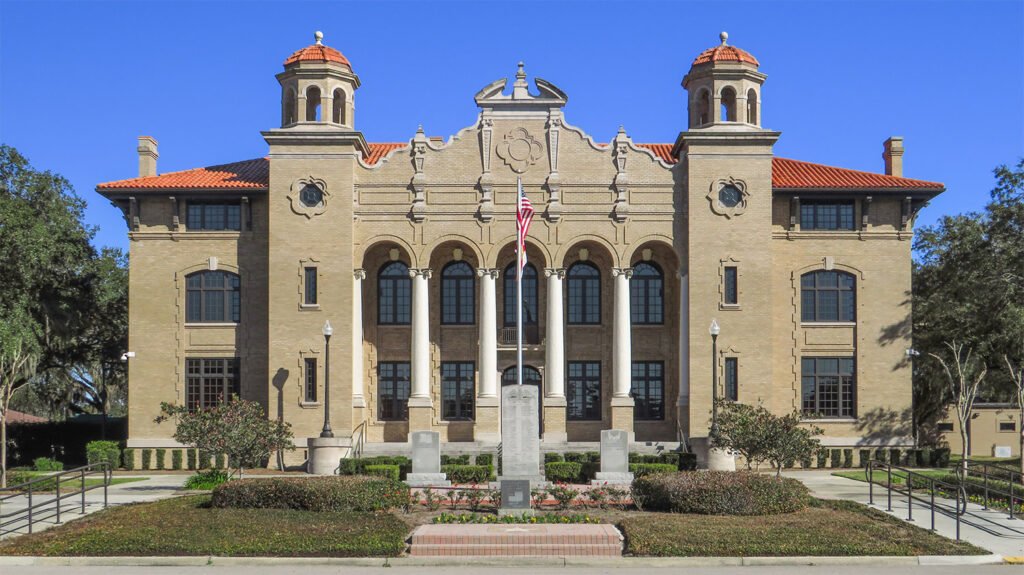
    W.A. Edwards.Sumter County Courthouse (1914). Bushnell, Florida.1 2

    References

    1. “Call for Bids for Erection of Courthouse and Jail.” The Atlanta Constitution, December 11, 1912, p. 16. ↩︎
    2. “The New Court House”. Tampa Morning Tribune (Tampa, Florida), April 1, 1914, Sumter County Magazine Section, p. 6C. ↩︎
  • The Pyramids (1972) – Indianapolis

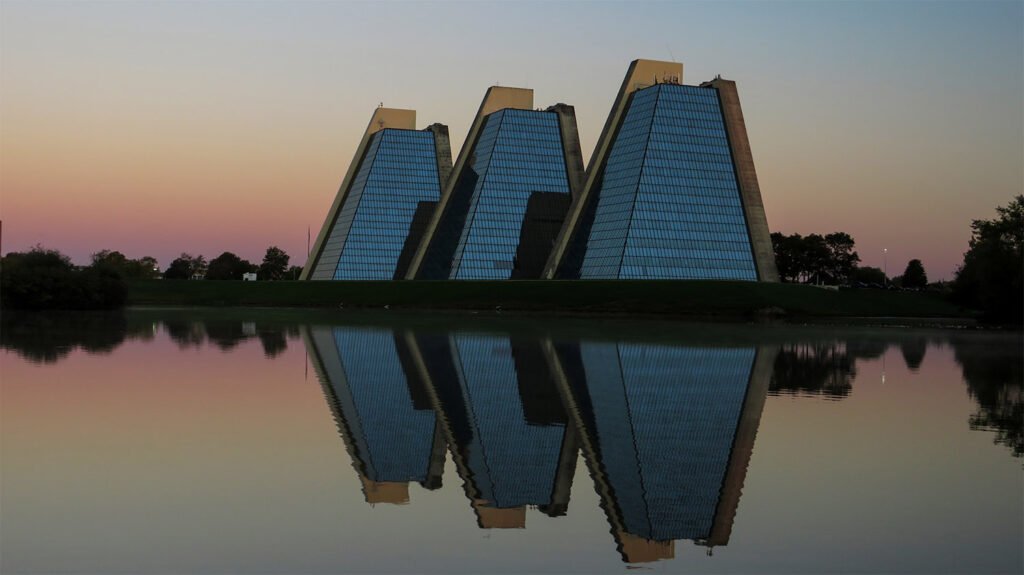
    Kevin Roche of Roche-Dinkeloo Associates.The Pyramids (1972). Indianapolis.1 2

    References

    1. “College Park Pyramids Set For Tenant”. The Indianapolis News, January 28, 1972, p. 29. ↩︎
    2. About – Indianapolis Pyramids ↩︎
  • “Style and Fashion” (1885) by L.B. Wheeler

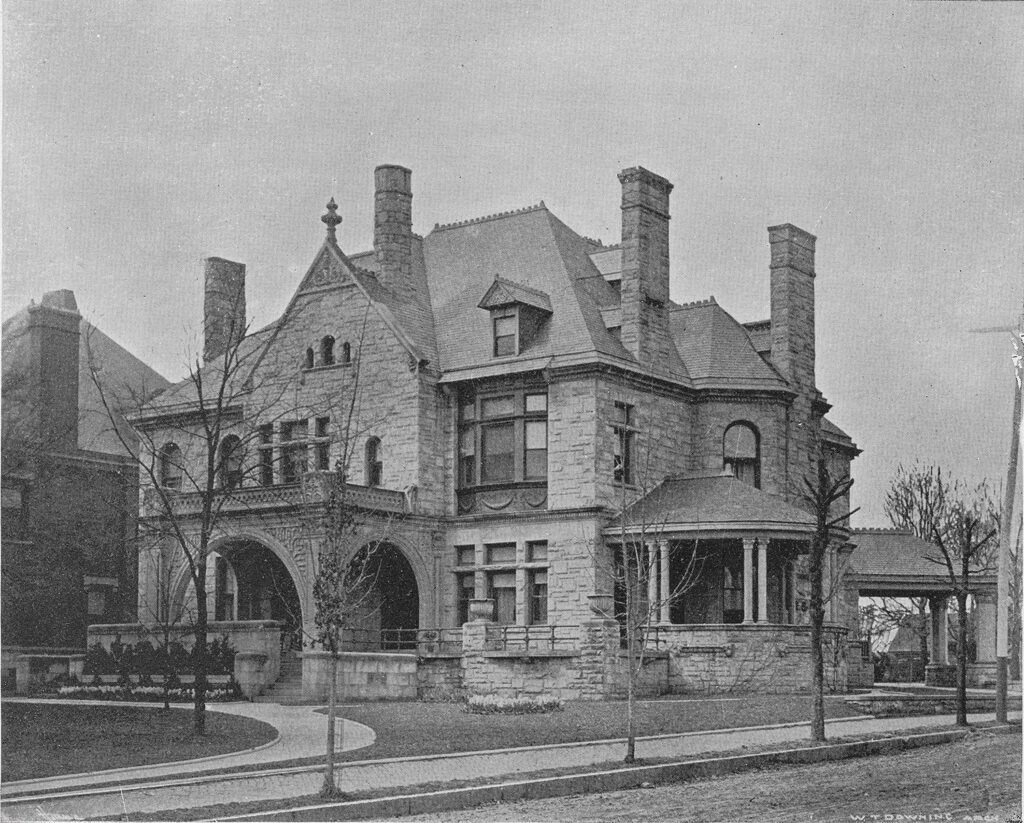
    L.B. Wheeler and W.T. Downing. S.M. Inman House (1890, demolished 1946). Atlanta.1 2 3 Photograph by W.T. Downing.4

    The Background

    This is the third in a series of 5 articles on home decoration written by L.B. Wheeler (1854-1899), an architect who practiced in Atlanta from 1883 to 1891. The articles were published in The Atlanta Constitution in December 1885 and January 1886.

    Here, Wheeler spoke in harsh terms of fickle fashionistas who fretted over building their homes in the latest style, imploring his readers to consider “the length of the period for which we expect to build, which shall, in all probability, be for the remainder of our lives”.

    That advice would have fallen on deaf ears in 1880s Atlanta, where the nouveau riche changed houses like their soggy underwear (from the humidity, of course), hopping from one new residence to the next every few years, each one inevitably more overwrought and gaudy than the last.

    Atlanta has always been a parade of bullshit and spectacle, and Wheeler could have only had the houses of Peachtree Street in mind when he spoke of “a museum in which we store all sorts of unnatural curiosities and uninteresting bric-a-brac…overloaded with superficial ornaments in strained and unnatural attitudes, posed with a smirk before the audience like a ballet dancer awaiting applause.”

    Wheeler mourned for the “lack of character, simplicity, refinement…” and other timeless attributes missing in late 19th-century architecture, a sentiment echoed by other Atlanta architects of the era — notably, G.L. Norrman, who later shared his own acerbic remarks about the city’s homes, although Wheeler was even more caustic here.

    The irony is that Wheeler proved himself quite willing to satiate the whims of Atlanta’s elite. Photographic evidence abounds of the many ostentatious residences of his design, a legacy continued by his protege, W.T. Downing, who spent years littering the city with garish mansions, most of them mercifully destroyed in the 20th century.

    It was as true then as it is today: If you have to be wealthy, for God’s sake, develop a little taste to relieve us of your affliction.


    Style and Fashion

    By L.B. Wheeler, Architect of the New H.L. Kimball House.

    December 27, 1885

    The prevailing style of architecture and the probable length of its fashionable existence, is to those contemplating the building of a home, often a question of serious disturbance. If we will think for a moment of the length of the period for which we expect to build, which shall, in all probability, be for the remainder of our lives, it would seem that the folly of following the dictation of an unreasoning fashion, which is constantly changing, would be apparent. If you are sure the style of your house is sanctioned by judgment and reason, you need have no fear in violating fashion’s decrees. 

    There is a prevailing impression that an architectural style consists of a set of forms–a sort of architectural clothing–to be used as fancy dictates. But the forms of a style, apart from its principles, which are its soul and life, are no more a style than the wooden image in front of a cigar store is a man. Taste, climate, materials, social conditions, wealth and various other circumstances, have given rise, in different countries and at different periods of time, to certain methods and principles of design, the application of which, in the erection of the monuments and buildings of those countries and periods have created certain architectural forms, which have been systematized and called styles. The frequency with which we see buildings dressed in these various styles without any regard to applicability, scattered along our thoroughfares like a great international masquerade, in which, by the way, some of the costumes are very curious, shows there must either be very great differences in the climate, social conditions and the nature and duties of materials on adjoining lots, or else there is a lamentable state of education in regard to the fitness of things.

    Have you ever realized the possibilities of beauty to which our modern streets are susceptible? The great picture galleries that might be made of them! What charming pictures of social and domestic life could be arranged along their sides!

    In the pictures of the artist the hills and foliage, the green meadows and even the sky are of paint: in ours they may be living, breathing realities possessing thousands of beauties inimitable. With such materials, what ought we not to accomplish, and what have we done? 

    Instead of making of our cities living pictures, expressing refinement, purity and nobility, we make of them a museum in which we store all sorts of unnatural curiosities and uninteresting bric-a-brac. The great faults of our modern architecture are lack of character, simplicity, refinement, delicacy, tenderness, beauty, grandeur, picturesqueness, homeliness, and sentiments, the expression of some one of which has been the endeavor of every good work erected by man. The designer’s highest purpose seems to be the representation of prettiness, novelty, and the demonstration of wealth, and even in this he fails–without any perception of the laws governing composition of the artistic susceptibilities of the materials used. His attempts to impart prettiness result in fantastic buildings, overloaded with superficial ornaments in strained and unnatural attitudes, posed with a smirk before the audience like a ballet dancer awaiting applause. Novelty which could formerly have been obtained by designing something more absurd than ever had been done before, would have been quite in his line and easy of accomplishment. If the field had not been so well filled by his contemporaries, that now a thing to be novel must necessarily be good–something quite beyond his powers. To demonstrate the possession of wealth he loads his building with starring ornaments, breaks everything up and fills every blank space with an inappropriate ornament. His universal recipe for producing repose, breadth and refinement in his composition, attaches his building to a tower of much grandeur, and no use whatever, and completes a building which, if it were not too large, would make a very good toy savings bank–a nice one with a tower handle. The exterior of a building should be the simple and natural clothing of the interior, and should express its character and purpose above all things. Truth is essential and means the correspondence of the representation with the facts. There should be no shams about the building. Nothing is as vulgar as the imitation by a cheap material of one more valuable. It deceives no one and creates on discovery an impression similar to that produced by the use of paste diamonds and bogus jewelry. The humblest materials used honestly, in positions suited to their functions, may be made beautiful, and in certain places their services are indispensable. It is by the arrangement of the materials and not their value that a house is made attractive. You might build a house of gold with diamond windows which would be very ugly and perfectly useless.

    There should be no unnecessary towers, dormers, gables, windows, or other features which, by their presence, imply that they are there for a practical purpose which they do not fulfill. Features used in this way are not ornaments; they are architectural lies. What would you think of a man who covered himself with glass eyes and wax roses to make himself beautiful? They would not be more ridiculous than are some of the excrescences which are put upon many of our buildings and not unlike them in effect. Some people are blind to beauty, as others are to color. It is a defect in their natures like the want of a musical ear. These with many others who from fear of criticism, thoughtlessness, indolence, ignorance, and a meek desire to follow, however distantly, in the footsteps of wealth, are guided in matters of taste almost exclusively by the dictates of fashion; and even in their devotion to so sordid a government they are often imposed upon, receiving some very bitter doses, sweetened with a few of the detail of a prevailing style which, to their unsophisticated palate, has the flavor of the genuine article. If the motives in which fashion has its origin and the sources from which it springs were thoroughly understood it would have numerous less worshipers than now. Nature’s fashions never change. The leaves of the trees come in spring with the summer winds and gay troops of young flowers and in the autumn put on their gorgeous mourning as they have ever done. It would puzzle the oldest inhabitant to remember a change in the fashion of man, still our fashions are changing constantly. It must be either because there is no beauty in them or we fail to discover or appreciate it. We should learn to understand beautiful things and love them for their inherent beauties and not bondage our likes and dislikes to popular fancy. There would be no objections to the edicts of fashion if they were good and right; but the fact that a thing to be fashionable must be sanctioned by the majority is when we think that on matters requiring special knowledge, the majority are never right, almost enough to condemn it without further evidence. Fashion is a common bait thrown by the tradesmen to allure the wary dollars from our pockets. What could be expected from such a motive? A high standard of merit endeavoring to elevate and purify the public taste? No. The fisher with such a bait would go hungry for dollars. He must throw something more palatable to the multitude. So he fits up something nice, new and bright, calls it the latest style and fills his basket with dollars. This latest style is a very popular bait. The later it is the better. “There are no old masters now.” In this advertising age of ours every lecture-play-musical composition and every product of the manufacturer is an improvement upon its predecessor, and he who waits for perfection “is like the rustic who waited for the river to run by.”5

    References

    1. “Eight Millions More.” The Atlanta Constitution, April 13, 1890, p. 7. ↩︎
    2. “A Handsome Residence”. The Atlanta Constitution, April 19, 1890, p. 4. ↩︎
    3. Furniss, Jim. “New York Firm Plans Store Here”. The Atlanta Constitution, August 21, 1946, p. 1. ↩︎
    4. Photo credit: Atlanta Homes: Attractiveness of Residences in the South’s Chief City. Atlanta: Atlanta Presbyterian Publishing Company. ↩︎
    5. Wheeler, L.B. “Style and Fashion.” The Atlanta Constitution, December 27, 1885, p. 4. ↩︎
  • Jefferson County Health Department (1979) – Birmingham, Alabama

    Henry Sprott Long & Associates. Jefferson County Health Department (1979). Birmingham, Alabama.1 2

    References

    1. Gates, Stephen. “Topping out today”. Birmingham Post-Herald (Birmingham, Alabama), September 27, 1978, p. A13. ↩︎
    2. “Health Dept. building spacious”. Birmingham Post-Herald (Birmingham, Alabama), April 12, 1979, p. C1. ↩︎