If you want to see bad architecture, go to Atlanta; if you want to see good architecture, go to New York. If you want to see interesting architecture, visit Philly.
Philadelphia has a long history of architects whose work is weird and idiosyncratic — the kind of projects that make you cock your head and go “huh”. Designers like Frank Furness, Wilson Eyre, Jr., Malcolm Wells, and — most famously — Louis Kahn, all developed approaches to architecture that were brash, distinctive, and groundbreaking.
Not to be overlooked is the husband-and-wife architectural team of Robert Venturi and Denise Scott Brown, whose Philadelphia-based firm pioneered what is now known as postmodern architecture.
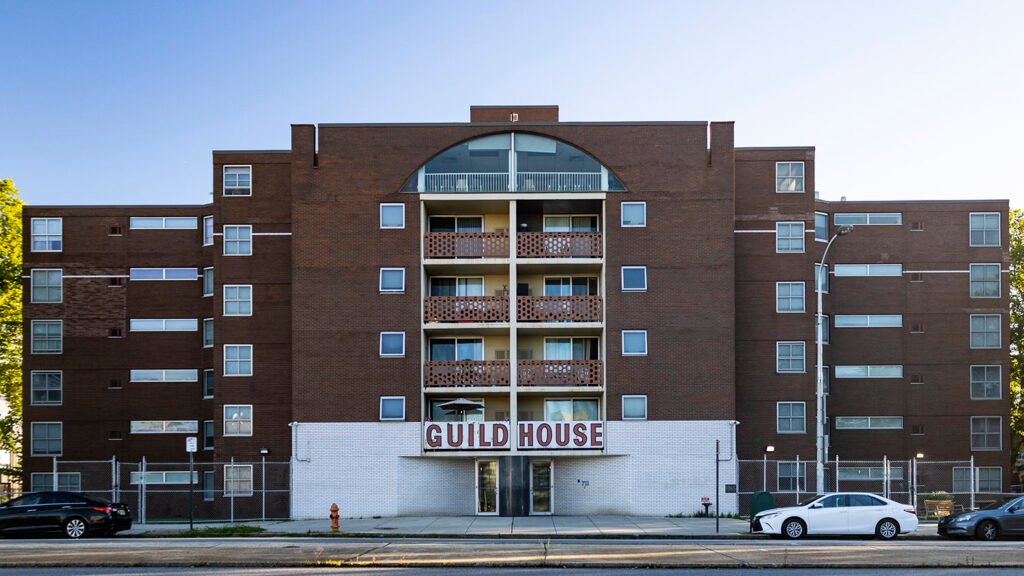
Pictured here is Guild House in Philadelphia’s Poplar neighborhood, which I visited in June. Completed in 1963, it’s Robert Venturi’s most important early work, designed with 91 apartments for low-income senior citizens.
As the duo shared in their seminal 1966 manifesto, Complexity and Contradiction in Architecture, Guild House was consciously modeled, in part, on the vernacular architecture of Philadelphia’s ubiquitous rowhouses.
At first glance, the building’s appearance is unremarkable — and that’s entirely the point. The flat facade covered in common brick blends seamlessly with the banal industrial buildings that surround the facility.
On closer observation, however, the structure’s bold massing and irregularly sized square windows form a provocative composition. The central opening with 8 partitioned balconies topped by a giant arched window resembles a giant shelf for knick-knacks — striking, yet oddly familiar and cozy.
The project was a conscious celebration of the commonplace, meticulously planned using plain, low-cost materials, right down to the chain-link fence that surrounds the building.
At the roots of the postmodern ethos was the egalitarian belief that art and architecture belonged to ordinary people, not just a self-anointed elite. Ironically — and inevitably — the movement was co-opted and corrupted by starchitects and corporate designers until it was thoroughly dismantled and destroyed.
Alas, this is the world we have created.
References
- Venturi, Robert. Complexity and Contradiction in Architecture. New York: The Museum of Modern Art, 1966. ↩︎