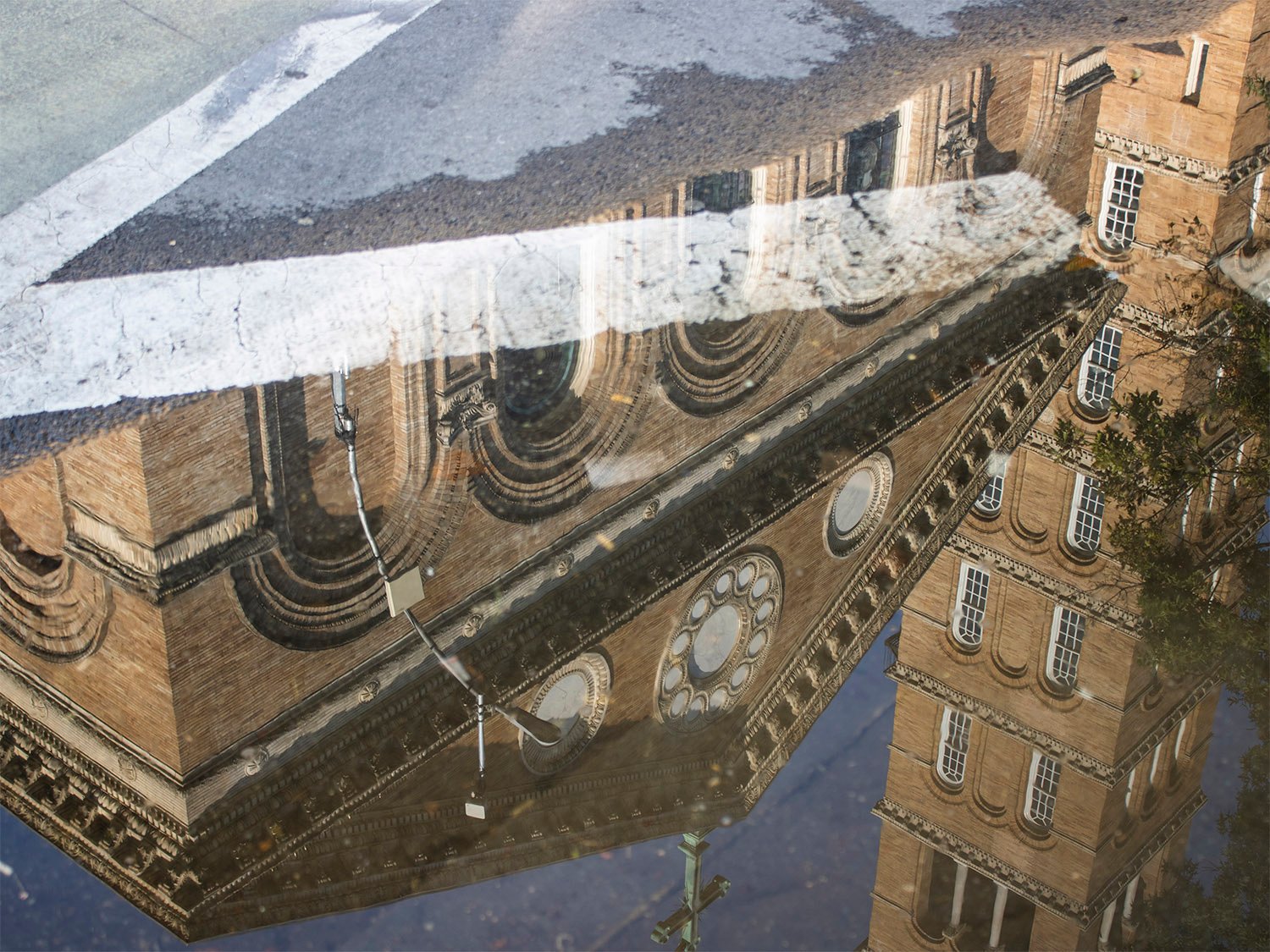
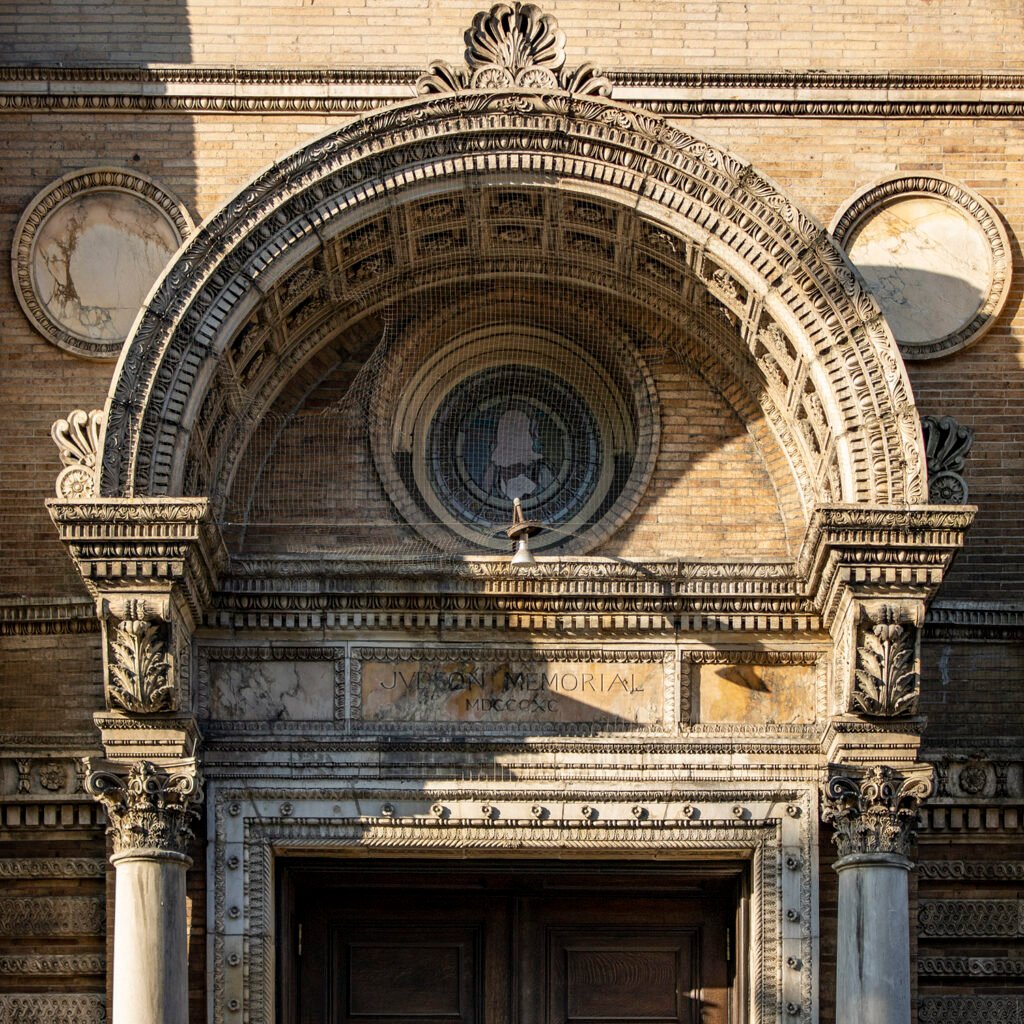
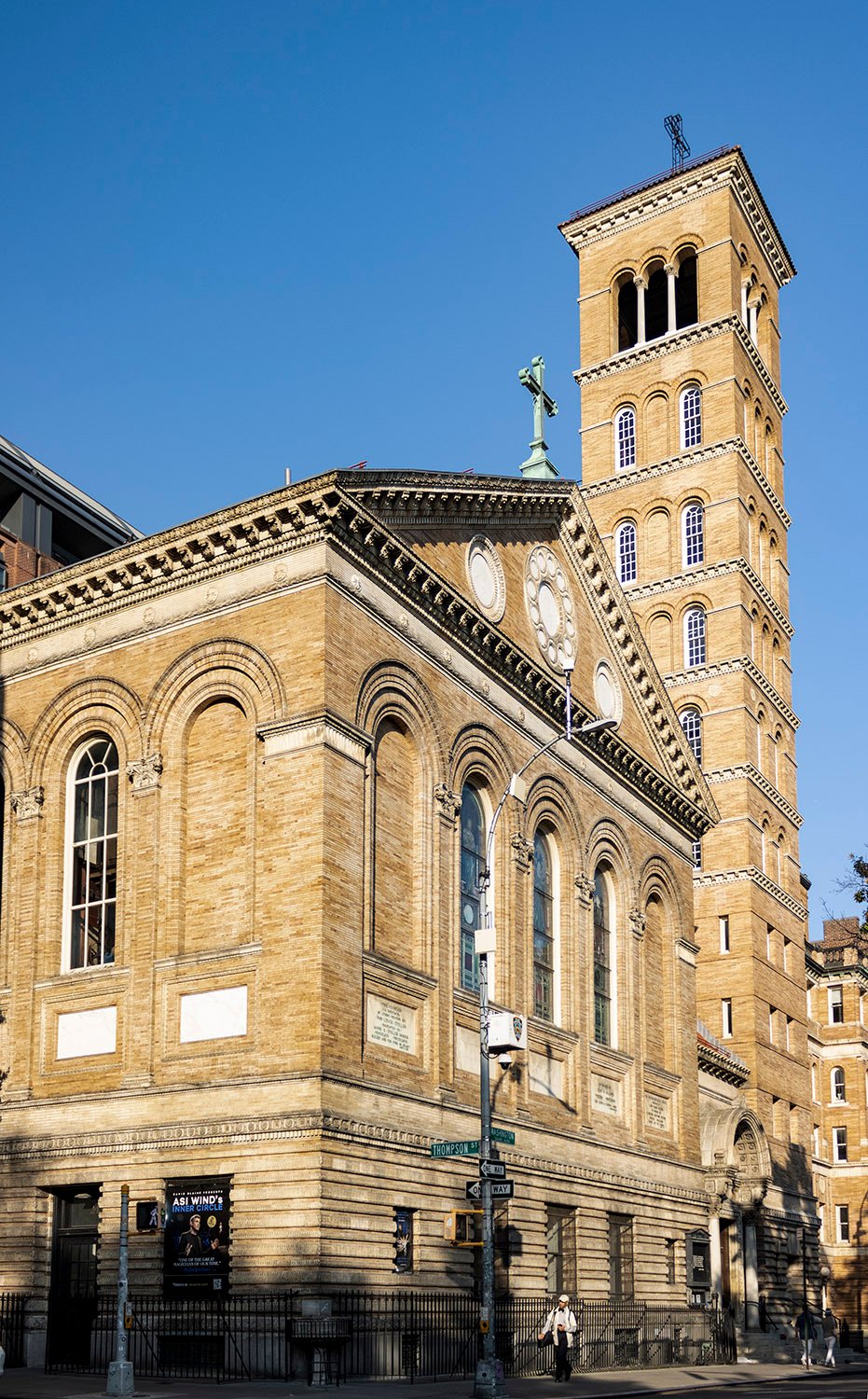
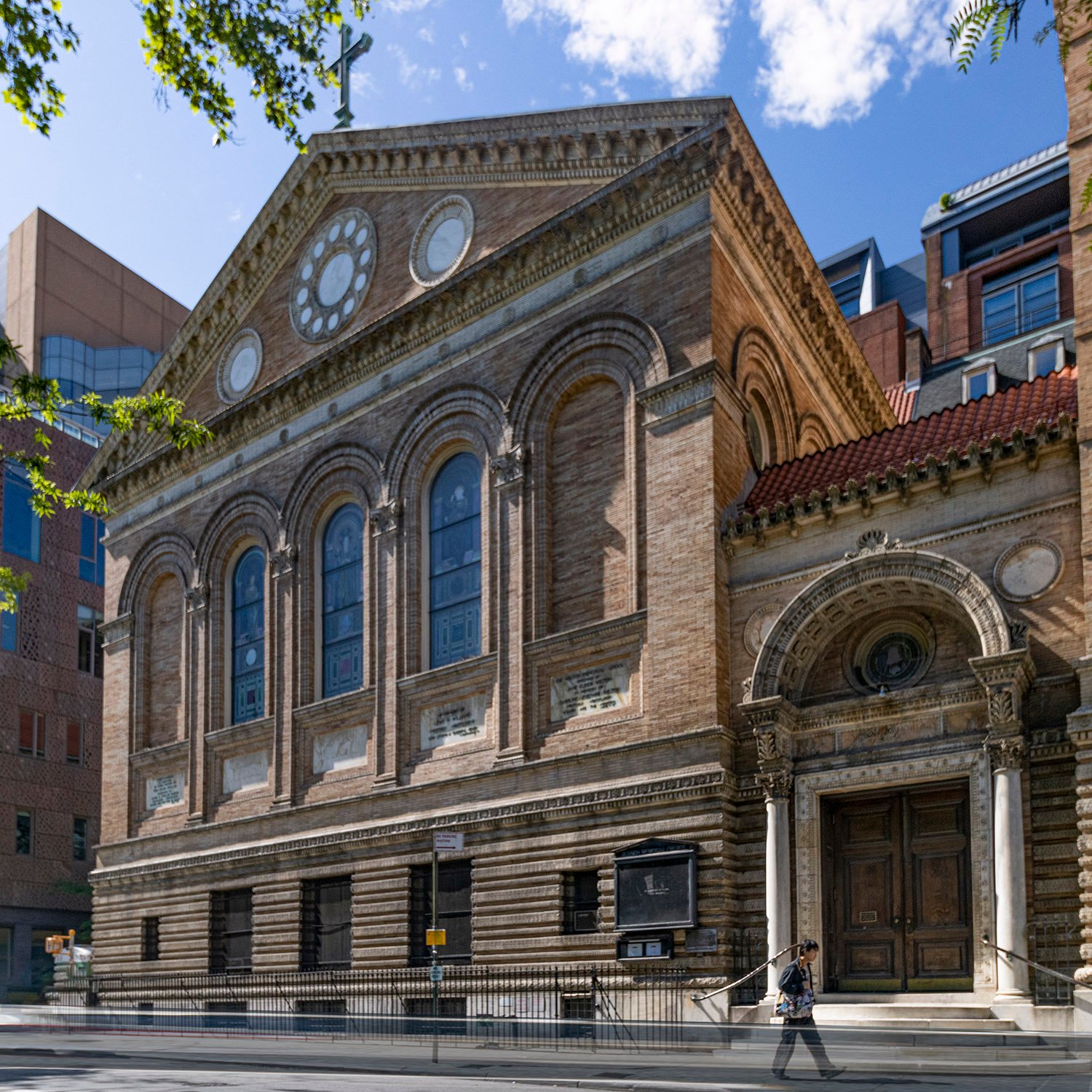
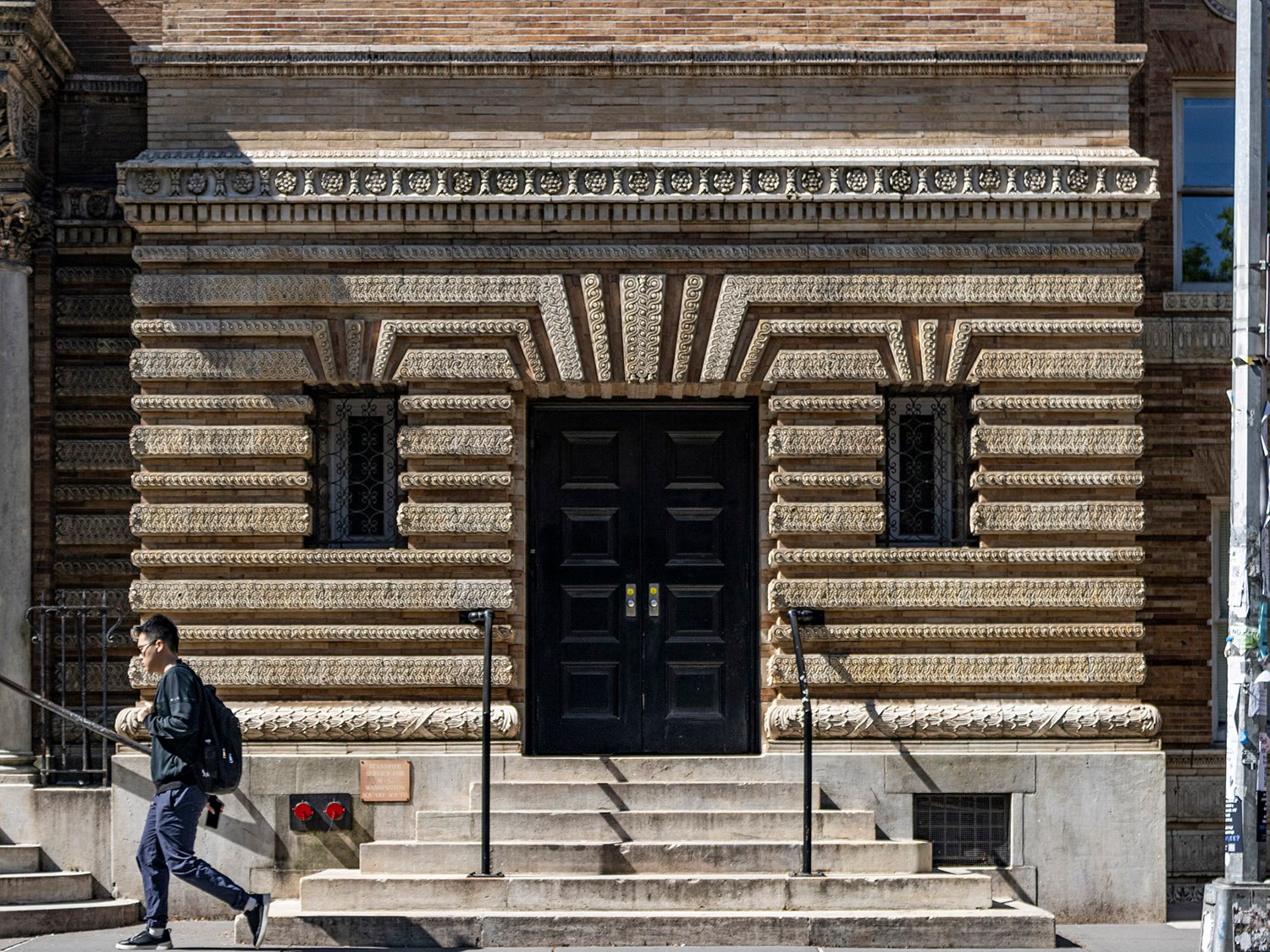
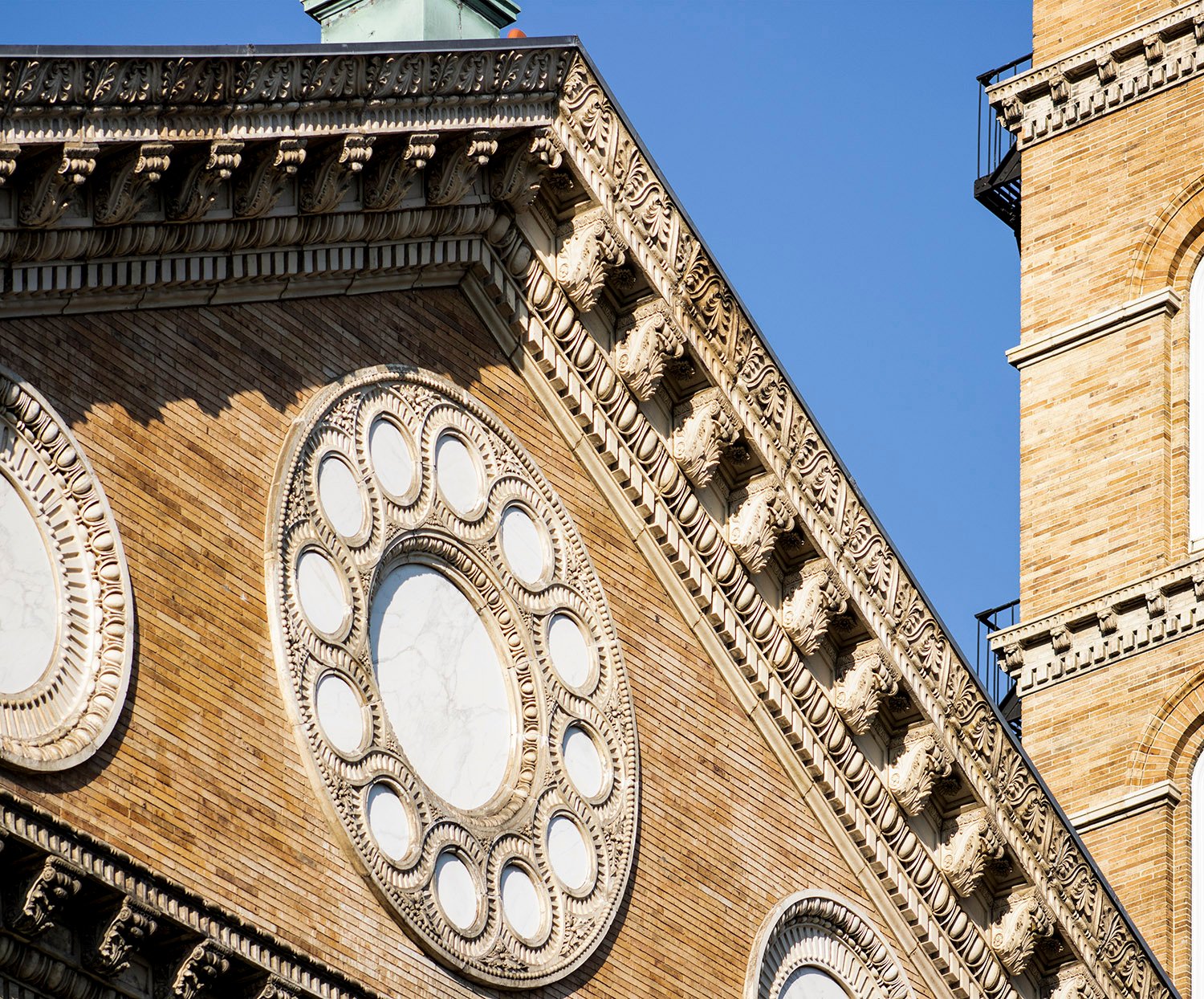
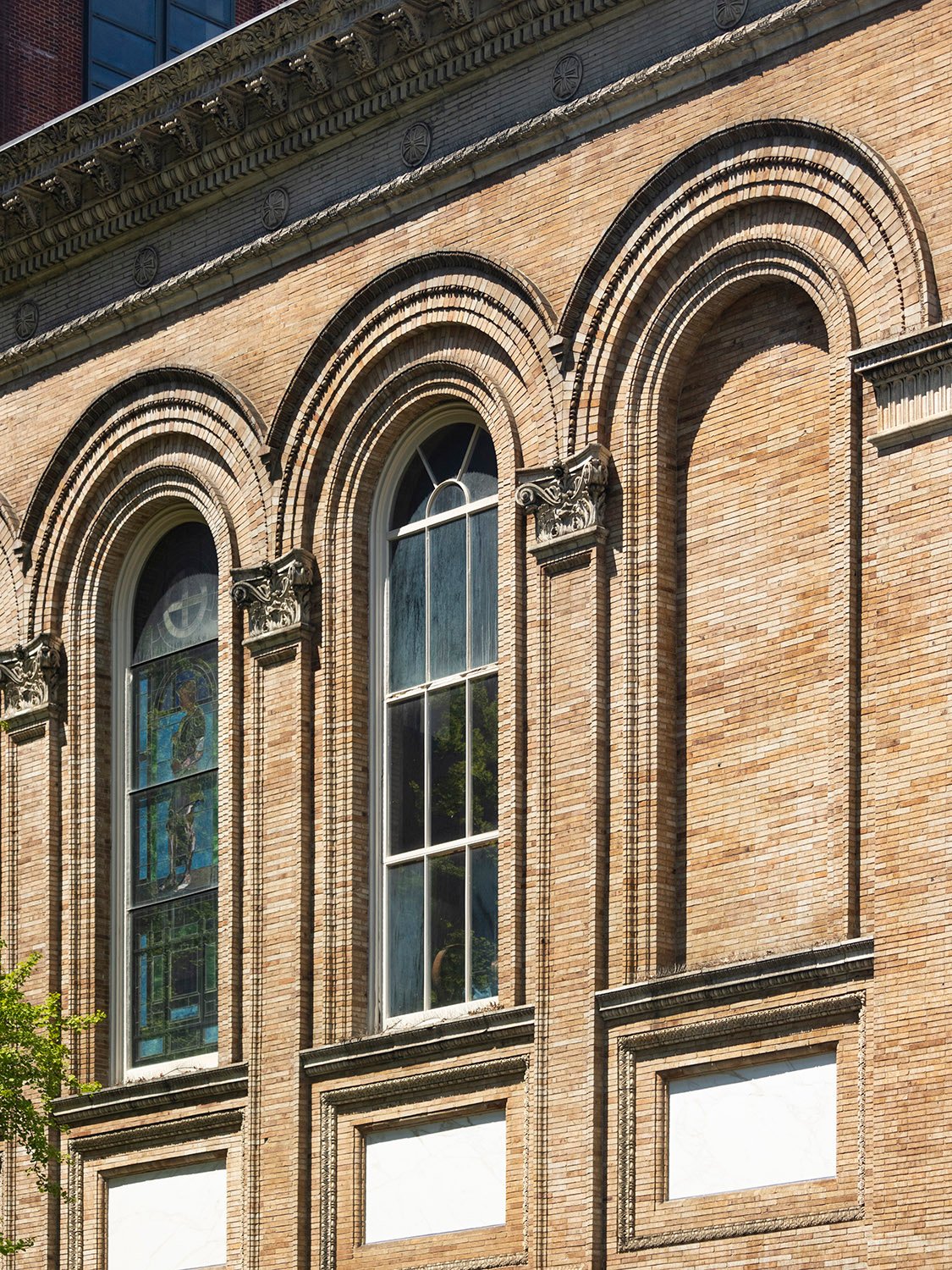
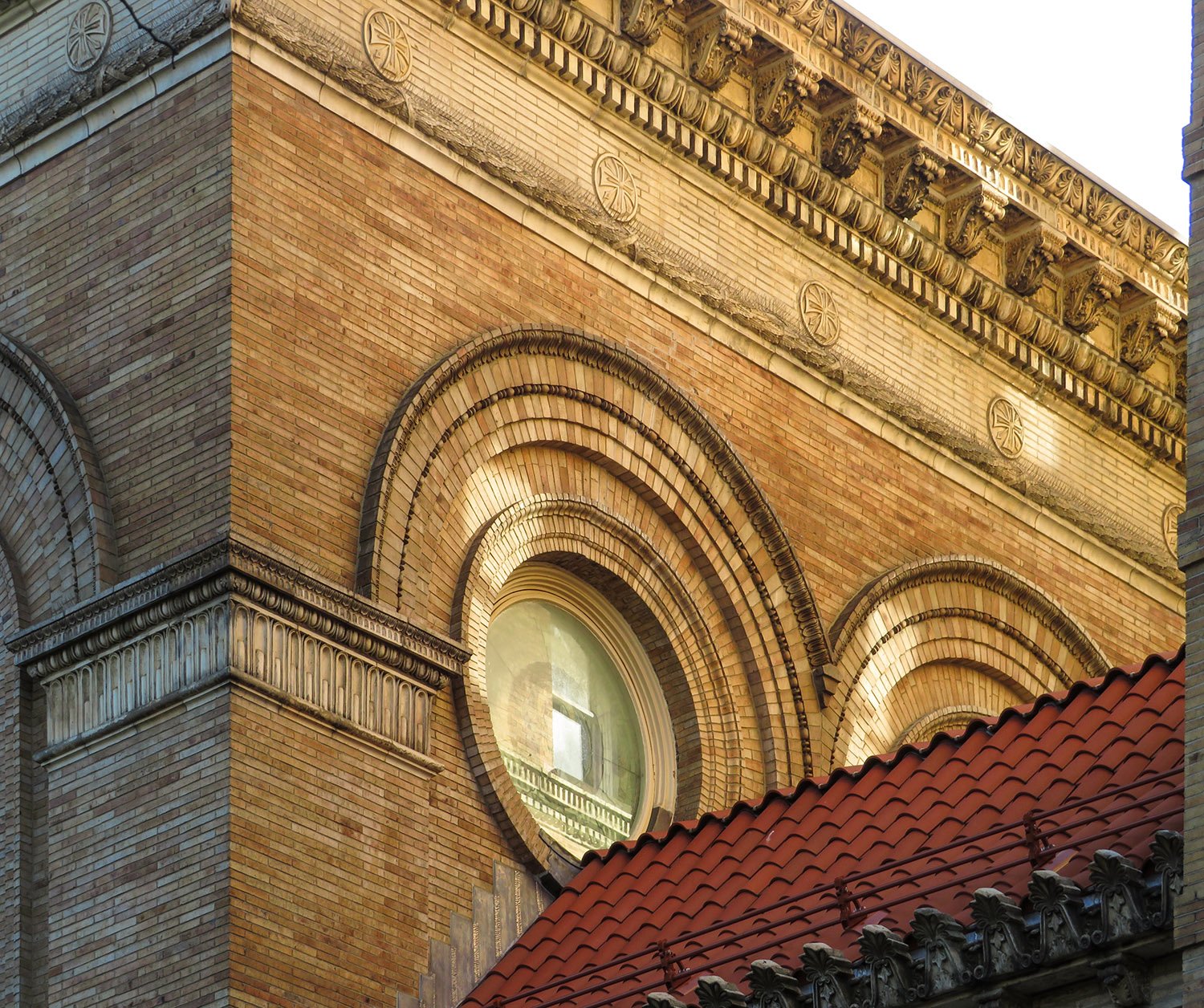
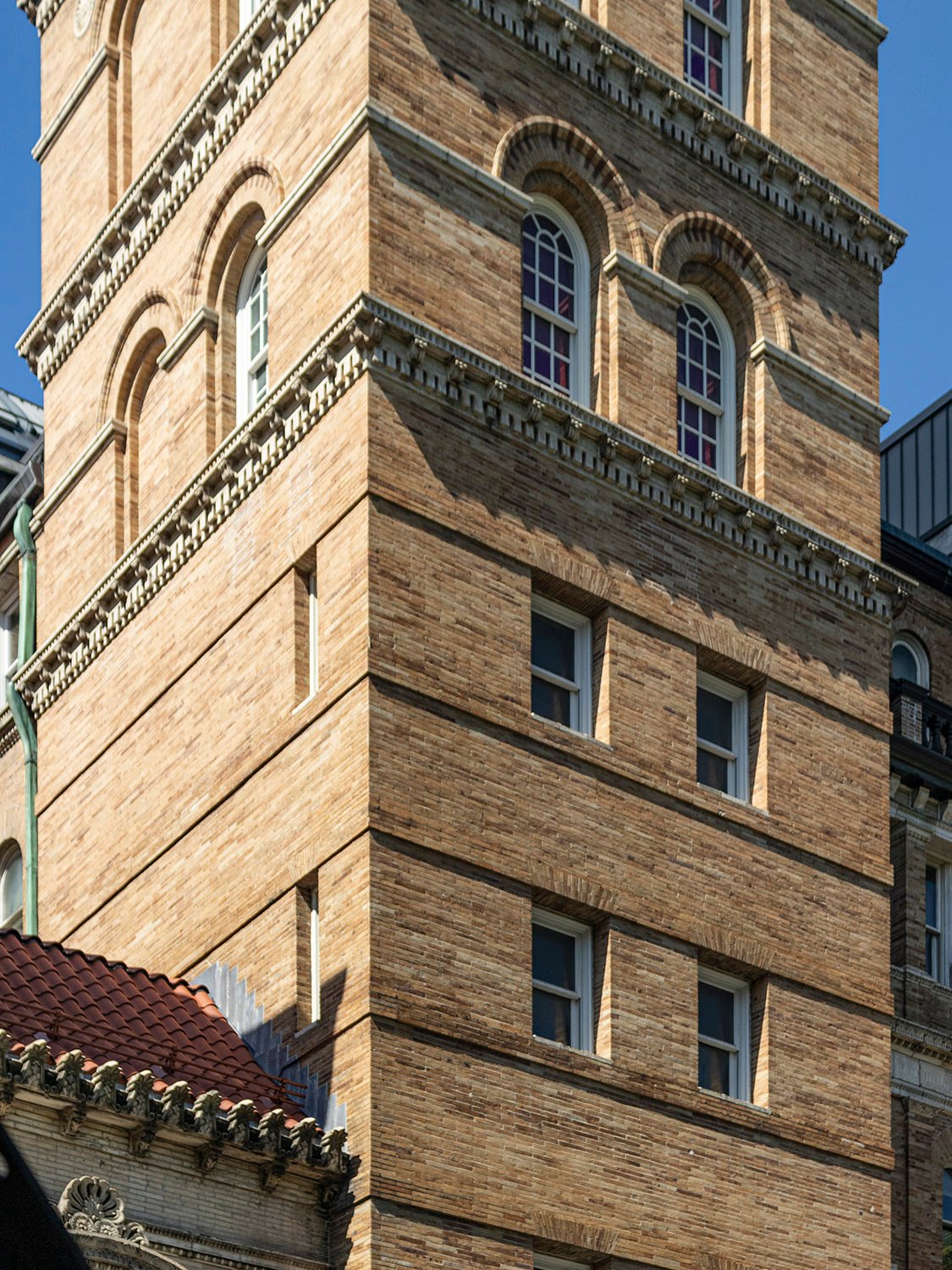
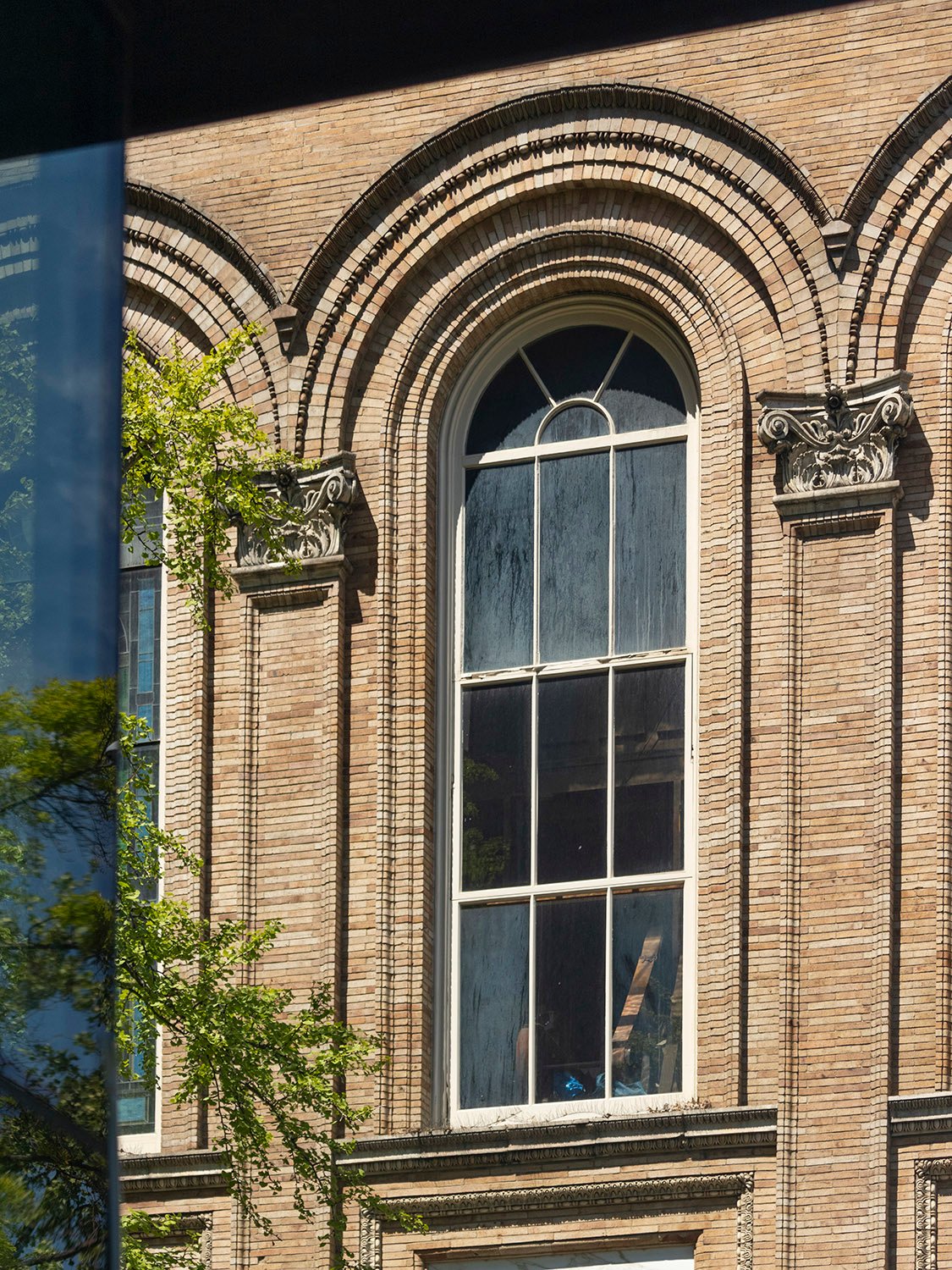
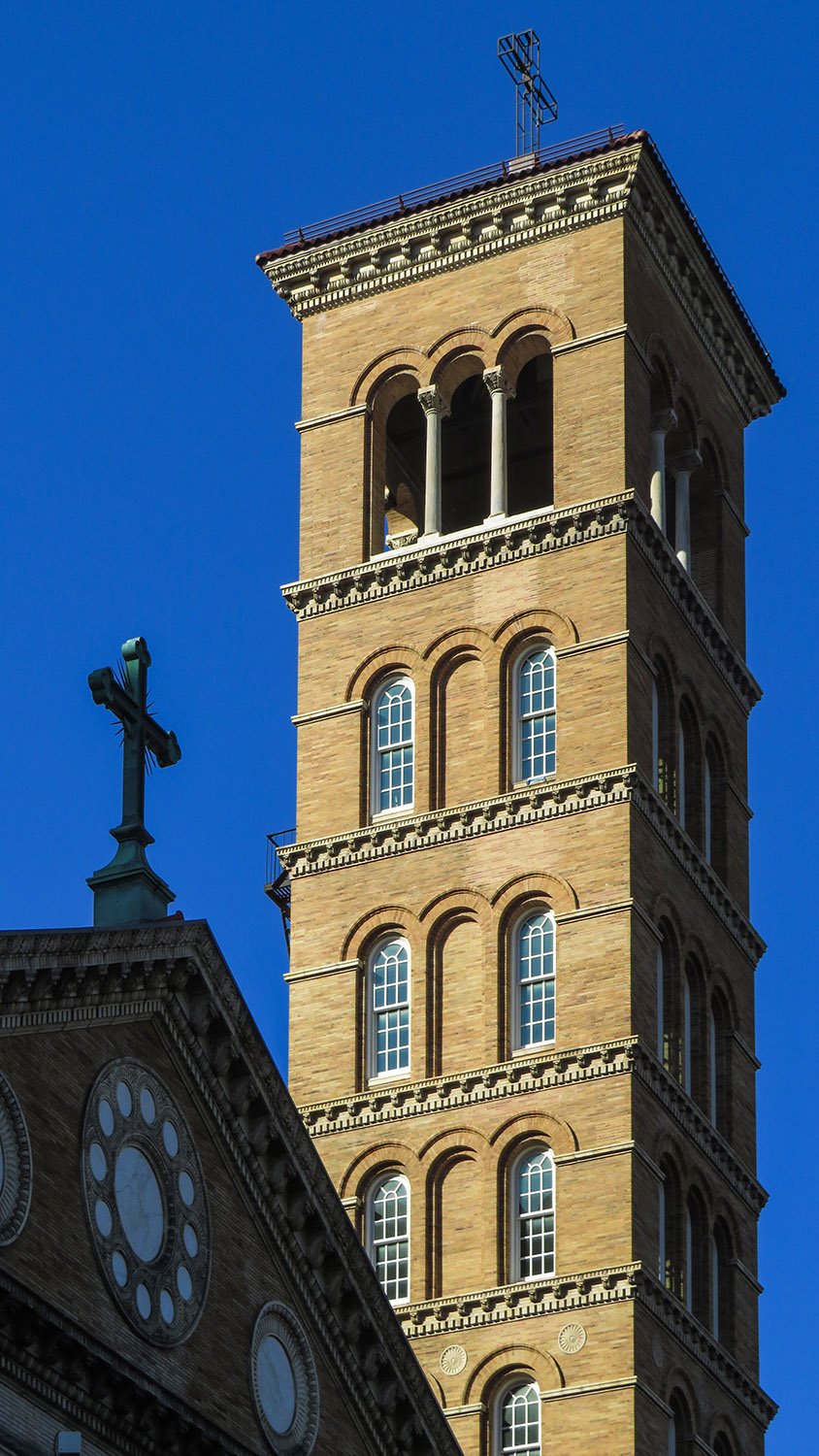
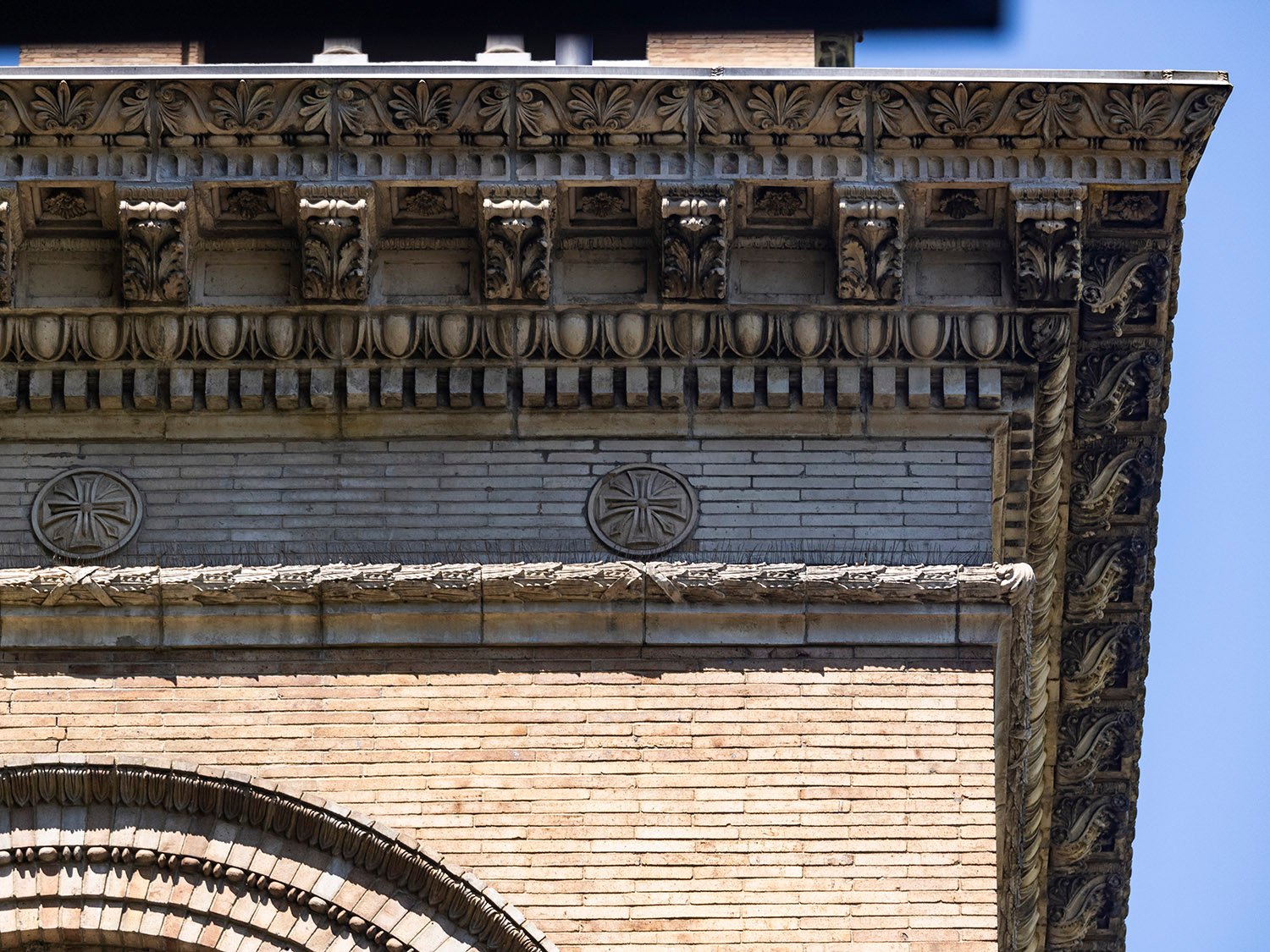
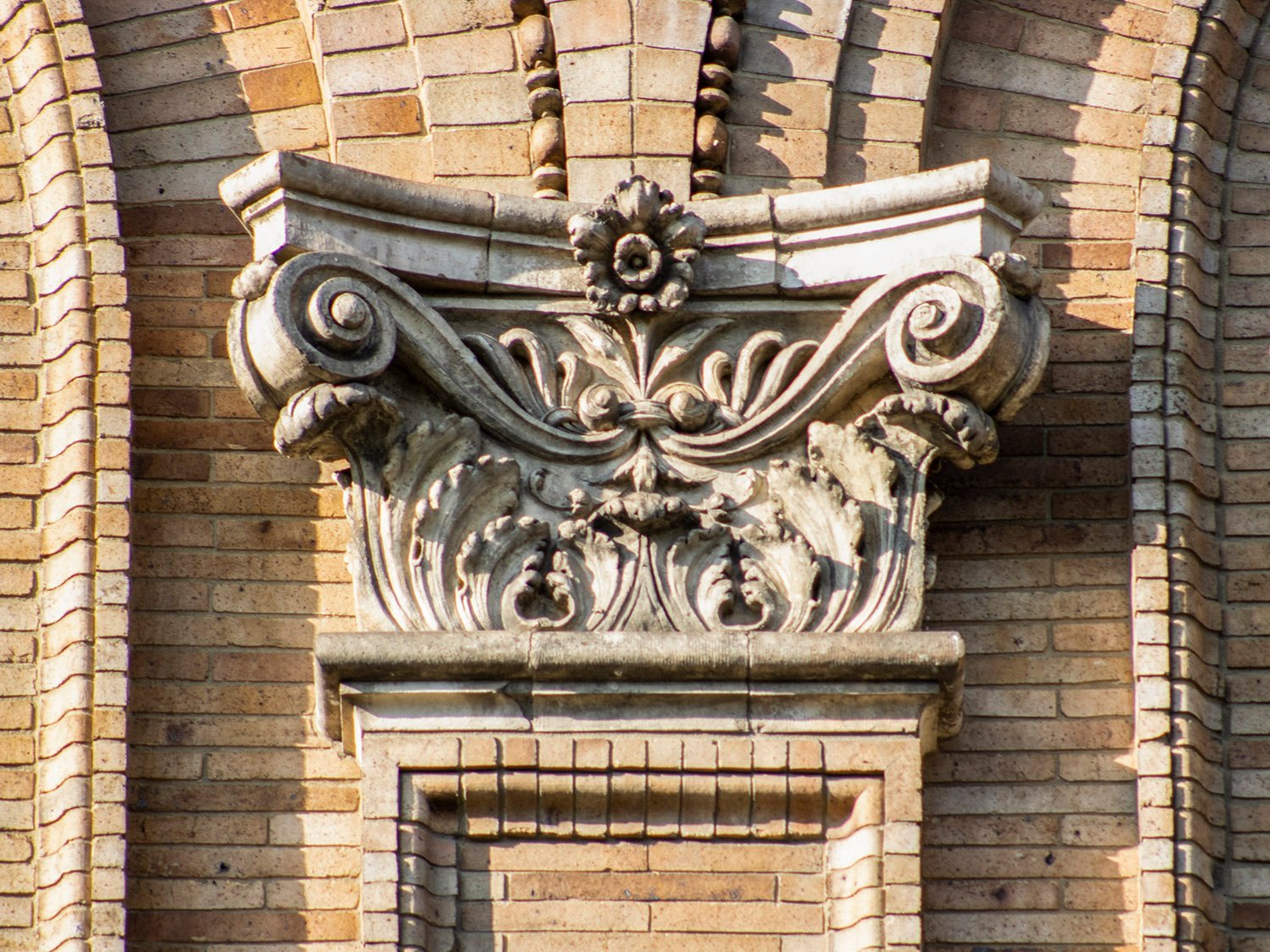
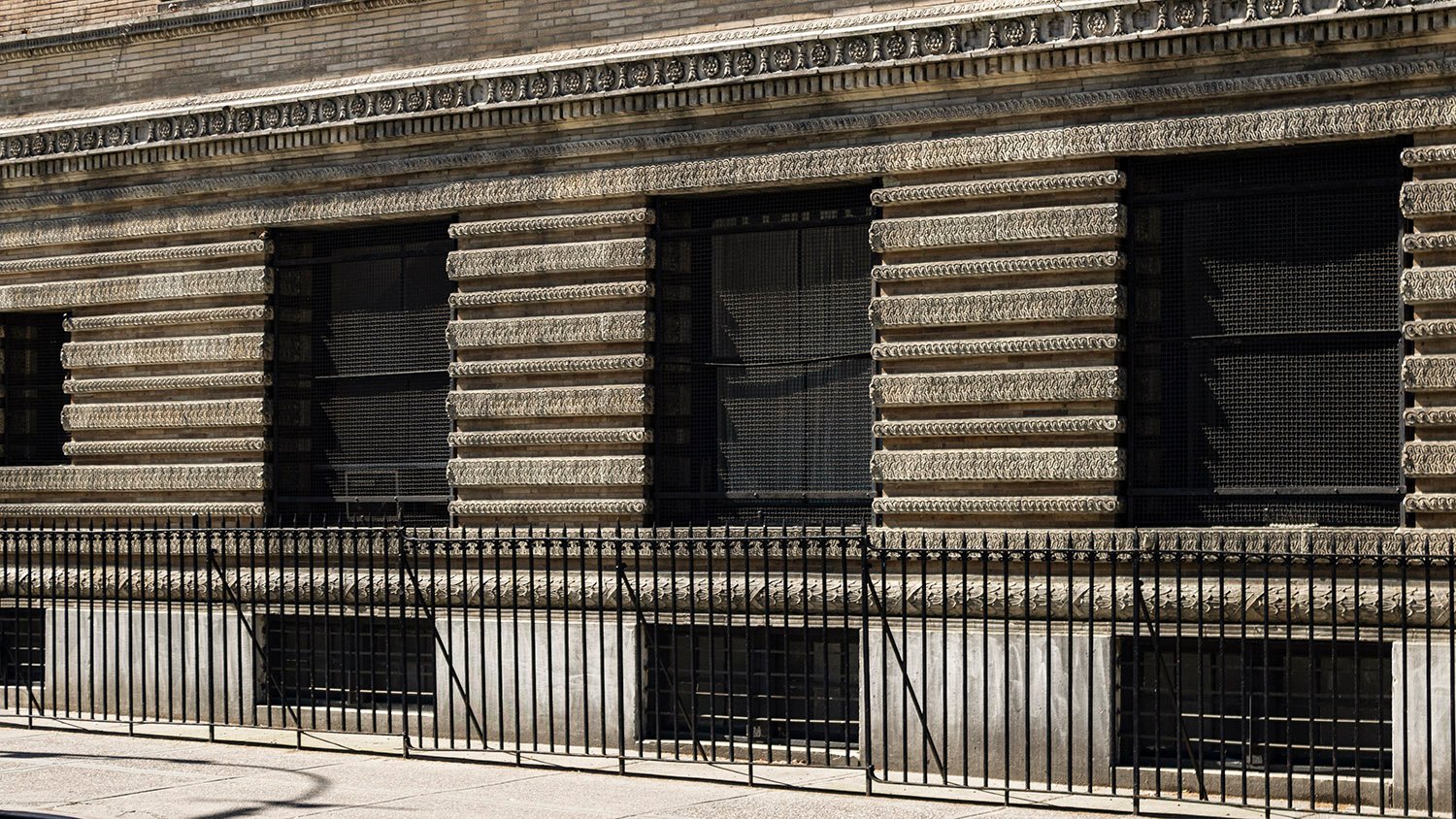
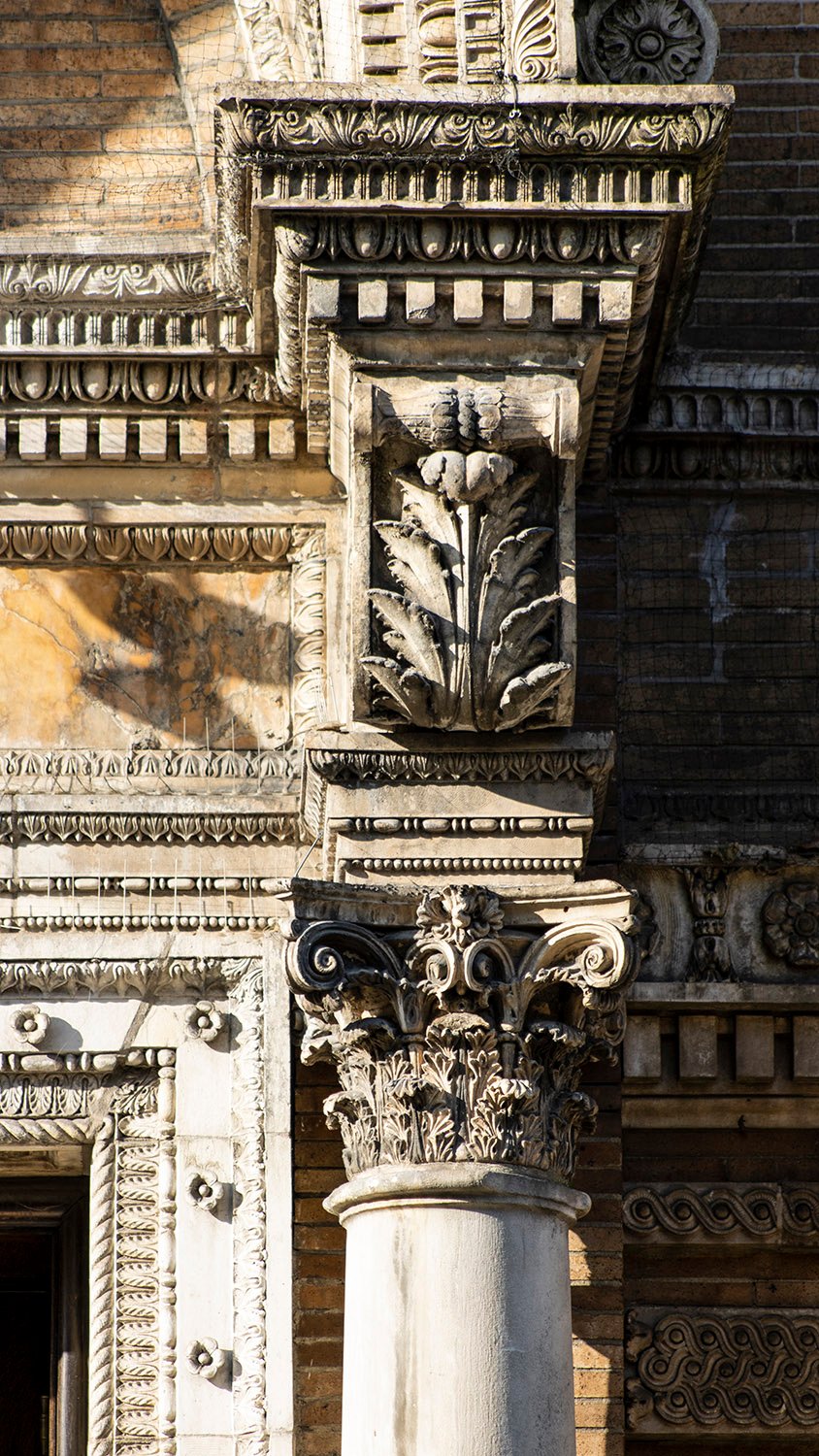
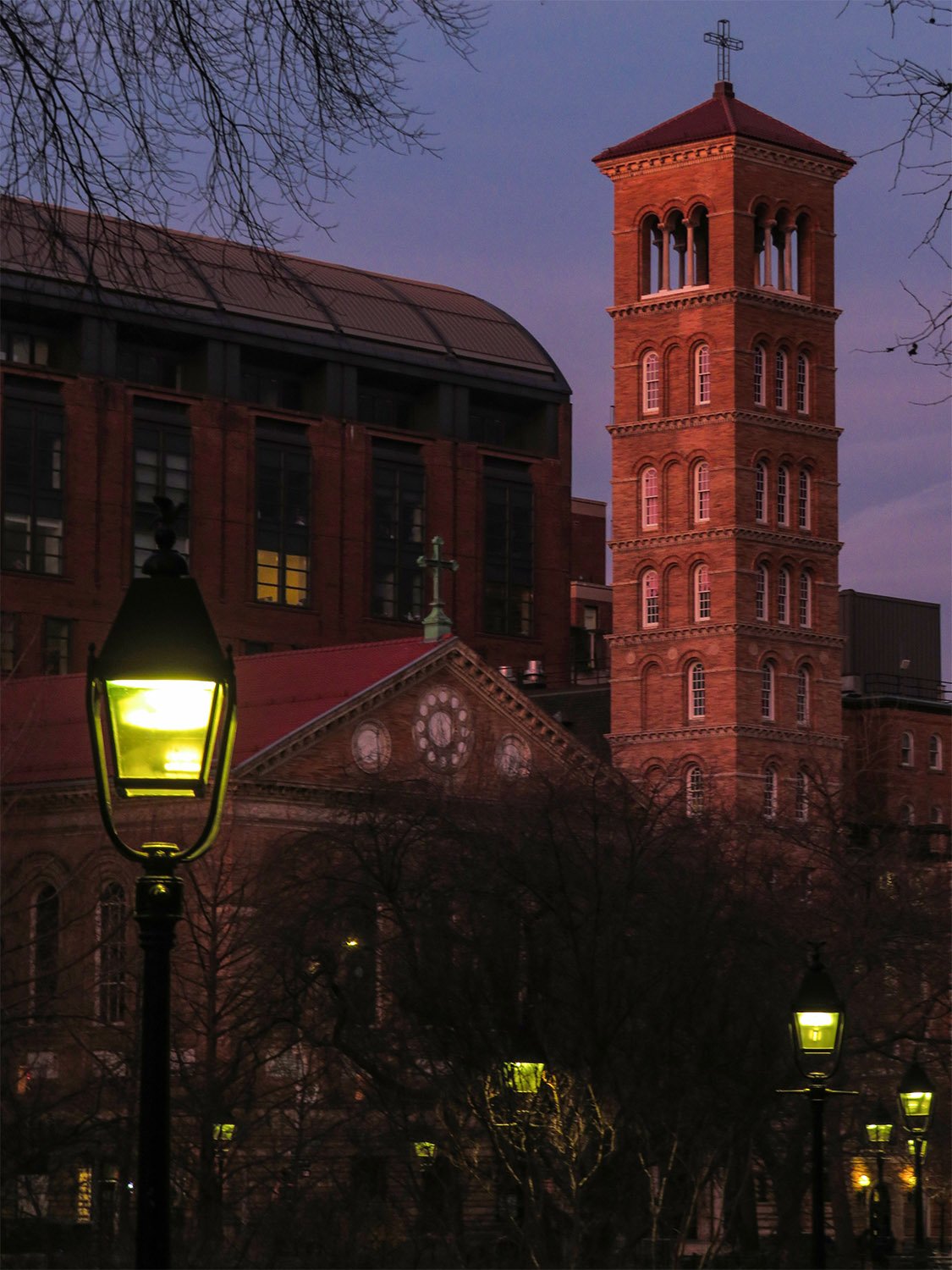
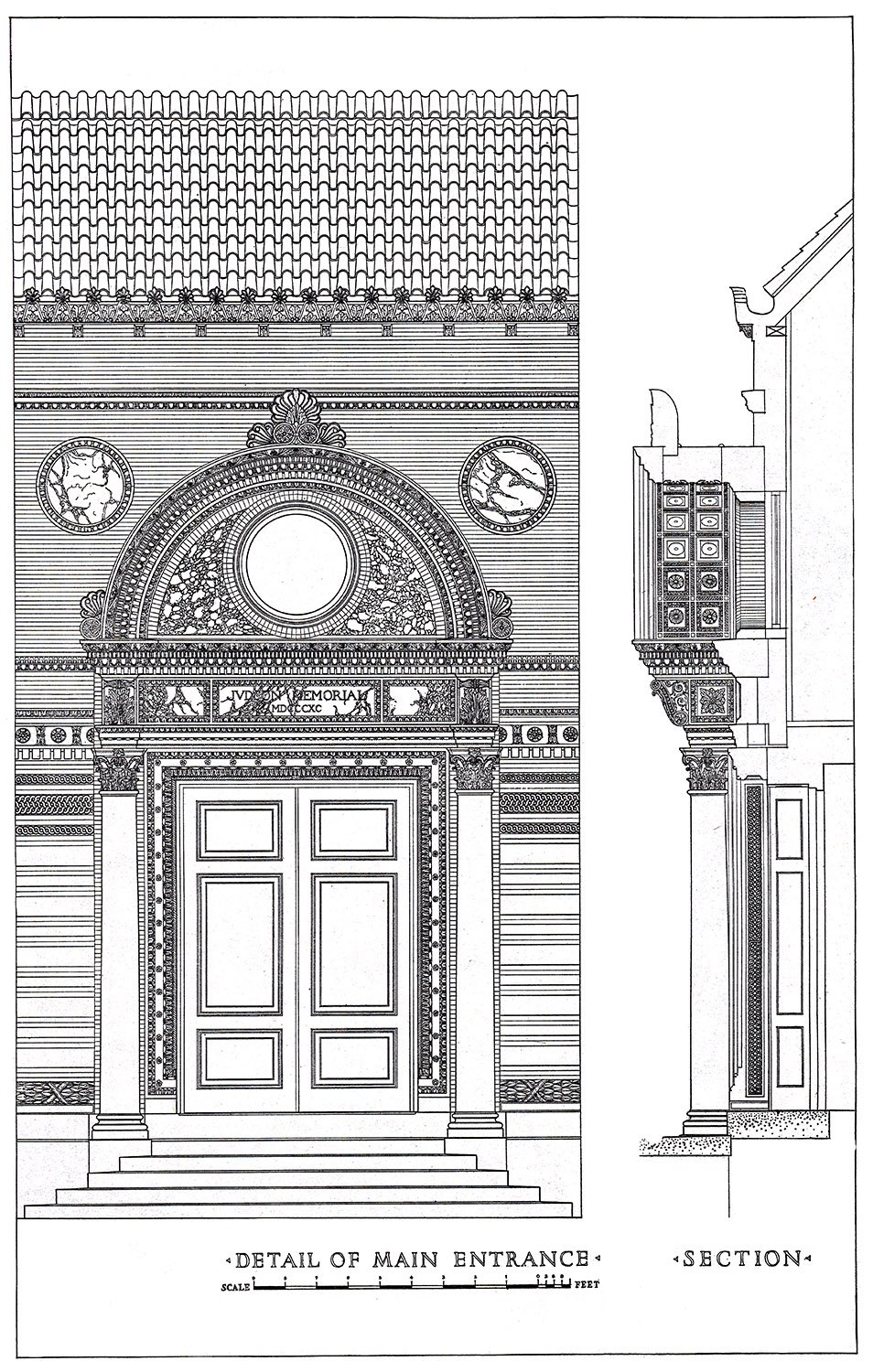
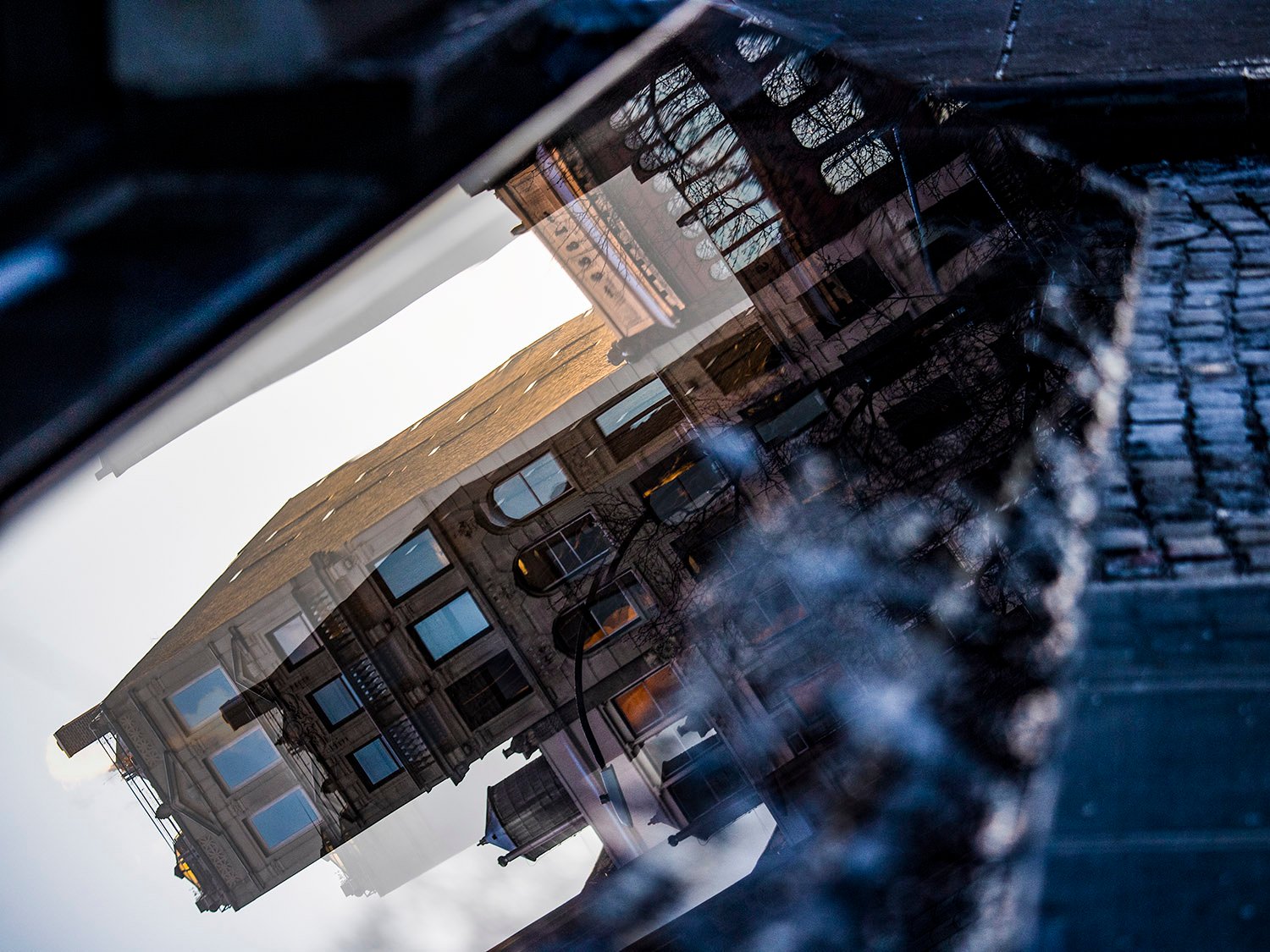
Stanford White of McKim, Mead & White. Judson Memorial Church, Sanctuary and Campanile (1893, 1896). Greenwich Village, New York.12345
Serious photographers (whatever the fuck that’s supposed to mean) despise reflection shots, but I’m kind of a sucker for them.
This puddle in Washington Square provided me with the best image I’ll likely ever get of Judson Memorial Church, built in stages between 1891 and 1896.
Location of the Judson Memorial Church
The church is a quirky, free-wheeling design by Stanford White that combines elements from numerous Renaissance-era Italian cathedrals, all cobbled together with rich textures and finely detailed ornamentation.
White’s eclectic compositions didn’t always work, but this one is exquisite and charming, and the church has become one of New York’s most distinctive landmarks.
Main Entrance of Judson Memorial Church, New York
Gallery
Looking at Judson Memorial Church from the northeastLooking at Judson Memorial Church from the northwestWindows on the north facade of Judson Memorial Church, New YorkMain entrance of Judson Memorial Church, New YorkGable on the north facade of Judson Memorial Church, New YorkWindows on the east facade of Judson Memorial Church, New YorkRound windows on the west elevation of Judson Memorial Church, New YorkLooking up at the campanile of Judson Memorial Church, New YorkWindow on the east facade of Judson Memorial Church, New YorkCross on Judson Memorial Church, New YorkCampanile of Judson Memorial Church, New YorkDormer windows on the north elevation of Judson Memorial Church, New YorkCornice on Judson Memorial Church, New YorkTerracotta string courses on Judson Memorial Church, New YorkBlind arch on Judson Memorial Church, New YorkTerracotta string courses on Judson Memorial Church, New YorkTerracotta pilaster capital on the north facade of Judson Memorial Church, New YorkWindows on the east facade of Judson Memorial Church, New YorkTerracotta ornamentation on the entrance of Judson Memorial Church, New YorkWindow spandrel on Judson Memorial Church, New YorkCorinthian capital on Judson Memorial Church, New YorkGround-floor and basement windows on the north facade of Judson Memorial Church, New YorkDecorated corbel and Corinthian capital at the main entrance of Judson Memorial Church, New YorkLooking at Judson Memorial Church from Washington Square Park, New York
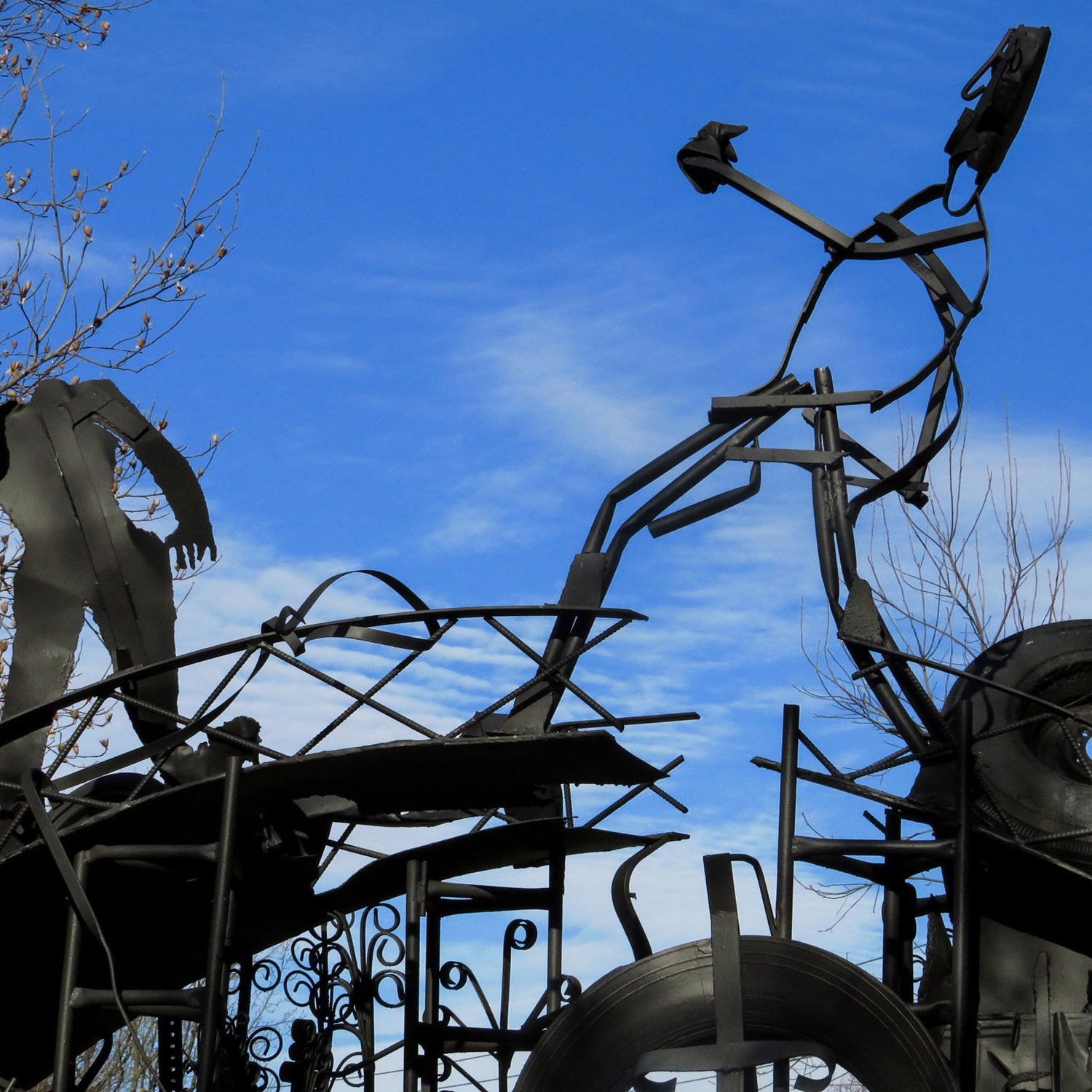
Thornton Dial. The Bridge (1997). Freedom Park, Atlanta.1
The Background
This is the fourteenth in a series of articles written for The Atlanta Journal in 1890 and 1891 by W.W. Goodrich, an architect who practiced in Atlanta between 1889 and 1895.
By now, Goodrich’s approach to writing is fairly predictable: posit yourself as an expert on a specific topic, weave in a few technical terms faintly recalled from some book or article, sprinkle in several imagined anecdotes with a heaping scoop of condescension.
It doesn’t have to make any sense as long as it sounds knowledgeable, right?
And while we’re talking about sounds, here Goodrich pontificates on the limited range of sound detectable to the human ear—after all, he wasn’t just a fraudulent architect, but also an amateur acoustician.
The article references several songs that would be mostly unfamiliar to modern readers—links to explanatory pages are provided.
For some reason, Goodrich includes a fabricated story about encountering desert tarantulas in Arizona that would jump “by actual measurement eleven to fifteen feet to sting us with their deadly poisonous fangs.”
The article also references a minor character from an obscure fairy tale by the Brothers Grimm, and Goodrich theorizes that mules can hear quarter-tones and half-tones, based on a visual assessment of their “auricular appendages,” by which he means ears.
Goodrich concludes with a description of the “multitudinous roar” and “brazen noises” of 1890s Atlanta: “braying mules,” “the negro driver upon his dray,” “steam whistles shrieking,” and so forth.
He opines that the fictional Prince Fine Ear “would go stark staring mad” in the cacophony of a 19th-century city, then concludes discordantly: “The less we cultivate our sense of hearing, the better it will be for the condition of your nerves.” Say what?
Science of Sounds.
The Great Acoustic Possibilities. One of Humanity’s Finer Lenses. Do the Auricular Nerves Convey Sound More Distinctly in the Present Day Than When Pre-historic Man Inhabited Caves and Trees?
Written for the Journal.
Eight musical notes cover the entire range of harmonious sounds which we are physiologically capable of appreciating.
It is true that this statement is to be modified, since music recognizes what are known as half tones, but they are only adjuncts or auxiliaries, and their general proposition is not affected materially by them.
With the eight notes or sounds, sub-divided into half tones, “only by the clearest of voices,” all the music of the world has been sung, from the first gruesome sounds of the Adamite man to the exquisite renditions of “Jesus, Lover of My Soul“, of our superb prima donna and leading sopranos of our many charming choirs. With these few notes, or tones, all the music of the world has been played, from the most stately symphony to the tune of the ragged waif, as his puckered lips whistles the melodies of the minstrel’s lay, which have a certain crisp and charming rendition, at the gatherings of the street urchins. And who has not listened to these urchins’ happy styles of vocalization, as perchance some dozen of them were fishing on a wharf after nightfall, and the calliope of some passing steamer was playing “Coming Through the Rye“, or “My Old Kentucky Home, Good Night“. With these few tones the great masters of harmony and melody brought into existence, enrapturing, grand, noble, soul inspiring melodies that have awakened in the human brain such longing and intensified desires to be like the meek and lowly Savior, as no other agent could possibly produce.
But suppose that by some process of cultivation or evolution, or electrical phenomena, the human ear should or could acquire such a delicacy and refinement of sensibility, as to be able to detect and classify quarter tones or eighth tones or tones beyond and outside of the present range of music. What a vast new field would be opened for the lover of music for music’s sake.
The capacity of the composer would be increased in geometrical ratio, and the permeations and combinations which would be possible would baffle the skill of the most profound mathematician to compute.
And such an idea is not visionary. We have abundant and positive reason to believe that many of the lower orders of animals can hear sounds that are entirely inaudible to us.
There are insectoria that communicate with each other by means of sound, what we can not hear; and even mankind, in occasional instances, have acuteness of hearing which we believe prove that the auditory nerves have never been educated to their ultimate possibilities.
The tarantulas of Arizona in frequent instances which we have seen, before we could possibly see them, would get in right angle positions to which we were coming, even with our moccasins treading on the softest possible places, would present a fighting front and would jump by actual measurement eleven to fifteen feet to sting us with their deadly poisonous fangs. Only raw hide leggings prevented them from killing us and our party. As they would fasten into the soft raw hide we would beat them to death with beaver tails.
The fairy story of Prince Fine Ear, who could hear the grass growing, may be only a survival of an earlier age when the senses of mankind were unblunted by misuse or not dulled by disuse, and when there were myriads of sounds to which we are now wholly deaf.
Surely the variety of sounds one hears in riding in our street cars, as the lazy mule and obnoxious car go jolting along, are not conducive to musical melody, yet quarter and half tones might possibly be distinguishable “to the mules,” judging from the way they lay their auricular appendages backward for sounds.
There is, however, this objection to the acoustic evolution spoken of that in proportion of delicacy of hearing should be gained, the consciousness of discordant sounds would be greatly intensified, and probably the tension on the nerves would be vastly magnified.
Imagine a musician of the future with an ear finely attuned to the sweet concourse of rounds and capable of distinguishing tones which to our ears are soundless and meaningless, compelled to listen to the multitudinous roar of this great city, with all its brazen noises, its braying mules, clashing and clanging of machinery and locomotive engines, the negro driver upon his dray furiously and vociferously caressing his team with a black rawhide whip, steam whistles shrieking, and bells tolling out their early morning harshness to awaken the sick and tired body of the overworked and careworn woman attending her sickly babe, wagons rumbling over our rough belgian blocks, dogs growling and snarling, thomas cats mewing for the zephyrs of symphony of mamma cat on the back yard fences, roosters crowing the rising sun. In such a babble as this, Prince Fine Ear would soon go stark staring mad. And have to be deported for his own safety. As a whole, we are better off as we are. We may miss the music of the unheard, but we would escape the sounds which would be acute agony to the more delicate and sensitive ear. Unless we can bring all varied noises of this city into concord. The less we cultivate our sense of hearing, the better it will be for the condition of your nerves.
Smallwood, Reynolds, Stewart, Stewart & Associates.Hearst Tower (2002). Charlotte, North Carolina.12Looking up at the entrance of Hearst Tower, Charlotte, North CarolinaEntrance of Hearst Tower, Charlotte, North CarolinaWindows and spandrels on Hearst Tower, Charlotte, North CarolinaTop of Hearst Tower, Charlotte, North Carolina
References
Smith, Doug. “Hearst Tower built to charm pedestrians.” The Charlotte Observer (Charlotte, North Carolina), August 25, 2000, p. 1D. ↩︎
Smith, Doug. “Say hello to 2nd-tallest building in town.” The Charlotte Observer (Charlotte, North Carolina), November 14, 2002, p. 1. ↩︎
He always despised the nanny state. What he wanted was a daddy state.
He wanted a big, strong father figure to tell him what to do. And like any good boy, he would dutifully obey.
He wanted Daddy to beat up the people he didn’t like; to mete vengeance on his enemies.
“Don’t you talk bad about my daddy,” he screamed at them. “He’s gonna beat you up.”
Sometimes, late at night, he imagined his daddy punishing him, too.
“Spank me harder, Daddy,” he heard himself sobbing, his bare cheeks quivering in the air. The pain was just part of Daddy’s love for him.
He liked Daddy to control him so he didn’t have to make his own decisions. Life is hard, and he didn’t want to think for himself. He certainly didn’t want to accept responsibility for anything.
Whatever he didn’t like, Daddy would fix for him. And if anything went wrong, he could pitch a fit and blame Daddy for it before running back into his arms in tears.
He despised Mommy and wanted Daddy to beat her down. He knew Daddy hated that bitch as much as he did—Daddy said the only thing vaginas are good for is fucking and birthing.
He wanted to join in while Daddy skullfucked Mommy. In his fantasies, he’d scream, “Shut up and let me cum on your tits,” while Daddy slowly choked her to death. That would show her who’s boss.
Now, Daddy’s fading into oblivion, and the truth of a life spent in darkness is coming to light. Turns out Daddy’s a demon: an empty, narcissistic husk who doesn’t give a single fuck about the boy—and never did.
Baby boy denies it, of course. He’s doubled down on his defense of Daddy because he’s too fragile to accept what everyone else already knows: that Daddy is a monster far worse than any of his childhood nightmares.
If no one else will tell him the truth, then I will—
Daddy isn’t coming back, baby boy. And you were always on your own, anyway.
This is the thirteenth in a series of articles written for The Atlanta Journal in 1890 and 1891 by W.W. Goodrich, an architect who practiced in Atlanta between 1889 and 1895.
Ah, metal—that most riveting of subjects. Here, Goodrich extolls the virtues of aluminum, which began appearing in the manufacture of commercial products in the early 1890s, although it wouldn’t emerge as an architectural material until the mid-20th century.
As Goodrich notes, the 19th century was the age of iron—cast iron, more specifically.
Cast iron was employed extensively in the 1800s as an inexpensive decorative material for the facades of commercial, industrial, and public buildings, especially in Northern cities like New York and Philadelphia.
In Southern cities like New Orleans, Savannah, and Charleston, hideous mass-produced cast-iron railings, posts, and fences became a defining architectural element of the mid-1800s, although the trend mercifully bypassed Atlanta.
Cast iron architecture was already falling out of favor by the 1890s, although another alloy—steel—was becoming an essential element in commercial building construction.
In 1892, the Equitable Building in Atlanta became the first major steel-framed structure in the Southeast,1 followed by buildings like G.L. Norrman‘s Citizens Bank in Savannah in 1896,2 and Atlanta’s English-American Building in 1897,3 designed by Bradford L. Gilbert of New York.
Architecture isn’t mentioned much here, which might have made this article more interesting.
Unsurprisingly, Goodrich’s history and description of aluminum is chock full of errors: it was discovered in 1825, not 1827, for starters. And many of his claims about aluminum’s “most surprising qualities” are incorrect. If you want a more accurate assessment, read the Wikipedia article.
In one curiously prescient remark, Goodrich anticipates the role of aluminum in the development of airplanes, noting its potential importance “if the problem of aerial navigation should ever be seriously discussed”. Even a stopped clock and all that.
The Coming Metal,
Wonderful Possibilities of Aluminum. A Formidable Rival of Gold Itself With the Newly Discovered Cheap Process of Manufacture it will Revolutionize the Use of Metals in the Arts and Industries.
Written for the Journal.
Among the good qualities of Napoleon III, “the man of Sedan,” was a high degree of courage as a scientific pioneer. One of the Napoleonic ideas was the economical production of the metal aluminum. To bring this about the autocrat of the Tuileries, in 1858, expended hundreds of thousands of dollars in subsidizing the labors of Deville, a French chemist of note. Deville succeeded in producing aluminum in masses and ingots never before seen, but as a commercial proposition the thing was seen to be infeasible, and soon the Sadowa and the needle gun drove all the arts and science not directly leagued with the war out of the Napoleonic mind.
It was only natural during the middle and ages for some centuries thereafter, when forests covered the greater part of Europe and nearly all the western continent, that wood should have been in such general use. Stone was naturally employed in the construction of the castles of the nobility, for the walls of cities and for the houses of the wealthy; but its use for fuel for ships, for the houses of the middle and lower classes, was so general that even in the sixteenth century, thoughtful statesmen foresaw the entire disappearance of this material unless measures were taken to preserve the forests.
Colbert, the great minister of Louis XIV is credited with the prophecy, “France will one day perish for want of wood.” The fear that he expressed was later shared by the statesmen of all the continental countries, and resulted in the forestry laws, which, by protecting the remaining forests, planting new ones and limiting the consumption of wood, have postponed for some centuries the threatened evil.
Colbert did not foresee the extent to which iron would take the place of the most perishable material. At that epoch it was chiefly used for the manufacture of engines of war, and for ornamental purposes it was wrought and chiseled into a thousand ornamental objects, some of which still remain to attest the mechanical skill and artistic taste of the golden age of France. Colbert never dreamed that the time would come when ships and buildings of all kinds would be constructed of iron, and when coal and mineral oils and gasses would be used for heating and generating steam – that motive power whose powers were then so imperfectly understood.
The present age has been called the age of iron, and with good reason. Iron is used for everything, enters into everything. But it has its disadvantages, though, for most things that demand strength and durability they are less serious those of wood. Wood is an organic substance, and though it may resist for a long time the action of the atmosphere, eventually perishes by exposure to water or to the attacks of insects. Iron is also perishable. It is easily oxidized, and its elements pass into the earth, air or water. In the course of time, like wood, it returns to dust. It is difficult of extraction, heavy and of long and troublesome manipulation. It exists in deposits that we are wont to think inexhaustible, but are not so.
A man need not be a confirmed pessimist to be convinced that the time will come when iron only be had in insufficient quantities and at a price that will practically exclude its general use. But even if that were not to be the case, a metal that will supply its place is greatly to be desired, and there are scientists that think that it has already been discovered, and that it is aluminum.
Aluminum is found in common clay. It was discovered in 1827, but owing to the difficulties of its extraction, and its high price, it has only been put to comparatively trivial uses, such as the making of tubes for field and opera glasses, and similar objects requiring only a small quantity. Constant efforts have been made by chemists for the last fifty years to find processes that would cheapen its extraction, and alloys that would be of practical use in mechanics. One of these alloys, with bronze, is in use in the United States navy as a substitute for steel in the making of screws, and it is said to be much more durable.
There is a manufacture of aluminum at Frankfort, in Germany, but the processes are kept secret. It was not until twenty-seven years after its discovery that a French chemist succeeded in producing it in a form that gives it its present practical value. Its price in Europe has never been less than $3 a kilogram (two pounds), but if it is true that an American has discovered a method of extraction and working that will enable it to be sold for a few cents a pound, the discovery is destined to work an industrial revolution.
Aluminum is credited with the most surprising qualities. Its weight as related to silver is only 3.56. Its resistant power is said to be equal to that of iron. It is elastic and therefore easily worked. It can be used for soldering with itself or with cast or wrought iron. It does not oxygenize, and it is not affected by water or by sulphuric acid or sulphurated hydrogen. It is only slightly susceptible to the action of azotic and chlorohydric acid, all of which mean that it is practically indestructible. Used in the form of a thin plating it protects other metal from destruction, and it is possible it would protect a ship’s bottom from barnacles, though that point is merely theoretical.
As clay is a substance universally disseminated over the surface of the globe in deposits of indefinite extent and thickness, which are constantly and will forever be in process of formation, the supply of aluminum is absolutely inexhaustible, even if it were used as an ordinary building material and for the construction of ships. In certain ways its lightness would be of the greatest advantage; in others, of doubtful utility. Houses built of it could not easily resist a high wind, unless securely anchored to solid foundations, while a lofty structure like the Eiffel tower would seem to be entirely impracticable.
There are points, however, which only practical experience would determine. If it were once in general use the practical disadvantages offered by its extreme lightness would perhaps all be overcome by scientific means, or even if this were impossible, would be far outbalanced by the infinite number of applications which this very quality would render possible. For the moment, the practical value of aluminum rests within the domain of conjecture, but there is every reason to hope for its final triumph, which will have to be recorded as an additional triumph for modern science, the creation of a new material for the use of modern art, and a new convenience for nineteenth century civilization.
The interesting feature of aluminum is that it combines the unchangeable qualities of gold with all the virtues of malleability, tenacity and ductility that belong to iron. In addition to these good qualities it is surprisingly light. A gun which, if made of iron, would require machinery to hoist it on its carriage and to put the trunions in place, might be carried under the arms of a man of ordinary strength. An iron pot of a capacity to hold three or four gallons, which would take a strong man to carry to and from the water faucet, could, if made from aluminum, be lifted on the forefinger or a child.
At seven cents per pound aluminum would revolutionize the world in the matter of malleable and ductile metals. It would drive tin plate entirely out of the market. It would quickly replace chinaware, because it is practically incorrodible and unbreakable. It would replace glass for everything where transparency is not required. It would be the material of the guns, ships, buoys, etc., of the future. In alloys it would displace nickel and silver from favor. It would be a formidable rival to gold itself.
Lastly, if the problem of aerial navigation should ever be seriously discussed the production of aluminum on a commercial and economical basis, will be the first step toward a solution of the question, for, be it remarked, aluminum is only two and a half times heavier than water. There is not a single metal in commercial use which comes near this standard, and common writing paper is the only practicable weight comparison for a sheet of metallic aluminum of corresponding thickness. The days of coats of mail are past, but it is certain that an overcoat of aluminum, thick enough to stop a bullet, would not oppress the wearer with its weight half so much as an ordinary winter overcoat. A helmet of aluminum would scarcely be felt by a cavalryman or a soldier of the line, certainly not more than a corresponding headgear of cork or pith, while no saber could cleave it.
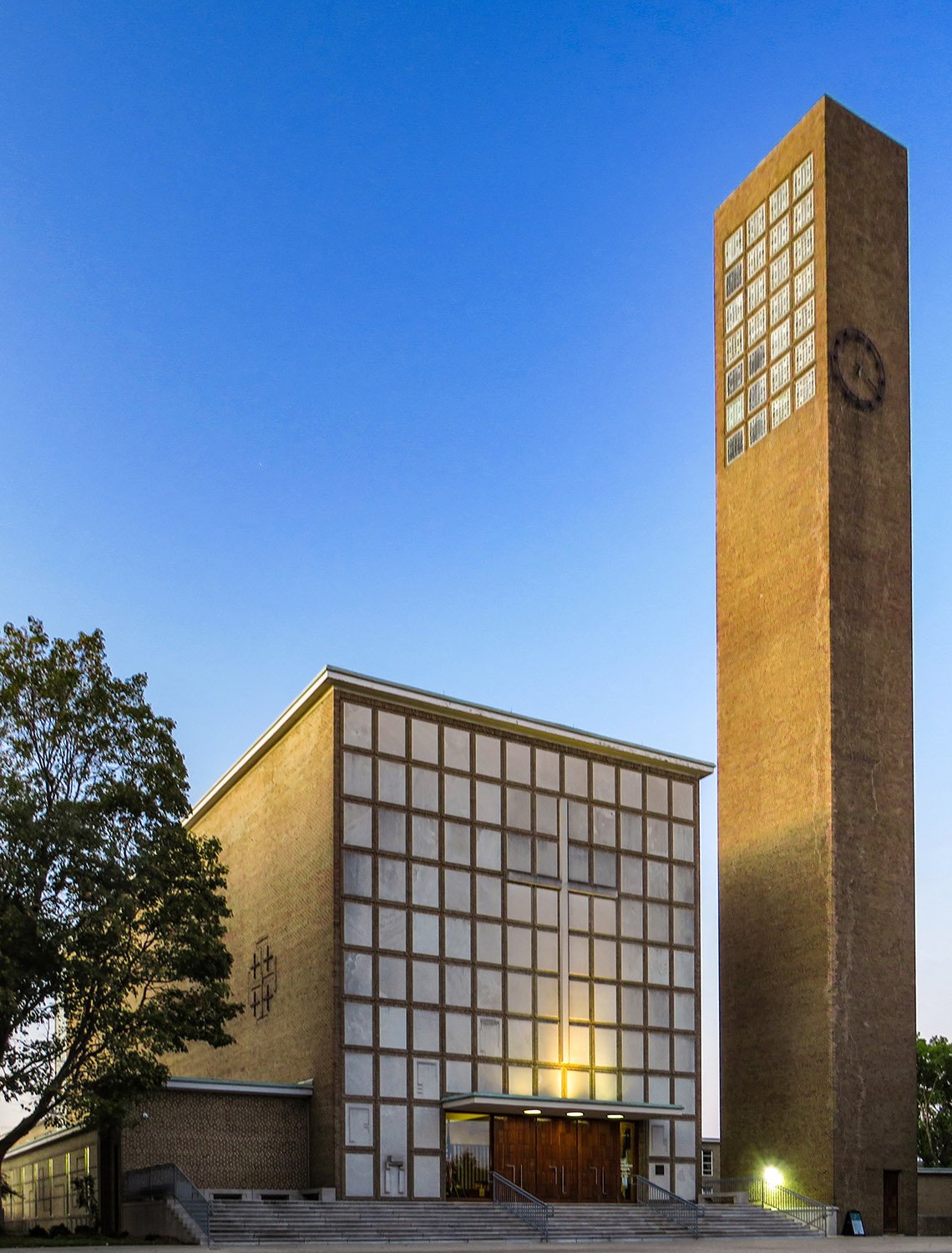
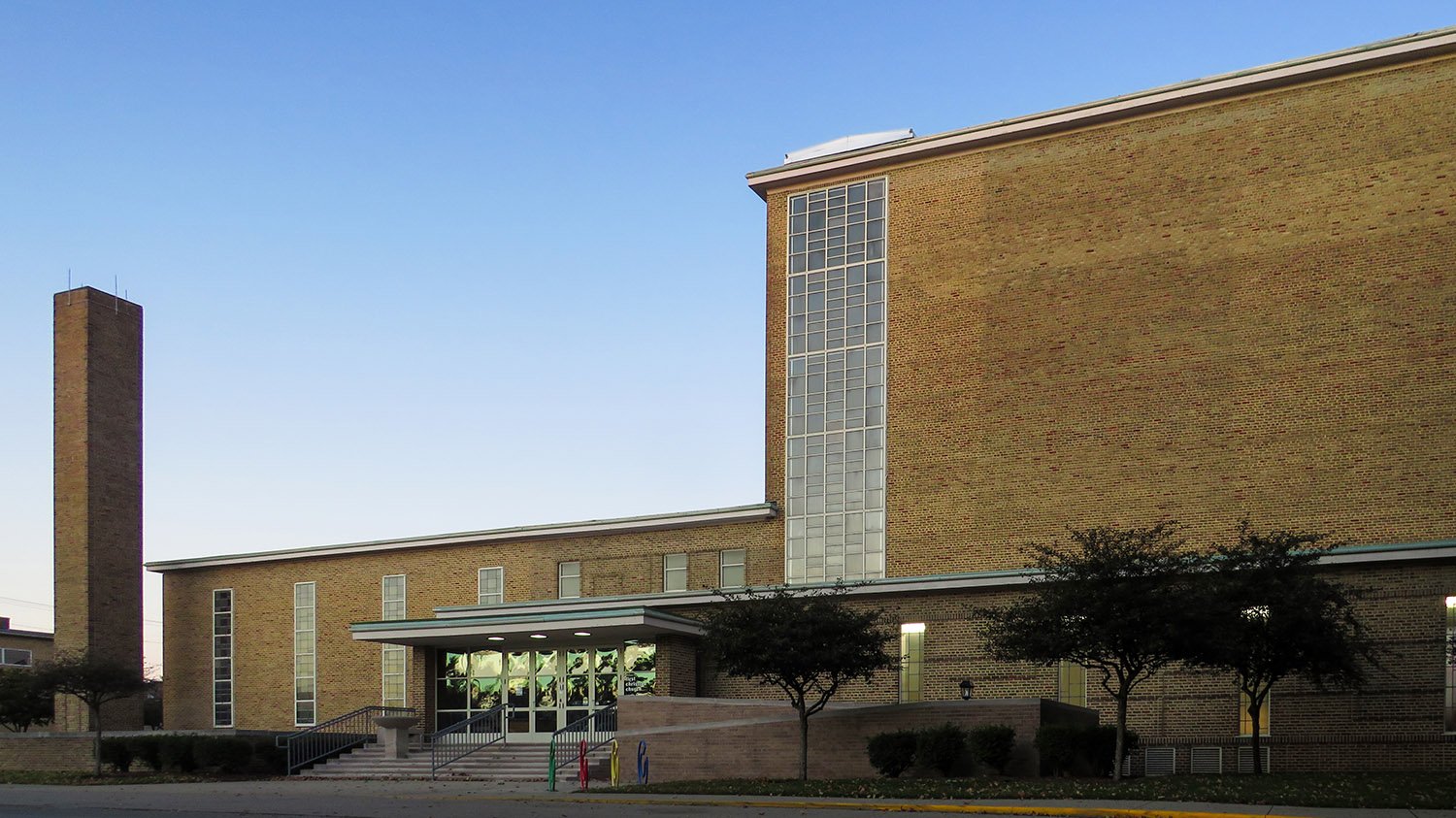
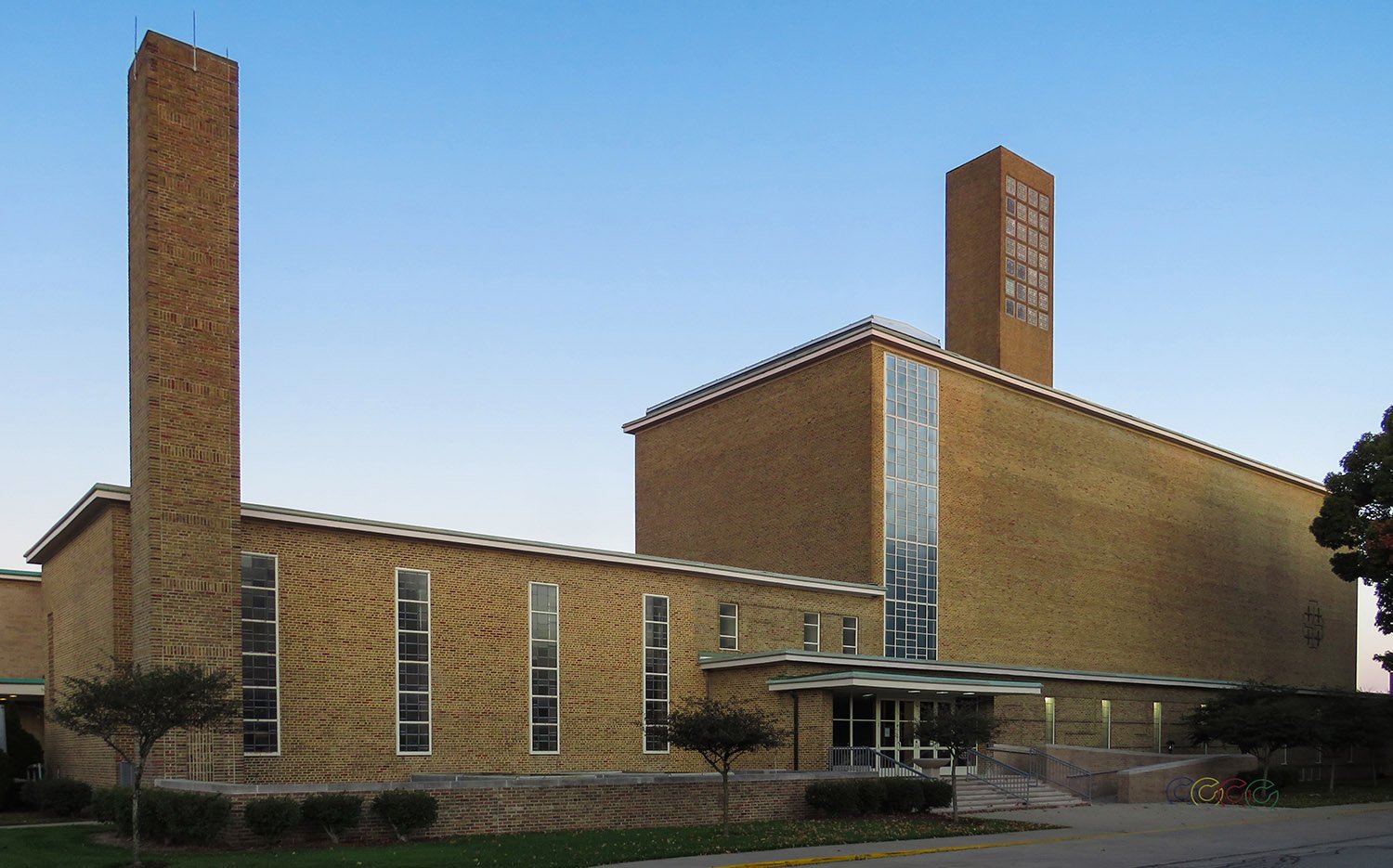
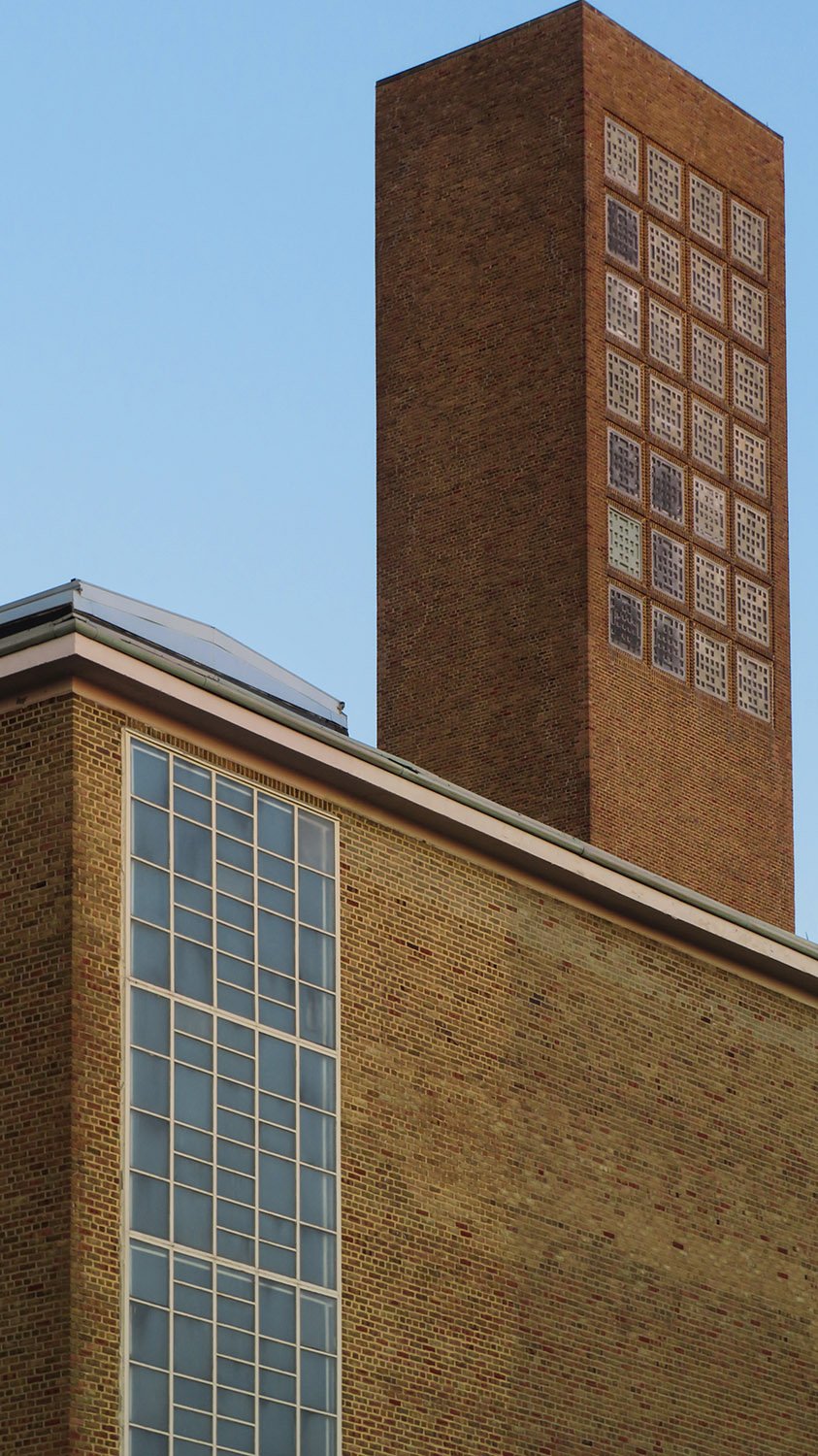
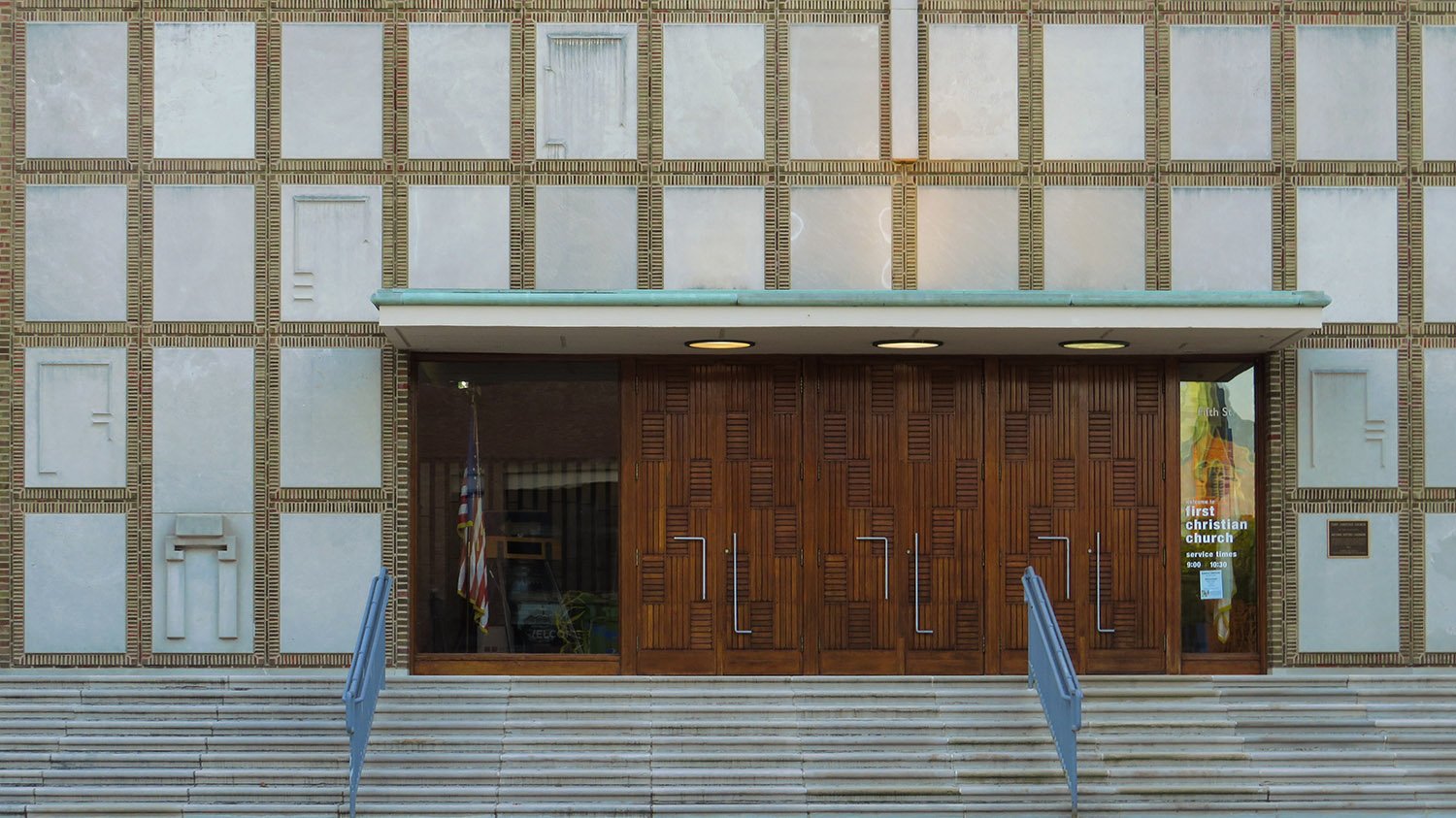
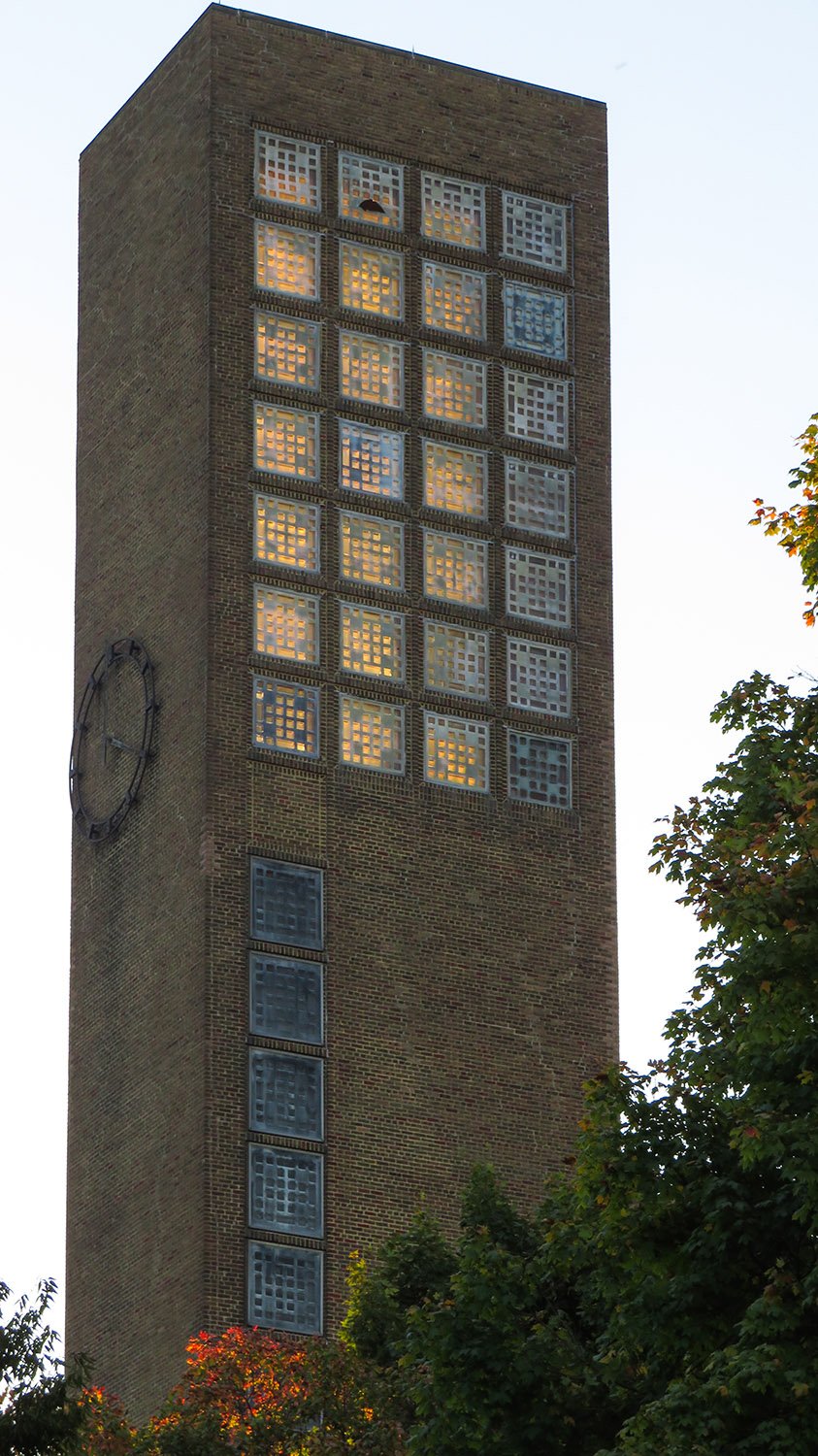
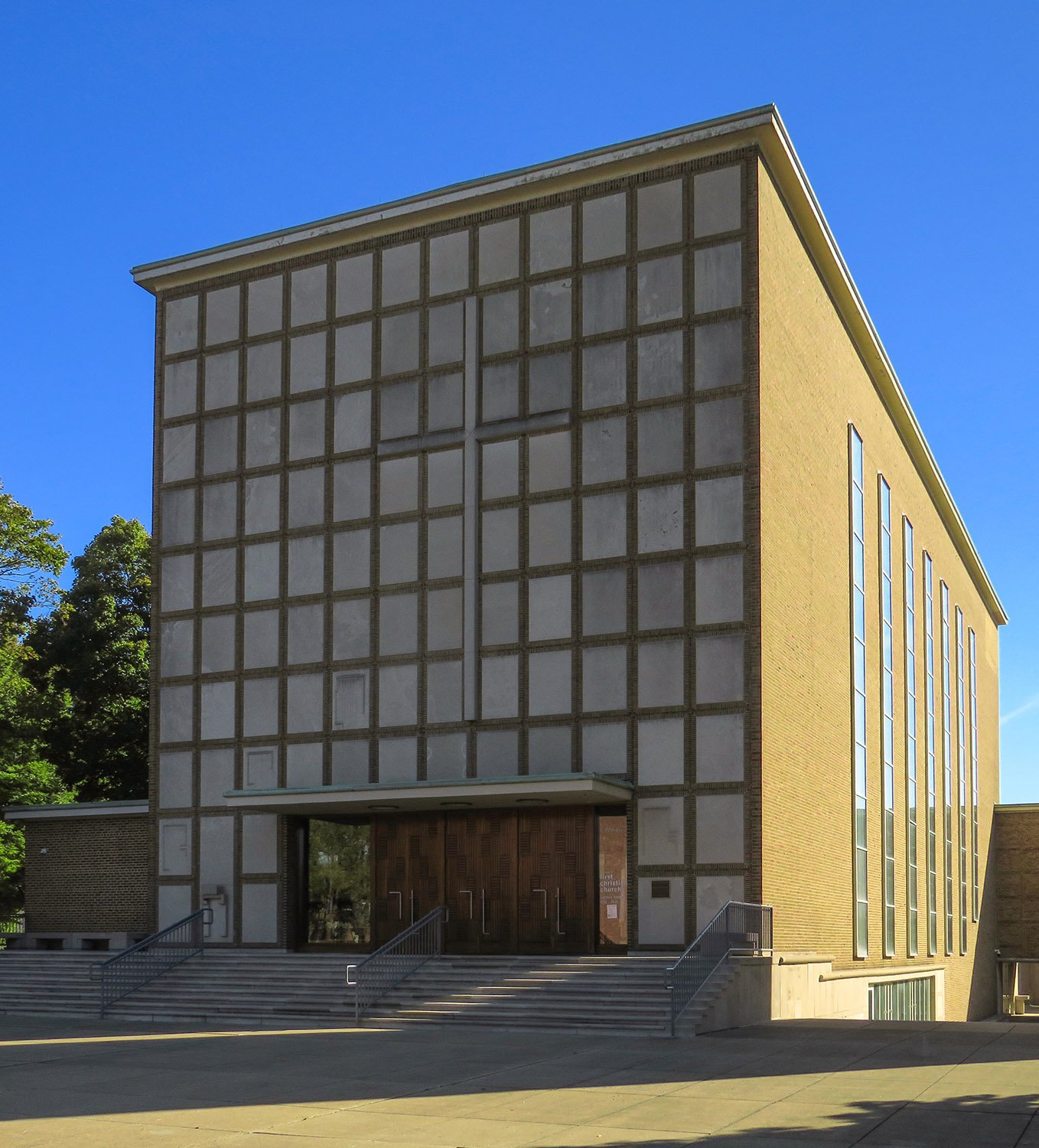
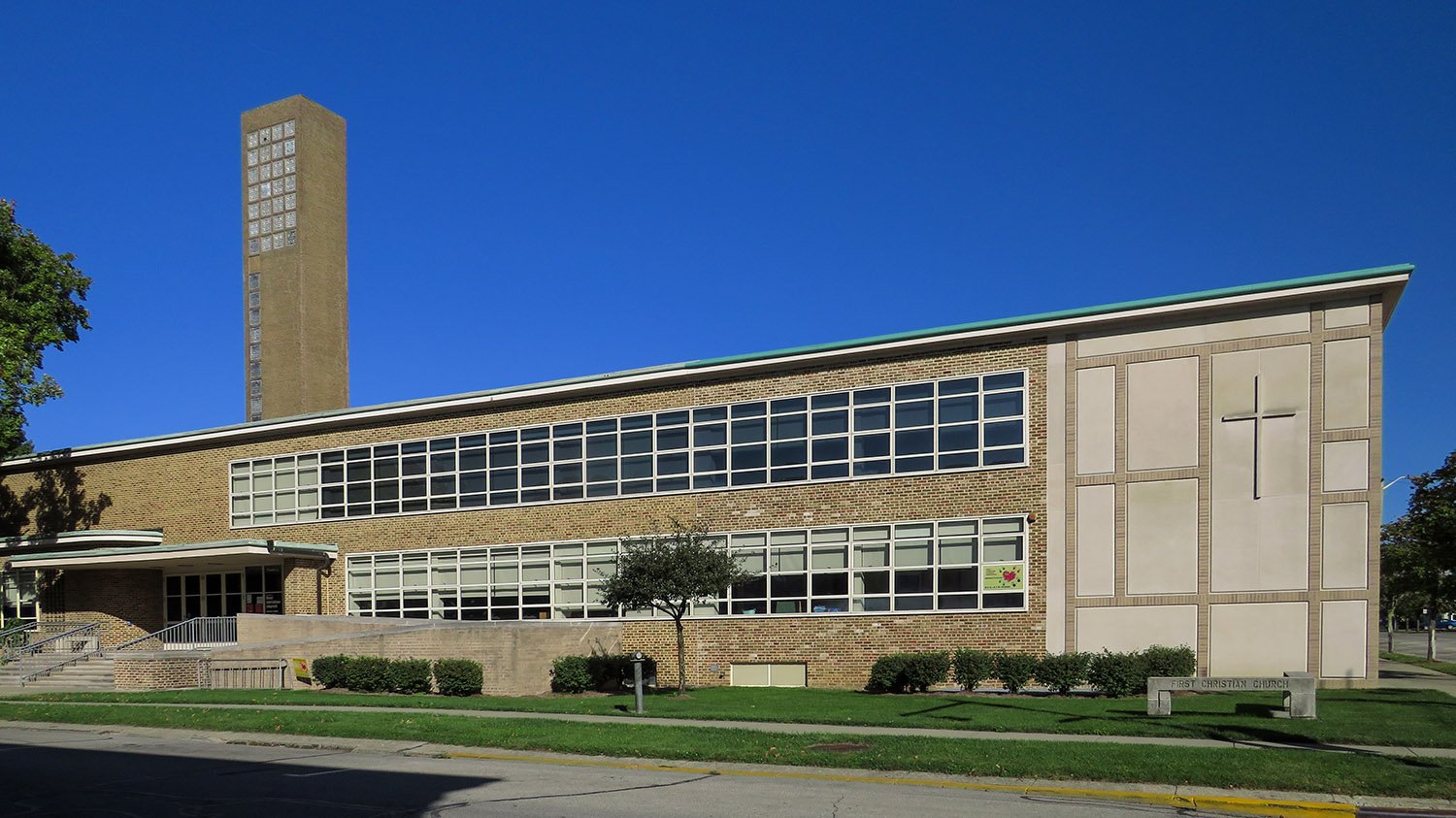
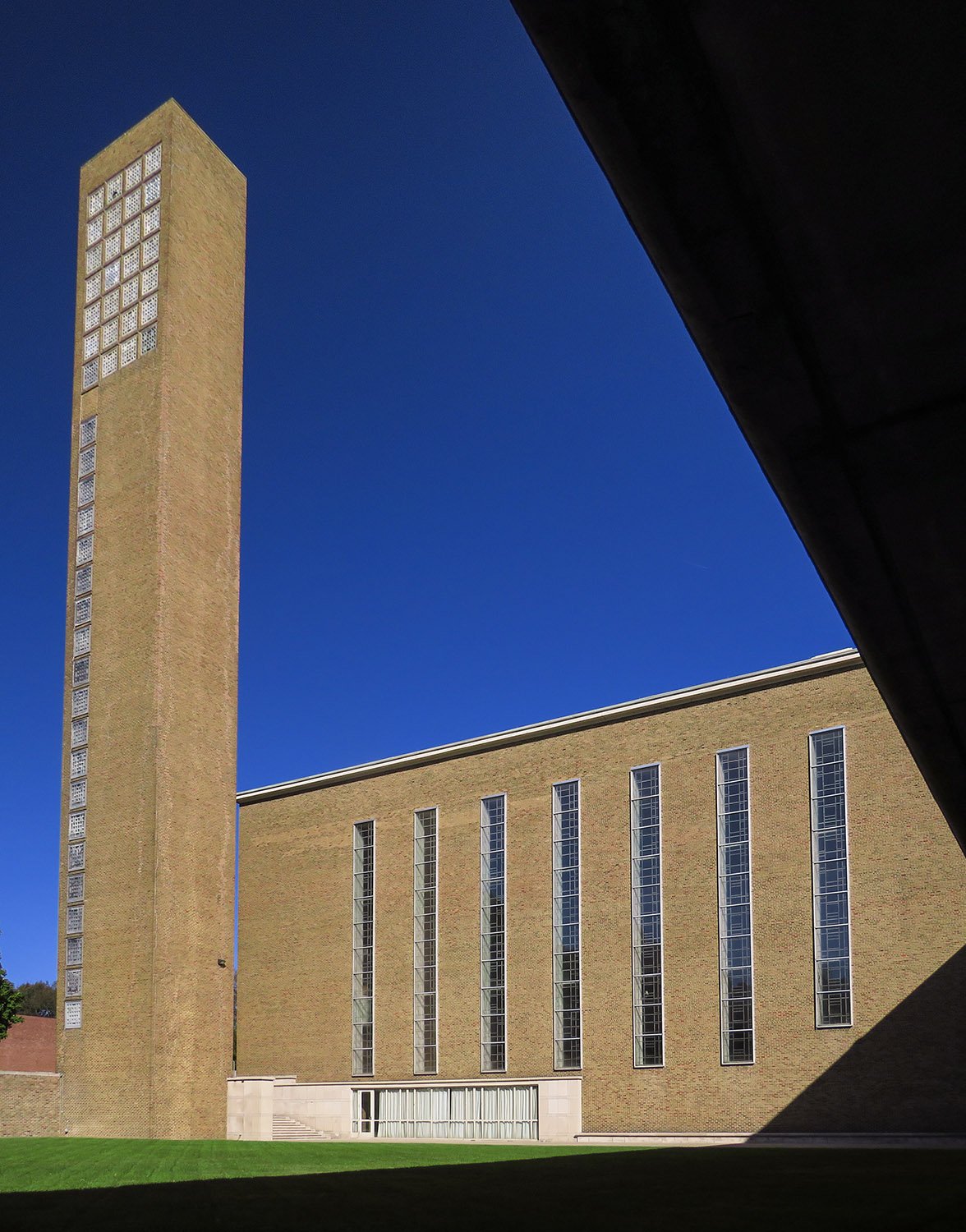
Eliel and Eero Saarinen.First Christian Church (1942). Columbus, Indiana.123East elevation of First Christian Church, Columbus, IndianaEast elevation of First Christian Church, Columbus, IndianaLooking at the east elevation and campanile of First Christian Church, Columbus, IndianaEntrance of First Christian Church, Columbus, IndianaCampanile of First Christian Church, Columbus, IndianaWindows and brickwork on the east elevation of First Christian Church, Columbus, IndianaLooking at the sanctuary of First Christian Church, Columbus, IndianaPanels on the facade of the campanile at First Christian Church, Columbus, IndianaSanctuary windows on the west elevation of First Christian Church, Columbus, IndianaConnecting bridge between the east and west wings of First Christian Church, Columbus, IndianaBeneath the connecting bridge of First Christian Church, looking toward the east wingWest wing of First Christian Church, Columbus, IndianaLooking at the west elevation of First Christian Church, Columbus, Indiana
References
Gordon, Bob. “Columbus Comment”. The Republic (Columbus, Indiana), September 16, 1958, p. 1. ↩︎
Gordon, Bob. “Columbus Comment”. The Republic (Columbus, Indiana), March 20, 1959, p. 1. ↩︎
Wheeler, Nancy. “First Christian celebrates years of baptism, discovery”. The Republic (Columbus, Indiana), May 16, 1992, p. A6. ↩︎
This is the eleventh in a series of articles written for The Atlanta Journal in 1890 and 1891 by W.W. Goodrich, an architect who practiced in Atlanta between 1889 and 1895.
Ever the delusionist, here Goodrich paints a story of himself as a school boy of Dutch descent. The story is set in the town of Kingston, New York, where Goodrich may have been raised, and practiced architecture from 18751 to 1878.2
In this story, Goodrich makes extensive use of place names from that area of Upstate New York. Fox Hall Road, for instance, still exists in Kingston as Foxhall Avenue.
It is incredibly hard to nail down any firm details of Goodrich’s early life, but it appears that his family was from Kingston, while census records show a person of his name and birthdate living in different households in Harmony, New York, near Pennsylvania, in 1850,3 and New York City in 1860.4
Goodrich uses his fictionalized reminiscence as a framing device for another tale—one just as terrible as any of his other stories, although it is notable for its unusually progressive central character: Catherine, a “brave, self-conscious and noble woman” who steers her fiancé’s sloop down the Hudson River on New Year’s Eve, racing past her bitterly jealous ex-suitor.
For reasons unclear, Catherine’s ex-suitor sheds his anger upon being overtaken by her sloop and later asks forgiveness for his surly behavior. Having tasted independence by steering the ship, Catherine promptly goes to church and marries her fiancé at midnight. This was, after all, the 19th century.
Goodrich was no doubt pleased to impress his readers with an arsenal of nautical terms: jib, belay, topsail, mainsail, and the like. The best of the bunch is—inarguably—lee scuppers. Look up the definition yourself.
Goodrich seems to have had an affinity for the name Catherine—it may have been his mother’s name.5
In 1901, he wrote a poem called Cathrine, about a young girl of Scottish—not Dutch—descent. The poem was published in multiple newspapers across the country. A representative passage follows:
“This little Miss, we’ve named her a dear, Old fashioned-name; ‘Tis sweet to call her Cathrine, for with her The fairies came.”6
It isn’t very good.
Catherine Romeyn,
OR
The Bride’s Forgiveness.
A New Year’s Story of the Hudson River.
Written for the Journal.
On Fox Hall road, in Kingston, was a gothic church, whose pointed spire towering to the ethereal blue, that canopied the Katterskills, as well as the noble river of Hendrik Hudson, upon which Rip Van Winkle first looked when he opened his eyes from his long sleep. Upon the apex of the spire was the cross of the infinite Saviour, its golden letters “In Hoc Signo Vinces” assuring the observer that the Saviour was, and always will be, the divine mediator between finite and infinite.
Dominee Fort ascended his pulpit, as the old chapel bell began to toll, its peal of silvery notes rang out upon the evening air, calling the old and young to witness that the scythe of Father time was speedily weakening in its efforts of destruction, and its arduous uses of, and during the first closing year were at the end. At midnight of each closing year, and at the first moments of the new, was always a marriage, most solemnly solemnized by the church and its communicants.
Dominee Fort was a most striking figure, clothed in a long white silk gown, his long white hair and beard of snowy whiteness, falling way down upon his back and chest; with a pair of big, round, gold-rimmed glasses, which he always wore, made him at all times a figure awe-inspiring to the Knickerbocker youngsters. And we were no exception, although we had frequently been to New Amsterdam and did not think we were so green as the boys show had not yet taken the packet for the ocean’s entreport (New York city). The pulpit was perched up to the underside of the lower chords of the roof truss and could only be reached by a winding staircase at its back. As we look back upon those scenes of our youth, and see this good old man in his box looking down upon us, we can but think of how the back of our necks used to ache, after listening to his sermon of an hour or over, as we had to look up at an angle of forty-five degrees to see the dominee. And if we fell asleep by the way of showing our appreciation of the dominee that we were not afraid of his anathemas, we were sure to get the placky’s striking blows when we got home, and then the dominee would not fare so well in our minds, reasoning as we did that he had no right to talk so long or so loud on subjects that did not interest our youthful minds, nor could we understand.
How quaintly we were dressed in those times! Long pants, home-made by mamma and home-spun caps with big ear-laps and sole-leather fronts; coats that would fit older and larger boys; home-made, that had done service to our elders; shoes with wooden soles and leather strings, worn only to church and Sabbath-school; as soon as boys could go alone, put in pants (either side was front), and long ones at that. And back in the Catskills to this day the old Holland people still adhere to the days of 1850.
The business on the Hudson river was done by sailing vessels, mostly by sloops of one hundred tons. With their big jibs, flying jibs, main sail and top sail, they presented a dashing appearances that was exhilarating to the well wishes of each skipper’s admirers.
The Addison had just been launched. As she left the ways, full rigged, for her trial trip, her skipper, Hans Van Schoonovan, with his affianced bride, stood on the knight heads. Catharine Romeyn, a proud Knickerbocker beauty, a stately brunette with true Dutch accent, christened the vessel the Addison by breaking a bottle of old Holland gin over her bow spirit. As she floated upon Esopus creek at Roundout, the ebb-tide just making, the skipper ordered the sailors to raise the jib, while Miss Romeyn took the wheel. “Clear away the mainsail! Hoist away! Belay all!” were the rapid orders of Hans, as the Addison made headway. She rapidly showed her heels. “Shake out the topsail! Run up the flying jib, belay all,” and sailed out Rondout creek. Miss Romeyn as “wheelsman and sailing master”, she kept her in the wind’s eye. As she turned the light house entering the Hudson river the crack sloops were in waiting to give her a brush to test her speed. Now, Hans had an enemy who had been an aspirant for the hand and heart of his affianced, who was the skipper and sailed the Hudson as her sailing master. She had been and was the crack sloop of the river, and her skipper, William Deitrich never forgot Hans for capturing the hand of Catharine Romeyn. As the two vessels came in stays, and Deitrich saw Kate at the wheel, he was furious at her audacity. Shaking out his kites he ordered a chase, the wind sou! sou! east! blowing twenty knots. The barometer was falling, and as the vessel rounded Esopus light, each staggering under full sail, the water rising in the lee scuppers. Hans ordered his hatches battered and his cabin locked. “We’ll see who is fastest;” taking one of his new brooms he ran it to the top mast-head, and closer hauled his sheets. Great white caps came bows on, the Addison rose on the crest of the waves like a duck, the Hudson fast falling behind in the wake of the Addison, buried her nose under each swell, this new greyhound of the Hudson, as she passed Hyde park, was the object of all eyes, as Deitrich had said in his braggadocia that he could not be beaten nor outsailed, and yet, here was a girl not twenty, sailing-master of her future husband’s vessel, she was keel hauling his vessel out of sight. Plucky girl! And there are thousands more like you when danger threatens, who can handle the wheel in all its watches with an expertness and dexterity that becomes a brave, self-conscious and noble woman. Poughkeepsie was soon passed, Newburg bay broadening out towards the highlands was entered. As Kate swept by the deck at Newburg the steamboats of that time rang their bells and whistled the brave girl a ringing salute, the Norwich giving chase under full steam. Sweeping close to Cornwall and tacking ship, she laid her course for New Hamburg. Dietrich, had tacked at Poughkeepsie and was sailing home, sadly and badly disappointed. Kate soon overhauled him a Esopus light bound up, the Addison prancing along like a race horse was a thing of life, and Kate was a sweet bareheaded girl. The thrill of joy could be seen in her eyes, her rosy cheeks kissed by the spray, her long trailing tresses flying in the winds, made her an object that excited the admiration of all the tars, and as she flew by them, her nostrils dilated, her grip on the wheel only intensified, she was the very personification of beauty, health and quiet determination – brave beautiful Kate. Deitrich dropped his colors and hauled down his broom that he had had at his mast head for years and as Kate swept by she waved her apron at him, crossed his bow and smiled. And Deitrich! He cried! Kate’s smile had melted his enmity towards her Hans, thereafter they were warm friends.
Hans and Kate walked up the aisle, Kate between the elder and Hans between the deacons as the bell tolled twelve o’clock midnight. Ring out the old-ring in the new, chanted the old Dutch preacher. The flickerings of the tallow candles and whale oil lamps, making the gold rim of his glasses glint and shine. He said Hans Van Schoonoven, do you take Catherine Romeyn to be your only wife, and to love cherish, protect and support her, for and during your life? I do. Catharine Romeyn, do you take Hans Van Schoonoven to be your husband and he only to love for his natural life? I do. Has any one in this congregation any reason why these two, this man and woman, should not be united in the holy bonds of matrimony? Slowly there came forward a man, whilst all eyes were instantly upon him. He was William Deitrich. Stepping in front of the elders, he said, in a low, clear voice, with much emotion: “I love Catharine Romeyn. She does not love me. I have hated Hans Van Schoonoven. I am sorry I did so. I was wrong. As the New Year is here, I ask forgiveness of Hans and of his future bride. I know they will as fully forgive me as I have been in the wrong, nay more, they will never remember it against me. Dominee Fort at this frank confession asked the couple to signify their wishes. Hans quickly forgave with a firm grasp of the hand, and speechless, the tears coursing down his cheeks, he led Deitrich to Kate. She was too full of joy for utterance, but clasping their hands together, Dietrich blessed them and prayed God Almighty to witness that the future of Hans and Kate should be as the vier’s seins when drawn ashore – full of fish so that the meshes of the net break. Throwing some rice upon the new married couple, Dominee Fort blessed them, telling Kate that, as she was such an expert sailor, she had the ocean of life before her, and by her dexterity and alertness she can sail this life over and enter that future sea of golden beauty with her husband, and whether the barometer was falling or rising hers would be a tranquil life of Christian firmness and lovable charity.
This is the tenth in a series of articles written for The Atlanta Journal in 1890 and 1891 by W.W. Goodrich, an architect who practiced in Atlanta between 1889 and 1895.
Here, Goodrich revisits his bootblack persona introduced in “The President and the Bootblack”, with a Dickensian tale set in New York City in Christmas 1863.
Goodrich’s writing is characteristically atrocious, but he at least draws a colorful cast of supporting characters: the grieving Irish-born mother of a dead Union soldier (Goodrich couldn’t resist a stereotyped accent), a rich old bitch decked in furs (“Get out of the way, you dirty little brat”), and a kindly cop who treats him to a Christmas feast.
Yeah, this story is pure fantasy.
The Civil War backdrop allows Goodrich to throw in a random reference to Ambrose Burnside, and the description of “brave boys in blue, some with arms and legs shot off” is particularly grim.
Goodrich was familiar enough with New York to mention the Bowery and the Cooper Union, but his usual embellishments make the city seem much more bleak than it actually is.
Having slept three nights on the streets of New York in December, I can assure you—it’s not that bad.
A flashback dream in the story mentionsRondout, a village in Upstate New York that became part of nearbyKingston, New York, where Goodrich may have been raised and practiced architecture from 18751 to 1878.2
The dream sequence also reveals that the character’s mother died during his birth—it’s unclear if that particular detail is based on Goodrich’s life, but a traumatic entry into the world and a neglectful childhood could certainly explain his compulsive lying.
A Crockery Crate.
A True Story of Christmas.
Written for the Journal.
The day before Christmas of ’63 was cold, dreary, generally uncomfortable and disagreeable, a drizzling rain, with slight falls of snow, which was rapidly melted, and at times the sharp driving sleet, penetrating to the skin, chilled and benumbed the thinly clad; and many were the cries of the bootblacks, “Shine, sir!” “Shine, sir!” but whose shines were not wanted, and the newsboys, whose papers were not taken and these boys whose stomachs were empty, and who were thinly clad, whose clothes were in rags, let alone the bare feet and almost bare ones, who had no homes to go to, no friendly voice to ask “howdy,” and with the salutation, a request to go to my home and get the comfort of warmth, good food, warm raiment, and a comfortable bed. All of these good things were unknown to the struggling news boy or boot black at that time, and are, to many, now.
Clad in a woolen shirt, twice too large for me, that was given me by an Irish woman, who said with the offering, “Smug, take this; me bonnie av a bye is asleep aff Hatteras, this wan he left at home, ye’es welcum; General Burnside will niver have me bye to carry the ould colors agin. Mike was a brave lad, kind to his mither, and win he left me arms it was with a “May the Holy Mither of God be wid ye’es and bring ye home agin, Mike. Sich a bye was me brave bye, Mike.”
A pair of pants suitable for a person whose avoirdupois [sic] might have been two hundred pounds, a strap for a suspender, in lieu of buttons were nails, an old slouch hat, a boot and a shoe, both of which were out at the toes. Thus equipped, with a twenty-five-cent and a ten-cent shin plaster and nothing to eat the previous night or day, I wandered down Broadway, cold, chilling benumbing cold, hungry, and longing for Kris Kringle to come and find me and take me to his home, which in my youthful imagination I pictured was heaven. Purchasing a broom for thirty cents, I had five cents left for a half loaf of bread which I had partly eaten and divided the balance with a fellow shiner. Sweeping the crossing across Broadway at Spring street in front of the Revere house, brave boys in blue, some with arms and legs shot off, discharged, homeward bound for the Christmas, others on their way to the army, whose term of furlough had expired, still others who had re-enlisted, old veterans, on their way to the front. The stores were gaily decorated and a general air of plenty and contentment possessed the many. No one wanted a shine. Kris Kringle did not come. From down Broadway a portly man and woman richly dressed in furs came to crossing after crossing, but which were not clean enough for them and they south higher up for one; coming to mine, with youthful boyishness I presented arms, as I had seen the soldier boys, as my walk was clean and dry as could be with the storm, when, with this gruff remark from the woman, “Get out of the way, you dirty little brat,” I courtesied [sic] with military salutation their passage over my crossing. A shop girl of a group passing at the time overheard the remark of the rich woman, and, reaching her hand to her pocket, drew out a crumpled five cent shin plaster, said, “Take this, Smug, you look hungry,” but I could not take it. Never a bootblack, nor street sweeper, nor newsboy yet was so ungallant as to take from the tired, careworn and overworked, half starved shop girl or woman, their scanty store. The day had passed, night drew on, the cold, gray clouds became darker and more dismal, the pent up storm, uneasy at being kept in check, suddenly burst, and with snow and rain and chilling sleet drove me off the street and to seek a place of shelter. Hurrying over to the Bowery, up to Fourth Avenue, I found an empty crockery crate on the sidewalk under the shadow of Cooper’s institute. It was but a moment’s exertion, and I was under the straw and had crawled near to the bottom of the crate. Wet, hungry and extremely tired, I was soon asleep.
Eighteen years before the above date, a lady of noble birth, closely related to the Stuarts of Scotland, eloped with a young man from Edinburgh, Scotland. Her noble parents spurned with contempt the adoration of their daughter’s suitor, for no other reasons save and except that the blood of the royal Stuarts did not flow in his veins. The young man was of honorable parentage. His father had been a poet laureate of Great Britain, and he had met this nobleman’s daughter while accompanying his poet father on visits to the gentleman’s castle. The young couple were of age and loved each other as only those can who are lovers for time and eternity, through prosperity and adversity. A quiet wedding in that city. Ostracised [sic] and disowned. Thrust out upon the world. This tender, but lovable woman, true to her husband and facing the future, entered the new world. He quickly obtained work, tending the pitch pot, turning the grindstone, plugging decks, a down pull in the saw pit, wedging treenails, a handy man about the ship yard at Rondout, New York. A daughter and son came to their home. With the advent of the son the mother’s life departed, even before the babe was clothed the noble mother was dead. The savings of the few years embalmed the mother’s body, and provided a burial case. The sorrowing father, with the daughter and his wife’s remains, returned to the mother’s old home in Scotland, where, by request, he was asked to bring the mother and her offspring should death be her fate before a reconciliation. The boy was left in the New World; his was fate. The daughter lies beside the father and mother in the old Kirk yard at Edinburgh. Requiescat in pace.
Kris Kringle is coming. The bells ring aloud the joyful sound. The choir is chanting. A pure voice is singing:
“Jesus, lover of my soul, Let me to thy bosom fly; While the raging billows roll, While the storms of life are nigh. Hide him, oh, my Savior hide, Till the storms of life are past; Sate into this heaven guide, Oh receive his soul, my son’s, My precious boy’s soul at last.”
“Mother! Mother! Mother!”
The struggle woke me up, and as I lay enraptured at the vision it slowly vanished away. I realized that I was a captive, the sleet had frozen over the crate and the snow was several inches deep over which was a crust. I gradually dug a hole in the straw to the side of the crate, and catching the coat of a cop, he saw my hand and dumped the crate over into the street which released me from my snow bound position.
“Come along wid me, Smug,” laying his hand on my shoulder. Thinking I was off for the stationhouse, with a resigned feeling I complied. On Tenth street he suddenly halted, and pushing me into a restaurant he sang out, “I say Jim, whar is yer?” The proprietor coming to the door, the peeler taking from his pocket a shin plaster of unknown denomination said, “Fill Smug up to the muzzle, for he’s a muzzle loader.” Kris Kringle had come. What a feast. Roast turkey and all that went with the bird as an accompaniment. My eyes could hardly believe this good fortune. But it was a reality, and ample justice was done to the repast.
Going up town after this meal, the strains of the music still ringing in my ears. Hark! from far away the same sweet strains were in the air. Entering a church of gothic purity, whose vaulted ceiling and chaste harmony enraptured my gaze. “In the gallery you will find a seat,” said the usher. Below, in the highest priced pew, was the lady and her husband, whose abrupt “Get out of the way, you dirty little brat,” instantly attracted my attention, still more fashionably dressed and richly attired. There was no present for the bootblack or newsboy, no one to wish them a merry Christmas. Wealth maketh many friends, but the poor is despised of his neighbor. And as the chimes of the old Trinity still linger in my ear, “Jesus Lover of My Soul,” methinks I can see that “angel mother,” with arms outstretched, ready to welcome her boy to that heavenly home, where is Kris Kringle always.