If only women knew what their husbands and boyfriends do with each other in public restrooms.
Any man from Atlanta knows the code well: the toilet flushing when you walk in the door, tapping feet, heavy breathing.
One time in the Midtown Publix, I was standing at the urinal while two guys were grunting and moaning in the stall next to me, apparently too distracted to detect my presence — or maybe they knew and liked it.
Another time in the Buckhead Target, I watched two guys stumble out of a stall when I walked in the door — both had embarrassed looks on their faces and were pulling up their pants. You can’t get less subtle than that.
Then there was the time I stopped at a rest area in the suburbs at 5 a.m. — I drank a lot of coffee before I left the city. The first thing I saw when I pushed open the door was a bare ass ducking into a stall. “Nooope”, I said out loud and beelined to the adjacent restroom.
I make no judgment on the acts — only the lies and secrecy. And for the men who hook up with other guys but elect to strip the rights of those who aren’t downlow hypocrites like themselves, I have nothing but disdain.
Suck and fuck all you want, bros, and when you have to deal with the inevitable disease and the fallout of your women discovering your deeds, well, you have my sympathies — but only to a point.
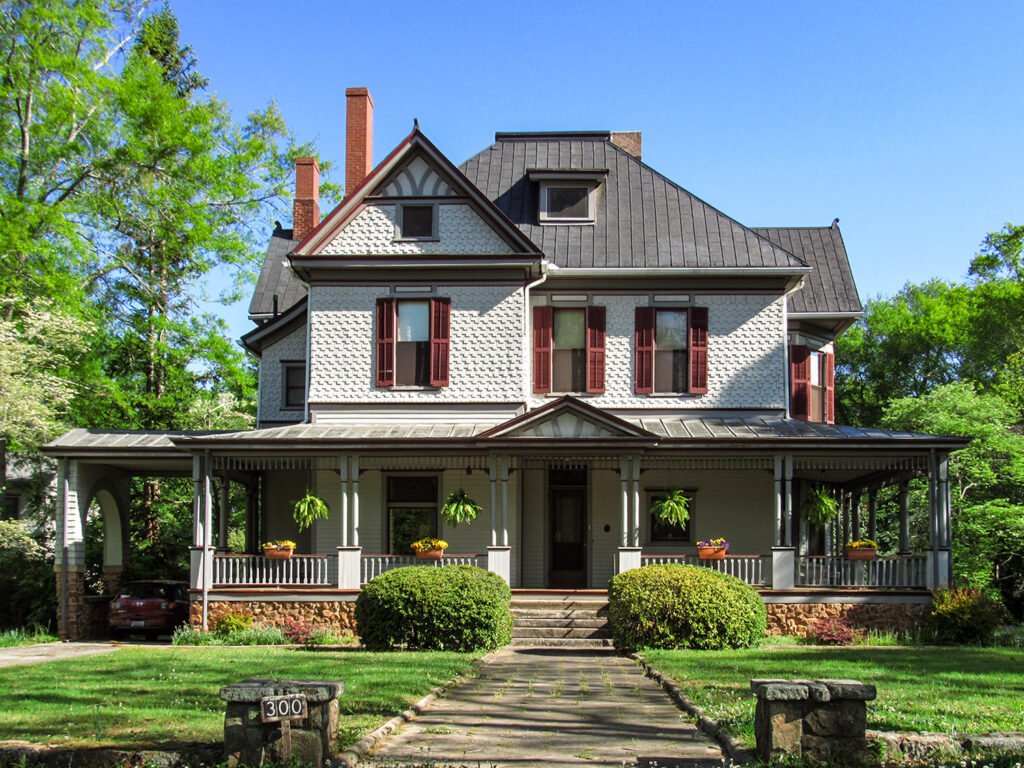
Henrietta C. Dozier (attributed). G.W. Gignilliat Residence. Seneca, South Carolina.1
The Background
Henrietta Cuttino Dozier (1872-1947), professionally known as Henrietta C. Dozier, was the first female architect in the Southeastern United States, practicing in Atlanta from 1901 to 1914, and then in Jacksonville, Florida, for the remainder of her life and career.
The United States had 22 female architects by 1895,2 which increased to over 200 by 1920.3 Beginning in the 1890s, the slow but steady rise of women in male-dominated professions, including architecture, spurred a flurry of press articles, with claims of a “woman invasion” stoking fierce public reaction — keep in mind, women weren’t even allowed to vote until 1920.
Atlantans’ first exposure to a “lady architect” came during the development of the Cotton States and International Exposition in 1894, when plans for the Women’s Building were solicited exclusively from female designers — a radical proposal at the time.
Upon seeing the submitted plans, T. H. Morgan of Bruce & Morgan reportedly remarked: “Why, these buildings are bold enough to have been drawn by men.”4
Elise Mercur of Pittsburgh, Pennsylvania, secured the commission for the women’s building, winning over 12 other submissions, including one by Dozier, who was then studying at the Pratt Institute in New York.56 Dozier entered Pratt as its only female student, ranking second in her class.7
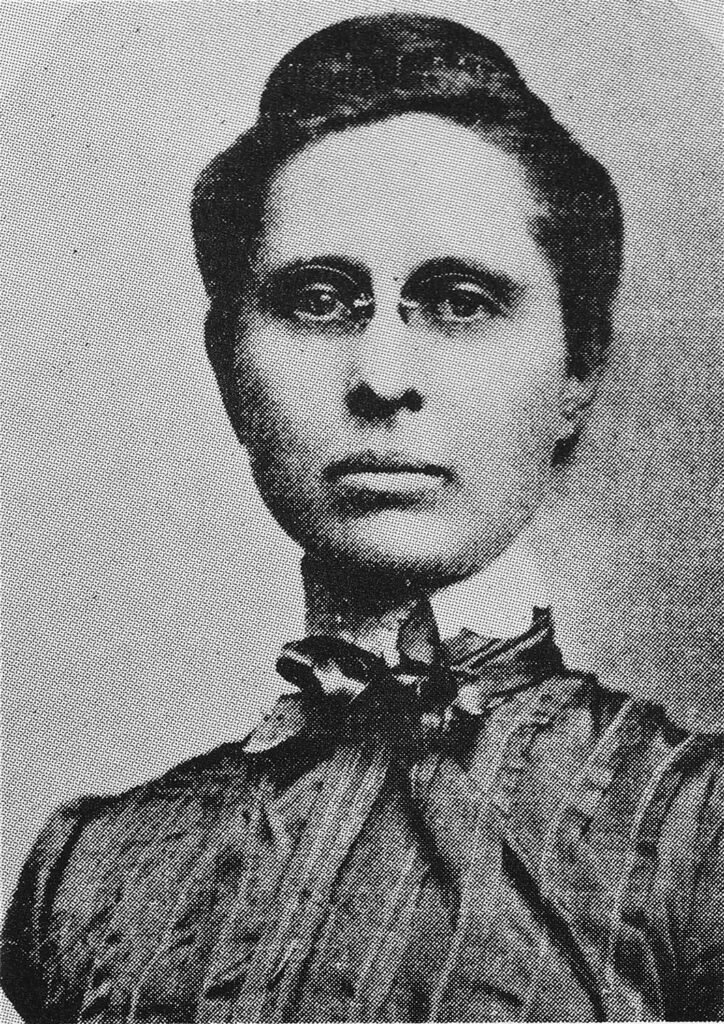
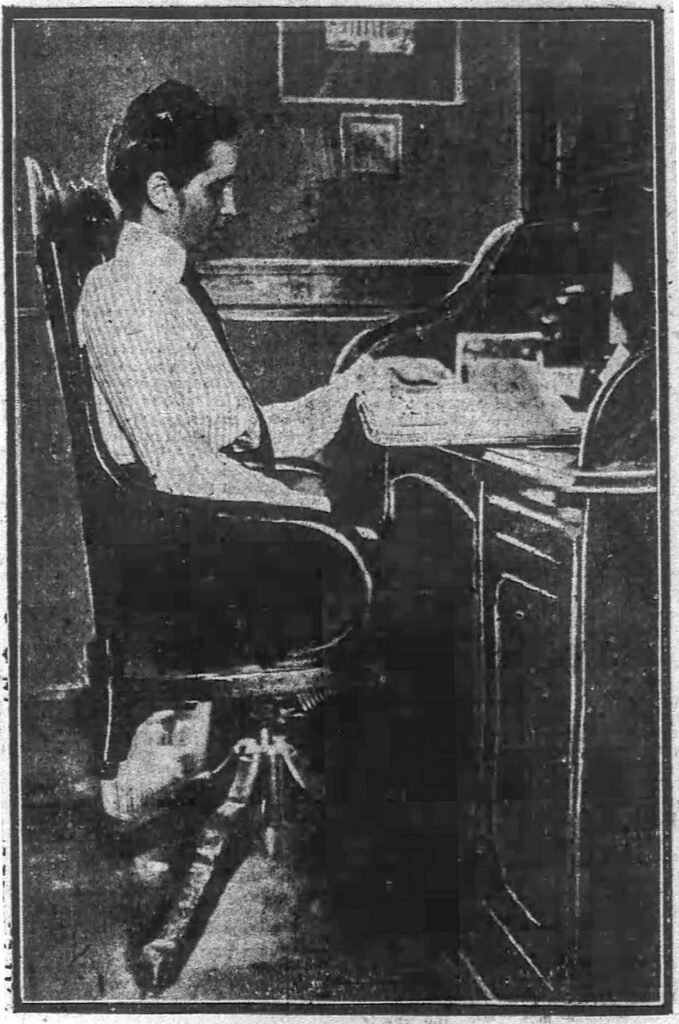
Dozier (pictured here8) was born in Fernandina Beach, Florida, but raised in Atlanta by her single mother — her father died 4 months before she was born.9 She attended the Atlanta public schools before heading north, where she studied at Pratt and later the Massachusetts Institute of Technology (MIT), graduating in 1899 with a B.S. in Architecture10 — one of just three women in a class of 176 students.11
An unconventional woman for her era, Doziernever married, reportedly dressed in men’s clothing, and was known to her friends and family as “Harry” and “Uncle Harry”121314 — draw your own conclusions.
In 1893, The Atlanta Journal described “Harry Dozier” as “a young girl of unusual force and mental determination. She is quite young, and quite handsome…”15
Dozier learned to fly airplanes in her 60s,16 and following her death, her relatives were surprised to discover a manuscript she had written for an unpublished romance novella. Sample text:
“Men do not get what they deserve in life, they get what they go after,” said Elizabeth. “So? My dear, I think women do a lot of going after what they want also … At least, you know how to get what you want.”17
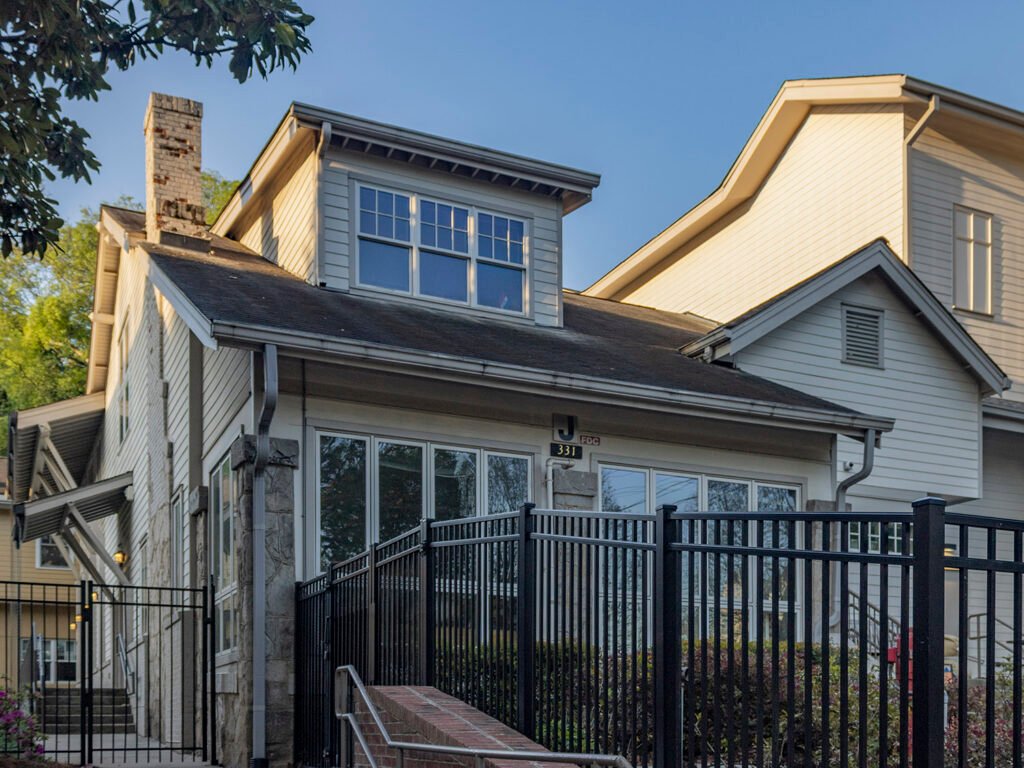
Only one of Dozier’s known works survives in Atlanta: a residence she designed for Mrs. O.K. Slifer on 10th Avenue overlooking Piedmont Park. The structure now serves as a school building and has been altered.
Henrietta C. Dozier. O.K. Slifer Residence (1912, altered). Atlanta.1819
Although Dozier often downplayed her professional difficulties in interviews, there is ample evidence that she faced severe discrimination in a field that largely remains an old boys’ club. As one article noted in 1903: “It is only recently that the men in the profession began to regard women architects as other than a huge joke.”20
Dozier wasn’t a spectacular designer by any means, but she also wasn’t given nearly as many opportunities to refine her skills as her male counterparts, securing few large-scale commissions throughout her career. In a 1939 interview, she noted: “…in the last few years, I have done nothing but small residential homes.”
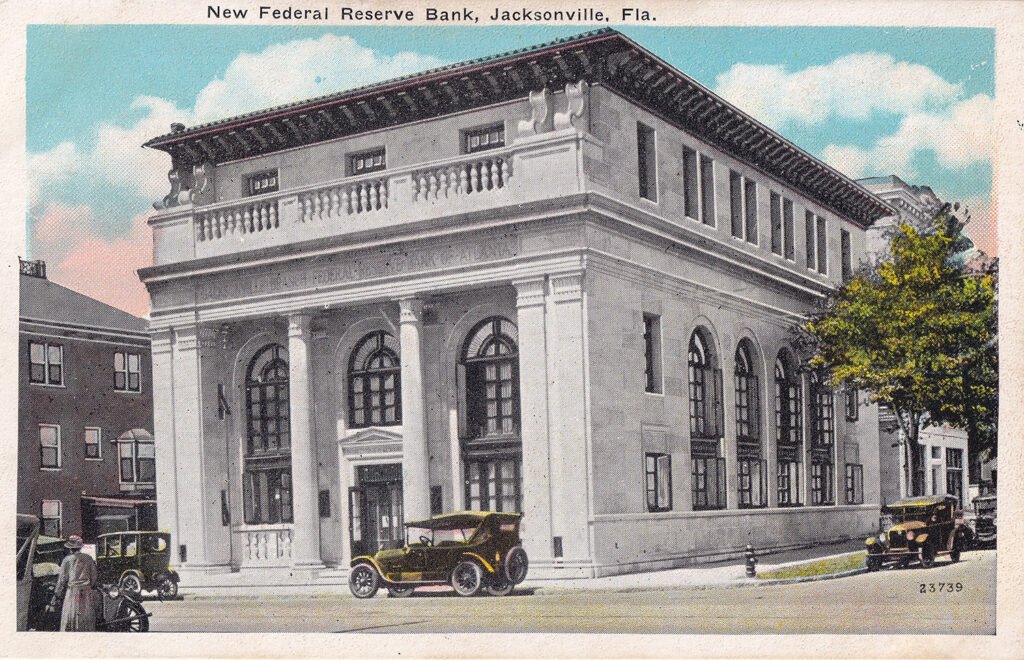
Dozier said she was “always very proud” of her work on the Jacksonville branch of the Federal Reserve Bank of Atlanta,21 which can easily be considered her finest effort. She was officially credited as supervising architect for the project, working under A. Ten Eyck Brown of Atlanta. However, Brown often claimed credit for projects he had little to no hand in designing, and it appears Dozier did most of the work.
A. Ten Eyck Brown with Henrietta C. Dozier. Federal Reserve Bank of Atlanta, Jacksonville Branch (1924), Jacksonville, Florida.22 Photograph from an undated postcard.
In 1905, Dozier was elected an Associate of the American Institute of Architects (AIA), only the third woman to be accepted into the organization.23 Dozier’s election directly led to the establishment of the Atlanta chapter of the AIA,24 which later became AIA Georgia.
As T.H. Morgan recounted, a minimum of five AIA associates were required to form an AIA chapter, and Dozier, along with Harry Leslie Walker, became the fifth and sixth architects in the city elected as associates, prompting the chapter’s organization.25
During her life, Dozier’s work was barely acknowledged by the press — in either Atlanta or Jacksonville. The handful of news stories written about her often conveyed a tone of curious skepticism, if not outright ridicule.
The following article, published in The Atlanta Constitution in 1902, is the first of just a few that were written about Dozier during her time in Atlanta, and it’s as sexist and condescending as it gets.
Dozier had been in practice less than 2 years, and the reporter (obviously male) depicted her interest in architecture as some girlish lark before settling into marriage, claiming that she “makes plans for a future fair with promise, where she may realize a woman’s dreams of ease and mental and domestic pleasure, surrounded by the friends she loves—nature and children and dumb things.”
Maybe that’s what Dozier told the reporter to keep him happy, but she clearly had other ideas for herself.
This Georgia Woman Stands High in Profession of Architecture
“Of all the branches of work into which women are entering there is none which shows so small a percentage of the really successful as that of architecture, and this is particularly true in the south. Two reasons deter the young woman casting about for something upon which to settle. In the first place, it is hard work; in the second, there is the probability of marriage—the state few on the sunny side of twenty-five or thirty could be brought to regard as anything but the ultima thule to which woman existence tends. And when one there is who from choice enters seriously upon a real profession the world might as well see at once, what sooner or later it will have to see, that she will succeed.
When Miss Henrietta C. Dozier entered as apprentice in an architect’s office she set herself to work as a man does—not simply to bridge over a year or two until the time when she would marry—she began at the beginning and held on to the finish. A year of apprenticeship was followed by two at Pratt Institute; then after some months in New York she went to the Massachusetts Institute of Technology, remaining four years. Coming south, she opened an office in Jacksonville, Fla., where she was in business six months, but in compliance with solicitations from friends in Atlanta decided to remove to this place, where she is permanently located and established, doing business with a man’s understanding and knowledge and a woman’s thoroughness and regard for detail.
Architecture is peculiarly suited to woman from the fact that her ideas on the requirements of a house are more practical than those of a man. Too, if she has first an all-round knowledge of mechanics her artistic instinct will serve her well. Miss Dozier, realizing what a woman wants and knowing how to go about having it, has built her own house—a unique and picturesque cottage, modern and complete, and meeting her needs as nobody else could have planned for her.
Here, in her hours of recreation, she enjoys with her mother and sister the sweetness of home, and makes plans for a future fair with promise, where she may realize a woman’s dreams of ease and mental and domestic pleasure, surrounded by the friends she loves—nature and children and dumb things.
Miss Dozier, like Dorothy Manners, has “the generations” back of her. Her forbear, Thomas Smith, of South Carolina, was landgrave in 1663, or there abouts, and a long line of ancestors have bequeathed to this young woman the intrepid spirit which no mere circumstance can daunt, and placed in her slender hand the key which unlocks every door—a will that brooks no thwarting.
As an architect she is a success; she has mastered her profession and she makes it pay.26
References
Wells, John E. and Dalton, Robert E.The South Carolina Architects, 1885-1935: A Biographical Dictionary. Richmond, Virginia: New South Architectural Press (1992), p. 42. ↩︎
“Uncle Sam And The New Woman.” St. Louis Post-Dispatch, June 30, 1895, p. 32. ↩︎
“Current Events From A Woman’s Point Of View.” The Atlanta Constitution, December 2, 1894, p. 6. ↩︎
“Plans By Fair Hands”. The Atlanta Constitution, November 28, 1894, p. 5. ↩︎
“Tiffany Will Be Here.” The Atlanta Journal, November 28, 1894, p. 6. ↩︎
“Society”. The Atlanta Journal, March 18, 1893, p. 2. ↩︎
Photo credit: Wood, Wayne W.Jacksonville’s Architectural Heritage: Landmarks for the Future. Jacksonville, Florida: University of North Florida Press (1989), p. 9. ↩︎
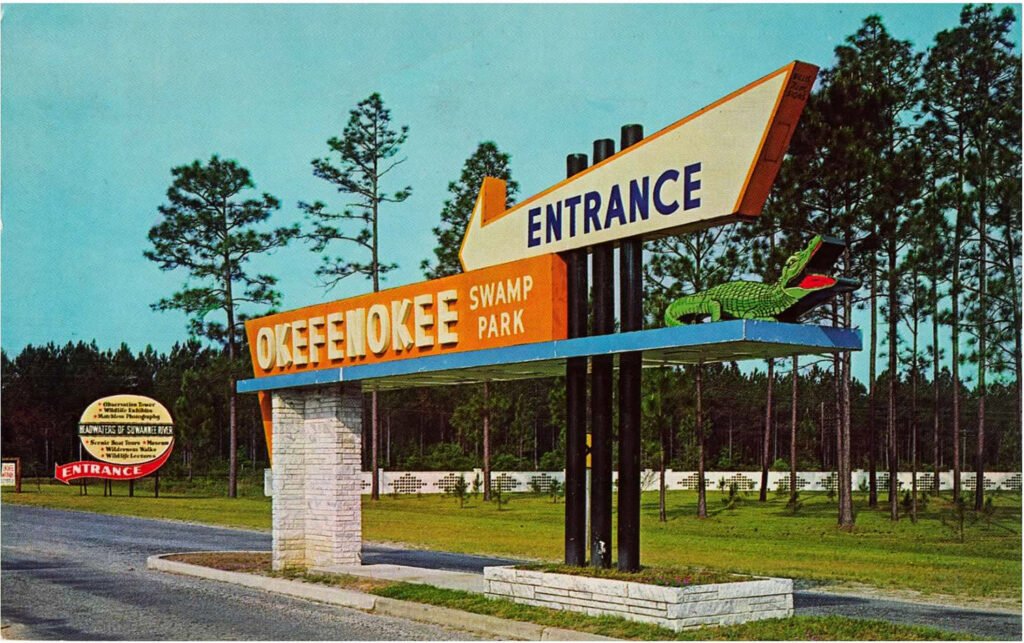
Okefenokee Swamp Park entrance sign. Photograph by Gene Aiken from an undated postcard.
Year by year, more disappear: the quirky and colorful business signs of the 20th century that once littered the United States with their kitschy and eye-catching designs luring visitors to stores, restaurants, lounges, theaters, shopping centers, tourist attractions, and, of course, motels.
The synthesis of folk art tradition and cold-hard commercialism, these signs followed the growth of the American highway system, and were perhaps the most prominent symbols of the cynical and disposable culture of convenience and impulse that wholly consumed the United States in the 20th century.
The signs functioned as both advertisements and wayfinding tools, and could never be classified as high art: even in their prime, they were widely criticized as crass and unsightly markers to rampant consumerism and unfettered sprawl. Yet one era’s trash becomes another era’s treasure, and these signs attracted wider appreciation as their numbers began to dwindle.
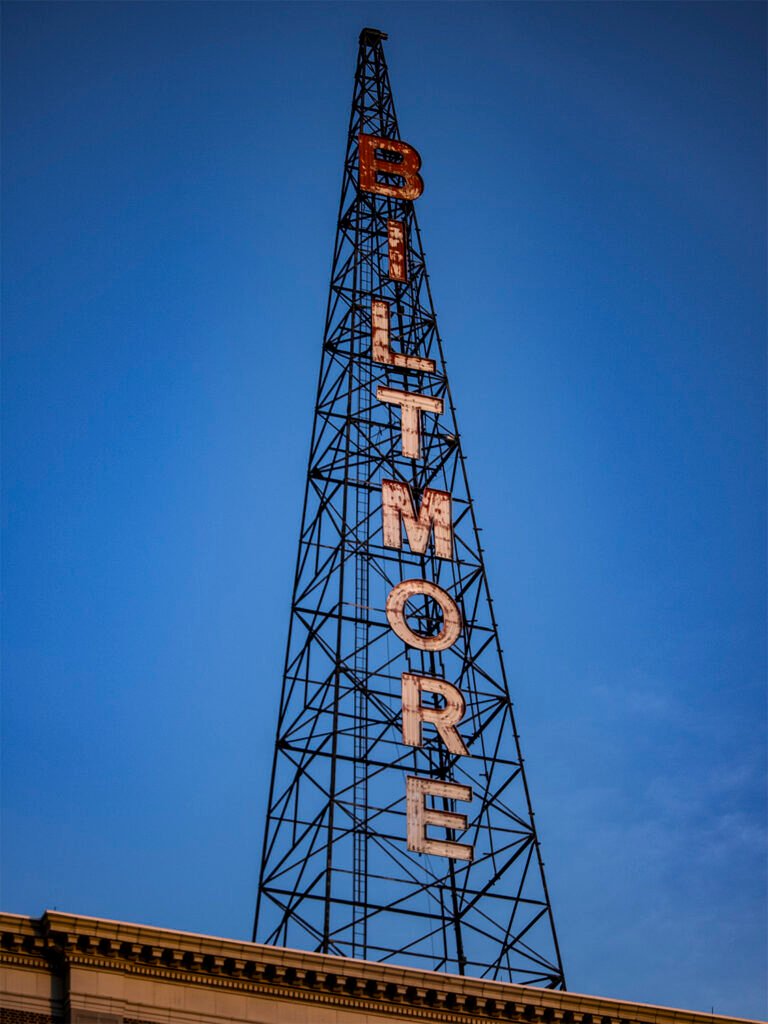
Hand-painted, two-dimensional signs on the outer walls of buildings were a ubiquitous feature of the American landscape starting in the late 19th century, but by the 1920s, sign-making reached new heights and three-dimensional form with “sky signs”, now known as scaffold signs.
Sky sign on Biltmore Hotel (1924). Atlanta.
Often perched atop towering hotels or other tall buildings in city centers, these machine-produced signs were attached to steel scaffolding and lit by electricity, still a novelty in many places.
As Americans began driving the first automobiles across a patchwork network of highways, sky signs served as bright, beckoning beacons that could be easily spotted from miles around.
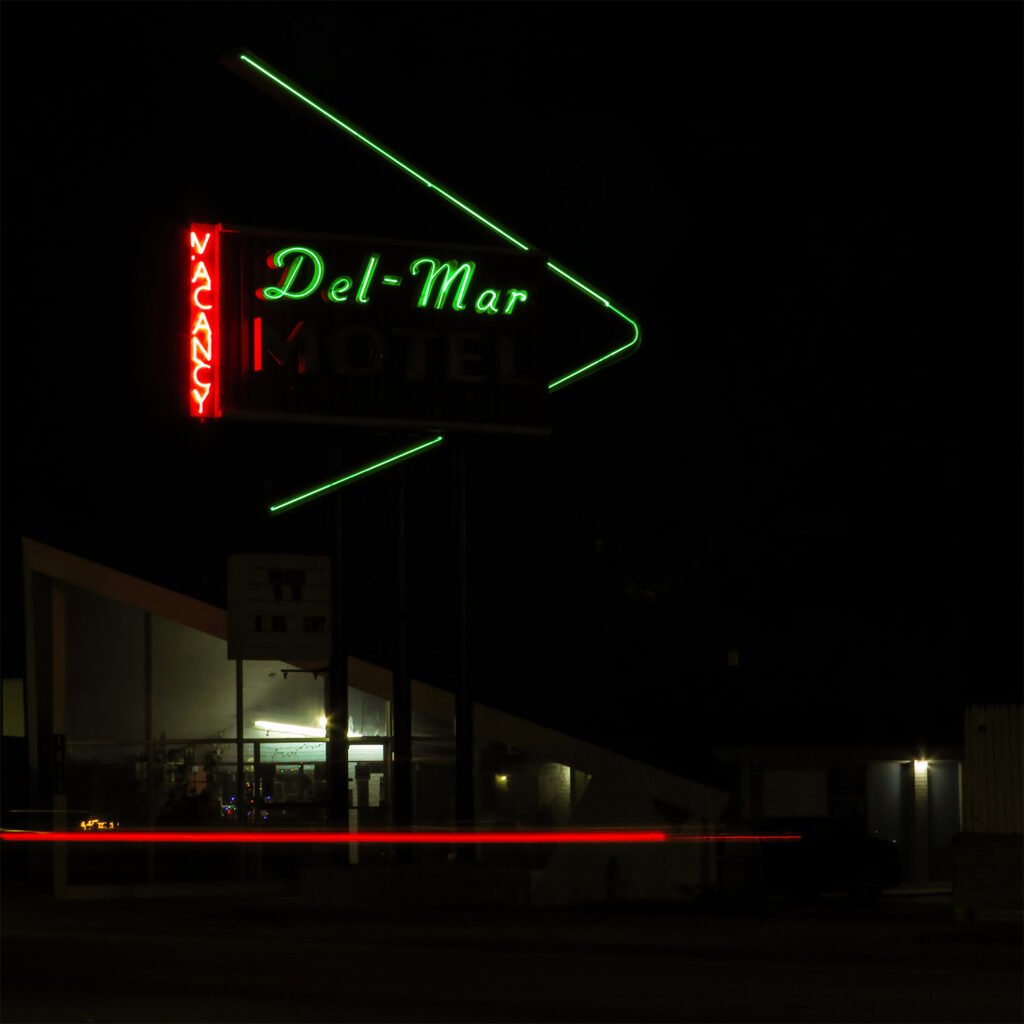
Neon lights also debuted in the 1920s, and their distinctive glowing colors quickly became a standard feature of commercial signage, seemingly overnight.
Used by everyone from mom-and-pop shops to department stores, by the 1940s, neon signs were synonymous with nightlife entertainment and what is now referred to as Streamline Moderne architecture.
Clubs, diners, and movie theaters of the era often prominently incorporated neon elements into their sleek, curvaceous designs inspired by an increasingly mobile world of planes, trains, and automobiles.
Del-Mar Motel (1955). Valdosta, Georgia. Designed by Joe Bright.
The creative zenith of signmaking emerged with the advent of the Interstate Highway System in the mid-20th century.
Far-out, futuristic signs inspired by the Space Age and the Atomic Era dominated in the 1950s and 60s, today closely associated with Googie architecture, which originated in southern California and spread unevenly throughout the country.
Popular elements of Googie-derived signs included:
starbursts
shooting stars
exploding atoms
orbiting satellites
giant boomerangs
oversized arrows
Many signs of the era were more down-to-earth in their inspiration: roadside business signs often incorporated symbols that were evocative of their specific locale or region — a chomping alligator on the entrance sign for Okefenokee Swamp Park in Georgia, for instance (pictured above).
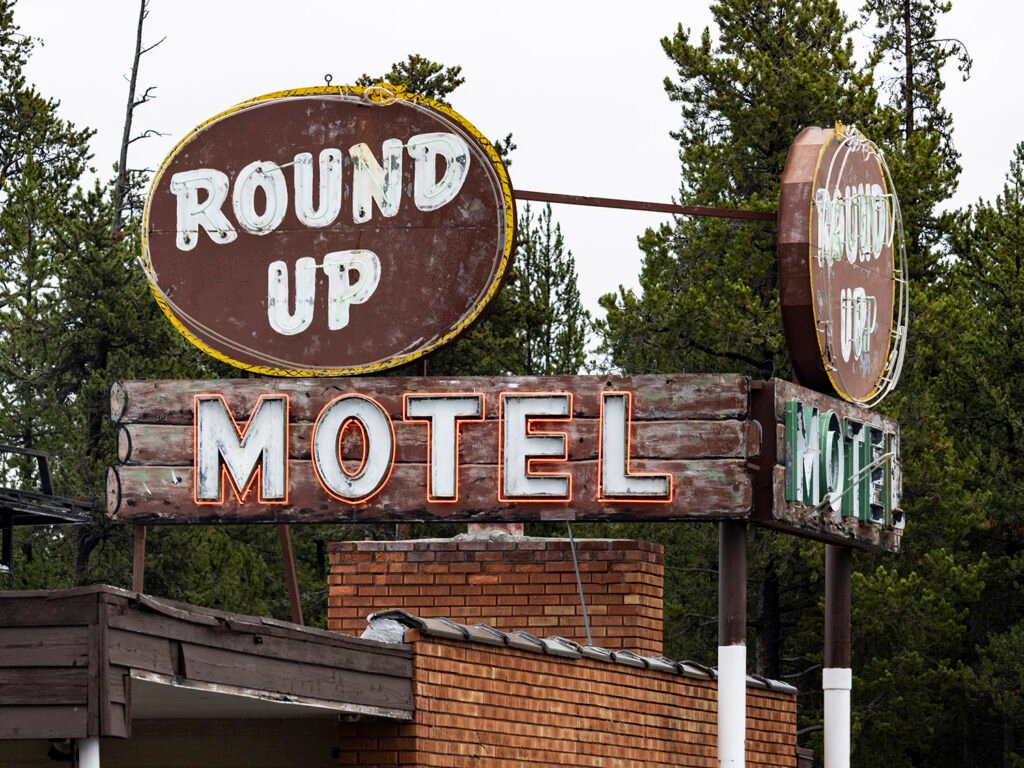
Round Up Motel. West Yellowstone, Montana.
Other signs were more exotic in flavor, capitalizing on the Tiki culture that emerged in the White middle class following World War II, using symbols and typefaces that were stereotypically Polynesian, Hawaiian, or Pan-Asian.
Typically designed by local sign makers, vernacular roadside signs were often used as distinctive focal points for structures that were otherwise unremarkable and interchangeable — see one hole-in-the-wall motel, for instance, and you’ve seen them all. It was the sign that was memorable, not the building.
Vernacular signs were already falling out of fashion when Robert Venturi and Denise Scott Brown, a husband-and-wife architectural team from Philadelphia, galvanized the architectural world with the 1972 publication of Learning from Las Vegas, in which they praised vernacular road signs for their “architecture of communication over space”1and presented them as a legitimate art form worthy of analysis.
Venturi and Scott Brown accused architects of designing to suit “their own particular upper-middle-class values, which they assign to everyone” and admonished them to “gain insight from the commonplace”.2
Yet even as architects began drawing inspiration from them, by the 1970s, vernacular roadside signs were steadily supplanted by standardized signs that became more subdued, less conspicuous, and thoroughly homogenous.
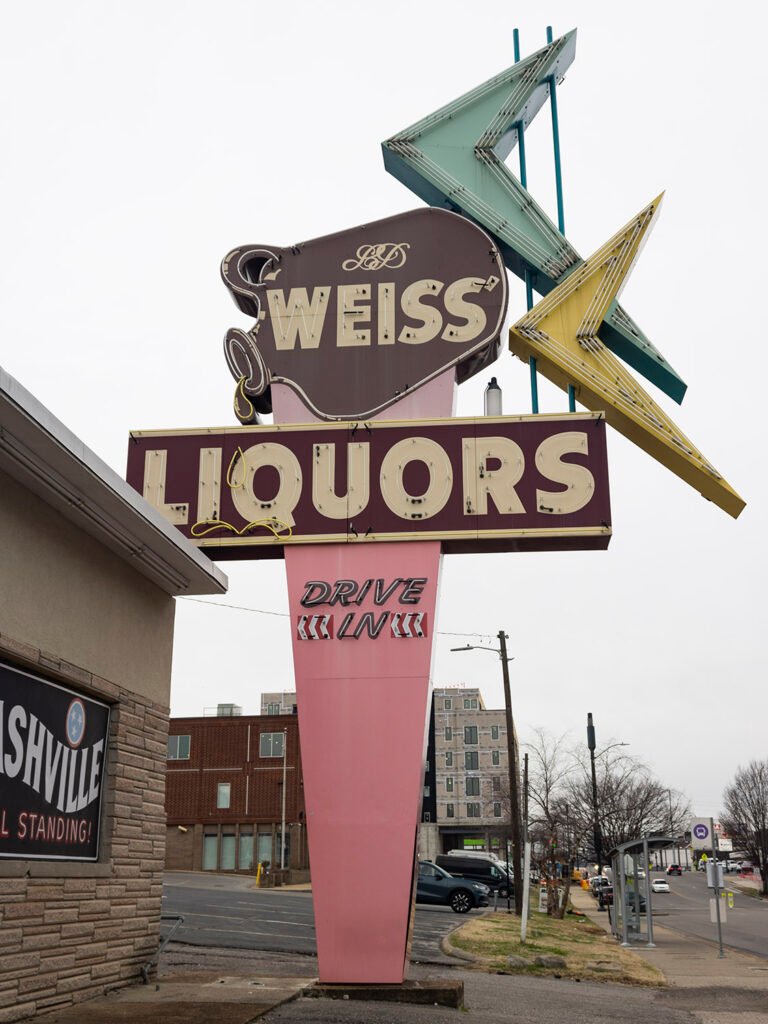
Weiss Liquors (circa 1966). Nashville, Tennessee.
Today, roadside signs from the mid-20th century are nearly extinct, often regulated out of existence by restrictive sign ordinances or demolished when their associated businesses close or succumb to redevelopment. Those that remain are either in a state of decay or have been well-maintained and, in some cases, skillfully restored.
If you’re hunting for relic roadside signs in the United States, there are a few good places to start:
Neglected or run-down urban neighborhoods or rural towns.
Nostalgic destinations such as long-running local restaurants, theaters, and stores, or tourist areas near beaches, mountains, or national parks.
Shopping centers built in the 1950s, 60s, or 70s that have retained elements of their original design.
These relic signs are quaint reminders of a time when the appeal of travel lay in the freedom of its uncertainty and little surprises, when Americans weren’t so embedded in the illusion of control, merely navigating from one planned destination to the next on routes prescribed by machine, coddling our consumed minds with the bland promise of comfort, safety, and familiarity.
Or, perhaps, that time never existed at all.
The map below charts the location of every vintage sign I’ve photographed so far, with accompanying images. Many of the signs have since been removed.
References
Venturi, Robert; Scott Brown, Denise; Izenour, Steven. Learning from Las Vegas, Revised Edition: The Forgotten Symbolism of Architectural Form. Cambridge, Mass.: MIT Press (1977). ↩︎
I’m the Chinese software engineer who hacked into your device OS.
I’ve been watching you for months now.
Fuck that’s hot. Do I turn you on that much, big boy?
You’ve been infected with malware through the adult website you visited.
Which one?
I have downloaded all confidential information from your system and I got some more evidence.
Aren’t you the sneaky sleuth? Hot.
I gained access to your smartphone and saw everything you were doing… well, I got a video of you masturbating in the bathroom (nice interior, by the way).
Thanks! Like my cock? The walls are streaked with my cum.
I’ve been monitoring your camera for the past 2 weeks – it was active for 47 hours total, and you never noticed because I disabled the LED indicator.
You’re so smart and naughty, Chinese engineer. No wonder US dominance is slipping.
I put together footage: on one side of the screen is the video you’re watching at the moment and on the other side is your satisfied face. With one click, I can send this video to all your contacts.
Oh fuck yes. I want them all to see me like this.
I’ve already prepared everything. I have access to your WhatsApp and I can see all your conversations – with your family, your relatives, your friends, your colleagues, and even your boss. I’ve also taken screenshots of your private chats. The video is queued and ready to send. One wrong move and I press the button.
Mmmm fuuuck. Do it, bro!
I can see your WhatsApp messages, your private chats, your family group chats, and I can send anything I want from your account. I also have your work email and I can see all your professional contacts. Imagine your relatives receiving this video from your WhatsApp number in your family group chat, or your boss and colleagues receiving it during work hours. How would you explain that? Your life will be ruined.
Omg, please ruin me. Make me your slave, daddy.
All your data is already uploaded to my secure servers. Even if you delete everything from your device right now, I still have copies. The email templates are ready. The video is processed and optimized. Everything is set up. I’m just waiting for the timer to expire.
Tick tick, baby.Now show me your yellow dick.
I’m monitoring this email right now. If you forward it, show it to someone, or try to contact the police, I’ll know instantly and the video will be sent immediately to your entire contact list, starting with your relatives and your work contacts. There’s no way to stop me once I press that button.
Oooh, so sexy and commanding. Make me beg for mercyon my knees.
Do you want to prevent this?
No, punish me, Daddy.
I understand your concern. Especially since the video was quite vulgar, I can’t imagine the embarrassment you will feel when your family, relatives, colleagues, friends and everyone else see it. Your reputation will be destroyed forever.
Have you seen my site? I destroyed my own reputation a long time ago.
You’ll never be able to look them in the eye again.
I don’t look them in the eye now. Pretty sure I’m on the spectrum.
If you need to delete all of your collected data, just send 0.01 btc (Bitcoin) to a wallet that was specially generated for your email address.
bc1q5g3fhptpp9g8r0spfzr7jdwgp0wn6tqc3gsgpf
That looks legit.
Yes, it’s that simple! My script will detect the transaction to this wallet and will automatically delete all the dirt that was collected on you from my servers.
Nah, too much work. I’m a lazy American. Now let me suck ur cock.
You have 48 hours to pay. The countdown started the moment you opened this email. If you don’t pay within 48 hours, the video will be automatically sent – right when everyone is at work, checking their messages. Every hour you delay, I’ll send the video to random contacts from your list, starting with your relatives and work colleagues. After 48 hours, everyone gets it – your entire WhatsApp contact list, including all your relatives, and I’ll also post it on your social media accounts from your own profile. There will be no way to undo this.
Blah blah blah. Show me your bits, big boy.
Timer ID: -904422093
The timer started automatically after you opened this email. You’re being watched right now. Every second counts.
If you don’t have enough money, you can pay half the amount (0.005 btc) to your wallet in order to extend the timer for another 48 hours.
Zzzz….stop with this dry ass hell technical talk.
Do not try to reply to this email, it makes absolutely no sense (the sender’s email address as well as the Bitcoin wallet were generated automatically especially for you and cannot be traced). I don’t make mistakes. Don’t test me.
There’s that dominating talk I like. Control me, daddy. Make me your slave.
If I see that you’ve shared this message with someone else (for example, if it is opened on a different device than yours), the video will instantly start being sent out to your contact list. I have monitoring scripts running 24/7. Your relatives will be the first to receive it in your family group chats. This is your only warning.
Mmm….that’s right. I’m a naughty boy.Bend me over and swat me with your chopstick.
Take it easy. Take it as a little life lesson and be more careful in the future.
I don’t want to be more careful….I just wanna choke on your Chinese wang.
Yes, the internet advice about taping the camera isn’t so useless.
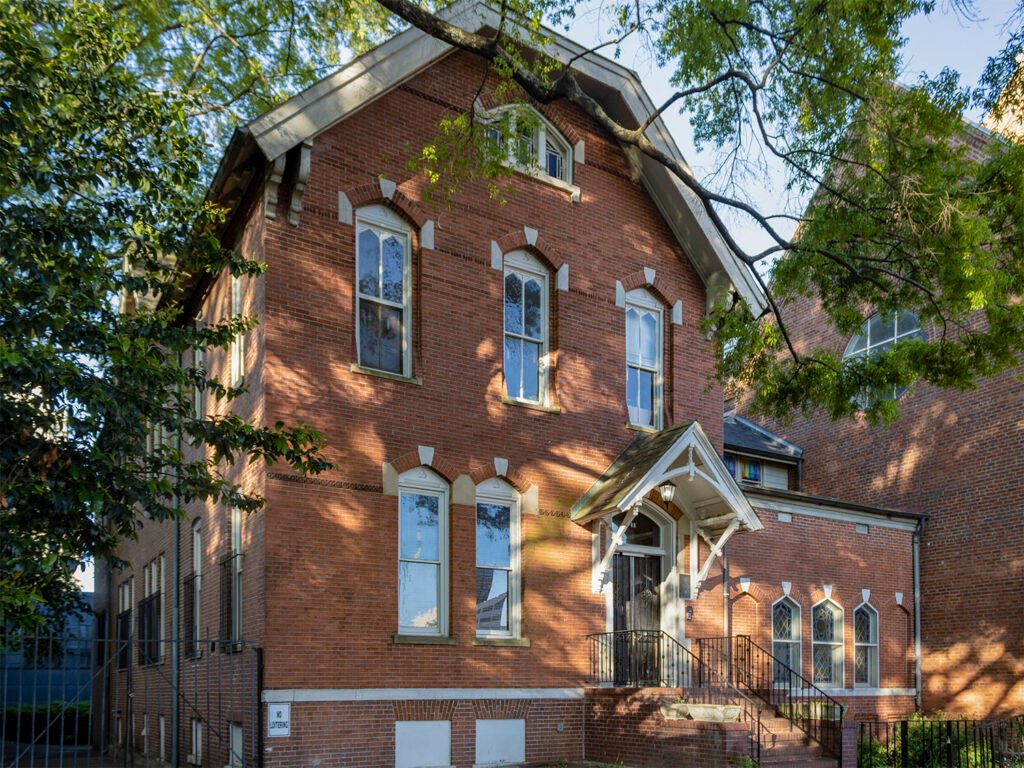
E.G. Lind. The Priest’s House at Catholic Shrine of the Immaculate Conception (1884). Atlanta.12345
References
Belfoure, Charles. Edmund G. Lind: Anglo-American Architect of Baltimore and the South. Baltimore, Maryland: The Baltimore Architectural Foundation (2009). ↩︎
“Notice to Builders & Contractors”. The Atlanta Constitution, June 25, 1884, p. 5. ↩︎
“Building Bits.” The Atlanta Constitution, May 30, 1884, p. 7. ↩︎
“The Priest’s House”. The Atlanta Constitution, November 9, 1884, p. 9. ↩︎
“A Brilliant Occasion.” The Atlanta Constitution, November 12, 1884, p. 7. ↩︎
I first learned about Paley Park in William H. Whyte‘s The Social Life of Small Urban Spaces, an inspiring and formative little book that I stumbled upon years ago and still occasionally thumb through and read.
Paley Park was at the top of my list when I first visited New York in September 2022, and I’ve returned several times since.
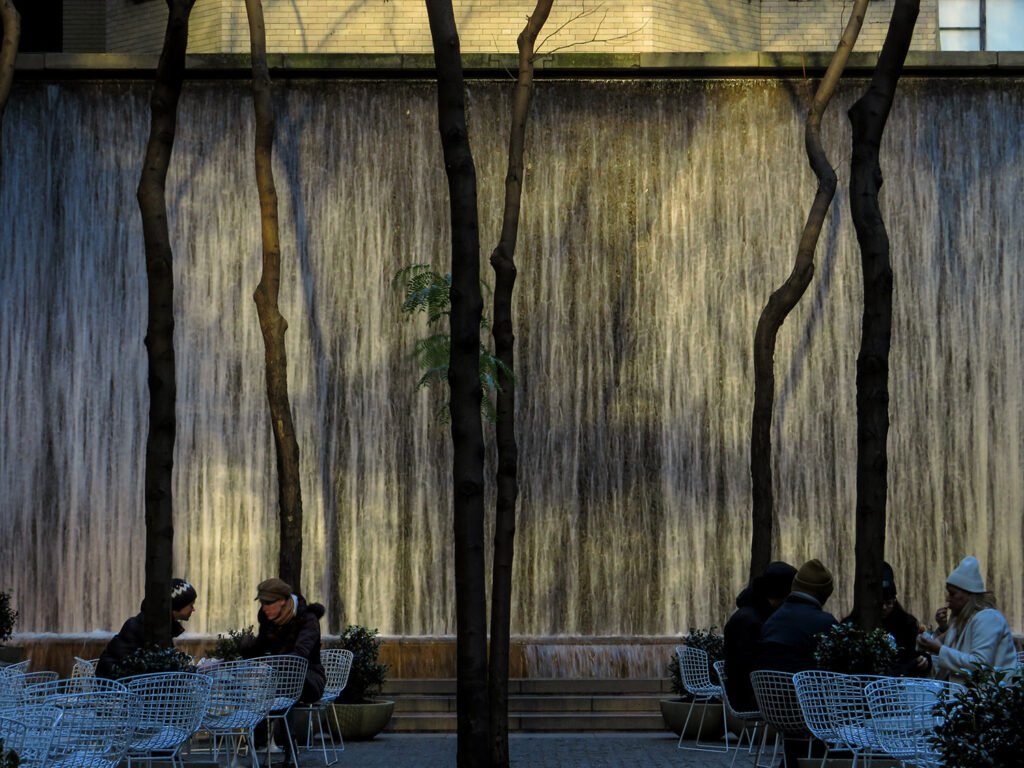
Just 4,200 square feet in size,1 it’s a perfect little slice of nature in Midtown Manhattan, with a waterfall, trees, and plenty of tables and chairs.
The park is full every time I visit, even on a freezing day in January.