From the Notebook

  • “A May-Day Dance” (1891) by W.W. Goodrich

    The Background

    This is the fifteenth in a series of articles written for The Atlanta Journal in 1890 and 1891 by W.W. Goodrich, an architect who practiced in Atlanta between 1889 and 1895.

    Goodrich briefly lived in Boise, Idaho, from 1882 to 1883, and here, in 2 tediously long paragraphs, he paints an idyllic (and fabricated) portrait of the Shoshone people of Idaho celebrating the annual return of salmon to the Snake River.

    His description of the Shoshones strikes an admiring, although occasionally condescending tone — not unusual for Goodrich — and conspicuously omits any mention of the tribe’s tenuous plight at the time.

    After years of fighting the seizure of their lands by White settlers, in 1875, the Shoshones were restricted by a presidential executive order to the tiny Lemhi Reservation along the Salmon River. Ultimately, the federal government — backed by the area’s covetous settlers — wanted to force the tribe onto a different reservation at Fort Hall, more than 200 miles to the south.

    By the time Goodrich lived in Idaho, the Shoshones, cloistered at the Lemhi Reservation, didn’t have access to the Snake River, which thoroughly discredits this story as one drawn from first-hand observation.

    After years of failed negotiations, in 1907, the Shoshones were forcibly removed to the Fort Hall Reservation in what has been referred to as Idaho’s Trail of Tears“. The Shoshones merged with the Bannock tribe, and today the descendant Shoshone-Bannock Tribes remain based on the reservation.

    Although a fixture of popular imagination, the annual return of salmon to the Snake River is now in rapid decline, as a series of dams erected in the 20th century by the United States Army Corps of Engineers has decimated salmon populations in the river. So much for American progress, eh?


    A May-Day Dance.

    A Picturesque Indian Custom.
    How It Is Spent By The Shoshones.
    They Rejoice at the Return of the Delicious Salmon – Their Grotesque Revelings in Their Beautiful Home in the Mountains.

    Written for the Journal.

    Idaho, that gem of the mountains, was never more beautiful than at this time, in its gorgeous array of wild flowers. Seven moons had come and gone since the last salmon had descended the falls, speeding its way to the “salt chuck.” The Snake river, winds its sinuous way to the Oregon, whence it empties into the Pacific. Amid grand scenic changes, this mighty river, of several hundreds of miles in length, touching many states, is the outlet for the overflow of a vast territory of most fertile soil and most wondrous growths; here is the home of the best peaches, potatoes, apples and small fruits that our grand country produces. Their flavor is superb; nay, delicious in the extreme. Nothing grown in any part of our common country can excel them in flavor. Here the cayute is in his native element, the coyote and the jack rabbit run races. The gray wolf and grizzly bear snarl and treat each other with extreme discourtesy over the bones of a slain antelope or venison. Here the mountain lion and his mortal enemy, man, meet in desperate combat, and man is the winner. High upon the range flashes an instant, then out, the signal fire. Again it flashes, thence from adjoining peaks, thence along the whole range, presently high fires are burning in every direction. Thus the Shoshones show their joy and gratitude for the return of May; of its muck a muck from the “salt chuck.” Salmon are running, flashing beauties, whose scales glitter with many and varied colors of the rising sun, are easily speared as they dart over the riffles and through the shallow waters. The silent Indian medicine man follows up and down the stream making grimaces and gesticulating wildly to the Great Spirit his approval of the running salmon. Then comes the chief, in beads and feathers, in gaudy colors and buck-skin moccasins, trimmed out with beads, utterly silent, and as informal as a bronze statue, and as cold in gesture as yonder snow-clad peak. The falls of the Snake river are of perfect grandeur; Shoshone falls, so named after the Indians who live on the Snake, are of quartz, fluorspar, granite and sandstone. Occasionally thin seams of the precious metals are interlaced and intertwined in the different formations. In the river’s bed are excellent placer mines of gold. Agates, amethysts and emeralds are in profusion, and when polished are beautiful in all the colors conceivable, and when cut present scenic effects that outrival any artistic effect of brush of any metal, however prettily worked or arranged. All along the banks of the Snake at various altitudes are lost rivers, varying from several feet above high water mark to hundreds of feet above water level. These rivers rise in the mountains and follow the canyons to the plains, thence flow underground for miles in the lava, which is spread all over the country in various thicknesses. And it is no uncommon sight to be traveling along over these lava plains, to see great holes just ahead of you, perpendicular and of from few feet to hundreds of feet deep with the rushing waters below rumbling and roaring, and seething and foaming. Many an animal and man has fallen into these places and been carried underground never to be seen or to be heard from again.

    Slowly circling about the chief in concentric circles, led by the medicine man, were all the bucks. Breaking ranks, each for himself ran to his cayute and galloped away for a mile then stopped with backs to the chief in a circle. On came the Shoshone, dressed in buckskin, and all over her blanket were still gaudier colors than the chief, her face painted in stripes, circles and squares. At some distance behind her came her children still further behind; from out of each teepee came the squaws and their children. As they came up with the chief each threw before him a wild flower, and as the last child passed in review he waved his hands towards the eternal mountains and calling upon the Great Spirit poured out in the fervency of his soul’s fondest desires praises to God for the return of May and of the run of salmon. After his prayer the pappooses and young children were seated about him on all sides, the grown daughters forming a circle about the children; then the squaws in a circle; then the young bucks; and at a given signal in rode the bucks straight at the chief, and at a pace that was furious, but just as they would ride over the ones about the chief they swerved, and rushing about in a circle, each brandishing his tomahawk, uttering the Indian yell of defiance to winter, of contempt for old boreas, and of joy at the coming of May. Then the squaws, hand in hand, danced before the chief;—and such a dance, and such grotesque actions, and such peculiar gyrations, and such can-cans;—and as their joyousness was becoming more boisterous the children took up the Indian refrains, their sacred music, and soon the whole tribe was a whirling mass of beings that you could not tell where the affair commenced or ended, so great were the contortions. At another given signal all again was as quiet as the grave; each wended his way to his teepee. At another signal all appeared at the outside of their teepees, and then the bucks, in single file, came to the chief dressed in feathers, gaudy ribbons, painted faces, in hideous stripes from their hair to their breech clouts, their legs painted in circles. Building a great fire from resinous trees, burrs and dry wood, all formed in the famous buck dance, that is so hideous and so full of contortions, grimaces and peculiar evolutions, finally winding up in complete exhaustion and absolute temporary uselessness of the body for any labor or any physical endurance. The squaws would have to pick up their lords and carry them to their teepees, so completely worn out were the bucks from the dance. Thus the noble Red man showed his appreciation of the 1st of May, and of the run of Salmon, his favorite food.

    W.W. Goodrich1

    References

    1. Goodrich, W.W. “A May-Day Dance.” The Atlanta Journal, May 2, 1891, p. 14. ↩︎
  • Piedmont Natives: Bumblebee on Georgia aster

    Bumblebee pollinating Georgia aster (Symphyotrichum georgianum)
  • Buckle Up

    I had a dream last night that I was the sole passenger on a train —
    A train that ran on no track.
    I only realized it when we passed through a place I wasn’t expecting.
    “This isn’t on the route”, I thought.
    I then noticed the train was free-falling down a steep slope.
    I was petrified.
    To my amazement, the unseen engineer skillfully navigated a sharp right turn onto an old trolley track,
    And we descended a curving road paved with Belgian block.
    The ride down was rough, but as we reached the bottom, we slid comfortably onto level ground.
    Then I watched with disbelief as the train coasted through a forbidding gate —
    The guard standing sentinel smiled and waved us through as if we were expected.
    I finally understood that this chaotic journey had been carefully orchestrated:
    The route without a track was exactly how I was supposed to reach my destination.

    It’s true that the mercurial twists and turns of my life have often scared and perplexed me.
    I learned long ago to work with whatever tools are available to me in the moment, without attachment,
    Trusting that, somehow, it will lead me to my next step.
    When the tool inevitably breaks and the moment ends,
    I’ve never hesitated to take the next turn, the next bend, the next exit —
    To my mind, I’ve never had a choice.
    To those outside my train, it must look confusing and erratic.
    I’ve become used to the looks of bewilderment, the remarks of scorn and ridicule.
    What people have yet to comprehend is that this is the future planned for all of us:
    The tracks that were long ago laid are being actively dismantled and destroyed.
    No longer will we have the luxury of following a prescribed route in comfort —
    We must now learn to trust the wisdom of irrational guidance.
    Buckle up.

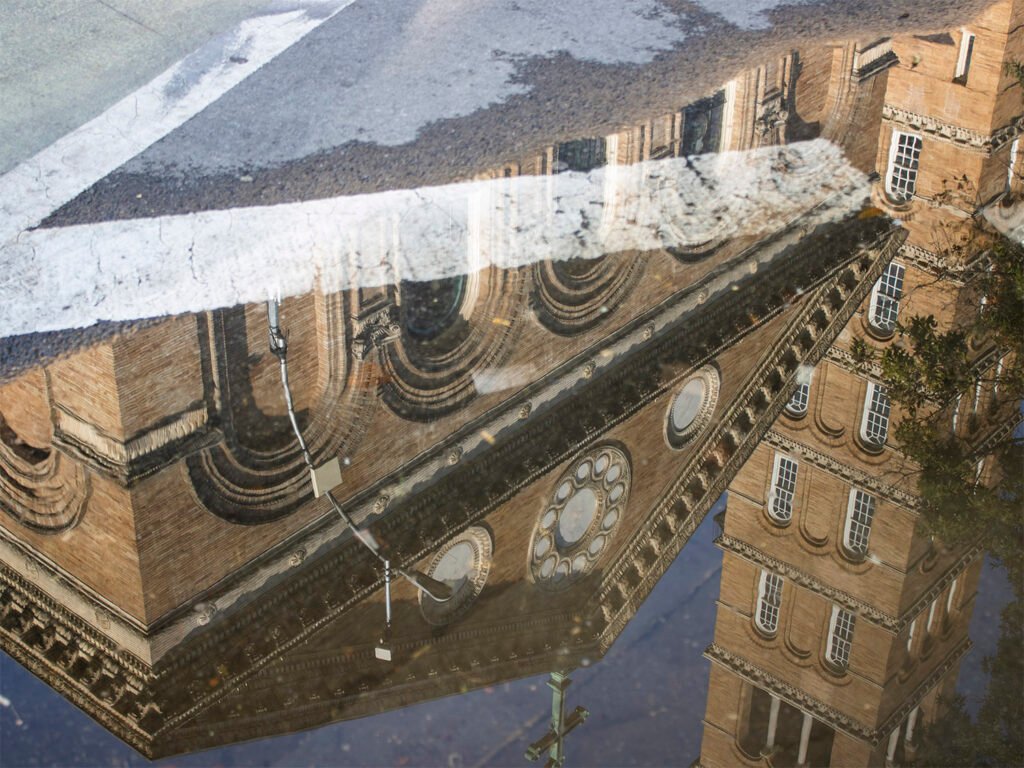
  • Reflection of Judson Memorial Church (1893) – New York

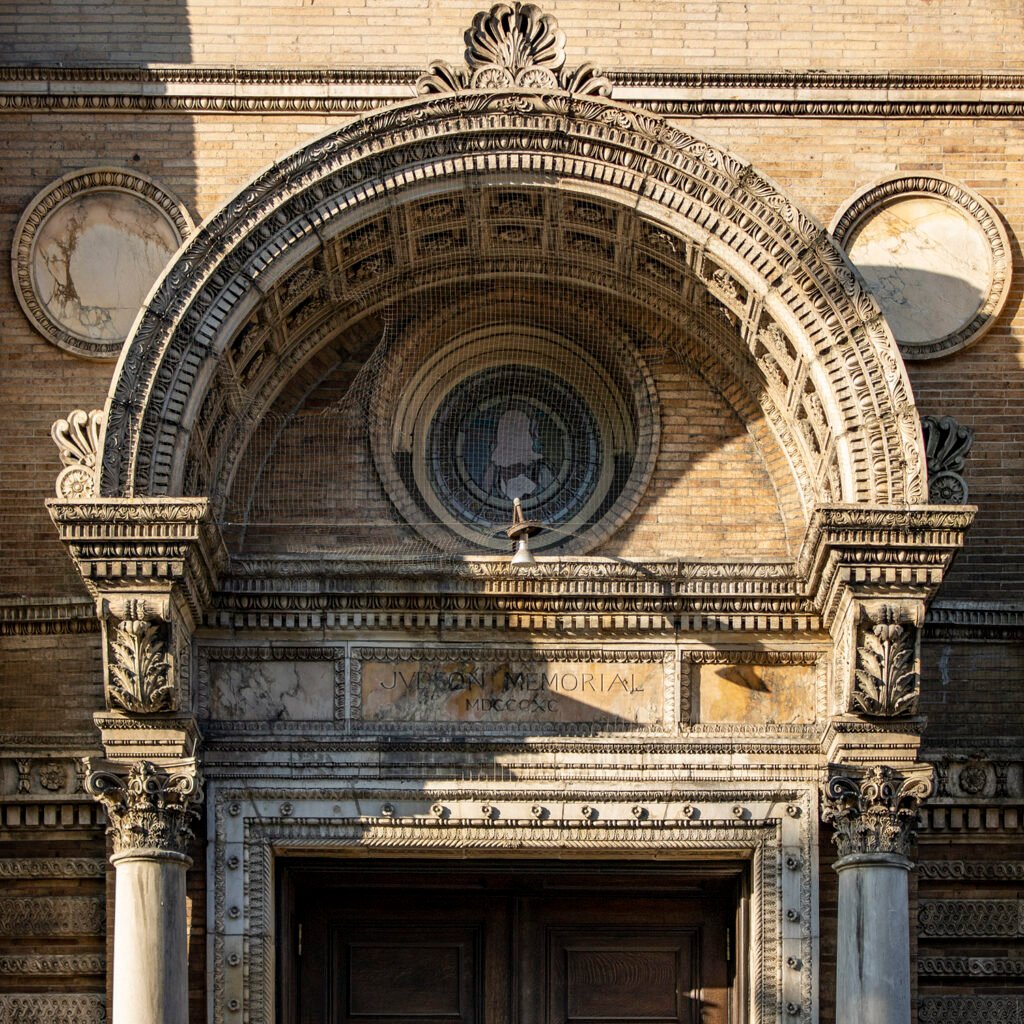
    Stanford White of McKim, Mead & White. Judson Memorial Church, Sanctuary and Campanile (1893, 1896). Greenwich Village, New York.12 3 4 5

    Serious photographers (whatever the fuck that’s supposed to mean) despise reflection shots, but I’m kind of a sucker for them.

    This puddle in Washington Square provided me with the best image I’ll likely ever get of Judson Memorial Church, built in stages between 1891 and 1896.

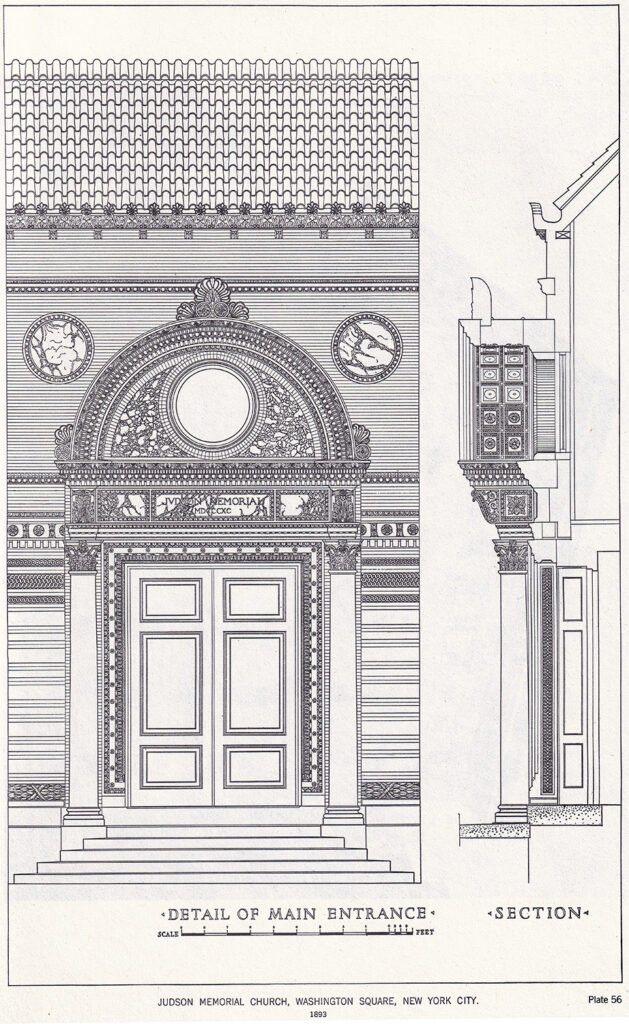
    It’s a quirky and free-wheeling design by Stanford White that combined elements from numerous Italian cathedrals of the Renaissance era, all cobbled together with rich textures and finely detailed ornamentation.

    White’s eclectic compositions didn’t always work, but this one is exquisite and charming, and the church has become one of New York’s most distinctive landmarks.

    Detail and Section of Main Entrance6

    References

    1. “The Judson Memorial.” New-York Daily Tribune, February 8, 1891, p. 19. ↩︎
    2. “Judson Memorial Church.” The New-York Times, January 23, 1893, p. 3. ↩︎
    3. “Judson Memorial Dedication.” The Sun (New York), January 30, 1893, p. 5. ↩︎
    4. “Sitters In Washington Square.” The Sun (New York), May 30, 1895, p. 6. ↩︎
    5. Judson Memorial Church: A Convergence of Arts and Service | National Trust for Historic Preservation ↩︎
    6. A Monograph of the Work of McKim Mead & White, 1879-1915. New York: The Architectural Book Publishing Company, 1915. ↩︎

  • “Science of Sounds” (1891) by W.W. Goodrich

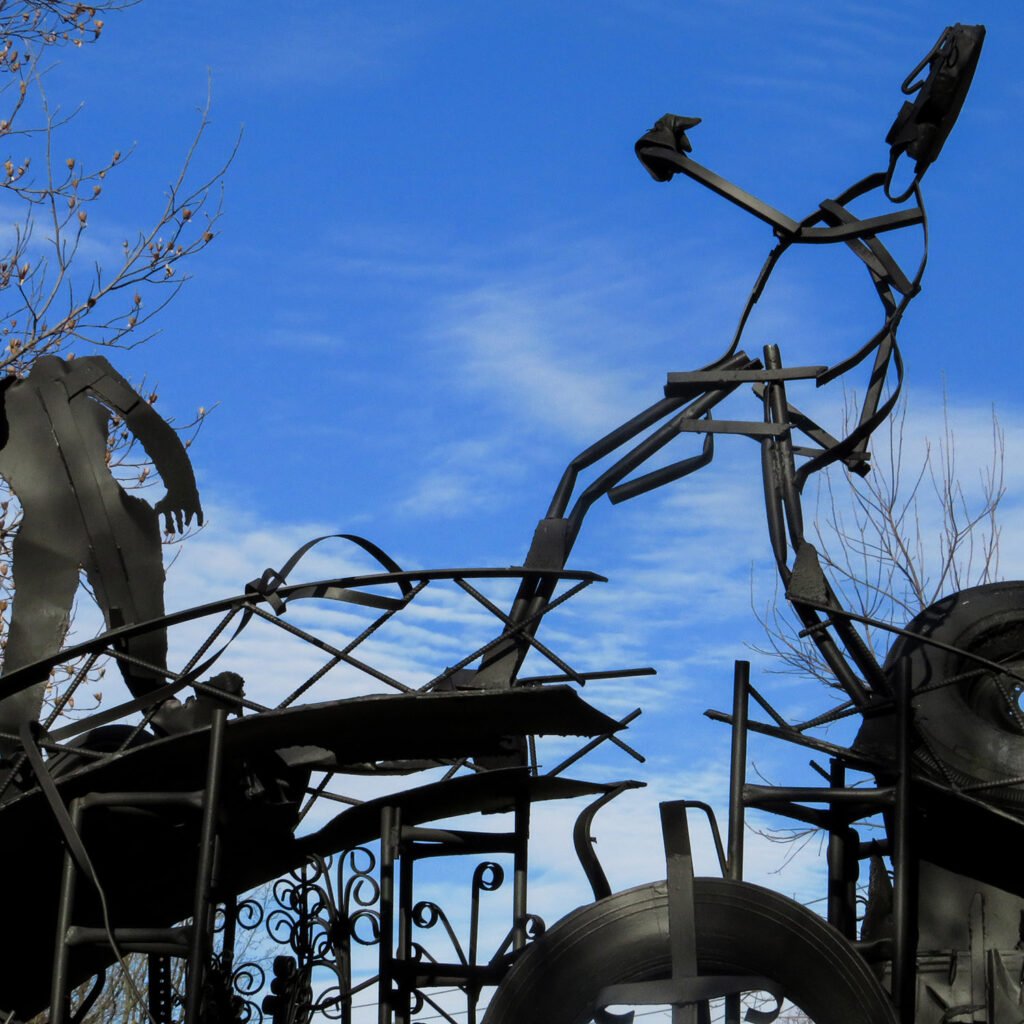
    Thornton Dial. The Bridge (1997). Freedom Park, Atlanta.1

    The Background

    This is the fourteenth in a series of articles written for The Atlanta Journal in 1890 and 1891 by W.W. Goodrich, an architect who practiced in Atlanta between 1889 and 1895.

    By now, Goodrich’s approach to writing is fairly predictable: posit yourself as an expert on a specific topic, weave in a few technical terms faintly recalled from some book or article, sprinkle in several imagined anecdotes with a heaping scoop of condescension.

    It doesn’t have to make any sense as long as it sounds knowledgeable, right?

    And while we’re talking about sounds, here Goodrich pontificates on the limited range of sound detectable to the human ear — after all, he wasn’t just a fraudulent architect, but also an amateur acoustician.

    The article references several songs that would be mostly unfamiliar to modern readers — links to explanatory pages are provided.

    For some reason, Goodrich includes a fabricated story about encountering desert tarantulas in Arizona that would jump “by actual measurement eleven to fifteen feet to sting us with their deadly poisonous fangs”.

    That longstanding myth is false: tarantulas can generally only jump a few inches. And as for his claim that “we would beat them to death with beaver tails”, no comment is necessary.

    The article also references a minor character from an obscure fairy tale by the Brothers Grimm; and Goodrich theorizes that mules can hear quarter-tones and half-tones, based on a visual assessment of their “auricular appendages”, by which he means ears.

    Goodrich concludes with a description of the “multitudinous roar” and “brazen noises” of 1890s Atlanta: “braying mules”, “the negro driver upon his dray”, “steam whistles shrieking”, and so forth.

    He opines that the fictional Prince Fine Ear “would go stark staring mad” in the cacophony of a 19th-century city, then concludes discordantly: “The less we cultivate our sense of hearing, the better it will be for the condition of your nerves.” Say what?


    Science of Sounds.

    The Great Acoustic Possibilities.
    One of Humanity’s Finer Lenses.
    Do the Auricular Nerves Convey Sound More Distinctly in the Present Day Than When Pre-historic Man Inhabited Caves and Trees?

    Written for the Journal.

    Eight musical notes cover the entire range of harmonious sounds which we are physiologically capable of appreciating.

    It is true that this statement is to be modified, since music recognizes what are known as half tones, but they are only adjuncts or auxiliaries, and their general proposition is not affected materially by them.

    With the eight notes or sounds, sub-divided into half tones, “only by the clearest of voices,” all the music of the world has been sung, from the first gruesome sounds of the Adamite man to the exquisite renditions of Jesus, Lover of My Soul, of our superb prima donna and leading sopranos of our many charming choirs. With these few notes, or tones, all the music of the world has been played, from the most stately symphony to the tune of the ragged waif, as his puckered lips whistles the melodies of the minstrel’s lay, which have a certain crisp and charming rendition, at the gatherings of the street urchins. And who has not listened to these urchins’ happy styles of vocalization, as perchance some dozen of them were fishing on a wharf after nightfall, and the calliope of some passing steamer was playing Coming Through the Rye, or My Old Kentucky Home, Good Night. With these few tones the great masters of harmony and melody brought into existence, enrapturing, grand, noble, soul inspiring melodies that have awakened in the human brain such longing and intensified desires to be like the meek and lowly Savior, as no other agent could possibly produce.

    But suppose that by some process of cultivation or evolution, or electrical phenomena, the human ear should or could acquire such a delicacy and refinement of sensibility, as to be able to detect and classify quarter tones or eighth tones or tones beyond and outside of the present range of music. What a vast new field would be opened for the lover of music for music’s sake.

    The capacity of the composer would be increased in geometrical ratio, and the permeations and combinations which would be possible would baffle the skill of the most profound mathematician to compute.

    And such an idea is not visionary. We have abundant and positive reason to believe that many of the lower orders of animals can hear sounds that are entirely inaudible to us.

    There are insectoria that communicate with each other by means of sound, what we can not hear; and even mankind, in occasional instances, have acuteness of hearing which we believe prove that the auditory nerves have never been educated to their ultimate possibilities.

    The tarantulas of Arizona in frequent instances which we have seen, before we could possibly see them, would get in right angle positions to which we were coming, even with our moccasins treading on the softest possible places, would present a fighting front and would jump by actual measurement eleven to fifteen feet to sting us with their deadly poisonous fangs. Only raw hide leggings prevented them from killing us and our party. As they would fasten into the soft raw hide we would beat them to death with beaver tails.

    The fairy story of Prince Fine Ear, who could hear the grass growing, may be only a survival of an earlier age when the senses of mankind were unblunted by misuse or not dulled by disuse, and when there were myriads of sounds to which we are now wholly deaf.

    Surely the variety of sounds one hears in riding in our street cars, as the lazy mule and obnoxious car go jolting along, are not conducive to musical melody, yet quarter and half tones might possibly be distinguishable “to the mules,” judging from the way they lay their auricular appendages backward for sounds.

    There is, however, this objection to the acoustic evolution spoken of that in proportion of delicacy of hearing should be gained, the consciousness of discordant sounds would be greatly intensified, and probably the tension on the nerves would be vastly magnified.

    Imagine a musician of the future with an ear finely attuned to the sweet concourse of rounds and capable of distinguishing tones which to our ears are soundless and meaningless, compelled to listen to the multitudinous roar of this great city, with all its brazen noises, its braying mules, clashing and clanging of machinery and locomotive engines, the negro driver upon his dray furiously and vociferously caressing his team with a black rawhide whip, steam whistles shrieking, and bells tolling out their early morning harshness to awaken the sick and tired body of the overworked and careworn woman attending her sickly babe, wagons rumbling over our rough belgian blocks, dogs growling and snarling, thomas cats mewing for the zephyrs of symphony of mamma cat on the back yard fences, roosters crowing the rising sun. In such a babble as this, Prince Fine Ear would soon go stark staring mad. And have to be deported for his own safety. As a whole, we are better off as we are. We may miss the music of the unheard, but we would escape the sounds which would be acute agony to the more delicate and sensitive ear. Unless we can bring all varied noises of this city into concord. The less we cultivate our sense of hearing, the better it will be for the condition of your nerves.

    W.W. Goodrich2

    References

    1. Fox, Catherine. “Gratitude girds ‘Bridge’ for Lewis”. The Atlanta Journal-Constitution, September 10, 2005, p. A1. ↩︎
    2. Goodrich, W.W. “Science of Sounds”. The Atlanta Journal, April 18, 1891, p. 1. ↩︎
  • Hearst Tower (2002) – Charlotte, North Carolina

    Smallwood, Reynolds, Stewart, Stewart & Associates. Hearst Tower (2002). Charlotte, North Carolina.1 2

    Rise up, Charlotte.

    References

    1. Smith, Doug. “Hearst Tower built to charm pedestrians.” The Charlotte Observer (Charlotte, North Carolina), August 25, 2000, p. 1D. ↩︎
    2. Smith, Doug. “Say hello to 2nd-tallest building in town.” The Charlotte Observer (Charlotte, North Carolina), November 14, 2002, p. 1. ↩︎
  • All for Daddy

    He always despised the nanny state. What he wanted was a daddy state.

    He wanted a big, strong father figure to tell him what to do. And like any good boy, he would dutifully obey.

    He wanted Daddy to beat up the people he didn’t like; to mete vengeance on his enemies.

    “Don’t you talk bad about my daddy,” he screamed at them. “He’s gonna beat you up.”

    Sometimes, late at night, he imagined his daddy punishing him, too.

    “Spank me harder, Daddy”, he heard himself sobbing, his bare cheeks quivering in the air. The pain was just part of Daddy’s love for him.

    He liked Daddy to control him so he didn’t have to make his own decisions. Life is hard, and he didn’t want to think for himself. He certainly didn’t want to accept responsibility for anything.

    Whatever he didn’t like, Daddy would fix for him. And if anything went wrong, he could pitch a fit and blame Daddy for it before running back into his arms in tears.

    He despised Mommy and wanted Daddy to beat her down. He knew Daddy hated that bitch as much as he did — Daddy said the only thing vaginas are good for is fucking and birthing.

    He wanted to join in while Daddy skullfucked Mommy. In his fantasies, he’d scream, “Shut up and let me cum on your tits”, while Daddy slowly choked her to death. That would show her who’s boss.

    Now, Daddy’s fading into oblivion, and the truth of a life spent in darkness is coming to light. Turns out Daddy’s a demon: an empty, narcissistic husk who doesn’t give a single fuck about the boy — and never did.

    Baby boy denies it, of course. He’s doubled down on his defense of Daddy because he’s too fragile to accept what everyone else already knows: that Daddy is a monster far worse than any of his childhood nightmares.

    If no one else will tell him the truth, then I will —

    Daddy isn’t coming back, baby boy. And you were always on your own, anyway.

    Guess it’s time to grow the fuck up.

  • Gate City Savings and Loan Association (1973) – Greensboro, North Carolina

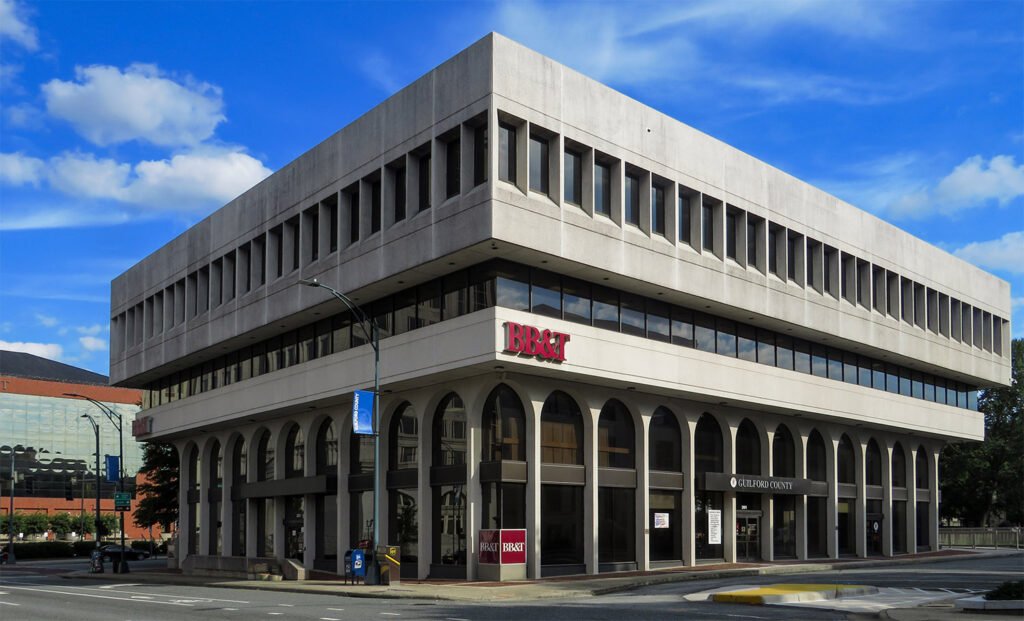
    McMinn, Norfleet, Wicker and Associates, Inc. Gate City Savings and Loan Association (1973). Greensboro, North Carolina.1

    References

    1. Weaver, Bill Rhodes. “Firm Will Tear Down Old Greene Street Building”. Greensboro Daily News (Greensboro, North Carolina), May 29, 1973, p. B1. ↩︎
  • “The Coming Metal” (1891) by W.W. Goodrich

    The Background

    This is the thirteenth in a series of articles written for The Atlanta Journal in 1890 and 1891 by W.W. Goodrich, an architect who practiced in Atlanta between 1889 and 1895.

    Ah, metal — that most riveting of subjects. Here, Goodrich extolls the virtues of aluminum, which began appearing in the manufacture of commercial products in the early 1890s, although it wouldn’t emerge as an architectural material until the mid-20th century.

    As Goodrich notes, the 19th century was the age of iron — cast iron, more specifically. Cast iron was employed extensively in the 1800s as an inexpensive decorative material for the facades of commercial, industrial, and public buildings, especially in Northern cities like New York and Philadelphia.

    In Southern cities like New Orleans, Savannah, and Charleston, hideous mass-produced cast-iron railings, posts, and fences became a defining architectural element of the mid-1800s, although the trend mercifully bypassed Atlanta.

    Cast iron architecture was already falling out of favor by the 1890s, although another alloy — steel — was becoming an essential element in commercial building construction.

    In 1892, the Equitable Building in Atlanta became the first major steel-framed structure in the Southeast,1 followed by buildings like G.L. Norrman‘s Citizens Bank in Savannah in 1896,2 and Atlanta’s English-American Building in 1897,3 designed by Bradford L. Gilbert of New York.

    Architecture isn’t mentioned much here, which might have made this article more interesting. Unsurprisingly, Goodrich’s history and description of aluminum is chock full of errors: it was discovered in 1825, not 1827, for starters. And many of his claims about aluminum’s “most surprising qualities” are incorrect. If you want a more accurate assessment, read the Wikipedia article.

    In one curiously prescient remark, Goodrich anticipates the role of aluminum in the development of airplanes, noting its potential importance “if the problem of aerial navigation should ever be seriously discussed”. Even a stopped clock and all that.


    The Coming Metal,

    Wonderful Possibilities of Aluminum.
    A Formidable Rival of Gold Itself
    With the Newly Discovered Cheap Process of Manufacture it will Revolutionize the Use of Metals in the Arts and Industries.

    Written for the Journal.

    Among the good qualities of Napoleon III, “the man of Sedan,” was a high degree of courage as a scientific pioneer. One of the Napoleonic ideas was the economical production of the metal aluminum. To bring this about the autocrat of the Tuileries, in 1858, expended hundreds of thousands of dollars in subsidizing the labors of Deville, a French chemist of note. Deville succeeded in producing aluminum in masses and ingots never before seen, but as a commercial proposition the thing was seen to be infeasible, and soon the Sadowa and the needle gun drove all the arts and science not directly leagued with the war out of the Napoleonic mind.

    It was only natural during the middle and ages for some centuries thereafter, when forests covered the greater part of Europe and nearly all the western continent, that wood should have been in such general use. Stone was naturally employed in the construction of the castles of the nobility, for the walls of cities and for the houses of the wealthy; but its use for fuel for ships, for the houses of the middle and lower classes, was so general that even in the sixteenth century, thoughtful statesmen foresaw the entire disappearance of this material unless measures were taken to preserve the forests.

    Colbert, the great minister of Louis XIV is credited with the prophecy, “France will one day perish for want of wood.” The fear that he expressed was later shared by the statesmen of all the continental countries, and resulted in the forestry laws, which, by protecting the remaining forests, planting new ones and limiting the consumption of wood, have postponed for some centuries the threatened evil.

    Colbert did not foresee the extent to which iron would take the place of the most perishable material. At that epoch it was chiefly used for the manufacture of engines of war, and for ornamental purposes it was wrought and chiseled into a thousand ornamental objects, some of which still remain to attest the mechanical skill and artistic taste of the golden age of France. Colbert never dreamed that the time would come when ships and buildings of all kinds would be constructed of iron, and when coal and mineral oils and gasses would be used for heating and generating steam – that motive power whose powers were then so imperfectly understood.

    The present age has been called the age of iron, and with good reason. Iron is used for everything, enters into everything. But it has its disadvantages, though, for most things that demand strength and durability they are less serious those of wood. Wood is an organic substance, and though it may resist for a long time the action of the atmosphere, eventually perishes by exposure to water or to the attacks of insects. Iron is also perishable. It is easily oxidized, and its elements pass into the earth, air or water. In the course of time, like wood, it returns to dust. It is difficult of extraction, heavy and of long and troublesome manipulation. It exists in deposits that we are wont to think inexhaustible, but are not so.

    A man need not be a confirmed pessimist to be convinced that the time will come when iron only be had in insufficient quantities and at a price that will practically exclude its general use. But even if that were not to be the case, a metal that will supply its place is greatly to be desired, and there are scientists that think that it has already been discovered, and that it is aluminum.

    Aluminum is found in common clay. It was discovered in 1827, but owing to the difficulties of its extraction, and its high price, it has only been put to comparatively trivial uses, such as the making of tubes for field and opera glasses, and similar objects requiring only a small quantity. Constant efforts have been made by chemists for the last fifty years to find processes that would cheapen its extraction, and alloys that would be of practical use in mechanics. One of these alloys, with bronze, is in use in the United States navy as a substitute for steel in the making of screws, and it is said to be much more durable.

    There is a manufacture of aluminum at Frankfort, in Germany, but the processes are kept secret. It was not until twenty-seven years after its discovery that a French chemist succeeded in producing it in a form that gives it its present practical value. Its price in Europe has never been less than $3 a kilogram (two pounds), but if it is true that an American has discovered a method of extraction and working that will enable it to be sold for a few cents a pound, the discovery is destined to work an industrial revolution.

    Aluminum is credited with the most surprising qualities. Its weight as related to silver is only 3.56. Its resistant power is said to be equal to that of iron. It is elastic and therefore easily worked. It can be used for soldering with itself or with cast or wrought iron. It does not oxygenize, and it is not affected by water or by sulphuric acid or sulphurated hydrogen. It is only slightly susceptible to the action of azotic and chlorohydric acid, all of which mean that it is practically indestructible. Used in the form of a thin plating it protects other metal from destruction, and it is possible it would protect a ship’s bottom from barnacles, though that point is merely theoretical.

    As clay is a substance universally disseminated over the surface of the globe in deposits of indefinite extent and thickness, which are constantly and will forever be in process of formation, the supply of aluminum is absolutely inexhaustible, even if it were used as an ordinary building material and for the construction of ships. In certain ways its lightness would be of the greatest advantage; in others, of doubtful utility. Houses built of it could not easily resist a high wind, unless securely anchored to solid foundations, while a lofty structure like the Eiffel tower would seem to be entirely impracticable.

    There are points, however, which only practical experience would determine. If it were once in general use the practical disadvantages offered by its extreme lightness would perhaps all be overcome by scientific means, or even if this were impossible, would be far outbalanced by the infinite number of applications which this very quality would render possible. For the moment, the practical value of aluminum rests within the domain of conjecture, but there is every reason to hope for its final triumph, which will have to be recorded as an additional triumph for modern science, the creation of a new material for the use of modern art, and a new convenience for nineteenth century civilization.

    The interesting feature of aluminum is that it combines the unchangeable qualities of gold with all the virtues of malleability, tenacity and ductility that belong to iron. In addition to these good qualities it is surprisingly light. A gun which, if made of iron, would require machinery to hoist it on its carriage and to put the trunions in place, might be carried under the arms of a man of ordinary strength. An iron pot of a capacity to hold three or four gallons, which would take a strong man to carry to and from the water faucet, could, if made from aluminum, be lifted on the forefinger or a child.

    At seven cents per pound aluminum would revolutionize the world in the matter of malleable and ductile metals. It would drive tin plate entirely out of the market. It would quickly replace chinaware, because it is practically incorrodible and unbreakable. It would replace glass for everything where transparency is not required. It would be the material of the guns, ships, buoys, etc., of the future. In alloys it would displace nickel and silver from favor. It would be a formidable rival to gold itself.

    Lastly, if the problem of aerial navigation should ever be seriously discussed the production of aluminum on a commercial and economical basis, will be the first step toward a solution of the question, for, be it remarked, aluminum is only two and a half times heavier than water. There is not a single metal in commercial use which comes near this standard, and common writing paper is the only practicable weight comparison for a sheet of metallic aluminum of corresponding thickness. The days of coats of mail are past, but it is certain that an overcoat of aluminum, thick enough to stop a bullet, would not oppress the wearer with its weight half so much as an ordinary winter overcoat. A helmet of aluminum would scarcely be felt by a cavalryman or a soldier of the line, certainly not more than a corresponding headgear of cork or pith, while no saber could cleave it.

    W.W. Goodrich4

    References

    1. “A Skeleton of Steel”. The Atlanta Constitution, April 12, 1891, p. 2. ↩︎
    2. “The Citizens Bank.” The Morning News (Savannah, Georgia), September 5, 1896, p. 8. ↩︎
    3. “The English-American Building Atlanta’s First 11-Story Structure”. The Atlanta Journal, November 6, 1897, p. 5. ↩︎
    4. Goodrich, W.W. “The Coming Metal”. The Atlanta Journal, April 4, 1891, p. 2. ↩︎

  • First Christian Church (1942) – Columbus, Indiana

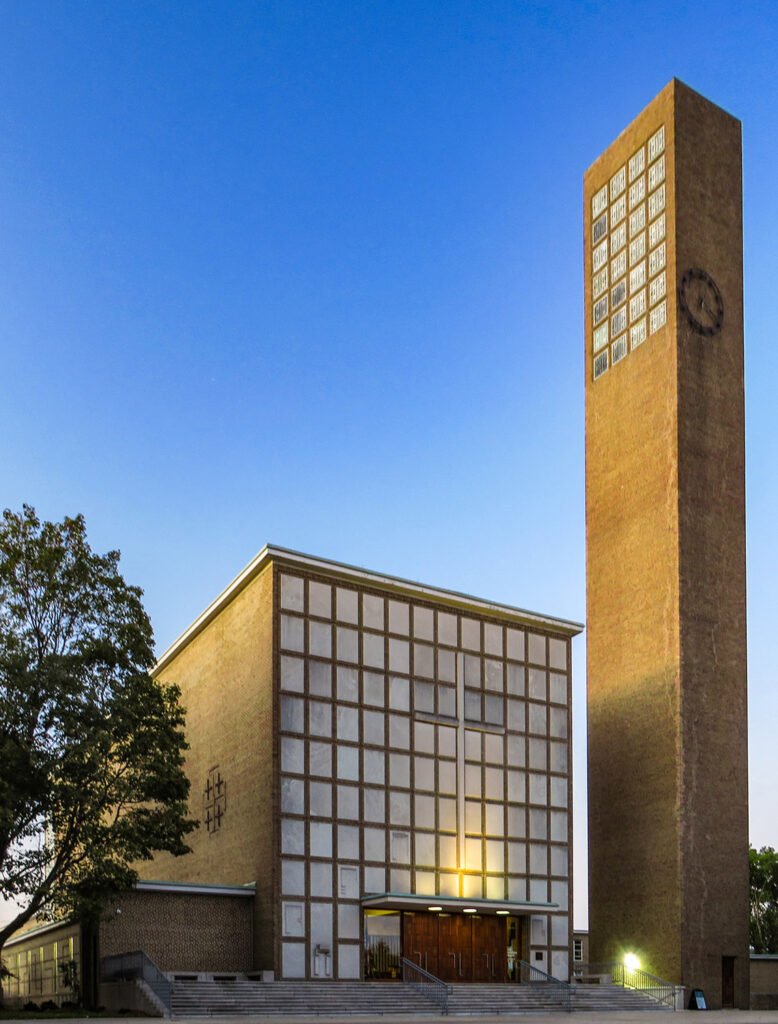
    Eliel and Eero Saarinen. First Christian Church (1942). Columbus, Indiana.1 2 3

    References

    1. Gordon, Bob. “Columbus Comment”. The Republic (Columbus, Indiana), September 16, 1958, p. 1. ↩︎
    2. Gordon, Bob. “Columbus Comment”. The Republic (Columbus, Indiana), March 20, 1959, p. 1. ↩︎
    3. Wheeler, Nancy. “First Christian celebrates years of baptism, discovery”. The Republic (Columbus, Indiana), May 16, 1992, p. A6. ↩︎