References
- “Lutheran Chapel to Be Dedicated”. The Atlanta Constitution, January 30, 1960, p. 6. ↩︎
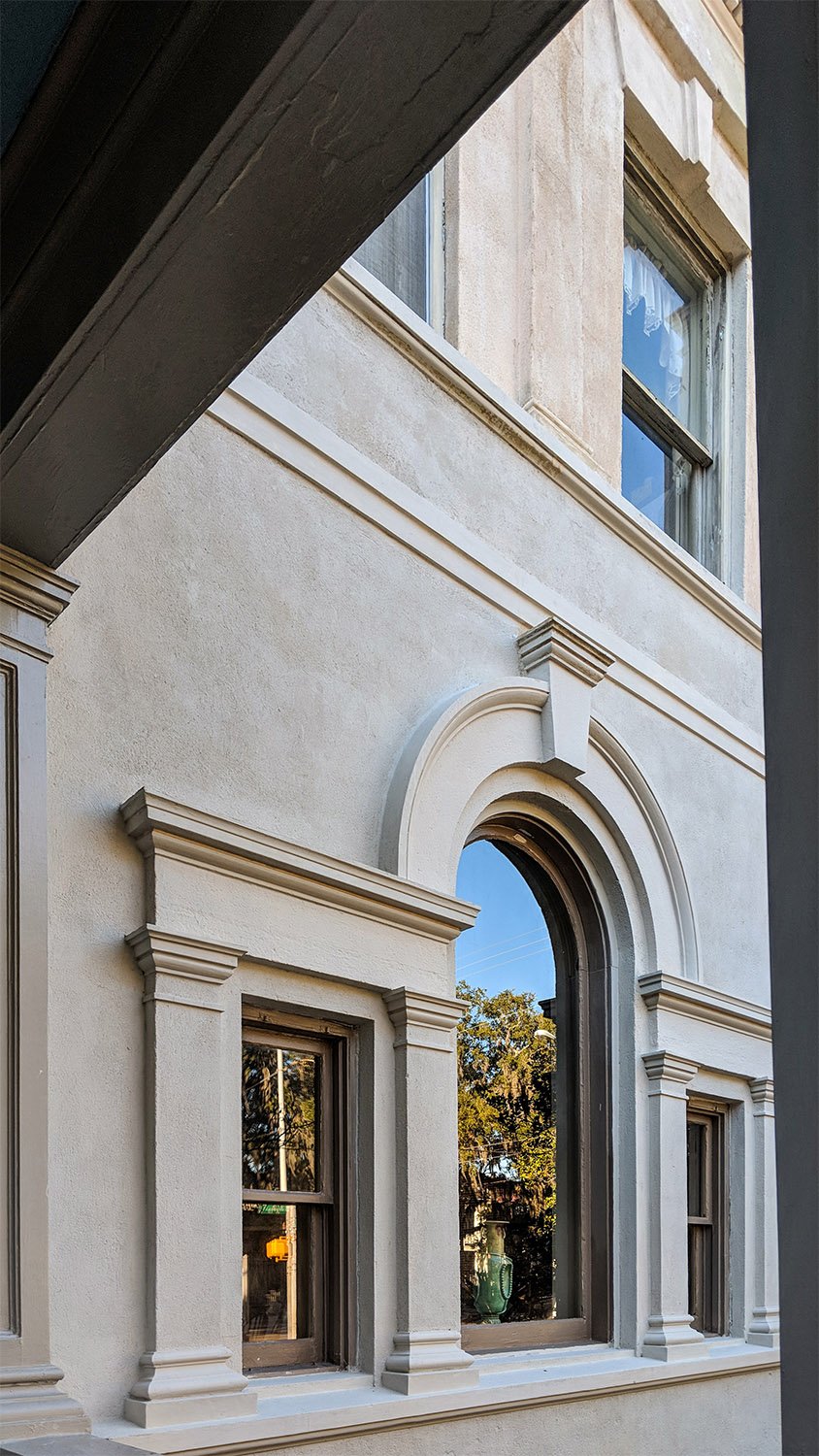
As was so often the case in his career, in September 1901, G.L. Norrman was compelled to justify his design choices to the dimwitted good ol’ boys of a local building committee.
Norrman had submitted plans in competition with 13 other architects for the Duval County Courthouse in Jacksonville, Florida, after the previous structure burned in the Great Fire of 1901.
Although Norman’s plan was publicly endorsed by five top officials, some members of the county commission reportedly objected to his proposal to finish the courthouse with stucco.
The objection now seems absurd given the ubiquitous Spanish-Mediterranean influence that would come to define the “Florida style”—by the 1920s, you’d be hard-pressed to find a single building in the state that wasn’t slathered in cheap stucco.
Norman used stucco extensively in his works from the late 1890s to the early 1900s, and, in response to the commission’s objections, he wrote a letter in which he deferentially offered to withhold the stucco finish from the structure, while also defending his preference for the material.
In the letter, Norrman charted stucco’s origins to ancient Rome, although he erroneously referred to the Pantheon as the Parthenon. Norrman also noted that the General Post Office and the U.S. Patent Office Building in Washington, D.C.—both designed by Robert Mills—were finished in stucco.
Norrman had to know that hick politicians in the Deep South wouldn’t give a shit about architecture in Europe or the North, though, too smugly consumed with playing God in their trashy little backwoods fiefdoms.
So he pulled out an old trick that often works on dick-measuring politicians—in Atlanta, anyway—insinuating that Jacksonville just didn’t measure up to other Southern cities: “All the old buildings of Charleston, Savannah and New Orleans are finished in stucco”, he explained.
Norrman’s effort was futile—the commission selected a fairly terrible plan designed by Rutledge Holmes, an unremarkable architect from Charleston who moved his practice to Jacksonville after the fire and lived in Florida for the remainder of his career.
Holmes, incidentally, shot himself to death in 1929, twenty years after Norrman did the same. Southern architects are a tragic lot.
The September 24, 1901, issue of The Evening Metropolis published Norrman’s letter to the Duval County commission in full.
County Commissioners:
“Dear Sir—I have been informed that there is some objection to the stucco finish which I specified as in my judgment being the most suitable finish for the new court house. If it be true that there there is any such objection to my design, I would respectfully suggest that the stucco be left off, and that the brick work be finished in the usual manner without any stucco. By such omission you will save 60 cents per yard or about $2,100. At the same time you will please allow me to call your attention to the fact that the oldest and most noted buildings in existence have been finished with stucco. Notably among these are the Parthenon [sic] and St. Peter’s, in Rome, which have been built for 2,000 years. Stucco is used in Europe, especially on the continent, nearly exclusively. All of the old buildings in Mexico, and, in fact, nearly all the buildings erected by the early Spaniards, both here and in South America, as well as in Spain, are finished with stucco. All of this is well known to every educated architect and can be corroborated by your expert.
“In this country nearly all the old State houses and court houses of importance that were erected before the war, and which are now in tact [sic], are finished in stucco.
“The United States postoffice [sic] and the patent office in Washington are finished in stucco.
“All the above, I think is known to every builder of any ordinary information.
“All the old buildings of Charleston, Savannah and New Orleans are finished in stucco, and Mr. Flagler is going to finish his Palm Beach palace with stucco, because it is actually the best finish to use on a brick or concrete building.
“In my own practice I had been using stucco on buildings for the past twenty-five years, with very satisfactory results.”
Very respectfully,
G.L. NORRMAN2
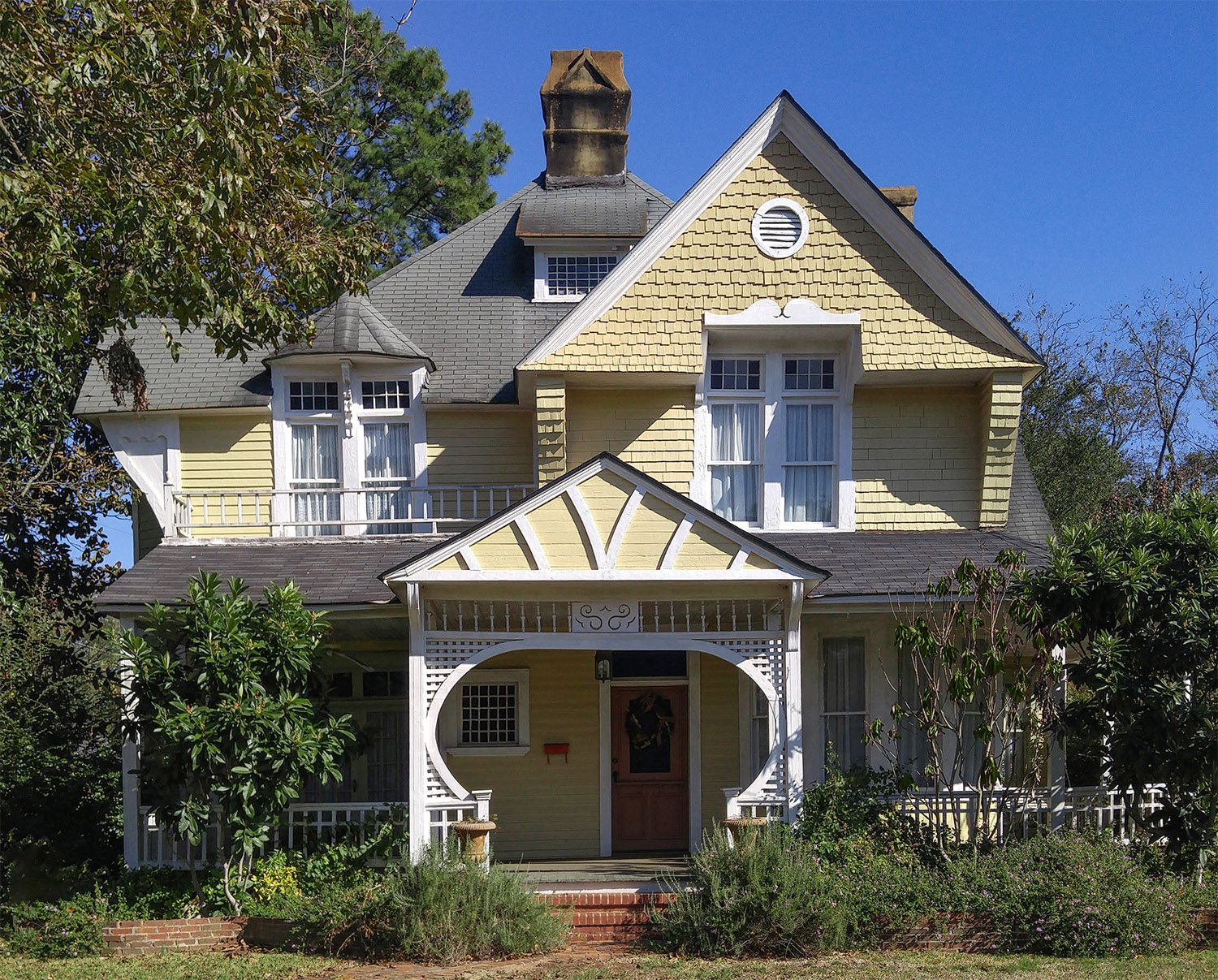
This picture gives me great joy.
I just found a stash of old images that I had completely forgotten, including this one I took in 2017 of the W.L. Glessner Residence in Americus, Georgia.
Planned as a seven-room cottage,1 this lovely two-story Queen Anne-style home is one of seven surviving buildings in Americus designed by G.L. Norrman. There isn’t historic documentation to prove it, but everything about the design indicates it’s his.
The home was built between May and September 1890 for W.L. Glessner,2 editor of the Americus Recorder newspaper, who was the town’s most vocal booster while it was—briefly—one of the fastest-growing cities in the state.
Glessner lived in the home for less than two years,3 leaving Americus in 1892,4 shortly after the town fell into economic collapse.
I toured this house at least once when I was eight or nine years old, but I don’t remember much about the interior, except that it felt a little creepy and reeked of bat guano, which is true of most old buildings in Americus.
By the early 1990s, the home had been abandoned and stripped of its original woodwork, mantels, and other interior elements, though it later underwent a meticulous restoration that incorporated salvaged pieces from local historic homes.
The owners at the time reported discovering a “secret room,” apparently sealed off for years behind a wall—that certainly piqued my adolescent curiosity.
I’ll revisit the design and history of this home at a later date.
Following the 1900 Galveston hurricane, which remains the deadliest natural disaster in U.S. history, G.L. Norrman opined that the Texas port city should build a seawall.
His comments appeared in Wallace Putnam Reed‘s column for The Macon Telegraph in September 1900.
If it sounds like Norrman was familiar with Galveston, there may be a reason: when he emigrated to the United States in 1874, he likely did so through the Port of Galveston.
It’s also possible that Norrman worked in Galveston as a draftsman before starting his practice in South Carolina—one source claims his early career in the United States included “a few years spent in Texas.”1 I’ve never been able to confirm that, though.
As a result of the hurricane, Galveston did indeed build a seawall.
“Galveston should have a sea wall. Holland is below the ocean, and yet it is efficiently protected by dykes. Galveston is six feet above the sea, and a wall is feasible.
“Then the buildings should be of a substantial, storm-proof character. People should prepare proper safeguards and not charge every disaster to Providence.”2

All hail the humble coneflower, one of the unsung heroes of the urban landscape.
When I first began growing native plants, I was attracted to the rare, hyperlocal ones with appealing origin stories: plants found only on a single creek bank 30 miles away or some such wankery.
The problem with those specimens is that they’re inevitably ill-suited for the harsh realities of city life: compacted soils, pissing dogs, pissing humans, careless drivers, overzealous mowers, etc.

Over time, I’ve come to appreciate the native plants that consistently prove their resilience, endurance, and dependability—the ones I can plant in any location under any conditions with the assurance that they’ll thrive.
One of those is the coneflower, which grows practically anywhere in the eastern half of North America. Butterflies and bees love it, humans find the blooms attractive, and I can easily grow it in a container outside my apartment door.
Beautiful!

A consistent theme in G.L. Norrman‘s life was his vocal opposition to prohibition, as the temperance movement was in full force in the United States in the late 19th and early 20th centuries, with many cities and states banning the sale and production of alcohol.
Atlanta enacted prohibition in July 1886,1 reportedly prompting Norrman’s return for a brief time to Greenville, South Carolina,2 which hadn’t yet passed its own prohibition law, although nearby Spartanburg had in 1884—by just four votes.3 4
Prohibition was immediately unpopular in Atlanta, and the city’s business leaders loudly complained about the resulting loss of revenue.
In November 1887, as Atlantans prepared to vote for a repeal of the law, The Atlanta Constitution asked the city’s architects if they had designed any commercial buildings since prohibition began—none had. Norrman reported:
“In response to your inquiry, I can say that I have no store building on hand to be erected in Atlanta, nor have I had for two years. I had some drawings made for five stores, two years ago, but they were not built, as the owner did not think it would pay to build them after prohibition started here.”5
Three days after Norrman’s remarks, an estimated 15,000 Atlantans took to the streets in protest of prohibition,6 and the next day, voters overwhelmingly approved a measure ending the ban.7
The threat of prohibition loomed again in 1899, when the Georgia House of Representatives approved a measure proposing a statewide ban,8 prompting Norman to write the following letter to The Atlanta Journal, published on December 2, 1899.
The attempt at statewide prohibition in Georgia failed a few days later,9 10 but ultimately succeeded in 1907, 13 years before prohibition was enacted nationwide.
“In answer to some requests for my opinion about the prohibition bill, I will say that I think it is too much ado about nothing.
“It is morally wrong to confiscate property, or to debar people from using the comforts and luxuries of life in moderation on account of a few drunkards.
“If school boys, church members, prohibitionists, club men and legislators, or anybody else if they should get drunk, were taken to the station house and well whipped, there would rarely, or ever, be and drunkenness.
“‘The punishment should always fit the crime.’ So disgraceful behavior deserves disgraceful punishment.
“Prohibition practically confiscates a great deal of capital which is now used in a legal and proper manner, while whipping drunkards instead of petting them would only queer the business of the professional revivalist. The only business that would be seriously affected by such a law is that of the temperance lecturer. He would necessarily have to go out of business less than six months after such a law went into effect, for the lack of stock in trade. After that time, if there should be any drunkards left, they would keep so quiet that he could hardly pick out enough to arouse any emotion, even in the most sentimental of sentimentalists.”
G.L. Norrman11

On early summer mornings at the local botanical garden, you can find all sorts of fine flowers and flying friends. Here’s a lovely pair I spotted last Saturday.
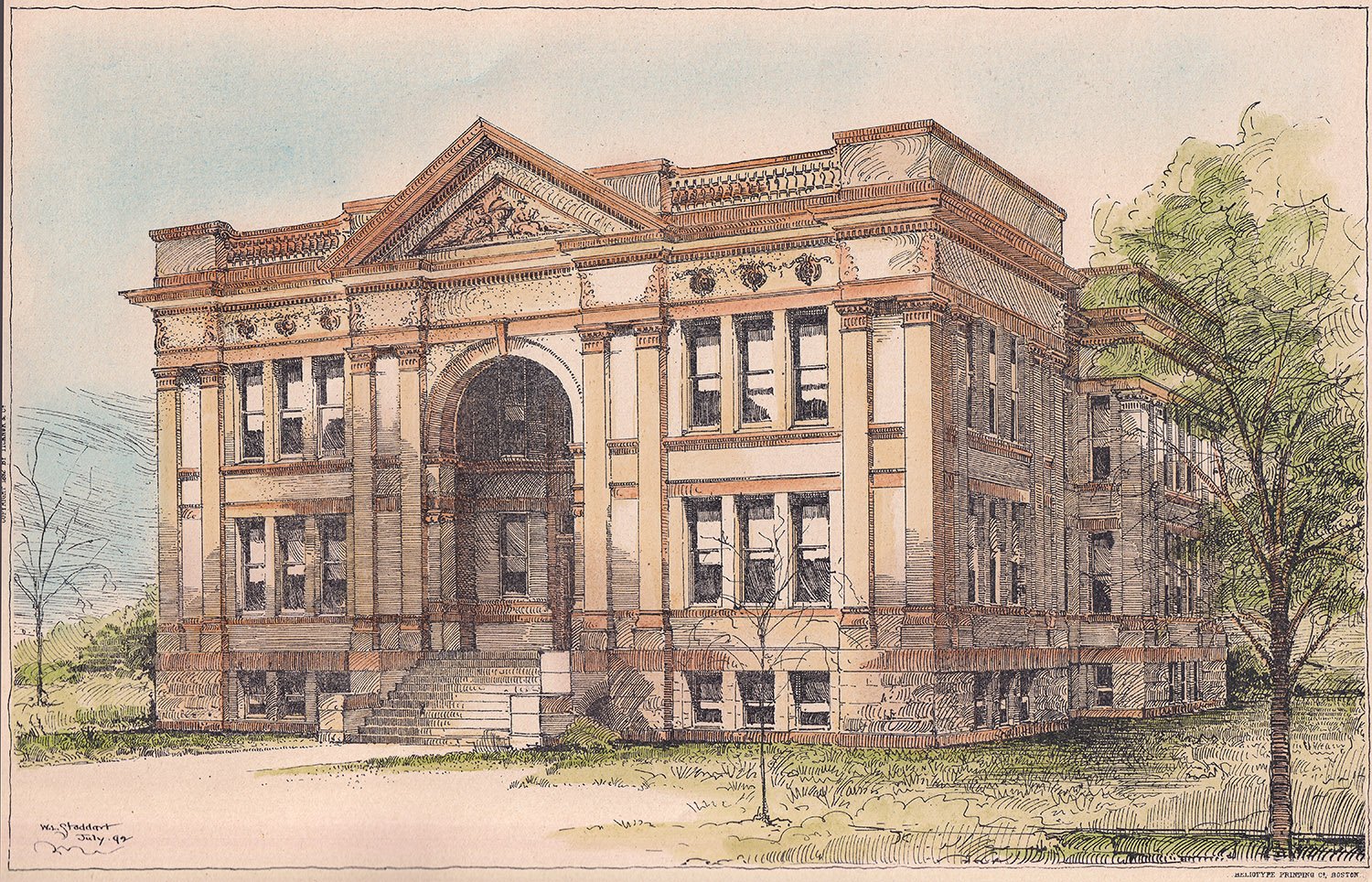
In June 1899, The Atlanta Constitution launched “The Constitution‘s Home Study Circle”, consisting of long-form printed lectures on a variety of subjects, with the promise of “instruction and general culture for those who make the most of its benefits.”
Following the program’s announcement, G.L. Norrman wrote the Constitution to express his tentative approval.
‘The “Home Study Circle” is on the right line. I am not familiar with the details of your plan, but a glance at your course of free lessons for your readers convinces me that they will be of great value to those who will give them proper attention. Education and culture cannot be purchased in job lots, nor picked up in the road, but some systems and methods are easier and more attractive than others, and I think that your scheme of popular instruction is a good one, and will be appreciate by hosts of old and new readers.’
Very sincerely,
G.L. NORRMAN2