Following the publication of G.L. Norrman‘s previous letters [read the first and second], Captain Hendrix of the school board issued a bland, deferential statement praising both Golucke & Stewart’s and Norrman’s work.1
For their part, Golucke & Stewart wrote a catty letter in response to Norrman’s criticism of the firm and their plans, concluding: “We shall pay no further attention to his malicious attacks.”2
Norrman had his say again, in an article appropriately titled “Mr. Norrman Is Mad”, published in The Atlanta Constitution on September 7, 1894. This time, Norrman’s primary target was Captain Hendrix, whom he likened to an “assistant hog drover”.
Norrman’s remarks:
“Why, do you know that the attempts that have been made to answer my objections to the plans selected through the public prints, have amounted to nothing. I objected to those plans first, because they were imperfect and not suitable. My objection then was that of an architect. But now that the committee has selected those plans I object to them as a citizen of Atlanta and as a taxpayer. The building erected by those plans will not only be unsuitable, but it will be unsafe. That building, I tell you, would not be safe for school purposes, and as a citizen I have a right to object to them.3
Norrman continued his rant with another letter:
Editor Constitution—
“The card in this morning’s paper answers none of the complaints in regard to the defects in the adopted plans for the boys’ high school.
“Architecture is a combination of art and science which requires many years of study to comprehend, and any one who reflects for a moment will see how very difficult it is to learn architecture and how subtle the principles are on which it is based, as only a few can, after a lifetime study, design a building which will bear professional criticism, but only very ordinary training is necessary to see the defects which are pointed out in the design adopted for the boys’ high school.
“Captain Hendrix says in his letter that he can see no defects in the plans adopted. I never thought that he could see them. In fact, I believe that he has not the slightest conception of anything which pertains to culture, and would be a much more useful member of the community in the position of assistant hog drover to the president of the board of education than that of chairman of the building committee. I think he could see when pigs were well fed, and he would not then be in a position to waste the public funds or to jeopardize the lives of the occupants of the building.
“As to the card by Golucke & Stewart, I do not blame them for pretending to be architects as long as people will give them work in that line. The idea which I wanted to convey in the former interview was not a reflection on the competency of Golucke & Stewart as architects, but rather a reflection on the culture of those who recommended them.”
As part of his ongoing dispute with the Atlanta school board, G.L. Norrman had choice words for the architectural firm of Golucke & Stewart. Norrman’s public criticism was unprofessional, but his assessment of the designers was correct, and frankly, not harsh enough.
Almost nothing is known of Stewart, but J.W. Golucke was a self-proclaimed architect from rural Georgia with no formal training or discernible skill. He was little more than a con artist who, throughout his career, managed to successfully swindle the good-ol’ boys of 27 Georgia counties and 4 Alabama counties, where he produced a string of courthouses that were sloppily designed and hideously styled, and in several cases so poorly constructed that they posed the risk of catastrophic failure.
Golucke died pathetically in 1907,1 a few weeks after trying to kill himself in a southwest Georgia jail, where he was being held on charges of — no surprise — forgery.23
Every known design by Golucke & Stewart shows consistently clumsy and crude work, and the plan for Atlanta’s boys’ high school was no exception. Norrman shared his opinion of the firm in The Atlanta Constitution for a September 5, 1894, article entitled “In Harsh Terms”.
Norrman’s remarks:
“Why, those plans which the building committee have accepted are a monstrosity in architecture, and the building should not be allowed to go up that way. No building should be erected in which valuable space is thrown away when it could be easily utilized. In fact, it could more easily be utilized than thrown away, as it is by these plans.
You should know that plans cannot be examined and passed upon except by one who knows architectural work thoroughly. Now, the tracing of those lines to the members of that committee were no more than the marks in India ink on a man’s arm. It is not meant for a reflection upon the members of the board or that committee when I say that, but it is said to show that they have simply made a mistake, and a mistake which should be corrected.
Now, Mr. Golucke does not pretend, as I understand it, to be an architect, but attends the building or contract work. Mr. Stewart is no architect: he is simply a tracer of lines. That’s about all, and cannot do anything more than make a nice picture. It was the picture, maybe, that caught the members of the committee which awarded the contract. Why, take for instance that stairway. To come from the second to the first floor there is but one, you may say, while from the third to the second there are two. Suppose all of those who might happen to be on the third floor should rush for an escape. On the second floor they would be joined or augmented by all on that floor. The reverse should be the case. Then, the way the designs read, a great deal of good space is lost that might be utilized, while the plan of ventilation is bad.”4
References
“Death Takes J.W. Golucke”. The Atlanta Constitution, October 28, 1907, p. 6. ↩︎
“J.W. Golucke Tries to Take His Life in Newton Jail”. The Atlanta Journal, October 7, 1907, p. 1. ↩︎
“Atlanta Man Tries Suicide”. The Atlanta Constitution, October 8, 1907, p. 9. ↩︎
“In Harsh Terms.” The Atlanta Constitution, September 5, 1894, p. 2. ↩︎
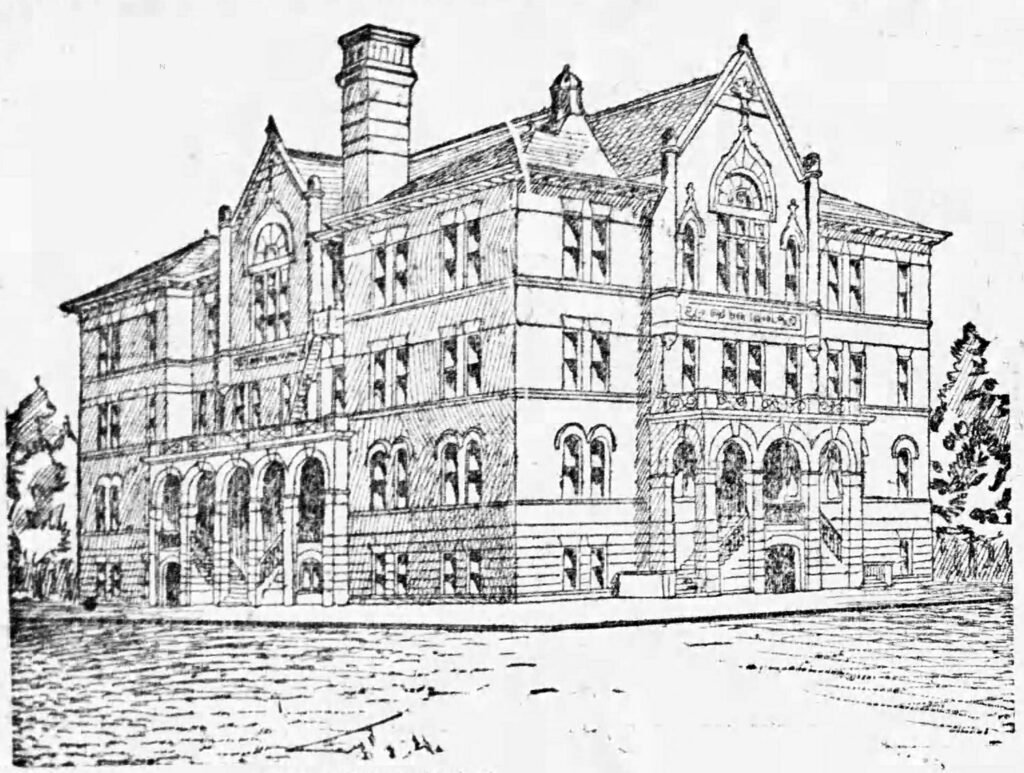
One of G.L. Norrman‘s most bitter public disputes — and there were several — unfolded in 1894, when plans that he and other legitimate Atlanta architects had submitted for the construction of the new Boys’ High School1 were passed over in favor of one designed by Golucke & Stewart,2 a substandard architectural firm even by Atlanta standards.
Golucke & Stewart.Boys’ High School (1894). Atlanta.3
Norrman had been shown the winning plans by Captain J.C. Hendrix, chairman of the school building committee, and was disgusted by what he found, writing a letter of opposition to the chairman of the school board, D.A. Beattie, in which he expressed his issues with the winning plans in exacting detail.4
Norrman apparently sent a copy to The Atlanta Constitution, which published the letter on September 5, 1894, in an article appropriately entitled “In Harsh Terms”.
Norrman’s remarks:
Atlanta, Ga., August 25, 1894
Mr. D.A. Beatie, City,
Dear Sir:
“The plans for the Boys’ High school were shown me yesterday by Captain Hendrix, and I find—
That the size of the building is much larger than the plans submitted by me, which will make it cost at least $5,000 more than my plan would have cost, and yet it has not as many appointments, which shows that there is a great deal of waste space in the plan accepted.
The ventilation is not as good, as only corner rooms in the accepted plan have windows on more than one side.
The accepted plan being four stories, makes it very much more inconvenient, and besides makes it very dangerous in case of fire, not only on account of its extra height, but on account of the stairway running zigzag so that one flight of stair does not come over the one below; especially so with the stairway leading to the public hall. So entirely different plans will have to be made, as the fire department and building inspectors will doubtless condemn the plan on account of the great fire risk.
The hall cannot be constructed without using columns to support the ceiling, and is not high enough for a gymnasium, which will make it practically useless.
The design is an architectural monstrosity, and will be a lasting reflection on the judgment of the board of education. If education is of any value at all, it is to adduce such qualities and surrounding as are in conformity with good taste, and I think among well-informed people, bad taste in architecture is more offensive than unconventional manners or incorrect speaking or writing. So it is of the greatest advantage that children should have training and correct architectural forms. To debauch children’s taste is about as bad as to debauch their morals, as taste and morals can hardly be separated.
“Believing that the board came to the decision without thorough examination into the designs submitted, I respectfully request that you allow me a hearing before the board. I feel sure that the result would be a reconsideration of your decision, as the plan submitted by myself should be accepted on account of less cost, superior appointment, better ventilation and greater safety in case of fire, and account of its architectural merit.
“As this is a matter of high public importance, I respectfully urge this request and ask you to lay it before the board at your earliest convenience. Not having seen any other plans, what I have said refers only to the plans adopted. There may be other plans of more merit than mine.”
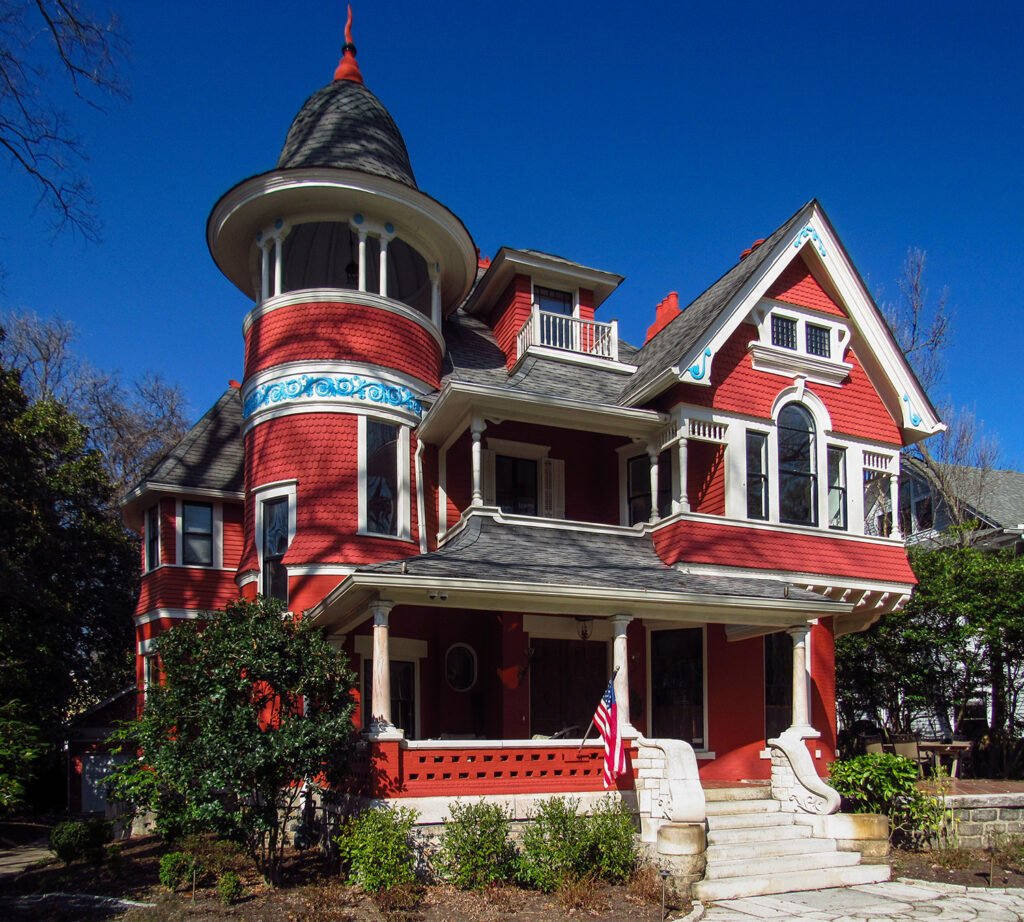
A.M.C. Nixon. J.M. Beath Residence (1890). Inman Park, Atlanta.
The Queen Anne-style J.M. Beath Residence in Atlanta’s Inman Park neighborhood, better known as the Beath-Dickey House, is the only known extant work by A.McC. Nixon, an architect who began his practice in Texas circa 1881 12 and first appeared in Atlanta in 1888.3
In late 1890, Nixon partnered with J.M.P. Lindsey under the name Nixon & Lindsey.4 The firm dissolved in 1894,5 shortly before a court trial in which the pair were acquitted on charges of larceny after trust stemming from their supervision of a home’s construction in 1891.6789 The client had accused the pair of pocketing money intended for the contractors, but the matter was successfully proven to be a simple accounting error.10
After the trial, Nixon’s work in Atlanta dwindled, and in July 1896, his personal possessions and business contents were sold at public auction to pay off debt.11 Apparently in poor health, he moved to England in July 1896, where he died that October.12
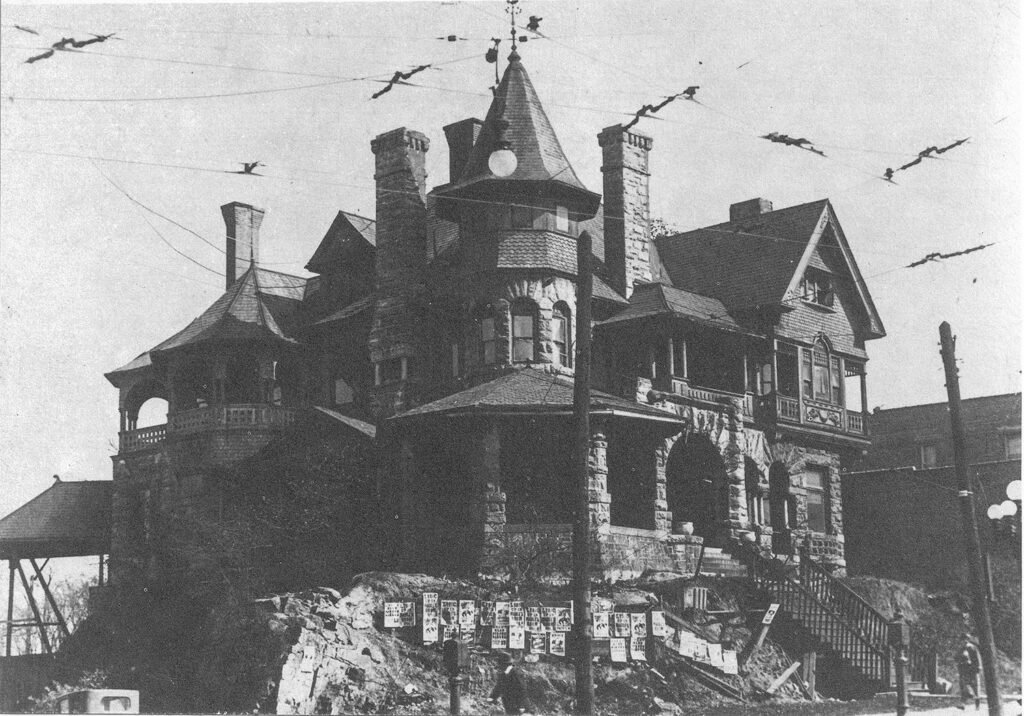
Nixon was not an especially good designer, and the Beath House’s clumsy, top-heavy design is typical of his oeuvre. In 1891, he also designed the similarly styled D.H. Dougherty Residence (later J.R. Hopkins Residence, demolished),13 which has been erroneously attributed to both G.L. Norrman and W.L. Stoddart. Atlanta really doesn’t know its own history.
Nixon & Lindsey. D.H. Dougherty House (1891, demolished). Atlanta.14
References
“San Sada.” The Galveston Daily News, May 15, 1881, p. 1. ↩︎
“Twenty-Five Cent Column”. The Austin Daily Statesman, June 2, 1881, p. 3. ↩︎
“From Our Notebooks.” The Atlanta Constitution, October 1, 1888, p. 4. ↩︎
“Wanted.” The Atlanta Journal, November 15, 1890, p. 7. ↩︎
“A Dissolution of Copartnership.” The Atlanta Constitution, April 4, 1894, p. 3. ↩︎
“Architects On Trial.” The Atlanta Journal, June 21, 1894, p. 1. ↩︎
“The Architect Not Guilty.” The Atlanta Journal, June 22, 1894, p. 3. ↩︎
“Mr. Nixon Not Guilty.” The Atlanta Constitution, June 23, 1894, p. 5. ↩︎
“The Case Dismissed.” The Atlanta Journal, June 23, 1894, p. 9. ↩︎
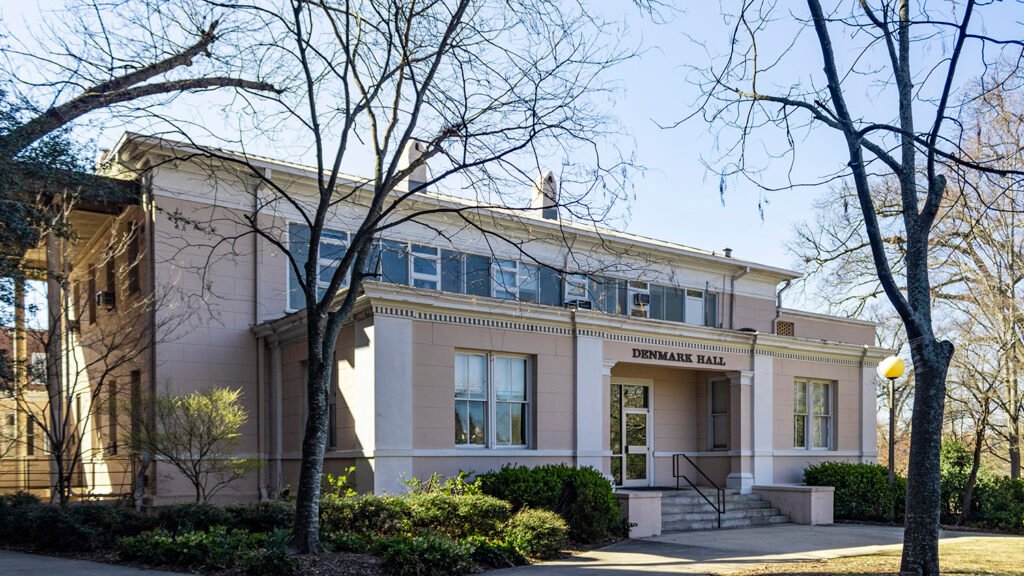
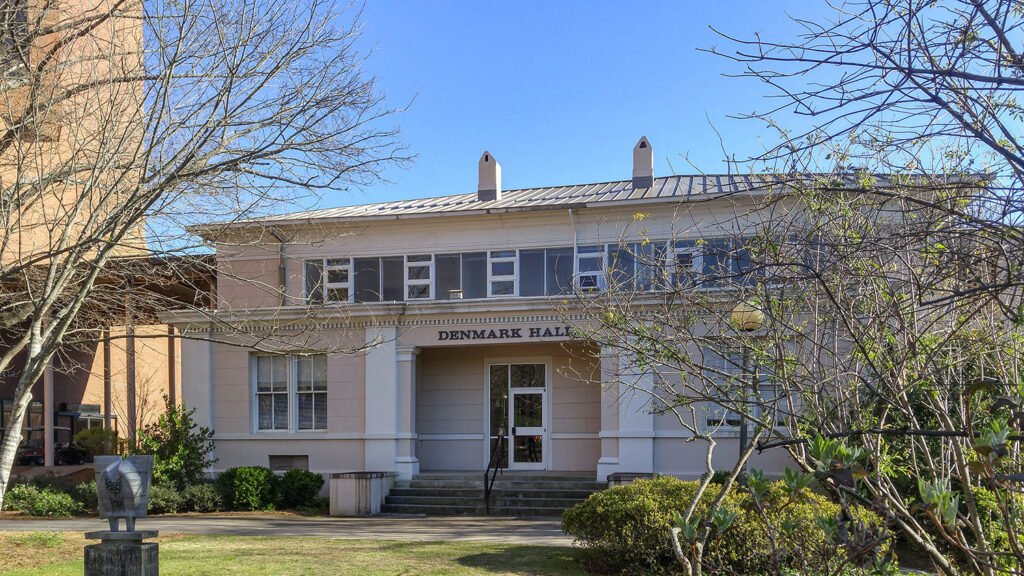
G.L. Norrman. Denmark Hall (1902). University of Georgia, Athens.
One of G.L. Norrman‘s least interesting works, Denmark Hall at the University of Georgia in Athens has always been something of a bastard stepchild.
Tucked in a dark corner of the campus near South Lumpkin Street, the structure was designed primarily as a dining hall containing two adjoining 1,296-square-foot dining rooms, and initially accommodated 144 students.1
The structure was built concurrently with nearby Candler Hall and was named for B.A. Denmark of Savannah2, a University of Georgia alumnus and the chairman of the building committee for the university’s Board of Trustees, who died in June 1901, just weeks after approving Norrman’s plans,3 and one day before the building’s cornerstone ceremony.4
Denmark had secured $45,000 from the Georgia legislature to fund the 2 buildings,5 but one of Norrman’s original plans called for combining the dining hall and dormitory into one structure — the committee rejected that proposal.6
Candler Hall subsequently received the bulk of the funding — $28,0007 — and most of Norrman’s attention, it seems. Denmark Hall was reportedly built for less than half that amount: $12,850.8
Norrman’s plans were selected in open competition against a fairly meager crop of designers: J.W. GoLucke of Atlanta, Hodgson & Company of Athens, Georgia; E.C. Seiz of Atlanta; a D.A. Myer of Williamsport, Pennsylvania; Alexander Blair of Macon, Georgia; and Walter & Legare of Columbia, South Carolina.9
It also no doubt helped that Norrman and B.A. Denmark had a history together: Denmark was a longtime member of Savannah’s local Board of Public Education, and approved Norrman’s plans for the Anderson Street School (1896),10 and presumably, the 38th Street School (1901).11
The Design
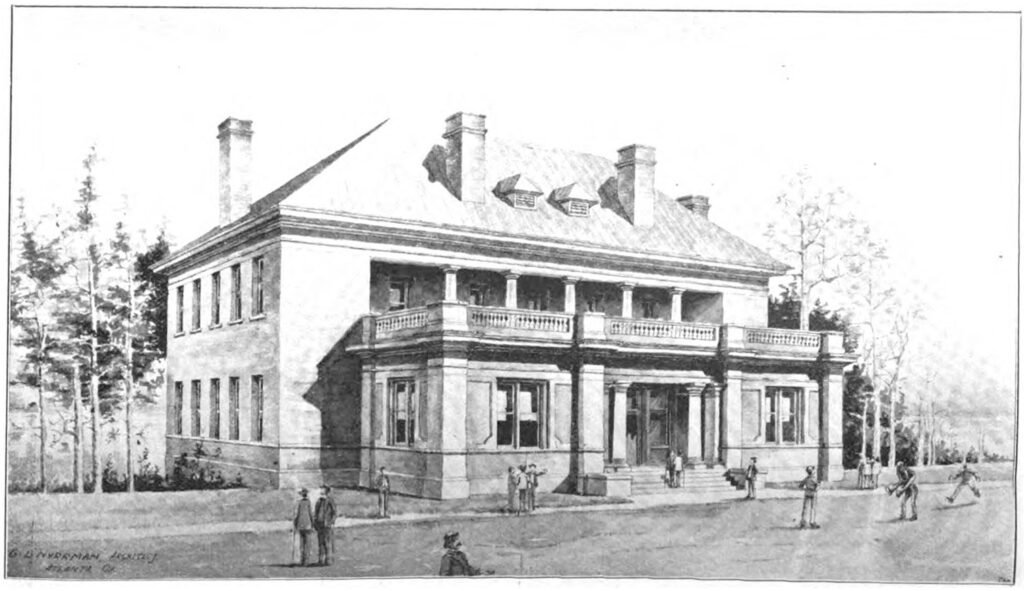
G.L. Norrman. Projected design of Denmark Hall (1901). University of Georgia, Athens.12
Low-slung and utilitarian, Denmark Hall was designed with a central 2-story structure that originally housed the dining rooms, flanked by a large one-story kitchen on the back, and a small one-story wing on the front, containing a sitting room, lounge, and small recessed entry porch. Storage rooms were located in the basement.13
The second floor included the “matron’s room” — living quarters for the dining hall manager — and “three other rooms for the use of students who may be sick enough to need such care and attention as they can be given there”, according to the Atlanta Constitution.14 A spacious recessed porch spanned the front of the second floor.
The exterior of the building was clad in stucco-covered brick scored to resemble stone, and given Neoclassical touches.
Intact original elements include:
A simple Tuscan cornice around the main structure
A plain string course at the base of the building
A composite cornice on the front wing
Smooth pilasters on the front wing
Mullioned windows on the front wing
4 chimneys
Original elements that have been removed include:
The second-floor porch
7 Doric columns
2 decorative columns framing the entry
5 supporting columns spaced across the second-floor porch
A balustrade lining the roof of the front wing
Dormer windows on the front and sides
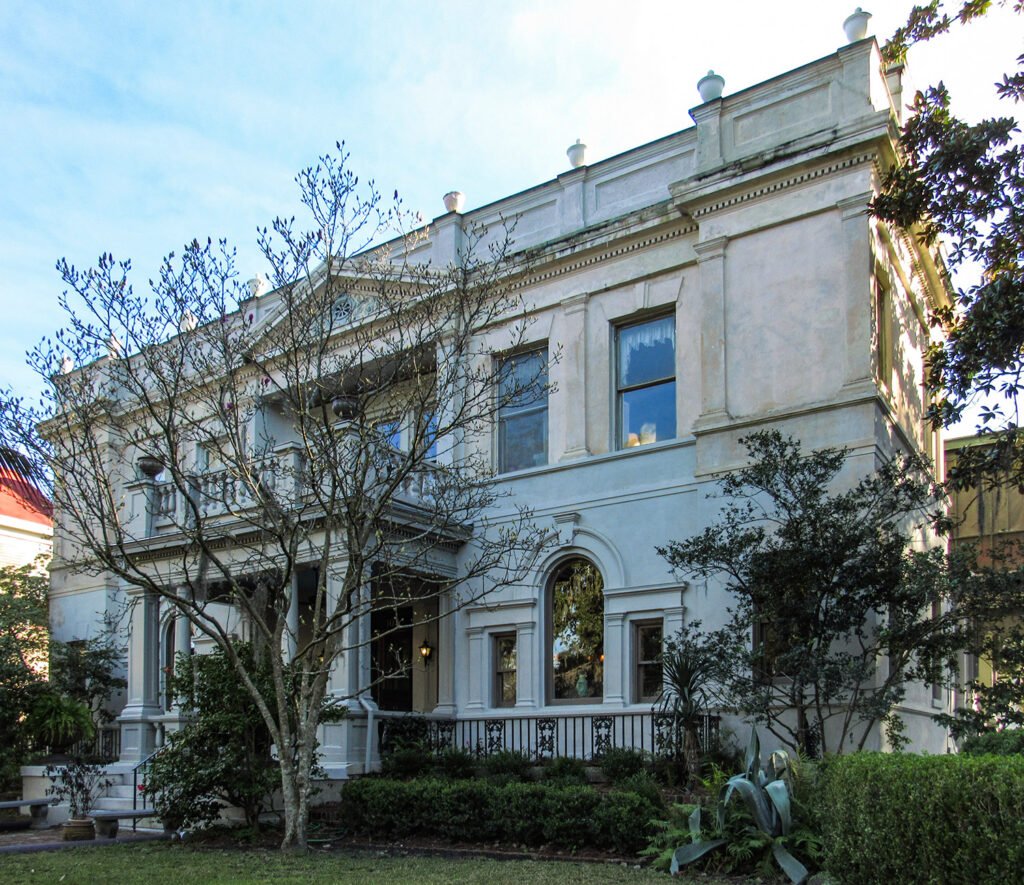
Denmark Hall’s facade evolved from Norrman’s design for the Arthur B.M. Gibbes House in Savannah, Georgia, built in 1900.15 The Gibbes home is one of the most atrocious designs Norrman ever put his name to, and Denmark Hall wasn’t much better.
G.L. Norrman. Arthur B.M. Gibbes House (1900). Savannah, Georgia.
By the turn of the 20th century, Norrman had all but abandoned the brash, soaring lines and elements of his earlier designs: the lofty towers, fantastically high roofs, oversized porches and gables, and prominent chimneys. The transition was partly due to changing tastes, but also reflected a severely depressed economy and Norrman’s own dwindling fortunes.
Looking at his projects circa 1897-1900, it’s clear that Norrman had lost confidence, inspiration, and interest: his designs from the time were often sluggish and banal, many of them poor rehashes of his earlier, more successful works. The Gibbes House was one such project, a clunky reiteration of his design for the Milton Dargan House in Atlanta.
For Denmark Hall, Norrman took the template for the Dargan and Gibbes facades and stretched it out. The entry porch from those designs remained, but the Palladian windows on each side were swapped for simpler versions. The small recessed porch from the previous plans was expanded across the second floor, and the 2 large dormer windows from the Dargan house were shrunk to fit the building’s reduced height.
Norrman was a master of working with solids and voids in his compositions, and in his design for Denmark Hall, you can easily spot his technique. It was as if he had removed a block of space from the second floor and placed it at the foot of the building, creating both the upper porch and the lower front wing — a simple but effective trick to achieve visual balance.
The building’s overall composition would have been stronger if it had remained faithful to the design shown in the original rendering (above), which included a higher roofline.
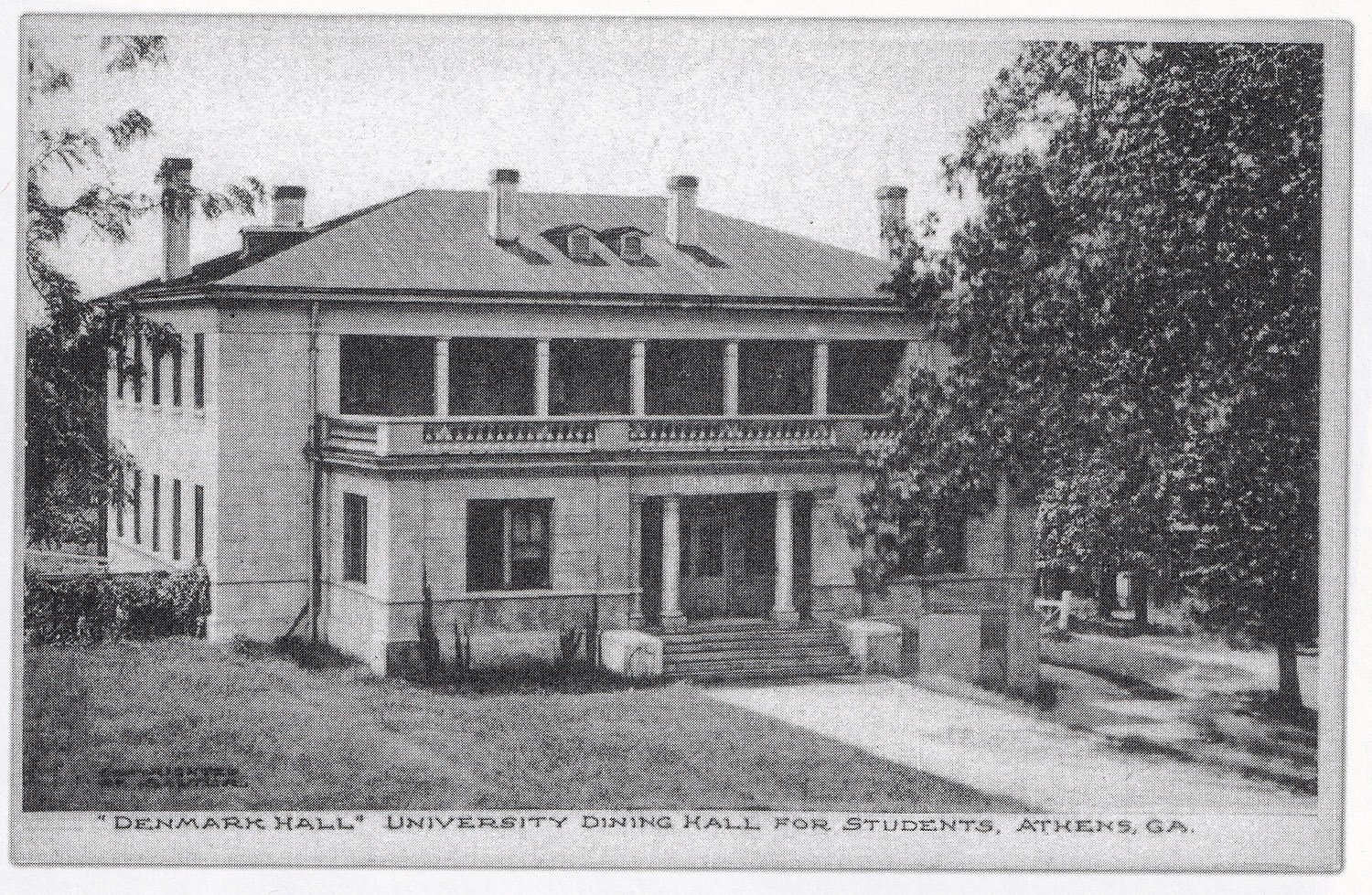
Why Norrman altered the roof to a lower pitch is unclear, but a vintage photograph of the building (below) shows that the large porch columns and wide chimneys depicted in the illustration were substituted with thinner versions to accommodate the altered design, robbing the composition of much-needed vigor.
Breaking from classical precedent, the odd number of columns across the front was an unconventional choice, and a subtle indicator of the building’s role as a modern facility for the 20th century.
G.L. Norrman. Denmark Hall (1902). Photograph from an undated postcard.16
Construction and History
Construction on Denmark Hall began circa May 1901,17 using convict labor loaned by Clarke County.18
There is a report from June 1901 that the university’s Board of Trustees had concerns about the quality of the building materials used in Denmark Hall and Candler Hall, which the Atlanta Constitution remarked were “without weight, the architect demonstrating to the satisfaction of the board that the material was all right.”19
Denmark Hall’s cornerstone was laid on June 14, 1901,20 and a July report from “Supt. McKinly” stated that work was expected to be completed on both buildings by late October.21 Instead, Denmark and Candler Halls opened simultaneously on January 7, 1902. With delays blamed on weather and the holidays, construction on the buildings ran to the last minute, and their completion delayed the start of the school semester by 4 days.22
In Denmark Hall’s first year of operation, students were charged a whopping $7.50 to $8 a month for meals.23 The original “matron” of the facility was Mrs. B.H. Kinnebrew.24 She resigned in March 1908,25 after her husband, a sheriff’s deputy, shot and killed himself with a .44 caliber pistol “from no known cause” in their apartment on the building’s second floor.2627
By that time, students had already begun referring to Denmark Hall as “the Beanery”,28 an inglorious name that stuck with the structure for decades. By 1910, with the school’s halls overflowing, part of the second floor was converted to dormitory space,29 a function it served through at least the early 1920s.
Norrman never seemed too concerned about planning his structures for anticipated growth: he publicly railed against “waste space” and consistently designed his interiors to be as compact as functionally possible. His design for Denmark Hall was no exception, and in November 1902, a newspaper report on the college’s record-breaking attendance stated that “every chair at the Denmark Dining Hall has been filled.”30
By 1903, seating was increased to 160,31 and in 1908, the hall reportedly served 253 students, with the Board of Trustees asking the governor and legislature for “increased facilities at Denmark Hall.”32 In 1911, a report stated that the building was “taxed to its capacity”, requiring “enlargement and better equipment.”33
Attendance at the school continued growing, and despite consistent requests for funding, Denmark Hall remained the only dining option on campus for more than 20 years. In 1914, the Athens Daily Herald reported that “the Beanery is crowded again this year”, adding “we hope that the legislature will be able to make appropriations to enlarge the dining hall.”34
In 1921, the Athens Daily Banner lamented: “Not only is the dining room crowded but the matter of cooking for 350 people in a kitchen equipped for two-thirds that number and not well equipped at that is taxing Mrs. Kennebrew’s [sic]most skillful management.”35 Apparently, Mrs. Kinnebrew returned.
Finally, with the opening of Memorial Hall in June 1924, the campus gained additional dining space,36 although Denmark Hall remained the primary facility for that purpose.
1936 addition to Denmark Hall
In 1936, Denmark Hall received its first expansion: a small cafeteria seating 92 students.3738The cafeteria wing was attached to the southwest corner of the building,39 and its exterior appearance is remarkably congruent with Norrman’s design. The basement was also remodeled during the expansion.40
The cafeteria plan quickly gained popularity, and in 1938, Denmark Hall became the first dining space on campus to switch entirely to the cafeteria system,41 ending the era of “food served in the old manner”, which required the employment of waiters.42 In 1939, Mrs. M.D. Dunlap became the new director and dietitian of Denmark Hall,4344 and she and her husband, a professor, took up residence on the second floor. At some point in their residency, Professor Dunlap began a garden on the roof of the front wing.45
In 1942 and 1943, Denmark Hall received multiple additions to accommodate the feeding of 1,200 Signal Corps troops who trained on the University of Georgia campus in preparation for World War II.464748The first expansion was an annex hastily added to the kitchen in 1942, expanding its size by a third.49 In 1943, four small additions were made to the building, including 2 screened porches.50 In September 1943, the Signal Corps school was closed,51 and the dining hall returned to student use.5253
With over $10,000 in improvements, the remodeled Denmark Hall was touted as “one of the most modern cafeterias on any campus in the South”,54 although that appears to have been hyperbole. In 1945, the university president reported to the Georgia general assembly that the building was “outmoded and inadequate”. 5556
In 1948, after 10 years living on the second floor, Professor Dunlap moved to Atlanta, leaving his rooftop garden at Denmark Hall “wiltering”, according to one report.57 Seizing the opportunity, the college’s department of landscape architecture took over the building’s second floor, creating 3 draft rooms.58
Since 1938, the landscape architecture department had been based at the Lumpkin House,5960 a small antebellum residence that still stands on campus. With 75 students enrolled in the program,61 the new space in Denmark Hall was a much-needed addition to accommodate the department’s growth.
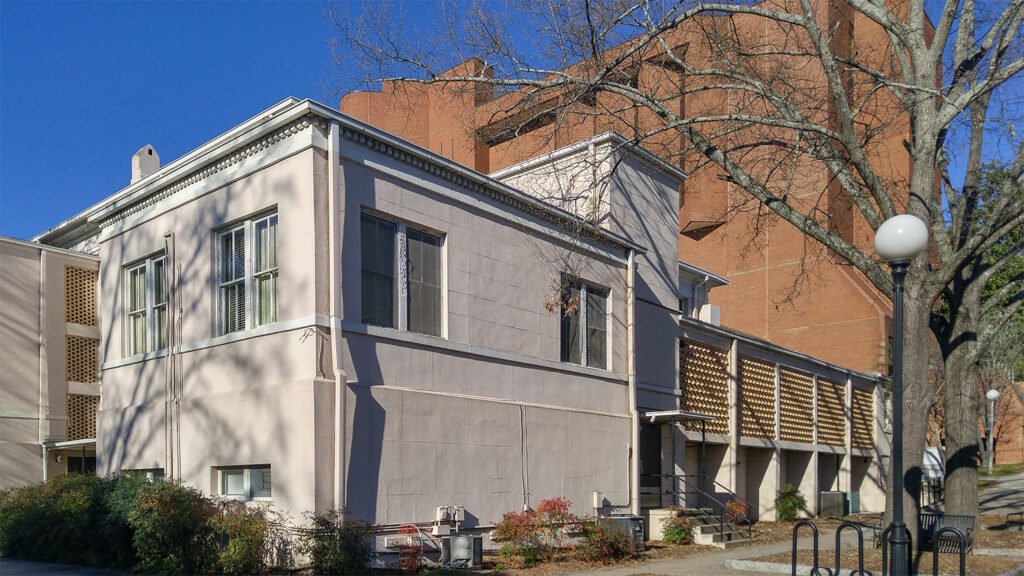
East side of Denmark Hall
In 1955, a popular student hangout spot called the Co-Op moved to Denmark Hall’s basement, which included a soda fountain, snack bar and grill, and a supply store. For the Co-Op’s occupation of the space, the basement was air-conditioned and refinished in knotty pine.6263
The rest of the building was not air-conditioned, however, and was reportedly “in bad shape”. In 1952, an inspection committee identified Denmark Hall as one of several buildings “in need of extensive repairs”.64 First-hand accounts of the Beanery at the time were unpleasant: students described it as “drab old Denmark Hall”,65 where “…to find your food during the warm months, you have to push literally dozens of flies from your plate”.66 Savory.
With the opening of a new cafeteria in nearby Memorial Hall, the last meal at Denmark Hall was served on March 14, 1956, ending 55 years of continuous food service.6768
The university had previously announced its plans to demolish Denmark Hall,6970 but the building was instead spared and given an extensive $40,000 overhaul for use as the landscape architecture department’s new home.7172
Denmark Hall
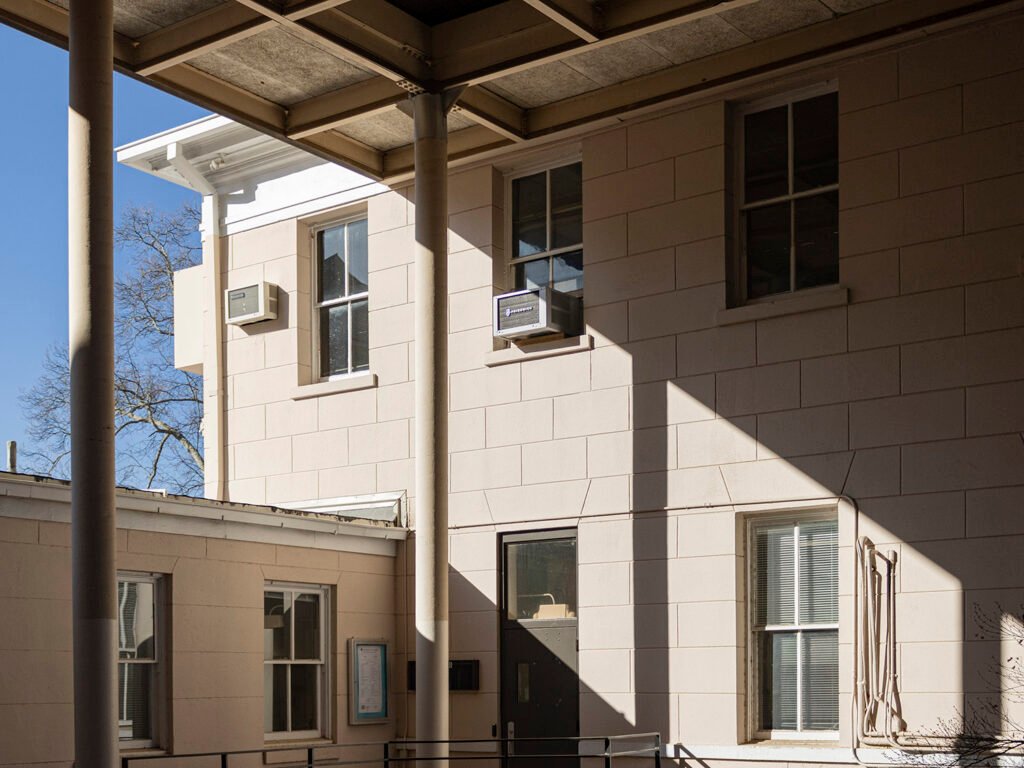
Primarily designed by E.C. Weren, a member of the landscape architecture faculty, Denmark Hall’s renovation was not kind to Norrman’s original design, and included the demolition of most of the original kitchen, a complete overhaul of the interior, enclosure of the second-floor porch, an outdoor stairwell tacked on to the west side of the building, air conditioning, and “extensive use of screen walls and glass”.73 This also appears to be when the columns, dormers, and balustrade were removed from the exterior, as they were still present in a photograph from 1951.74 The renovated building officially reopened on October 16, 1957.75
The Co-Op remained in the basement during Denmark Hall’s renovation and was expanded,767778 but in 1963, it was unceremoniously shuttered for full occupation by the landscape architecture department.79 On October 6, 1964, the building officially reopened again, the basement now housing a model shop, blueprint room, dark room, drafting room, and 2 classrooms. The basement renovation reportedly cost $100,000, more than twice the amount spent on the entire building 7 years earlier.80
Denmark Hall’s 1964 renovation was its last substantial alteration, although it has received piecemeal alterations and upgrades for decades. As of 2025, the building remains in use by the landscape architecture department’s successor, the College of Environment + Design.
Essentially nothing of Denmark Hall’s original interior remains, but if you stand outside and squint your eyes, you can still make out the form of Norrman’s design.
While Candler Hall received a beautiful renovation in 2003,81 the University of Georgia has shown little appetite to renovate its less-attractive sibling, which can still be accurately described as “drab old Denmark Hall”.
The College of Environment + Design’s 2025 strategic plan included the vague goal to “renovate Denmark Hall as a cutting-edge teaching facility” with the added caveat of “funds permitting”.82 That doesn’t sound very promising, does it?
References
“Plan of University Buildings Complete”. The Atlanta Constitution, April 24, 1901, p. 1. ↩︎